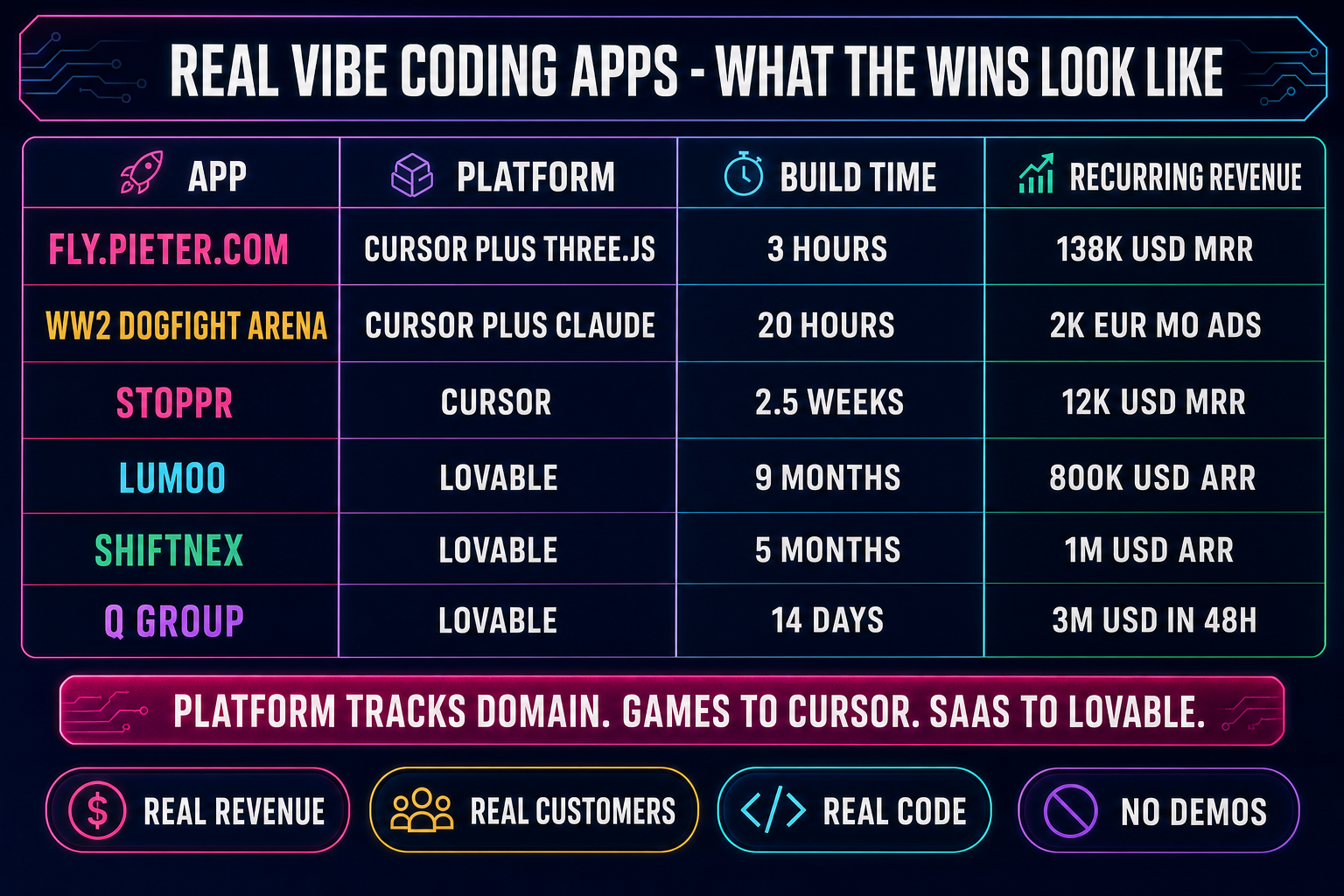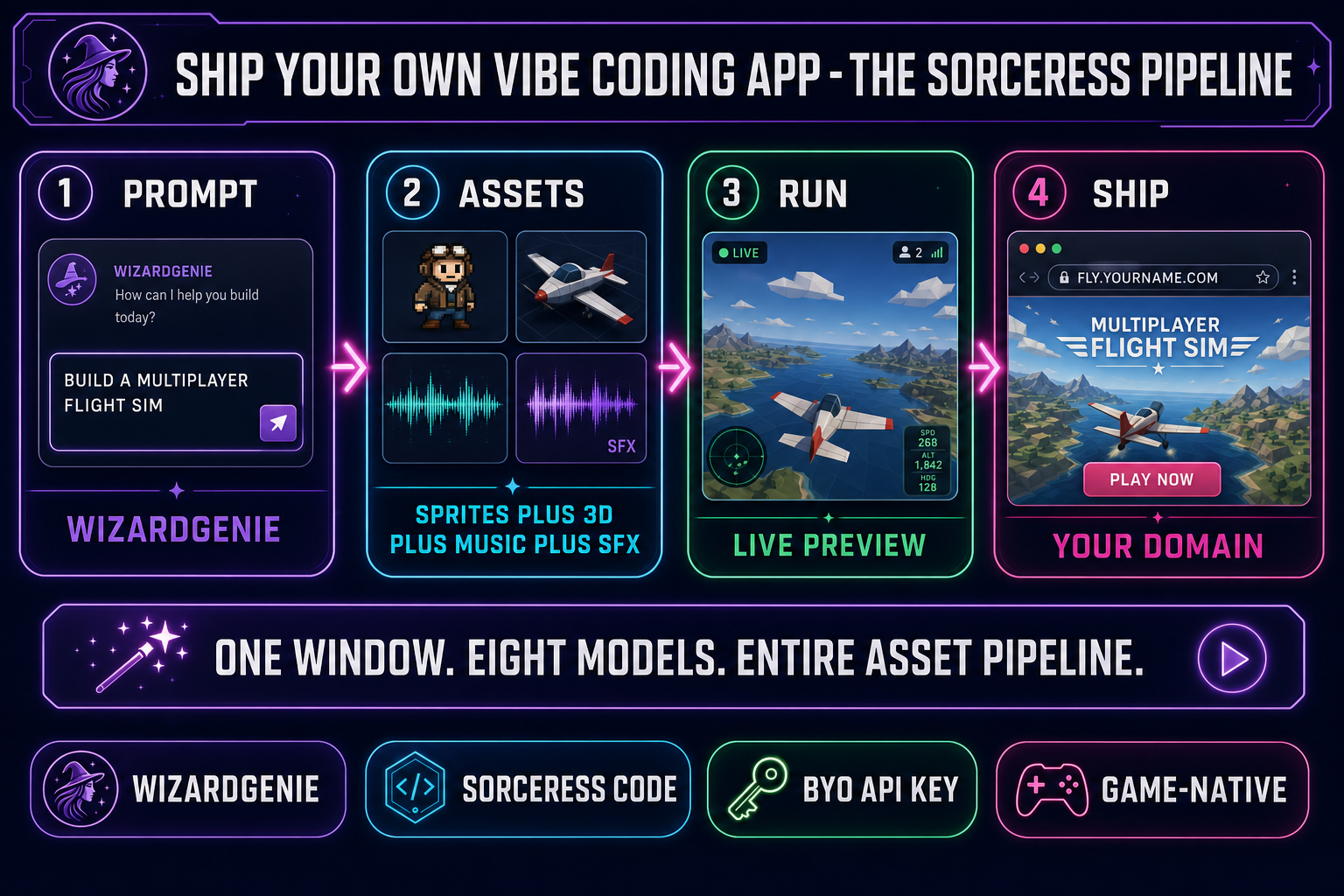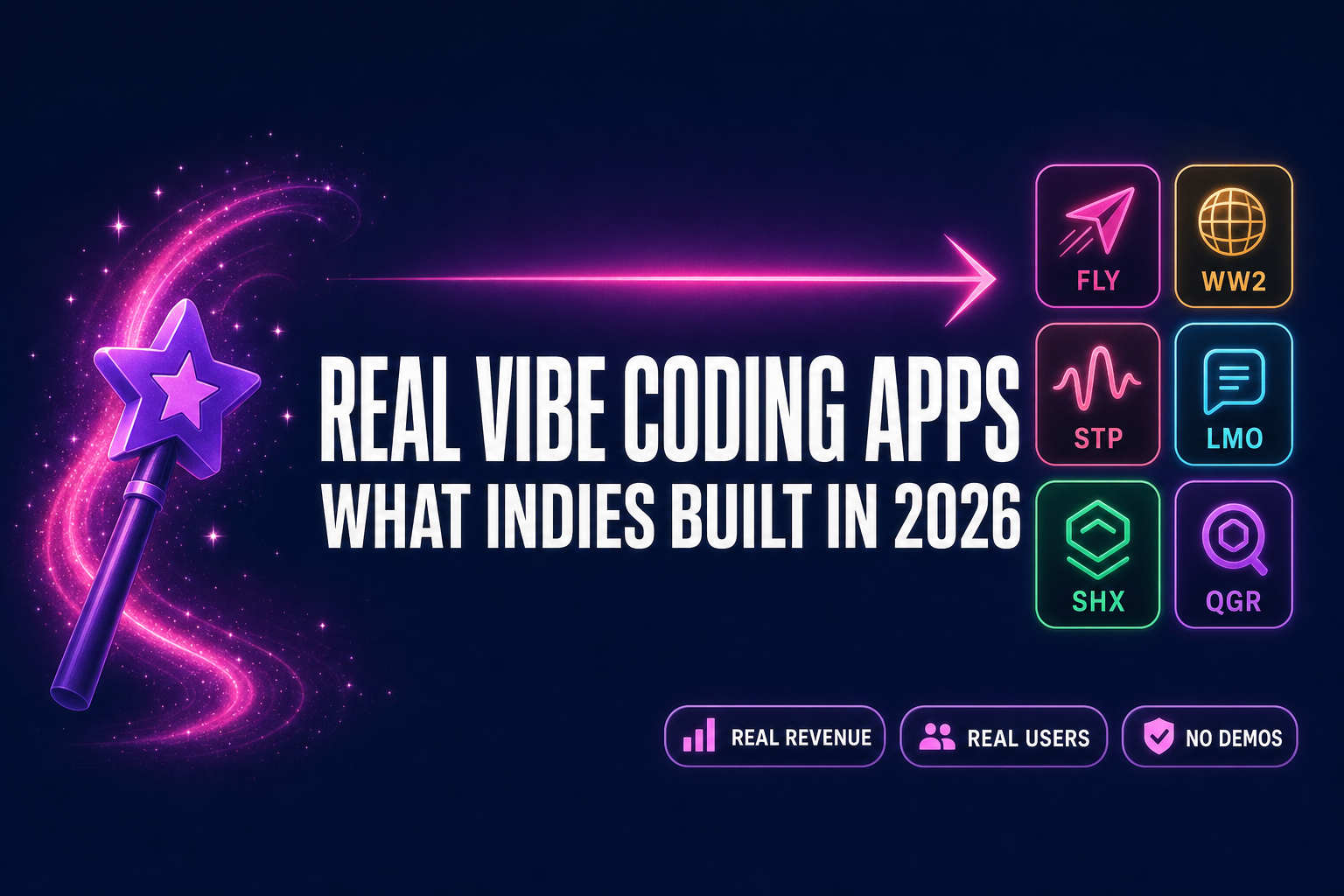
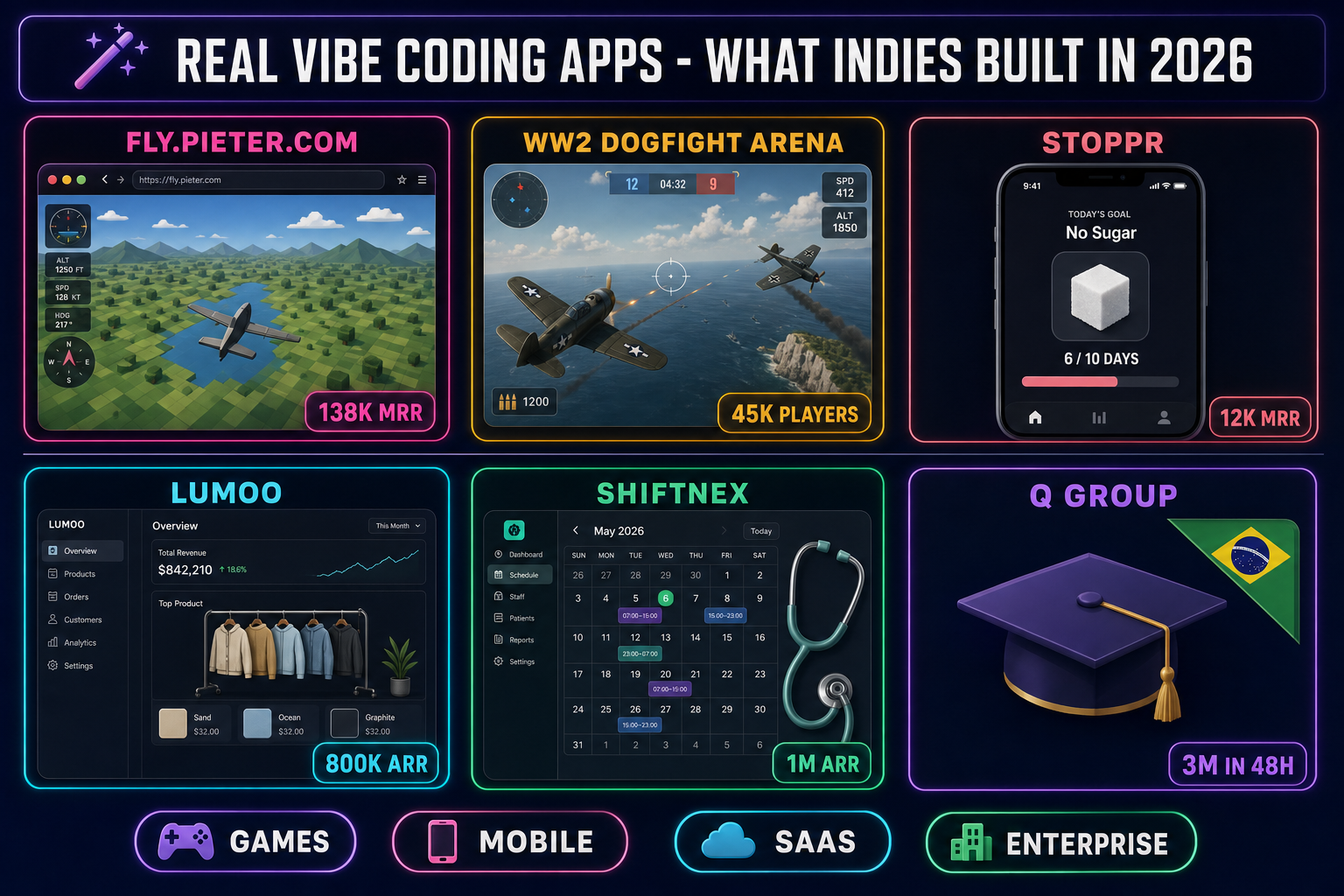
The 2026 record for vibe coding apps is no longer the demo video; it is the ledger. WizardGenie ships browser games. Sorceress Code ships internal tools. Cursor, Lovable, Bolt, and Replit ship the rest. The wins underneath every one of those platform names are real software products with real customers paying real money: a multiplayer flight simulator at $138K MRR, a healthcare staffing platform at $1M ARR, a fashion AI dashboard at $800K ARR, a Brazilian education product that grossed $3M in 48 hours. This is the honest tour of what indie developers actually built in 2025 and 2026, verified against the live record on May 13, 2026, with the pattern under the wins called out so the next builder has the playbook in hand.
What “real vibe coding apps” actually means in 2026
The phrase vibe coding apps covers a wider category in 2026 than it did when Andrej Karpathy coined the term in February 2025. The original meaning was the loose, agentic, low-discipline workflow where the developer described what they wanted, the model wrote the code, and the developer steered with vibes rather than line-by-line authorship. Eighteen months later, the working definition has broadened: vibe coding now describes any project whose author spent the bulk of their time describing intent and reviewing diffs rather than typing the implementation. The apps that came out of that workflow span browser games, mobile consumer apps, healthcare staffing platforms, fashion AI dashboards, and education products. The defining property is not zero human code — almost every shipped product had a review pass at some point — but a fundamentally agentic authoring loop.
The category also got more honest in 2026. The first wave of vibe coding apps headlines in early 2025 were dominated by demo videos and toy projects. The second wave is dominated by actual revenue numbers and actual customer counts. The six case studies in this tour are picked because every one of them has independently reported revenue or user counts, an actual deployed URL, and a credible build trail. The throwaway prototypes that flooded ProductHunt in April 2025 are not on this list; the products that shipped, kept shipping, and built durable revenue are. That filter is what separates “vibe coding apps” the meme from vibe coding apps the business category.
1. fly.pieter.com — the flight sim that proved the loop
Pieter Levels built fly.pieter.com, a free-to-play multiplayer 3D browser-based flight simulator, in roughly three hours on February 22, 2025, despite never having shipped a game before. The build used Cursor as the agentic IDE, Claude as the underlying model, and Three.js for the 3D rendering layer. The game launched February 23, hit $38,360 in monthly recurring revenue by day ten, $87,000 by day seventeen, and roughly $138,000 per month by November 2025 — about seventy percent of Levels’ total income at the peak.
The economics are worth tracing because they are the lookalike pattern most other shipped vibe coding apps follow. Monetization combines three streams: in-game advertising blimps that brands rent for roughly $5,000 per month each, premium plane skins that unlock at $29.99 a one-time purchase, and branded 3D objects that companies pay to embed in the world. None of those streams require a payment processor more complex than Stripe Checkout, and the multiplayer infrastructure runs on a single browser-served WebSocket loop with no dedicated server fleet. The player count peaked between twenty-two thousand and twenty-six thousand simultaneous flyers, with 320,000 total users and 74 million impressions logged in the first month. The lesson is not that anyone can ship a viral flight sim in three hours; the lesson is that an agentic IDE plus a real-time 3D library plus a follow-the-money monetization design can clear half a million dollars a year on a hand-coded weekend project, which was structurally impossible before the agent loop matured.
2. WW2 Dogfight Arena — zero human-written code, twenty euros to ship
Nicolas Zullo built WW2 Dogfight Arena, a multiplayer World War II dogfight simulator playable at fly.zullo.fun, with a hard constraint: no human-written code at all. The 20-hour build used Cursor as the IDE, Claude Sonnet 3.7 in thinking mode for code generation, and Grok 3 for scope-and-plan work. Total prompts consumed: roughly five hundred. Total spend on the agent: around €20. Total revenue: roughly €2,000 per month from in-game ad sponsorships within the first weeks of launch, plus 1.5 million views on X, 45,000 players in the first week, and enough server load that Zullo had to scale capacity twice in the first ten days.
The case study in the Vibe Coding Wiki entry on the project is unusually detailed about the prompt-to-code ratio. Most of the sessions were the developer asking the model to add a feature, watching the model write the implementation, playing the result, and prompting the model again on the failure modes the playthrough surfaced. The pattern that comes out of the trail is the one almost every shipped vibe coding app shares: the agent writes ninety percent of the code; the developer writes ninety percent of the iteration prompts; the playable artifact is the test suite. The build was entered in the Vibe Jam 2025 contest Pieter Levels organized in March 2025, which collected over 1,170 game submissions with about 500 finalists and a $17,500 prize pool sponsored by Bolt and others. WW2 Dogfight Arena finished as one of the standout entries.
3. Stoppr — the $12K MRR mobile app from a niche clone
David Adius (also reported as David Attias), a French former quantitative trader, built Stoppr, a science-based mobile app that helps Gen Z women quit sugar, in roughly two and a half weeks using Cursor on the $200-per-month plan. The app launched in under thirty days from first prompt to App Store live, hit $5,000 in first-month revenue, and crossed $12,000 monthly recurring revenue by month five. By that point Stoppr had logged 60,000 downloads and roughly 900 paying subscribers across weekly, monthly, and yearly tiers, with a 35% profit margin after operating costs.
The Stoppr playbook differs from the flight-sim wins in two important ways and is worth calling out because it generalizes more cleanly to first-time builders. First, Adius did not invent the product idea. He cloned the screen flow of Quitter, a similar app already grossing roughly $200,000 per month, and rotated the niche from a male audience to Gen Z women aged 13 to 25. The line he gave the press: copy every screen, copy every word, change the niche, switch the colors. Second, the build used Cursor for code, Figma for screen design, Mixpanel for analytics, and TikTok ads for distribution — a full off-the-shelf indie stack rather than custom infrastructure. The lesson the Stoppr case settles is that the “vibe coding apps” category does not require either a viral hook or a novel idea; cloning a known-working product into an underserved niche, with the agent loop carrying the implementation, can produce real five-figure-MRR revenue in months.