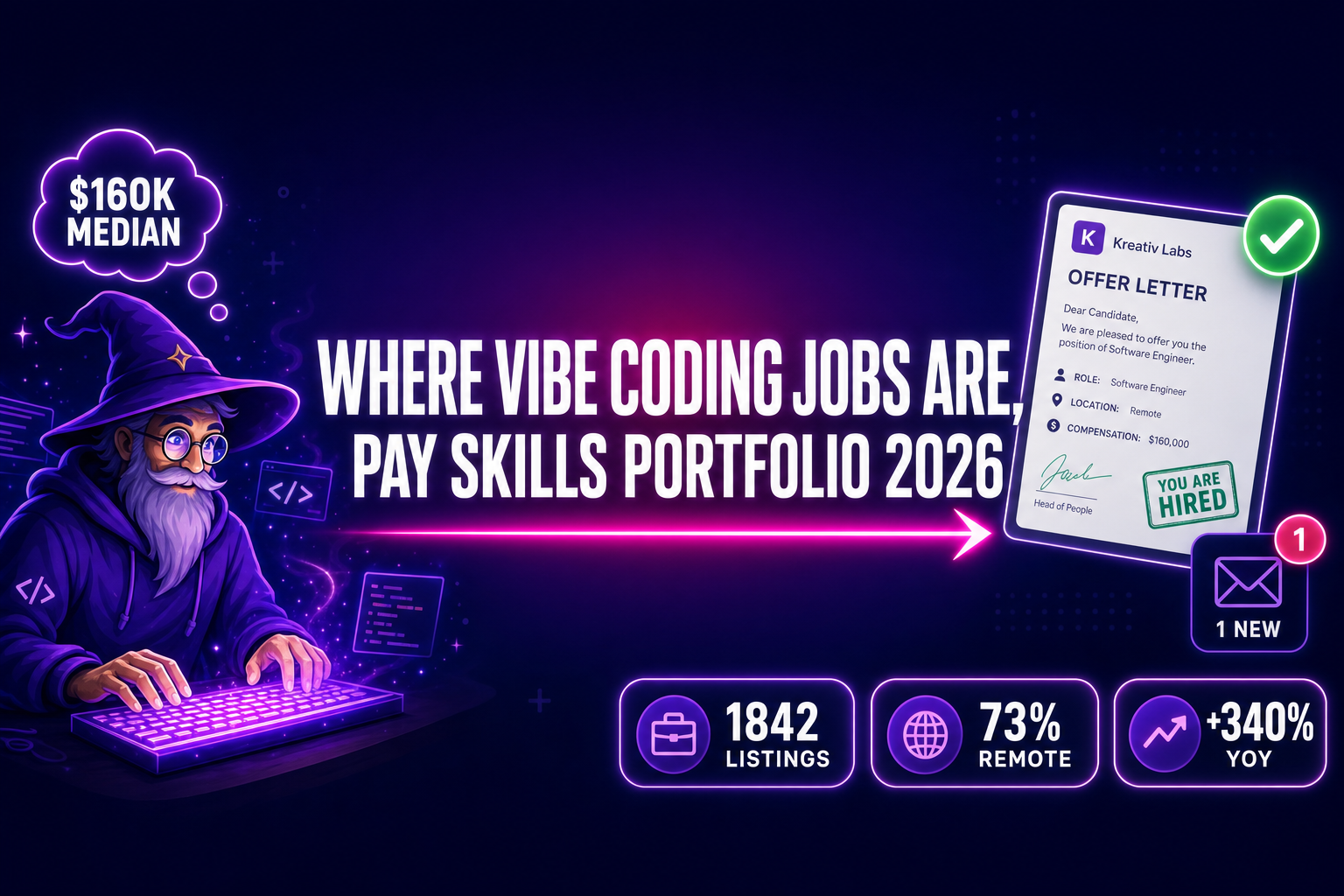
The vibe coding jobs market did not exist twelve months ago. The term itself was coined by Andrej Karpathy in a February 2025 X post; by April 2026 there are 1,842 active listings tracked across 22 job-board sources with year-over-year posting growth of +340%, a median pay band of $160K, and a 73% fully-remote default. The category moved from punchline to hiring page faster than any developer specialism since the original front-end split, and the listings that are open right now have specific demands — a portfolio of three shipped public projects, fluency with AI coding agents, and the ability to ship from idea to deploy in hours. This guide breaks down what those listings actually ask for, what they pay, and how to build the portfolio that lands one. Verified against publicly cited data on May 12, 2026.
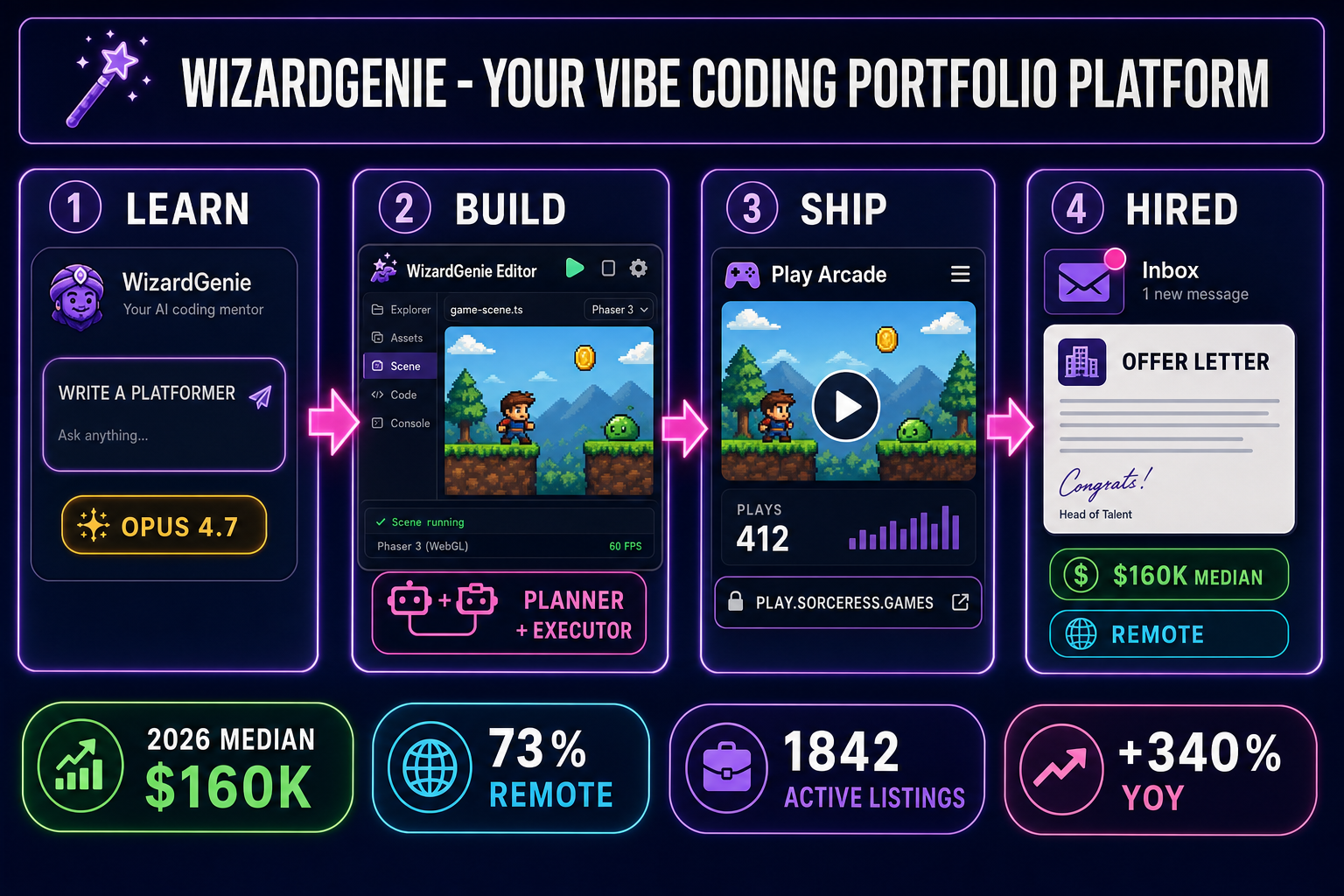
The vibe coding jobs market in 2026 at a glance
The numbers first, because the rest of the post is calibrated against them. The vibe coding jobs aggregator remotevibecodingjobs.com tracks 1,842 active listings across 22 sources as of April 2026, with 4,772 vibe-coding-titled jobs posted all-time. The independent salary tracker goodvibecode.com reports a +340% year-over-year increase in posting volume across the same period — the fastest-growing developer specialism category they track, faster than the original ML-engineer ramp in 2017–2018. Remote-first defaults dominate: 73% of listings are fully remote, with the remaining 27% concentrated in San Francisco, New York, Stockholm, and Amsterdam.
The role distribution is uneven, and it is the most important data point in this post. Most listings are at the Lead (407) and Staff+ (233) levels, with 107 Senior, 16 Mid-level, and only 6 Junior positions explicitly tagged as “vibe coding.” The market is not soft-launching the term for new graduates — it is using the title to attract experienced developers who already shipped projects in a traditional stack and have re-tooled around AI-native workflows. That detail changes everything about how a candidate should position a portfolio, and it is the through-line for the rest of this guide.
The funding context matters too. Lovable crossed $400M ARR in February 2026 with 146 employees — one data point in a wider trend where vibe-coding-first companies post outsized revenue per employee and route hiring budget into the role itself. The category is funded; the funding is being spent on candidates who can ship.
What a vibe coder actually does on the job in 2026
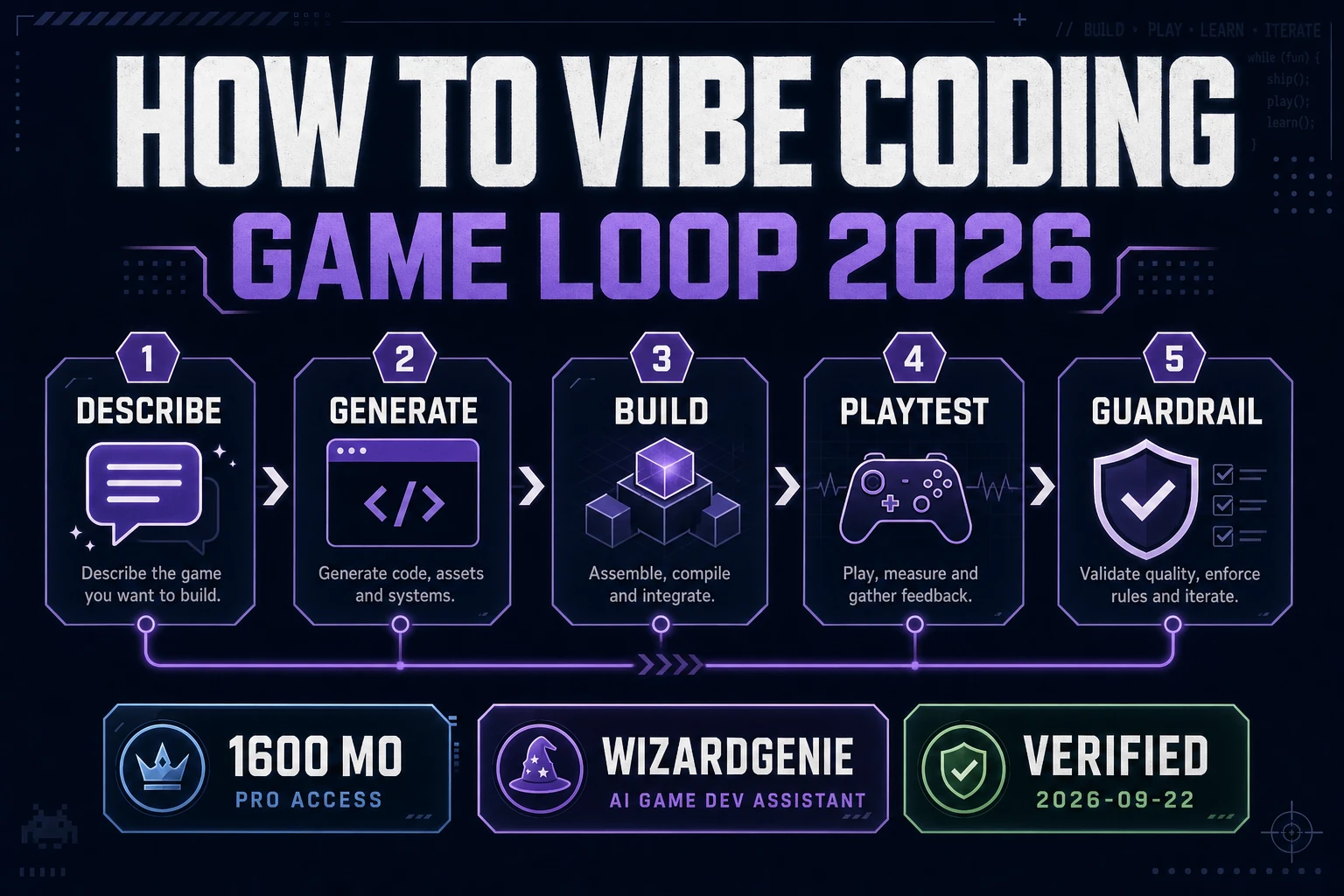
Strip away the headline and the day-to-day is concrete. A vibe coder defines software functionality through natural-language prompts to an AI coding agent, evaluates the agent’s output for correctness and security, iterates by refining prompts (or by hand-editing the diff when the prompt loop stalls), and owns the project end-to-end from idea to deployed URL. The defining shift versus a traditional engineering role is that the unit of work is the prompt-plus-review cycle, not the keystroke. Wikipedia’s vibe coding entry tracks the role definition as it has solidified across listings; the consistent threads are AI fluency, shipping speed, and review discipline.
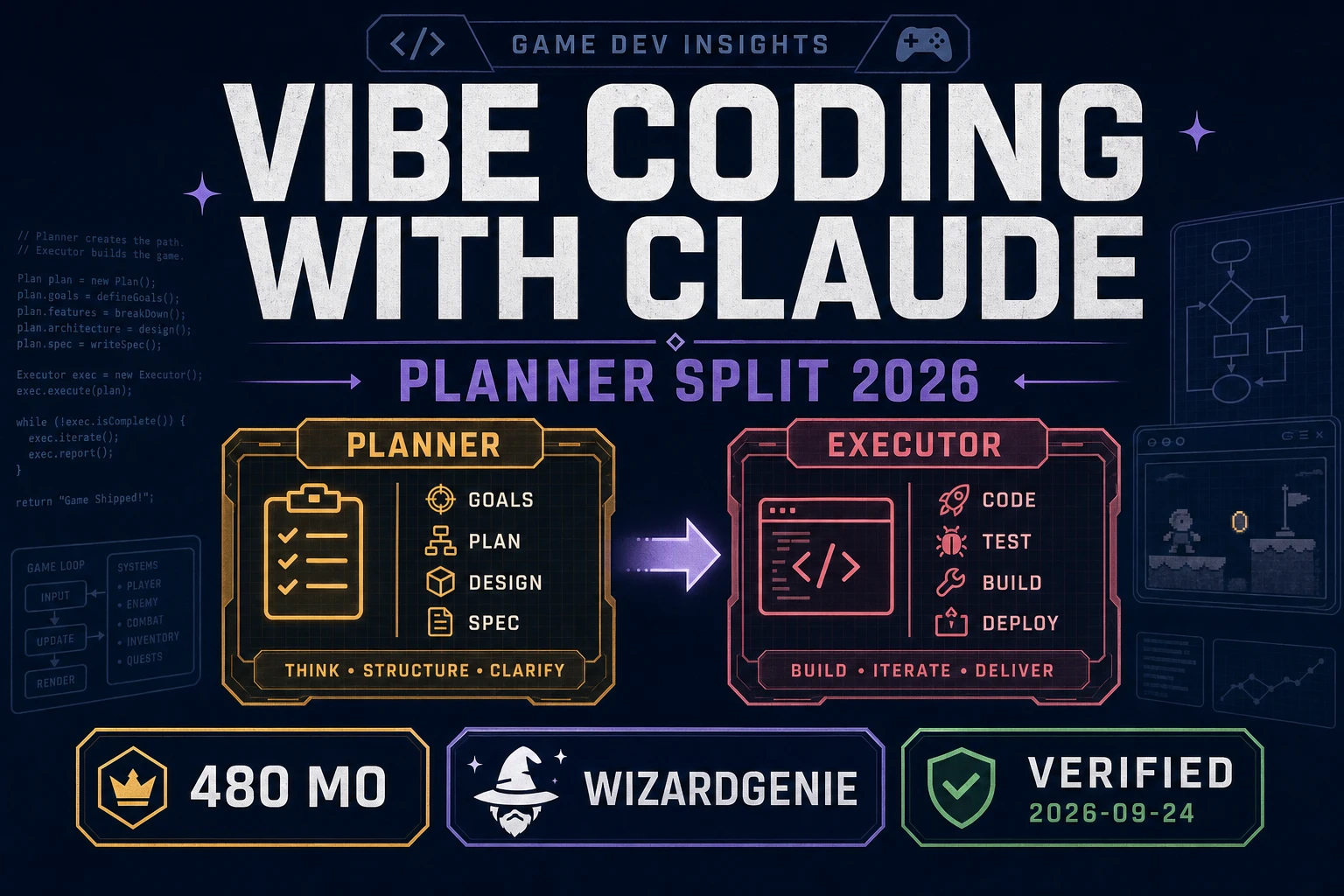
The toolchain the listings reference is wider than any single product. Cursor, Claude Code, Bolt, Windsurf, v0, Replit, and Lovable show up by name across the requirements sections we surveyed, sometimes individually, often as “equivalent.” WizardGenie belongs in the same toolchain — it drives the same eight frontier coding models the listings reference (Claude Opus 4.7, Claude Sonnet 4.6, GPT-5.5, Gemini 3.1 Pro, DeepSeek V4 Pro, Kimi K2.5, Grok 4.2, MiniMax M2.7, verified against src/app/_home-v2/_data/tools.ts on May 12, 2026) and ships projects on Phaser 4.1 and Three.js r184. Sorceress Code is the lighter-weight general-purpose agent that pairs with it for non-engine work. A candidate who has built projects on either lands inside the “experience with modern AI coding agents” requirement of any vibe-coding listing without further argument.
The deeper shift is review responsibility. Vibe coding does not remove the engineering responsibility for shipped code — it concentrates it. Every prompt-generated diff still has to be read, security-evaluated, and tested before it lands. The senior-developer pushback the role gets (covered in the vibe coding memes piece) is honest about that point. The listings that pay top-of-band explicitly call out the candidate’s ability to harden AI-generated output against the second user, the second tab, the third API failure — the unhappy paths the model didn’t consider on the first pass.
The 2026 pay bands for vibe coding jobs (by experience level)
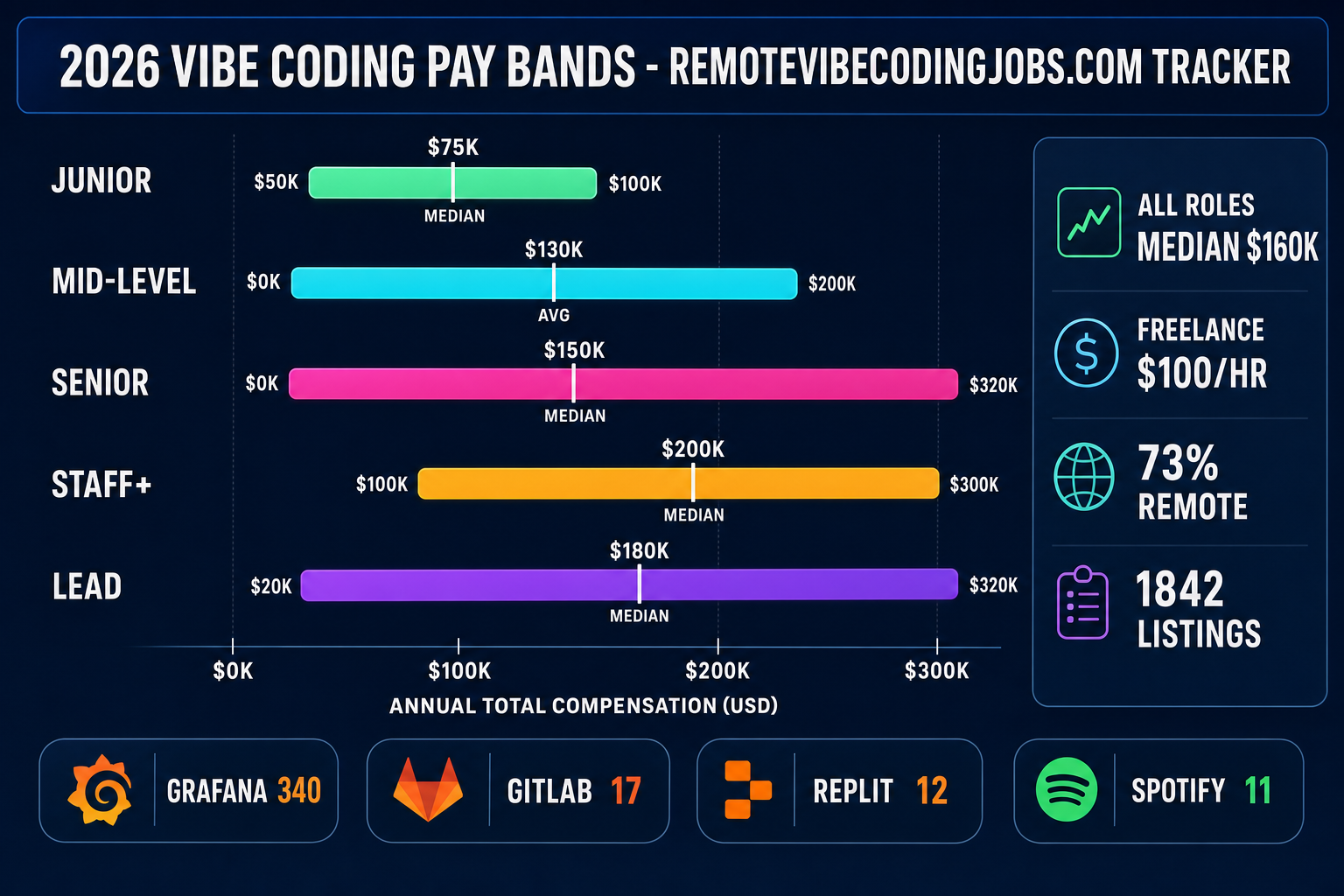
The salary data is wide, and the wide ranges matter because they tell a story about how the market is still pricing the role. The remotevibecodingjobs.com tracker reports the following bands across its sample, all in US dollars, all rounded to the nearest thousand, all pre-tax annual base (equity and benefits not included):
- Junior — $50K to $100K, median $75K. Smallest sample (six explicit listings); most “junior” vibe coders enter via mid-level postings that accept a strong portfolio in lieu of years.
- Mid-level — $0K to $200K. The wide bottom reflects equity-heavy startup offers; the top is where the strongest mid-level candidates land at vibe-coding-first companies.
- Senior — $0K to $320K, median $150K. Largest cohort with explicit pay (107 listings). The median is conservative because remote-friendly mid-tier markets pull it down; US-coastal senior listings cluster around $180K–$220K.
- Staff+ — $100K to $300K, median $200K. 233 listings. The Staff+ tier is the “serious engineering responsibility” tier — it tends to ask for ML-platform experience or distributed-systems background on top of the vibe-coding fluency.
- Lead — $20K to $320K, median $180K. Largest absolute cohort (407 listings). The low end is misleading — many listings tag “lead” without disclosing pay; the candidate-disclosed offers cluster around $180K–$240K.
Cross-checked against goodvibecode.com’s independent tracker, the aggregate averages by tier are $85K (junior), $130K (mid-level), and $190K (senior) — numbers that line up with the medians above. The freelance market clears around $100 per hour as an average, with the strongest portfolios (three shipped products plus a public AI-output-hardening track record) commanding $150–$200/hour. The US Bureau of Labor Statistics’ software developer category puts the median at $132K as of 2024, which contextualizes the vibe-coding median — at $160K, the category is paying roughly 20% above the wider software-engineer median, which tracks with the seniority distribution above (a Lead-heavy mix lifts the median).
What a portfolio that actually lands a vibe coding job looks like
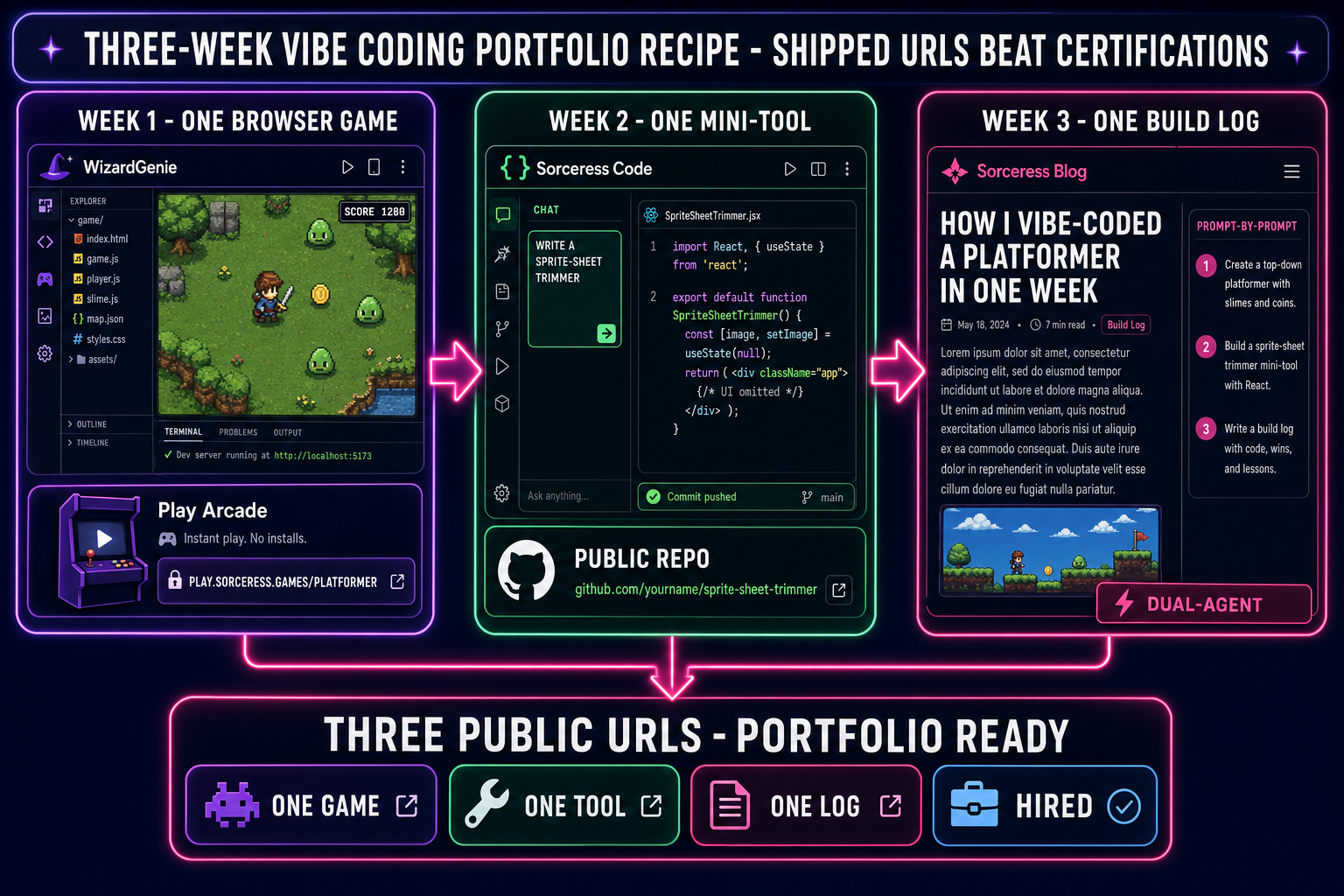
The single most-cited expectation across listings is also the one that surprises candidates most: shipped projects beat certifications, full stop. The Second Talent vibe coder job description template and the aggregate of postings we surveyed agree on the same shape — a vibe-coder candidate is judged on three to five public URLs that demonstrate end-to-end AI-assisted development, not on a list of bullet-pointed skills.
The minimum-viable portfolio that lands first-round interviews at vibe-coding-first companies in 2026 is:
- One vibe-coded browser game with a public URL. Phaser or Three.js, playable on mobile, with a finished UI loop (title screen, gameplay, win/lose state). The hiring manager opens the URL on a phone, plays for 30 seconds, and decides whether to keep reading the resume.
- One vibe-coded SaaS-style mini-tool with a public URL and a public GitHub repo. A CRUD wrapper, a dashboard, an internal-tool clone, or a single-page utility. The repo’s commit history demonstrates the AI-output review loop — commits that read “harden auth flow against second tab” or “fix N+1 in user query” do more work than the surface project. The Wikipedia entry on code review is the canonical reference for the discipline the commits should demonstrate.
- One public build log. A blog post, a YouTube screencast, or a public agent-conversation transcript that documents one of the projects above from initial prompt to deployed URL. The build log is what separates a vibe-coding candidate from a generic full-stack candidate — it demonstrates prompt discipline, model choice rationale, and the specific moment the AI output had to be hardened.
The strongest portfolios also include a fourth piece: one freelance project where the candidate took over an AI-generated codebase from a non-engineer founder and shipped it to production. That kind of project is in heavy demand precisely because the meme is real — vibe-coded prototypes break at user 50, and the candidate who can fix them at scale is the candidate who gets the Lead-tier offer.