Linus Torvalds Vibe Coding: Where He's Right and Wrong

By Arron R.12 min read
Linus Torvalds vibe coding take, distilled: fine for learners and toy projects (his own AudioNoise repo proves it), 'horrible' for production maintenance. The e

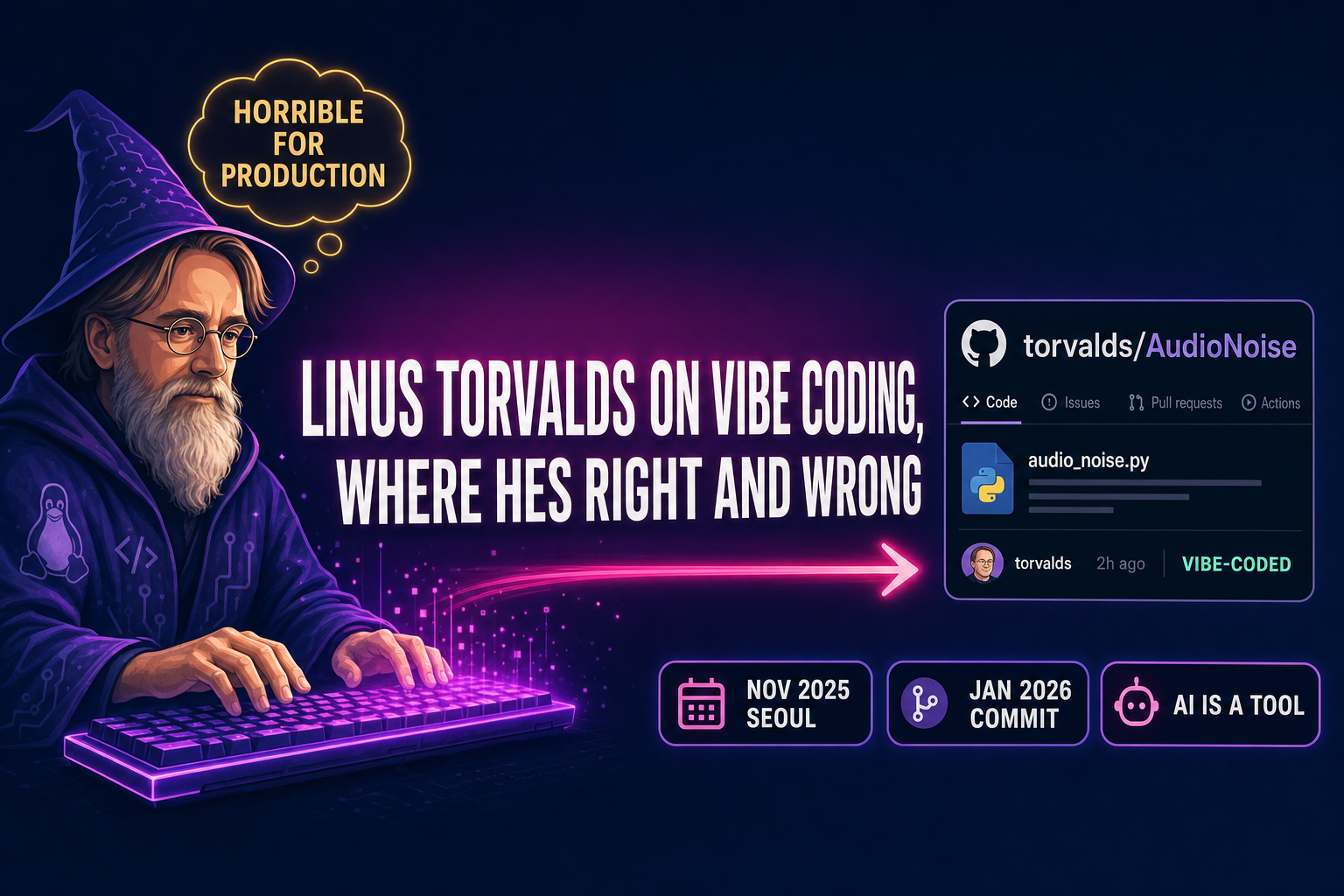
Two months separate the most-cited Linus Torvalds vibe coding moments. In November 2025, on a Seoul stage with Verizon’s Dirk Hohndel, he called vibe coding “a horrible, horrible idea from a maintenance standpoint” for production work while saying he was “fairly positive” about it for newcomers. In January 2026 he created a public GitHub repository, torvalds/AudioNoise, and committed a Python visualizer with a README that says it was “basically written by vibe-coding” using Google Antigravity. Both takes are correct on their own terms. The interesting question is what the gap between them tells engineers who actually ship AI-assisted code in 2026 — and how the WizardGenie and Sorceress Code workflows answer the maintenance critique without retreating from the productivity gain. Verified against the live torvalds/AudioNoise repository, the November 18 2025 Register write-up, and the January 13 2026 Ars Technica follow-up on May 13, 2026.
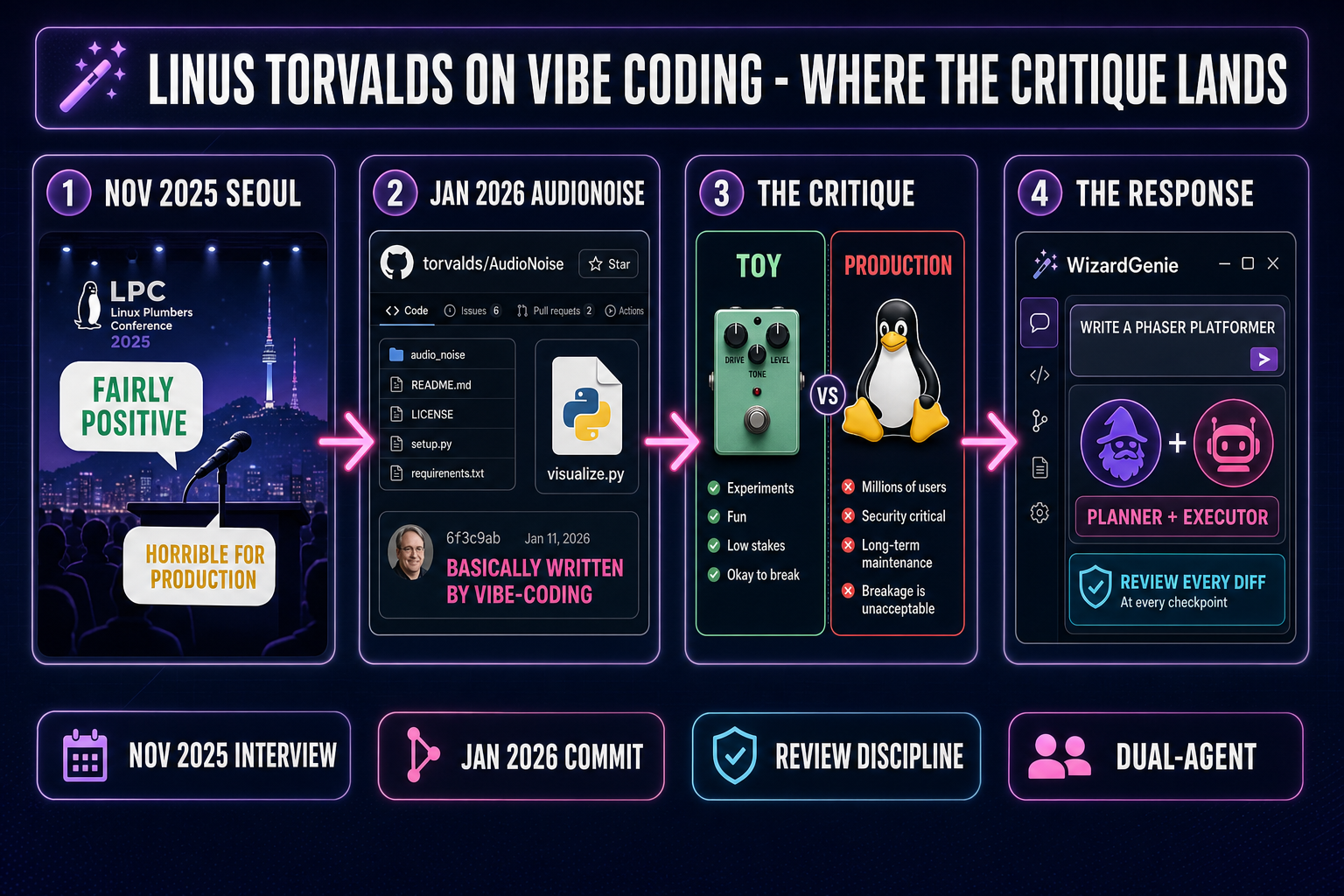
Linus Torvalds vibe coding timeline: November 2025 Seoul interview, January 2026 AudioNoise commit, the maintenance critique, and the engineering response — review discipline plus dual-agent Planner+Executor in WizardGenie
The two Linus Torvalds vibe coding moments that defined the 2026 conversation, side-by-side with the engineering response that addresses the critique without abandoning the workflow.

The two interviews that defined the Linus Torvalds vibe coding take

The Linus Torvalds vibe coding conversation has exactly two anchor moments and a lot of secondary commentary. Anchor one: an on-stage interview at the Linux Foundation Open Source Summit Korea in Seoul, November 2025, conducted by Verizon’s open-source chief Dirk Hohndel. The Register’s November 18 2025 write-up of that interview is the canonical source for the “horrible, horrible idea from a maintenance standpoint” quote, the “fairly positive” framing for new entrants, and the AI-as-compiler analogy that anchors his broader read on the field. Anchor two: a public GitHub repository at github.com/torvalds/AudioNoise, created January 9, 2026, in which Torvalds documents that the project’s Python visualizer tool was “basically written by vibe-coding” using Google Antigravity, the new agentic coding IDE that began life as a fork of Windsurf.

Everything in the broader Linus Torvalds vibe coding discourse hangs off those two moments. Ars Technica’s January 13 2026 follow-up traced the gap between the November critique and the January commit and argued, correctly, that the two are not contradictory. Phoronix covered the AudioNoise repo as the lead story the same week. The thread that runs through every serious read of both moments is the same one this post is going to follow: there are two buckets of code in Torvalds’ head, and the bucket determines whether vibe coding is fine or fatal.

The buckets matter because the senior-developer skepticism the role still gets — covered honestly in the vibe coding memes piece — collapses both buckets into one. Torvalds himself does not. That is the entire move worth studying.

November 2025 Seoul: “fairly positive” and “horrible idea” in one breath

Strip the headline writing away and the actual position Torvalds laid out in Seoul is precise. He said vibe coding is “a great way for people to get computers to do something that maybe they couldn’t do otherwise” — an entry point for hobbyists, students, and newcomers who would otherwise be locked out of building software at all. The same paragraph in The Register’s reporting carries the qualifier: “may be a horrible, horrible idea from a maintenance standpoint” for production code, and a separate dismissal of people who “hope to make billion-dollar companies by just using vibe coding.”

Two takes, two audiences, two code-quality bars. A learner who vibe-codes a Tetris clone to feel out the shape of game programming is operating on the toy bucket; nothing about the project will be maintained by a second engineer five years out, so the maintenance critique simply does not apply. A startup that vibe-codes its payment-processing layer and ships it to a thousand paying customers is operating on the production bucket; the maintenance critique is the entire problem statement and the prototype that worked for the first user is the liability that will surface when the fifty-first user logs in. Torvalds’ comments are coherent the moment you stop reading them as one position.

The compiler analogy in the same interview is the through-line. “AI is just another tool, the same way compilers freed people from writing assembly code by hand,” he told Hohndel. The framing is deliberately deflating — he is not predicting the end of programming, and he is not predicting that LLM agents will replace senior engineers. Compilers did not eliminate the need for engineers who understood the machine; they raised the abstraction at which engineers worked, and the engineers who did not understand what the compiler was emitting got worse code than the engineers who did. The same shape applies here, and Torvalds is saying it on the record.

January 2026: when Linus Torvalds vibe coded his own project

Two months later he proved the bucket reading himself. The AudioNoise repository is a hobby project for digital guitar-pedal effects — about 58% C, 38% Python, GPL-2.0 licensed, no production deployment, no second engineer downstream. The README is explicit: the project is “entirely a personal hobby project” and the visualizer tool was “basically written by vibe-coding” because Python is not Torvalds’ specialty — he is a C developer by habit, and the alternative to vibe coding the visualizer was, as he put it, “google and monkey-see-monkey-do” copying from forums.

The agent he used was Google Antigravity, the agentic coding IDE Google released in late 2025 as a fork of Windsurf. The choice is interesting on its own — it is a frontier-tier agent, not a toy, and Torvalds is not slumming with a budget tool to make a point. He picked the strongest available agent for a non-critical hobby tool and let it write most of the code. The repository’s commit history shows the “Merge branch ‘antigravity’” commit at 93a72563 as the canonical landing point for the visualizer.

That is the proof of bucket discipline. Torvalds did not vibe code the C audio engine; he hand-wrote that, because that is the half of the project he understands deeply enough to maintain himself. He did vibe code the Python visualization layer, because the visualizer is a throwaway tool he uses to look at signals and the cost of getting it “wrong” is exactly zero. Two buckets, two tools, one engineer who reads his own code-quality bar correctly. The engineering takeaway for vibe coders shipping in 2026 is the same: the bucket determines the workflow, not the headline.
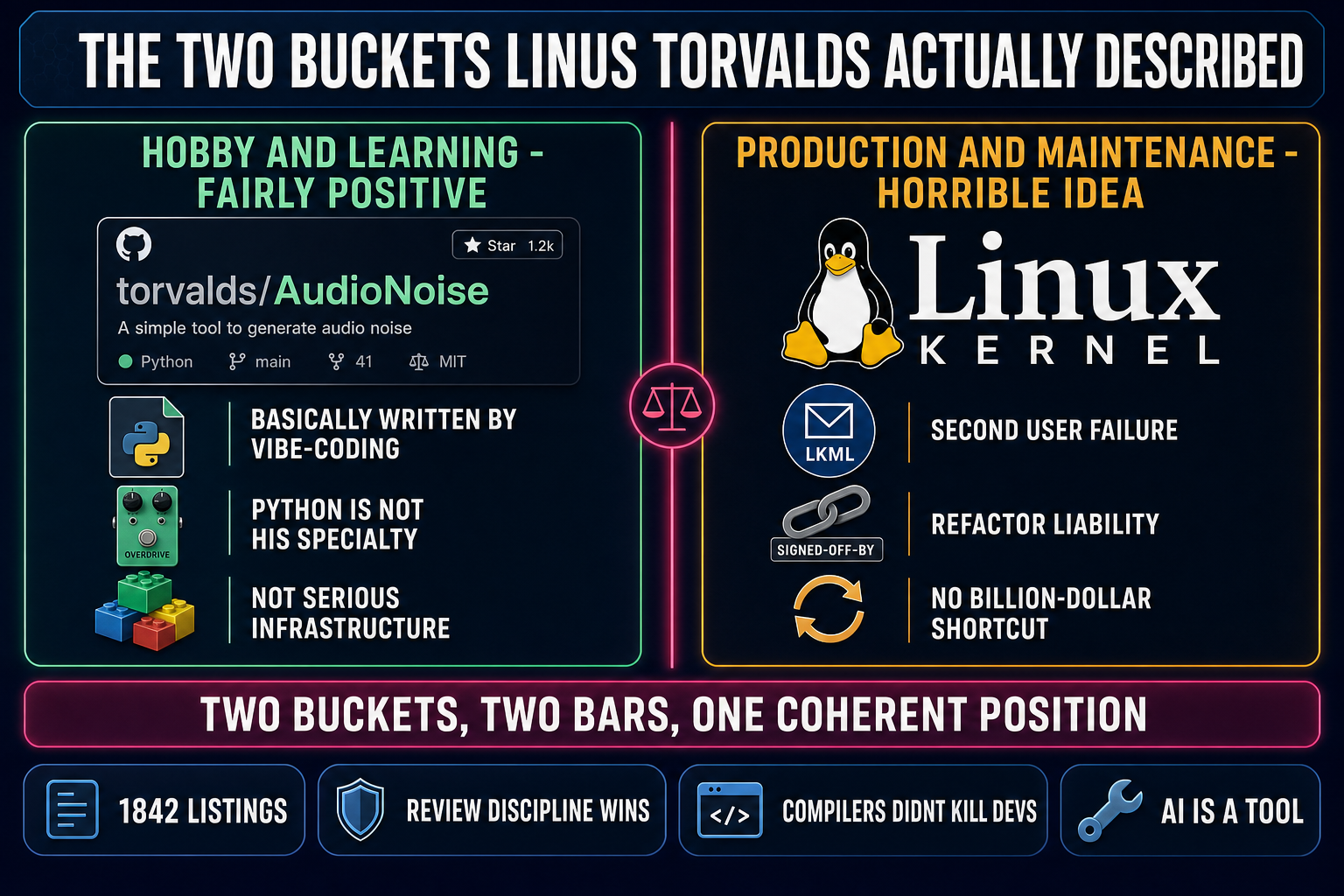
Two-bucket Linus Torvalds vibe coding chart: hobby and learning column with AudioNoise repo, Python visualizer, toy infrastructure markers labeled fairly positive in mint green; production and maintenance column with Linux kernel, lkml mailing list, signed-off-by chain markers labeled horrible idea in amber
The two-bucket reading of the Linus Torvalds vibe coding position. Toy and learning code: fairly positive. Production code with downstream maintainers: horrible idea. Both takes are coherent the moment you stop collapsing the buckets.

Where the Linus Torvalds vibe coding critique actually lands

The maintenance critique is correct on its terms, and the engineers most allergic to the headline are usually the ones who agree with the substance once they read it carefully. Production code is judged on how well it survives a refactor, not on whether the first prompt produced something that compiled. Code that nobody understands well enough to extend or harden is a liability the moment a second user, a second deployment, or a third API failure shows up. That is the failure mode Torvalds is naming, and it is real.

The shape of the failure is concrete: the prototype works for the first user and breaks for the fifty-first; the auth flow looks clean in a single-tab demo and ships a session-fixation bug the moment a second tab opens; the database query that returns in 40ms on the seed dataset is an N+1 disaster on the production table. None of those are LLM-specific failures — they show up in human-written code too — but they show up faster and more often when nobody on the team has done the reading-and-thinking pass that surfaces them. Code review is the formal name for that pass; vibe-coded production code with no review pass is the worst-case shape of the practice.

The Linux kernel is the cleanest counter-example to vibe coding without review and Torvalds is not subtle about that. The kernel’s submission process — patches posted to the lkml mailing list, multi-maintainer review, signed-off-by chains traceable to the contributor — is review discipline made institutional. He has stated publicly that he is not personally using AI-assisted coding for kernel work and that other maintainers experimenting with it privately is fine, but the patch will be judged the same way every other patch is. The kernel will absorb AI-generated code when, and only when, the patch demonstrably passes the same review bar a human-written patch faces. That is not anti-AI. It is anti-handing-the-keyboard-over-without-reading-the-output.
Where the critique misses: review discipline as the engineering response

The honest gap in the strong reading of the Torvalds critique is that it implicitly equates vibe coding with no-review vibe coding. That is the worst-case shape of the practice, not the practiced one. The 2026 vibe coding job market is explicit about which version employers actually pay for: review discipline is the most prized competency in Senior+ listings, ahead of raw prompt throughput, ahead of model-naming trivia, ahead of the framework stack itself. The full hiring breakdown is in our vibe coding jobs analysis, and the through-line is that the role’s top tier is paid to do exactly what Torvalds is asking for — read every diff, test the unhappy paths the model skipped, and harden the output before it ships.

The senior developers most public about that discipline have been saying so for two years. Simon Willison’s September 2025 essay defining vibe coding versus “real engineering” (cited in the Wikipedia entry on vibe coding) drew the line in the same place: the practice is fine for prototypes and toy projects, dangerous for production unless paired with the review pass that catches the model’s reliable failure modes. The line and the workflow it implies are the engineering response to the maintenance critique. Vibe coding does not remove engineering responsibility for shipped code; it concentrates it on the diff-reading step that LLM throughput tries to compress.

The competency the strongest vibe coders demonstrate, in interviews and in public build logs, is exactly that compression resistance. They read every AI-generated diff before they commit it. They test the second-tab and second-user code paths the model did not consider. They keep their own API keys in the loop so they control which model writes which code — the bring-your-own-key flow is a first-class feature in WizardGenie and Sorceress Code for that reason. They ship a public build log alongside the project so the prompt-by-prompt review trail exists outside the codebase. None of those practices remove vibe coding from the workflow; all of them harden the workflow against the maintenance failure mode the Torvalds critique correctly names.

The dual-agent pattern as the cost-discipline answer

The other half of the engineering response is cost discipline, and it is the half the headline coverage of the Linus Torvalds vibe coding interview missed entirely. Single-frontier vibe coding — running every prompt through Claude Opus 4.7 or GPT-5.5 alone — is expensive enough that the economics break before the maintenance critique does. A 12-file refactor on a single-frontier executor can clear $50 in tokens before the engineer has read the diff. That cost is real, it shows up in interview rounds at vibe-coding-first companies, and it is the structural pressure that pushes serious teams toward the Planner+Executor pattern.

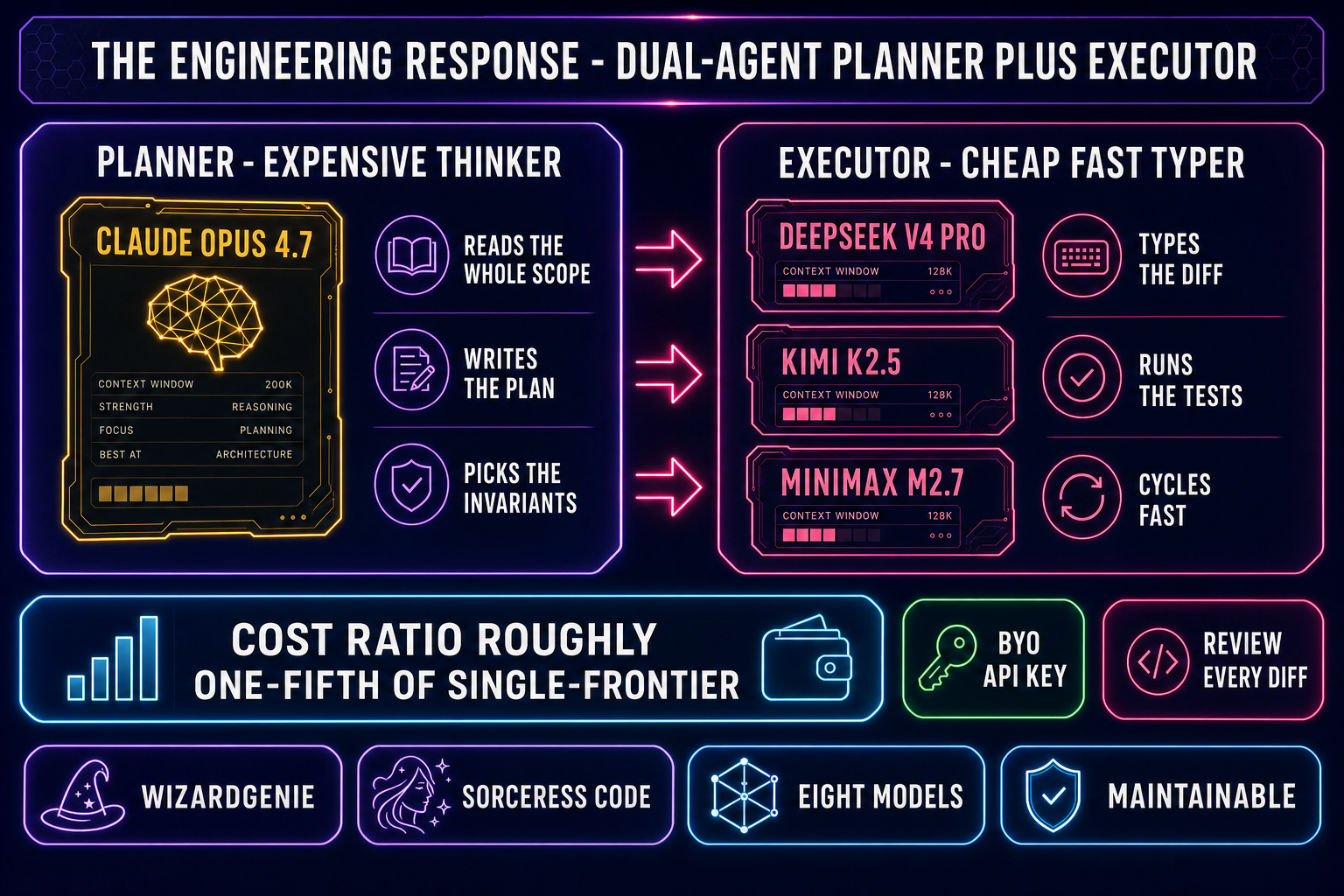
The pattern is straightforward. A frontier reasoner reads the scope, writes the plan, and picks the invariants — that is the Planner. A cheap fast model types the diff, runs the tests, and cycles fast on small fixes — that is the Executor. The cost ratio is roughly one-fifth of single-frontier, and the model-quality ceiling is preserved because the expensive thinking still happens at the planning step. The acceptable Planner roster in 2026 is Claude Opus 4.7, GPT-5.5, Gemini 3.1 Pro, and Grok 4.2. The acceptable Executor roster is DeepSeek V4 Pro, Kimi K2.5, MiniMax M2.7, plus the cheap variants of the frontier families — verified against the CODING_MODELS array in src/app/_home-v2/_data/tools.ts on May 13, 2026. Pairing two frontier-priced models is a pattern violation that erases the cost advantage; the model picker guide walks the cost math in detail.

The vibe-coding-job interview round most candidates miss is the model-choice round: “You have a $50 token budget for a 12-file refactor across our codebase. Which model do you use as planner, which as executor, what is your expected total cost?” A candidate who has paired Opus 4.7 with DeepSeek V4 Pro in production answers in 60 seconds. A candidate who has only run single-frontier sessions has to do the math live and gets it wrong. The engineering response to the Torvalds critique includes a quantifiable cost discipline, not just a quantifiable review discipline, and the dual-agent pattern is what the discipline looks like at the workflow layer.

Dual-agent vibe coding cost-comparison diagram: Claude Opus 4.7 as planner expensive thinker on the left, DeepSeek V4 Pro plus Kimi K2.5 plus MiniMax M2.7 as cheap fast executors on the right, cost ratio roughly one-fifth of single-frontier with bring-your-own-key and review-every-diff badges
The dual-agent Planner+Executor pattern that answers the cost half of the maintenance critique. WizardGenie and Sorceress Code ship the pattern as a first-class mode across all eight frontier coding models.

What this means for vibe coders shipping today

The practical consequence of taking both Torvalds takes seriously is a workflow that looks the same on a hobby project and on a production cut, with one variable changed: the rigor of the review pass. On a hobby project — an AudioNoise visualizer, a weekend platformer, a one-off dashboard for personal use — the review pass can be lightweight. The code does not need to survive a refactor by a second engineer because there is no second engineer. The practice in that bucket is “fairly positive” and the only honest correction to the Torvalds line is that he should have said the same about the Python visualizer he committed two months later, which is exactly what he did.

On a production cut — a paid SaaS, a shipped game with a player base, an internal tool other engineers will modify — the review pass is the entire job. Every AI-generated diff gets read by a human who can spot the unhappy-path failure mode the model skipped. Every auth-related change gets a security pass. Every database query gets the production-dataset reasoning pass. Every model invocation runs through the Planner+Executor pattern so the cost ledger does not become a separate engineering crisis. That workflow is what shipped vibe coders actually do, and it is what the strongest vibe coding tools comparison measures the platforms against.

WizardGenie and Sorceress Code were both built around that bucket discipline. WizardGenie ships a finished playable browser game on the Sorceress Play Arcade — the hobby-bucket flow Torvalds explicitly endorsed. The same agent loop, in dual-agent mode with a bring-your-own-key Planner and a cheap fast Executor, is the production-bucket flow that addresses the maintenance critique on its own terms. Sorceress Code is the lighter-weight general-purpose agent that pairs with it for non-engine work and ships the public build-log trail that hiring managers screenshot. Neither tool tries to argue Torvalds is wrong. Both tools are the engineering response that takes him seriously.

Will Linus Torvalds vibe code the Linux kernel?

No, not by default in 2026, and not as a general policy shift. He has said publicly that he is not testing AI-assisted coding for kernel work and that the kernel’s patch-review culture is what would have to change, not the agent. Other maintainers experimenting with the tools privately is acceptable; the bar for an AI-generated patch landing is the same bar a human-written patch faces. The signed-off-by chain still has to point at a human contributor who understands the code, can defend it on the mailing list, and will own the maintenance burden when the patch ships in a stable kernel. That is the production bucket at maximum strength, and the workflow is unchanged.

The separate concern Torvalds has flagged in interviews is AI-driven crawler traffic submitting fabricated security reports to kernel.org infrastructure. That is a different problem than AI-generated patches and the kernel project is treating it as adversarial traffic, not as a contribution channel. The two issues do not collapse into one. The honest read is that Torvalds is engaging with the AI-and-software question on its actual terms — bucket-by-bucket, code-quality-bar by code-quality-bar — and the 2026 vibe coding workflow that takes him seriously will look more like the kernel’s review culture than less.

Frequently Asked Questions

What did Linus Torvalds actually say about vibe coding?

At the Linux Foundation Open Source Summit Korea in November 2025, in an interview with Dirk Hohndel of Verizon, Linus Torvalds described himself as 'fairly positive' about vibe coding as a way for newcomers to get into computing and 'get computers to do something that maybe they couldn't do otherwise.' In the same conversation he called vibe coding 'a horrible, horrible idea from a maintenance standpoint' for production code, and dismissed people who 'hope to make billion-dollar companies by just using vibe coding.' He compared AI broadly to compilers — 'AI is just another tool, the same way compilers free people from writing assembly code by hand' — and said he is not personally using AI-assisted coding for the Linux kernel. The two takes are not contradictory; they describe two different audiences and two different code-quality bars.

Has Linus Torvalds himself ever vibe coded?

Yes. On January 9, 2026, Torvalds created a public GitHub repository at github.com/torvalds/AudioNoise, a GPL-2-licensed hobby project for digital guitar-pedal effects. The repository's README states that the included Python visualizer tool was 'basically written by vibe-coding,' using Google Antigravity as the AI agent. Torvalds noted that Python is not his specialty — he is a C developer by habit — and the visualizer was a non-critical hobby tool, so the trade-off was acceptable. He explicitly framed the project as 'entirely a personal hobby project' and 'pretty much just a toy, not serious infrastructure.' The two-month gap between the November 2025 'horrible idea' interview and his own vibe-coded January 2026 commit is itself the most-cited counterexample to the strong reading of his critique.

Is the Linus Torvalds vibe coding criticism actually correct?

Mostly yes, with one important qualification. The maintenance critique is correct on its terms: code that nobody understands well enough to extend or harden is a liability when the second user, the second deployment, or the third API failure shows up. Production code is judged on how well it survives a refactor, not on whether the first prompt produced something that compiled. Where the critique is incomplete is in its framing: it implicitly equates vibe coding with no-review vibe coding, which is the worst-case shape of the practice rather than the practiced one. The 2026 vibe coding job market is explicit that review discipline is the most prized competency in senior listings, not raw prompt throughput. A vibe coder who reads every diff, security-tests every flow, and pairs a frontier reasoner with a cheap fast executor for cost discipline is engaging in software engineering — just with a different unit of work than the keystroke.

Will Linus Torvalds accept AI-generated patches into the Linux kernel?

Not by default in 2026, and not as a general policy shift. Torvalds has stated publicly that he is not using or testing AI-assisted coding tools for kernel work, though he has acknowledged that other kernel maintainers are experimenting with them privately. The kernel's existing review culture — patch series posted to the lkml mailing list, multi-maintainer review, signed-off-by chains — already filters submissions hard enough that the question is academic for most contributors. A separate concern Torvalds has flagged in interviews is that AI-driven crawlers are submitting fabricated security reports to kernel.org infrastructure, which is a different problem than AI-generated patches and one the project is treating as adversarial traffic rather than as a contribution channel. The honest read: the kernel will incorporate AI-generated code when (and only when) the patch demonstrably passes the same review bar a human-written patch faces, with the burden of proof on the submitter.

How should a vibe coder respond to the Linus Torvalds critique?

By building review discipline into the workflow rather than around it. Five practices that satisfy the critique on its own terms: read every AI-generated diff before you commit it (the senior-developer skill the 2026 listings prize most highly), test the unhappy paths the model skipped on the first pass (the second user, the second tab, the third API failure), use the dual-agent Planner+Executor pattern so a frontier reasoner thinks while a cheap fast executor types (cost ratio roughly one-fifth of single-frontier), keep your own API key in the loop so you control which model writes which code (WizardGenie and Sorceress Code both expose bring-your-own-key flows), and ship a public build log alongside the project so the prompt-by-prompt review trail exists outside the codebase. None of those practices remove vibe coding from the workflow; all of them harden the workflow against the maintenance failure mode the Torvalds critique correctly names.

Sources

  1. Linus Torvalds: Vibe coding is fine, but not for production (The Register, Nov 18 2025)
  2. Linus Torvalds tries vibe coding, world still intact somehow (The Register, Jan 13 2026)
  3. Even Linus Torvalds is trying his hand at vibe coding (but just a little) (Ars Technica, Jan 2026)
  4. Linus Torvalds' Latest Open-Source Project Is AudioNoise — Made With The Help Of Vibe Coding (Phoronix)
  5. torvalds/AudioNoise — GitHub repository
  6. Vibe coding (Wikipedia)
  7. Linus Torvalds (Wikipedia)
  8. Code review (Wikipedia)
  9. Open Source Summit Korea 2025 (Linux Foundation Events)
Written by Arron R.·2,736 words·12 min read

Related posts