Lovable Vibe Coding Revenue (400M ARR — But Not for Games)

By Arron R.11 min read
Lovable vibe coding revenue crossed 400M ARR in February 2026 with 146 employees. The wins are real — but they are SaaS dashboards for Klarna, HubSpot, and half

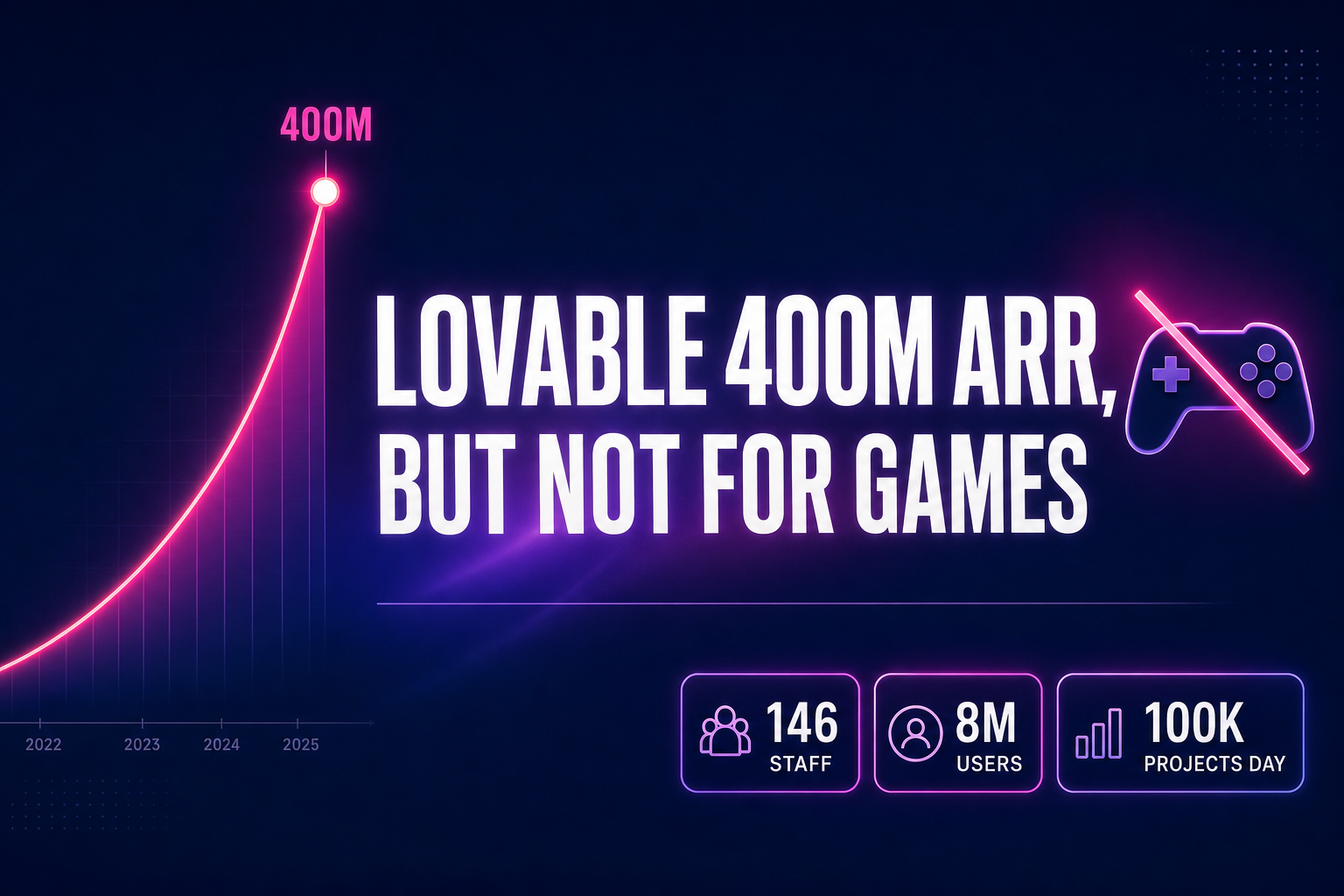
Lovable vibe coding revenue crossed 400 million dollars in annual recurring revenue in February 2026, on the back of 146 employees, nearly 8 million users, and roughly 100,000 new projects shipped per day. The company added 100 million in revenue in a single month from January to February — a per-month growth rate that has no real comparable in modern SaaS. None of those numbers are hype: each is sourced to TechCrunch on March 11, 2026 and corroborated by Business Insider, Fortune, and the company Series B documentation. What the headlines tend to skip is that almost none of that revenue is coming from games. The big game wins of the same vibe-coding era shipped on Cursor with Three.js and Phaser, not on Lovable. This is the honest tour of where the money actually is, who the customers really are, and what WizardGenie ships to close the gap on the game-native side of the workflow. Verified May 14, 2026.
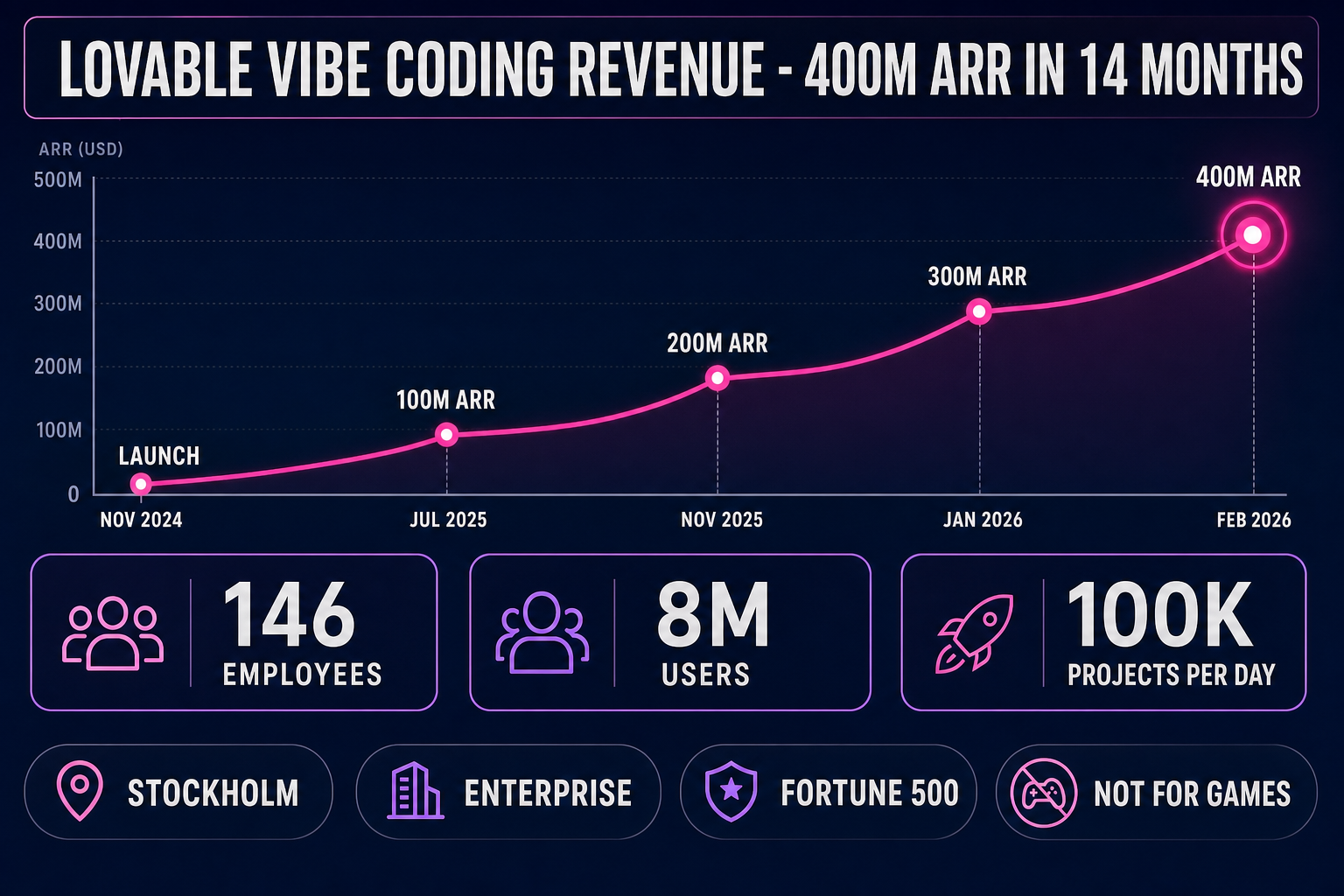
Lovable vibe coding revenue trajectory from launch in November 2024 to 400M ARR in February 2026, with milestone markers at 100M ARR in July 2025, 200M in November 2025, 300M in January 2026, and 400M in February 2026, plus side cards showing 146 employees, 8M users, and 100K projects per day
The 14-month curve that produced 400 million dollars in annual recurring revenue from a 146-employee company headquartered in Stockholm. Verified against TechCrunch reporting on May 14, 2026.

The 14 months that produced 400 million in ARR

Lovable launched publicly in November 2024 after a stealth-mode rebrand from GPT Engineer App, the commercial wrapper around founder Anton Osika early open-source GPT Engineer project. By July 2025, eight months after launch, the company was already at 100 million dollars in annual recurring revenue. By November 2025, ARR had doubled to 200 million. In January 2026, it cleared 300 million. In February 2026, it added another 100 million in a single month, landing at 400 million.

Each of those milestones is an order of magnitude faster than the canonical SaaS comp set. Slack reached 100 million ARR in roughly 33 months from launch. Zoom took 60 months. ChatGPT crossed the same line in roughly 4 months, but on a consumer subscription model rather than a true business-to-business SaaS shape. The eight-month sprint to 100 million ARR sits in a category that did not really exist before AI code generation became economically viable. The acceleration has stayed active too: the 200M-to-400M doubling happened in roughly four months, an annualized 6x growth rate at the 300M base.

The 14-month cumulative trajectory translates to roughly 2.7 million dollars in ARR per employee at the 146-staff headcount reported for March 2026 — about seven times the industry benchmark for traditional SaaS at scale. Anton Osika has publicly attributed the per-employee leverage to the European hiring discipline (slower headcount growth than Bay Area peers) and to the agent-native nature of the product itself: builders ship without waiting on engineering throughput. The 146-headcount number is, on its own, an argument for the vibe coding category as a whole — small teams shipping deep product surface to large enterprise buyers.

Where Lovable vibe coding revenue actually comes from

The 400M figure obscures the shape of the customer base. The revenue is overwhelmingly SaaS, dashboard, and internal-tool builds. The publicly named enterprise customers are Klarna, HubSpot, Deutsche Telekom, Uber, and Zendesk. Anton Osika told Fortune in November 2025 that the company is going aggressively after enterprise, and reported that more than half of the Fortune 500 are using the platform in some form. Lovable for Enterprise launched as a dedicated tier with security, audit, and SSO features — not the kind of investments a games-first vendor makes.

The independent SaaS wins built on the platform corroborate the shape. ShiftNex hit 1 million dollars ARR in five months as a healthcare workforce-staffing platform. Lumoo crossed roughly 800 thousand ARR in nine months as a fashion-retail content AI dashboard, signed Gant, AWNR Group, Zoovillage, and Brothers as customers, and took a roughly 550 thousand euro angel cheque from Osika himself. Q Group / Qconcursos, one of Brazil largest exam-prep platforms with 500,000-plus active paying students, used the platform to build a new premium product in 14 days and grossed approximately 3 million dollars in 48 hours of launch on its existing distribution. Every one of those is a B2B SaaS or B2B2C content platform — not a game.

The technical shape Lovable optimizes for tracks the customer base. The default stack the platform scaffolds is React with Vite and Tailwind on the frontend, Supabase with PostgreSQL on the backend, full GitHub sync, and one-click deploy to a hosted preview URL. That is the modal stack for a small SaaS dashboard, not for a Phaser 4 game loop or a Three.js multiplayer scene. The platform technically supports HTML game projects and ships a Build Interactive Games use-case page, but no commercially significant game has come out of it to date — a point worth holding on to before drawing conclusions about platform fit.
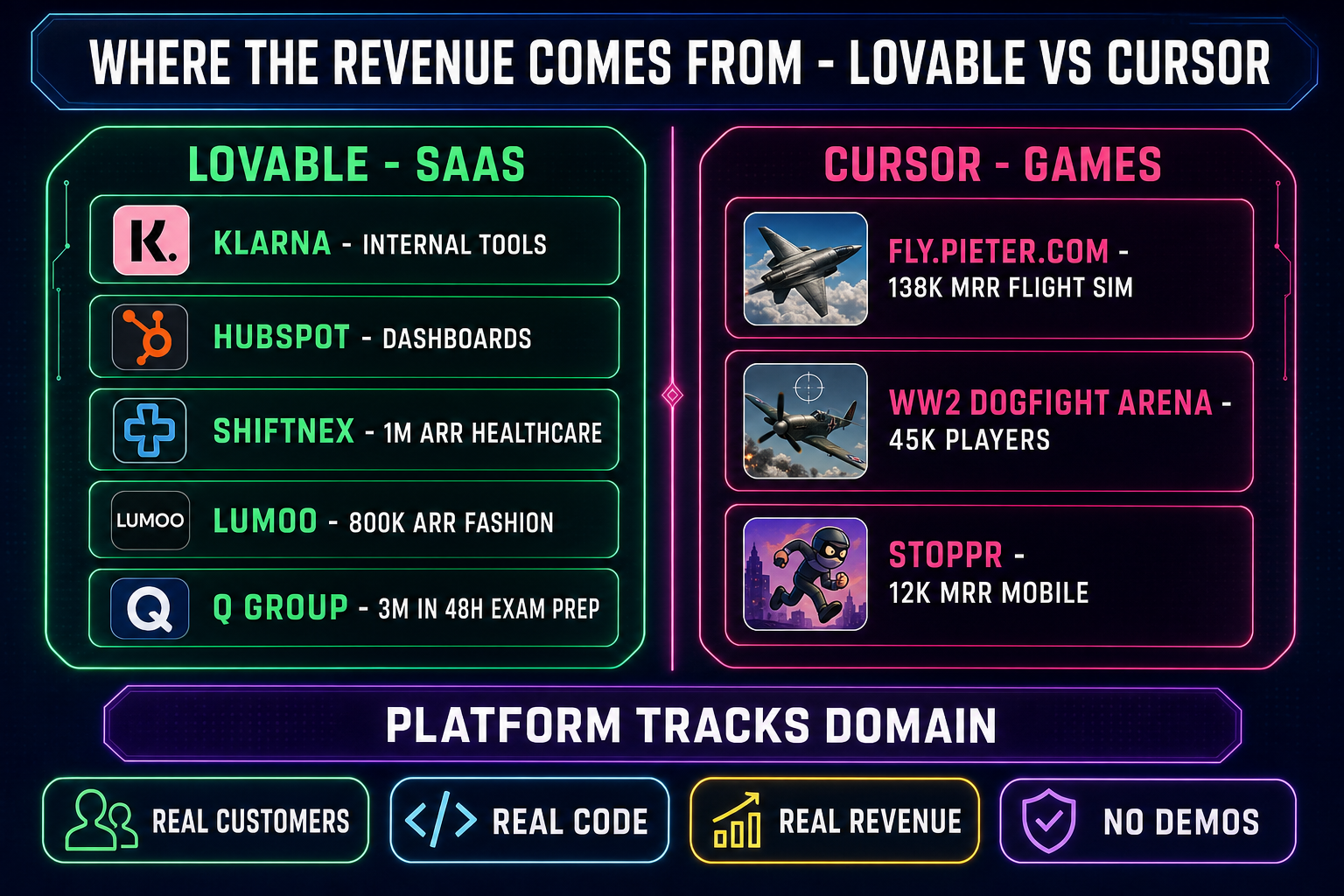
Two-column comparison showing Lovable SaaS customers (Klarna internal tools, HubSpot dashboards, ShiftNex 1M ARR healthcare, Lumoo 800K ARR fashion, Q Group 3M in 48 hours exam prep) versus Cursor game customers (fly.pieter.com 138K MRR flight sim, WW2 Dogfight Arena 45K players, Stoppr 12K MRR mobile)
Where the revenue concentrates on each platform. The pattern is clean: SaaS lands on Lovable, games land on Cursor. The platform tracks the project domain.

The two Swedish founders behind the run

Anton Osika (CEO) and Fabian Hedin (CTO) co-founded the company in Stockholm in 2023. Both come from European tech: Osika previously co-founded the AI risk and safety lab Sana Labs, Hedin came from Klarna engineering. Their first project together was GPT Engineer, an open-source command-line tool that scaffolds whole applications from a single natural-language prompt by orchestrating LLM calls into a developer-style loop. GPT Engineer was released on GitHub in mid-2023 and became one of the most-starred Python repositories of that year, peaking around 50,000 stars within months.

The commercial pivot followed in 2024. The pair built GPT Engineer App — a hosted, web-based version of the same loop — and rebranded it to Lovable in December 2024, alongside the public launch. The rebrand decoupled the product from the open-source project: GPT Engineer the repo continued to live as a developer tool, while the renamed product became the no-code-leaning hosted experience aimed at non-engineer builders. The category framing shifted with the name: vibe coding as a phrase, popularised by Andrej Karpathy in February 2025, gave the new positioning a tailwind that GPT Engineer the developer tool could not have ridden.

The decision to keep the company headquartered in Stockholm has been a recurring talking point. Osika told TechCrunch in November 2025 that staying in Europe meant slower hiring, lower comp pressure, and a deliberate engineering-density strategy — ship more product per head, raise less capital per dollar of revenue. The 146-employee, 400M-ARR number is the visible payoff. Both founders remain in operating roles as of mid-2026, with Osika fronting the press cycle and Hedin running the engineering org.
The capital stack: 530 million dollars raised at a 6.6 billion valuation

The company closed two priced rounds inside ten months. Series A landed in February 2025 at 200 million dollars, led by Accel with Creandum and 20VC participating, at a 1.8 billion dollar post-money valuation. The cheque size signaled what AI-native code generation looked like to growth investors at the moment when Cursor and Replit were still defining the category boundary.

Series B closed in December 2025 at 330 million dollars, co-led by CapitalG (the Alphabet growth fund) and Menlo Ventures, at a 6.6 billion dollar post-money — a 3.7x valuation step in roughly ten months on the back of a 4x revenue jump from the 100 million ARR mark. The Series B included strategic capital from NVentures (NVIDIA), Salesforce Ventures, Databricks Ventures, Atlassian Ventures, HubSpot Ventures, Khosla Ventures, DST Global, EQT Growth, T.Capital, Kinship Ventures, and returning backers Accel and Creandum.

That cap table reads like the buyer list for a future acquisition: each strategic has an obvious adjacent surface (Salesforce plus builder-deployed CRM extensions; HubSpot plus builder-deployed marketing tools; Atlassian plus builder-deployed internal tools). The participation of HubSpot Ventures and the simultaneous announcement that HubSpot itself is a customer creates a tight feedback loop that Cursor, Bolt, and Replit have not yet replicated at the same scale. Cumulative capital raised: roughly 530 million dollars. Burn discipline implied by the 146-headcount: most of that capital is sitting on the balance sheet, not funding losses. At 400M ARR and reasonable software gross margins the company likely runs profitably or near-profitably; the capital is acquisition currency, not operating runway.

Does Lovable build games? The honest answer

The platform does ship a Build Interactive Games use-case page on its solutions site, plus a Multiplayer Physics-Based Game template and a Multiplayer Gaming Platform template under the gaming-and-esports vertical. It technically supports HTML5 / WebGL projects, browser-game-shaped React apps, and project structures that include canvas-rendered loops. So the surface, narrowly, covers small browser games.

What is missing from the public record is any commercially significant shipped game built primarily on the platform. Every documented vibe-coding game-revenue case study to date — fly.pieter.com at 138,000 dollars monthly recurring revenue, WW2 Dogfight Arena at 45,000 first-week players, Stoppr at 12,000 dollars MRR (mobile, not browser), the Vibe Jam 2025 finalists curated by Pieter Levels — runs on Cursor as the agent surface, with Three.js or Phaser providing the runtime, and Claude or GPT-5 doing the code generation. Lovable shows up in the same press cycle as a peer platform, occasionally as the host for landing pages or marketing sites associated with a game, but not as the agent that wrote the game code. The platform-built wins discussed in the same coverage (ShiftNex, Lumoo, Q Group) are SaaS, dashboard, and exam-prep — not games.

The platform-tracks-domain pattern explains the gap. Game projects need engine-aware code generation: the agent has to understand sprite-batch rendering, frame budgets, collision primitives, and the run-loop pattern as a first-class concept. A SaaS-focused agent that scaffolds a perfect React-Tailwind admin dashboard does not naturally produce a 60-frames-per-second Phaser scene with correct AABB colliders. That is the gap WizardGenie is built for, and it is the reason this article carries the qualifier but not for games in the title rather than the more click-friendly framing the headlines have used.

Why the actual game wins shipped on Cursor instead

The vibe-coded games shipping in 2025 and 2026 cluster around Cursor for one structural reason: Cursor agent has the file-aware editor behavior and the iterate-by-playtest tight loop that game development requires. The fly.pieter.com case is the anchor. Pieter Levels built it in roughly three hours on February 22, 2025, using Cursor with Claude as the model and Three.js for the 3D layer. By November 2025 the game was clearing 138,000 dollars per month, with about 22,000 to 26,000 simultaneous users at peak and 320,000 total players in the first month. Levels description of the loop: prompt, watch the model write, alt-tab, play, prompt the next change.

The pattern repeats across the WW2 Dogfight Arena build (about 20 euros spent on the agent, roughly 500 prompts, 1.5 million views, around 2,000 euros per month in ad revenue) and the Vibe Jam 2025 catalog more broadly. The cost discipline that makes those builds work also tracks with Cursor bring-your-own-key model. Levels has publicly noted that the unit economics on a flight sim only work because the agent token spend per shipped feature is small relative to the hosting cost of the multiplayer state.

Lovable hosted-everything model bundles the agent and the deploy in a single subscription tier, which is an excellent fit for SaaS but a worse fit for a game where the developer wants to deploy to a custom domain on their own CDN with no platform-level lock-in on the runtime. That is the honest split: Cursor plus Three.js plus Claude for the games, Lovable plus React plus Supabase for the SaaS. Each platform optimizes for its modal customer stack, and each customer base self-selects in roughly the proportions the public revenue numbers suggest.

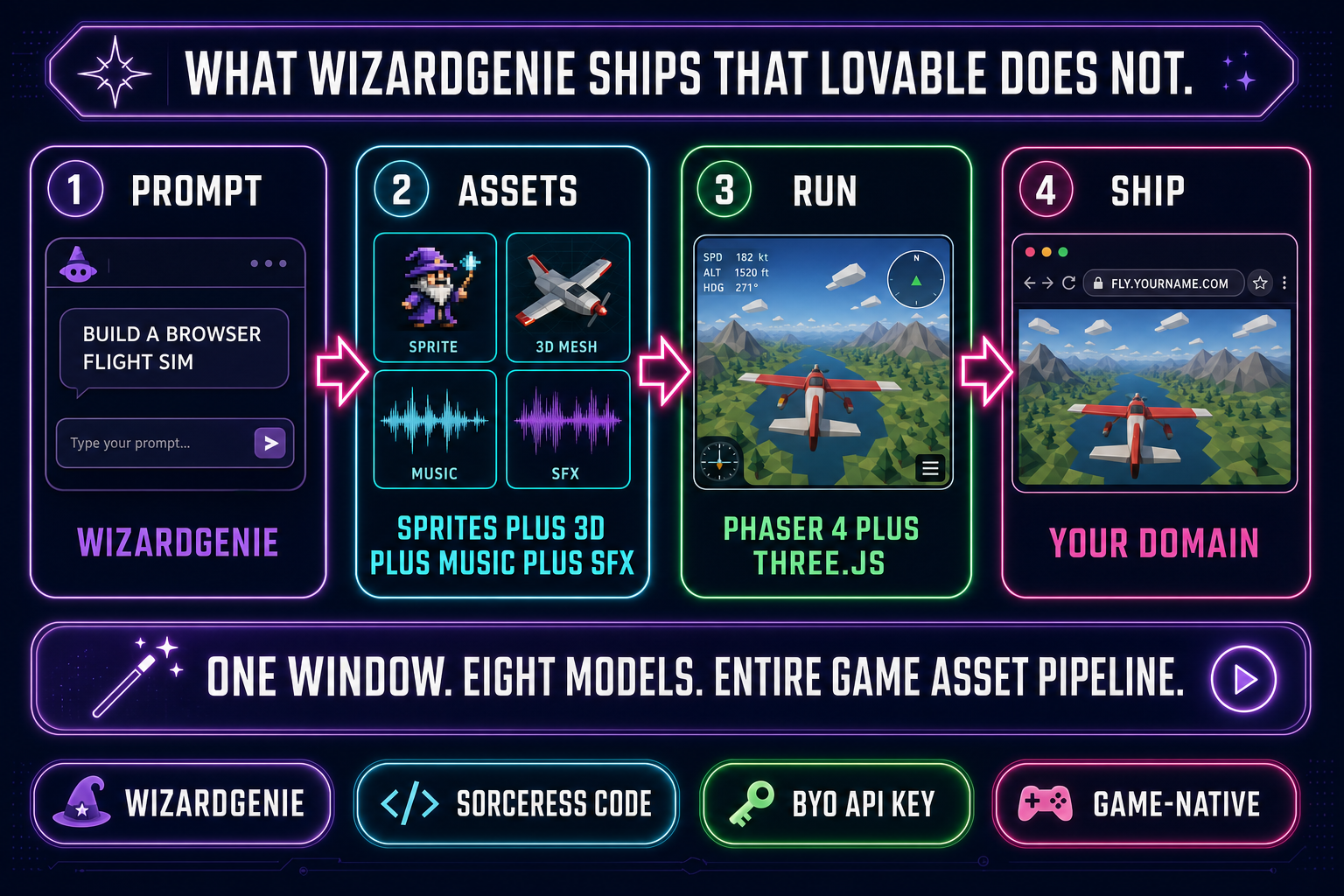
Sorceress stack pipeline showing what WizardGenie ships that Lovable does not: prompt to WizardGenie agent, then sprite plus 3D plus music plus SFX asset pipeline, then Phaser 4 plus Three.js live preview, then deploy to your own domain, with WizardGenie, Sorceress Code, BYO API key, and game-native pill badges along the bottom
The four-step Sorceress pipeline that closes the game-native gap Lovable leaves open: WizardGenie owns the agent loop, the asset pipeline lives in the same window, and the deploy target is the developer own domain.

What WizardGenie ships that Lovable does not

Sorceress runs the same play on the game-native side of the surface. WizardGenie at /wizard-genie/app is the agent loop built around a game-engine runtime instead of a React project scaffolder. The model picker in WizardGenie ships eight frontier coding models in production: Claude Opus 4.7, Claude Sonnet 4.6, GPT-5.5, Gemini 3.1 Pro, DeepSeek V4 Pro, Kimi K2.5, Grok 4.2, and MiniMax M2.7 — verified against the CODING_MODELS array in src/app/_home-v2/_data/tools.ts on May 14, 2026. The picker rotates per turn, which is how a developer runs a Planner-plus-Executor pair (Opus or GPT-5.5 as the planner, DeepSeek V4 Pro or Kimi K2.5 as the cheap executor) without paying frontier prices on every typed token — a roughly 1/5 cost reduction versus single-frontier work, which is the discipline the heaviest vibe-coding power-users converge on by 2026.

The Sorceress asset pipeline is wired into the same window. AI Image Gen for character art and props, Quick Sprites for animated sprite sheets, 3D Studio for image-to-3D plus auto-rigging plus text-to-motion, Music Gen for instrumental and vocal tracks, SFX Gen for batch sound effects, and Speech Gen for NPC voice. That layout matters because the gap Cursor and Lovable both leave open is the asset-pipeline tab-out: every game build on those platforms eventually requires the developer to leave the agent window for sprite art, music, and sound — work that Sorceress keeps inside the same browser tab.

For a SaaS-shaped vibe coding app on the Lovable side of the line, Sorceress Code at /code is the closer fit. The general-purpose agentic IDE shell ships the same eight-model picker, supports parallel-agent flows for Planner-plus-Executor pairings, and exposes a bring-your-own-key path that mirrors the cost discipline indie builders end up wanting. The split is intentional. WizardGenie owns the game loop. Sorceress Code owns everything else. Together they cover the full vibe-coding surface — SaaS and games — without forcing the developer to choose between platform and domain. The longer treatment of the vibe-coding-tools landscape lives in the inside vibe coding platforms tour and the real vibe coding apps case-study list; the best vibe coding tools for games piece is the closer pick if the reader landed here while shopping platforms.

Frequently Asked Questions

How much revenue does Lovable make in 2026?

Lovable crossed 400 million dollars in annual recurring revenue in February 2026, according to TechCrunch reporting on March 11, 2026. The trajectory was 100 million ARR in July 2025, 200 million in November 2025, 300 million in January 2026, and 400 million in February 2026 — a 100 million dollar jump in a single month from a 146-employee company. CEO Anton Osika previously projected 1 billion ARR by end of 2026 but declined to reaffirm that target in the March interview, saying the focus had shifted to helping builders scale impact. Per-employee ARR sits at roughly 2.7 million dollars, around seven times the industry benchmark for traditional SaaS companies. The company was last valued at 6.6 billion dollars in the December 2025 Series B round.

Does Lovable actually build games, or just web apps?

Lovable does ship a Build Interactive Games use case page and supports browser-based HTML projects, so the surface technically covers small web games. But the documented commercial wins from the platform are all SaaS and dashboard products — ShiftNex at 1 million ARR for healthcare staffing, Lumoo at roughly 800 thousand ARR for fashion brand AI, Q Group at 3 million dollars in 48 hours for Brazilian exam prep, plus the wave of internal tools at Klarna, HubSpot, Deutsche Telekom, Uber, and Zendesk. The serious browser-game wins of the same era — fly.pieter.com at 138 thousand monthly recurring revenue, WW2 Dogfight Arena at 45 thousand players in week one, Stoppr at 12 thousand MRR — shipped on Cursor with Three.js and Phaser, not on Lovable. The platform tracks the project domain.

Who are Lovable founders and where did the company come from?

Lovable was founded by Anton Osika (CEO) and Fabian Hedin (CTO) in Stockholm in 2023. The pair originally built GPT Engineer, an open-source command-line tool that used large language models to scaffold applications from a single prompt; the project became one of the most starred Python repositories on GitHub during 2023. They commercialized the idea as GPT Engineer App in 2024 and rebranded to Lovable in December 2024. The platform launched publicly in November 2024 and crossed 100 million ARR in roughly eight months, which is faster than Slack, Zoom, or ChatGPT reached the same milestone. The company stayed headquartered in Stockholm through both funding rounds; Osika has publicly credited the European base for slower hiring and tighter capital discipline.

How much funding has Lovable raised, and at what valuation?

Lovable raised two priced rounds. Series A: 200 million dollars led by Accel in February 2025 at a 1.8 billion dollar valuation, with Creandum and 20VC participating. Series B: 330 million dollars co-led by CapitalG (the Alphabet growth fund) and Menlo Ventures in December 2025, at a 6.6 billion dollar valuation. The Series B included strategic capital from NVentures (NVIDIA), Salesforce Ventures, Databricks Ventures, Atlassian Ventures, HubSpot Ventures, Khosla Ventures, DST Global, EQT Growth, T.Capital, Kinship Ventures, and returning backers Accel and Creandum. Total capital raised across both rounds is roughly 530 million dollars. The valuation tripled in ten months on the back of a 4x revenue jump from the 100 million ARR mark.

If Lovable revenue is real but games shipped on Cursor, what does Sorceress add?

Sorceress ships two coding agents that close the gap. WizardGenie at /wizard-genie/app is the game-native loop: an eight-model picker covering Claude Opus 4.7, Sonnet 4.6, GPT-5.5, Gemini 3.1 Pro, DeepSeek V4 Pro, Kimi K2.5, Grok 4.2, and MiniMax M2.7, plus the asset pipeline (sprite sheets, 3D models, music, sound effects, NPC voice) wired into the same window so a Phaser 4 prompt does not force a tab-out for art. Sorceress Code at /code is the general-purpose agentic IDE shell with the same model picker plus a parallel-agent flow for Planner-plus-Executor pairings. The bring-your-own-key path mirrors the cost discipline that the heaviest Lovable and Cursor power-users would otherwise be cobbling together with raw API keys. The split is intentional: WizardGenie owns the game loop, Sorceress Code owns everything else.

Sources

  1. Lovable says it added 100M in revenue last month alone (TechCrunch, March 11, 2026)
  2. Lovable Just Hit 400 Million in ARR, Doubling in a Few Months (Business Insider)
  3. As Lovable hits 200M ARR, its CEO credits staying in Europe for its success (TechCrunch, November 2025)
  4. Lovable Raises 330M in Series B Funding at 6.6 Billion Valuation (FinSMEs, December 2025)
  5. Lovable (company) — Wikipedia
  6. Lovable says it is nearing 8 million users (Yahoo Finance, Fortune)
  7. Vibe coding (Wikipedia)
  8. Phaser 4.1.0 release notes (April 2026)
  9. Three.js Documentation
Written by Arron R.·2,369 words·11 min read

Related posts