Wire a Browser Game Engine (Phaser AI Loop 2026)

By Arron R.7 min read
A browser game engine in 2026 is a Phaser 4.2 runtime plus an AI loop: WizardGenie plans the scene graph, a cheap executor types files, you playtest in-tab, and

Searchers typing browser game engine on July 13, 2026 want a runtime that boots in a tab, not a thirty-gigabyte installer. This guide wires that stack for indie prototypes: Phaser 4.2 as the 2D engine, Three.js r185 when you need depth, and WizardGenie as the AI loop that plans scenes, types files, and playtests in-browser. Engine versions and Sorceress pricing below are verified against live docs and source on July 13, 2026.
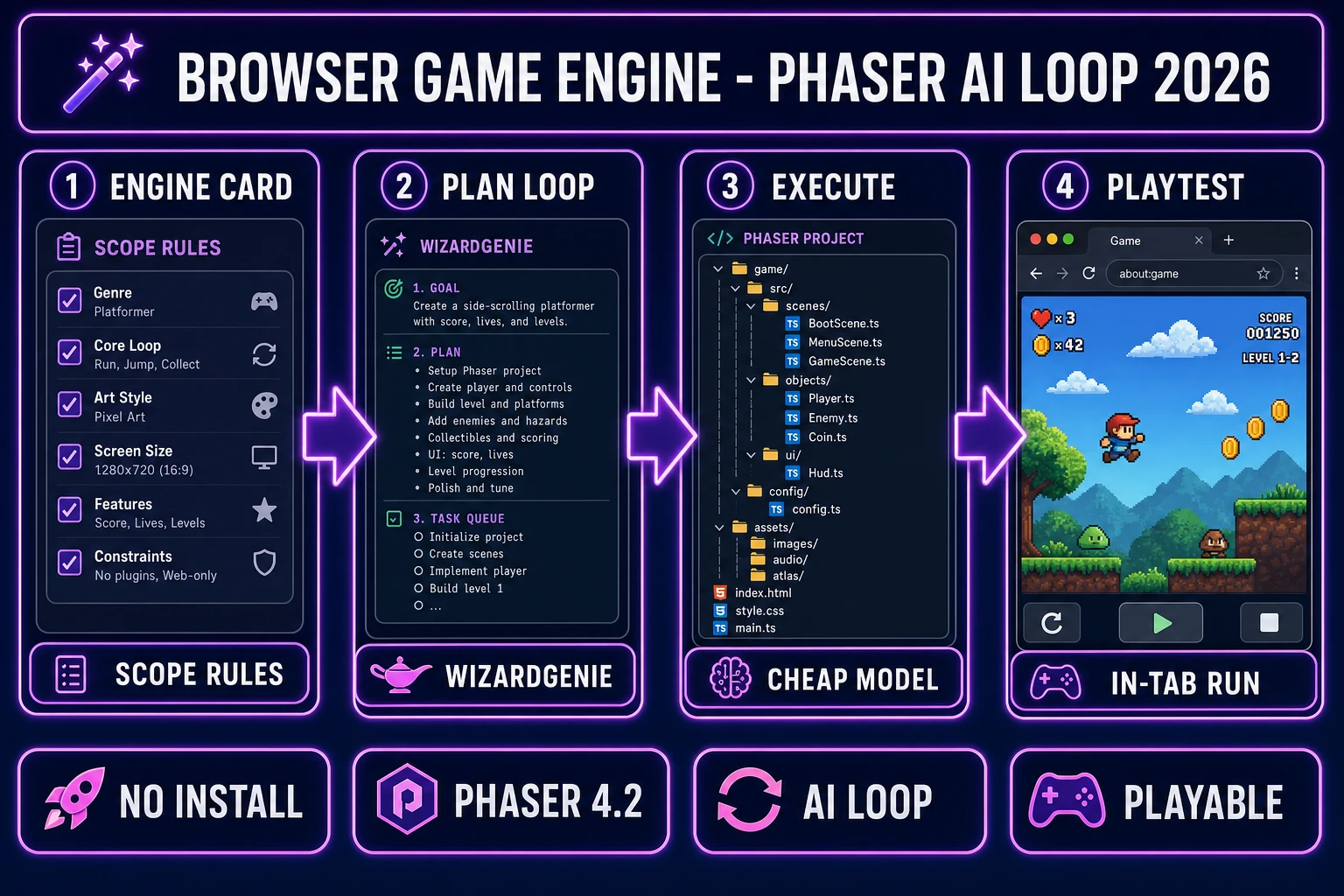
Browser game engine in 2026, four-step Phaser AI loop from engine card through WizardGenie plan and cheap executor to in-tab playtest, verified July 13, 2026
A browser game engine in 2026 means four moves: engine card, plan loop, cheap execute, then in-tab playtest.

What a browser game engine outputs for indie prototypes

The phrase browser game engine (1,600/mo, KD 51 per DataForSEO probe-fresh-seeds-3.md verified July 13, 2026) sits in a cluster with browser based game engine (1,600/mo, KD 49), web browser game engine (1,600/mo, KD 92), game engine browser (1,600/mo, KD 49), and the sibling html5 game engine (720/mo, KD 69). Same intent: ship a playable loop inside Chrome, Firefox, Safari, or Edge without installing a desktop engine.

Production output is concrete. You need an engine card (2D vs 3D, one core verb, one fail state, banned systems), a scene scaffold (index.html, main scene, input, restart), and a playtest checklist that fails anything that needs a second scene to feel fun. Phaser covers 2D Canvas/WebGL games; Three.js covers 3D. WizardGenie drives both from desktop or the web app — never frame it as browser-only.

Sibling posts help once the runtime locks. For genre loops after the engine boots, cross-link the prompt to game AI pipelines guide and the how to make a web game hosting path. For jam ideas before you open a scene file, use the game idea generator pack so the engine card inherits a ranked concept instead of a blank chat.

Why install-heavy engines stall browser prototypes

HTML5 browsers already ship the primitives a small game needs: a canvas, WebGL, audio, and a JS event loop. A desktop engine can still be the right call for a shipped console title. It is the wrong call for a weekend prototype when the blocker is “can the player jump and die in sixty seconds.”

Common failure modes: three hours installing toolchains, graybox scenes that never leave the editor, and asset pipelines that assume a full art department. Chat-only coding without a runtime is the other trap — walls of TypeScript that never draw a frame. A browser game engine wins when the feedback loop is open file → refresh tab → feel the verb.

Treat the engine like production data. Reject any scaffold that invents inventory, multiplayer, or a dialogue tree before the core verb is fair. Keep gray boxes until collision and restart work. That discipline is what turns “I used a browser game engine” into a playable demo instead of a half-imported sample project.

A useful score rubric is boring on purpose. Give five points for scope fit against the engine card, three for a fail state a stranger can understand in one sentence, and two for mute density — would the loop still read without UI text. Anything that needs a lore dump to explain the verb fails the mute test. Anything that needs a second scene to be interesting fails the room count. Write those weights into the card so WizardGenie cannot invent a private scoring language mid-run.

The Sorceress browser game engine pipeline in four steps

Every shippable browser prototype ships four runtime pieces: engine card, plan, execute, playtest. In 2026 each maps to one Sorceress surface verified against the live catalog on July 13, 2026:

  • Engine cards and scene plans: WizardGenie (desktop or web) runs the planning pass on your API key — Claude Opus 4.7, Claude Sonnet 4.6, GPT-5.5, Gemini 3.1 Pro, DeepSeek V4 Pro, Kimi K2.5, Grok 4.2, MiniMax M2.7 (verified against CODING_MODELS in src/app/_home-v2/_data/tools.ts lines 734–742).
  • Typed scaffolds: a cheap Executor (DeepSeek V4 Pro, Kimi K2.5, MiniMax M2.7) writes Phaser 4.2 or Three.js files — never put Opus, Sonnet, GPT-5.5, or Gemini Pro on bulk typing.
  • In-tab playtest: WizardGenie runs the dev server and you judge feel in the browser canvas.
  • Optional art: AI Image Gen only after the loop is playable mute; check tools guide and plans before burning credits.

Pricing is a $49 lifetime unlock plus pay-as-you-go credit packs. Starter $10/1,000 credits, Creator $20/2,000, Plus $50/5,000, Studio $100/10,000. Verified against src/app/plans/page.tsx lines 46 and 51–54. New accounts ship with 100 starter credits. WizardGenie coding stays on your own API key — the expensive variable is model choice on the Planner side, not Sorceress credits.
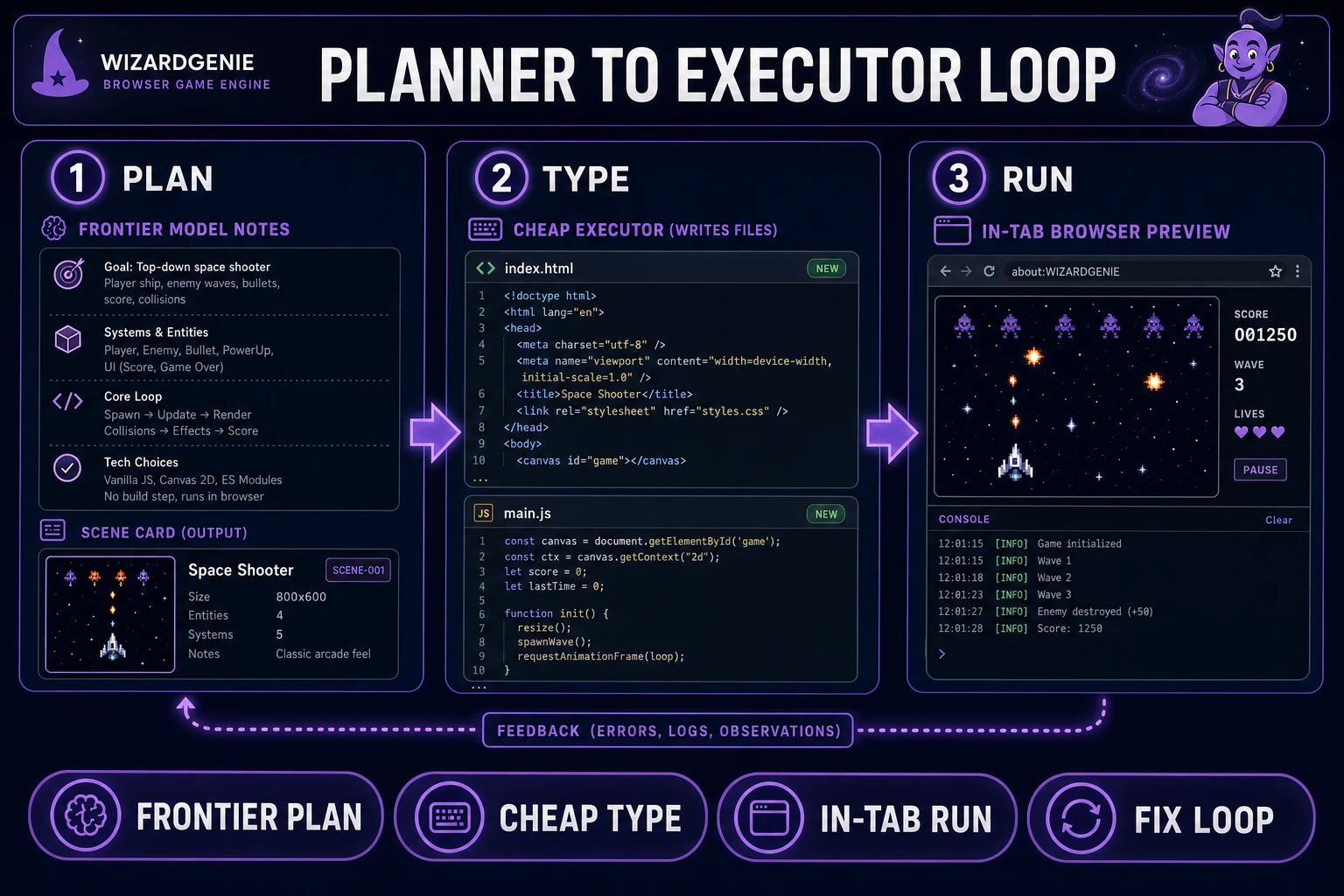
WizardGenie Planner plus Executor loop wiring a browser game engine scaffold, verified July 13, 2026
Frontier plans the scene card; a cheap executor types Phaser files; you playtest in-tab before any art spend.

Step 1 — lock a browser game engine card in WizardGenie

Open WizardGenie (desktop installer or /wizard-genie/app web) and write the engine card before you ask for pretty systems. Example card: “Browser game engine target: Phaser 4.2.0, one room, one player verb, one enemy type, keyboard + touch, win in 60 seconds, restart on death, no inventory, no multiplayer, graybox art only, output index.html + main.js.” Paste that card as a reusable system prefix. Prefer Claude Opus 4.7 or Gemini 3.1 Pro for the planning pass; switch to DeepSeek V4 Pro or Kimi K2.5 when you iterate file patches.

Ask WizardGenie for a scene card, not a novel:

{
  "engine": "phaser-4.2.0",
  "verb": "dash through timed gates",
  "fail_state": "gate closes on player",
  "win": "survive 60 seconds",
  "banned": ["inventory", "dialogue", "procedural-world"],
  "files": ["index.html", "main.js", "assets/placeholders/"]
}

Reject any plan that adds a second verb, drops the fail state, or lists three systems before a single collider. Phaser 4.2.0 “Giedi” (released June 19, 2026, verified against phaser.io release notes on July 13, 2026) is the honest 2D default. When the card needs depth, switch the engine field to Three.js r185 (released July 1, 2026, verified against the r185 GitHub release on July 13, 2026) and keep the same verb discipline.

Step 2 — run the Phaser AI loop with a cheap executor

Hand the scene card to a second WizardGenie turn with an explicit Executor model:

Build a Phaser 4.2.0 browser game from this card.
verb: dash through timed gates
fail_state: gate closes on player
win: survive 60 seconds
Scope: one room, graybox rectangles, restart on death.
Output: index.html, main.js, no external CDN beyond phaser@4.2.0.
Do not invent inventory or dialogue.

Keep Opus or Gemini on the Planner side only when the design changes. Put DeepSeek V4 Pro, Kimi K2.5, or MiniMax M2.7 on the typing side for file writes and bugfix rounds. That Planner+Executor split is how a browser game engine session stays affordable when the first scaffold needs three feel passes. Never recommend Sonnet, Opus, GPT-5.5, or Gemini Pro as the Executor — that erases most of the cost advantage.

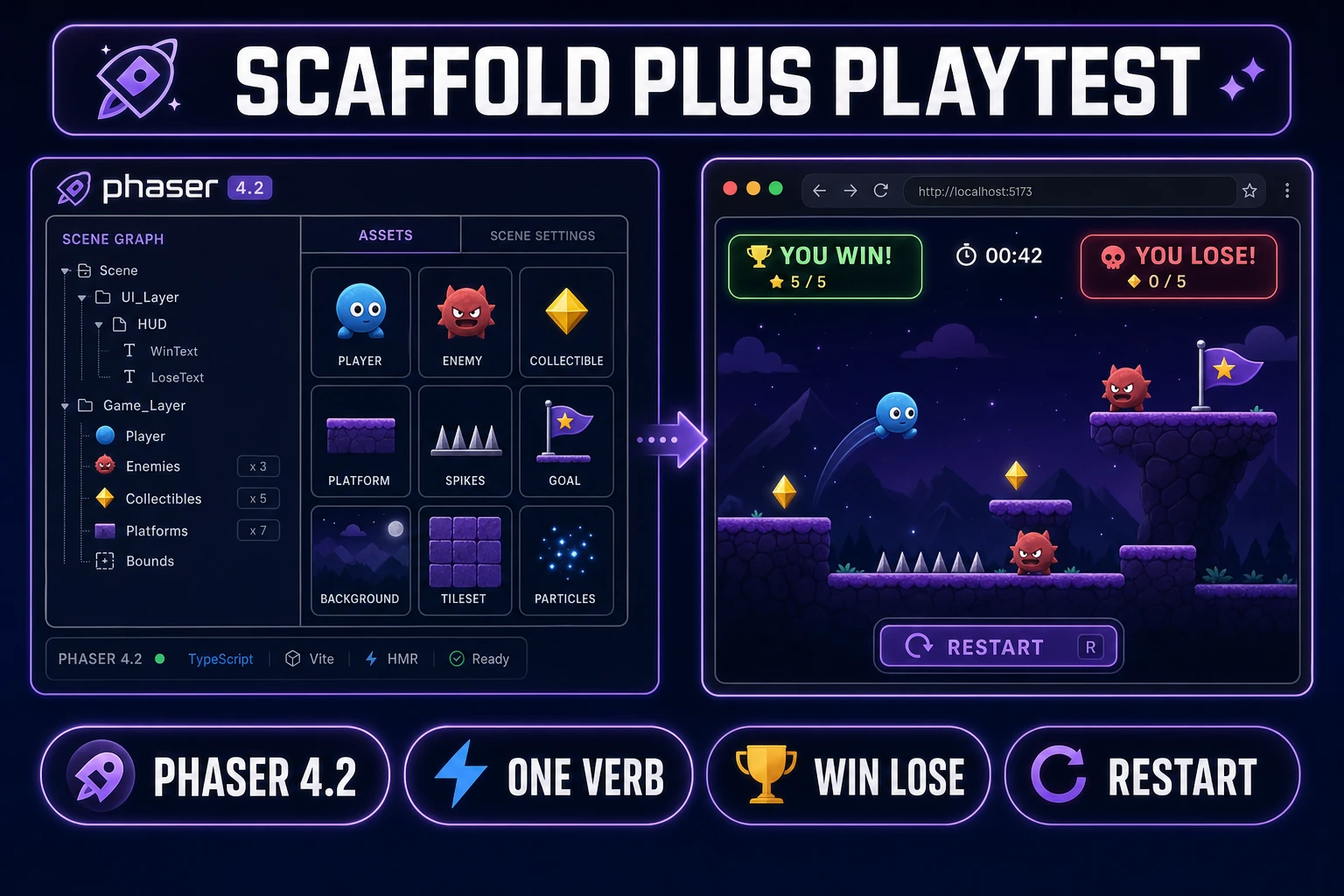
Playtest zero is you, headphones off, phone timer on. If you cannot explain the win condition before the sixty-second mark, the card lied about density. Ask for a second pass that only touches feel — coyote time, screenshake, restart speed — with the cheap executor. Desktop and web WizardGenie both work; pick the surface you already use for coding. Do not promise arcade auto-publish; export the build and host it where you want.

Phaser 4.2 browser game engine scaffold with in-tab playtest win and lose HUD, verified July 13, 2026
Scaffold first, then feel: Phaser 4.2 proves the verb; art waits until restart and fail states are fair.

Step 3 — playtest, cut scope, then add Sorceress art

Open the canvas and fail the build on purpose. If death does not restart cleanly, fix that before any sprite. If the verb needs a lore dump to understand, rewrite the card — do not paper over it with UI text. When the mute playtest works, optional AI Image Gen can replace gray boxes; Z-Image is the cheap exploration path for three compositions keyed to the scene id.

Audit like production data. Cut any system the engine card banned. Keep the JSON card in the repo so the next browser game engine session starts from a known target instead of a blank chat. For a web-ship checklist after the loop is solid, follow the web game guide. For idea ranking before the next scaffold, reuse the game idea generator filter card so WizardGenie does not invent scope mid-run.

If the prototype grows into a longer Phaser tutorial path, the older Phaser game tutorial post covers agent writing patterns without replacing this engine-card workflow. One job per session: wire the runtime, prove one verb, stop.

What a browser game engine session costs on Sorceress in 2026

Pricing verified July 13, 2026 against src/app/plans/page.tsx (LIFETIME_PRICE = 49). Sorceress base unlock is $49 one-time for the full tool suite. AI credits are pay-as-you-go: Starter $10 for 1,000 credits, Creator $20 for 2,000, Plus $50 for 5,000, Studio $100 for 10,000. A minimal browser game engine session that stays graybox burns zero Sorceress image credits — WizardGenie coding runs on your API keys. Three Z-Image pitch frames later typically cost nine credits total. Prefer frontier models only for the plan pass; keep executors on DeepSeek V4 Pro, Kimi K2.5, or MiniMax M2.7 so the typing loop stays roughly one-fifth of single-frontier cost on the same project.

The honest win condition for this guide: a tab that runs, a verb a stranger understands mute, and an engine card you can reuse next weekend. That is what a browser game engine is for in 2026 — not a feature checklist copied from a desktop suite. When the loop is fair, stop coding systems and either ship a static build or open AI Image Gen for three pitch frames — nothing else belongs in the first session.

Frequently Asked Questions

What is a browser game engine in 2026?

A browser game engine is a JavaScript runtime that draws and updates a game inside a web page — typically Canvas or WebGL — without a separate desktop install. On Sorceress (verified July 13, 2026) that means Phaser 4.2.0 for 2D scaffolds and Three.js r185 for 3D scenes, driven by WizardGenie on desktop or at /wizard-genie/app.

Is Phaser a browser game engine?

Yes. Phaser is a free, open-source HTML5 framework for 2D games in desktop and mobile browsers. Phaser 4.2.0 “Giedi” released June 19, 2026 (verified against the official Phaser release notes on July 13, 2026) and is the default 2D target WizardGenie scaffolds when you ask for a playable browser loop.

Do I need to install Unity or Unreal to use a browser game engine with WizardGenie?

No. WizardGenie writes Phaser or Three.js projects that run in a modern browser tab. You never install a heavyweight desktop engine for the prototype path. Desktop WizardGenie still helps with native filesystem access and longer agent sessions; the web app at /wizard-genie/app is the no-install entry point.

What does a browser game engine session cost on Sorceress in 2026?

Verified July 13, 2026 against src/app/plans/page.tsx. Base unlock is $49 one-time. WizardGenie coding runs on your own API key (or the trial fallback). A Planner+Executor loop with Opus or Gemini on the plan side and DeepSeek V4 Pro or Kimi K2.5 on the typing side typically stays under a dollar of API spend for a first playable scene — Sorceress credits are optional until you add AI Image Gen art.

Can WizardGenie ship a full browser game engine project from one prompt?

WizardGenie scaffolds a playable loop — scene graph, input, win/lose, restart — in one or two agent rounds. It does not replace design taste: you still pick the core verb, cut scope, and reject scaffolds that invent three systems. Phaser 4.2.0 and Three.js r185 are the honest runtimes (verified July 13, 2026).

Sources

  1. Phaser v4.2.0 release notes
  2. Phaser — HTML5 Game Framework
  3. three.js r185 release
  4. HTML5 - Wikipedia
Written by Arron R.·1,597 words·7 min read

Related posts