Spark a Game Idea Generator (Jam Prompt Pack 2026)

By Arron R.8 min read
A game idea generator in 2026 is a four-step jam prompt pack: WizardGenie ranks ten concepts against a filter card, you pick one, scaffold a Phaser 4.2 prototyp

Blank weekends kill more jam entries than hard themes. Searchers typing game idea generator on July 13, 2026 want a ranked jam prompt pack — genre, core verb, fail state, one-sentence pitch — not a mood board that never becomes a build. This guide covers the 2026 pipeline: WizardGenie locks a filter card and scores ten concepts, you scaffold a Phaser 4.2 loop from the winner, and AI Image Gen pitches the look before the clock matters. Tool costs below are verified against the live Sorceress source on July 13, 2026.
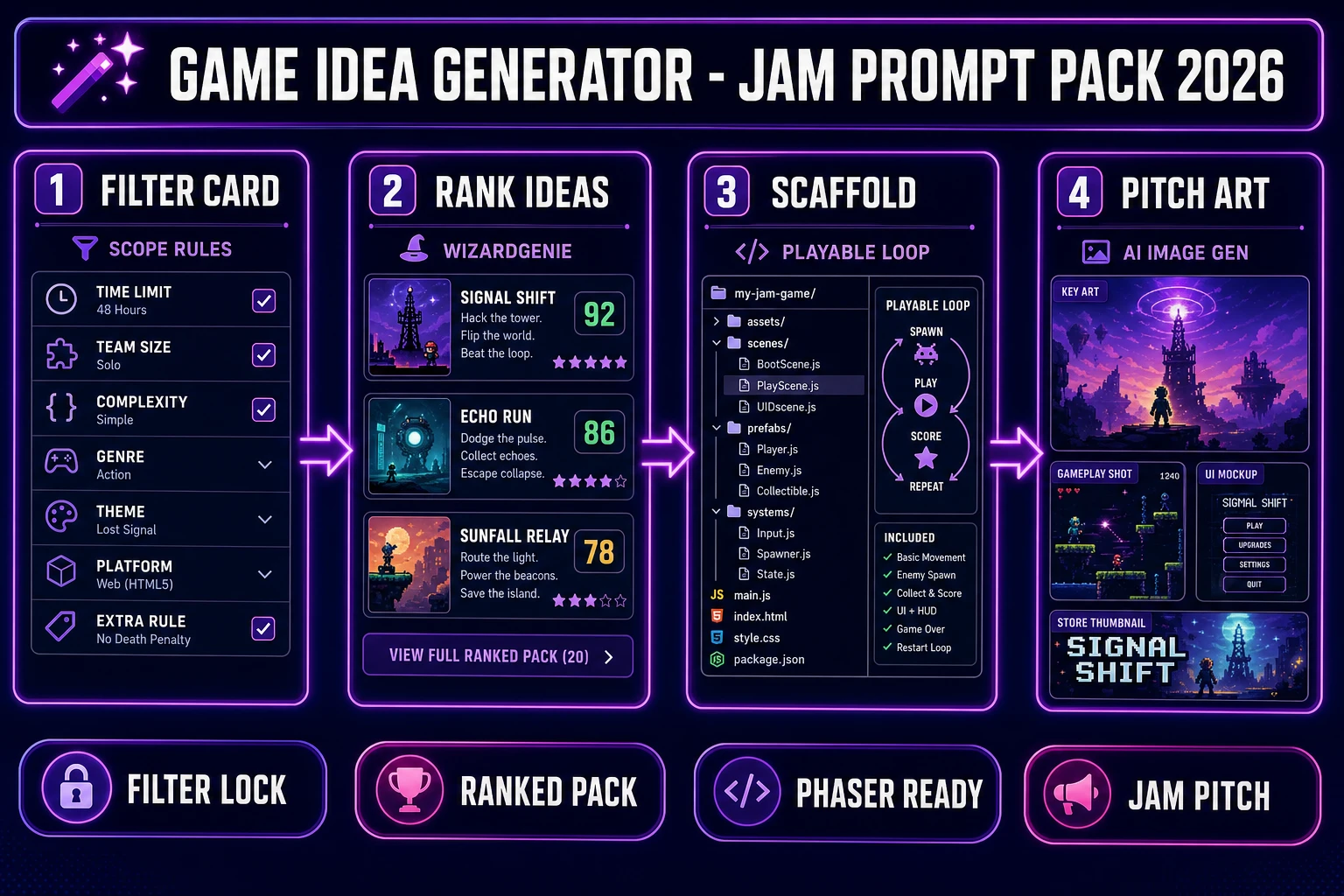
Game idea generator in 2026, four-step jam prompt pack from WizardGenie filter cards through ranked concepts and Phaser scaffolds to AI Image Gen pitch art, verified July 13, 2026
A game idea generator in 2026 means four moves: filter card, ranked pack, Phaser scaffold, then pitch art.

What a game idea generator outputs for indie jam prompts

The phrase game idea generator (880/mo, KD 0 per DataForSEO probe-fresh-seeds-3.md verified July 13, 2026) targets solo jammers, portfolio sprints, and teams staring at a blank itch.io draft with no official theme yet. Sibling queries in the same cluster — video game idea generator (260/mo, KD 4), random game idea generator (110/mo, KD 2), plus niche cuts like horror or board-game variants — all describe the same deliverable: concepts you can filter into a playable prototype tonight.

Production output is structured. Ship a filter card (solo or duo, hours available, engine, hard scope cuts), a ranked list of ten ideas with id, genre, core_verb, fail_state, pitch, and score, then one winner card you actually scaffold. Pair that pack with the game jam theme generator post when an official phrase already exists — themes constrain interpretation; a game idea generator invents candidates you constrain yourself. For a public title once the genre locks, cross-link the game name generator sibling so store copy matches the pitch.

Why random idea dumps stall playable prototypes

Game design starts when a concept becomes a verb the player repeats under pressure. A naked randomizer dumps “underwater stealth RPG with crafting” and walks away. That string feels productive because it fills a notes app. It fails a game jam because it implies three systems, a world map, and a UI tree before hour six.

Official events like Global Game Jam force a shared theme so teams interpret instead of invent forever. Solo practice weekends lack that external kill switch. Without a filter card, every new idea looks equally shiny and you never open a scene file. The failure modes are predictable: ten unfinished pitches, zero playtests, and a Sunday panic rewrite into yet another “one button” clone.

Treat the pack like production data. Reject any idea that needs multiplayer, procedural worlds, or a full inventory on a 48-hour solo clock. Keep ideas that prove one verb in one room with one fail state. That discipline is what turns a game idea generator from novelty into a jam prompt pack you can ship.

A useful score rubric is boring on purpose. Give five points for scope fit against the filter, three for a fail state a stranger can understand in one sentence, and two for would-I-play-this-mute density. Anything that needs a lore dump to explain the verb fails the mute test. Anything that needs a second scene to be interesting fails the room count. Write those weights into the filter card so WizardGenie cannot invent a private scoring language mid-run.

The Sorceress game idea generator pipeline in four steps

Every shippable jam prompt pack ships four runtime pieces: filter card, ranked ideas, playable scaffold, and pitch art. In 2026 each maps to one Sorceress surface verified against the live catalog on July 13, 2026:

  • Filter cards and ranked JSON: WizardGenie (desktop or web) runs the ranking pass on your API key — Claude Opus 4.7, Claude Sonnet 4.6, GPT-5.5, Gemini 3.1 Pro, DeepSeek V4 Pro, Kimi K2.5, Grok 4.2, MiniMax M2.7 (verified against CODING_MODELS in src/app/_home-v2/_data/tools.ts lines 734–742).
  • Playable scaffold: WizardGenie builds a Phaser 4.2.0 scene from the winning card — input, one enemy or obstacle type, win/lose, restart.
  • Pitch frames: AI Image Gen (AI Credits) batches concept thumbnails; Z-Image is 3 credits per frame for fast exploration (verified against src/lib/models.ts).
  • Scope check: Tools guide and plans for credit math before you burn art on ideas that will not survive the filter.

Pricing is a $49 lifetime unlock plus pay-as-you-go credit packs. Starter $10/1,000 credits, Creator $20/2,000, Plus $50/5,000, Studio $100/10,000. Verified against src/app/plans/page.tsx lines 46 and 51–54. New accounts ship with 100 starter credits. WizardGenie coding stays on your own API key — the expensive variable is model choice on the Planner side, not Sorceress credits.
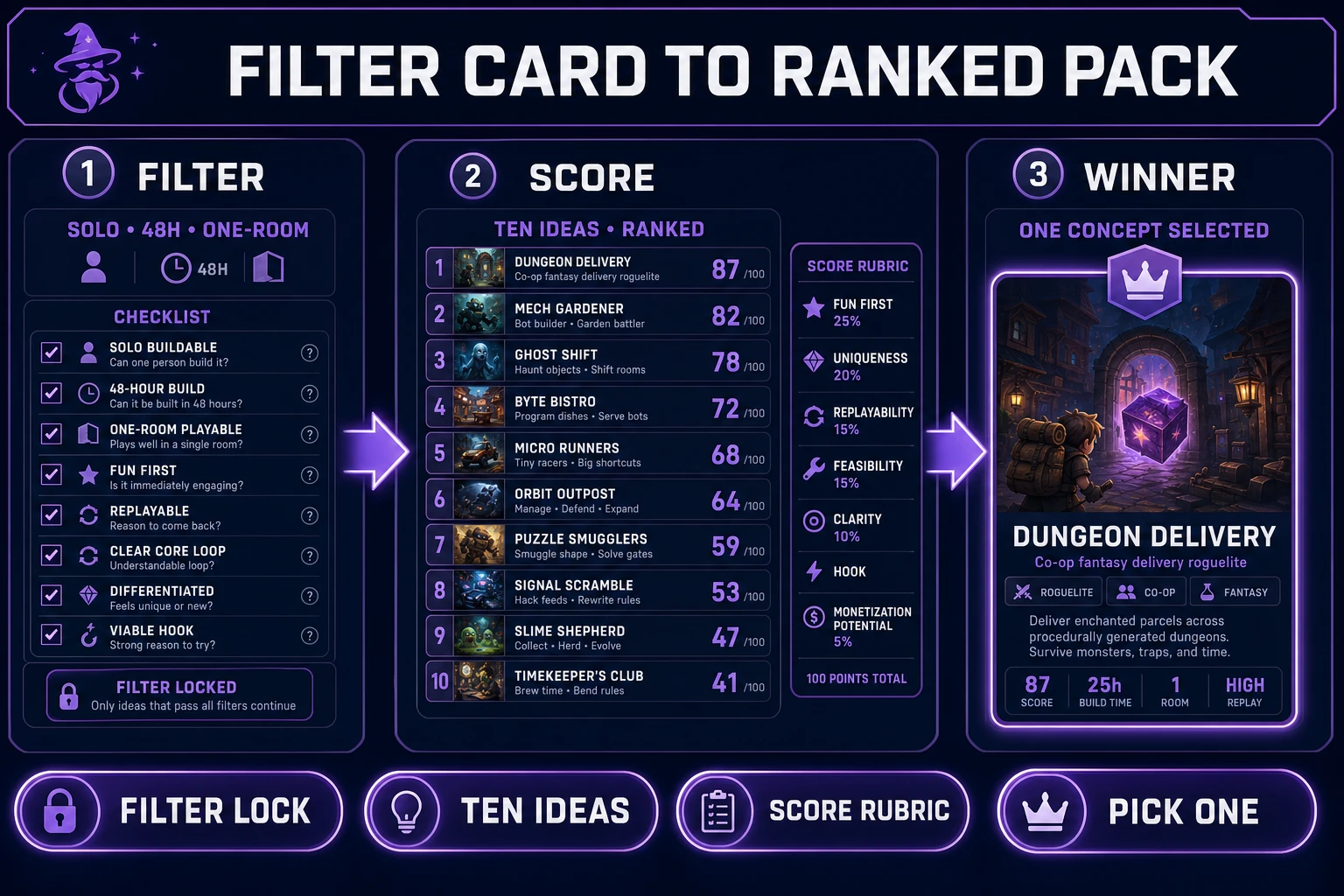
WizardGenie filter card and ranked jam prompt pack for a game idea generator workflow, verified July 13, 2026
WizardGenie locks the filter card — hours, room count, banned systems — before any idea earns a score.

Step 1 — lock a jam prompt pack filter card in WizardGenie

Open WizardGenie (desktop installer or /wizard-genie/app web) and write the filter before you ask for pretty concepts. Example card: “Solo, 48 hours, Phaser browser build, one room, one player verb, one enemy type, no inventory, no dialogue trees, must be playable mute, score ideas 1–10 on scope fit then fun density.” Paste that card as a reusable system prefix. Prefer Claude Opus 4.7 or Gemini 3.1 Pro for the ranking pass; switch to DeepSeek V4 Pro or Kimi K2.5 when you iterate JSON fields — never put a frontier-priced model on bulk typing.

Ask WizardGenie for a ranked pack, not a novel:

{
  "filter": {
    "solo": true,
    "hours": 48,
    "engine": "phaser-4.2",
    "maxRooms": 1,
    "banned": ["multiplayer", "inventory", "dialogue-tree"]
  },
  "ideas": [
    {
      "id": "ghost_echo",
      "genre": "action-puzzle",
      "core_verb": "place delayed echoes of your last move",
      "fail_state": "echo hits you",
      "pitch": "You are hunted by your own past inputs.",
      "score": 9
    }
  ]
}

Reject any row that invents a second verb, drops the fail state, or scores itself high while listing three systems. Treat the filter like a production bible: hours, room count, and banned systems are non-negotiable. When you already have an official theme phrase, stop here and route through the game jam theme generator pipeline instead — do not double-generate open ideas under a locked theme.

Step 2 — scaffold the prototype from the winning idea

Pick the highest score that still makes you curious after a five-minute walk. Paste the winner card into a second WizardGenie prompt:

Build a Phaser 4.2.0 browser game from this card:
id: ghost_echo
core_verb: place delayed echoes of your last move
fail_state: echo hits you
Scope: one room, one enemy type, survive 60 seconds to win.
Output: index.html, main.js, assets/ placeholders.

Phaser 4.2.0 “Giedi” (released June 19, 2026, verified against phaser.io release notes on July 13, 2026) is the honest browser runtime for jam scaffolds on Sorceress. Keep gray boxes until the verb feels fair. Do not polish art before collision boxes and restart work. Desktop and web WizardGenie both work — pick the surface you already use for coding. Do not promise arcade auto-publish; export the build and host it where you want.

If the scaffold needs a web-ship path later, the how to make a web game guide covers static hosting without inventing a backend. For genre-specific loops after the idea is proven, branch into idle, card, or mobile how-tos — the game idea generator’s job ends when the first playable loop compiles.

Playtest zero is you, headphones off, phone timer on. If you cannot explain the win condition before the sixty-second mark, the card lied about density. Ask WizardGenie for a second pass that only touches feel — coyote time, screenshake, restart speed — with DeepSeek V4 Pro or MiniMax M2.7 on the typing side. Keep Opus or Gemini for the rare redesign that changes the core verb itself. That Planner versus Executor split is how a weekend stays affordable when the idea pack forces three scaffolds before one sticks.

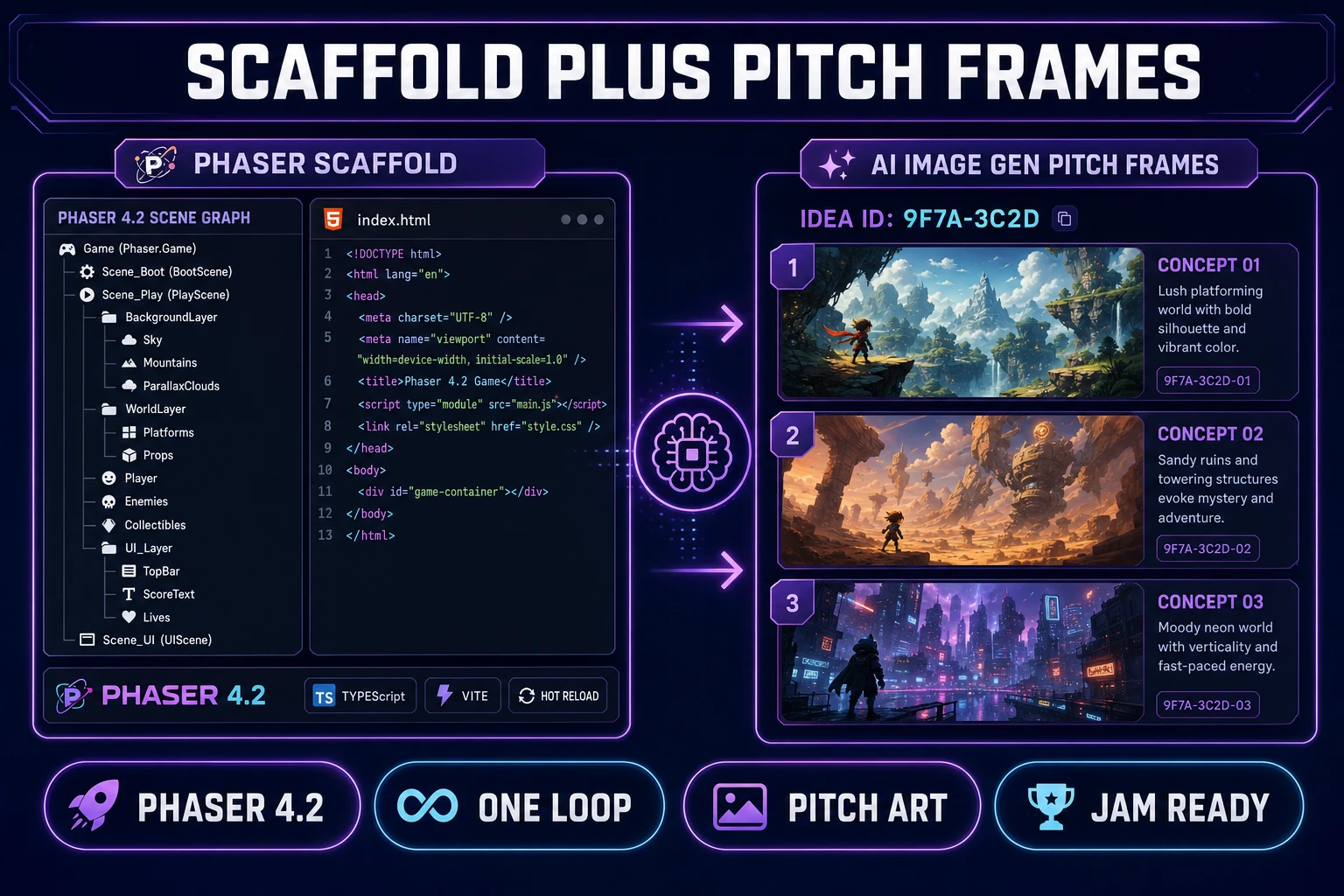
Phaser 4.2 scaffold and AI Image Gen pitch frames closing a game idea generator jam prompt pack, verified July 13, 2026
Scaffold first, then pitch: Phaser 4.2 proves the verb; AI Image Gen sells the look for friends and jam pages.

Step 3 — pitch the pack with AI Image Gen and a clear name

Open AI Image Gen only after the loop is playable mute. Prompt from the winner card, not from vibes: “Top-down one-room action puzzle, player leaves glowing echo trails, dark navy floor, neon magenta trails, no UI text, no readable logos, jam thumbnail composition.” Use Z-Image at 3 credits to explore three compositions; spend a higher-credit model only if you need a store hero later.

Name files to match the idea id (ghost_echo_pitch_01.webp). Reject frames that invent a second room, add a shopkeeper, or paint illegible “lore text.” For the public title string, run the game name generator once with genre + core verb locked — do not rename mid-scaffold. Optional Quick Sprites passes can wait until playtests say the silhouette is unclear; the jam prompt pack is complete when a stranger understands the pitch in one glance and the build runs.

Audit like production data. Read the pitch aloud. Cut any sentence that promises systems the filter banned. Keep the ranked JSON in the repo so next weekend’s game idea generator run starts from a known filter instead of a blank chat.

What a game idea generator session costs on Sorceress in 2026

Pricing verified July 13, 2026 against src/app/plans/page.tsx (LIFETIME_PRICE = 49). Sorceress base unlock is $49 one-time for the full tool suite. AI credits are pay-as-you-go: Starter $10 for 1,000 credits, Creator $20 for 2,000, Plus $50 for 5,000, Studio $100 for 10,000. A minimal jam prompt pack with three Z-Image pitch frames typically burns nine credits total — often under $0.10–$0.40 on top of the lifetime unlock if you stay card-first. WizardGenie coding runs on your own API keys.

Compare that to burning an afternoon in an idea Discord and still opening Unity empty-handed. The integrated game idea generator path wins on iteration speed: change the filter’s banned list, regenerate ten scores, scaffold the new winner, re-render two frames — done in a session. Browse the full stack at Sorceress Tools Guide or see plans for credit tiers. When the weekend already has an official theme, switch to the game jam theme generator sibling; when you need a web hosting path after the prototype sticks, use the web game guide.

The category shift is simple: a game idea generator in 2026 is not a novelty randomizer with buzzwords. It is a production pipeline — locked filters, ranked jam prompt packs, engine-ready scaffolds, pitch frames — that respects how a shippable weekend actually works. Sorceress built the pieces to run that pipeline in one account; your job is to kill every idea that needs a second verb before you ask for pretty neon. Your filter card is the product; the ranked list is inventory; the scaffold is proof.

Frequently Asked Questions

What is a game idea generator used for in indie development?

A game idea generator produces ranked playable concepts — genre, core verb, fail state, and one-sentence pitch — that you can scaffold tonight, not a mood-board paragraph. In the Sorceress pipeline (verified July 13, 2026) that means locking a filter card in WizardGenie, scoring a ten-idea pack, scaffolding a Phaser 4.2 loop from the winner, and pitching it with AI Image Gen.

How is a game idea generator different from a game jam theme generator?

A game jam theme generator outputs a single shared constraint every entry must obey. A game idea generator outputs open-ended concepts you filter yourself — useful for solo practice jams, portfolio sprints, and weekends without an official theme reveal. Use the Jam sibling post when you already have a theme phrase; use this pipeline when you need a ranked jam prompt pack from a blank page.

Is a game idea generator free on Sorceress?

WizardGenie coding runs on your own API key (or the trial fallback key). AI Image Gen spends AI Credits via getModelCredits in src/lib/models.ts — Z-Image is 3 credits per frame for fast pitch art. New accounts ship with 100 starter credits; the $49 lifetime unlock covers Pro tools (verified against src/app/plans/page.tsx LIFETIME_PRICE = 49 on July 13, 2026). You can rank and scaffold ideas in WizardGenie without burning image credits until one concept wins.

Can WizardGenie build a full jam game from a game idea generator pack?

WizardGenie scaffolds a playable browser prototype — Phaser 4.2.0 scene graph, input, and win/lose — from the winning idea card in one or two agent rounds. It does not replace taste: you still pick which ranked idea to ship and when to cut scope. Phaser 4.2.0 (Giedi) released June 19, 2026 — verified against the official Phaser release notes on July 13, 2026.

What does a game idea generator session cost on Sorceress in 2026?

Verified July 13, 2026 against src/app/plans/page.tsx. Base unlock is $49 one-time. A minimal jam prompt pack typically burns 0–30 Sorceress credits for three Z-Image pitch frames (3 credits each), while WizardGenie coding stays on your API key — often under $0.40 of Starter-tier credits on top of lifetime if you stay card-first before art.

Sources

  1. Game jam - Wikipedia
  2. Game design - Wikipedia
  3. Global Game Jam — What is a game jam?
  4. Phaser v4.2.0 release notes
Written by Arron R.·1,774 words·8 min read

Related posts