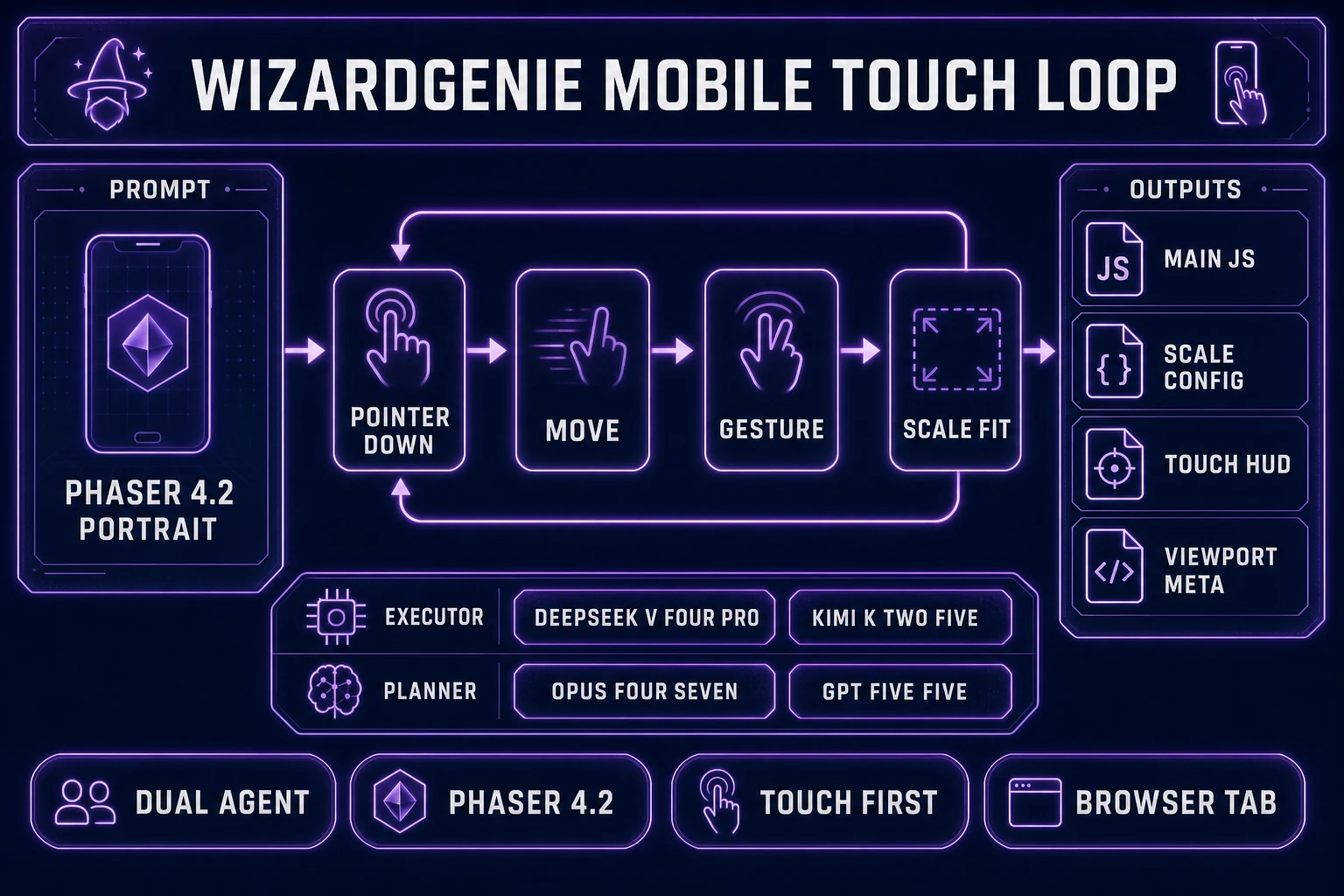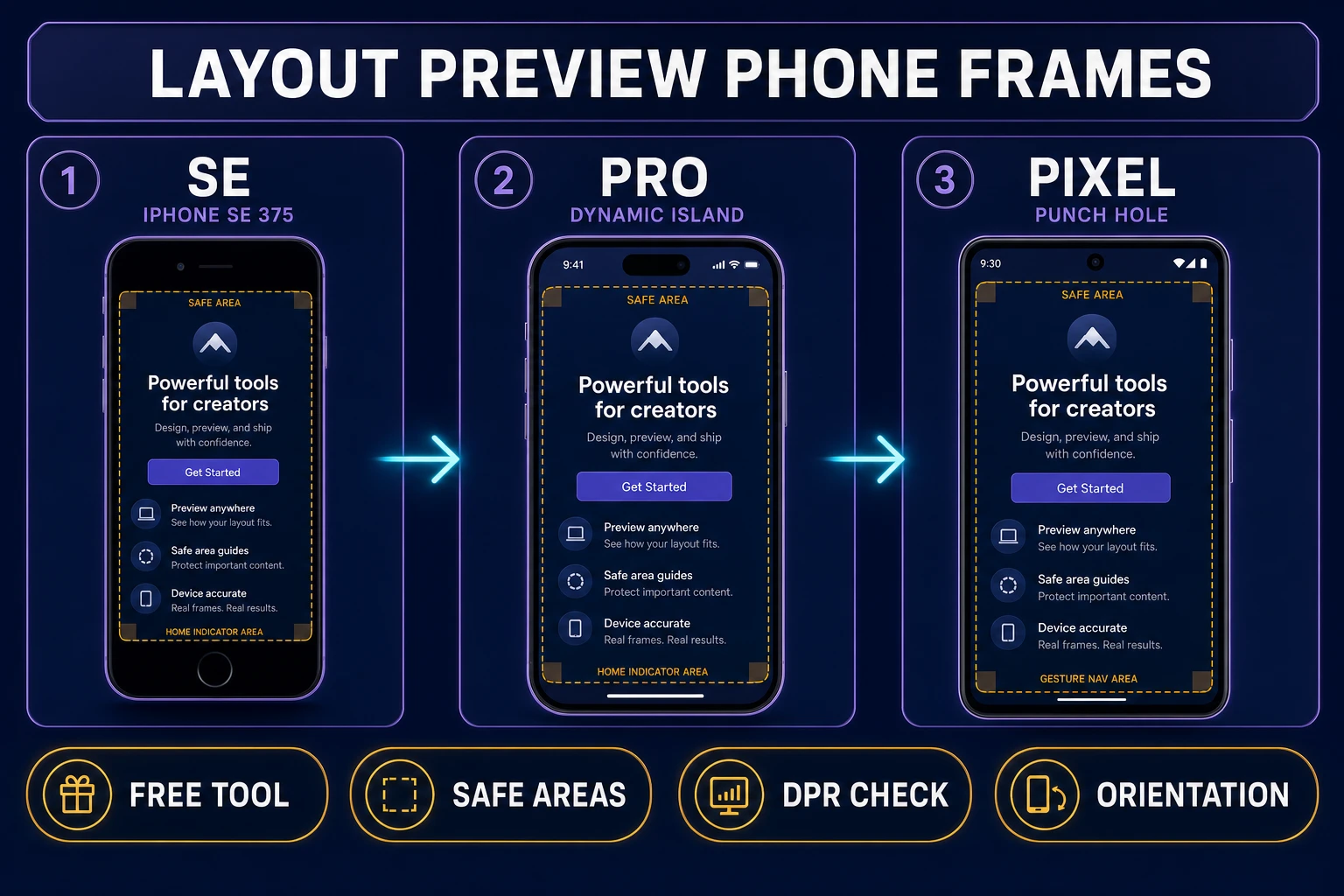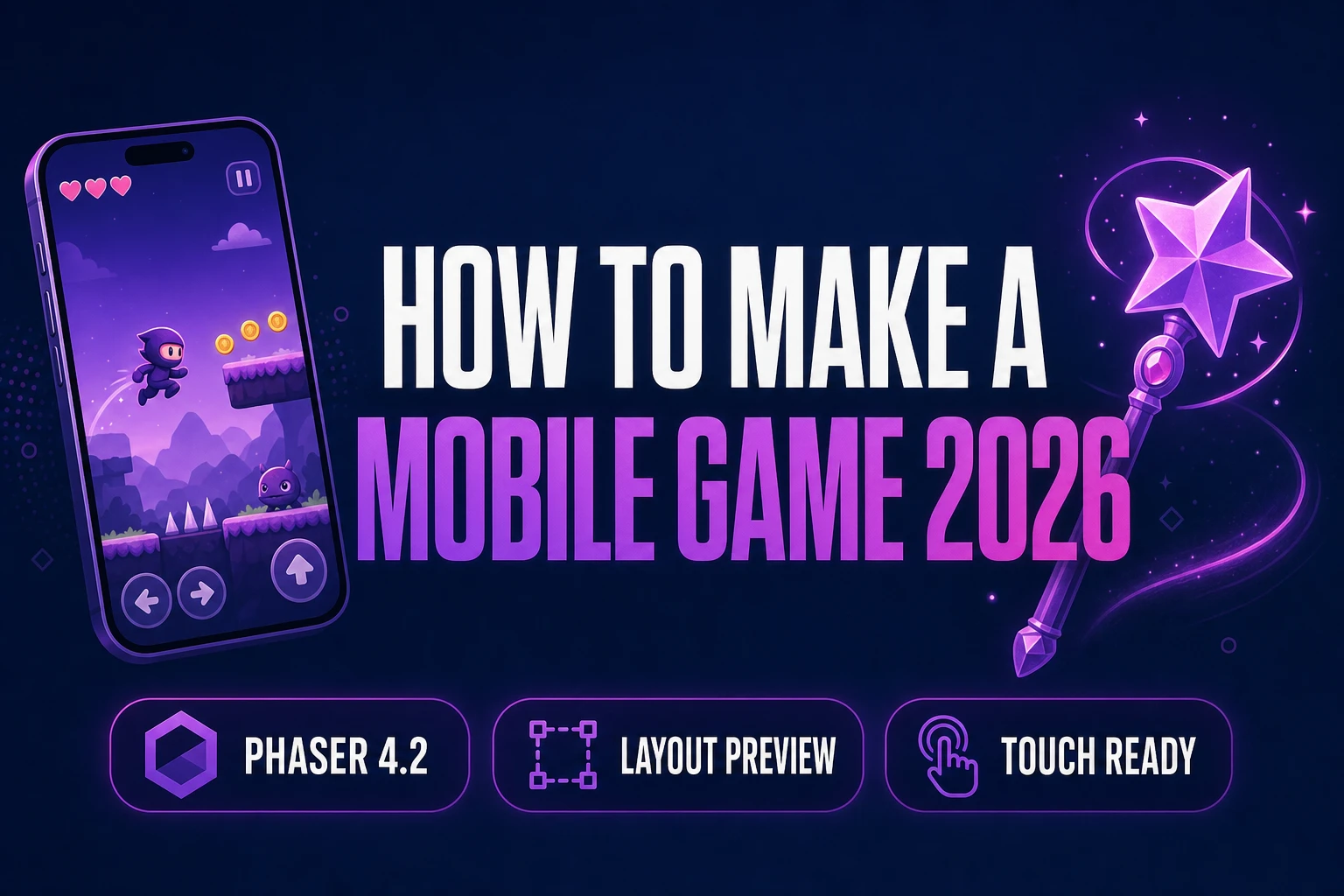
Search how to make a mobile game on July 12, 2026 and the SERP still pushes you toward native IDE installs, store-certification checklists, and engine tutorials that assume you already own a Mac for Xcode. That stack is real — and it is the wrong first week for most indie readers. The honest 2026 path is browser-first: ship a touch-ready HTML5 loop that already plays on phones, prove the layout across device frames, then wrap for stores only if you need them. This guide walks that path with WizardGenie writing the Phaser 4.2 scaffold and Layout Preview stress-testing notches, safe areas, and thumb reach. Every tool cost and model name below is verified against the live Sorceress source on July 12, 2026.
What “how to make a mobile game” actually means in 2026
The phrase how to make a mobile game (1,000/mo, KD 8 per DataForSEO probe-fresh-seeds-5.md verified July 12, 2026) targets readers who want a playable game on a phone — not necessarily a day-one App Store binary. Sibling queries confirm the cluster: how to make a mobile phone game (1,000/mo, KD 6), how to make a game for mobile (1,000/mo, KD 9), and how to make a game on mobile (1,000/mo, KD 16). A mobile game in this sense is defined by input and viewport constraints (touch, portrait bias, notch safe areas, high DPR), not by which store badge sits on the icon.
That definition unlocks a cleaner pipeline. A responsive browser game with a correct viewport meta tag (width=device-width, initial-scale=1) already runs on the same phones your players hold. Native packaging becomes a deployment choice after the loop is fun — not a prerequisite for writing the first tap handler.
Why browser-first beats native SDK for a first mobile ship
Native SDKs force toolchain setup before you have a mechanic worth defending. Browser-first flips the order: prove the game on real phone CSS pixel sizes inside a desktop browser, then decide whether Capacitor, a PWA shell, or a store binary is worth the paperwork. Phaser’s Scale Manager, pointer events, and FIT/RESIZE modes were built for this exact path — HTML5 that behaves on mobile viewports without a full engine install.
WizardGenie sits on both desktop and web, so you can scaffold and iterate without leaving the Sorceress account you already use for art. Pair that with Layout Preview (Free badge in MORE_TOOLS, src/app/_home-v2/_data/tools.ts) and you get device frames with notch metadata — iPhone SE through iPhone 16 Pro Max, Pixel punch-hole layouts, iPads — before you buy a developer license. Cross-link the broader no-store web path in how to make a web game; this article is the mobile-specific drill-down.
The Sorceress how to make a mobile game pipeline in four steps
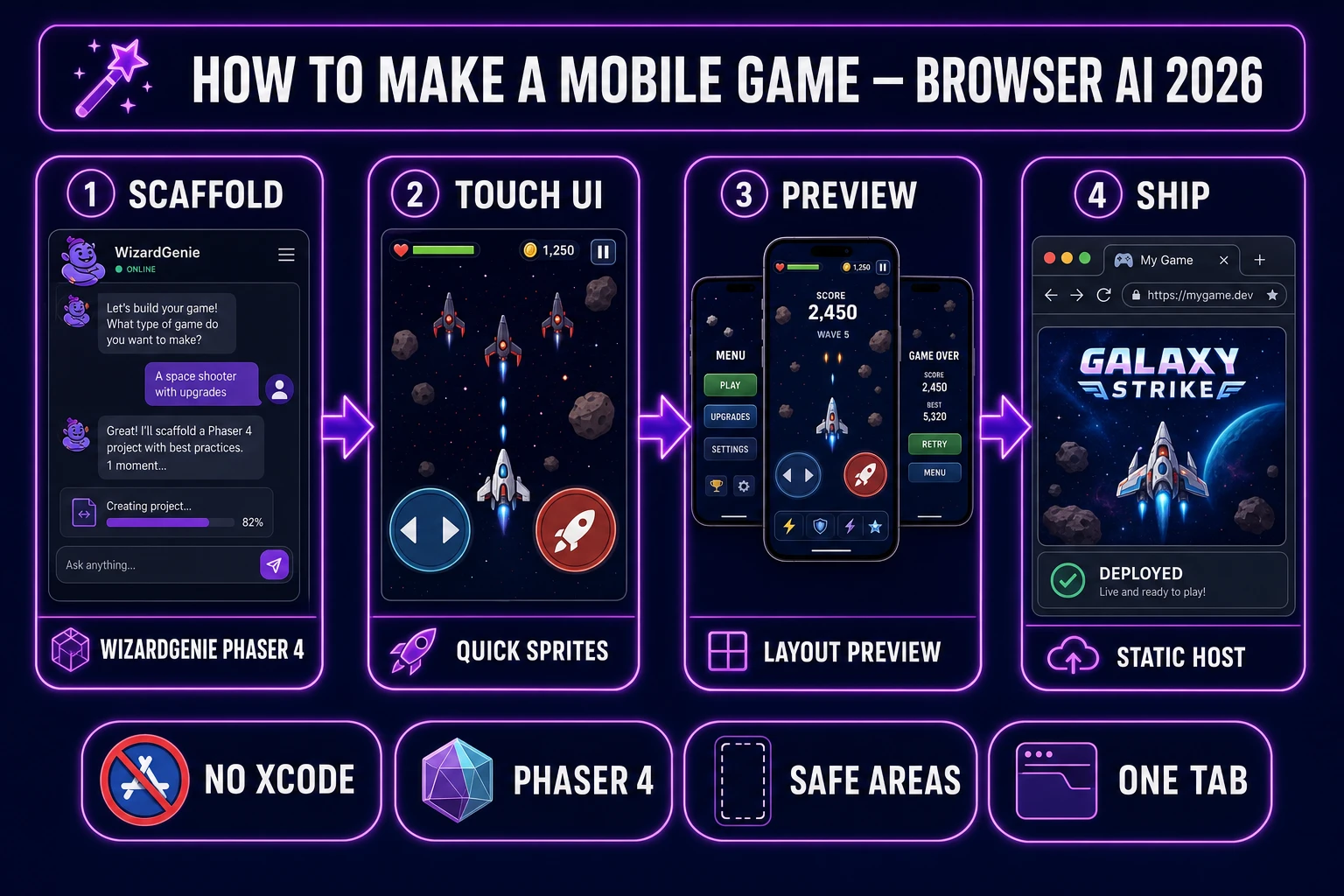
Every mobile-first browser game ships four layers regardless of genre: touch-aware game code, thumb-reachable HUD art, multi-device layout proof, and a static host or wrapper. In 2026 each layer maps to a verified Sorceress tool:
- Touch scaffold — WizardGenie with eight
CODING_MODELS(Claude Opus 4.7, Sonnet 4.6, GPT-5.5, Gemini 3.1 Pro, DeepSeek V4 Pro, Kimi K2.5, Grok 4.2, MiniMax M2.7 persrc/app/_home-v2/_data/tools.tslines 734–742). - Touch icons and HUD glyphs — Quick Sprites at 9 credits per generation (
CREDITS_PER_GEN = 9insrc/app/quick-sprites/page.tsxline 21). - Splash, panels, and backgrounds — AI Image Gen across the image model lineup in
src/lib/models.ts. - Device proof — Layout Preview, free, with the live
DEVICE_DATABASEinsrc/app/layout-preview/page.tsx(safeTop / safeBottom / notch fields for Dynamic Island and punch-hole frames).
Pricing is a $49 lifetime unlock plus pay-as-you-go credit packs — Starter $10/1,000 credits, Creator $20/2,000, Plus $50/5,000, Studio $100/10,000 — verified against src/app/plans/page.tsx lines 46 and 50. New accounts ship with 100 starter credits. WizardGenie coding uses your own API key.