Face an AI Avatar Generator (Game Portrait Pack 2026)

By Arron R.7 min read
An ai avatar generator in 2026 is a four-step browser pipeline: AI Image Gen locks face cards into portrait packs, BG Remover cuts transparent PNGs, True Pixel

Steam wishlist art with a soft selfie crop looks fine until you drop it into a party list at 48 pixels and the eyes vanish. Searchers typing ai avatar generator on July 12, 2026 want face-forward packs that survive HUD chrome: locked jawline, transparent cutouts, and pixel icons that match the same card. This guide covers the 2026 browser pipeline: AI Image Gen drafts portraits from a face card, BG Remover cuts clean PNGs, True Pixel snaps game-ready icons, and WizardGenie wires the pack into Phaser 4.2. Tool costs below are verified against the live Sorceress source on July 12, 2026.
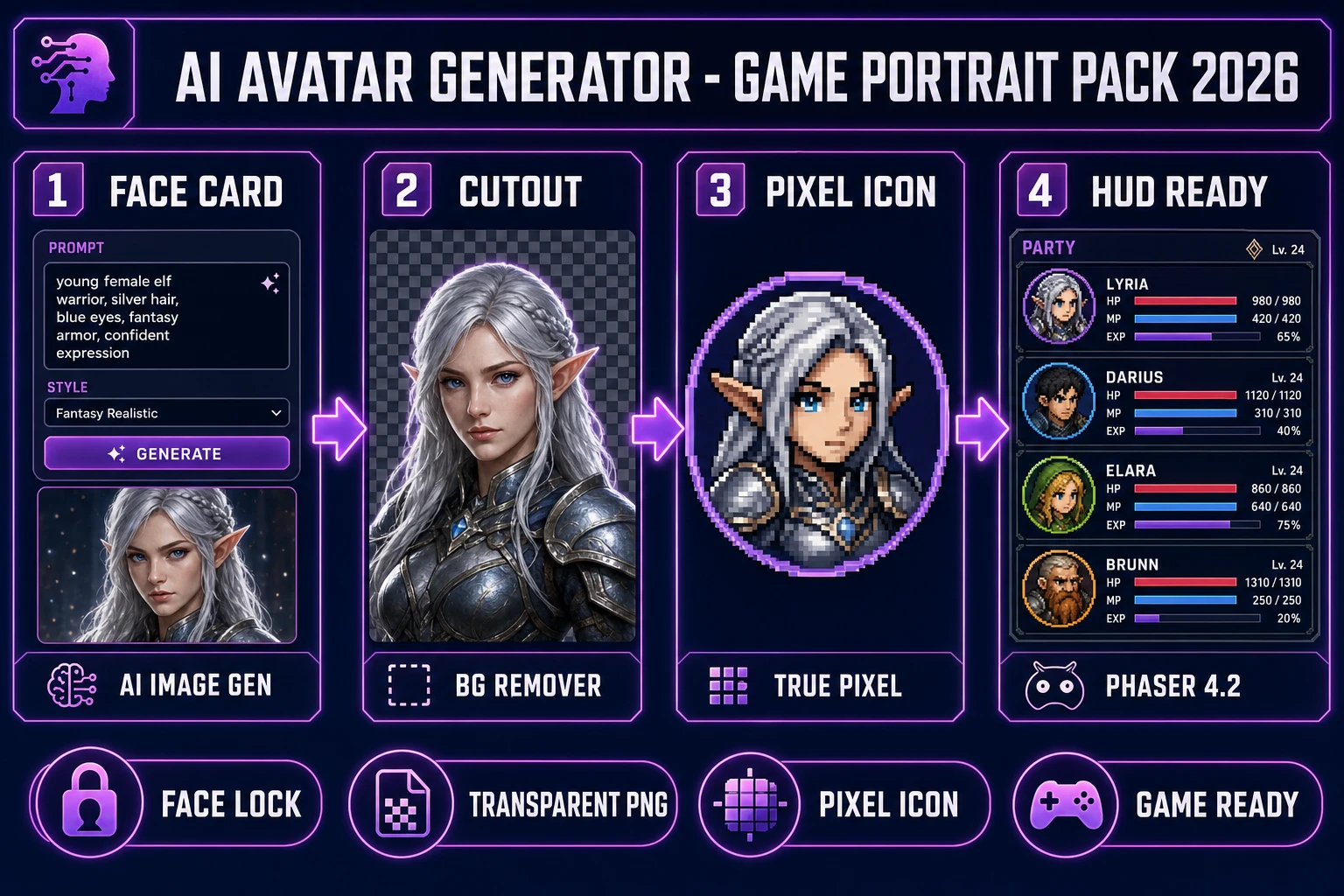
AI avatar generator in 2026 — four-step browser pipeline from AI Image Gen face card through BG Remover and True Pixel to Phaser 4.2 HUD icons, verified July 12, 2026
An ai avatar generator in 2026 means four moves: lock a face card in AI Image Gen, cut transparent PNGs in BG Remover, snap pixel HUD icons in True Pixel, then wire the pack into Phaser 4.2.

What an ai avatar generator outputs for indie game portraits

The phrase ai avatar generator (4,400/mo, KD 35 per DataForSEO probe-fresh-seeds-4.md verified July 11, 2026) targets creators who need a reusable avatar — not a one-off novelty selfie. Sibling queries confirm the cluster: ai avatar generator free (880/mo, KD 36), free ai avatar generator (320/mo, KD 31), and game avatar maker all describe the same hunger: a face that stays readable when it shrinks into lobby lists, party slots, and dialogue busts.

For game developers that deliverable is a production pack: menu portrait, circular HUD icon, lobby thumbnail, and optionally a dialogue bust that share head shape, palette, and signature accessory. Social avatar toys without a face card look sharp in a browser and then fight your UI atlas the moment you need a second emotion. Pair full character cards from the oc maker post when you also need walk sprites, and keep sheet layouts in the AI character sheet generator pipeline so stats art matches the same face.

Why one-off profile selfies stall production packs

Profile selfies optimize for social recognition, not for character design constraints that survive a 32-pixel crop. Soft photo-real lighting that sells a Discord headshot fights pixel grids the moment you run True Pixel. Hair that blooms past a circular mask looks fine at 512 px and then clips every party-slot frame. Palettes that drift between regenerations force you to re-author every UI thumbnail.

The traditional bottleneck was never Phaser’s image loader. It was locking a readable face mass, cutting transparent edges without leftover backdrop crumbs, and converting the same bust into a sprite-friendly icon that matches the portrait’s proportions. AI Image Gen closes the portrait layer; BG Remover closes the cutout layer; True Pixel closes the pixel grid. Cross-link NPC roster naming in the fantasy name generator post when you batch a full cast of labeled avatars.

The Sorceress ai avatar generator pipeline in four steps

Every shippable avatar pack ships four runtime pieces regardless of art style: face card, transparent portrait, pixel icon, and scene wiring. In 2026 each maps to one Sorceress tool verified against the live catalog on July 12, 2026:

  • Face card + portraitsAI Image Gen (AI Credits) with models such as GPT Image 2 and Nano Banana Pro via the unified panel; credit cost varies by model via getModelCredits in src/lib/models.ts.
  • Transparent cutoutsBG Remover (AI Credits badge) for clean PNG silhouettes without backdrop crumbs.
  • Pixel HUD iconsTrue Pixel (Pro badge) converts the cutout into cleaned pixel frames and sprite-sheet export.
  • In-game wiringWizardGenie scaffolds Phaser 4.2 portrait + avatar usage; your API key covers coding credits.

Pricing is a $49 lifetime unlock plus pay-as-you-go credit packs — Starter $10/1,000 credits, Creator $20/2,000, Plus $50/5,000, Studio $100/10,000 — verified against src/app/plans/page.tsx lines 46 and 51–54. New accounts ship with 100 starter credits. The Sorceress tools guide lists every tool in the catalog.
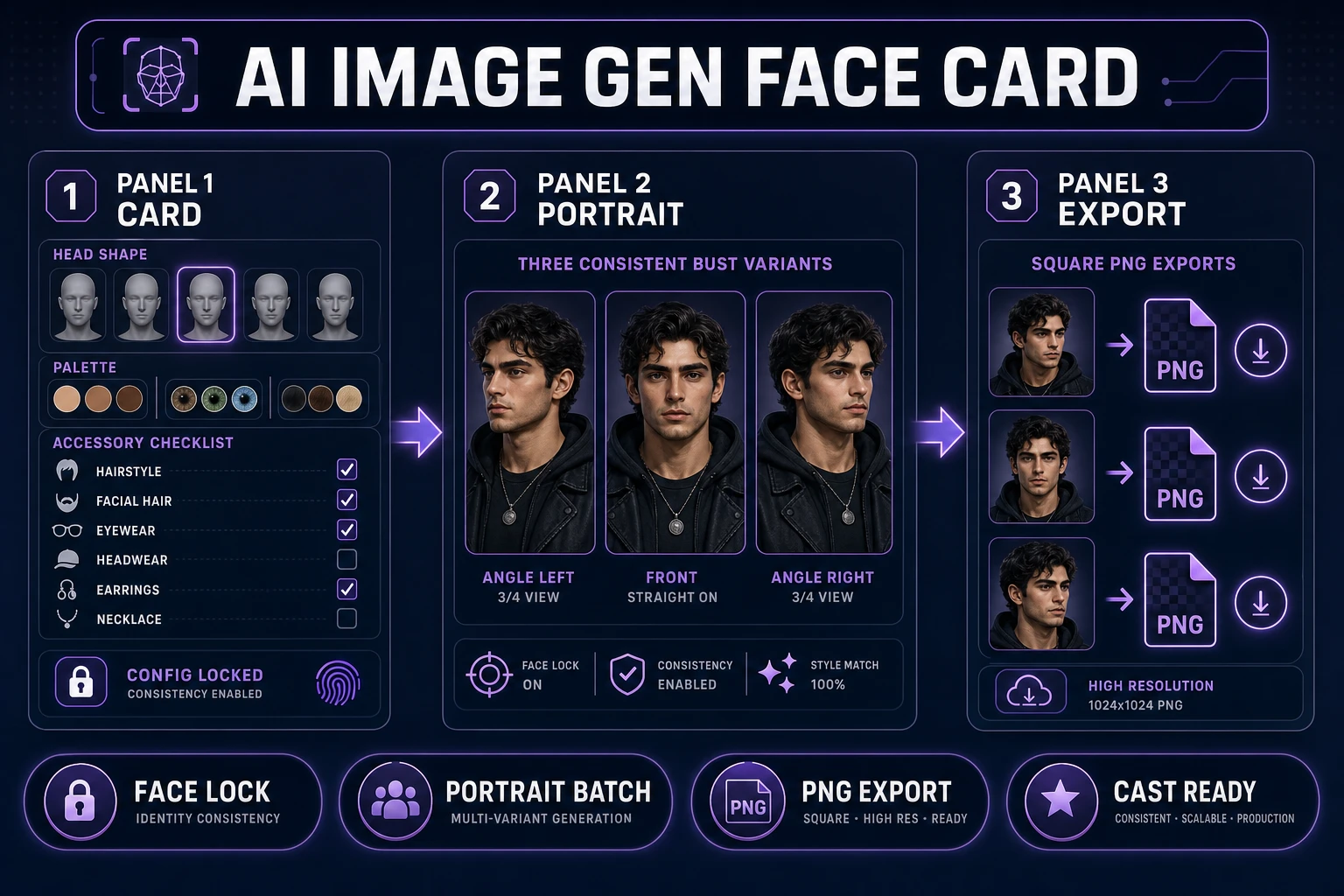
AI Image Gen face card and portrait batch for an ai avatar generator workflow, verified July 12, 2026
AI Image Gen turns a locked face card into portrait variants — reuse the same jawline, palette, and accessory prefix so the cast stays on-model.

Step 1 — lock a face card and prompt AI Image Gen

Open a plain text note and write the face card before you touch a prompt field: age band, head shape (round/angular), hair mass, three palette hexes, one signature accessory, and three forbidden traits (“no floating hair ribbons,” “no photo-real skin pores,” “no asymmetric horns”). That card is the production bible. Without it, every regenerate invents a new face.

Open AI Image Gen, pick a square 1:1 portrait aspect, and paste the card as a reusable prefix. Example: “pixel-friendly indie game avatar portrait, compact head shape, teal hair #2A9D8F, brass earring prop, clean cel shading, neutral gray backdrop, front-facing bust, consistent face, game UI avatar.” Batch three variants with the same prefix — smile, serious, injured — and keep only the ones that share jawline and eye spacing. Prefer GPT Image 2 or Nano Banana Pro when you need legible costume edges for later pixel snap.

Save winners as PNG. Do not upscale with soft filters; True Pixel wants crisp edges. If you also need circular social crops for store pages, generate a second pass with “tight head crop, centered pupils, empty corners for circular mask” using the same card prefix so the bust and icon agree.

Step 2 — cut transparent PNGs with BG Remover

Open BG Remover and run each portrait once. Inspect hair edges and earring outlines on a checkerboard — leftover gray halos will show up as dirt on every party-slot frame. Re-run only the frames that still carry backdrop crumbs; do not re-prompt the whole face unless the silhouette itself failed.

Export transparent PNGs into a folder named after the face card (hero_teal_hair/). Keep the original with-background file for marketing stills, but mark the transparent cutout as the source of truth for in-game UI. Canvas (Free badge) can composite a temporary party lineup if you want a Discord feedback sheet before you spend more credits — stack four cutouts on a dark navy board and export one PNG for playtesters.

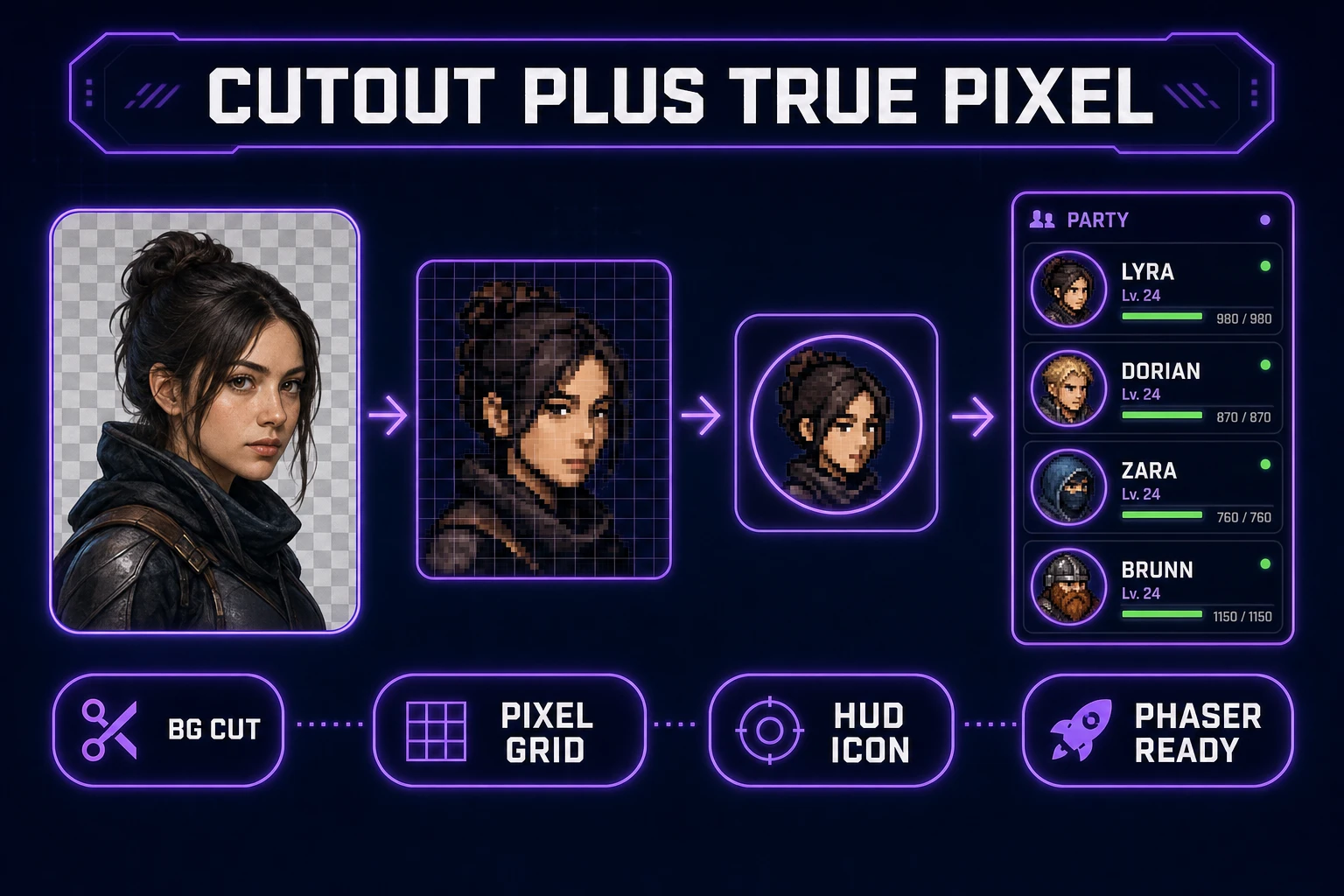
BG Remover transparent cutout and True Pixel HUD icons for an ai avatar generator pipeline, verified July 12, 2026
BG Remover clears the backdrop; True Pixel snaps the same silhouette onto a pixel grid and exports HUD icon frames for Phaser.

Step 3 — snap pixel HUD icons in True Pixel

Open True Pixel (Pro badge verified in src/app/_home-v2/_data/tools.ts on July 12, 2026). Drop the transparent portrait, enable chroma / edge cleanup as needed, and lock a pixel scale that matches your HUD (often 32×32 or 48×48 for party icons). The tool’s job is to turn soft AI shading into readable pixel masses without inventing a new face.

Export a sprite sheet with at least a neutral idle icon. If you need emotion variants for dialogue, snap smile and hurt frames from the same card’s cutouts — but only after the idle silhouette is locked; animating a drifting face wastes the card. Preview frames in Sprite Analyzer when you need to confirm crop centering before Phaser import.

Reject any sheet where hair mass or earring placement disagrees with the portrait. Regenerate the True Pixel pass with a tighter crop rather than prompting a brand-new face in AI Image Gen — consistency beats novelty once the card is locked.

Step 4 — wire avatars into Phaser 4.2 via WizardGenie

Phaser 4.2.0 “Giedi” shipped June 19, 2026 (verified against phaser.io/news/2026/06/phaser-v4-2-0-released and phaser.io/download/phaser4 on July 12, 2026). Open WizardGenie and prompt: “Add Phaser 4.2 PartyRoster and DialogueBust: load hero_portrait.png for dialogue bust top-left, load hero_icon.png as circular party avatar texture, scale to 3x nearest-neighbor, expose setAvatarEmotion(id) stub.”

Pick Claude Opus 4.7 or Gemini 3.1 Pro for the first scaffold — texture keys, nearest-neighbor filtering, and depth sorting benefit from the heavy reasoner. Iterate on placement tweaks with DeepSeek V4 Pro or Kimi K2.5 as the executor; never put a frontier model on the typing side. Pass exact filenames from your avatar folder so WizardGenie does not invent placeholder art names.

Bind the display name from your roster JSON to the same character id so portrait, icon, and label stay one object. That is the difference between an ai avatar generator that ships and a folder of pretty PNGs that never reach playtests.

What an ai avatar generator session costs on Sorceress in 2026

Cost math verified July 12, 2026. Base unlock: $49 lifetime. True Pixel: Pro badge under that unlock. A minimal party pack typically burns 40–120 Sorceress credits ($0.40–$1.20 at Starter tier rates) covering two to four AI Image Gen portrait runs, one or two BG Remover passes, and WizardGenie coding on your own API key. Compare that to commissioning a custom portrait pack from a freelance character artist for a one-weekend jam — the ai avatar generator SERP reader is usually a solo dev optimizing for one shippable browser build.

Start with the 100 free credits, lock one face card, generate three portraits, cut the winner, snap the idle icon, then spend credits only on a second emotion the playtest proves players notice. The pricing page shows live credit tiers; the plans page mirrors the same $49 lifetime figure from source.

The verdict on ai avatar generator workflows in 2026

An ai avatar generator in 2026 is no longer a weekend dragging selfie crops into circular masks and hoping the HUD still reads the eyes. AI Image Gen locks the face card into portraits, BG Remover clears the backdrop, True Pixel snaps the pixel grid, and WizardGenie writes the Phaser bindings. The technical spine is face-mass discipline; the art pass is what players remember when they decide whether your party roster feels intentional.

Pick one hero mood — teal-hair rogue, brass-earring scholar, scarred pilot — lock the card, cut the PNG, snap the icon, and prompt the PartyRoster until the face matches the dialogue bust. Avatar packs reward calm constraints over infinite outfit slots. AI generation now handles the slice that used to stall every solo dev between “I have a cool face” and “the portrait is in the build.”

Frequently Asked Questions

What is an ai avatar generator used for in game development?

An ai avatar generator drafts reusable face art for player profiles, party slots, lobby lists, and dialogue busts — assets that stay on-model across menu UI and in-game HUD. In the Sorceress pipeline (verified July 12, 2026) that means prompting AI Image Gen from a locked face card, cutting transparent PNGs in BG Remover, snapping pixel icons in True Pixel (Pro), and wiring the pack into Phaser 4.2 with WizardGenie.

Is an ai avatar generator free on Sorceress?

AI Image Gen and BG Remover spend AI Credits via the live credit math in src/lib/models.ts. True Pixel is a Pro-badge tool covered by the $49 lifetime unlock (verified against src/app/plans/page.tsx LIFETIME_PRICE = 49 and tools.ts badge: Pro on July 12, 2026). New accounts ship with 100 starter credits. WizardGenie coding runs on your own API key (or the trial fallback key).

How is an ai avatar generator different from an oc maker?

An ai avatar generator optimizes for face-forward pack sizes — square or circular crop, readable at 32–128 px in HUD lists. An oc maker (see the sibling OC maker post) often includes full-body concept art and walk sprites tied to a longer character bible. Use the avatar pipeline when you need roster icons; use the OC pipeline when you need a playable silhouette.

How do I keep avatar faces consistent across a cast?

Write one face card before you batch: head shape, hair mass, three palette hexes, signature accessory, and three forbidden traits. Feed that card as a reusable prompt prefix in AI Image Gen and reject any output that breaks jawline or eye spacing. Treat the card like a production bible, not a mood board.

What does an ai avatar generator session cost on Sorceress in 2026?

Verified July 12, 2026 against src/app/plans/page.tsx. Base unlock is $49 one-time. A minimal party pack typically burns 40–120 Sorceress credits for portrait variants plus BG Remover cutouts (model-dependent), True Pixel under the lifetime Pro unlock, and WizardGenie coding on your API key — often under $1.20 of Starter-tier credits on top of lifetime if you stay card-first.

Sources

  1. Avatar (computing) - Wikipedia
  2. Character design - Wikipedia
  3. Sprite (computer graphics) - Wikipedia
  4. Phaser v4.2.0 release notes
Written by Arron R.·1,643 words·7 min read

Related posts