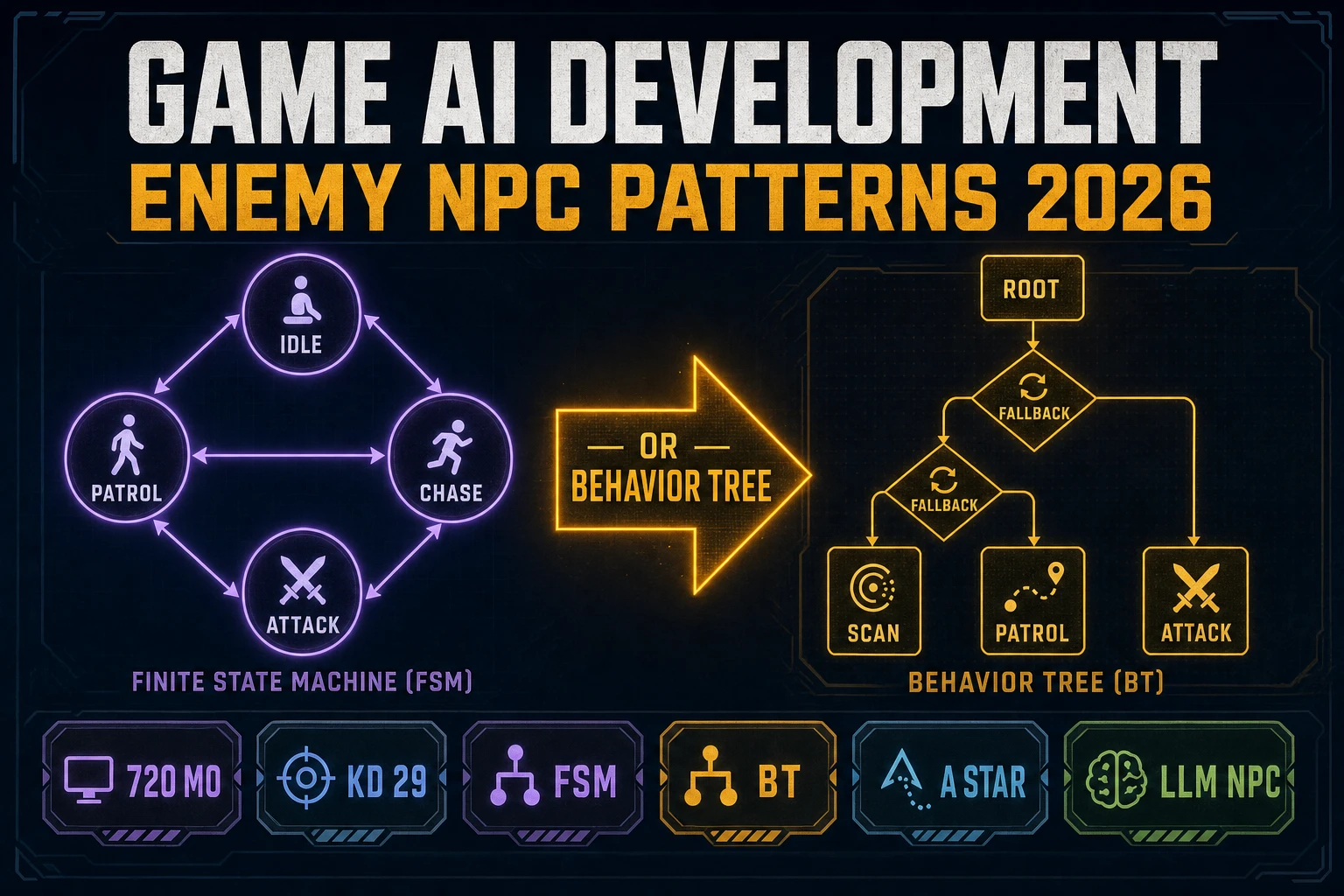
Game AI Development (Enemy NPC Patterns 2026)

By Arron R.11 min read
Game AI development is the AI that runs inside your game — enemy patrol loops, boss decision trees, A* pathfinding, LLM-driven dialogue. This article covers the

The reader who types game ai development into Google in 2026 is building a game — not shopping for a code assistant. They want the AI that runs inside the game: the goblin that patrols a corridor, the boss that decides whether to heal or press the attack, the shopkeeper NPC that remembers the player picked a fight last chapter. This article is the honest 2026 pattern set — finite-state machines, behavior trees, A* pathfinding, and the newest arrival, LLM-driven NPCs — plus the exact way to prompt WizardGenie to generate the full stack from plain English. Every concept here is live-verified against the authoritative source (Wikipedia's behavior tree, A*, and FSM articles; Phaser's own docs; MDN's game-dev tree) on 2026-10-06.
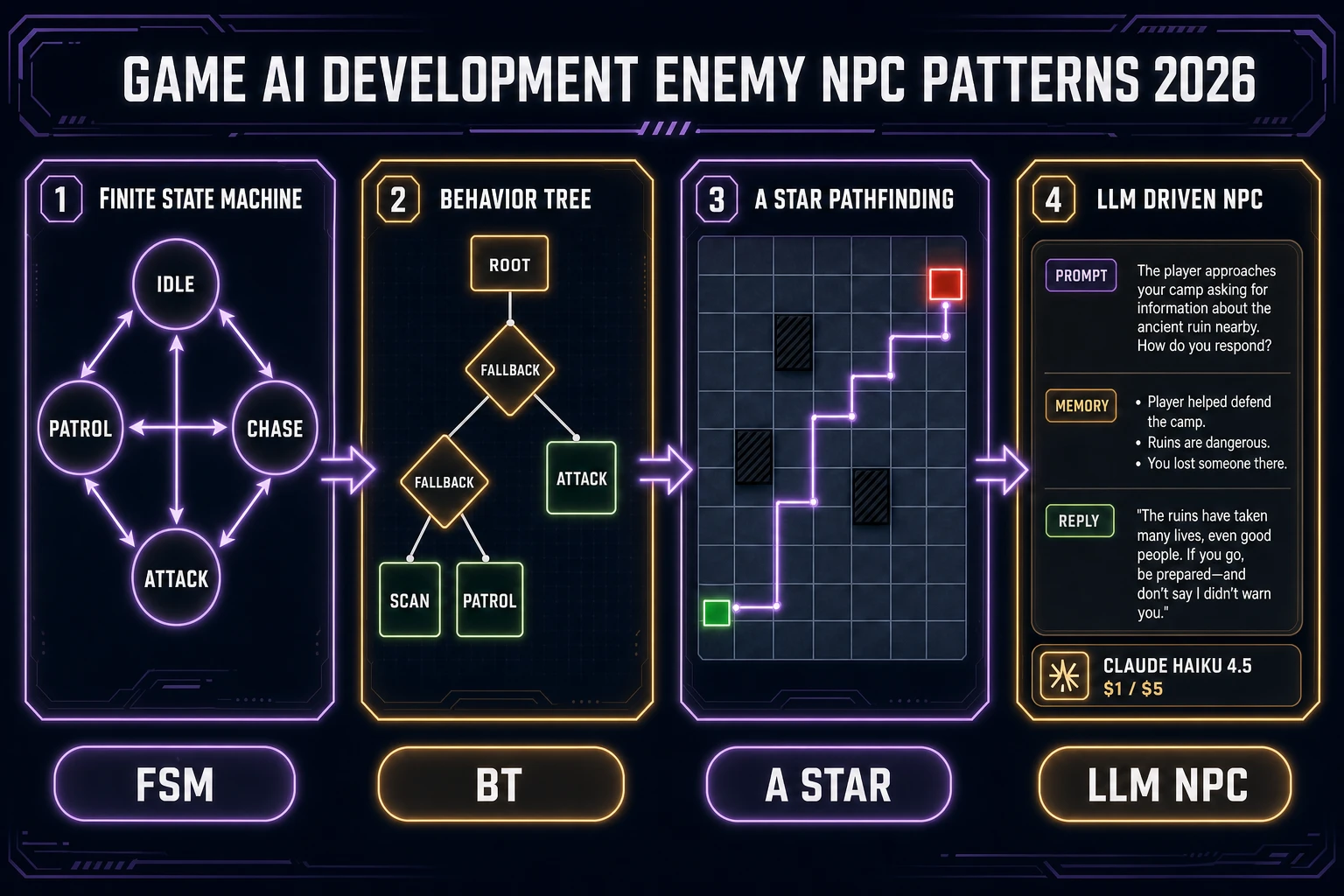
Game AI development enemy NPC patterns 2026 pipeline overview
Four patterns cover almost every indie-game need: FSM for small casts, behavior trees when the cast grows, A* for navigation, and LLM-driven NPCs for dialogue and memory.

What people typing game ai development actually want

DataForSEO lists game ai development at 720 monthly searches, keyword difficulty 29, competition 0.30, intent commercial (verified 2026-10-06 against tools/research-output.md, AI Game Dev umbrella cluster). The important thing about this query is what it is not. The reversed-word-order phrase ai game development — also 720/mo — targets AI-assisted tooling: code assistants, asset generators, playtest bots. game ai development targets the opposite: the AI that runs inside the shipped game. Same two words, opposite intent. A reader who conflates the two picks the wrong article and bounces, which Google notices.

What changed in 2026 is not the patterns — FSM, behavior tree, A*, utility AI have all been stable since the mid-2000s. What changed is that an LLM can now plausibly handle the "dialogue and personality" slot that used to be hand-scripted dialogue trees, and a dual-agent coding flow can write every FSM and behavior tree in your project from a plain-English brief. The rest of this article walks the four patterns, when to pick each, and the exact prompt shapes that produce shippable enemy AI code on WizardGenie.

The four patterns every indie needs in 2026

Not every game needs every pattern. The honest decision tree:

  • Finite-state machines (FSM) — three to seven states, clean transitions, one state active at a time. The right pick for jam games, platformers, shoot-'em-ups, and anything where enemies have 3-5 distinct behaviors. Cheap per tick, trivial to debug, the first thing anyone writing a game loop ends up with.
  • Behavior trees (BT) — hierarchical trees of tasks the engine ticks each frame, with fallback and sequence nodes composing complex behavior out of simple building blocks. The right pick when the cast grows past a handful of enemy types, when a single enemy layers behaviors (patrol while scanning while listening), or when designers want to tweak behavior in a visual editor instead of reading code. The Wikipedia Behavior tree article (verified 2026-10-06) lists Halo 2, BioShock, and Spore as the games that drove behavior trees into mainstream game AI; both Unity and Unreal ship them as first-class systems today.
  • Utility AI — each possible action gets a score from a weighted set of considerations (how hungry? how injured? how close is the player?), and the NPC picks the highest-scoring action each tick. The right pick for strategy games, sims, and sandbox worlds where behavior should feel driven by shifting internal state. Rarely needed for action games.
  • LLM-driven NPCs — a language model generates dialogue, remembers the player across sessions, and (optionally) picks high-level goals the FSM or behavior tree then executes. The 2026-specific addition. Pairs with the other three patterns, not in place of them — the LLM handles dialogue and planning, the FSM handles the actual tick-by-tick behavior, because running a model every frame is wasted budget.

Pick FSM first. Graduate to behavior trees when the FSM state count passes about seven. Add A* the moment enemies navigate around obstacles. Add LLM-driven NPCs only when the game has dialogue worth generating. Most indie projects ship FSM + A*; most RPG-shaped projects ship all four.

Finite-state machines for small casts

Verified 2026-10-06 against the Wikipedia Finite-state machine article: an FSM is an abstract machine that is exactly one of a finite set of states at a time, with transitions between states triggered by inputs. In game AI, the "input" is usually something the NPC can sense (line-of-sight to the player, distance to a waypoint, elapsed time) and the "state" is the current behavior (idle, patrol, chase, attack, flee).

A goblin FSM for a 2D platformer, in the shape the Executor actually writes:

class Goblin {
  constructor() {
    this.state = 'patrol';
    this.chaseTimer = 0;
  }
  update(dt, player) {
    switch (this.state) {
      case 'patrol':
        this.walkTowardWaypoint();
        if (this.canSee(player)) this.state = 'chase';
        break;
      case 'chase':
        this.walkToward(player);
        if (!this.canSee(player)) {
          this.chaseTimer += dt;
          if (this.chaseTimer > 5) {
            this.state = 'patrol';
            this.chaseTimer = 0;
          }
        } else if (this.distanceTo(player) < 1) {
          this.state = 'attack';
        }
        break;
      case 'attack':
        this.swingSword();
        if (this.distanceTo(player) > 2) this.state = 'chase';
        break;
    }
  }
}

Three states, three transitions, under 30 lines. This is the entire budget for most jam-grade enemies. Constant time per tick, trivial to debug (print the current state), maps 1:1 onto every mainstream engine. The honest FSM ceiling in practice is seven to ten states — past that, you spend more time maintaining the transition table than writing new behavior, and transitions start stealing priority from each other. That is the signal to graduate.

Behavior trees when the cast grows

Verified 2026-10-06 against the Wikipedia Behavior tree article: a behavior tree is a directed tree where the root ticks its single child, which ticks its children, and so on down to leaves. Each node returns one of three statuses — Running, Success, or Failure — and the control-flow nodes above decide what to tick next. The two primary control-flow nodes are Selector (fallback), which ticks children left-to-right until one returns Success or Running, and Sequence, which ticks children left-to-right until one returns Failure or Running.

A behavior tree for the same goblin, grown with a "scan for cover" layer that an FSM would struggle with:

root (selector)
├── sequence: ATTACK
│   ├── canSee(player)?
│   ├── inRange(player, 1)?
│   └── swingSword()
├── sequence: CHASE
│   ├── canSee(player)?
│   └── walkToward(player)
├── sequence: SCAN
│   ├── heardSound()?
│   └── turnToward(sound)
└── sequence: PATROL
    └── walkTowardWaypoint()

The root is a Selector, so it ticks top-to-bottom and runs whichever branch succeeds first. Adding "flee if low HP" is one more branch above ATTACK. Adding "call for backup" is one more branch below CHASE. The tree composes without rewiring — the exact property FSMs lack past seven states. The Wikipedia Behavior tree article names Halo 2 as the first high-profile shipping behavior tree (Damian Isla's GDC 2005 talk is the canonical reference), followed by BioShock and Spore. Both Unity and Unreal ship behavior-tree systems today. The pattern is mature, well-understood, and heavily documented.
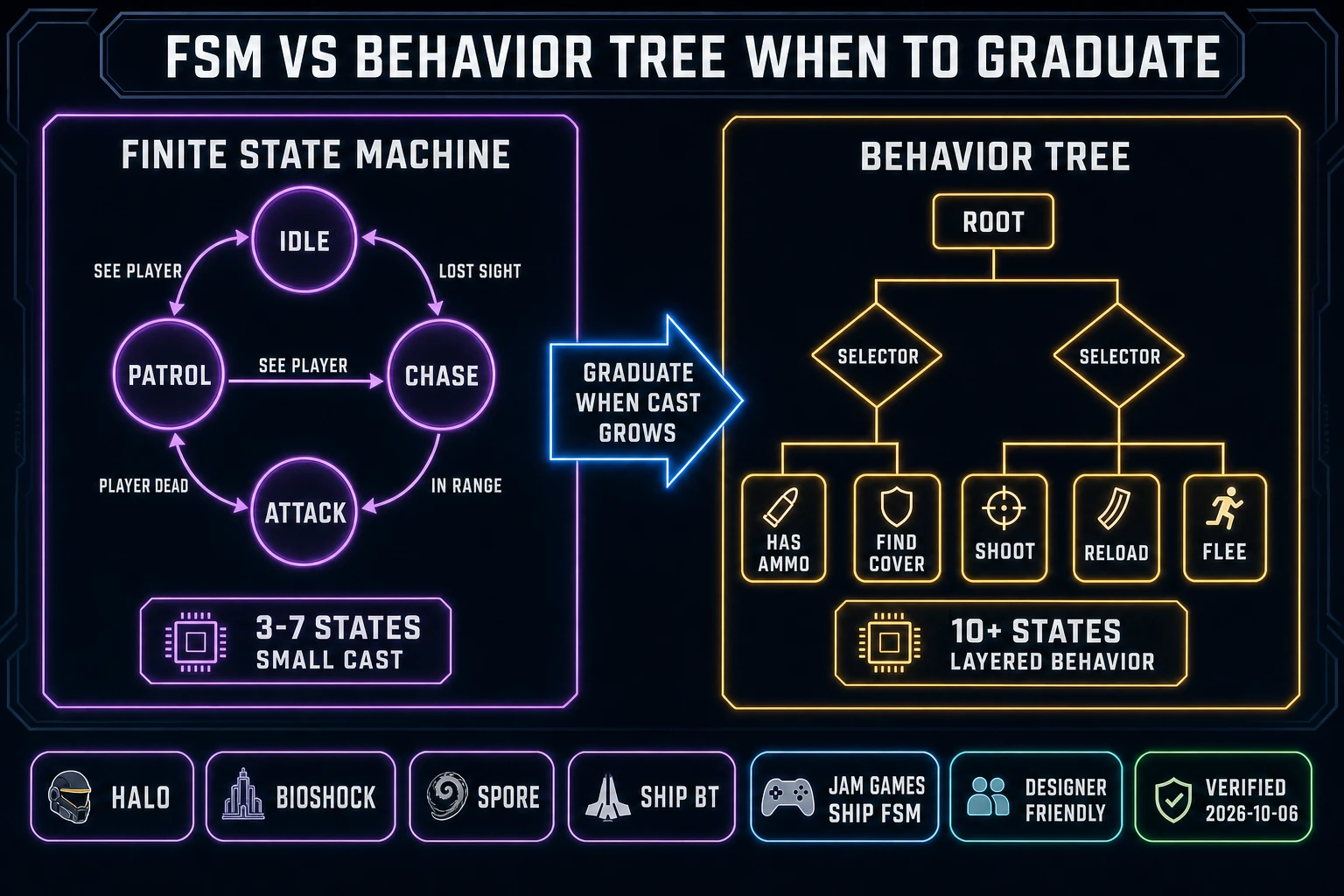
FSM vs behavior tree when to graduate from state machine to tree
Rule of thumb: FSM up to about seven states, behavior tree past that. Halo, BioShock, and Spore all shipped behavior trees; jam games rarely need one.

A* pathfinding on tile grids and navmeshes

Verified 2026-10-06 against the Wikipedia A* search algorithm article: A* (A-star) was first described in 1968 by Peter Hart, Nils Nilsson, and Bertram Raphael at Stanford Research Institute, as an extension of Edsger Dijkstra's shortest-path algorithm. It is a best-first graph search that evaluates nodes by the function f(n) = g(n) + h(n), where g(n) is the known cost from the start node to n and h(n) is a heuristic estimate of the cost from n to the goal. A* is complete (always finds a path when one exists) and optimal when the heuristic is admissible — meaning it never overestimates the true remaining cost. The usual admissible heuristic for a tile grid is Manhattan distance (for 4-connected grids) or Chebyshev distance (for 8-connected grids).

Three practical implementation notes:

  1. You almost never need to write A* from scratch. Phaser ships easystar.js integration; Godot ships AStarGrid2D as a first-class node; Unity ships NavMesh baking in the editor. Use the engine's built-in system until a profile proves it is the bottleneck.
  2. Tile grids are enough for most 2D games. Navmesh baking exists to handle non-grid 3D worlds — grid A* runs faster and is easier to debug on tile-based maps.
  3. Chunk the pathfinding frequency. Running A* every frame per enemy is the single most common perf bug in indie games. Re-plan when the enemy enters CHASE, then only when the player moves more than two tiles from the pathed target or every 500ms. The FSM state transition is the natural hook.

If the game is open-field with no obstacles between enemies and the player, skip A* entirely — use direct steering (vector toward player, with simple avoidance). A* earns its complexity cost on tile grids and dungeons, not on empty fields.

LLM-driven NPCs in 2026 (when a dialogue model earns its tokens)

The 2026 addition to the pattern set is using a language model as the "brain" of specific NPCs — usually the dialogue layer, sometimes a high-level planner that picks goals the FSM then executes. The pattern works, but it has an honest ceiling. Running an LLM every tick is wasted budget; running it per dialogue turn is cheap enough to ship in a $30-budget indie.

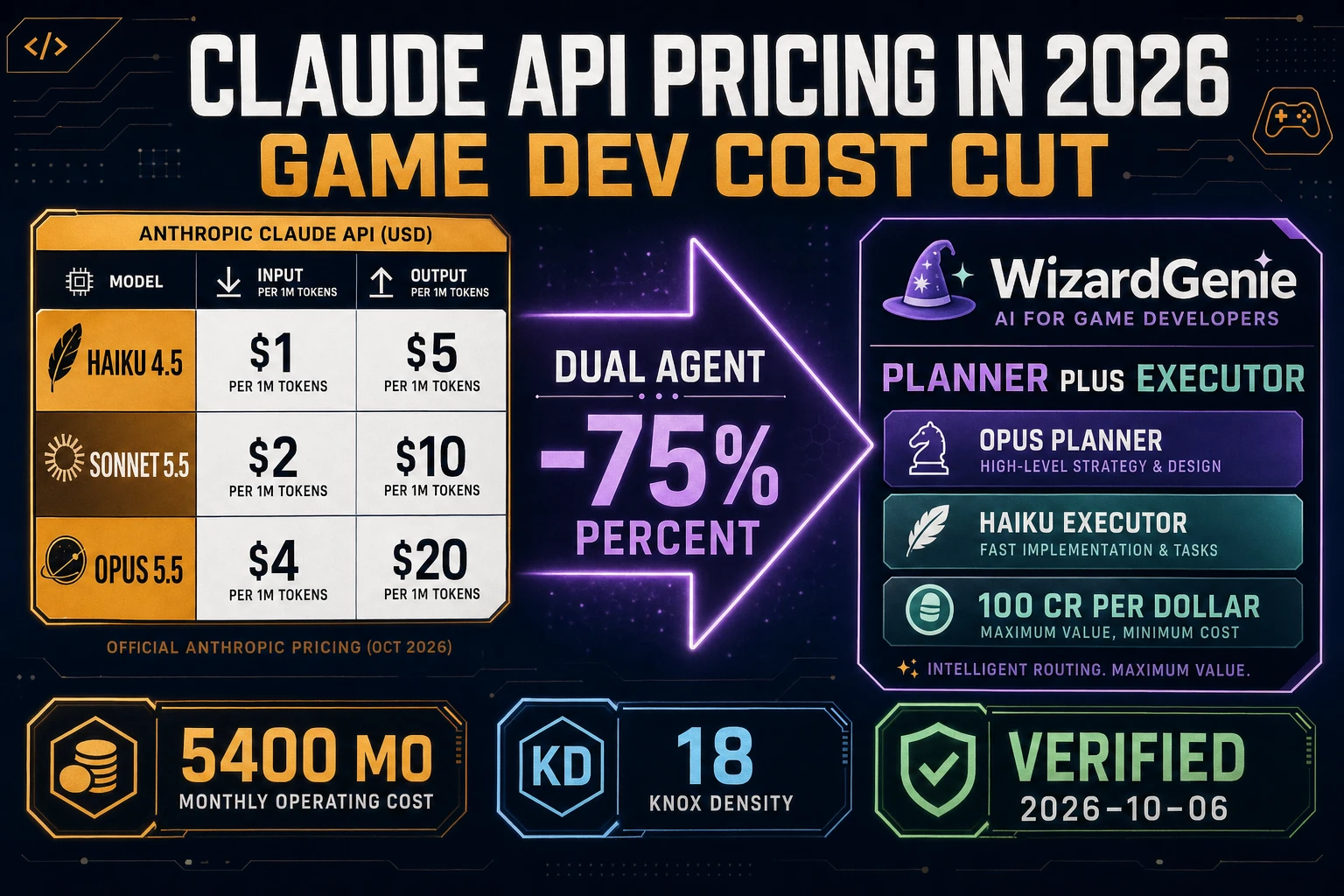
Cost math at 2026-10-06 Claude API rates (verified against docs.claude.com, cross-referenced with the Claude API pricing article from earlier today). A short NPC dialogue turn is roughly 300 input tokens and 150 output tokens. On Claude Haiku 4.5 ($1 / $5 per MTok), one turn costs about $0.001. Fifteen NPCs with ten turns each across a full playthrough bills roughly $0.15 — about 15 credits at the Sorceress CREDITS_PER_DOLLAR = 100 rate (src/lib/models.ts line 69, verified 2026-10-06). The economics work.

The pattern that does not work: calling an LLM in the update loop. A model call takes 300ms to 2 seconds; a game frame is 16ms. The LLM has to live outside the tick loop. The honest architecture is:

  • The FSM or behavior tree handles tick-by-tick behavior (patrol, chase, attack).
  • The LLM fires on specific triggers only — player initiates dialogue, boss transitions phase, quest state changes.
  • The LLM's output is cached as a dialogue line (or a goal, or a plan), and the FSM reads the cached result on subsequent ticks.
  • Conversation history gets prompt-cached on repeat dialogue, so the second and third turns within the same conversation bill at the cache-read rate (10% of base input on most Claude SKUs, 5% on Opus 5.5, per docs.claude.com verified 2026-10-06).

For memory — the "NPC remembers the player picked a fight last chapter" case — the shape is a per-NPC memory block concatenated into the system prompt on each turn. Keep it tight; the cost scales linearly with memory size, and most NPC memory compresses to a bulleted list of likes, dislikes, and past interactions.

How to prompt WizardGenie to generate the full enemy AI stack

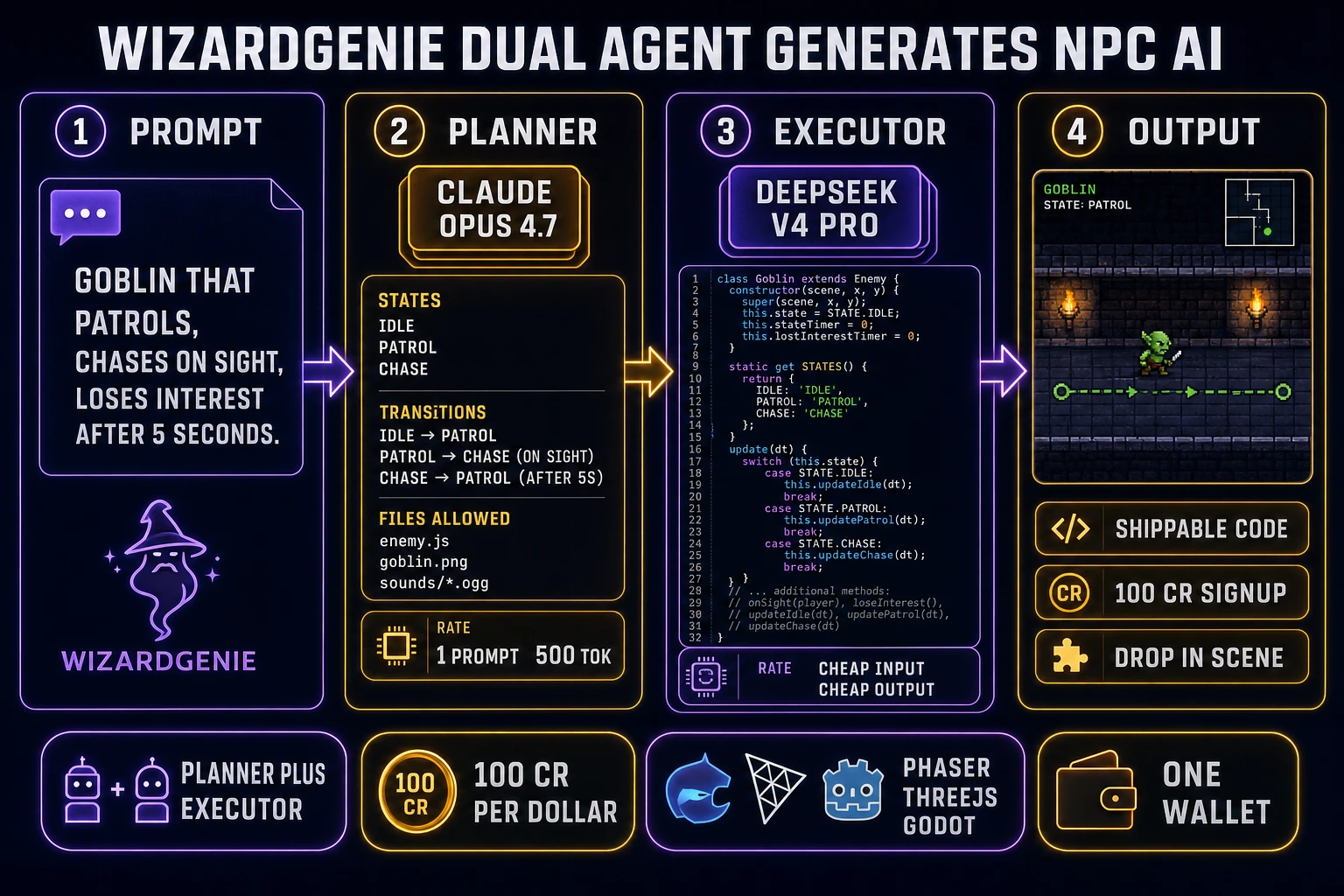
WizardGenie's dual-agent flow (src/app/wizard-genie/page.tsx lines 297-299, verified 2026-10-06: "A smart Planner thinks; a cheap Executor codes. Same quality at roughly a quarter of the token cost.") is a direct fit for generating the four patterns above. The Planner reads the spec and emits a tight brief; the Executor types the code. The right prompt shape produces shippable FSM, behavior tree, and A* code without manual stitching.

The prompt shape that works, in three parts:

  1. Context — what engine, what language, what file structure. "I'm using Phaser 3 in JavaScript, enemies live in src/enemies/, each enemy has its own file extending a base Enemy class."
  2. Behavior spec in plain English — exactly how the enemy acts. "Goblin: patrols between two waypoints. If it sees the player (line-of-sight check, 8-tile radius), it chases. If it loses sight for 5 seconds, it returns to patrol. If it gets within one tile, it attacks (300ms wind-up, deals 10 damage). If its HP drops below 20%, it flees to the nearest waypoint."
  3. Pattern instruction — tell it which pattern to use. "Use a finite-state machine with four states (patrol, chase, attack, flee). Do not use a behavior tree. Use Phaser's easystar.js for pathfinding when fleeing."

The Planner (Claude Opus 4.7, GPT-5.5, Gemini 3.1 Pro, or Grok 4.2 per the CODING_MODELS lineup at src/app/_home-v2/_data/tools.ts lines 767-774, verified 2026-10-06) reads that brief and emits a structured plan: four states, four transitions, three files to touch, two tests to add. The Executor (DeepSeek V4 Pro, Kimi K2.5, MiniMax M2.7, or Claude Haiku 4.5) types the actual FSM. Full cycle under five cents at 2026-10-06 rates. The signup credit grant lands 100 credits in your wallet on first login — enough for roughly a dozen enemy-AI generations before you spend anything of your own. Scope the signup session: generate the FSM first, test it in Phaser, graduate to a behavior tree only if the state count passes seven.

WizardGenie dual-agent generates NPC AI from prompt
Planner reads the goblin spec, Executor types the FSM. One dual-agent cycle under five cents at 2026-10-06 rates — the signup credit grant covers roughly a dozen.

The verdict: four patterns, one generator, no behavior-tree-first mistakes

Game AI development in 2026 is boring in the best possible way. The patterns stabilized two decades ago (FSM and A* in the 1960s-80s, behavior trees in the mid-2000s), the industry precedent is well-documented (Halo, BioShock, Spore), and the engines ship first-class systems for all of them. What is new is the generation cost: a dual-agent coding flow can now produce shippable FSM and behavior-tree code from a plain-English brief for pennies per enemy type.

The practical sequence for a solo indie in 2026:

  1. Scope the cast. If it is under five enemy types, FSM only.
  2. Generate the FSMs with WizardGenie's dual-agent flow. Burn the 100-credit signup grant on the first pass to prove the shape.
  3. Add A* pathfinding only when enemies need to navigate around obstacles. Use the engine's built-in system (Phaser's easystar.js, Godot's AStarGrid2D, Unity's NavMesh).
  4. Graduate to behavior trees only when the FSM state count passes seven. Do not start with a behavior tree — the extra abstraction is wasted on a four-state goblin.
  5. Add an LLM-driven dialogue layer only when the game actually has dialogue worth generating, and only when the game loop fires it on triggers (not every tick). Cache the output.

For the generation economics, the Claude API pricing article and the executor picks article ship the up-to-the-day numbers. The vibe coding with Claude article covers the Planner-plus-Executor pattern end to end, and the Lovable vs WizardGenie piece argues why a code-first flow still beats a web-app builder when the project is a game. For the general "starting from zero" path, the how to make a video game with AI article is the entry point and the prompt to game AI pipeline is the natural next step. Browse the full stack in the tools guide, or jump straight to WizardGenie, burn the signup credit, and generate a goblin before you close this tab.

Frequently Asked Questions

What is game AI development in 2026?

Game AI development means designing and implementing the AI that runs inside your game — enemy decision-making, NPC behavior, pathfinding, state transitions, and (increasingly in 2026) LLM-driven dialogue and planning. It is distinct from AI-assisted game development, which is about using AI tools to help you write engine code and generate assets. The four patterns that cover almost every indie-game need in 2026 are finite-state machines for small casts, behavior trees for larger casts and layered behaviors, utility AI for stat-driven decisions, and LLM-driven NPCs for dialogue, memory, and emergent personality. Behavior trees in particular trace back to Rodney Brooks' subsumption architecture and became industry standard through games like Halo, BioShock, and Spore (verified 2026-10-06 via the Wikipedia Behavior tree article).

Game AI development vs AI game development — what is the difference?

The two phrases are reversed word order and reversed intent. Game AI development is about the AI inside your game — the behavior that drives enemies, companions, and NPCs. AI game development is about the AI that helps you build the game — code assistants, asset generators, dialogue writers, playtest bots. A single project usually needs both. You use AI game development tools (like WizardGenie dual-agent) to write the C# / JavaScript / GDScript, and you use game AI development patterns (behavior trees, FSMs, A*) to drive the enemies the player actually fights. Confusing the two leads to wasted budget — buying an AI code assistant does not give your goblin a brain, and reading up on behavior trees does not help you write the game loop.

When should an indie use a behavior tree vs a finite-state machine?

Use a finite-state machine when the NPC has 3 to 7 distinct states with clean transitions (idle, patrol, chase, attack, flee) and no need to interleave actions. Use a behavior tree when the cast grows past a handful of enemy types, when a single enemy needs to layer behaviors (patrol while scanning while listening for footsteps), or when designers want to tweak behavior without reading code. The Wikipedia Behavior tree article (verified 2026-10-06) frames the trade-off cleanly: behavior trees are modular, composable, and designer-friendly; FSMs are simpler, cheaper per tick, and easier to debug for small casts. Halo 2, BioShock, and Spore all shipped behavior trees because their cast sizes and designer workflow demanded it. A game-jam platformer with four enemy types rarely does.

What is A* pathfinding and when do I actually need it?

A* (A-star) is a best-first graph search algorithm — the standard algorithm for finding the shortest path between two points on a tile grid or navmesh. Verified 2026-10-06 via the Wikipedia A* article: A* was first described in 1968 by Peter Hart, Nils Nilsson, and Bertram Raphael at Stanford Research Institute. It evaluates nodes by f(n) = g(n) + h(n), where g is the cost from the start and h is a heuristic estimate of the cost to the goal. A* is complete and optimal when the heuristic is admissible (never overestimates). You need it the moment an enemy has to navigate around obstacles to reach the player on a tile-based or navmesh-based level. Line-of-sight and simple vector steering are enough for open-field games; A* earns its complexity cost on tile grids and dungeons.

How much does an LLM-driven NPC cost per interaction in 2026?

At 2026-10-06 Claude API rates, a short NPC dialogue turn (300 tokens input, 150 tokens output) on Claude Haiku 4.5 ($1 input / $5 output per million tokens) costs roughly $0.001 per interaction. On Claude Sonnet 5.5 ($2 / $10), roughly $0.002 per interaction. On DeepSeek V4 Pro, substantially less. The honest ceiling for most indie games is one LLM call per NPC dialogue turn, batched across a conversation. Running an LLM every frame or every tick is wasted budget — the FSM or behavior tree handles decision-making between dialogue turns, and the LLM only generates when the player actually talks. A full conversation of 10 turns per NPC with 15 NPCs across a 5-hour playthrough bills under a dollar on Haiku 4.5. The Sorceress credit math (CREDITS_PER_DOLLAR = 100 at src/lib/models.ts line 69, verified 2026-10-06) means that same play session bills under 100 credits.

How does WizardGenie help with game AI development specifically?

WizardGenie's dual-agent flow (src/app/wizard-genie/page.tsx lines 297-299, verified 2026-10-06: 'A smart Planner thinks; a cheap Executor codes. Same quality at roughly a quarter of the token cost.') is a direct fit for generating game AI code. The Planner reads the game spec ('I want a goblin that patrols a corridor, chases on line-of-sight, and loses interest after 5 seconds') and emits a tight brief naming the states, transitions, and files to touch. The Executor types the actual FSM or behavior tree in your engine's language. The signup credit grant (SIGNUP_GRANT = 100 credits) at CREDITS_PER_DOLLAR = 100 means a single free dollar covers roughly a dozen enemy-AI generations before you spend anything. The CODING_MODELS lineup (src/app/_home-v2/_data/tools.ts lines 767-774, verified 2026-10-06) includes Claude Opus 4.7, GPT-5.5, Gemini 3.1 Pro, Grok 4.2 as acceptable Planners and DeepSeek V4 Pro, Kimi K2.5, MiniMax M2.7 as acceptable Executors.

Sources

  1. Behavior tree (artificial intelligence, robotics and control) — Wikipedia
  2. A* search algorithm — Wikipedia
  3. Finite-state machine — Wikipedia
  4. What is Phaser? — Phaser Help
  5. Anatomy of a video game — MDN Web Docs
  6. Game development — MDN Web Docs
Written by Arron R.·2,500 words·11 min read

Related posts