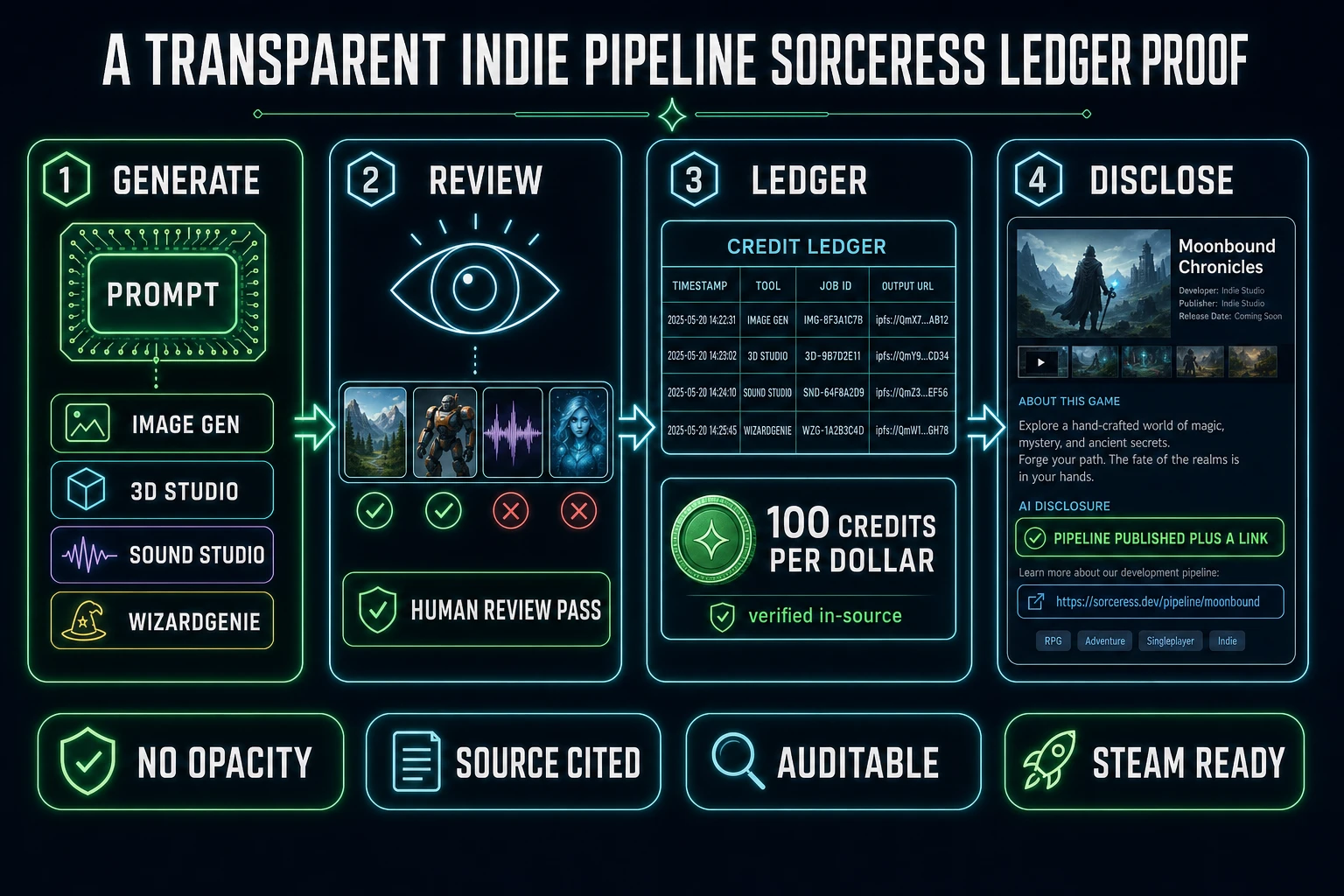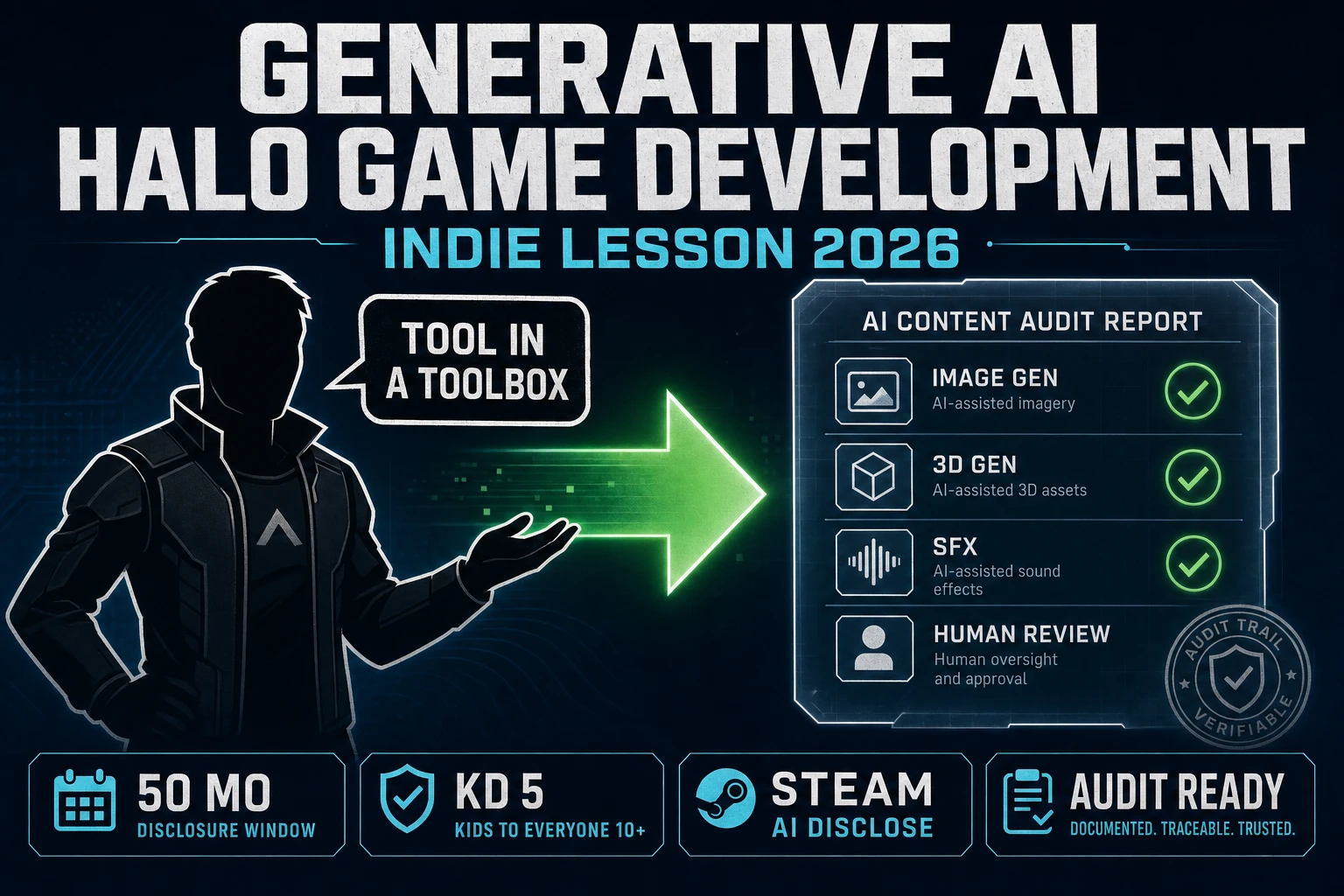
The phrase generative ai halo game development is doing 50 searches a month at keyword difficulty 0 in October 2026 for a reason — the Rolling Stone interview with Halo Studios on Halo: Campaign Evolved turned into a story about which assets did or didn’t go through a model, and the devs would not say. That’s a problem for them and a free lesson for anyone shipping an indie game in 2026. The AAA studio can absorb the trust hit; a first-time indie dev cannot. The actual move is to invert the posture — publish the pipeline, name every tool, point at the Sorceress API ledger or equivalent, and ship the Steam AI disclosure the same day the store page goes up. Every capability named below is verified against the Sorceress source in src/app/_home-v2/_data/tools.ts on 2026-10-06, and every Halo-side claim is cited against a 2026-10-06 news source.
What the generative AI Halo game development story actually is
DataForSEO lists generative ai halo game development at 50 monthly searches, keyword difficulty 5, commercial intent (verified 2026-10-06 against tools/research-output.md, AI Game Dev umbrella seed). The query didn’t exist a year ago — it exists today because Halo: Campaign Evolved, the 2026 campaign-only remake of the original 2001 Halo: Combat Evolved, pulled generative AI into the news cycle. The remake is built in Unreal Engine 5 on top of what the official Halo Waypoint art post calls a "hybrid" with the legacy Blam engine, co-developed with Abstraction Games (verified at halowaypoint.com’s "Inside the Art of Campaign Evolved" on 2026-10-06).
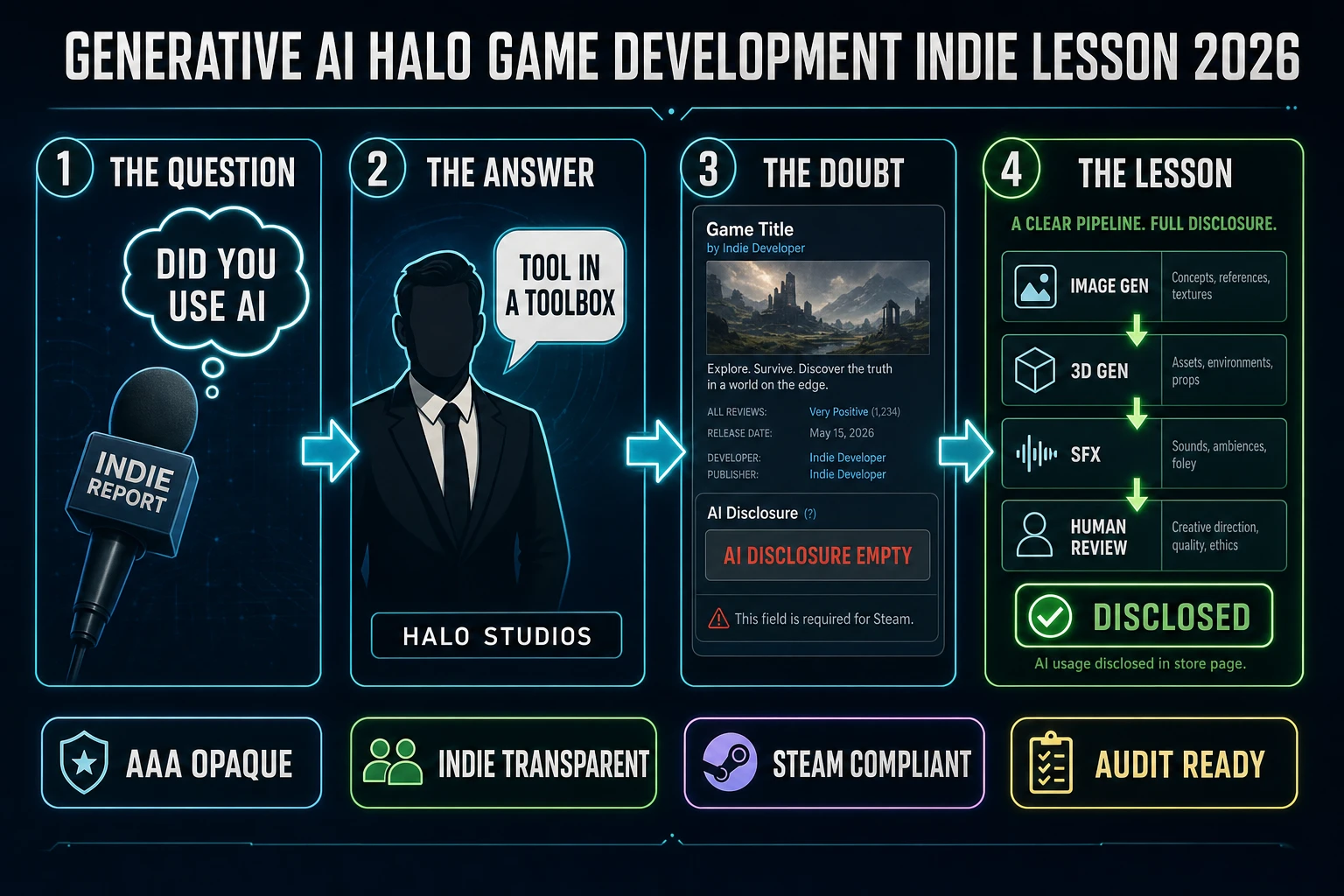
The news-cycle story is not the engine choice. It is a two-part sequence of events. First, a Rebs Gaming source alleged that generative AI was being used "heavily" across enemy AI behavior, terrain, and asset generation. Second, Rolling Stone interviewed Halo Studios' executive producer Damon Conn and game director Greg Hermann, and both declined to confirm or deny any specific AI usage, instead offering the now-circulated quote: "It’s a tool in a toolbox" (coverage verified at tweaktown.com and escapistmagazine.com, both 2026-10-06).
What makes it a story rather than a shrug is the audience’s follow-up: Steam requires every store page to indicate whether and how generative AI touched the game, and the r/gaming thread covering the controversy on 2026-10-06 flagged that no such disclaimer appeared on the Halo: Campaign Evolved Steam page at the time of checking. The silence became the signal.
What the devs confirmed and what they didn’t
Pulling the actual quotes apart matters here, because the lesson for indie devs lives in the gap between the two columns.
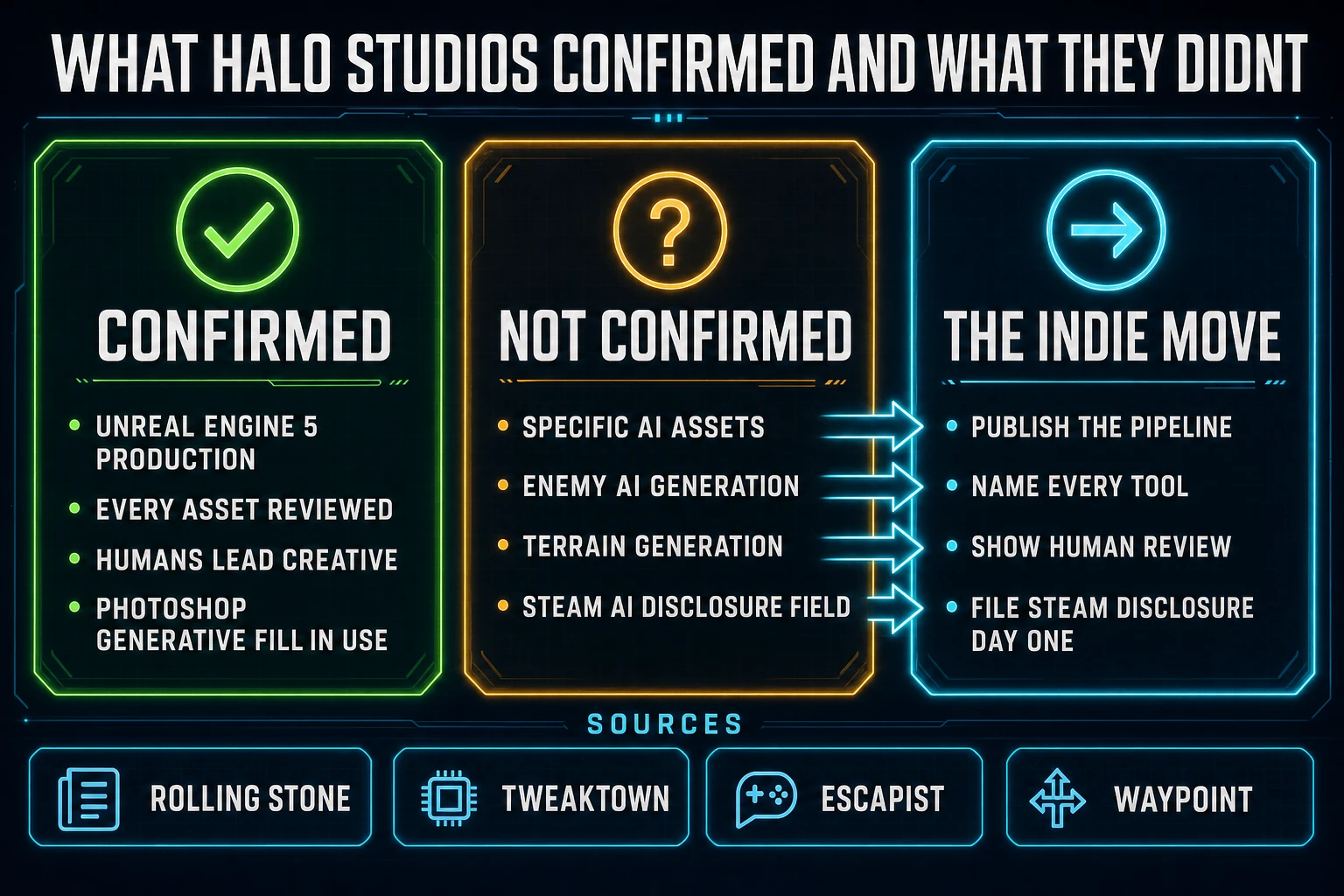
Confirmed in the Rolling Stone interview and the Halo Waypoint post: People lead creative work. AI "can improve workflows." The team used Unreal Engine 5 on an entirely fresh content set, built every asset from scratch, and reviewed against the original Halo: Combat Evolved. Photoshop’s generative fill is in common use and makes "the boundary lines... a little fuzzy" per Hermann. An Xbox spokesperson added: "There is no mandate to use generative AI in our game development, and that includes Halo: Campaign Evolved" (TweakTown, 2026-10-06).
Not confirmed and not denied: Whether any shippable in-game asset — environment art, texture, concept image, enemy behavior tree, line of code — went through a generative model at any point. Whether the Steam AI disclosure field will be filled in before launch. Which specific tools or models (beyond Photoshop generative fill) are in the production stack.
The gap is where the trust problem sits. A one-sentence Xbox statement about mandates doesn’t answer the per-asset question, and the "tool in a toolbox" framing is accurate but non-specific. The audience walks away unable to tell whether the Covenant plasma rifle textures were hand-painted, Photoshop-generative-filled, or run through a text-to-image pass. Reasonable adults can hold any of those answers; what they cannot hold is "we’re not saying."
Why AAA opacity hurts the whole industry
There are two ways the opacity leaks downhill into indie dev. The first is cultural: when a flagship franchise refuses to name its tools, every subsequent "AI in game development" discussion gets dragged back to the Halo question. Prospective indie buyers start assuming the worst about any studio using the words "AI-assisted," because the loudest recent example was a studio that would not confirm specifics. The generative artificial intelligence Wikipedia article is now updated monthly with new game-industry controversy sections (verified 2026-10-06), which keeps the topic warm in search intent indefinitely.
The second is procedural. Valve’s Steam AI disclosure policy applies equally to a billion-dollar franchise and a $5 solo-dev game. If the biggest franchise on Xbox ships without filling the field, the review-brigade crowd develops the habit of checking the field aggressively on every new release and voting on anything that reads as evasive. The indie dev who was going to write a careful, honest disclosure now has to compete with the memory of a blank one on a flagship store page. That is not a fair fight.
The structural fix is on the AAA side — publish the pipeline — but no indie dev gets to wait for Microsoft to change the posture of its subsidiaries. The actionable fix is the one the indie can do today, and it is the opposite move.