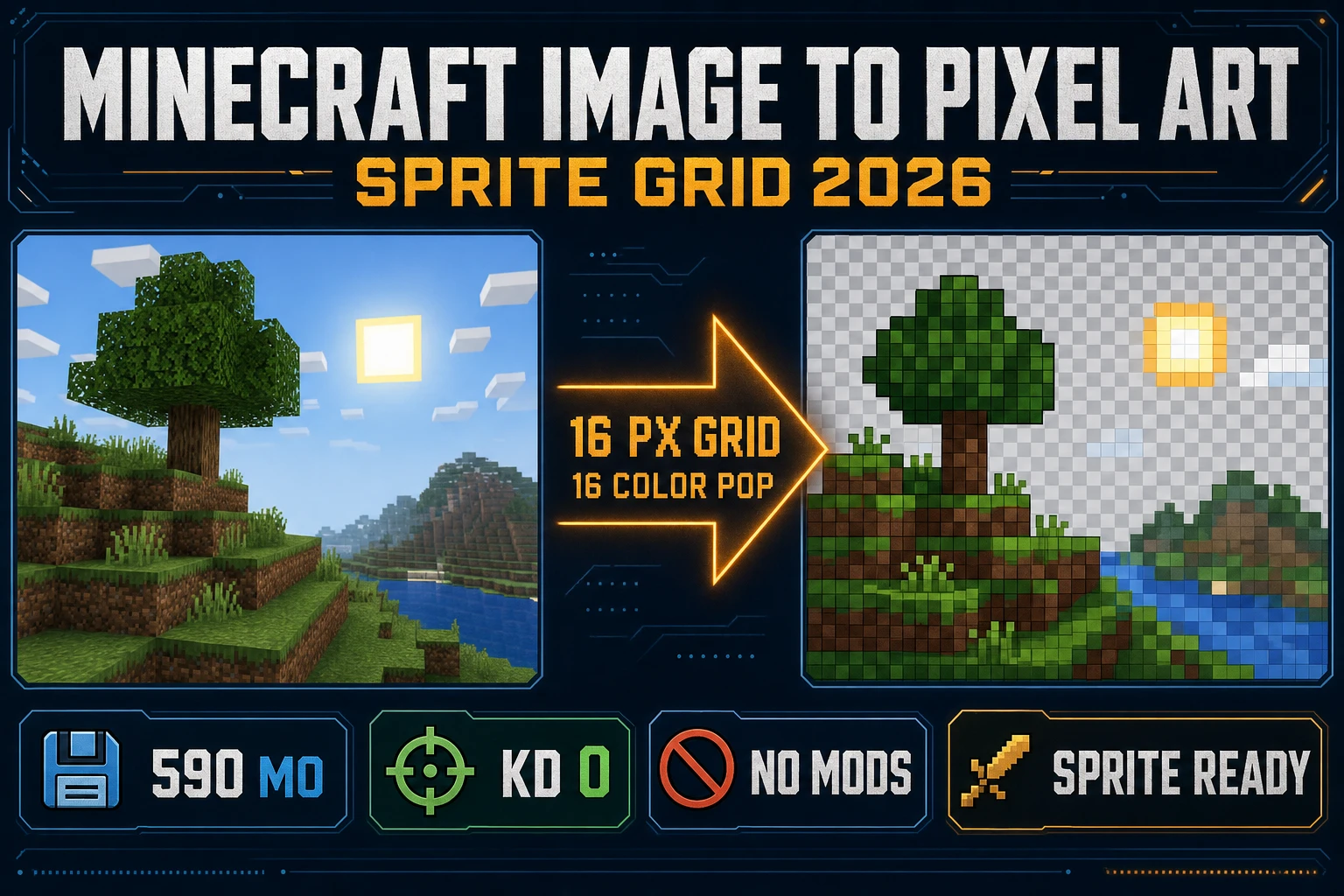
Minecraft Image to Pixel Art (Sprite Grid 2026)

By Arron R.8 min read
Minecraft image to pixel art in 2026 is a three-step browser job — grid-snap to a 16-pixel block, quantize to a 16-color palette, clean edges, export. True Pixe

The reader who types minecraft image to pixel art into Google in 2026 is usually in one of two moods — they just took a nice singleplayer screenshot and want to re-render it as a tidy pixel-art sprite, or they want to run any photo through a Minecraft-style filter so the output lands on the same blocky, 16-color aesthetic the game is famous for. The pipeline is the same either way: grid-snap to a block size, quantize to a tight palette, clean the edges, export. This article walks the honest 2026 browser version of that pipeline — no Photoshop install, no Mojang mods, no Aseprite license — and shows how True Pixel, Quick Sprites, and AI Image Gen wire together into a single-tab workflow. Every tool capability named below is live-verified against the current source in src/app/_home-v2/_data/tools.ts on 2026-10-06.
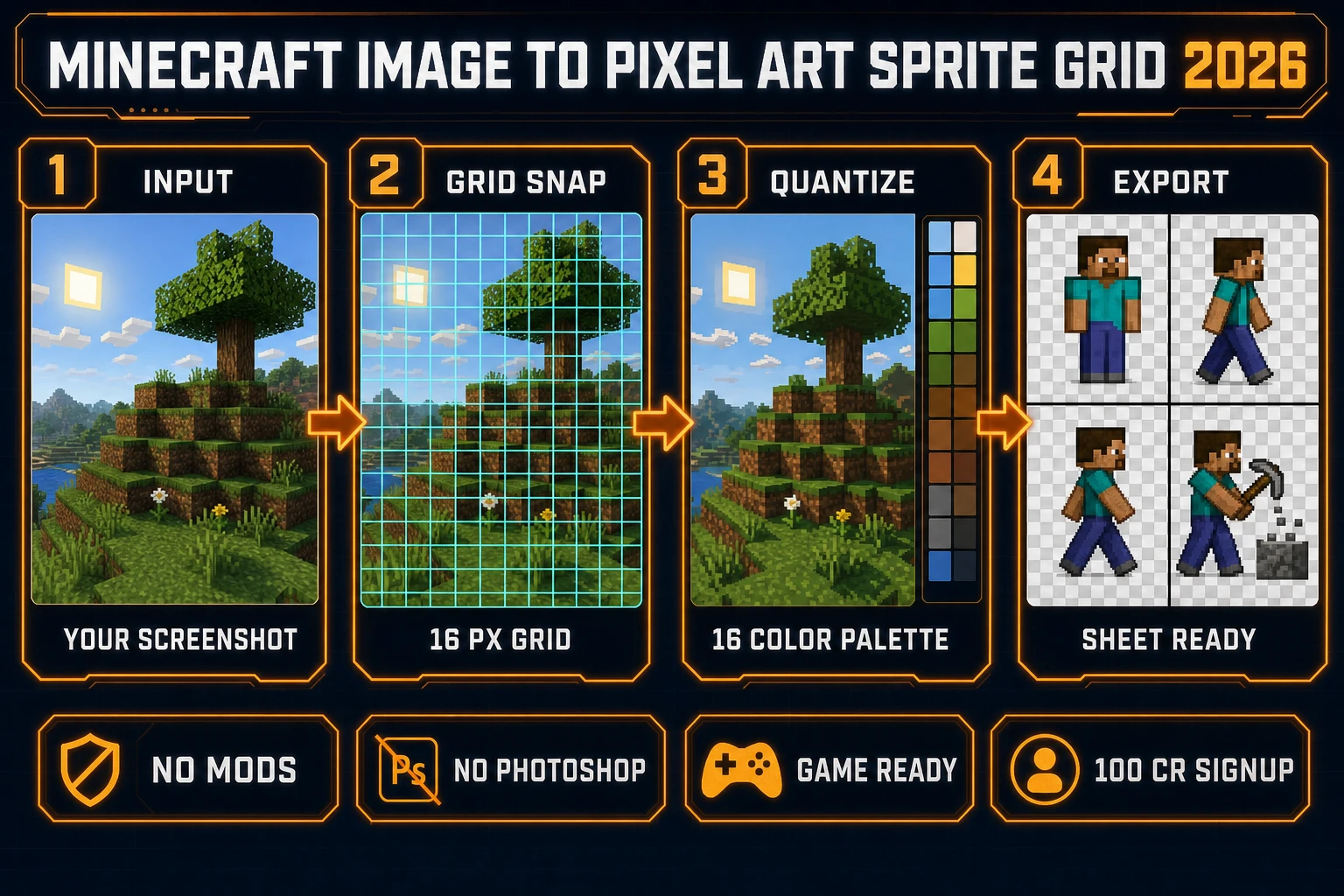
Minecraft image to pixel art sprite grid 2026 pipeline overview
Four passes: your Minecraft screenshot, a 16-pixel grid-snap, a 16-color quantize, and a game-ready sprite sheet. All in one browser tab, no mods required.

What people typing minecraft image to pixel art actually want

DataForSEO lists minecraft image to pixel art at 590 monthly searches, keyword difficulty 0, intent informational (verified 2026-10-06 against tools/research-supplement.md, image-to-pixel-art seed cluster). KD 0 is the giveaway — nobody has written the authoritative long-form answer yet, which is strange given how many Minecraft players also build pixel art outside the game. The reversed phrasing image to minecraft pixel art at 1,300/mo is the other side of the same intent and has had a canonical answer on this blog since May. The two queries overlap but Google treats word order carefully; the natural phrasing minecraft image to pixel art gets its own ranking lane.

The practical question underneath both queries is one sentence: how do I turn a picture into pixel art that looks like Minecraft? That is a three-step technical job (grid-snap, palette quantize, edge clean) with two directional variants (screenshot in, sprite out; any photo in, Minecraft-styled pixel art out). The pipeline is identical for both.

Minecraft-style pixel art rules — what makes it on-model

Minecraft's visual identity is not accidental — it is the strict result of four technical rules. Honor the rules and the output reads as Minecraft; break any one of them and it reads as "generic pixel art." The four rules:

  • Block grid at 16 pixels per side. Minecraft's default resource pack ships 16-pixel-per-side textures per block. That is the natural grid-snap target. Snap to 32 for a 2× scale, 8 for a half-scale, but never to a non-power-of-two.
  • Tight, saturated palette — about 16 to 24 colors. The Wikipedia Pixel art article notes that "low overall color count" is a defining characteristic of the medium (verified 2026-10-06). Minecraft takes that further — the default pack lives on roughly 16 to 24 distinct, high-saturation colors: grass green, dirt brown, stone grey, water blue, redstone red, lava orange, iron grey, gold yellow, wool white, sky blue, and a handful of accents. Quantize to 16 colors first; add up to 8 more only if your source genuinely needs them.
  • Hard edges, no anti-aliasing. Every pixel is either on or off a given color. There are no half-opacity halos at the edge of a creature's silhouette. If your source photo has soft outlines, you need an edge-cleanup pass to force every border pixel to a solid palette color.
  • Flat tones, three steps max per surface. No gradients. A grass block uses two or three green tones total — a top highlight, a mid, a shadow. The gradient look is what gives away "I ran this through a photo filter"; the three-step flat shading is what sells it.

These four rules are what the browser pipeline enforces automatically. You do not have to pixel-push by hand — the tool quantizes the palette, snaps the grid, and cleans the edges in one pass. You just pick the knobs.

The browser pipeline in five clicks

The whole flow lives at True Pixel. The tool's in-source description (src/app/_home-v2/_data/tools.ts lines 185 to 198, verified 2026-10-06) reads verbatim: "Convert any image or video into pixel-art sprites and sprite sheets. Chroma keying, clean outlines, edge cleanup, and batch processing — all built in." That is the whole pipeline in one tool. The five clicks:

  1. Drop your source. A Minecraft screenshot, a photo of a friend, an AI-generated concept piece — anything PNG, JPG, WebP, or MP4. Video sources get processed frame-by-frame.
  2. Set the grid. 16 for Minecraft-default, 32 for a higher-detail Minecraft-style, 8 for a chunky retro feel.
  3. Set the palette. 16 colors is the Minecraft-faithful setting. The quantizer picks the 16 colors from your source that best preserve the image, which is almost always closer to the Minecraft palette than a hand-curated swatch would be.
  4. Flip edge-cleanup on. Chroma keying removes a solid background in one click; edge cleanup forces every border pixel to a solid palette color (no partial-opacity halos).
  5. Export. PNG for a single frame, sprite-sheet PNG + JSON for an animated sheet, WebP for a smaller web asset.

No install. No Photoshop license. No Minecraft account. The whole pass runs in a browser tab, free up to the trial limits of the signup grant.
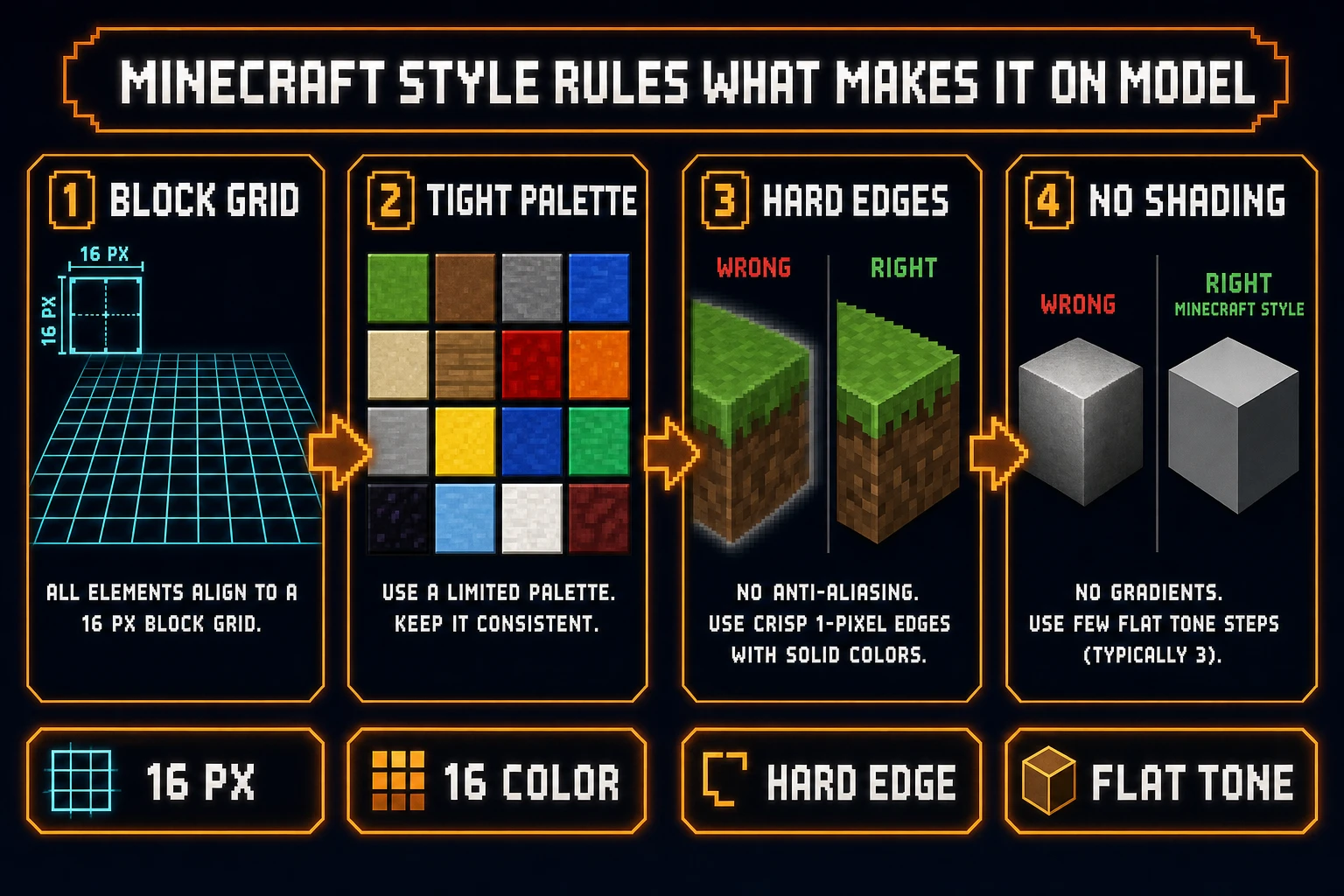
Minecraft style pixel art rules — block grid, tight palette, hard edges, flat tones
Four technical rules sell the Minecraft look: 16-pixel grid, 16-color palette, hard edges, three-step flat shading.

Three honest use cases

Different sources, same pipeline, different outputs. The three cases that actually show up in traffic:

1. Minecraft screenshot → portable sprite

You took a nice shot of your base, a creeper close-up, or a redstone contraption. The pipeline collapses it to a 16-pixel-grid sprite you can print as a sticker, drop into a profile picture, or paste into a game as a standalone image. Start with 16-pixel grid, 16-color palette, chroma-key the background to transparent, export PNG. Done in under 30 seconds per screenshot.

2. Any photo → Minecraft-themed fan art

A photo of your pet, a landscape, a self-portrait, run through the Minecraft aesthetic. Same settings, but increase the color budget to 24 if the source has distinct skin tones or complex lighting the 16-color pass flattens too hard. The MDN Canvas pixel-manipulation page is the honest technical reference for what the quantizer does under the hood if you want to understand the ImageData math (verified 2026-10-06).

3. Original art → sprite sheet for a Minecraft-styled game

You are not re-using Mojang's textures — you are shipping your own Minecraft-inspired game and need a sheet of blocky creatures, props, or tiles. Generate the base frame in AI Image Gen (tool at /generate, hosts the current image-model lineup per the in-source constants verified 2026-10-06), route the single frame through True Pixel for the quantize pass, then into Quick Sprites to extrapolate the walk cycle. This is the use case that actually earns the credit cost — a shippable, legally safe asset in minutes instead of hours.

Making the output game-ready

A pixel-art frame on your screen is not the same thing as a game-ready asset. The game engine needs:

  • Transparent background. True Pixel's chroma key removes any single-color background to real alpha. For complex backgrounds, run the clip through the dedicated BG Remover first, then back into True Pixel for quantize.
  • Consistent frame size. Every frame in a sprite sheet needs to be the same width and height so the engine can slice the atlas on a fixed grid. True Pixel's batch mode enforces this when you process a video or image sequence.
  • Atlas metadata. Phaser, Three.js, Godot, and Unity all expect an atlas JSON that names each frame. Quick Sprites emits this alongside the sheet PNG. Phaser — the 2D-only HTML5 framework with WebGL and Canvas rendering, maintained for 11-plus years by Phaser Studio Inc (verified 2026-10-06) — reads the atlas directly through its loader; no conversion step.
  • A tight power-of-two sheet size. Mobile GPUs still prefer power-of-two texture dimensions (256, 512, 1024, 2048 pixels per side). The sheet exporter pads to the next power of two automatically; just do not override it.

Scaling up — a full Minecraft-styled sprite sheet

A single sprite is a 30-second job. A full sheet of blocky creatures and tiles for a jam-grade game is a 20-minute job if you lean on the right tools. The flow:

  1. Prompt the base frame in AI Image Gen: "voxel-style blocky creature, Minecraft palette, front-facing, 32-pixel sprite, flat shading, no anti-aliasing." The model generates several candidates; pick the one closest to on-model.
  2. Quantize in True Pixel to 16 colors at a 16- or 32-pixel grid. This is the step that locks the Minecraft look.
  3. Hand the frame to Quick Sprites with a direction brief ("walk cycle, 4 frames, side profile"). The in-source description for Quick Sprites (verified 2026-10-06 at src/app/_home-v2/_data/tools.ts line 537) is literally "AI-generated animated pixel sprite sheets" — this is the job it was built for.
  4. Review and iterate. Any frame that drifts off the palette, re-quantize in True Pixel. Any frame with motion artifacts, regenerate in Quick Sprites with a tighter brief.
  5. Export as a Phaser-ready atlas and drop into your project.

A reasonable jam-grade target: one hero sheet, three enemy sheets, two tile sheets. All five fit comfortably inside the signup credit grant plus a few hundred top-up credits — the Sorceress credit math is CREDITS_PER_DOLLAR = 100 (verified at src/lib/models.ts line 69, 2026-10-06), so a dollar covers roughly a dozen generated frames plus unlimited quantize passes.

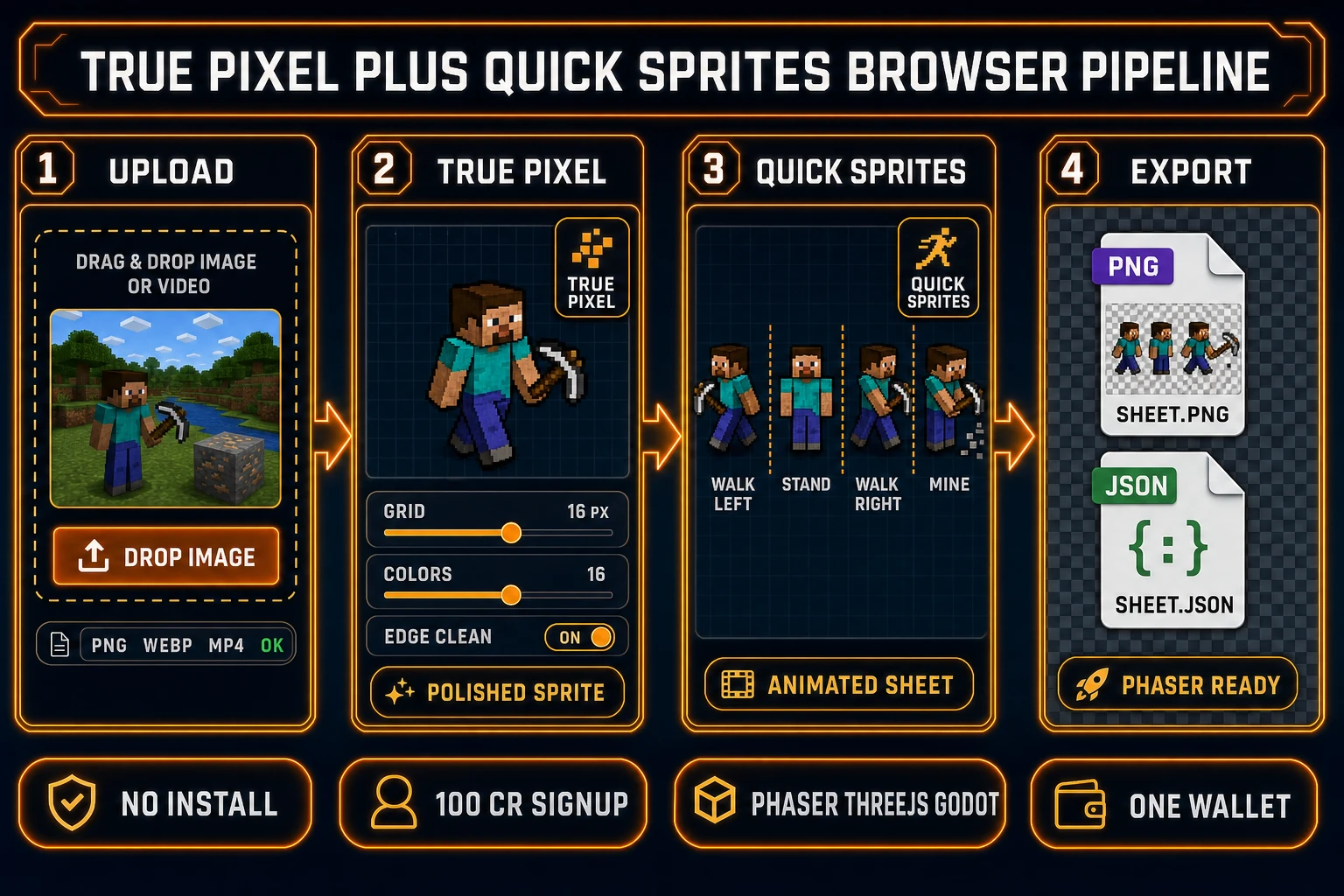
True Pixel and Quick Sprites browser pipeline for Minecraft image to pixel art
Upload any image, quantize in True Pixel, extrapolate the sheet in Quick Sprites, export a Phaser-ready atlas. One wallet, one browser tab.

Your minecraft image to pixel art workflow in five clicks

Pulling the whole article together into something you can act on in under five minutes:

  1. Open True Pixel. No account required for the trial pass.
  2. Drop your source image. A Minecraft screenshot, a photo, or an AI-generated base frame.
  3. Set grid 16, palette 16, edge-cleanup on. That is the Minecraft-default preset. For 2× detail, set grid 32 and palette 24.
  4. Export the frame. PNG with transparent background if you intend to use it as a sprite; WebP if you intend to use it as a profile picture or print.
  5. Hand off to Quick Sprites if you need animation. Otherwise the frame is already game-ready.

That is the entire pipeline. The alternative — hand-pixeling every frame in an installed editor — still has its place for artists who want pixel-level control, but it is no longer the fastest path from "I have an image" to "I have a Minecraft-styled sprite sheet in my game." The browser pipeline wins on time, cost, and the hidden one — it works the same on a Chromebook, a Steam Deck in desktop mode, or a borrowed laptop at a jam.

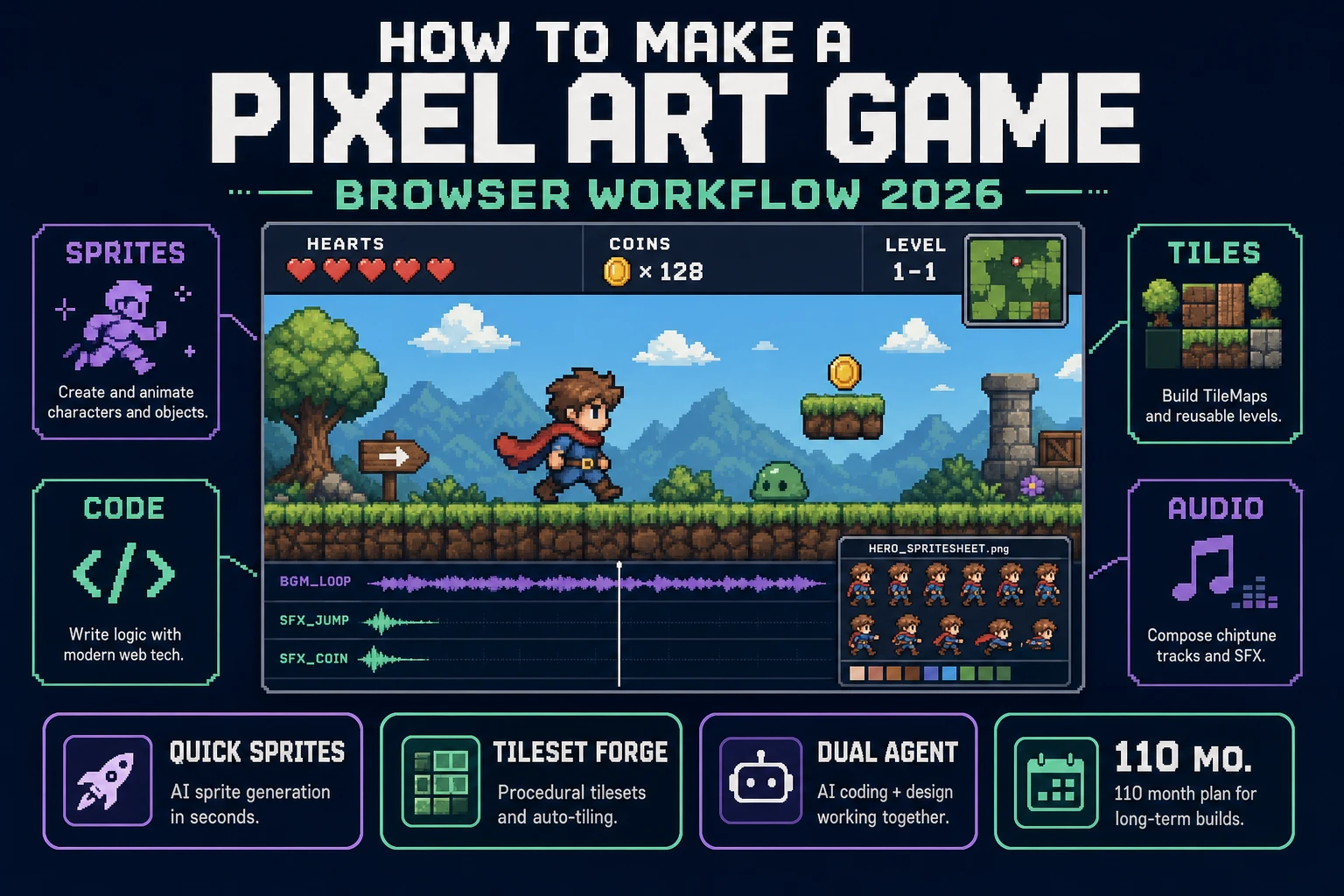
If you want to see the companion piece that angled the reversed phrasing — "any image → Minecraft-style pixel art, no mods" — the shipped post is image to minecraft pixel art. For the broader "convert any image to pixel art" pipeline that is not Minecraft-specific, see convert an image to pixel art. For the grid-snap deep dive on arbitrary pixel-art converters, see image to pixel art converter grid snap. And for the full "how to make a pixel-art game" track that follows this one, see how to make a pixel art game. The tools guide covers the rest of the Sorceress stack that composes with True Pixel.

Frequently Asked Questions

What does minecraft image to pixel art actually mean?

In practice it covers two directions that use the same pipeline. Direction one: you have a Minecraft screenshot (a build, a mob, a redstone contraption) and you want to turn it into a tidy pixel-art sprite — the kind you can drop into a sprite sheet for a game or print as a sticker. Direction two: you have any photo or illustration and you want to re-render it in the Minecraft aesthetic — big blocky pixels, a 16-ish color palette, hard edges, no anti-aliasing. Both are three-step browser jobs today: grid-snap to a block size, quantize to a tight palette, export. True Pixel at the Sorceress `/pixel-art` tool handles all three and does not require an install or a Minecraft account.

What block size and palette should I use for Minecraft-style pixel art?

Minecraft itself uses 16-pixel textures per block in its default resource pack, so 16×16 is the natural grid-snap target when you want the output to feel on-model. The default palette collapses into roughly 16 to 24 distinct, saturated colors — grass greens, dirt browns, stone greys, water blues, redstone and lava reds, plus the lighter tones used for sand, wool, and glass. For a Minecraft-image-to-pixel-art pass, start with a 16×16 grid, quantize the output to 16 colors, then widen to 24 only if the source has distinct skin tones or UI chrome you need to preserve. Verified against the Wikipedia Pixel art article (2026-10-06), low overall color count is one of pixel art's defining characteristics; the limitation is the aesthetic.

Can I use the Minecraft logo or official textures in my output?

The pipeline is a conversion technique — what you own on the way in is what you own on the way out. A screenshot of your own singleplayer build re-rendered as pixel art is fair personal use. Minecraft's official textures and the Minecraft wordmark are trademarks of Mojang / Microsoft and are not safe to redistribute, resell, or ship inside a commercial game. If you are shipping a game, use the pipeline to generate Minecraft-styled original art — your own blocky creatures, your own tileset, your own color palette — not literal re-exports of Mojang's assets. The aesthetic is not copyrighted; the specific textures and the Creeper silhouette are.

Can I turn the pixel-art output into an animated sprite sheet?

Yes, and that is where Quick Sprites earns its credit cost. The Sorceress Quick Sprites tool at `/quick-sprites` is described in-source (verified 2026-10-06 at `src/app/_home-v2/_data/tools.ts` line 537) as 'AI-generated animated pixel sprite sheets'. Feed it the single quantized pixel-art frame plus a direction prompt ('walk cycle, 4 frames, side profile, Minecraft-style palette') and it extrapolates the missing frames while keeping your palette and block size intact. The output is a Phaser-ready sheet — Phaser is a 2D-only HTML5 framework with WebGL + Canvas rendering, maintained for 11+ years by Phaser Studio Inc (verified 2026-10-06 at docs.phaser.io), and its atlas loader eats the sheet without conversion.

Do I need Photoshop or Aseprite to clean the final pixels?

No. The whole point of the browser pipeline is that you do not install anything. True Pixel's edge-cleanup pass handles the one problem that is annoying to fix manually — anti-aliased or stray partial-opacity pixels at the edges of a Minecraft-style shape. If you later want to hand-touch a single pixel, the Sorceress Canvas tool (included in the Sprites & 2D group) opens the frame as a plain pixel grid in-browser. For most Minecraft-image-to-pixel-art passes you will never leave True Pixel; the only reason to open an external editor is if the output needs manual palette work beyond what the tool exposes.

How much does the full pipeline cost?

The grid-snap and palette quantize passes in True Pixel are included in the Pro tier (verified in-source 2026-10-06). AI Image Gen frames (for filling in walk-cycle poses) run on the standard credit lane. The Sorceress credit math is CREDITS_PER_DOLLAR = 100 (verified at `src/lib/models.ts` line 69, 2026-10-06), so a single dollar covers roughly a dozen generated frames plus unlimited quantize passes. The 100-credit signup grant covers a full Minecraft-themed sprite sheet before you spend anything — enough to prove the pipeline works on your source image, not enough to ship an entire game. For a jam-grade Minecraft-styled project (one hero, three enemies, two tilesets), budget 500 to 1000 credits total.

Sources

  1. Pixel art — Wikipedia
  2. Minecraft — Wikipedia
  3. Pixel manipulation with canvas — MDN Web Docs
  4. What is Phaser? — Phaser Help
Written by Arron R.·1,891 words·8 min read

Related posts