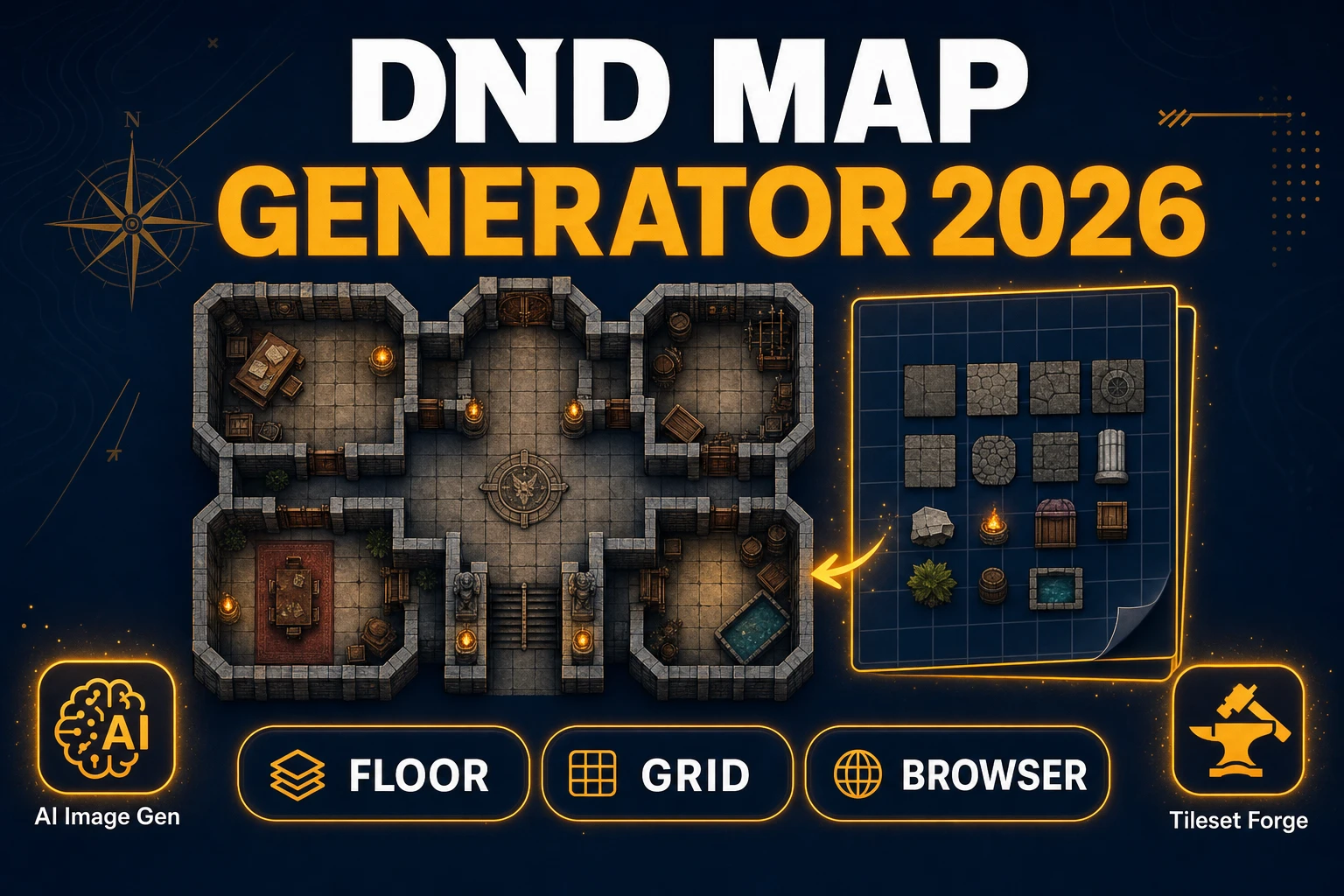
Scout a Dnd Map Generator (Tabletop Floor Plans 2026)

By Arron R.8 min read
A dnd map generator in 2026 is a four-step browser pipeline: AI Image Gen locks top-down floor plans, Tileset Forge snaps walkable tile grids, Canvas annotates

Most jam dungeon crawls stall on the same asset: combat works, loot tables exist, and then every fight happens on a blank rectangle. Searchers typing dnd map generator on July 12, 2026 want top-down floor plans their party can measure — rooms, doors, corridors, cover — not a pretty concept painting they have to redraw onto a grid by hand. This guide covers the 2026 browser pipeline: AI Image Gen locks the map card and batches floor plans, Tileset Forge snaps walkable tile grids, and Canvas annotates rooms before Phaser 4.2 or a VTT exports the pack. Tool costs below are verified against the live Sorceress source on July 12, 2026.
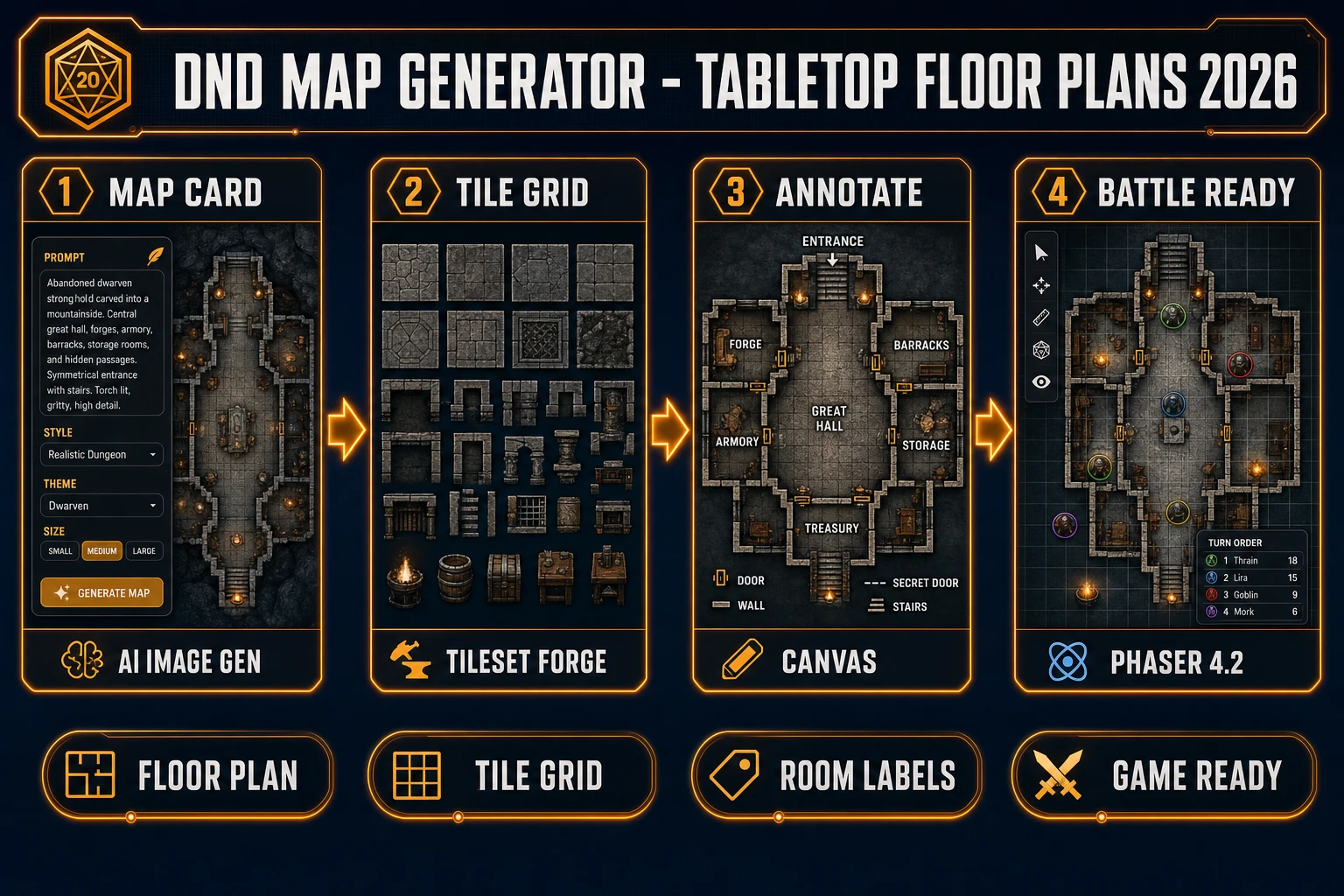
DnD map generator in 2026, four-step browser pipeline from AI Image Gen top-down floor plans through Tileset Forge grids and Canvas labels to Phaser battle-ready maps, verified July 12, 2026
A dnd map generator in 2026 means four moves: map card in AI Image Gen, tile snap in Tileset Forge, room labels in Canvas, then Phaser 4.2 or VTT export.

What a dnd map generator outputs for tabletop floor plans

The phrase dnd map generator (4,400/mo, KD 44 per DataForSEO probe-fresh-seeds-5.md verified July 11, 2026) targets a GM or indie developer who needs a playable battle surface, not a world atlas. Sibling queries in the same cluster — dnd generator map (4,400/mo, KD 44), map generator dnd (4,400/mo, KD 27), dungeon floor plan, and battle map generator — all describe the same deliverable: a top-down layout with stable room IDs, door openings, and a readable grid your tokens or sprites can occupy tonight.

Game and tabletop pipelines need structured output. Ship a PNG (or WebP) floor plan, a matching tileset atlas for walkable floors and walls, and a short room table with id, name, exits, and cover so lighting, spawns, and encounter scripts share keys. Pair that pack with the AI fantasy map generator post when you need coasts and kingdoms at campaign scale, and with the DnD NPC generator post when named residents belong in those rooms. World overviews and NPC cards are different jobs — keep the dnd map generator focused on the encounter floor.

Why screenshot dumps stall playable battle maps

A dungeon in tabletop play is a spatial puzzle: sight lines, choke points, and cover decide fights. A chat screenshot of a “cool crypt” has no grid scale, no door width, and no walkable vs blocked distinction. You print it, guess at 5-foot squares, argue about whether the pillar blocks a fireball, and lose an hour before initiative.

Battle maps exist because freehand sketches fail under token density. Players need edges they can count. Digital VTTs and browser engines both assume a tile-aware surface — the same reason tile-based games still dominate 2D RPG movement. An unconstrained concept render almost always ships a painterly mess: beautiful shadows that hide doors, perspective that lies about corridor width, and no atlas you can reuse for the next three rooms.

Practical failure modes show up in session zero. Two maps that contradict each other’s exit labels make the crypt feel pasted. A “door” that is only three pixels wide teaches players to ignore the art. Treat the map card as production data: lock scale and room count first, batch top-downs second, reject any image that breaks the grid or invents a fourth exit the card did not list. That discipline is what separates a usable dnd map generator pipeline from a novelty wallpaper.

The Sorceress dnd map generator pipeline in four steps

Every shippable tabletop floor plan ships four runtime pieces regardless of art style: map card, tile grid, annotations, and export. In 2026 each maps to one Sorceress tool verified against the live catalog on July 12, 2026:

  • Top-down floor plans: AI Image Gen (AI Credits) at 1:1 for battle maps; credit cost varies by model via getModelCredits in src/lib/models.ts (Z-Image at 3 credits for fast iteration, Nano Banana Pro at 18 for hero maps).
  • Walkable tilesets: Tileset Forge (Pro badge) extracts, aligns, and previews tile grids from the AI art so floors and walls snap cleanly.
  • Room labels and doors: Canvas (Free badge) paints labels, door markers, and cover icons without leaving the browser.
  • In-game or VTT runtime: WizardGenie scaffolds a Phaser 4.2.0 tilemap scene, or you drop the annotated PNG into any VTT that accepts battle-map images.

Pricing is a $49 lifetime unlock plus pay-as-you-go credit packs. Starter $10/1,000 credits, Creator $20/2,000, Plus $50/5,000, Studio $100/10,000. Verified against src/app/plans/page.tsx lines 46 and 51–54. New accounts ship with 100 starter credits. The Sorceress tools guide lists every tool in the catalog. Tileset Forge and Canvas badges verified July 12, 2026 against src/app/_home-v2/_data/tools.ts (Pro and Free respectively).
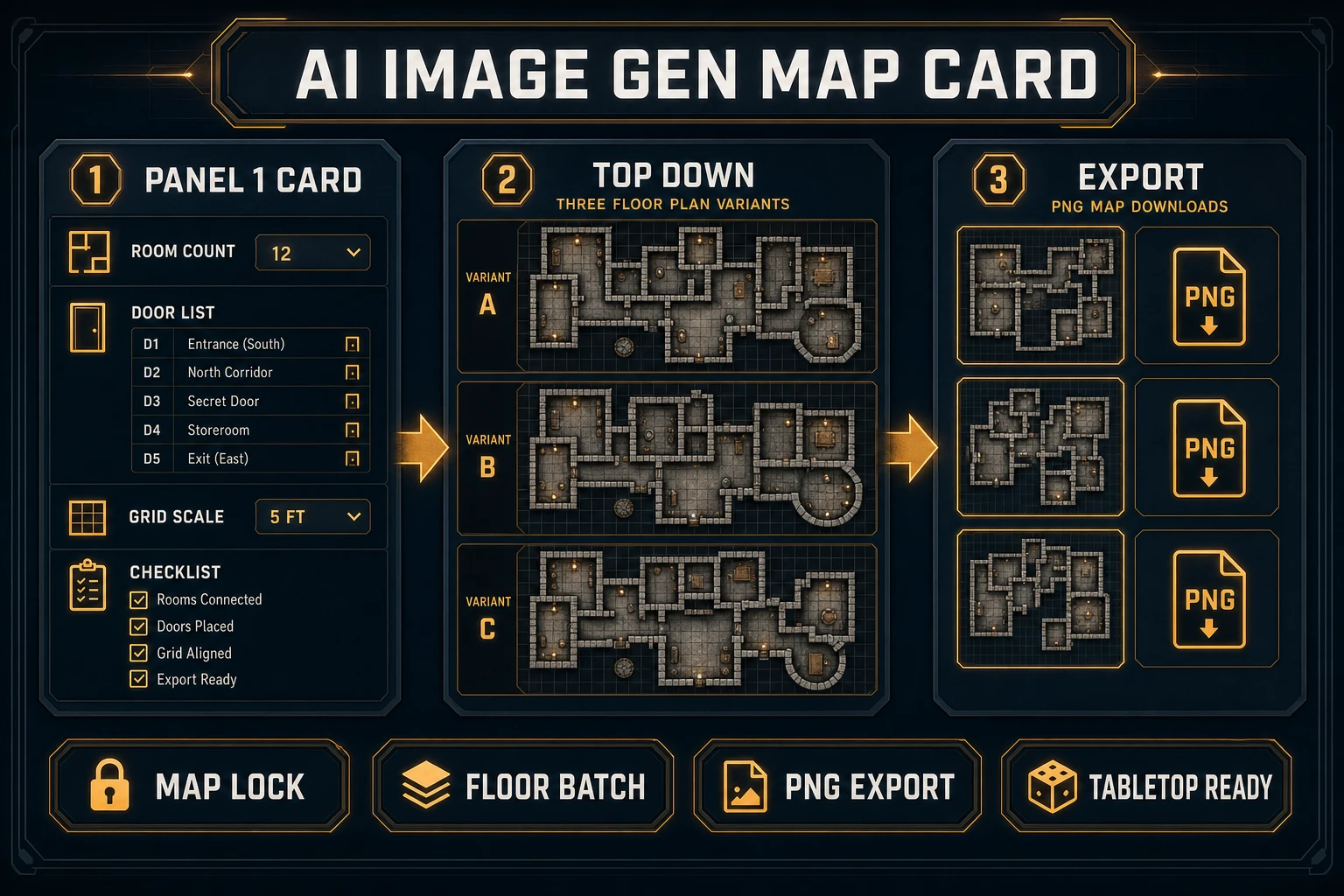
AI Image Gen map card and top-down dungeon floor plan batch for a dnd map generator workflow, verified July 12, 2026
AI Image Gen locks the map card — room count, exits, grid scale — before Tileset Forge or Canvas touch the file.

Step 1 — lock a map card and prompt AI Image Gen

Open AI Image Gen and write a map card before you batch pretty renders. Example card: “Ash Crypt Level 1, top-down orthographic, 1:1, 20×20 grid implied, four rooms (vestibule, west wing, east wing, boss crypt), three doors, one collapsed corridor, stone floor, no perspective, no UI chrome, no text, torch light only.” Paste that card as a reusable prompt prefix. Z-Image at 3 credits is enough to explore layouts; spend Nano Banana Pro (18 credits default 1K/2K) only when the layout is locked and you need a hero battle map for the store page.

Reject any output that invents a fifth room, warps into isometric, or paints illegible corridors. Treat the card like a production bible: head count of rooms, exit list, and “no text in image” are non-negotiable. If you also need a campaign atlas after tonight’s fight, cross-link the fantasy-map sibling once the dungeon pack stabilizes — do not mix world coasts into a battle-map batch.

Keep the batch ruthless. Three variants of the same card beat fifteen unrelated crypts. Name files to match room packs (ash_crypt_l1_a.webp) so Tileset Forge and Canvas stay in sync. When a map needs a named resident later, pull display names from your fantasy name generator roster by npc_id instead of inventing spellings on the map labels.

Step 2 — snap walkable tiles in Tileset Forge

Drop the winning top-down into Tileset Forge. The tool’s job is the unglamorous half of a dnd map generator: detect tile edges, align AI art to a clean grid, preview seams, and export a sheet your engine or VTT can trust. Verified July 12, 2026: Tileset Forge is Pro-badge in tools.ts, covered by the $49 lifetime unlock — no per-tile credit burn for the alignment pass itself.

Audit the sheet like production data. Walk every floor tile for seam breaks. Confirm wall thickness stays consistent across doorways. Export a jam subset first (floors + walls + one door tile) so you are not polishing twenty decorative props before the party can move. Tile-based movement only feels fair when the atlas matches the art players see — that is why Forge sits between Image Gen and Canvas, not after labels.

If a tile refuses to align, do not “fix” it with a blurry upscale. Re-prompt Image Gen with a stricter orthographic clause, or crop the offender in Canvas and re-run Forge on the cleaned crop. Iteration on the map card beats shipping a warped atlas that breaks pathfinding. When you need seamless filler for large open courtyards, pair Forge with Seamless Tile Gen for grass or stone loops — keep the structural walls and doors on the Forge atlas so collision stays honest.

Document the atlas once. Write a one-line legend next to each tile ID (floor_a, wall_n, door_open) in a markdown file beside the PNG. Future-you will thank that file when WizardGenie asks which tile blocks diagonal movement. The dnd map generator pipeline only scales when the atlas legend and the room JSON share vocabulary.

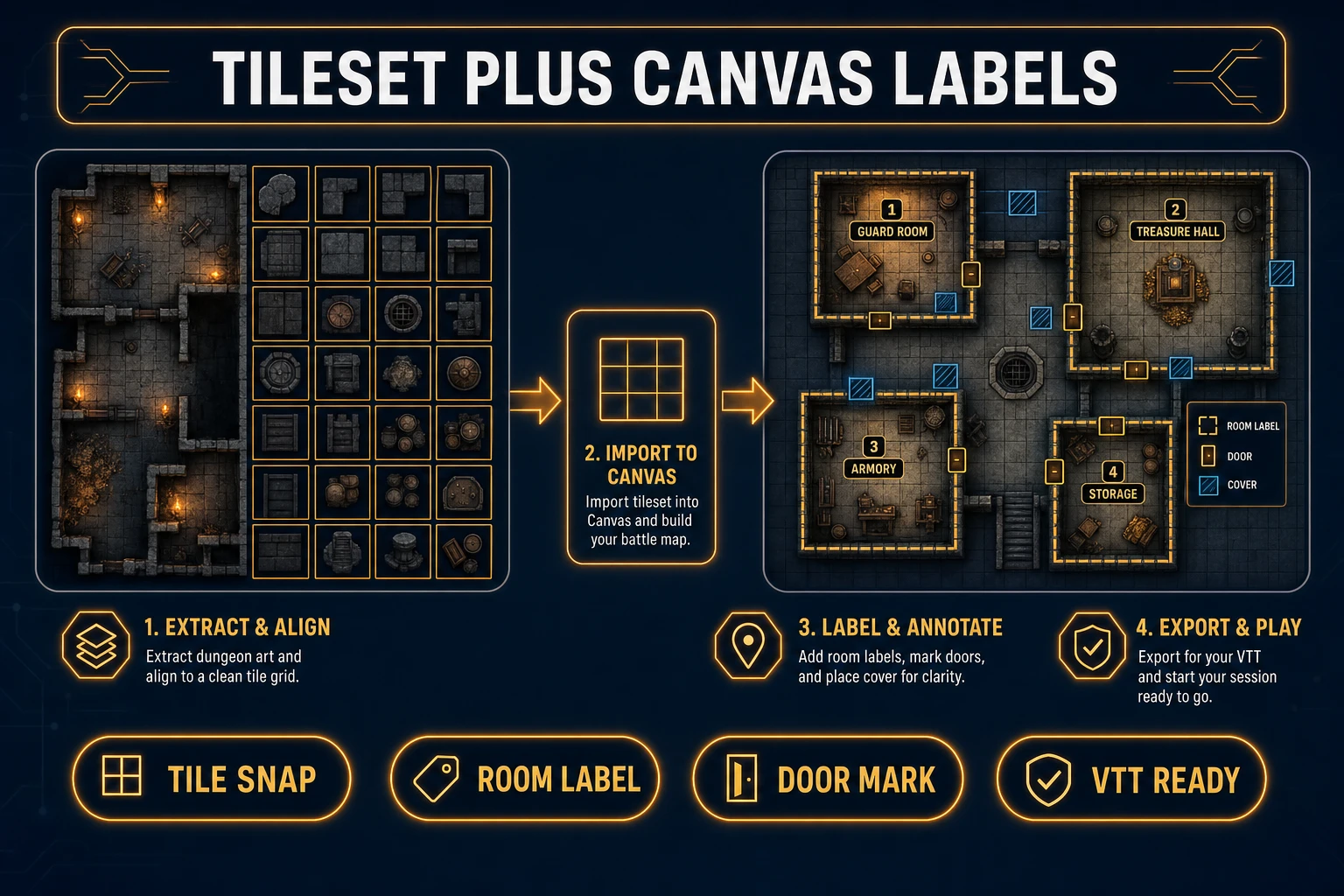
Tileset Forge tile grid and Canvas room labels for a dnd map generator battle map pack, verified July 12, 2026
Tileset Forge snaps the walkable atlas; Canvas closes the dnd map generator loop with room names, door marks, and cover icons keyed to the same IDs.

Step 3 — annotate rooms in Canvas and export for Phaser or VTT

Open the annotated pass in Canvas (Free). Paint short room labels (VESTIBULE, WEST WING, BOSS CRYPT), mark doors with a consistent icon, and drop cover glyphs on pillars and crates. Keep labels outside token footprints when you can — GMs zoom; players click. Export a clean PNG for the VTT and keep an unlabeled twin for in-engine tilemaps if your HUD will draw its own names.

Shipping is where amateur pipelines die. Phaser 4.2.0 “Giedi” (released June 19, 2026, verified against phaser.io release notes on July 12, 2026) is the honest browser runtime for a playable dungeon loop. Ask WizardGenie: “Generate a Phaser 4.2 TilemapScene that loads assets/maps/ash_crypt_l1.json, uses the Tileset Forge atlas for floors and walls, places spawn markers from a room table, and toggles a debug grid overlay.” Desktop and web WizardGenie both work — pick the surface you already use for coding.

For pure tabletop, skip Phaser and drop the Canvas PNG into your VTT as a battle map. The same dnd map generator pack serves both audiences when you keep IDs stable: room_id in the JSON matches the label paint and the spawn list. If you need branching quest prose for those rooms next, the AI dungeon story generator sibling covers graph-first narrative after the floor plan locks.

{
  "id": "ash_crypt_l1",
  "grid": { "cols": 20, "rows": 20, "feetPerCell": 5 },
  "rooms": [
    { "id": "vestibule", "exits": ["west_wing", "east_wing"], "cover": ["pillar_a"] },
    { "id": "boss_crypt", "exits": ["antechamber"], "cover": ["sarcophagus"] }
  ],
  "tileset": "ash_crypt_atlas.png",
  "battleMap": "ash_crypt_l1_labeled.png"
}

What a dnd map generator session costs on Sorceress in 2026

Pricing verified July 12, 2026 against src/app/plans/page.tsx (LIFETIME_PRICE = 49). Sorceress base unlock is $49 one-time for the full tool suite. AI credits are pay-as-you-go: Starter $10 for 1,000 credits, Creator $20 for 2,000, Plus $50 for 5,000, Studio $100 for 10,000. A single three-room crypt with two layout variants, one Forge atlas, and Canvas labels typically burns twenty to eighty credits total — often under $1 on top of the lifetime unlock if you stay card-first on Z-Image. Tileset Forge and Canvas sit on Pro/Free badges under lifetime; WizardGenie coding runs on your own API keys.

Compare that to renting a map subscription plus redrawing every door by hand every time the boss room changes. The integrated dnd map generator path wins on both money and iteration speed: change the card’s exit list, regenerate two top-downs, re-snap Forge, re-label Canvas, reload — done in minutes. Browse the full stack at Sorceress Tools Guide or see plans for credit tiers. For landscape backdrops behind the grid, the AI landscape generator post covers scene art; for party faces on the initiative tracker, use the AI avatar generator sibling.

The category shift is simple: a dnd map generator in 2026 is not a novelty wallpaper spinner. It is a production pipeline — locked map cards, walkable atlases, labeled battle surfaces, engine-ready JSON — that respects how battle maps actually get used at the table and in the browser. Sorceress built the pieces to run that pipeline in one account; your job is to lock room count and exits before you ask for pretty stone.

Frequently Asked Questions

What is a dnd map generator used for in game development?

A dnd map generator drafts reusable top-down floor plans for tabletop sessions and browser RPGs — rooms, corridors, doors, and cover that stay on a readable grid. In the Sorceress pipeline (verified July 12, 2026) that means prompting AI Image Gen from a locked map card, snapping walkable tiles in Tileset Forge (Pro), annotating rooms in Canvas (Free), and exporting for Phaser 4.2 or a VTT.

Is a dnd map generator free on Sorceress?

AI Image Gen spends AI Credits via the live credit math in src/lib/models.ts. Tileset Forge is a Pro-badge tool covered by the $49 lifetime unlock (verified against src/app/plans/page.tsx LIFETIME_PRICE = 49 and tools.ts badge: Pro on July 12, 2026). Canvas is Free. New accounts ship with 100 starter credits.

How is a dnd map generator different from an AI fantasy map generator?

A dnd map generator optimizes for battle-map scale — rooms, doors, and 5-foot grids players can measure. An AI fantasy map generator (see the Chart sibling post) optimizes for world/region overviews with coasts, roads, and kingdoms. Use the dungeon pipeline when you need tonight’s encounter map; use the fantasy-map pipeline when you need the campaign atlas.

Can I export a dnd map generator pack for Phaser or a VTT?

Yes. Export the annotated PNG from Canvas, keep the Tileset Forge sheet as your walkable atlas, and ask WizardGenie for a Phaser 4.2.0 tilemap scene that loads both. Phaser 4.2.0 (Giedi) released June 19, 2026 — verified against the official Phaser download page on July 12, 2026. For tabletop, drop the same PNG into any VTT that accepts a battle-map image.

What does a dnd map generator session cost on Sorceress in 2026?

Verified July 12, 2026 against src/app/plans/page.tsx. Base unlock is $49 one-time. A minimal three-room crypt pack typically burns 20–80 Sorceress credits for top-down variants (model-dependent), Tileset Forge and Canvas under the lifetime Pro/Free badges, and optional WizardGenie scaffolding on your API key — often under $1.00 of Starter-tier credits on top of lifetime if you stay card-first.

Sources

  1. Dungeon - Wikipedia
  2. Battle map - Wikipedia
  3. Tile-based video game - Wikipedia
  4. Phaser v4.2.0 release notes
Written by Arron R.·1,865 words·8 min read

Related posts