Lead an AI Dungeon Master (Tabletop Session AI 2026)

By Arron R.8 min read
An ai dungeon master in 2026 is a four-step browser pipeline: WizardGenie locks session cards and encounter loops, Speech Gen voices NPCs, AI Image Gen boards t

Most jam RPGs stall on the same seat: the party sheet exists, the map is ready, and then nobody wants to referee the table. Searchers typing ai dungeon master on July 12, 2026 want a runnable session loop — scene beats, checks, NPC reactions, fail states — not a chat novel that forgets initiative the moment combat starts. This guide covers the 2026 browser pipeline: WizardGenie locks the session card and encounter JSON, Speech Gen voices NPCs, and AI Image Gen boards the table with scene art before Phaser 4.2 wires the referee UI. Tool costs below are verified against the live Sorceress source on July 12, 2026.
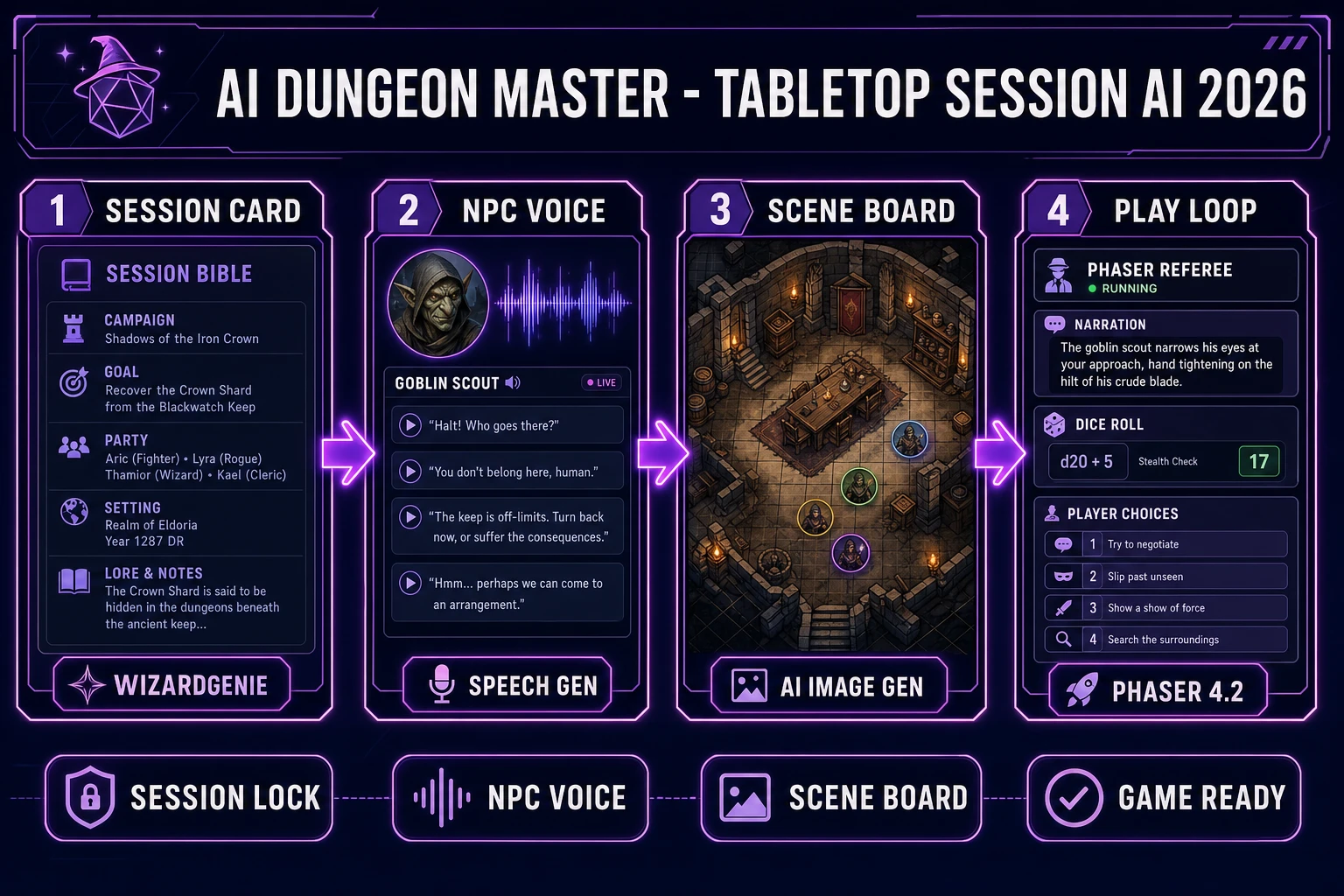
AI dungeon master in 2026, four-step browser pipeline from WizardGenie session cards through Speech Gen NPC voices and AI Image Gen boards to Phaser play loops, verified July 12, 2026
An ai dungeon master in 2026 means four moves: session card in WizardGenie, NPC voice in Speech Gen, scene boards in AI Image Gen, then Phaser 4.2 play.

What an ai dungeon master outputs for indie RPG sessions

The phrase ai dungeon master (1,900/mo, KD 45 per DataForSEO probe-fresh-seeds-5.md verified July 12, 2026) targets a GM-less party, a solo designer prototyping encounters, or an indie shipping a browser RPG who needs a referee that can react. Sibling queries in the same cluster — dnd ai dungeon master (320/mo, KD 45), ai dungeon master dnd (210/mo, KD 19), best ai dungeon master (170/mo, KD 42), and free ai dungeon master (90/mo, KD 55) — all describe the same deliverable: a session that advances on player choices and dice, not a wallpaper paragraph about a crypt.

Production output is structured. Ship a session card (party size, tone, stakes, session length), a beat list with scene_id, checks[], npc_lines, and next_on_success / next_on_fail, optional MP3s keyed by npc_id, and scene boards keyed by the same scene_id. Pair that pack with the AI dungeon story generator post when you need a graph-first adventure spine, and with the DnD map generator post when tonight’s fight needs a measured battle surface. Story graphs and floor plans are different jobs — keep the ai dungeon master focused on the live referee loop.

Why chat-only referees stall playable loops

A Dungeon Master in tabletop play is organizer, narrator, and referee at once: they describe the world, portray every NPC, and adjudicate rules while players control only their characters. A naked chat window can mimic the voice for ten minutes. It cannot keep initiative order, remember which door the rogue jammed, or refuse to invent a fifth act when the session card promised a one-shot.

Tabletop role-playing games survive because consequences stick. Dungeons & Dragons formalized that asymmetry — one seat runs the world, the rest run heroes — and browser RPGs inherit the same split. Unstructured AI chat collapses the split: it puppets player characters, forgets fail states, and rewrites the villain mid-fight because the prompt window has no memory contract.

Practical failure modes show up in playtest zero. Two scenes that contradict each other’s exit labels make the crypt feel pasted. An NPC who changes accent every line teaches players to ignore voice. A “hard check” that always succeeds after a second try teaches players to spam the model. Treat the session card as production data: lock stakes and beat count first, batch prose second, reject any output that invents a fourth act or steals player agency.

The Sorceress ai dungeon master pipeline in four steps

Every shippable session loop ships four runtime pieces regardless of system flavor: session card, voiced NPCs, scene boards, and play UI. In 2026 each maps to one Sorceress tool verified against the live catalog on July 12, 2026:

  • Session cards and encounter JSON: WizardGenie (desktop or web) scaffolds the referee loop on your API key — Claude Opus 4.7, GPT-5.5, Gemini 3.1 Pro, DeepSeek V4 Pro, Kimi K2.5, Grok 4.2, MiniMax M2.7 (verified against CODING_MODELS in src/app/_home-v2/_data/tools.ts).
  • NPC voices: Speech Gen (AI Credits) renders HD narration at 0.5 credits per 1,000 characters with a 1-credit minimum per render (verified against CREDITS_PER_1K_HD and MIN_TTS_CREDITS in src/app/speech-gen/page.tsx).
  • Scene boards: AI Image Gen (AI Credits) batches room and encounter art; credit cost varies by model via getModelCredits in src/lib/models.ts (Z-Image at 3 credits for fast boards, Nano Banana Pro at 18 for hero table art).
  • Playable referee UI: WizardGenie scaffolds a Phaser 4.2.0 scene that loads the JSON, plays Speech Gen clips, and advances on choices and check results.

Pricing is a $49 lifetime unlock plus pay-as-you-go credit packs. Starter $10/1,000 credits, Creator $20/2,000, Plus $50/5,000, Studio $100/10,000. Verified against src/app/plans/page.tsx lines 46 and 51–54. New accounts ship with 100 starter credits. The Sorceress tools guide lists every tool in the catalog.
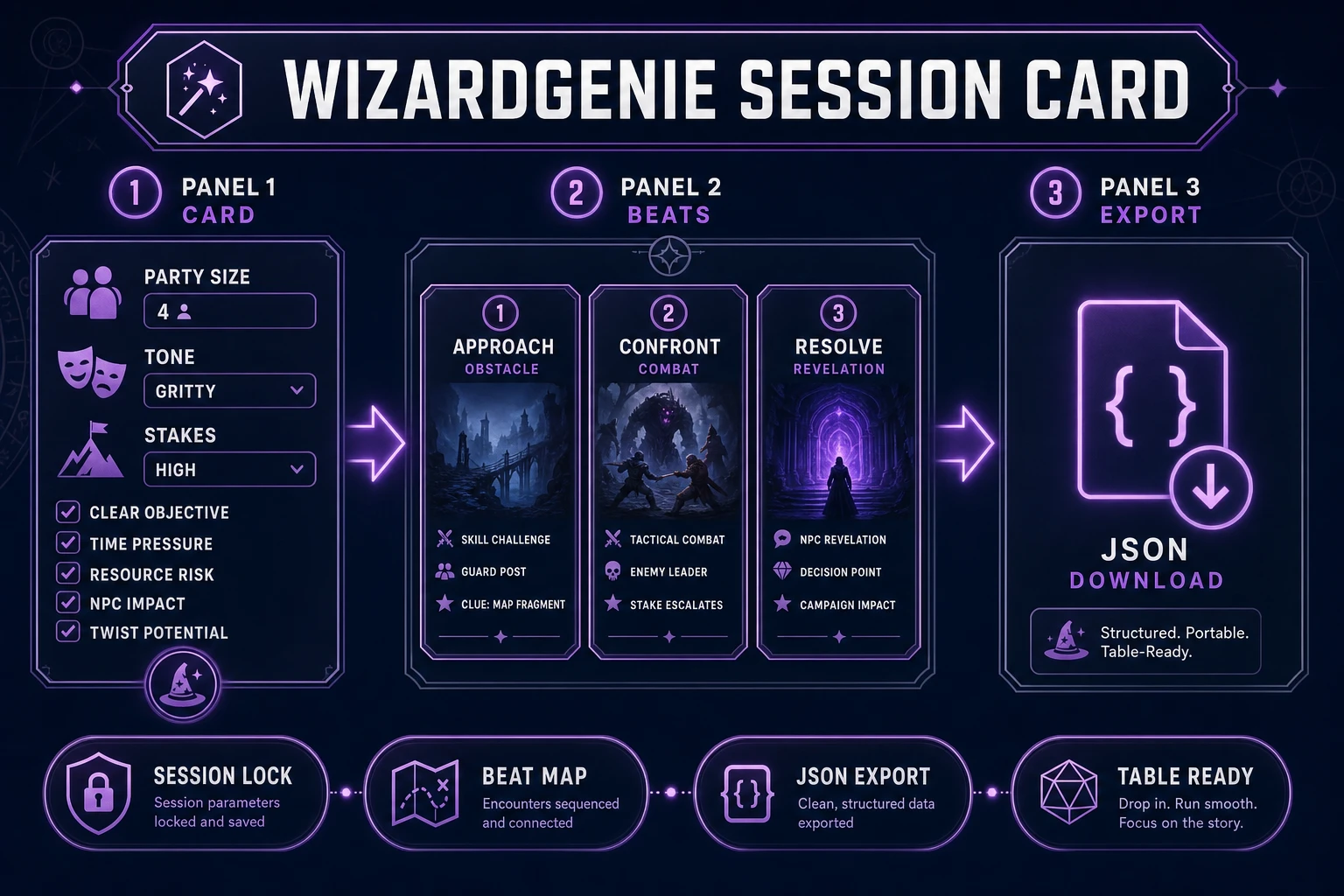
WizardGenie session card and encounter beat map for an ai dungeon master workflow, verified July 12, 2026
WizardGenie locks the session card — party size, tone, stakes, beat count — before Speech Gen or AI Image Gen touch the file.

Step 1 — lock a session card and scaffold in WizardGenie

Open WizardGenie (desktop installer or /wizard-genie/app web) and write a session card before you ask for pretty prose. Example card: “Ash Crypt one-shot, 3–4 players, 90 minutes, grim-hopeful tone, three scenes (vestibule, flooded wing, boss crypt), two hard checks, one social NPC, one combat, no railroading of PC intent, fail-forward on missed checks.” Paste that card as a reusable system prefix. Prefer a cheap executor like DeepSeek V4 Pro for JSON scaffolding; save frontier planners for the one beat that needs careful stakes design.

Ask WizardGenie for a JSON pack, not a novel:

{
  "id": "ash_crypt_oneshot",
  "party": { "size": "3-4", "levelBand": "3-5" },
  "scenes": [
    {
      "id": "vestibule",
      "beats": ["read the carved warning", "choose the west or east door"],
      "checks": [{ "id": "spot_trap", "dc": 13, "onFail": "take_1d4", "onSuccess": "mark_trap" }],
      "npc_lines": [{ "npc_id": "warden_echo", "text": "Turn back. The ash remembers." }],
      "next_on_success": "flooded_wing",
      "next_on_fail": "flooded_wing"
    }
  ]
}

Reject any output that invents a fourth scene, puppets a player character’s feelings, or drops check DCs without onFail paths. Treat the card like a production bible: beat count, tone, and “players control PCs” are non-negotiable. When you need named residents for those scenes, pull display names from the fantasy name generator roster by npc_id, and pull fuller NPC cards from the DnD NPC generator sibling — do not invent spellings mid-session.

Step 2 — voice NPCs with Speech Gen

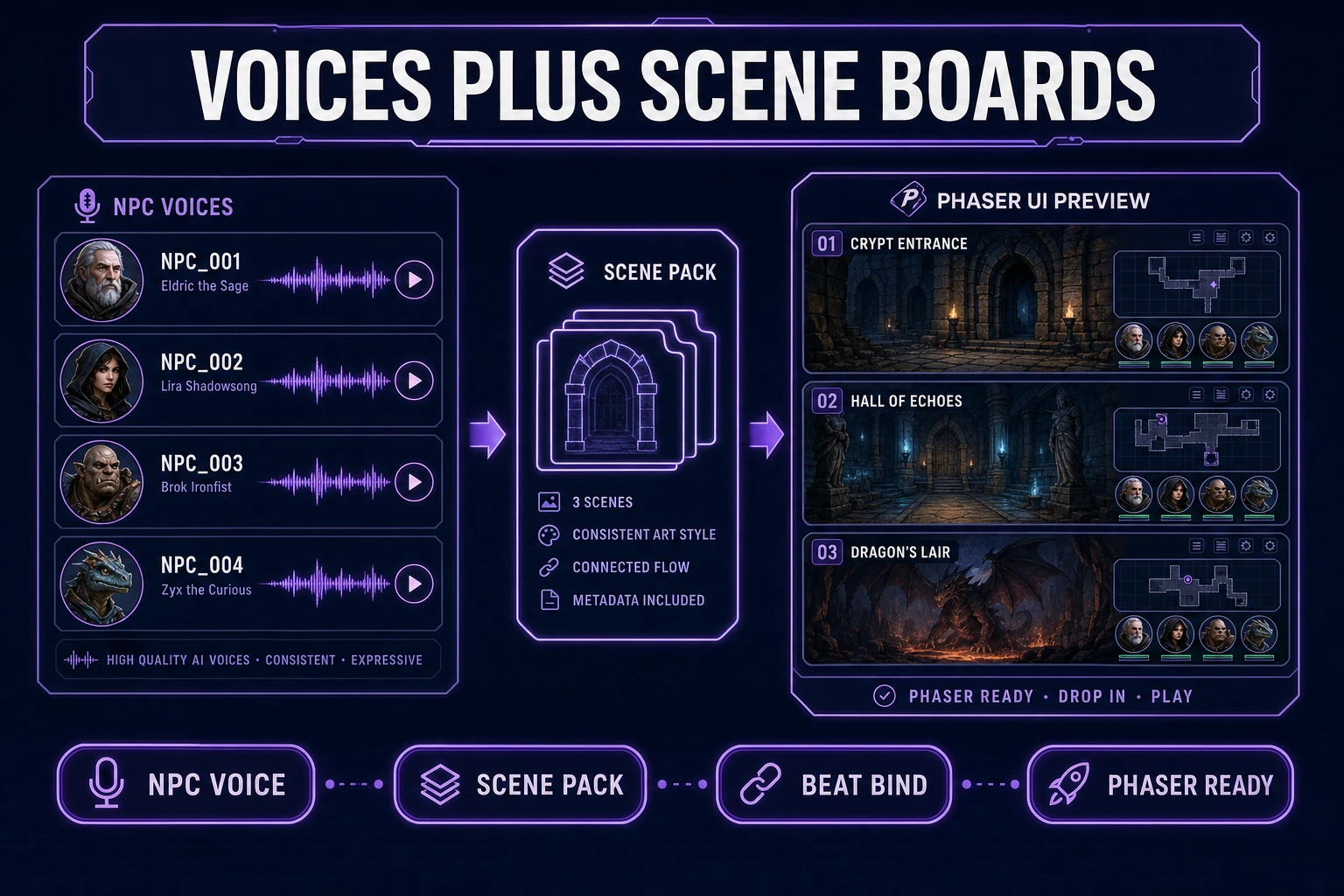
Drop each stable npc_lines[].text into Speech Gen. Pick one voice per npc_id and keep it for the whole one-shot — the ai dungeon master pack only feels coherent when the warden echo does not swap timbre between vestibule and boss crypt. HD pricing verified July 12, 2026: 0.5 credits per 1,000 characters, minimum 1 credit per successful render (src/app/speech-gen/page.tsx). A short bark under 2,000 characters is one credit; a longer monologue scales in whole credits.

Name files to match IDs (warden_echo_vestibule.mp3) so Phaser can bind audio without a guess sheet. Skip voice until the JSON beat list is locked — regenerating art and audio for unstable prose is how credit budgets die. If you need ambient stingers later, keep them out of Speech Gen; that tool owns narration and dialogue, not Foley. The referee loop should play fine mute on first pass; voice is polish on a working state machine.

Audit like production data. Read every line aloud once. Cut any sentence that tells a player what their character feels. Keep stage directions out of the TTS string — put them in the JSON as stage fields WizardGenie can show in the UI chrome instead. That discipline is what separates a usable ai dungeon master pipeline from a novelty chatbot with a microphone.

Speech Gen NPC voices and AI Image Gen scene boards for an ai dungeon master table pack, verified July 12, 2026
Speech Gen locks NPC voices by id; AI Image Gen closes the ai dungeon master loop with scene boards keyed to the same beat list.

Step 3 — board the table with AI Image Gen scene art

Open AI Image Gen and prompt from the session card, not from vibes. Example board prompt: “Ash Crypt vestibule, top-down-friendly wide establishing shot, stone floor, carved warning lintel, two doors west and east, torch light only, no UI chrome, no readable text, grim-hopeful fantasy, consistent palette #2a2a32 #c4a574 #6b8f71.” Use Z-Image at 3 credits to explore composition; spend Nano Banana Pro (18 credits default 1K/2K) only when the beat list is frozen and you need hero art for the store page or session zero slides.

One board per scene_id is enough for a jam one-shot. Name files to match (vestibule.webp, flooded_wing.webp, boss_crypt.webp). Reject boards that invent a third door, add a shopkeeper the card never listed, or paint illegible “ancient runes” that look like UI text. If you already exported a measured battle map from the Scout sibling pipeline, use that for combat scenes and keep Image Gen boards for social and exploration beats — do not regenerate the atlas as a painting.

Shipping is where amateur pipelines die. Phaser 4.2.0 “Giedi” (released June 19, 2026, verified against phaser.io release notes on July 12, 2026) is the honest browser runtime for a playable referee UI. Ask WizardGenie: “Generate a Phaser 4.2 SessionScene that loads assets/sessions/ash_crypt_oneshot.json, shows the matching scene board, plays Speech Gen clips by npc_id, rolls checks against DC, and advances via next_on_success / next_on_fail.” Desktop and web WizardGenie both work — pick the surface you already use for coding. Do not promise arcade auto-publish; export the build and host it where you want.

What an ai dungeon master session costs on Sorceress in 2026

Pricing verified July 12, 2026 against src/app/plans/page.tsx (LIFETIME_PRICE = 49). Sorceress base unlock is $49 one-time for the full tool suite. AI credits are pay-as-you-go: Starter $10 for 1,000 credits, Creator $20 for 2,000, Plus $50 for 5,000, Studio $100 for 10,000. A three-scene one-shot with two layout variants per board, six short NPC lines, and Phaser scaffolding typically burns twenty to one hundred credits total — often under $1.20 on top of the lifetime unlock if you stay card-first on Z-Image and Speech Gen HD minimums. WizardGenie coding runs on your own API keys.

Compare that to renting a separate chat referee plus redrawing every scene when the boss room changes. The integrated ai dungeon master path wins on both money and iteration speed: change the card’s beat count, regenerate two boards, re-render three lines, reload JSON — done in minutes. Browse the full stack at Sorceress Tools Guide or see plans for credit tiers. For branching quest prose after the session loop stabilizes, use the AI dungeon story generator sibling; for party faces on the initiative tracker, use the AI avatar generator post.

The category shift is simple: an ai dungeon master in 2026 is not a novelty chatbot with dice emojis. It is a production pipeline — locked session cards, voiced NPCs, scene boards, engine-ready JSON — that respects how a Dungeon Master actually runs a table. Sorceress built the pieces to run that pipeline in one account; your job is to lock beat count and fail states before you ask for pretty stone.

Frequently Asked Questions

What is an ai dungeon master used for in game development?

An ai dungeon master drafts a runnable session loop — scene beats, encounter checks, NPC lines, and fail states — that a party or solo player can play through, not a one-shot chat novel. In the Sorceress pipeline (verified July 12, 2026) that means locking a session card in WizardGenie, voicing NPCs in Speech Gen, boarding scenes in AI Image Gen, and wiring the referee UI in Phaser 4.2.

Is an ai dungeon master free on Sorceress?

WizardGenie coding runs on your own API key (or the trial fallback key). Speech Gen and AI Image Gen spend AI Credits via the live credit math in src/app/speech-gen/page.tsx and src/lib/models.ts. New accounts ship with 100 starter credits; the $49 lifetime unlock covers Pro tools (verified against src/app/plans/page.tsx LIFETIME_PRICE = 49 on July 12, 2026). You can iterate session cards in WizardGenie without burning image or TTS credits until the loop stabilizes.

How is an ai dungeon master different from an ai dungeon story generator?

An ai dungeon master owns the live referee loop: initiative, checks, NPC reactions, and pacing at the table. An ai dungeon story generator owns the branching quest graph — rooms, choices, flags, endings — as prose nodes. Use the Narrate sibling post when you need a graph-first adventure spine; keep the dungeon-master pipeline when you need a session that can react in play.

Can I export an ai dungeon master pack for a browser game?

Yes. Ask WizardGenie for JSON with scene_id, beats[], checks[], npc_lines, and next_on_success / next_on_fail fields, then scaffold a Phaser 4.2.0 scene that advances on player choices and dice results. Phaser 4.2.0 (Giedi) released June 19, 2026 — verified against the official Phaser download page on July 12, 2026. Pair Speech Gen MP3s by npc_id for optional voiced lines.

What does an ai dungeon master session cost on Sorceress in 2026?

Verified July 12, 2026 against src/app/plans/page.tsx. Base unlock is $49 one-time. A minimal three-scene one-shot typically burns 20–100 Sorceress credits for scene art (model-dependent) plus Speech Gen HD at 0.5 credits per 1,000 characters with a 1-credit minimum per render, while WizardGenie coding stays on your API key — often under $1.20 of Starter-tier credits on top of lifetime if you stay card-first.

Sources

  1. Dungeon Master - Wikipedia
  2. Dungeons & Dragons - Wikipedia
  3. Tabletop role-playing game - Wikipedia
  4. Phaser v4.2.0 release notes
Written by Arron R.·1,815 words·8 min read

Related posts