Spin Sprite Generator AI (Sheet Pack 2026)

By Arron R.7 min read
A sprite generator AI that ships a jam sheet pack is Quick Sprites (retro-diffusion/rd-animation, 9 credits): pick Four Angle Walking or Small Sprites, keep ret

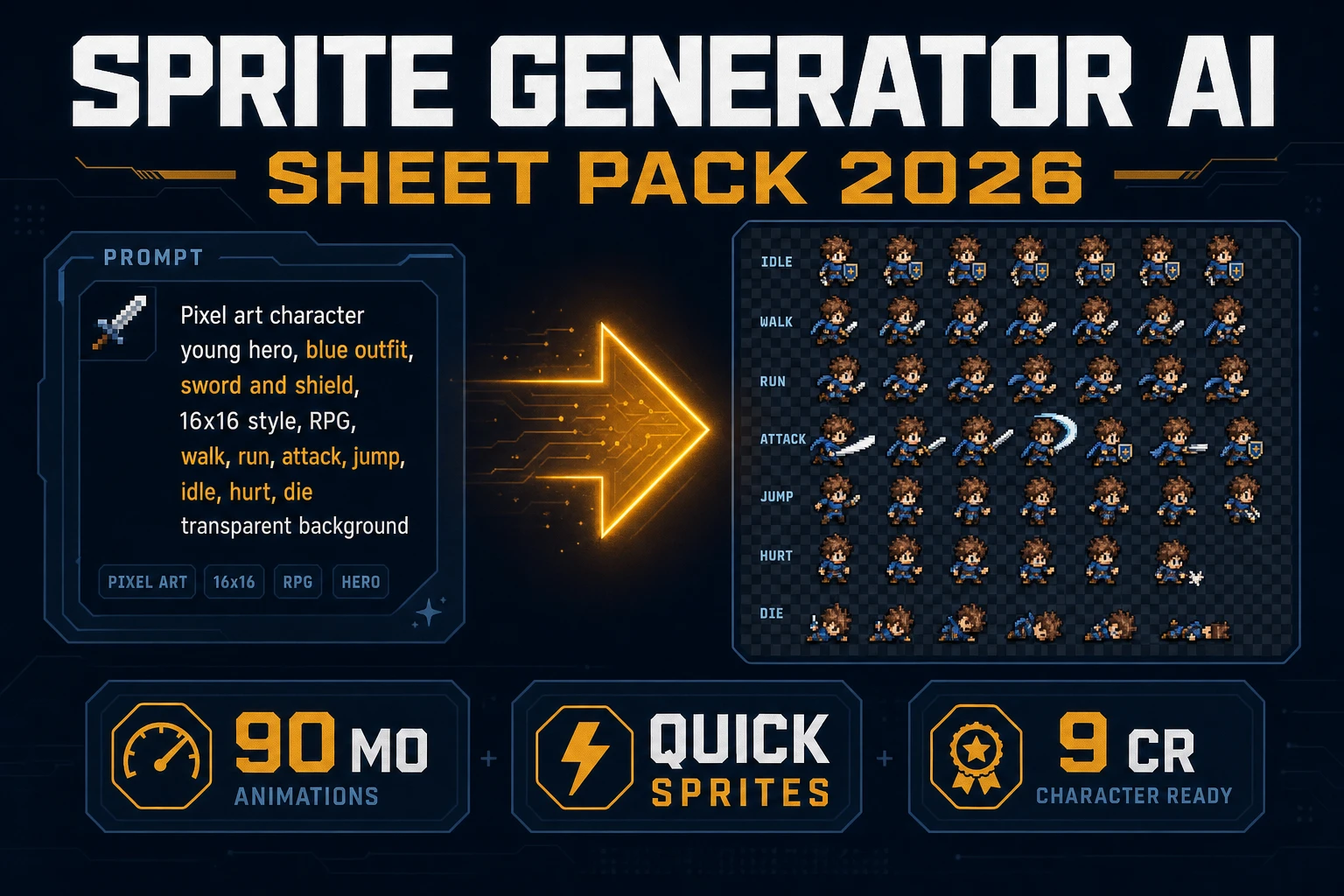
Transactional shoppers who reverse the usual phrase and type sprite generator ai are not looking for a mood board. They want a sheet pack: a transparent PNG grid with equal cells, walk rows that share a baseline, and enough NPC fillers that a one-screen jam does not look like a single hero pasted three times. This page builds that pack on Sorceress with Quick Sprites as the generator, optional True Pixel when the palette drifts, and nearest-neighbor import so the atlas stays sharp in-engine.
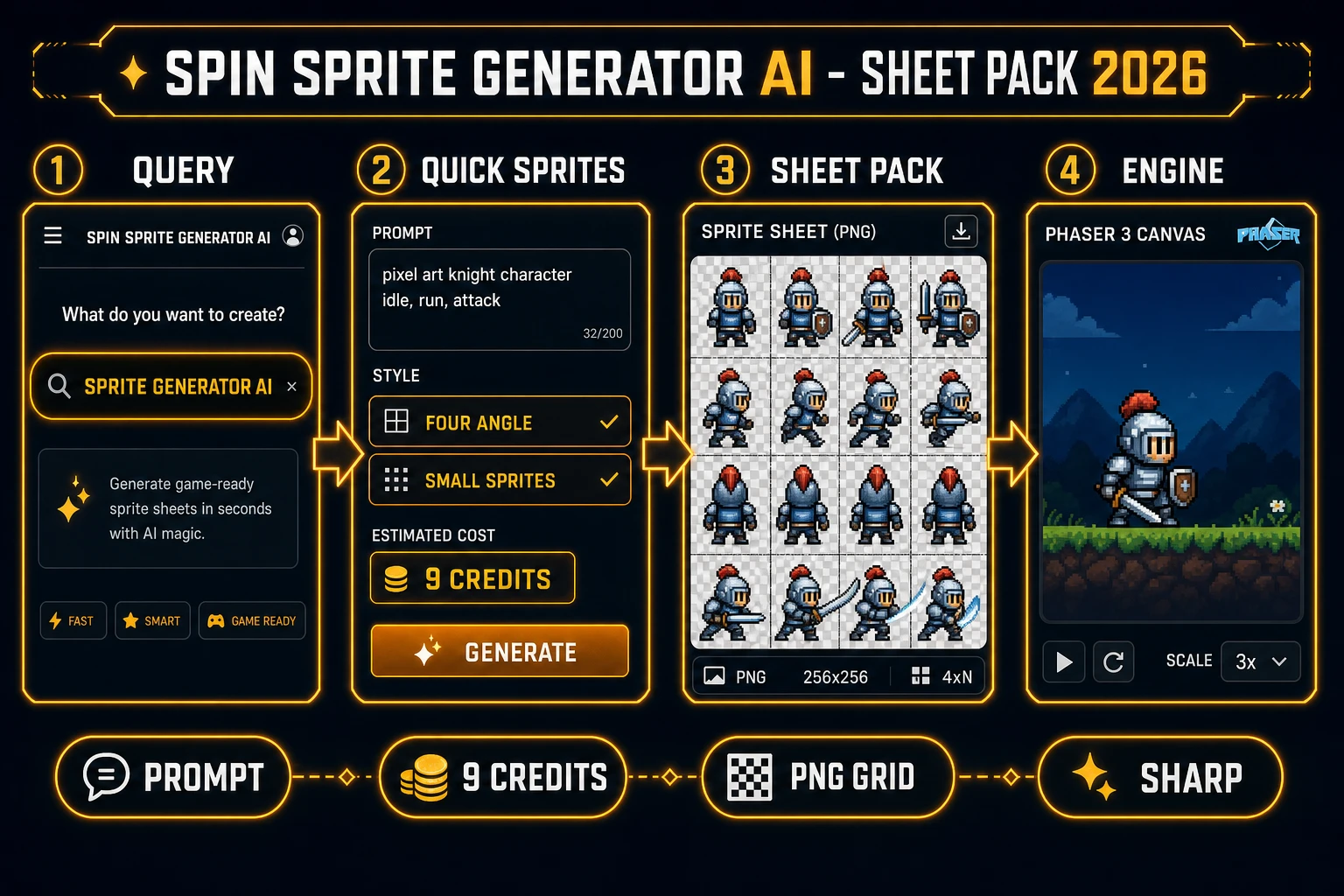
Sprite generator AI sheet pack pipeline: query chip, Quick Sprites at 9 credits, transparent PNG grid, sharp Phaser import
A sprite generator AI sheet pack in four beats: query → Quick Sprites grid → pack check → crisp engine load.

What a sprite generator AI search is asking for

DataForSEO lists sprite generator ai at 90 searches a month, KD 24, transactional intent (verified 2026-10-14 in tools/research-output.md, seed ai sprite generator). Neighboring rows on the same table matter for framing:

  • ai sprite generator — 590/mo, KD 22 (the head informational phrasing)
  • ai sprite sheet generator — 320/mo, KD 3
  • sprite sheet generator ai — 90/mo, KD 8
  • sprite ai generator — 50/mo, KD 32

The reverse word order is the shopping door: people already decided they want a generator and are typing the product category. Wikipedia’s Sprite (computer graphics) page (checked 2026-10-14) defines a sprite as a 2D bitmap composited into a larger scene. Your sprite generator AI job is to invent those bitmaps with consistent outline weight, cell size, and alpha — then hand the atlas to the loader.

Sibling Sorceress posts already own nearby verbs. AI sprite generator covers the 590/mo head term. Sprite sheet generator AI covers the “sheet” middle phrasing. This page stays on sprite generator ai and the multi-character sheet-pack workflow: hero walk + townsfolk fillers + one VFX burst, one credit plan, one import recipe.

Sheet pack anatomy before you spend credits

Wikipedia’s Texture atlas page (checked 2026-10-14) is the neutral name for packing many sprites into one bitmap. A sprite generator AI export is that atlas. Rules that prevent silent loader bugs:

  • Equal cells. Every frame in a sheet shares the same width and height. Mixing 32×32 Small Sprites with 48×48 Four Angle Walking in one atlas forces the loader to stretch someone.
  • Shared baseline. Feet land on the same row across walk frames so the character does not bob when the animation loops.
  • Real alpha. Empty cells must be actually empty on a checkerboard — not a pale fringe that becomes a glowing outline after downscale.
  • One pack job per night. Decide the roster list first (hero, two enemies, one NPC, one hit burst), then generate. Open-ended “keep rolling until it feels cool” is how 9-credit calls stack into a bad afternoon.

Write the pack list as plain text before you open the tool. Example: “48×48 knight Four Angle Walking; two 32×32 goblins Small Sprites; one 64×64 slash VFX.” That list is boring. It also stops you from regenerating the hero because you forgot you needed a death filler.
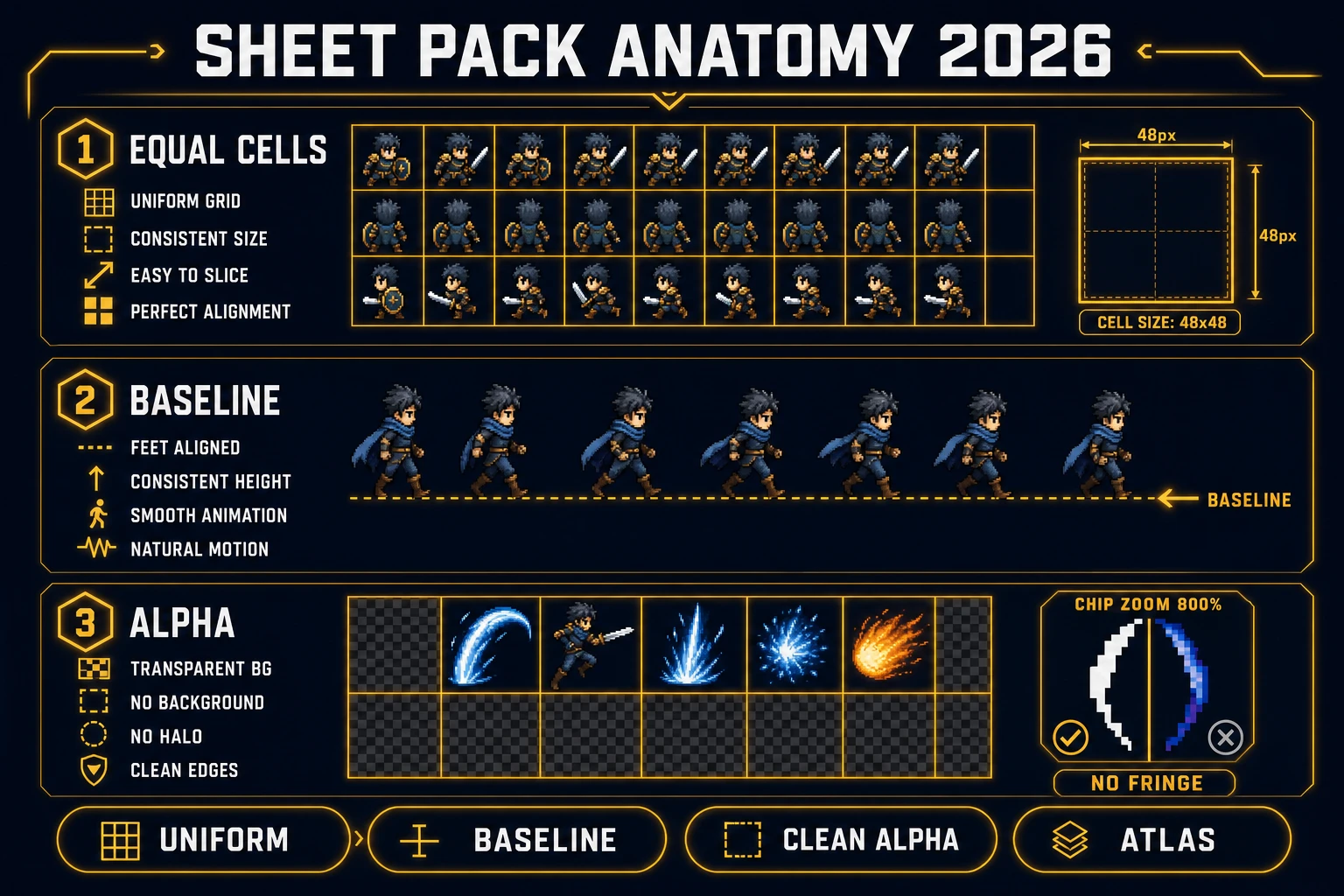
Sheet pack anatomy for sprite generator AI: equal cells, shared baseline, clean alpha on checkerboard
Sheet pack anatomy that keeps a sprite generator AI export loadable: equal cells, shared baseline, clean alpha.

Quick Sprites: the Sorceress sprite generator AI path

Quick Sprites is the Sprites & 2D tool that answers the sprite generator AI search on this site. The home card badges it AI Credits and describes “AI-generated animated pixel sprite sheets” (verified 2026-10-14 in src/app/_home-v2/_data/tools.ts). The live page bills CREDITS_PER_GEN = 9 credits per generation against Retro Diffusion rd-animation (MODEL_ID = 'retro-diffusion/rd-animation', verified 2026-10-14 in src/app/quick-sprites/page.tsx). Signup grant is SIGNUP_GRANT = 100 in src/app/api/admin/credits/route.ts — about eleven generations before a top-up.

Three built-in styles (same file, ANIMATION_STYLES, verified 2026-10-14):

  • Four Angle Walking — consistent four-direction, four-frame walking for humanoid characters at 48×48 only. Row labels: Up, Right, Down, Left.
  • Small Sprites — 32×32 set with six rows: Right, Left, Arms, Look, Surprise, Lay Down. Good for townsfolk and enemy fillers.
  • VFX Effects — fire, explosions, lightning, and similar bursts. Default 64×64 with selectable sizes 24–96 px at 1:1.

A practical sprite generator AI run for a jam sheet pack:

  1. Open Quick Sprites and pick Four Angle Walking when the hero must face four ways.
  2. Prompt for silhouette, outfit, and palette mood. Example: “short knight, round shield, hard black outline, warm bronze armor, no soft painterly shading.”
  3. Keep return-as-spritesheet on (returnSpritesheet defaults to true in the page state) so you get a transparent PNG grid, not a single still.
  4. Generate. Cost is 9 credits for that call.
  5. Repeat for Small Sprites enemies with the same outline weight and palette mood words, then one VFX burst if combat needs a hit flash.
  6. Download each PNG and inspect on a checkerboard before you atlas.

Prompt once per party member with the same outline weight and cell size. Soft adjectives (“epic”, “beautiful”, “detailed”) waste tokens on rd-animation. Concrete nouns and hard style constraints win: subject first, outline rule, palette mood, negatives in plain words (“no drop shadow, no ground blob”).

When you already have a video walk or an AI video clip and you need a sheet, not a fresh prompt, switch to Auto-Sprite v2 (Pro badge on the Sprites & 2D row, verified 2026-10-14). Use Auto-Sprite when the motion already exists. Use Quick Sprites when you want a sprite generator AI to invent the walk rows from text.
Palette lock after the generator

A sprite generator AI sheet can still drift off the game’s palette. True Pixel is the Pro tool for locking stills (or keyed frames) onto a short palette (badge verified 2026-10-14 in tools.ts). For a pack that already looks right from Quick Sprites, skip True Pixel. For a still you want to match to the same PICO-8 bed as the tileset, run True Pixel once and keep dither restrained until banding forces a trial.

Pack-level palette discipline beats per-frame polish. Pick three to five mood words before the first generation (“cool greens, charcoal, hard black outline”) and paste them into every prompt in the pack. When two enemies share a biome, they should share outline weight and highlight color even if silhouettes differ. If one sheet lands warmer than the rest, quantize that sheet once in True Pixel rather than regenerating the whole roster — nine credits for a full walk grid is more expensive than a palette pass on a still you already like.

Free fringe cleanup sits in Canvas when a pale halo survives the sheet edge. If you need to cut a packed PNG into individual frames for debugging, Slicer is the grid slicer on the same Sprites & 2D row. Sprite Analyzer helps preview how rows will play before you rewrite the loader. The full tool map lives in the tools guide.

Stop regenerating when the silhouette reads at walking distance and every frame shares the same outline weight. A fifth roll that only changes belt buckle color is a credit sink, not a sprite generator AI win. For still-only convert verbs without inventing animation, see convert an image to pixel art. For Minecraft-flavored grid snaps, see Minecraft image to pixel art.

Import the sprite generator AI sheet without blur

Export the PNG, then scale with nearest-neighbor — never bilinear. MDN’s crisp pixel art look guide (checked 2026-10-14) shows image-rendering: pixelated on img and canvas. Draw 1:1 into canvas pixels before any CSS scale.

img.sheet-pack, canvas.game {
  image-rendering: pixelated;
}

Phaser v4.2.1 “Giedi” (released 9 July 2026, stable download page checked 2026-10-14) loads a uniform grid with load.spritesheet and generateFrameNumbers. Keep frameWidth and frameHeight equal to the Quick Sprites cell size you chose (48 for Four Angle Walking, 32 for Small Sprites).

Practical import checklist for a sheet pack:

  1. Name files by role: hero-walk-48.png, goblin-a-32.png, slash-vfx-64.png.
  2. Register one spritesheet key per file; do not glue unequal cell sizes into one key.
  3. Playtest at integer scale (2× or 3×) before fancy camera zoom.
  4. If one direction drifted, re-roll that style with the same seed rather than regenerating the whole party.
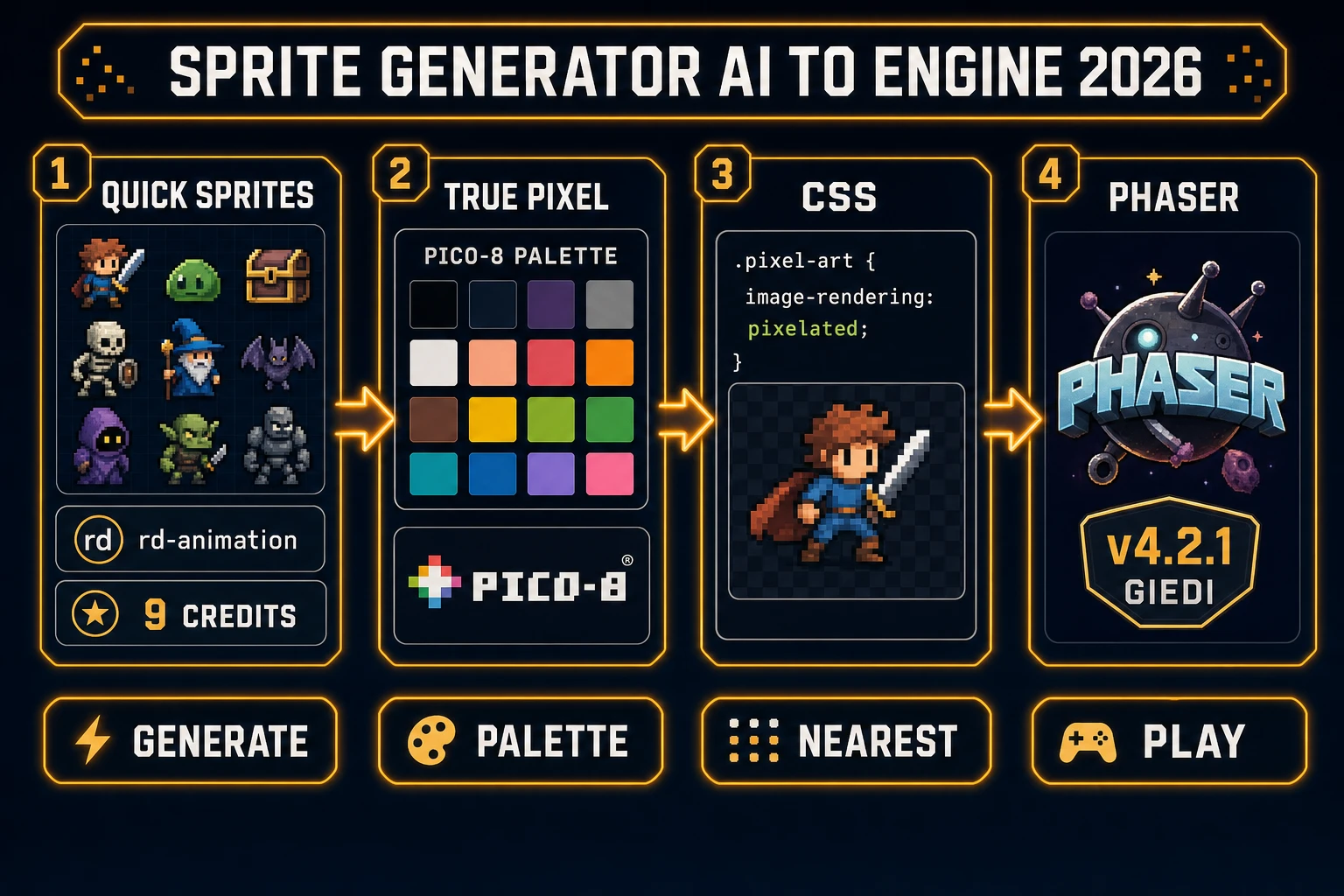
Sprite generator AI to engine path: Quick Sprites 9 credits, True Pixel palette, image-rendering pixelated, Phaser 4.2.1 Giedi
After the sprite generator AI export: optional palette lock, image-rendering: pixelated, Phaser v4.2.1 uniform spritesheet load.

Credits math and when to stop the pack

A minimal jam sheet pack on Quick Sprites is often four to six generations: one hero Four Angle Walking, two Small Sprites enemies, one NPC filler, one VFX burst. At 9 credits each, that is 36–54 credits — well inside a 100-credit signup grant if you do not burn retries. Budget one intentional retry per hero silhouette; treat enemy fillers as “good enough at walking distance.”

Keep a short note next to each PNG: style id, seed (if you locked one), credits spent, and whether return-as-spritesheet was on. That notebook line is dull. It also stops you from burning another 27 credits rediscovering a knight that already worked yesterday. Seed locking helps when Right looks solid and Left looks like a different character — re-roll only the drifted style with the same seed rather than redoing the whole pack.

Honest limits: Quick Sprites invents pixel animation from a prompt — it is not a photo-to-sheet converter. Photo convert lives in True Pixel. Clip-to-sheet lives in Auto-Sprite v2. Mention competitor sprite toys only as plain text if you must; this page’s destination is the Sorceress sheet path under one wallet with the rest of the suite at sorceress.games.

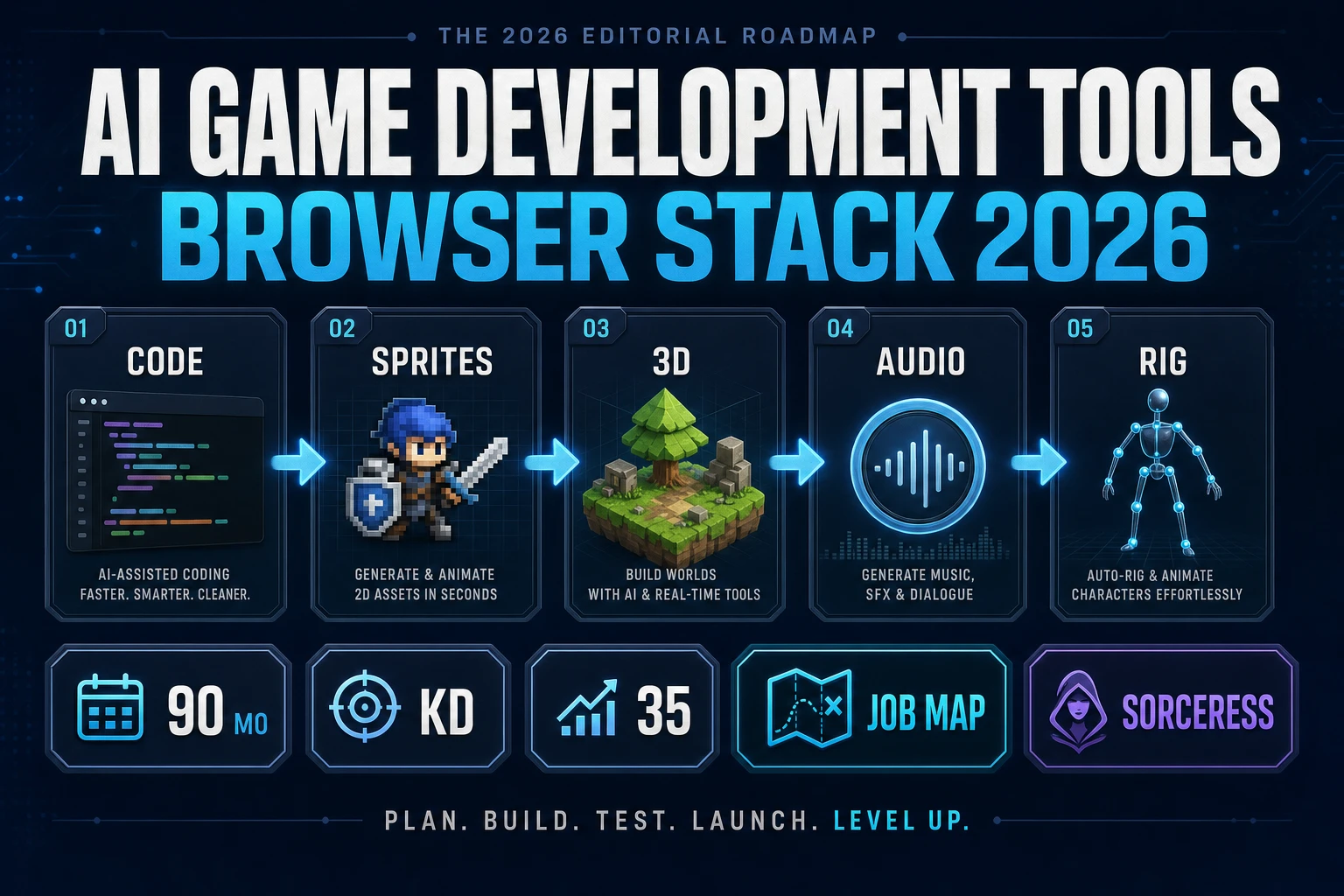
For a broader browser stack that places sprites next to code, 3D, audio, and rigging, see AI game development tools. For pixel-art game workflow that starts from art direction instead of a shopping query, see how to make a pixel art game.

The verdict

A sprite generator AI that ships a jam sheet pack is Quick Sprites at 9 credits per rd-animation call, Four Angle Walking or Small Sprites for humanoids, optional True Pixel palette lock, and Phaser (or plain canvas) with image-rendering: pixelated. Lock the pack list before you spend. Keep cell sizes uniform. Verified against DataForSEO tables, Sorceress source, MDN, and Phaser’s stable download page on 2026-10-14.

Frequently Asked Questions

What does a sprite generator AI search want in 2026?

DataForSEO lists sprite generator ai at 90 searches a month, KD 24, transactional intent (verified 2026-10-14 in tools/research-output.md under the ai sprite generator seed). Shoppers want a tool that invents a transparent PNG grid the engine can slice — walk rows, NPC fillers, VFX bursts — not a single soft portrait. Wikipedia’s Sprite (computer graphics) page (checked 2026-10-14) defines a sprite as a 2D bitmap composited into a larger scene; a sprite generator AI’s job is to invent those bitmaps with shared cell size and clean alpha.

How much does Quick Sprites cost per sheet pack generation?

Quick Sprites bills CREDITS_PER_GEN = 9 credits per successful call against Retro Diffusion rd-animation (MODEL_ID = retro-diffusion/rd-animation in src/app/quick-sprites/page.tsx, verified 2026-10-14). The home card badges it AI Credits on the Sprites & 2D row (src/app/_home-v2/_data/tools.ts). SIGNUP_GRANT = 100 in src/app/api/admin/credits/route.ts covers about eleven generations before a top-up.

Which Quick Sprites style should I pick for a sheet pack?

Four Angle Walking (48×48, four directions × four walk frames) fits a top-down or side-facing hero that must turn. Small Sprites (32×32, six rows: Right, Left, Arms, Look, Surprise, Lay Down) fits townsfolk and enemy fillers. VFX Effects covers fire, explosions, and lightning at selectable 24–96 px (default 64×64). Those labels live in ANIMATION_STYLES and STYLE_ROW_LABELS in src/app/quick-sprites/page.tsx (verified 2026-10-14). Keep one cell size per atlas.

How is sprite generator AI different from ai sprite generator?

Same commercial family, different word order. The head term ai sprite generator sits at 590/mo, KD 22; the reverse phrasing sprite generator ai is 90/mo, KD 24 (both verified 2026-10-14 in tools/research-output.md). Sorceress already has a roster-sheet post on the head term; this page stays on the reverse transactional phrasing and the multi-character sheet-pack workflow. Sibling sprite sheet generator ai (90/mo, KD 8) is covered separately when the search includes “sheet” in the middle.

How do I keep a sprite generator AI sheet sharp in Phaser?

Export the PNG, then scale with nearest-neighbor. MDN’s crisp pixel art guide (checked 2026-10-14) shows image-rendering: pixelated on img and canvas. Phaser v4.2.1 “Giedi” (released 2026-07-09, phaser.io/download/stable checked 2026-10-14) loads a uniform grid with load.spritesheet and generateFrameNumbers. Match frameWidth and frameHeight to the Quick Sprites cell size (48 for Four Angle Walking, 32 for Small Sprites).

Sources

  1. Sprite (computer graphics) - Wikipedia
  2. Texture atlas - Wikipedia
  3. Crisp pixel art look with image-rendering - MDN
  4. Phaser v4.2.1 Giedi download
Written by Arron R.·1,663 words·7 min read

Related posts