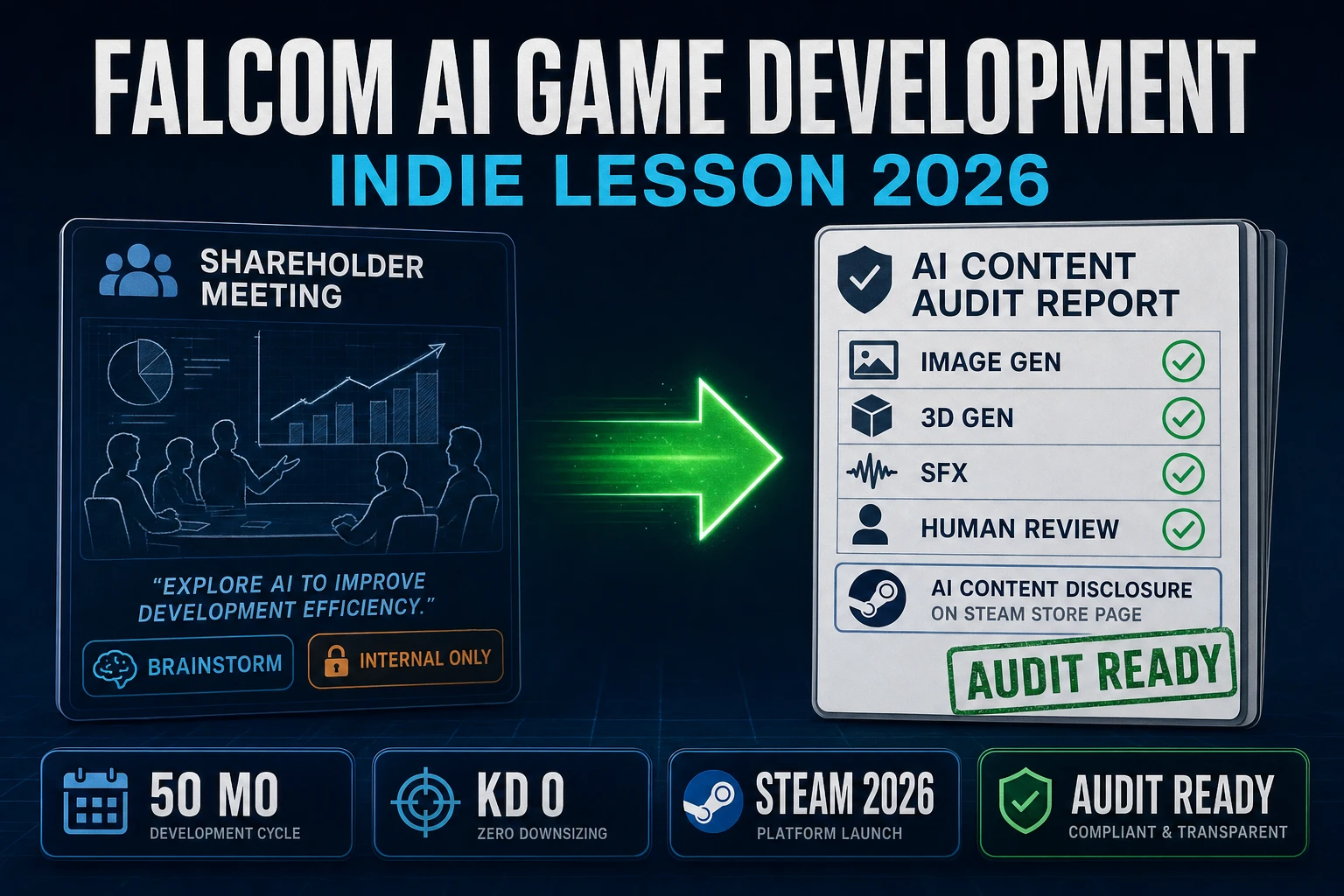
Nihon Falcom — the Tachikawa studio behind Ys and The Legend of Heroes: Trails — told shareholders in December 2025 exactly which generative AI jobs it would and would not run. That is rarer than silence, and it still triggered a fan backlash about writing authorship. The phrase falcom ai game development now pulls about 50 searches a month at keyword difficulty 0 (DataForSEO, AI Game Dev umbrella in tools/research-output.md, verified 2026-10-14). This post charts what Falcom confirmed, how Steam’s 2026 Content Survey draws the player-consumed line, and the audit-first indie posture that turns both layers into a feature instead of a controversy. Every Falcom-side claim below is re-checked against Eurogamer, Gamemeca, and Hitmarker on 2026-10-14; every Sorceress capability is checked against src/app/_home-v2/_data/tools.ts the same day.
What falcom ai game development searchers are actually asking
The query is not “does Falcom exist.” Wikipedia’s Nihon Falcom page (verified 2026-10-14) already covers the 1981 founding, president Toshihiro Kondo, and the Trails / Ys catalog. Searchers landing on falcom ai game development want three concrete answers: Did the studio confirm generative AI? Where in the pipeline? Does that mean Trails dialogue is machine-written?
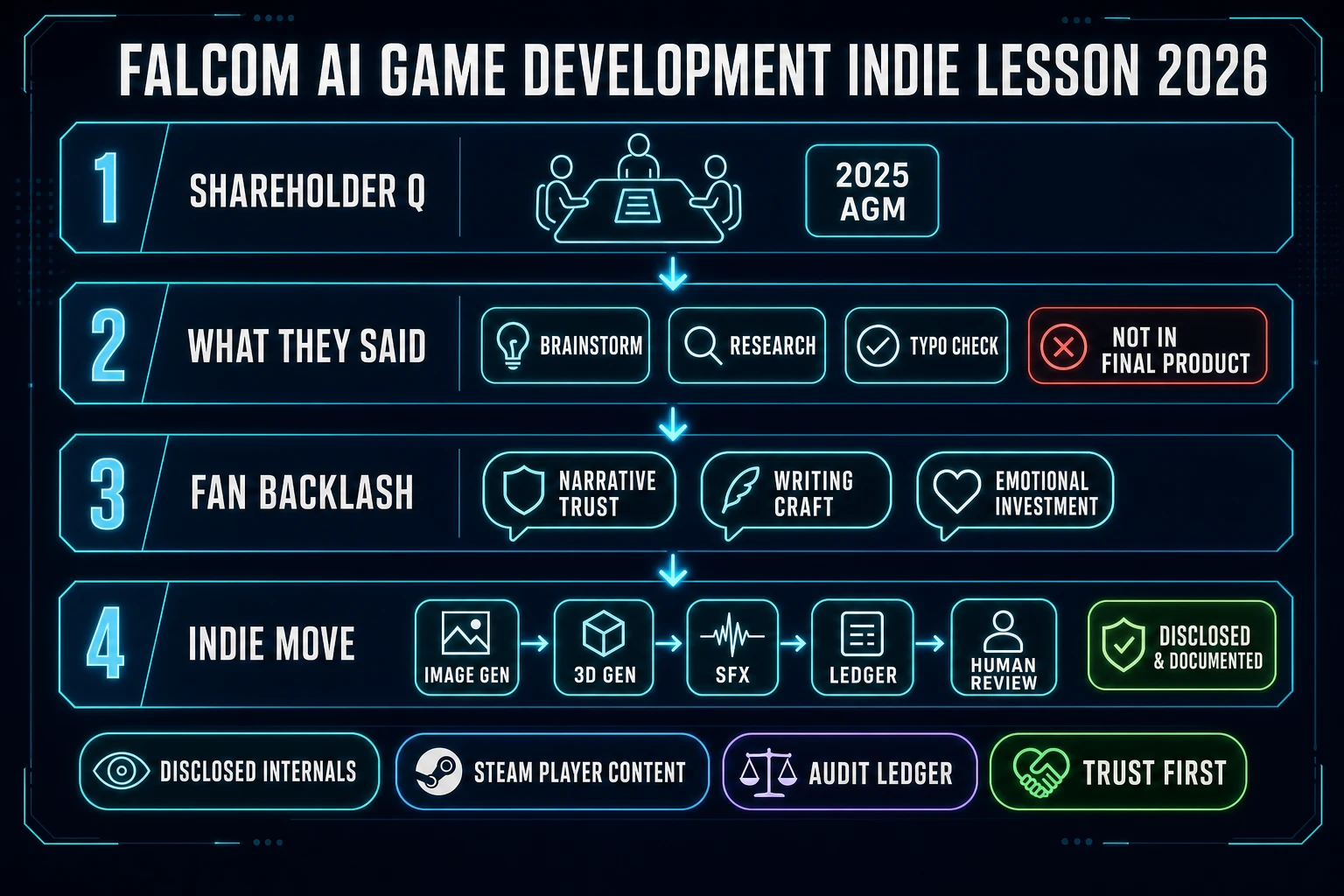
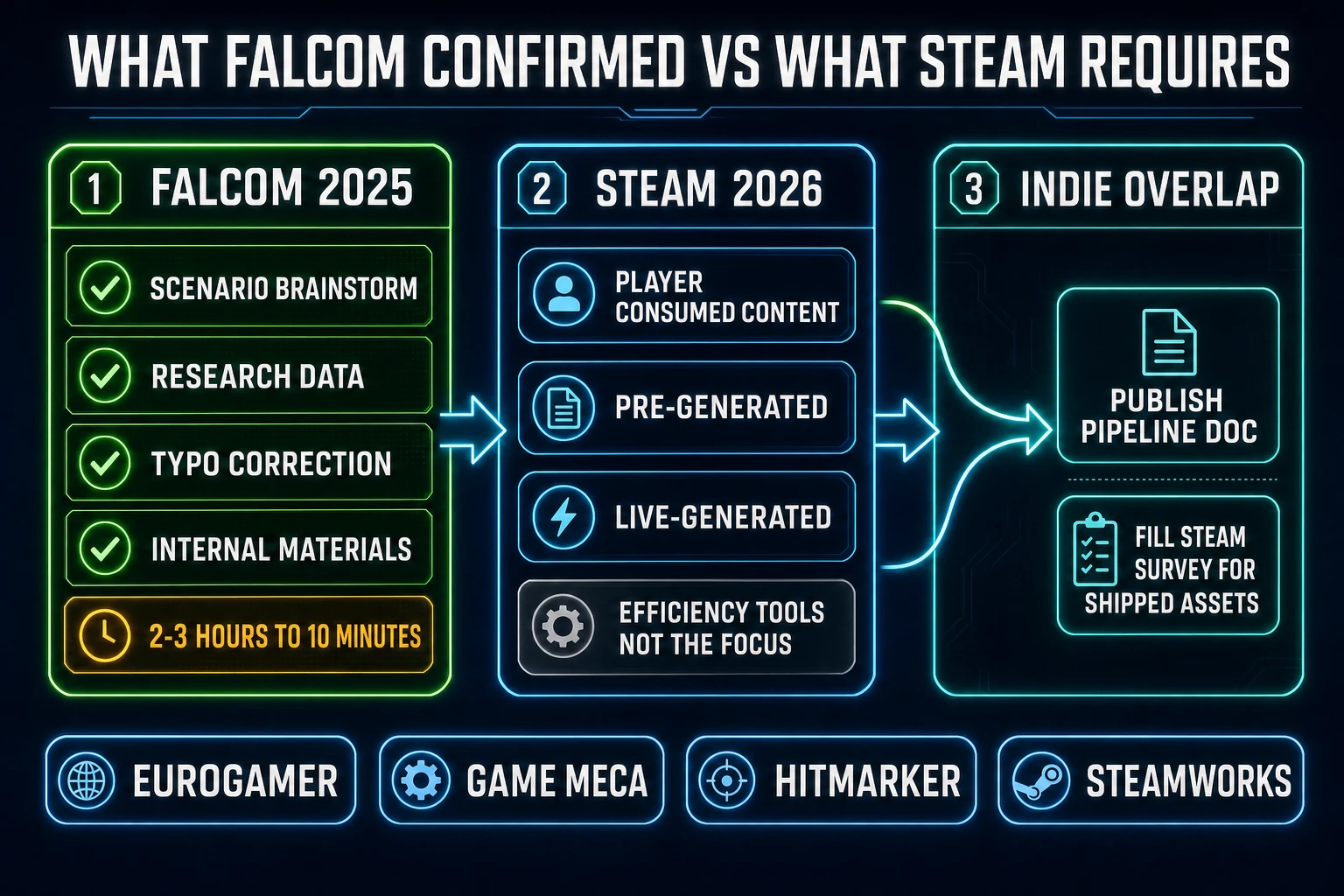
The December 2025 coverage answers the first two with unusual specificity and leaves the third intentionally closed. Eurogamer’s Dec. 18, 2025 report (re-verified 2026-10-14 at eurogamer.net) quotes a Falcom representative, via attendee Umisuika’s translation: the studio is “proceeding cautiously due to legal issues,” using AI “to brainstorm scenarios and do research,” cutting some tasks “from 2–3 hours… to 10 minutes,” and also using AI “to correct typos in the scenario.” Gamemeca’s Dec. 19, 2025 write-up (re-verified 2026-10-14) adds that Falcom framed copyright risk as the reason generative results stay out of products delivered to players, limiting use to internal purposes such as data collection and meeting materials. Hitmarker’s same-day English summary matches those three job categories: brainstorming, research, typo / script checks.
That is a disclosure. It is also incomplete reassurance for an audience that buys Falcom games for human-authored political intrigue spanning dozens of hours. The indie takeaway starts there: specificity about where AI sits still fails if you refuse to talk about how it influences the creative chain players care about.
What Falcom confirmed — and the gap fans still hate
Confirmed (shareholders’ Q&A, Dec. 2025, English coverage re-verified 2026-10-14):
- Generative AI is in use for scenario brainstorming and research.
- AI assists typo / scenario proofreading.
- Some internal tasks that used to take two to three hours now finish in about ten minutes.
- Direct use in final products is treated as legally difficult because of copyright concerns; use is described as limited to internal work and meeting materials.
Not claimed in those same reports: AI-authored shippable dialogue in a Trails or Ys release; AI-generated character art shipping to players; AI music or voice in a retail build; a public per-title pipeline document naming models and human-review owners.
Fan pushback, including long-form essays and the r/Falcom threads that followed the AGM quotes, focused on the brainstorming seat. If a model proposes plot branches and a human only filters them, authorship gets fuzzy even when no AI paragraph lands in the final script. That is a different controversy shape than the Halo Studios “tool in a toolbox” opacity covered in our companion post on generative AI Halo game development. Falcom named jobs. Fans still asked who owns the story.
AAA opacity vs indie disclosure — two different failure modes
Halo-style opacity fails by refusing to name tools. Falcom-style disclosure can still fail by naming only the efficiency layer while the brand promise is narrative craft. Japanese industry context makes the story louder, not quieter: Eurogamer’s same article notes Tokyo Game Show polling where over half of surveyed developers acknowledged AI in development, and Gamemeca cites CESA survey coverage claiming 51% of 54 Japanese game companies already use AI (both claims attributed to those Dec. 2025 reports; re-verified as published wording on 2026-10-14 — treat the percentages as press summaries of CESA, not as a Sorceress primary dataset).
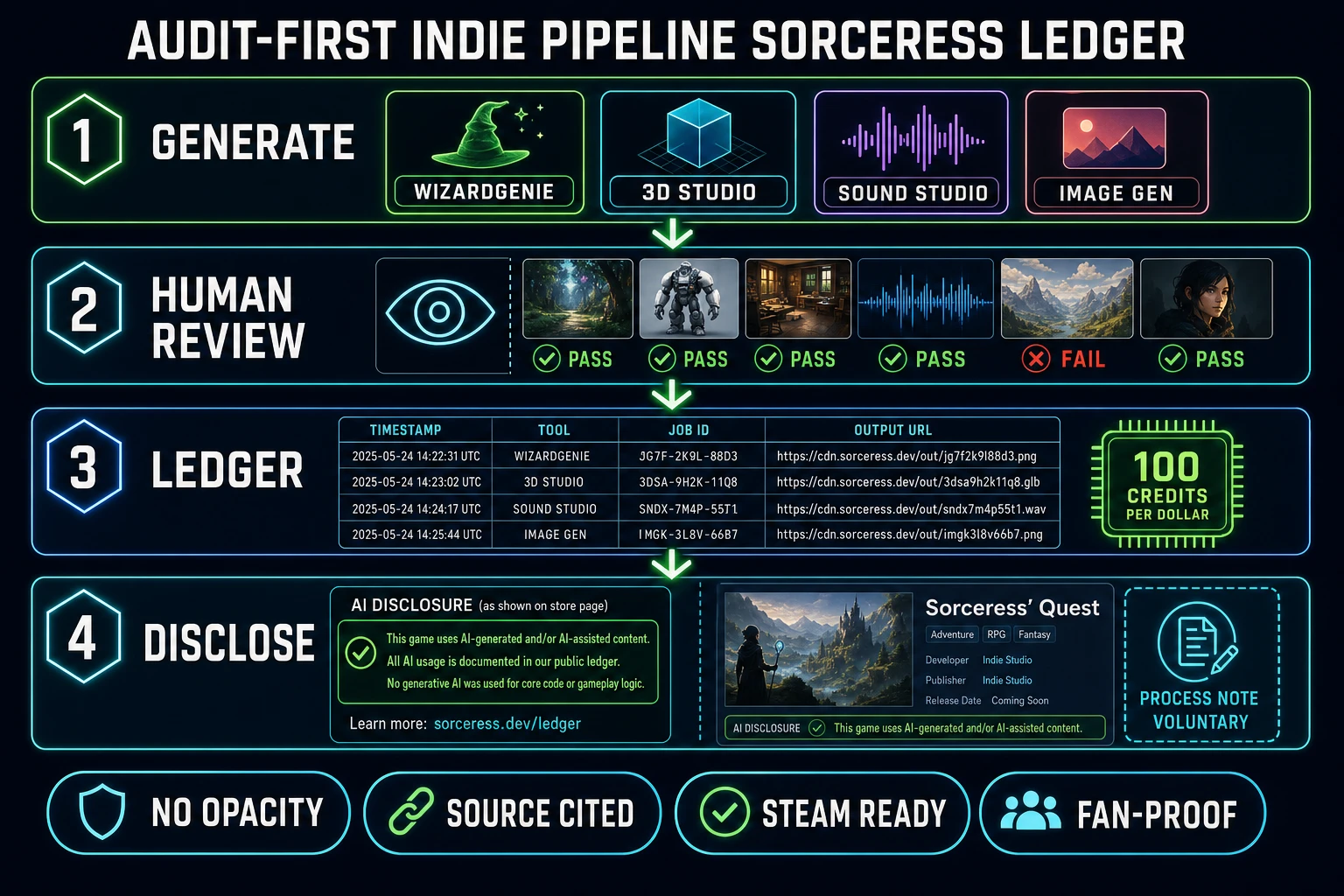
For a solo or five-person indie team, the asymmetry cuts the other way. You do not have a forty-year franchise buffer. If your Steam reviews open with “is the writing AI,” you need a document ready before the question trends. The fix is not “never use generative tools.” The fix is a two-layer disclosure that matches how players actually argue:
- Steam layer (mandatory when content ships). Anything players see or hear that was created with generative AI during development, plus live-generated runtime systems.
- Process layer (voluntary, brand-critical for story games). Whether AI brainstormed quests, outlined dialogue, or proofread scripts — even if every shipped line was rewritten by a human.
Falcom spoke to layer two in a shareholders’ room and still got hit because Trails fans treat layer two as the product. Indie RPG authors should assume the same standard.