Gauge Convert 2D Image to 3D Model (Prop Pipeline 2026)

By Arron R.7 min read
Convert 2D image to 3D model on Sorceress in one loop: prep a clean PNG, pick Hunyuan 3D 3.1 at 30 credits (or TRELLIS 2 / Meshy 7 / Tripo), tune texture and re

A searcher who types convert 2D image to 3D model is rarely hunting for a photogrammetry lecture. They have one PNG — a concept paint, a product still, or an AI render — and they need a rotatable mesh that drops into a game engine. This guide walks that job end to end on Sorceress: clean the plate, choose the right generator in 3D Studio, set texture and remesh flags without burning credits twice, then export GLB. Plan on twenty to forty minutes for a first prop if the photo is clean.
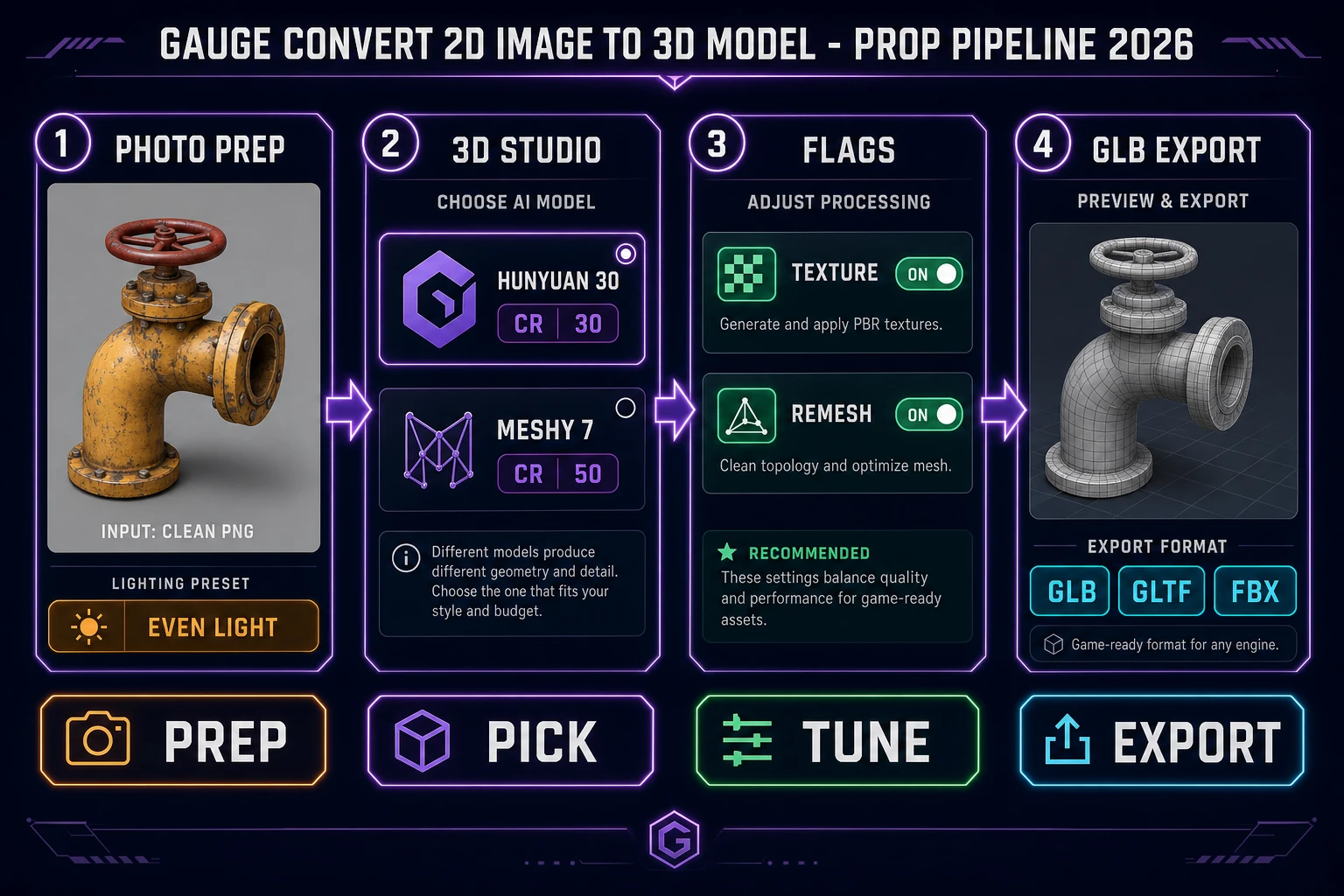
Convert 2D image to 3D model pipeline: photo prep, 3D Studio picker, texture flags, GLB export
Convert 2D image to 3D model as one prop pipeline: prep the photo, pick a generator, tune flags, export GLB.

What convert 2D image to 3D model searchers want

DataForSEO lists convert 2d image to 3d model at 320 searches a month, KD 26, competition 0.54, intent informational (verified 2026-10-14 in tools/research-supplement.md). The sibling 2d image to 3d model sits at 1,000/mo and KD 30 — same job, shorter phrasing. Readers land here because they want a concrete pipeline, not a vendor brochure. Adjacent posts cover related angles: converting image to 3D model, 2D to 3D converter image, and lift a 2D image to 3D model. This page stays on the verb convert: one bitmap in, one mesh file out.

Wikipedia’s Photogrammetry article (verified 2026-10-14) frames the classical path: measure an object from photographs, often with overlapping views. Stereophotogrammetry uses two or more pictures. A modern single-image generator invents the occluded sides from learned priors. That trade — speed and coverage versus measurement-grade accuracy — is the entire reason this workflow exists for indie props.

Single-image vs multi-view before you convert

Before you open the picker, decide whether you honestly have one frame or a short turntable. The registry in src/lib/threed-models.ts (verified 2026-10-14) splits input modes into image-to-3d, text-to-3d, and multi-image-to-3d.

  • Single image only: Hunyuan 3D 3.1 (30 credits, rating best-budget), TRELLIS 2 (40 credits at 1024), Rodin 2.0 (50 credits), Tripo P2 (125 credits), and Pixal3D (0 credits, VIP-only).
  • Multi-image capable: Meshy 7, Meshy 6, Tripo v3.1, and Tripo Smart Mesh. Use these when you shot three to six angles around the prop.

If you only have one clean PNG, do not fake multi-view by duplicating the same file. Feed it to Hunyuan 3D 3.1 or TRELLIS 2 and iterate. If you have a real turntable set, Meshy 7 or Tripo v3.1 will usually recover silhouette fidelity that a single frame invents incorrectly — especially on thin handles, straps, and open frames. A mug shot from three sides beats one heroic three-quarter every time when the handle must survive the lift.

Photo prep is part of the conversion, not a side quest. Even light, a plain background, and the subject filling most of the frame matter more than which model you pick on the first try. Soft window light with a gray card behind a lantern will outrun a flashy AI still that still has a bedroom behind it. Crop hard. Remove the floor plane. Then convert.

Microsoft’s TRELLIS research repo (CVPR’25 Spotlight, verified 2026-10-14) describes structured 3D latents for scalable generation. Tencent’s Hunyuan3D-2.1 open weights (verified 2026-10-14) show the same family of single-image lifts. Sorceress wraps those families behind credit-priced picker cards so you never touch a local CUDA install.
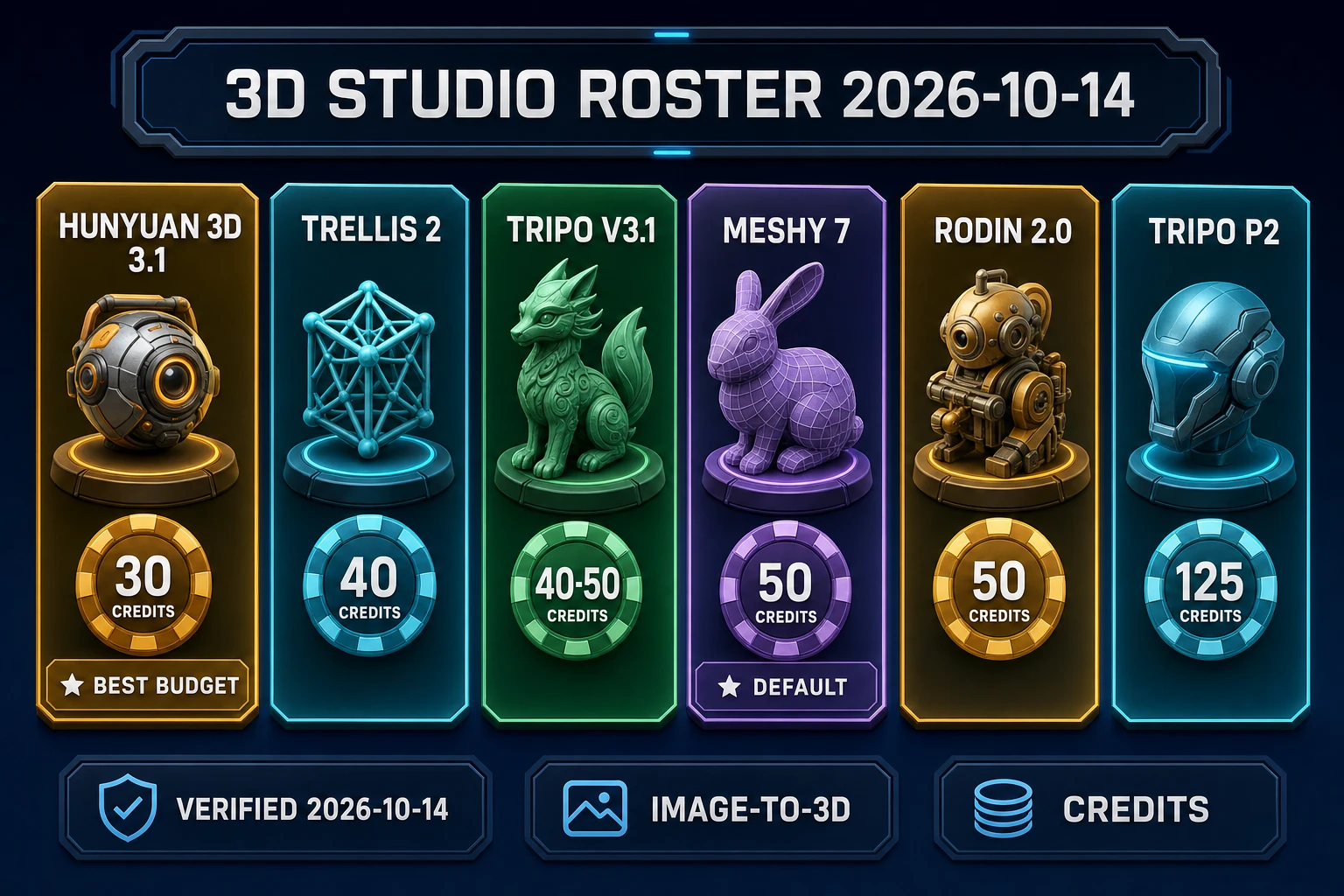
3D Studio roster credit chart for convert 2D image to 3D model verified 2026-10-14
Credit sheet for the public image-to-3D roster in 3D Studio, verified 2026-10-14 against src/lib/threed-models.ts.

Pick the model that converts a 2D image to a 3D model

Open 3D Studio, switch to image-to-3D, and drop the reference. The home card (verified 2026-10-14 in src/app/_home-v2/_data/tools.ts) describes the full chain: AI image generation, single-image to textured 3D, humanoid auto-rigging, and text-to-animation, with export to FBX, GLB, or GLTF. For a static prop you only need the mesh step. Numbers below are quoted from src/lib/threed-models.ts on 2026-10-14 — do not trust stale screenshots from last month.

Model Credits (typical image-to-3D) Modes Best first use
Hunyuan 3D 3.1 30 (best-budget) image-to-3d First prop pass, organic shapes
TRELLIS 2 35 / 40 / 45 at 512 / 1024 / 1536 image-to-3d Balanced single-frame lift
Tripo v3.1 40 standard texture, 50 HD image + multi-image Clean UVs, turntable sets
Meshy 7 50 default (35 + 15 texture) image + multi-image Hard-surface detail, remesh control
Rodin 2.0 50 image-to-3d Character-leaning props
Tripo Smart Mesh 65 textured standard image + multi-image Low-poly realtime budgets
Tripo P2 125 (135 HD) image-to-3d Hero mesh after the cheap lane works

New Sorceress accounts receive SIGNUP_GRANT = 100 starter credits (verified 2026-10-14 in src/app/api/admin/credits/route.ts). That covers three Hunyuan 3.1 runs or two TRELLIS 2 defaults before a top-up. Pixal3D shows credits: 0 with label “Free unlimited,” but vipOnly: true — do not promise public free unlimited 3D generation.

Practical order for a prop pack: burn one Hunyuan 3.1 pass to prove the silhouette. If the shape is right but soft, escalate to TRELLIS 2 or Meshy 7. Only pay Tripo P2 once the input photo is proven. That is how you convert 2D image to 3D model without lighting the wallet on a bad plate.
Set texture and remesh flags without double-charging

Credit stickers on the picker are defaults, not always the final bill. Meshy 7’s getCredits (verified 2026-10-14) starts at 35 for single-image geometry, adds 15 when Generate Texture is on (the default), adds 15 for Remesh, and adds 10 for Ultra Mode. Leaving Remesh off returns Meshy’s raw high-poly mesh — often a million-plus triangles — which the param description flags explicitly. Turn Remesh on and set target_polycount between 100 and 300,000 when the mesh must ship in a realtime engine.

Tripo v3.1 prices by texture tier: no texture 30, standard 40, HD 50 for image mode, with +5 for Quad Mesh and +30 for detailed geometry quality. TRELLIS 2 prices by resolution only. Hunyuan 3D 3.1 has no extra param surcharges in the registry — 30 credits is the whole bill.

Rule of thumb: keep texture on for anything the player will see up close. Keep remesh on for engine drops. Leave Ultra and detailed geometry off until the silhouette is already approved on a cheaper pass. A failed Ultra run is the most expensive way to learn that the photo was underlit.

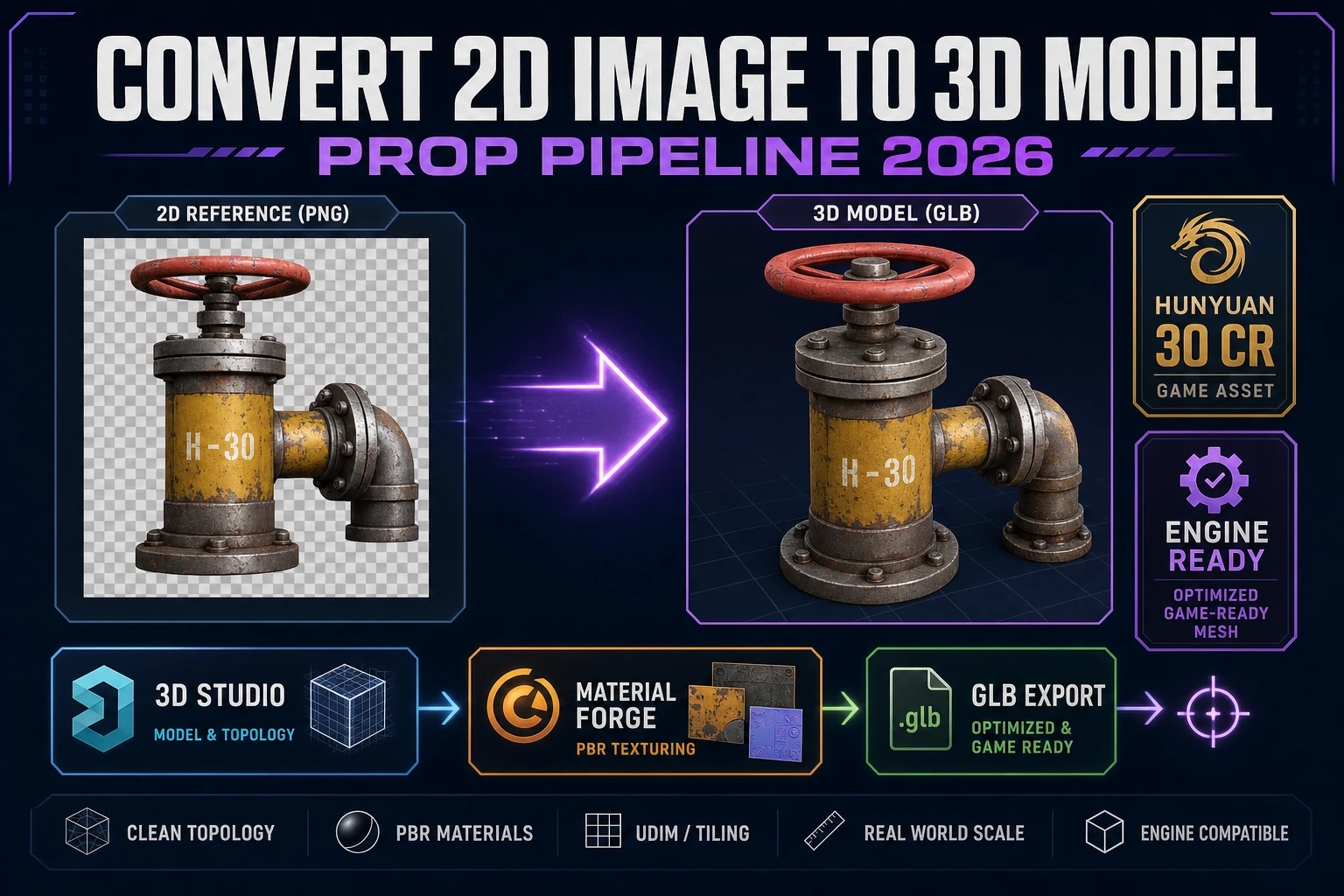
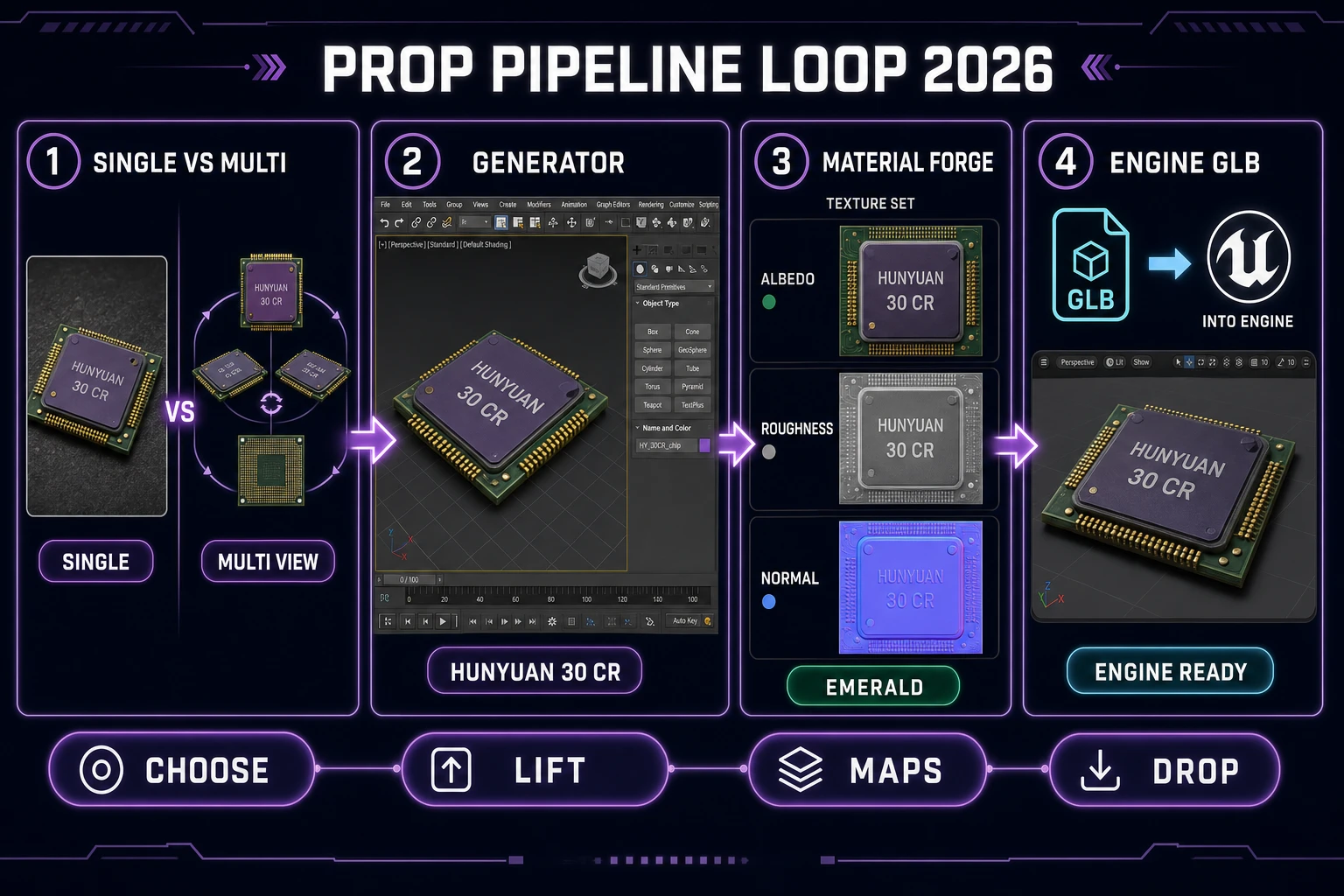
Prop pipeline loop: single vs multi-view, 3D Studio lift, Material Forge maps, engine GLB
After the mesh lands: decide single vs multi-view, lift in 3D Studio, add PBR maps only when needed, drop GLB into the engine.

Game prop checklist after the mesh lands

A convert-2D-image-to-3D-model pass is finished when the file is engine-usable, not when the progress bar hits 100%. Run this checklist before you call the prop done:

  1. Silhouette: rotate in the 3D Studio viewport. Thin parts that vanished mean the photo lacked contrast or the wrong model was used — re-shoot or escalate, do not paint over a bad mesh.
  2. Poly budget: if Remesh was off on Meshy, remesh now or the draw call will punish a mobile build.
  3. Materials: baked color is enough for distant crates. Hero armor, wet stone, and brushed metal need a PBR set from Material Forge — albedo, roughness, metallic, normal, AO from one image (verified 2026-10-14 in the Material Forge home-v2 card).
  4. Voxel alternate: blocky or Minecraft-adjacent props can branch to Voxel Studio instead of a dense triangle mesh.
  5. Export: download GLB for web and most engines, GLTF when you want separate JSON + bins, FBX when a DCC expects it. Khronos calls glTF the “JPEG of 3D” and notes glTF 2.0 is ISO/IEC 12113:2022 (verified 2026-10-14 on khronos.org/gltf). MDN’s 3D games on the Web guide covers loading those assets in the browser.
  6. Rigging: static props skip this. Humanoids go to Auto-Rigging after an A-pose or T-pose reference — the mesh conversion does not attach a skeleton by itself.

For plate cleanup before the lift, BG Remover and AI Image Gen keep the subject on a plain field so the generator does not invent floor geometry. The full tool map lives in the tools guide.

Common issues when you convert a 2D image to a 3D model

  • Melted silhouette: busy backgrounds and heavy shadows confuse every model. Recrop to a plain plate, even lighting, subject filling most of the frame, then rerun Hunyuan 3.1.
  • Million-triangle dump: Meshy Remesh was off. Turn Remesh on, set a target under 100k for mobile props, regenerate — do not import the raw mesh into the engine “just to see.”
  • Soft plastic look: baked albedo without PBR. Keep the mesh, open Material Forge, and rebuild the surface stack instead of paying for a second geometry pass.
  • Wallet shock on first try: you started on Tripo P2 or Meshy Ultra. Start at 30 credits, escalate only after the photo is proven.

Verdict: the prop pipeline that sticks

To convert 2D image to 3D model for indie props in 2026, treat 3D Studio as the hub and the credit sheet as a ladder: Hunyuan 3D 3.1 at 30 credits for the first silhouette, TRELLIS 2 or Meshy 7 when you need more fidelity, Material Forge when lighting must read as metal or stone, GLB out for the engine. Multi-view is a privilege you earn with real extra photos, not a checkbox that invents angles. Verified against src/lib/threed-models.ts and the 3D Studio home-v2 description on 2026-10-14 — if a credit number in an old screenshot disagrees with the picker today, trust the picker.

Ship a one-prop rehearsal before you batch a full set dressing pack. One lantern that reads in-engine teaches you more about plate lighting, remesh targets, and Material Forge handoff than five parallel jobs that all fail the same way. Once the rehearsal GLB loads, clone the settings and convert the rest of the shelf.

Start at 3D Studio, keep the Sorceress suite in the same tab for materials and cleanup, and ship the prop before you open a DCC you did not need.

Frequently Asked Questions

What does convert 2D image to 3D model mean for a game prop?

It means one flat PNG or photo becomes a downloadable textured mesh. On Sorceress that job lives in 3D Studio at /3d-studio as image-to-3D: drop a reference, pick a model that lists image-to-3d in src/lib/threed-models.ts, and export FBX, GLB, or GLTF (verified 2026-10-14 in src/app/_home-v2/_data/tools.ts). It is not multi-photo photogrammetry.

Which model should I pick first when I convert a 2D image to a 3D model?

Hunyuan 3D 3.1 is marked rating best-budget at 30 credits and accepts image-to-3d only (verified 2026-10-14 in src/lib/threed-models.ts). TRELLIS 2 defaults to 40 credits at 1024 resolution. Meshy 7 and Tripo v3.1 sit higher when texture is on. Pixal3D is credits 0 with creditLabel Free unlimited but vipOnly true. New accounts start with SIGNUP_GRANT = 100 free credits.

Is converting one image the same as photogrammetry?

No. Photogrammetry, per Wikipedia (verified 2026-10-14), measures objects from photographs, and stereophotogrammetry uses two or more overlapping views. A single-image converter invents unseen sides from learned priors. Use multi-image-to-3d on Meshy 7 or Tripo v3.1 when you have a short turntable set; keep Hunyuan 3D 3.1 and TRELLIS 2 for honest single-frame lifts.

What file should I export after I convert a 2D image to a 3D model?

3D Studio exports FBX, GLB, or GLTF. Khronos calls glTF the JPEG of 3D and notes glTF 2.0 is ISO/IEC 12113:2022 (verified 2026-10-14 on khronos.org/gltf). Use GLB for single-file web and many engine pipelines. MDN’s 3D-on-the-web guide covers WebGL loaders such as Three.js.

When do I open Material Forge after the mesh lands?

When the silhouette is fine but the surface needs a separate PBR stack — brick, wood, metal panels — not when the baked texture from the lift is enough for a background prop. Material Forge at /material-forge turns one image into albedo, roughness, metallic, normal, and AO (verified 2026-10-14 in src/app/_home-v2/_data/tools.ts). Keep that spend on materials; do not burn a second image-to-3D pass for albedo alone.

Sources

  1. Photogrammetry - Wikipedia
  2. glTF - Khronos Group
  3. Tencent-Hunyuan/Hunyuan3D-2.1
  4. microsoft/TRELLIS - CVPR'25 Spotlight
  5. 3D games on the Web - MDN
Written by Arron R.·1,637 words·7 min read

Related posts