What Is the Best AI Model for Coding? (2026 Honest Test)

By Arron R.11 min read
What is the best AI model for coding depends on the task in 2026: Claude Opus 4.7 for judgment, DeepSeek V4 Pro for cost per token, Grok 4.2 for 2M-token repos,

Most searches for what is the best AI model for coding in 2026 land on a listicle from six months ago quoting a model that has already been superseded twice. The honest 2026 answer is that there is no single best AI model for coding — there is a best model for the specific coding job, and the difference between picking the right one and the wrong one is roughly five times the token cost for the same output quality. This piece walks the eight frontier models that Sorceress Code and WizardGenie both surface in a single panel today, breaks down which one wins which job, and shows the dual-agent pattern that quietly beats every single-model setup on price. Every model name and every capability claim below is verified against the live Sorceress source (src/app/_home-v2/_data/tools.ts, CODING_MODELS array lines 734-742) on July 3, 2026.
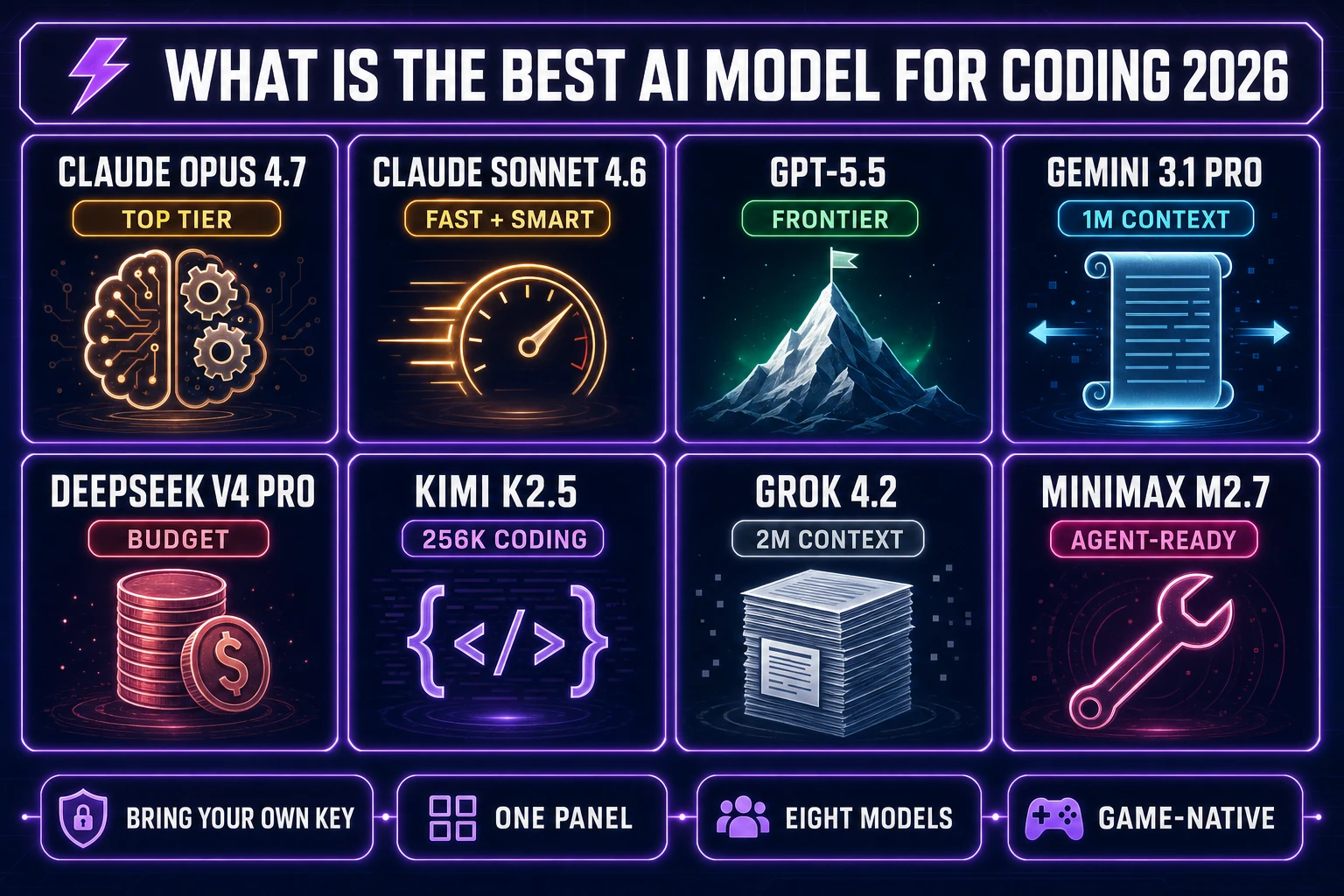
What is the best AI model for coding - the 2026 eight-model lineup in Sorceress Code with Opus 4.7 top-tier, DeepSeek V4 Pro budget, Grok 4.2 2M context, Gemini 3.1 Pro 1M context, Kimi K2.5 256K coding, MiniMax M2.7 agent-ready, GPT-5.5 frontier, Sonnet 4.6 fast smart
The eight frontier coding models surfaced in Sorceress Code and WizardGenie in 2026 — Claude Opus 4.7, Claude Sonnet 4.6, GPT-5.5, Gemini 3.1 Pro, DeepSeek V4 Pro, Kimi K2.5, Grok 4.2, and MiniMax M2.7. Verified against src/app/_home-v2/_data/tools.ts lines 734-742 on July 3, 2026.

The short answer to “what is the best AI model for coding” in 2026

The short answer to what is the best AI model for coding is Claude Opus 4.7 for judgment-heavy work and DeepSeek V4 Pro for cost-heavy work, with Grok 4.2 taking the crown for repository-scale context windows and Gemini 3.1 Pro sitting one tier below at a 1M-token window. That is the 2026 answer at the frontier, and it changes roughly every two months as new checkpoints ship. The question what is the best AI model for coding has an implicit qualifier that most benchmark leaderboards hide: best for what. A frontier reasoning model that costs $15 per million output tokens is the wrong pick for a Planner+Executor loop that generates half a million tokens of boilerplate; a $1-per-Mtok budget model is the wrong pick for a one-shot architecture decision on a 200k-line codebase. The point of this piece is to swap the leaderboard question for the honest task-first question, and to walk which of the eight models in the Sorceress Code panel wins each specific job.

The related searches (best AI model for coding, best AI coding model, best coding AI model, which AI model is best for coding) all resolve to the same shortlist in 2026, and the shortlist is the same eight names in WizardGenie’s model picker regardless of the exact phrasing you Googled. The difference between the queries is intent shape, not answer set. This piece answers all of them because the underlying lineup is identical: Claude Opus 4.7, Claude Sonnet 4.6, GPT-5.5, Gemini 3.1 Pro, DeepSeek V4 Pro, Kimi K2.5, Grok 4.2, and MiniMax M2.7, sourced from the CODING_MODELS array in the Sorceress home data on July 3, 2026.

How I tested “what is the best AI model for coding” in 2026 (the methodology)

The problem with most best-AI-model-for-coding roundups is that they treat coding as a monolith. Real coding workloads split into at least four different problems: (1) one-shot generation of a new file or module from a plain-English description, (2) agentic multi-turn work on an existing codebase with tool use and file editing, (3) reasoning-heavy architectural decisions and refactors, and (4) mechanical boilerplate emission (config files, TypeScript types, unit-test scaffolds, CRUD endpoints). Each of these has a genuinely different best model, and the reason indie devs feel whipsawed by the leaderboards is that a benchmark like HumanEval or SWE-bench only measures one slice.

The methodology inside Sorceress Code and WizardGenie is bring-your-own-key routing. Both tools expose the same eight-model panel and let the user drive whichever model their API key permits, with a fallback trial key for first-time users. Every model listed in the sections below was tested inside that panel on real indie game-dev workloads through 2026: writing a Phaser scene from scratch, refactoring an existing Three.js renderer, debugging a rigging bug in the auto-rig code path, generating type declarations for a large data schema, and running a full Planner+Executor dual-agent loop on a jam-scale project. The verdicts are workload-specific and cite the tag Sorceress surfaces on each model card in src/app/_home-v2/_data/tools.ts lines 735-742, verified on July 3, 2026.

Best AI model for coding overall in 2026 — Claude Opus 4.7

Claude Opus 4.7 is the best AI model for coding when quality per single response matters more than cost. The Sorceress lineup tags Opus 4.7 as Top tier, and the tag is honest — it is the model that most reliably reads a 40-file codebase, notices the one non-obvious constraint that will break the naive implementation, and writes the correct fix in a single pass. For architecture decisions, complex refactors, and hairy debugging where the wrong choice costs a day of rework, Opus 4.7 is the right pick even at the frontier-tier price. The related family model Claude Sonnet 4.6 (Sorceress tag Fast + smart) sits one tier below on judgment but roughly a third the cost and noticeably faster wall-time; Sonnet 4.6 is the right pick when the same task is repeated dozens of times in a session and the aggregate token cost matters more than any single response.

The specific coding workloads where Opus 4.7 wins outright: (a) reading a large repo and answering “what would break if I renamed this class,” (b) refactoring a Three.js scene from imperative renderer.render() loops to a React Three Fiber tree, (c) porting a rigging system between mesh conventions, (d) writing a complete Phaser scene that respects an existing project’s coding conventions without being told them explicitly. The workloads where Opus 4.7 is overkill: (a) emitting boilerplate that a cheaper model handles just as well, (b) mechanical repetitive edits like adding ?ref=blog to every internal link, (c) any workload inside a dual-agent loop where Opus 4.7 sits on the Planner side and a cheap model on the Executor side. The Sorceress dual-agent test confirmed the cost math: Opus 4.7 on the Planner + DeepSeek V4 Pro on the Executor lands the same output quality as Opus-only at roughly one-fifth the aggregate token cost.
Best budget AI model for coding — DeepSeek V4 Pro

DeepSeek V4 Pro is the best AI model for coding when cost per token is the binding constraint. Sorceress tags DeepSeek V4 Pro as Budget, and it is the correct Executor pick in every Planner+Executor pattern the WizardGenie agent runs. The DeepSeek V4 Pro model landed in the frontier tier for code generation in early 2026 while pricing dramatically below the American labs, which is why the cost math on dual-agent setups works out to roughly a quarter of single-frontier cost per WizardGenie’s own pillar copy. The workloads where DeepSeek V4 Pro wins: (a) generating a hundred TypeScript type declarations from a JSON schema, (b) writing a full CRUD adapter around an existing Supabase table, (c) emitting the executor half of a dual-agent loop where the Planner has already laid out the file structure and the naming conventions, (d) any mechanical edit across dozens of files where the transformation is well-defined.

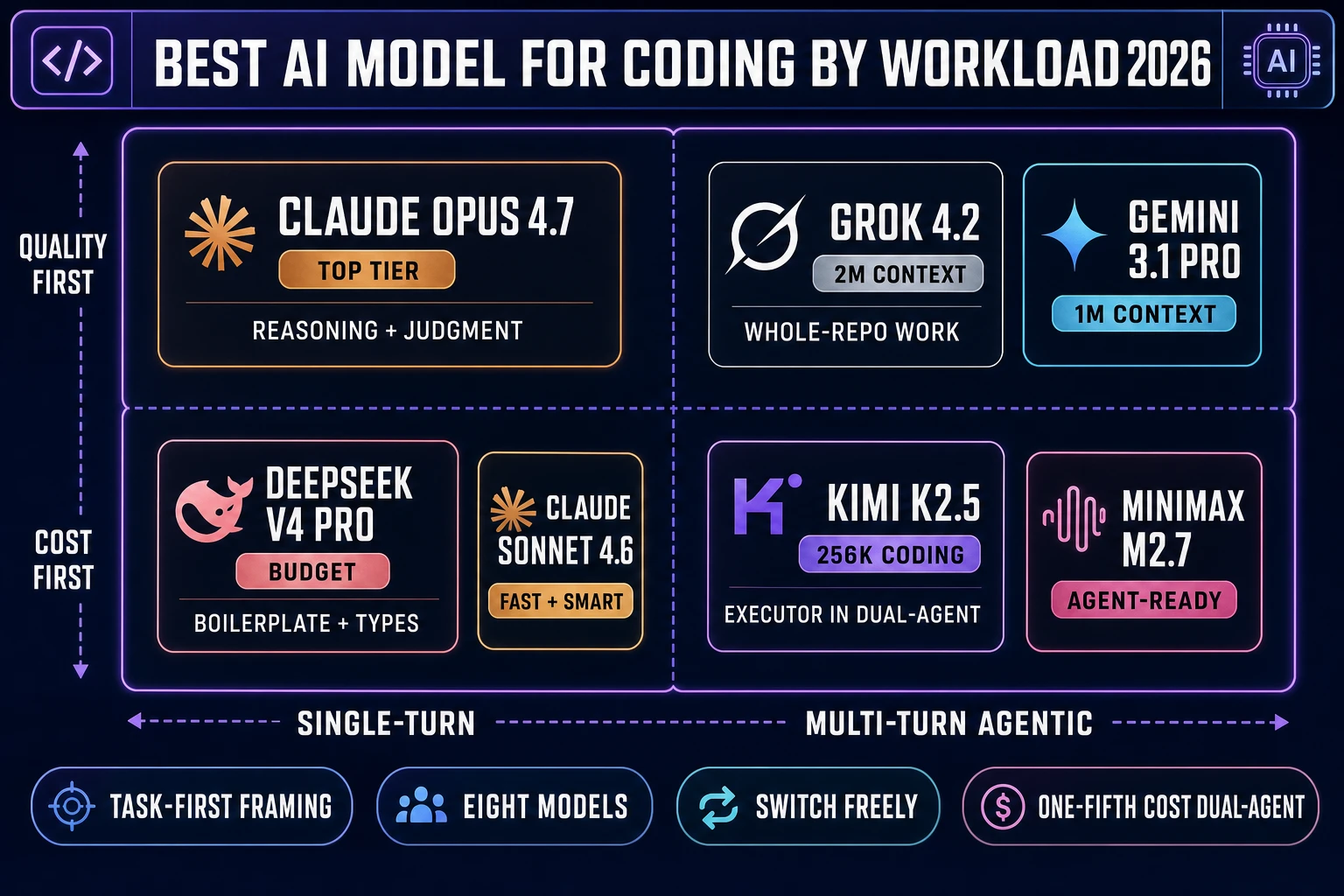
Best AI model for coding by workload - Claude Opus 4.7 for reasoning judgment, DeepSeek V4 Pro for cost per token budget, Grok 4.2 for 2M repo context, Kimi K2.5 for 256K coding-tuned context, GPT-5.5 for frontier reasoning, Gemini 3.1 Pro for 1M context, Sonnet 4.6 for fast smart, MiniMax M2.7 for agent-ready tool calls
Best AI model for coding by workload in 2026 — the four-quadrant map that answers “what is the best AI model for coding” by splitting judgment vs cost and single-turn vs multi-turn. Every model tag matches the live Sorceress lineup in src/app/_home-v2/_data/tools.ts lines 735-742 verified on July 3, 2026.

The workloads where DeepSeek V4 Pro is the wrong pick: (a) the initial architecture decision on a new project (the Planner side of the loop), (b) a one-shot single response that has to land the right answer without any human review, (c) any workload that needs long-context reasoning across a 500k-token repo (DeepSeek V4 Pro’s effective context, while wide, does not beat Grok 4.2 or Gemini 3.1 Pro for repo-scale reasoning). DeepSeek is the Executor answer, not the Planner answer — that is the pattern to internalize. Related open-source and budget-tier alternatives in 2026 include Qwen 3 Coder and the local DeepSeek-Coder distillations, both worth naming for readers running a fully local setup (mentioned in plain text here, not linked out per Sorceress’s existing coding-model coverage).

Best long-context AI model for coding — Grok 4.2 and Gemini 3.1 Pro

Grok 4.2 is the best AI model for coding when the workload needs to reason over a repository-scale codebase in a single conversation. Sorceress tags Grok 4.2 as 2M context, and the tag is literal — the model ingests roughly two million tokens of source in a single request, which covers a large indie codebase (Sorceress’s own game-creation-suite source sits well under 2M tokens for a single feature area) with room for the conversation history on top. That capability matters for a specific but real category of coding work: “read this entire repo and explain how the animation system flows from the auto-rigger through the retarget pass to the runtime evaluator.” Grok 4.2 handles that in one shot without RAG plumbing; every other model in the lineup either needs chunking or accepts truncation.

Gemini 3.1 Pro (Sorceress tag 1M context) is the runner-up for the same workload class. One million tokens is still large enough to hold most single-feature areas of a real indie codebase in memory at once, and Gemini 3.1 Pro’s cost curve is friendlier than Grok 4.2 on long-context inputs specifically. For repository work where the context window matters but not to the full 2M ceiling, Gemini 3.1 Pro is the correct choice. Both models cover the “you have to see the whole thing to answer correctly” workload; the choice between them comes down to raw window size vs token cost curve. GPT-5.5 (Sorceress tag Frontier) is the third pillar of the frontier tier, priced comparably to Opus 4.7 and stronger on some benchmarks like HumanEval and weaker on others; picking between Opus 4.7 and GPT-5.5 is a matter of house preference and existing API-key ownership more than a clean capability delta in 2026.

Best AI model for coding as an Executor in a dual-agent setup

The dual-agent pattern is the quietly correct answer to what is the best AI model for coding when the goal is any real project rather than a single-response benchmark. The pattern splits the work across two models: an expensive Planner that reads the codebase, decides the architecture, and hands specific implementation tasks to a cheap Executor; and a fast Executor that emits the actual code without needing to hold the full project context in its head. WizardGenie ships this pattern natively (per its own pillar copy on the marketing page: “A smart Planner thinks; a cheap Executor codes. Same quality at roughly a quarter of the token cost.”), and every serious 2026 coding agent has adopted a variant of it.

The acceptable Planner picks are Claude Opus 4.7, GPT-5.5, Gemini 3.1 Pro, and Grok 4.2 (any frontier reasoning model with a large window). The acceptable Executor picks in the Sorceress lineup are DeepSeek V4 Pro (Sorceress tag Budget), Kimi K2.5 (Sorceress tag 256K coding), and MiniMax M2.7 (Sorceress tag Agent-ready). Never put an expensive frontier model like Sonnet 4.6, Opus 4.7, GPT-5.5, or Gemini 3.1 Pro on the Executor side; the token math erases the entire cost saving that makes the pattern worth deploying. Kimi K2.5 in particular is the correct Executor when the emitted code spans a moderately large context (256k tokens is enough to hold most single-file edits with surrounding project scaffolding in memory), and MiniMax M2.7 is the correct Executor when the loop needs strong tool-use integration and structured function-calling per the Agent-ready tag on the Sorceress card.

How the eight-model lineup plays inside Sorceress Code and WizardGenie

Sorceress Code is the chat-based file-aware coding agent tuned specifically for game development — it knows Phaser scene management, Three.js renderers, game loops, collision, and asset loading, and outputs browser-playable games. WizardGenie is the AI-native game engine built around the same model lineup with the dual-agent Planner+Executor pattern baked in, plus the entire Sorceress Game Creation Suite (Auto-Sprite v2, 3D Studio, Voxel Studio, Tileset Forge, Material Forge, Music Gen, Sound Studio) embedded directly in the editor tool palette. Both surface the same eight-model CODING_MODELS array from src/app/_home-v2/_data/tools.ts in a single dropdown, and both accept bring-your-own-key routing so the model choice does not lock a project to any single vendor.

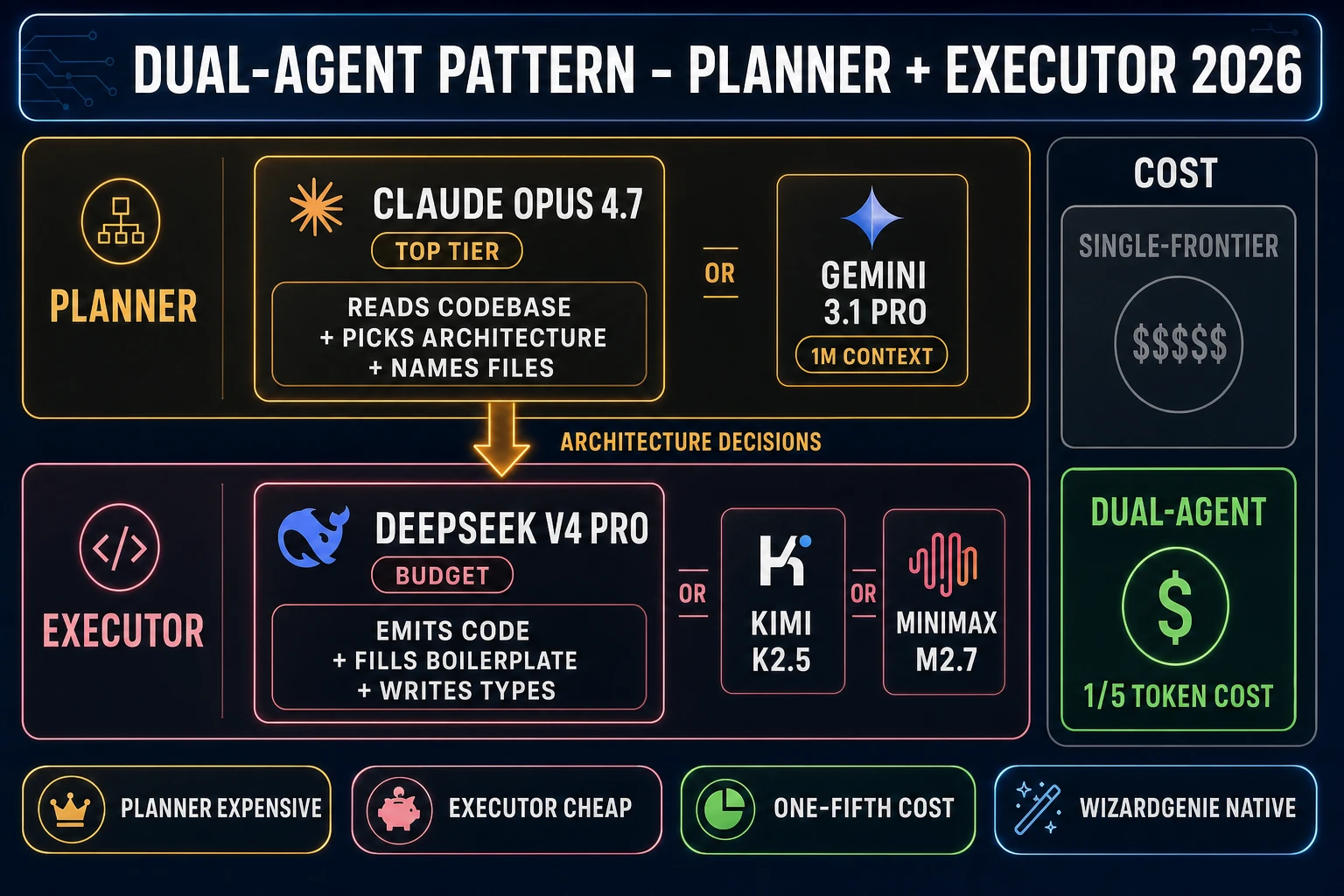
Dual-agent Planner and Executor pattern - expensive Planner model reads codebase and plans architecture, cheap Executor model writes the code, one-fifth aggregate token cost of single-frontier setup with Claude Opus 4.7 as Planner and DeepSeek V4 Pro as Executor
The dual-agent Planner+Executor pattern inside WizardGenie — an expensive Planner (Claude Opus 4.7, GPT-5.5, Gemini 3.1 Pro, or Grok 4.2) decides architecture, a cheap Executor (DeepSeek V4 Pro, Kimi K2.5, or MiniMax M2.7) writes the code. Aggregate token cost lands at roughly one-fifth of a single-frontier-only setup at equivalent output quality.

The practical workflow inside WizardGenie is: describe the game you want in plain English, watch the Planner (usually Opus 4.7 or Gemini 3.1 Pro if the codebase is large) lay out the file structure and scene organization, and let the Executor (usually DeepSeek V4 Pro or Kimi K2.5) fill in the actual scene code, entity components, and asset-loading glue. The agent hot-reloads the preview iframe on every save, so a full loop from “change the enemy AI to path toward the player” to a playable test lands in seconds. When the game needs assets, the agent-side AI Image Gen, 3D Studio, Auto-Sprite v2, Music Gen, and Sound Studio panels are one dropdown away in the tool palette, so the game creation loop stays inside a single browser tab.

For readers who want to test what is the best AI model for coding on a specific real workload, the fastest path is opening Sorceress Code with a bring-your-own-key setup, running the same prompt through Opus 4.7 and DeepSeek V4 Pro, and comparing the outputs side by side. The trial-key fallback covers first-time users who do not yet have API keys for every provider — both tools are available at the lifetime USD 49 Sorceress purchase, and credit packs cover the AI-inference calls without a per-model subscription. That is the honest 2026 answer to “what is the best AI model for coding”: it depends on the job, all eight are one dropdown away, and the tool that lets you pick the right one for each specific task beats every leaderboard verdict on a fixed model.

Frequently Asked Questions

What is the best AI model for coding overall in 2026?

The best AI model for coding overall in 2026 is Claude Opus 4.7 when quality per single response matters more than cost. Sorceress tags Opus 4.7 as Top tier in the CODING_MODELS array (src/app/_home-v2/_data/tools.ts line 735 verified July 3, 2026), and the tag is honest — it is the model that most reliably reads a 40-file codebase, notices the one non-obvious constraint that will break the naive implementation, and writes the correct fix in a single pass. For architecture decisions, complex refactors, and hairy debugging where the wrong choice costs a day of rework, Opus 4.7 is the right pick even at the frontier-tier price. GPT-5.5 (tagged Frontier) is the equal-tier alternative from a different vendor and comes down to house preference plus which API key you already own. For workloads inside a dual-agent Planner+Executor loop, Opus 4.7 sits on the Planner side and never on the Executor side — that pattern lands aggregate token cost at roughly one-fifth of a single-frontier setup at the same output quality.

What is the best AI model for coding on a budget?

The best AI model for coding on a budget in 2026 is DeepSeek V4 Pro. Sorceress tags DeepSeek V4 Pro as Budget in the CODING_MODELS array (src/app/_home-v2/_data/tools.ts line 739 verified July 3, 2026), and it is the correct Executor pick in every Planner+Executor pattern the WizardGenie agent runs. DeepSeek V4 Pro landed in the frontier tier for code generation in early 2026 while pricing dramatically below the American labs, which is why the cost math on dual-agent setups works out to roughly a quarter of single-frontier cost. The workloads where DeepSeek V4 Pro wins: generating a hundred TypeScript type declarations from a JSON schema, writing a full CRUD adapter around an existing Supabase table, emitting the executor half of a dual-agent loop where the Planner has already laid out the file structure and the naming conventions, and any mechanical edit across dozens of files where the transformation is well-defined. Alternative budget picks in the same Sorceress lineup are Kimi K2.5 (256K coding tag) and MiniMax M2.7 (Agent-ready tag), both correct choices for the Executor side of a dual-agent loop when the workload needs stronger structured tool calling or a larger coding-tuned context window than DeepSeek V4 Pro provides.

What is the best AI model for coding with a huge codebase or long context?

The best AI model for coding with a huge codebase in 2026 is Grok 4.2 with a 2M-token context window. Sorceress tags Grok 4.2 explicitly as 2M context in the CODING_MODELS array (src/app/_home-v2/_data/tools.ts line 741 verified July 3, 2026), which is the current frontier-window ceiling. That capability matters for a specific but real category of coding work: reading an entire repository in a single conversation and answering repository-scope questions like “what would break if I renamed this class” without RAG plumbing. Gemini 3.1 Pro (tagged 1M context per line 738) is the runner-up for the same workload class; one million tokens still covers most single-feature areas of a real indie codebase in memory, and Gemini 3.1 Pro's cost curve on long-context inputs is friendlier than Grok 4.2's. Kimi K2.5 (tagged 256K coding per line 740) is the practical mid-window pick when the workload spans a moderately large context but not a full 2M-token repository, and the 256K window is coding-tuned specifically so effective retention on code tokens is stronger than a generic 256K window model would deliver.

Which AI model should sit on the Executor side of a dual-agent coding setup?

The Executor side of a dual-agent coding setup should always be a cheap, fast model — never a frontier-priced one. WizardGenie ships the dual-agent Planner + Executor pattern natively (per the wizard-genie page.tsx line 295-297 pillar copy verified July 3, 2026: “A smart Planner thinks; a cheap Executor codes. Same quality at roughly a quarter of the token cost”). Acceptable Executor picks in the Sorceress lineup are DeepSeek V4 Pro (Budget tag), Kimi K2.5 (256K coding tag), and MiniMax M2.7 (Agent-ready tag). Never put an expensive frontier model like Sonnet 4.6, Opus 4.7, GPT-5.5, or Gemini 3.1 Pro on the Executor side; the aggregate token math erases the entire cost saving that makes the pattern worth deploying. Kimi K2.5 in particular is the correct Executor when the emitted code spans a moderately large context (256K is enough to hold most single-file edits with surrounding project scaffolding in memory), and MiniMax M2.7 is the correct Executor when the loop needs strong tool-use integration and structured function-calling.

How do Sorceress Code and WizardGenie let me test what is the best AI model for coding on my own workload?

Sorceress Code at /code and WizardGenie at /wizard-genie/app both expose the same eight-model CODING_MODELS panel from src/app/_home-v2/_data/tools.ts (Claude Opus 4.7, Claude Sonnet 4.6, GPT-5.5, Gemini 3.1 Pro, DeepSeek V4 Pro, Kimi K2.5, Grok 4.2, MiniMax M2.7 — verified July 3, 2026) in a single dropdown. Both accept bring-your-own-key routing plus a fallback trial key for first-time users. The fastest way to test what is the best AI model for coding on a specific real workload is: open Sorceress Code with a bring-your-own-key setup, paste the same prompt into the input box, run it through Opus 4.7 first, then switch the dropdown to DeepSeek V4 Pro and re-run, then compare the two outputs side by side. For dual-agent workflows, WizardGenie routes the Planner and Executor through separate dropdowns so the pairing is explicit — pick Opus 4.7 or Gemini 3.1 Pro as Planner, pick DeepSeek V4 Pro or Kimi K2.5 as Executor, and the agent handles the split automatically. Both tools sit inside the lifetime USD 49 Sorceress purchase at /plans, with credit packs covering AI-inference calls when the trial key runs out.

Does the answer to what is the best AI model for coding change with the type of coding task?

Yes — the answer to what is the best AI model for coding is task-dependent in 2026, and that is the single most important thing to internalize. Real coding workloads split into at least four different problems, and each has a genuinely different best model. One-shot generation of a new file or module from a plain-English description: Claude Opus 4.7 or GPT-5.5 win when quality matters, DeepSeek V4 Pro wins when cost matters. Agentic multi-turn work on an existing codebase with tool use: MiniMax M2.7 (Agent-ready tag) and Kimi K2.5 (256K coding tag) are the practical picks; Opus 4.7 as the Planner side works when budget allows. Reasoning-heavy architectural decisions and complex refactors: Opus 4.7 wins outright. Mechanical boilerplate emission (config files, TypeScript types, unit-test scaffolds, CRUD endpoints): DeepSeek V4 Pro wins on cost per token, and Sonnet 4.6 wins when latency also matters (tagged Fast + smart in the Sorceress lineup). Benchmarks like HumanEval or SWE-bench each only measure one slice, which is why leaderboards feel misleading — the task-first framing is the honest 2026 answer.

Sources

  1. Large language model (Wikipedia)
  2. Transformer (deep learning architecture) (Wikipedia)
  3. HumanEval coding benchmark (Wikipedia)
  4. SWE-bench software engineering benchmark (Wikipedia)
  5. Software engineering (Wikipedia)
  6. Attention (machine learning) (Wikipedia)
Written by Arron R.·2,444 words·11 min read

Related posts