Shuffle a Random Game Generator (Jam Pivot Pack 2026)

By Arron R.8 min read
A random game generator in 2026 is a four-step jam pivot pack: lock genre–verb–constraint axes in WizardGenie, shuffle a scored shortlist, scaffold a Phaser 4.2

Mid-jam walls feel different from blank-page panic. Searchers typing random game generator on July 17, 2026 usually already have a half-built loop that stopped being fun — they need a constrained pivot, not another open brainstorm. This guide covers the 2026 pipeline: WizardGenie locks genre–verb–constraint axes, shuffles a scored shortlist, and scaffolds a Phaser 4.2 loop from the winner before you throw away the weekend. Tool costs and model names below are verified against the live Sorceress source on July 17, 2026.
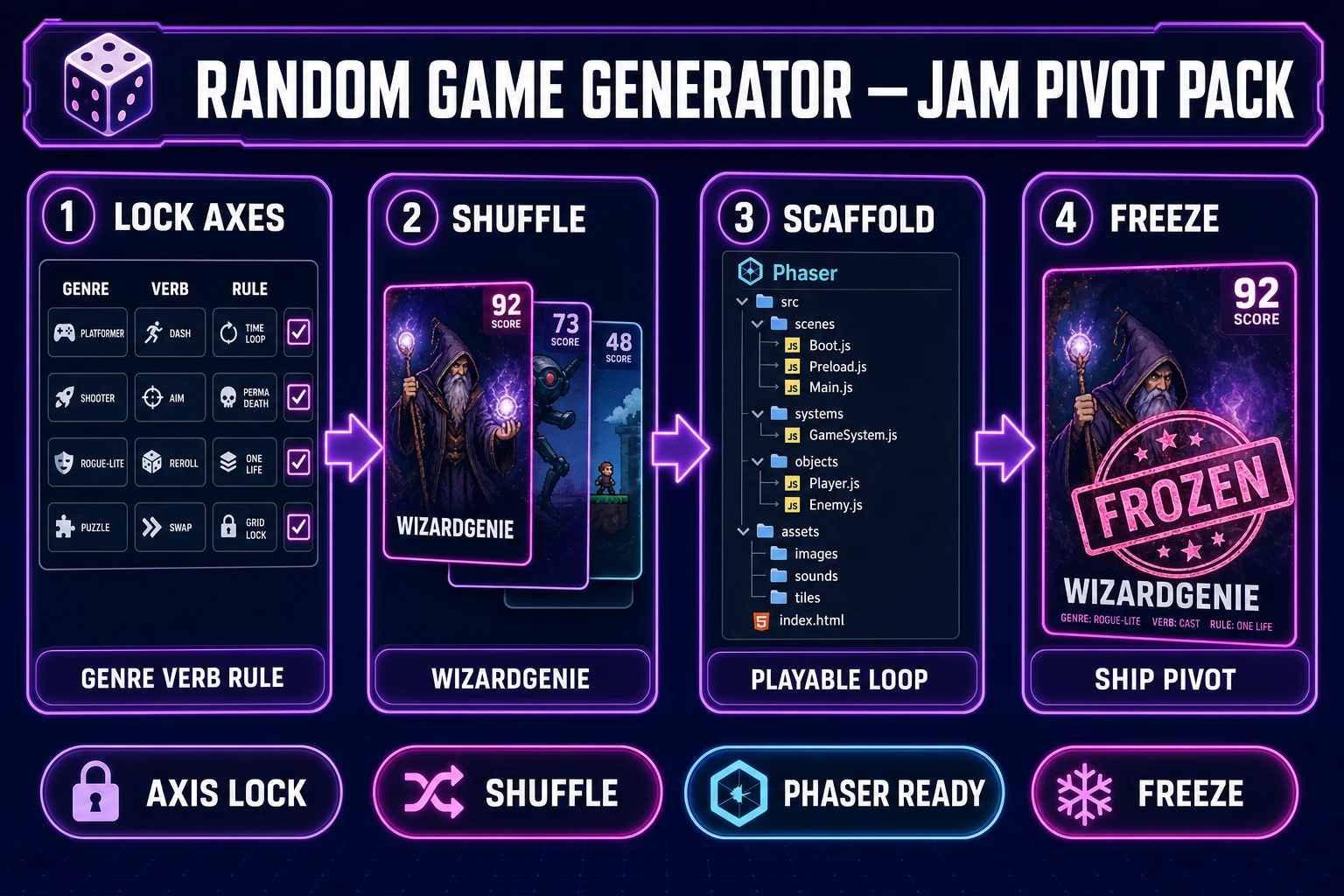
Random game generator in 2026, four-step jam pivot pack from locked axes through WizardGenie shuffle and Phaser scaffold to a frozen winner, verified July 17, 2026
A random game generator in 2026 means four moves: lock axes, shuffle a scored pack, scaffold, then freeze the pivot.

What a random game generator outputs for indie jam pivots

The phrase random game generator (1,600/mo, KD 13 per DataForSEO probe-fresh-seeds-5.md verified July 16, 2026) targets solo jammers and small teams who need a clean turn when the first direction stalls. Sibling queries in the same cluster — random video game generator (480/mo, KD 8), random game generator name (880/mo, KD 0) — often mix naming and concept intent. This post stays on the concept pivot: a shortlist you can build tonight, not a storefront title pass.

Production output is structured. Ship an axis card (genre pool, verb pool, hard constraints, banned systems), eight scored pivot rows with id, genre, core_verb, constraint, fail_state, pitch, and score, then one winner you actually scaffold. Pair that pack with the game idea generator sibling when you are still inventing the weekend from a blank page — Spark ranks open concepts; a random game generator shuffles inside locked axes. When an official theme phrase already exists, route through the game jam theme generator instead of inventing unconstrained draws.

Why unconstrained random dumps stall jam pivots

Game design recovers from a bad mid-jam direction by changing one axis at a time under pressure. A naked randomizer dumps “co-op farming MMO with real-time strategy” and pretends that is a pivot. That string feels productive because it fills a notes app. It fails a game jam because it invents three new systems after you already spent twelve hours on the wrong verb.

Official events like Global Game Jam force a shared theme so teams reinterpret instead of invent forever. Solo practice weekends lack that external kill switch. Without locked axes, every new draw looks equally shiny and you never reopen the scene file. The failure modes are predictable: eight unfinished pitches, a deleted repo, and a Sunday panic rewrite into yet another endless runner.

Treat the shuffle like production data. Keep the engine, art budget, and room count you already paid for. Change genre tone, core verb, or one constraint — not all three at once unless the scaffold is still gray boxes. Reject any draw that needs multiplayer, procedural worlds, or a full inventory on a 48-hour solo clock. That discipline is what turns a random game generator from novelty into a jam pivot pack you can ship.

A useful score rubric is boring on purpose. Give four points for reuse of the existing scaffold, three for a fail state a stranger can understand mute, two for verb clarity in one sentence, and one for would-I-play-this density. Anything that requires deleting the current scene graph to “start fresh” fails the reuse test. Write those weights into the axis card so WizardGenie cannot invent a private scoring language mid-run.

The Sorceress random game generator pipeline in four steps

Every shippable jam pivot pack ships four runtime pieces: axis card, shuffled shortlist, playable scaffold, and freeze stamp. In 2026 each maps to one Sorceress surface verified against the live catalog on July 17, 2026:

  • Axis cards and shuffled JSON: WizardGenie (desktop or web) runs the shuffle on your API key — Claude Opus 4.7, Claude Sonnet 4.6, GPT-5.5, Gemini 3.1 Pro, DeepSeek V4 Pro, Kimi K2.5, Grok 4.2, MiniMax M2.7 (verified against CODING_MODELS in src/app/_home-v2/_data/tools.ts lines 734–742).
  • Playable scaffold: WizardGenie rebuilds or retargets a Phaser 4.2.0 scene from the winning pivot — input, one obstacle type, win/lose, restart.
  • Optional pitch frames: AI Image Gen (AI Credits) only after the pivot loop is playable; Z-Image is 3 credits per frame (verified against src/lib/models.ts).
  • Scope check: Tools guide and plans for credit math before you burn art on a pivot that fails the reuse test.

Pricing is a $49 lifetime unlock plus pay-as-you-go credit packs. Starter $10/1,000 credits, Creator $20/2,000, Plus $50/5,000, Studio $100/10,000. Verified against src/app/plans/page.tsx lines 51 and 56–59. New accounts ship with 100 starter credits. WizardGenie coding stays on your own API key — the expensive variable is Planner model choice, not Sorceress credits, when you keep the pack text-first.
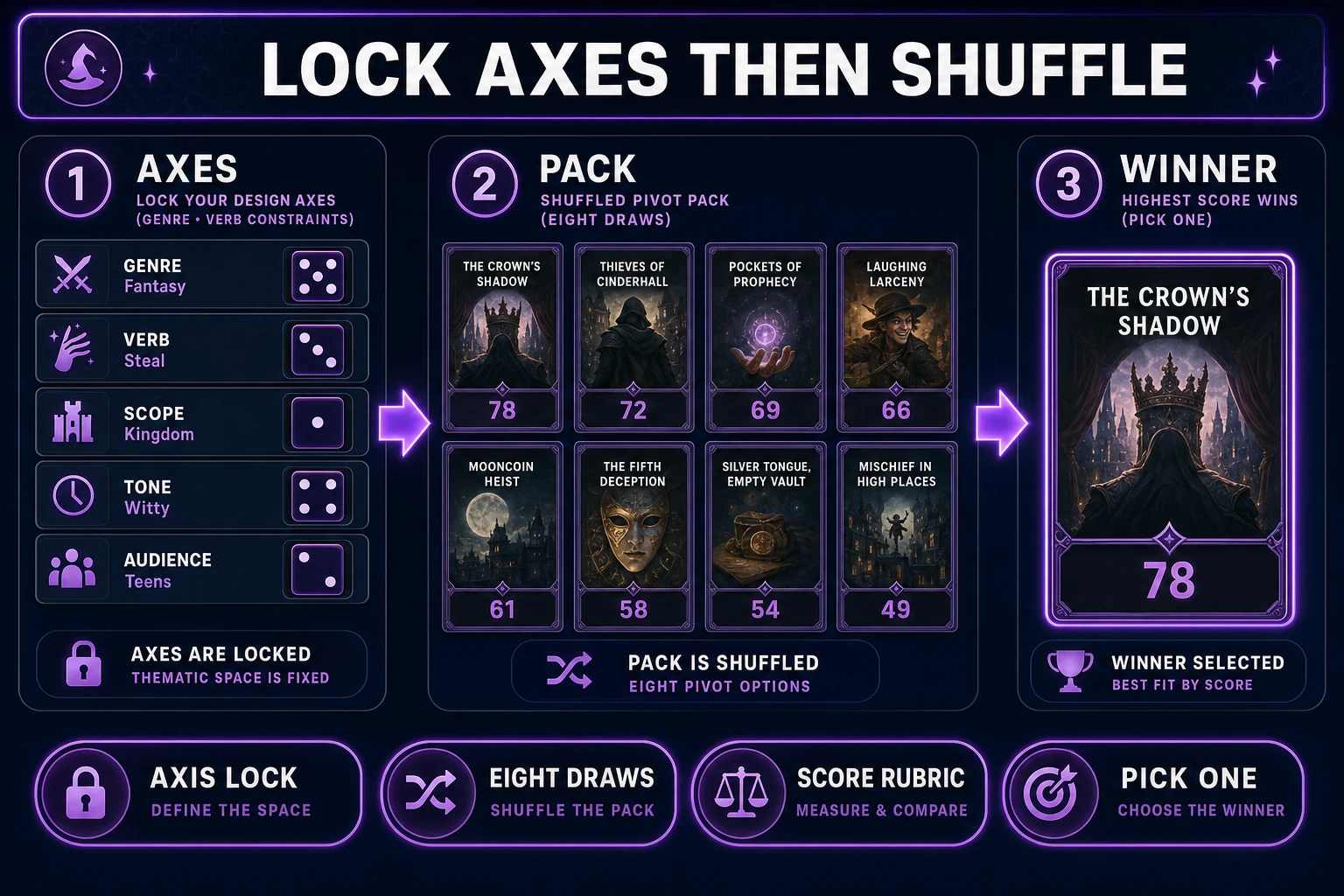
WizardGenie axis lock and shuffled jam pivot pack for a random game generator workflow, verified July 17, 2026
WizardGenie locks genre, verb, and constraint pools before any random draw earns a score.

Step 1 — lock pivot axes in WizardGenie

Open WizardGenie (desktop installer or /wizard-genie/app web) and write the axes before you ask for pretty concepts. Example card: “Solo, 36 hours left, Phaser browser build already started, keep one-room layout, genre pool [action-puzzle, stealth, arcade], verb pool [dash, place, pull], constraints [gravity flip, timed echo, light radius], banned [multiplayer, inventory, dialogue tree], score 1–10 on scaffold reuse then fail-state clarity.” Paste that card as a reusable system prefix. Prefer Claude Opus 4.7 or Gemini 3.1 Pro for the first shuffle; switch to DeepSeek V4 Pro or Kimi K2.5 when you iterate JSON fields — never put a frontier-priced model on bulk typing.

Ask WizardGenie for a pivot pack, not a novel:

{
  "axes": {
    "hoursLeft": 36,
    "engine": "phaser-4.2",
    "keepRooms": 1,
    "genrePool": ["action-puzzle", "stealth", "arcade"],
    "verbPool": ["dash", "place", "pull"],
    "constraintPool": ["gravity-flip", "timed-echo", "light-radius"],
    "banned": ["multiplayer", "inventory", "dialogue-tree"]
  },
  "pivots": [
    {
      "id": "echo_pull",
      "genre": "action-puzzle",
      "core_verb": "pull delayed echoes of your last dash",
      "constraint": "timed-echo",
      "fail_state": "echo collides with you",
      "pitch": "Your past dash is the enemy.",
      "score": 9
    }
  ]
}

Reject any row that invents a second verb, drops the fail state, or scores itself high while listing three new systems. Treat the axes like a production bible: hours left, room count, and banned systems are non-negotiable. If you still need an open ranked brainstorm instead of a pivot, stop here and use the game idea generator pipeline — do not shuffle open ideas and call it a random game generator.

Step 2 — shuffle and score a constrained pack

Run eight draws inside the pools. Force WizardGenie to sample without replacement across verbs so you do not get five “dash” clones. Cap the pack at eight — more rows become a second brainstorm disguised as randomness. Sort by score, then read the top three mute. If you cannot explain the win condition before a sixty-second timer ends, the card lied about density.

Keep the Planner versus Executor split honest. Use Opus or Gemini when the axes themselves need redesign. Use DeepSeek V4 Pro, Kimi K2.5, or MiniMax M2.7 when you only need field cleanup, duplicate culls, or a second shuffle after you ban one more system. That cost discipline is how a weekend stays affordable when the first random game generator pass forces two packs before one sticks.

When the jam already has an official theme phrase, do not fight it with unconstrained draws. Re-lock the constraint pool to interpretations of that phrase, then shuffle again. The game jam theme generator sibling covers theme-first weekends; this pipeline covers mid-build pivots under axes you still control.

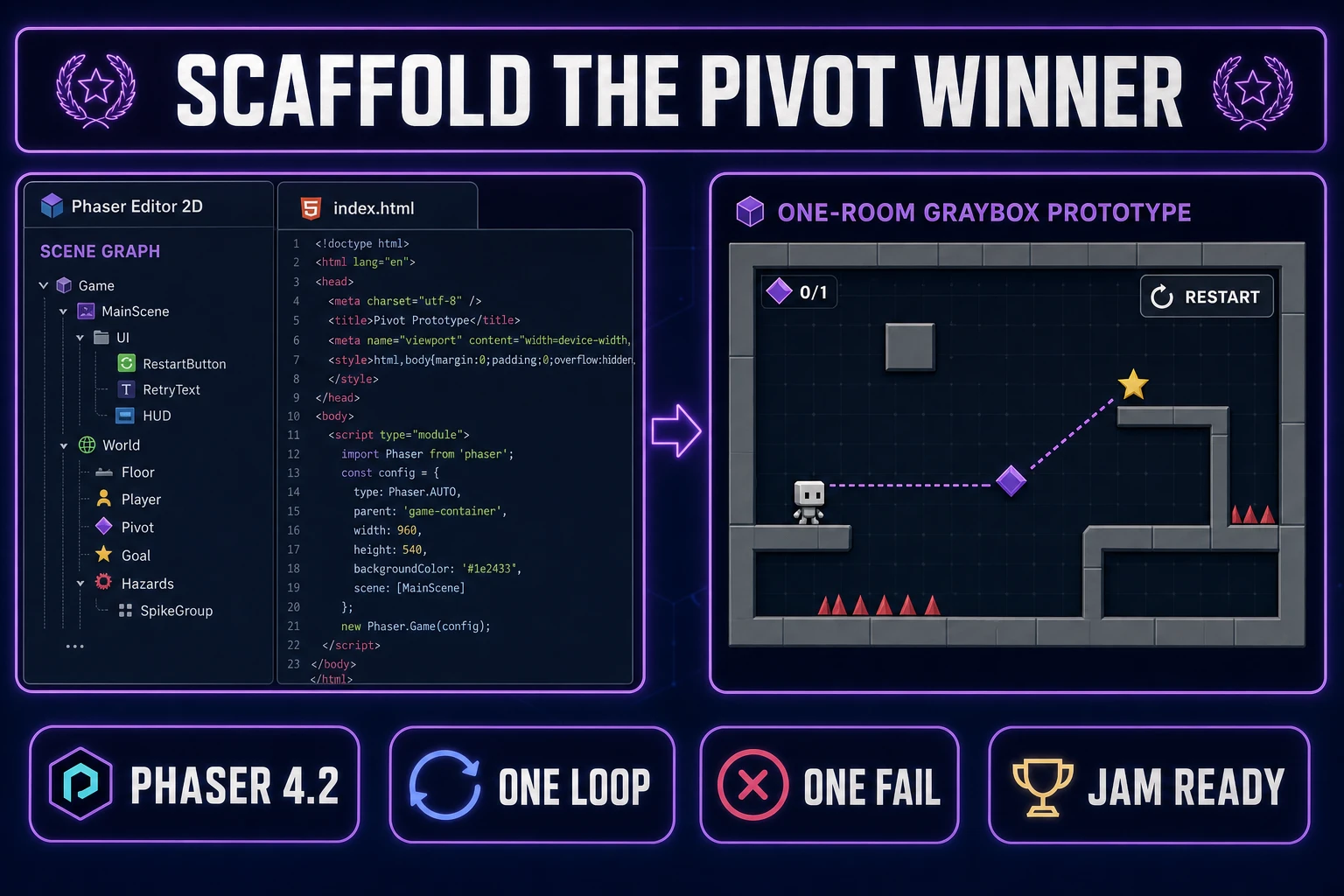
Phaser 4.2 scaffold closing a random game generator jam pivot pack, verified July 17, 2026
Scaffold the pivot winner first: Phaser 4.2 proves the new verb before you spend art credits.

Step 3 — scaffold the pivot winner and freeze it

Pick the highest score that still reuses your existing room layout. Paste the winner into a second WizardGenie prompt:

Retarget this Phaser 4.2.0 browser game to the pivot card:
id: echo_pull
core_verb: pull delayed echoes of your last dash
constraint: timed-echo
fail_state: echo collides with you
Keep: one room, restart, mute-readable feedback.
Change: player verb + fail condition only.
Output: patch main.js; keep index.html structure.

Phaser 4.2.0 “Giedi” (released June 19, 2026; patch 4.2.1 on July 9, 2026 — verified against phaser.io release notes and the Phaser download archive on July 17, 2026) is the honest browser runtime for jam scaffolds on Sorceress. Keep gray boxes until the new verb feels fair. Do not polish art before collision boxes and restart work. Desktop and web WizardGenie both work — pick the surface you already use for coding. Do not promise arcade auto-publish; export the build and host it where you want.

Freeze the winner in the repo as pivot-winner.json so the next panic does not reopen the full pack. Optional Z-Image pitch frames can wait until playtests say the silhouette is unclear. For a public title string after the pivot sticks, run the game title generator once with genre + core verb locked — do not rename mid-scaffold. If you need a web-ship path later, the how to make a web game guide covers static hosting without inventing a backend.

What a random game generator session costs on Sorceress in 2026

Pricing verified July 17, 2026 against src/app/plans/page.tsx (LIFETIME_PRICE = 49). Sorceress base unlock is $49 one-time for the full tool suite. AI credits are pay-as-you-go: Starter $10 for 1,000 credits, Creator $20 for 2,000, Plus $50 for 5,000, Studio $100 for 10,000. A minimal random game generator pivot that stays on WizardGenie burns zero Sorceress image credits. Add three optional Z-Image pitch frames and you spend nine credits — often under $0.10–$0.40 on top of the lifetime unlock if you stay axis-first. WizardGenie coding runs on your own API keys.

Compare that to deleting the project at hour thirty and reinventing from Discord suggestions. The integrated random game generator path wins on iteration speed: tighten the banned list, reshuffle eight scores, retarget the scaffold, freeze the winner — done in a session. Browse the full stack at Sorceress Tools Guide or see plans for credit tiers. When you still need an open ranked brainstorm, switch to the game idea generator sibling; when the weekend already has an official theme, use the game jam theme generator guide.

The category shift is simple: a random game generator in 2026 is not a novelty slot machine with buzzwords. It is a production pipeline — locked axes, shuffled jam pivot packs, engine-ready scaffolds, freeze stamps — that respects how a mid-build recovery actually works. Sorceress built the pieces to run that pipeline in one account; your job is to kill every draw that needs a second verb before you ask for pretty neon. Your axis card is the product; the shuffled list is inventory; the scaffold is proof.

Frequently Asked Questions

What does a random game generator output for jam pivots?

A random game generator for pivots produces a scored shortlist of constrained concepts — locked genre, core verb, one constraint, and fail state — not an open brainstorm dump. On Sorceress that maps to WizardGenie for the pivot JSON and a Phaser 4.2.0 scaffold from the winning card.

How is a random game generator different from a game idea generator?

A game idea generator (see the sibling Spark post) ranks open concepts from a blank filter card. A random game generator assumes you already started a jam and need a constrained shuffle on fixed axes when the first direction stalls. Use Spark to invent the weekend; use Shuffle when you need a pivot without restarting from zero.

Can WizardGenie run a random game generator shuffle in the browser?

Yes. Prompt WizardGenie for a pivot pack with fields genre, coreVerb, constraint, failState, pitch, and score. Use Claude Opus 4.7 or Gemini 3.1 Pro for the first shuffle, then DeepSeek V4 Pro or Kimi K2.5 as the executor for JSON edits. The coding lineup is verified against src/app/_home-v2/_data/tools.ts CODING_MODELS on July 17, 2026.

Is a random game generator free on Sorceress?

WizardGenie coding runs on your own API key (or the trial fallback key). A pivot pack that stays text-and-scaffold only burns zero Sorceress image credits. New accounts ship with 100 starter credits; the $49 lifetime unlock covers Pro tools (verified against src/app/plans/page.tsx LIFETIME_PRICE = 49 on July 17, 2026).

What does a random game generator session cost on Sorceress in 2026?

Verified July 17, 2026 against src/app/plans/page.tsx. Base unlock is $49 one-time. A typical pivot session burns 0–9 Sorceress credits if you add three optional Z-Image pitch frames (3 credits each); WizardGenie coding stays on your API key. Credit packs: Starter $10/1,000, Creator $20/2,000, Plus $50/5,000, Studio $100/10,000.

Sources

  1. Game jam — Wikipedia
  2. Game design — Wikipedia
  3. Global Game Jam — What is a game jam?
  4. Phaser v4.2.0 release (Giedi)
Written by Arron R.·1,758 words·8 min read

Related posts