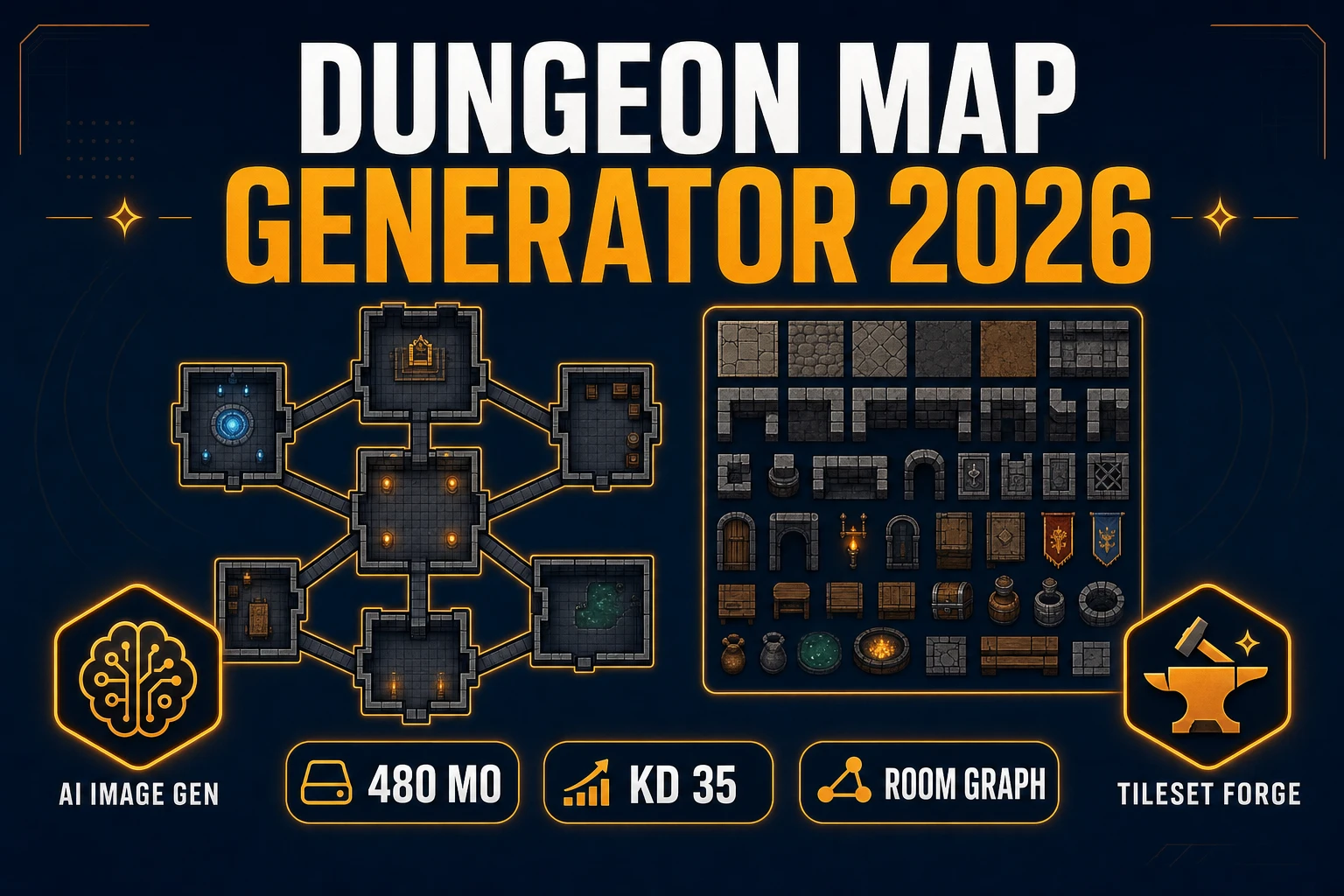
Pretty crypt paintings stall the moment you need a second floor. Searchers typing dungeon map generator on July 17, 2026 already know a single battle wallpaper is not a crawler — they need connected rooms, stable exits, and a walkable atlas a browser engine can load twice without redrawing doors by hand. This guide covers the 2026 production path: lock a room graph in AI Image Gen, snap tiles in Tileset Forge, label nodes in Canvas, then wire the pack into Phaser 4.2 with WizardGenie. Model credits, tool badges, and Phaser versions below are verified against the Sorceress source and Phaser release notes on July 17, 2026.
What a dungeon map generator outputs for indie room graphs
The phrase dungeon map generator (480/mo, KD 35 per DataForSEO probe-fresh-seeds-2.md verified July 16, 2026) targets solo and jam teams who need a playable crawl layout, not a campaign atlas. Sibling phrases — fantasy dungeon map, room graph pack, procgen floor plan, dungeon floor plan generator — all describe the same deliverable: rooms as nodes, corridors as edges, and a tile atlas that pathfinding can trust.
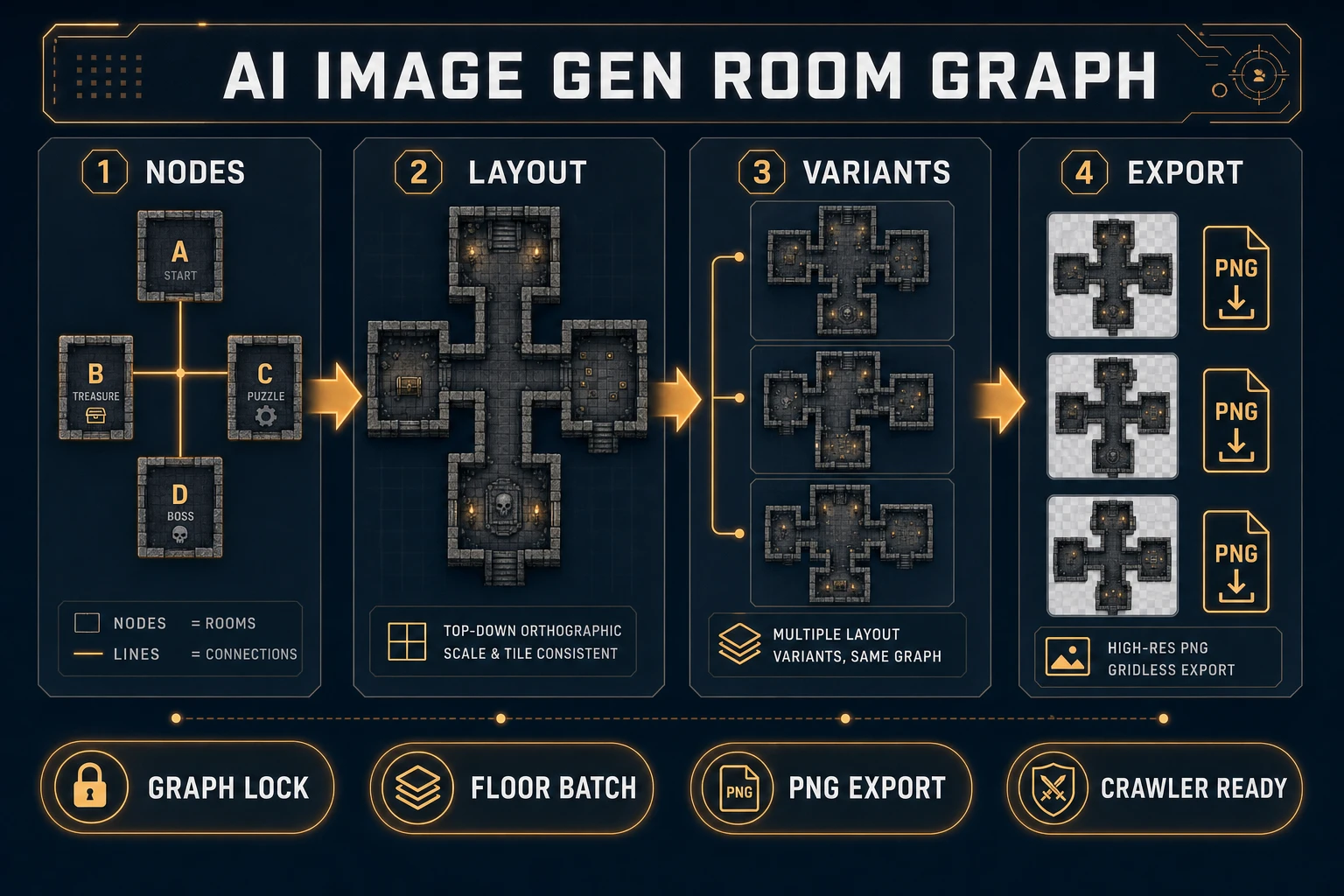
Production output is structured. Ship a graph card (room count, exit list, banned perspective), separate top-down PNG variants that obey that card, a Tileset Forge atlas for floors and walls, and a short JSON table with id, exits, and spawn keys so loot and lighting share vocabulary. Pair that pack with the DnD map generator sibling when you need tabletop battle-map grids and VTT cover icons — Scout answers “can tokens measure five-foot squares tonight?”; this dungeon map generator session answers “can Phaser load a reusable room graph?” When you also need coasts and kingdoms at campaign scale, route through the AI fantasy map generator guide after the dungeon graph locks.
Why one-shot wallpapers stall playable crawls
A dungeon in a browser RPG is a graph problem before it is an art problem. Players move room to room; encounters fire on node IDs; doors that only exist as painted shadows break collision. A single concept render almost always ships the wrong contract: isometric tilt that lies about corridor width, three mystery exits the card never listed, and no atlas you can reuse for the next wing.
Procedural generation pipelines fail the same way when the art layer ignores connectivity. You can randomize room templates forever and still ship a crawl that feels pasted if exits do not match the graph JSON. Tile-based games stay dominant in 2D RPG movement because walkable vs blocked is data — not a vibe. Treat the dungeon map generator as production data: lock nodes and edges first, batch orthographic top-downs second, reject any image that invents a room or paints a door three pixels wide.
Tabletop-first workflows still matter — the Scout sibling covers 5-foot battle maps and VTT export. Do that when you are running a session with tokens. When you are shipping a browser crawler, switch to a room graph pack so the engine owns spawn keys and the atlas owns collision.
The Sorceress dungeon map generator pipeline in four steps
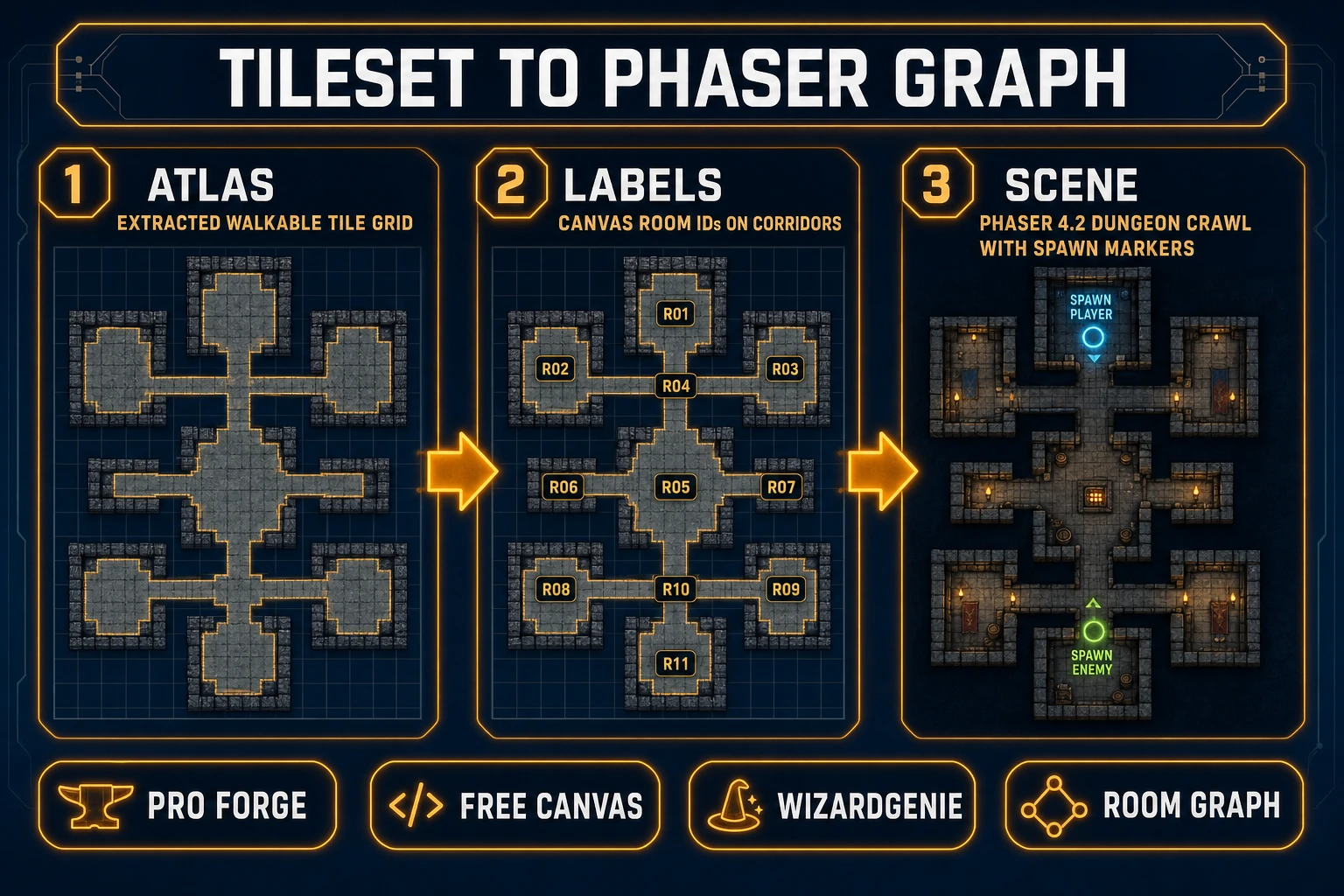
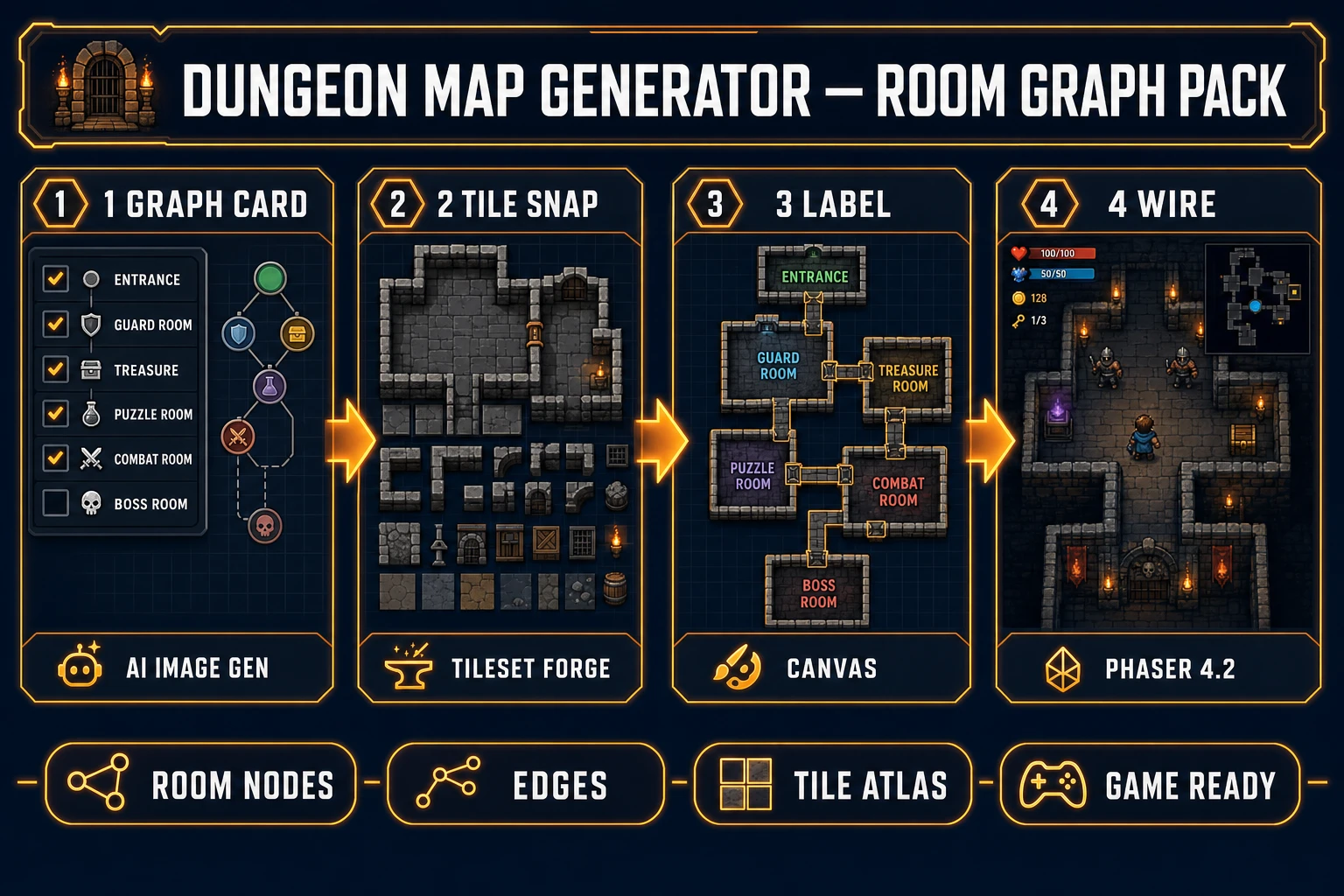
Every shippable room graph pack ships four runtime pieces: graph card, tile atlas, labels, and a wired scene. In 2026 each maps to one Sorceress surface verified against the live catalog on July 17, 2026:
- Graph lock: write room count, exit list, grid scale, and “no text in image” before you spend credits.
- Layout generation: AI Image Gen drafts top-downs across models (Z-Image at 3 credits for fast comps, GPT Image 2 at 5 credits for cleaner orthographic locks, Flux 2 Pro at 6 credits with references —
src/lib/models.tsverified July 17, 2026). - Tile snap: Tileset Forge is Pro-badge (
src/app/_home-v2/_data/tools.ts) for extract, align, preview, and export of walkable grids under the $49 lifetime unlock. - Label and wire: Canvas is Free-badge for room IDs and door marks; WizardGenie scaffolds a Phaser 4.2 TilemapScene on your own API keys — Phaser v4.2.0 “Giedi” shipped June 19, 2026; patch 4.2.1 landed July 9, 2026 (verified against phaser.io and GitHub on July 17, 2026).
Pricing is a $49 lifetime unlock plus pay-as-you-go credit packs. Starter $10/1,000 credits, Creator $20/2,000, Plus $50/5,000, Studio $100/10,000. Verified against src/app/plans/page.tsx lines 51 and 56–59. New accounts ship with 100 starter credits. Keep WizardGenie coding on your own API key so graph wiring never burns Sorceress image credits.