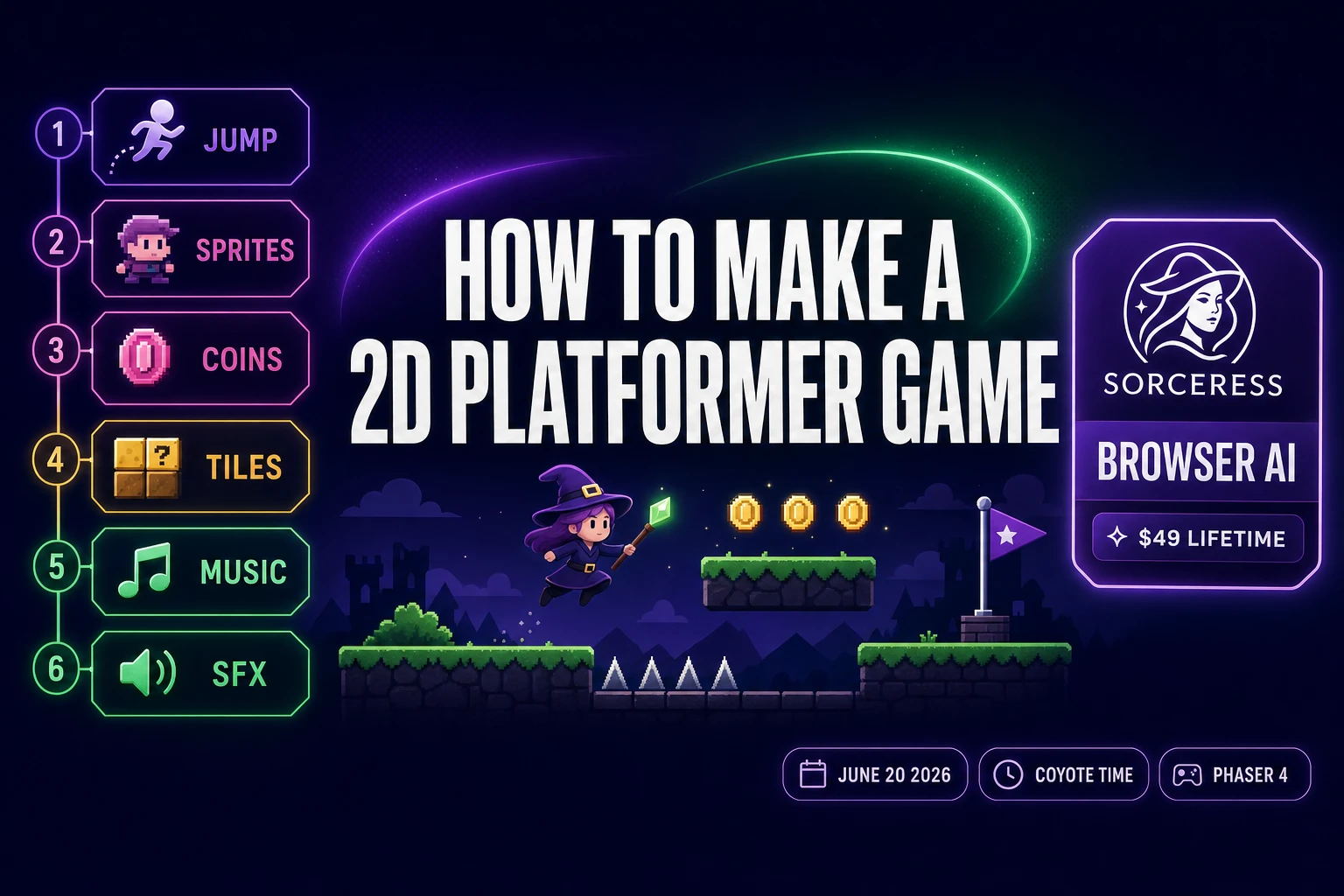
Type how to make a 2d platformer game into Google on June 20, 2026 and the SERP is split between two readers. One has played 80 hours of Celeste and Hollow Knight and now wants to ship a tight platformer of their own. The other has just finished a Phaser tutorial, found Donkey Kong on Wikipedia, and wants to know which AI tools turn the genre conventions into a real run loop. This guide answers both. The honest 2026 path to make a 2D platformer game is one prompt-driven coding tab plus five asset layers, all in one Sorceress catalog, verified against the live source on June 20, 2026. Tight jump physics, parallax tilesets, and the death-and-respawn loop are the easy half — the hard half is asset volume, and that is exactly the half AI now removes.
What “how to make a 2d platformer game” actually means in 2026
The phrase how to make a 2d platformer game covers a much narrower design surface than “how to make a game” in general, and that is good news for an indie dev. A platform game in the 2026 sense traces a continuous lineage from Donkey Kong (1981) to Super Mario Bros (1985) to Sonic the Hedgehog (1991) to Celeste (2018) and Hollow Knight (2017). The genre vocabulary is small and stable: a hero who runs and jumps, gravity that pulls them back to the ground, hazards that hurt or kill on contact, pickups that score or unlock, and discrete levels that end at a flag, gate, or boss. A 2026 dev does not need to invent any of these primitives; they need to ship them well. What does not count as a platformer is “a top-down adventure with jump-on-blob mechanics”: the absence of a side-scrolling camera and the absence of gravity-as-the-primary-conflict are the two failure modes every reviewer flags.
The reason this matters for a how-to is that the genre constraints collapse the asset budget in a way that maps cleanly onto AI generation. A 2D platformer does not need a 40-hour main quest with branching dialogue trees. It needs one hero with a five-frame walk cycle, four enemy archetypes with simple loops, twelve hand-tuned levels using one tileset (with autotile rules), one music loop per biome, and a death sting. That entire content list fits in one Sorceress tab session, and the level-design layer recombines tiles forever — one biome of hand-curated tiles and props stretches across an entire ten-hour playthrough. The honest 2026 answer to how to make a 2d platformer game is therefore not “build everything from scratch” but “curate one tight content seed, write the run loop once, and let the level-design phase do the storytelling.”
The seven beats every 2D platformer ships — and where AI shaves time
Before picking a tool stack, a dev needs a clear beat list because every beat maps to a specific AI handoff. The seven beats an indie 2026 platformer actually has to ship are: (1) the run loop — spawn, run, jump, hit hazard or enemy, die, respawn at the last checkpoint; (2) jump physics — gravity, variable jump height, coyote time, jump-buffering, optional double-jump or wall-jump; (3) character art — one playable hero with idle, run, jump, fall, and damage frames, plus three to eight enemy archetypes with their own simple loops; (4) tile art — a tile-based level set with autotile rules and one to three parallax background layers; (5) pickups and goals — coins or shards for scoring, keys for gating, hearts or shields for survival, the end-of-level flag or door; (6) audio — one to three music loops per biome plus the SFX one-shots that cover jump, land, hit, pickup, and death; (7) UI — a HUD with health and score, a pause menu, a level-end screen, and the death-and-restart prompt. Skip any of these and the run feels broken.
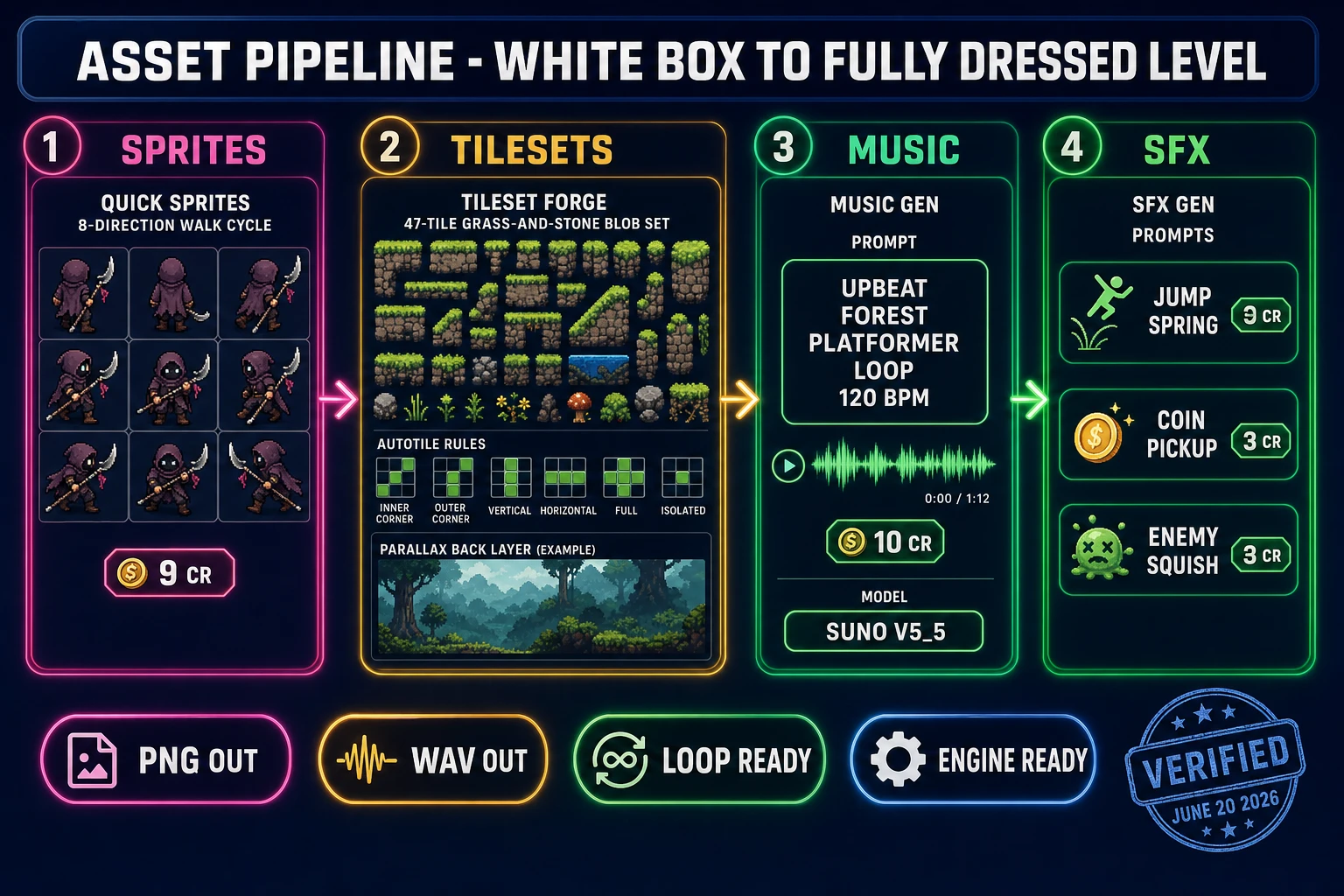
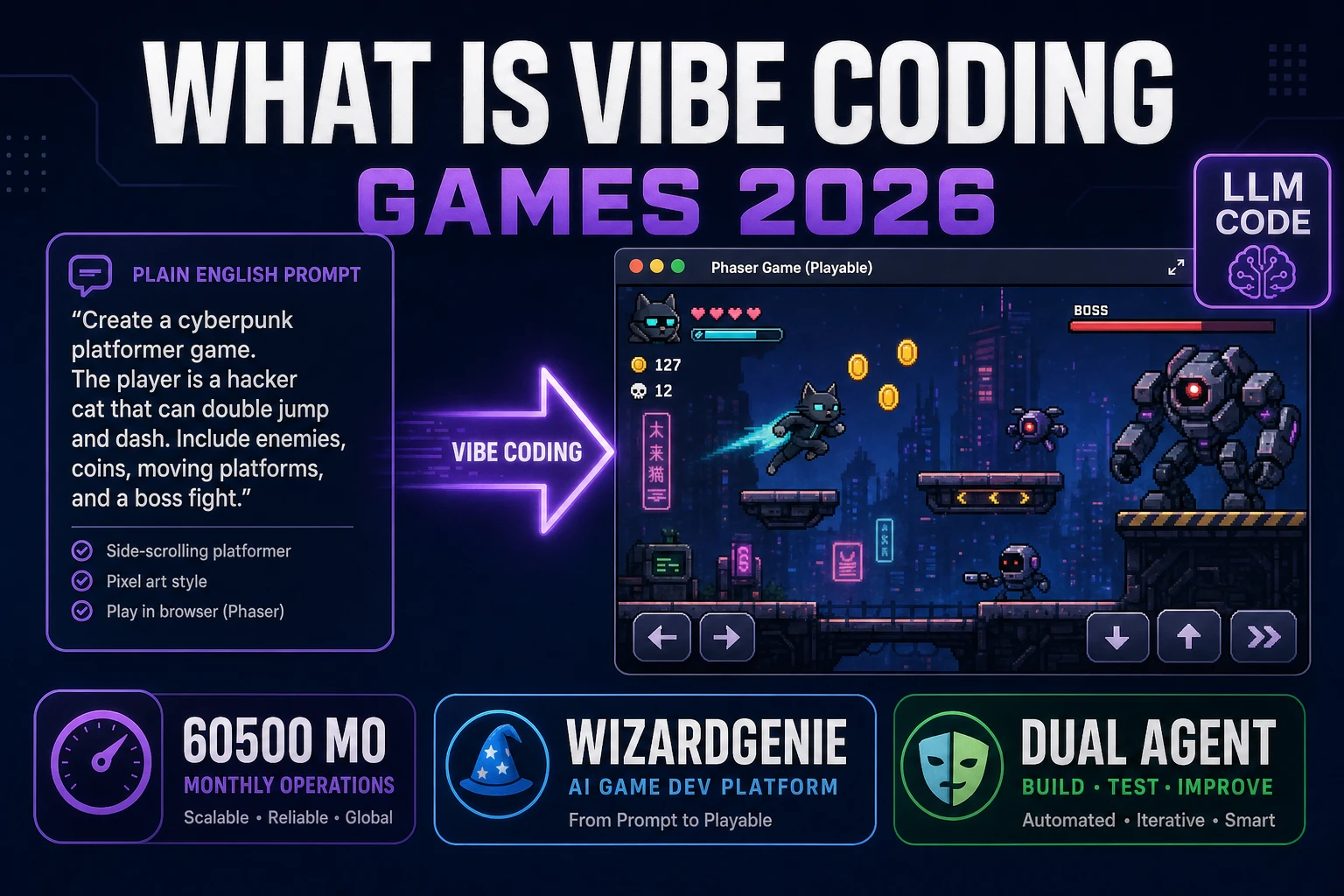
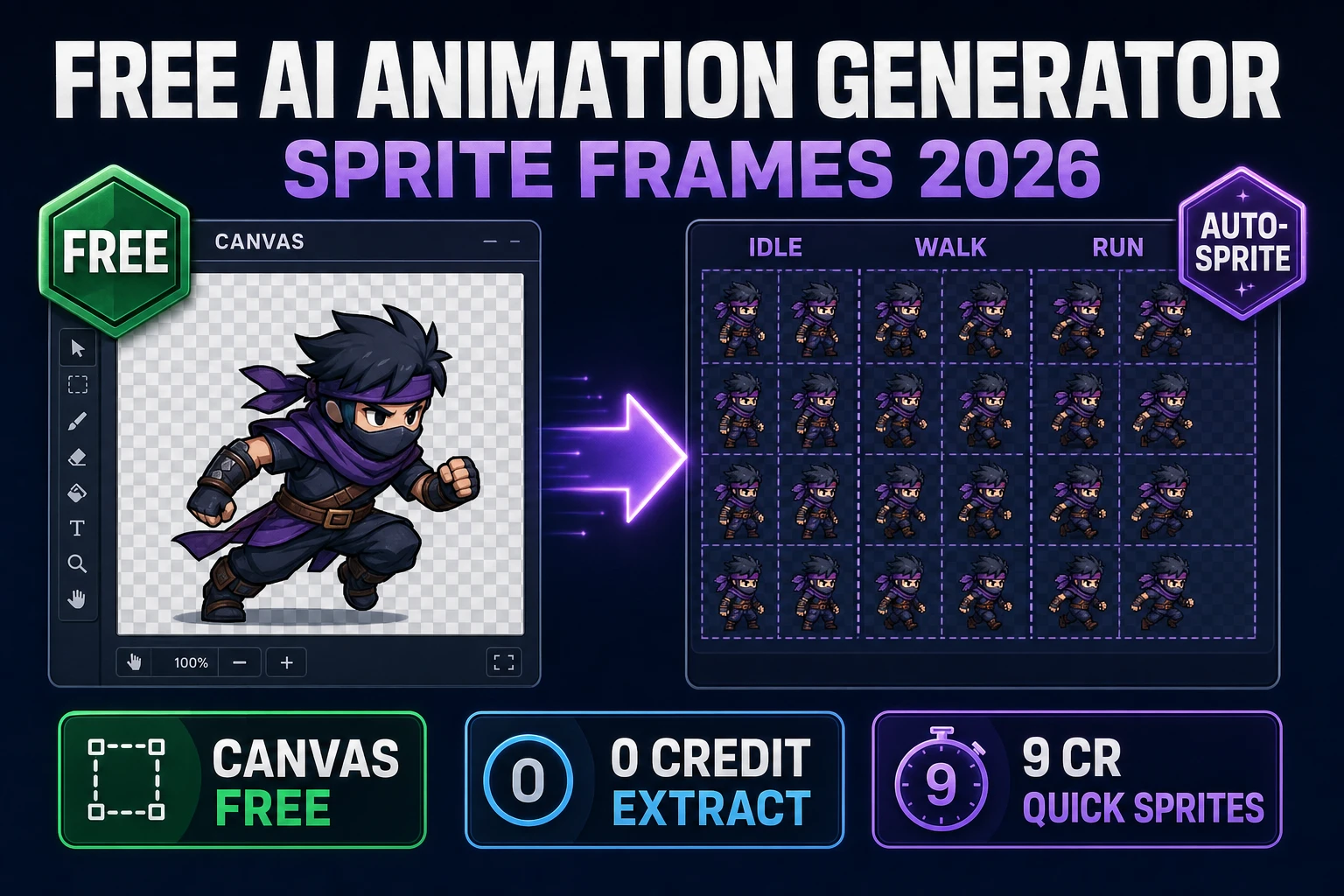
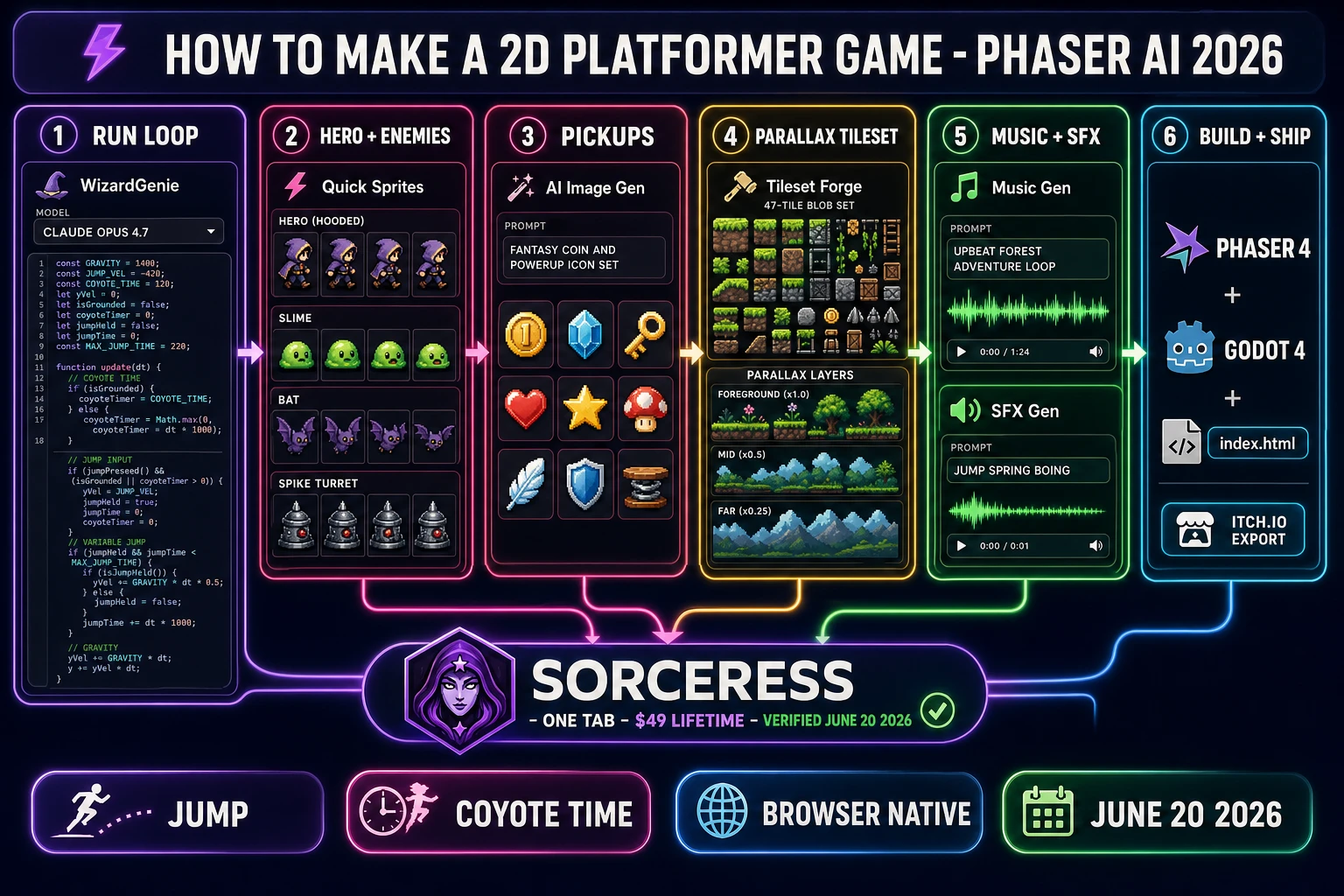
The split between human-curated and AI-generated work falls cleanly along these beats. Beats 1 and 2 are code — WizardGenie writes them on prompt with the eight-model coding picker (verified against src/app/_home-v2/_data/tools.ts CODING_MODELS on June 20, 2026: Claude Opus 4.7, Sonnet 4.6, GPT-5.5, Gemini 3.1 Pro, Grok 4.2, DeepSeek V4 Pro, Kimi K2.5, MiniMax M2.7). Beats 3 and 5 are visual asset generation — Quick Sprites for hero and enemy walk cycles, AI Image Gen for pickup icons and parallax background layers, optionally Material Forge when the hero or enemy is rendered as a 2.5D mesh. Beat 4 is dedicated tile work — Tileset Forge for the autotile blob set, with Pixel Snap handling photo-to-pixel-art conversion for one-off props and decorations. Beat 6 is audio generation — Music Gen for biome loops, SFX Gen for jump and pickup sounds, optionally Speech Gen for vendor or boss-taunt voice lines. Beat 7 is UI markup — back to WizardGenie because the HUD and pause menu are just code wrapped around the asset layers. Every beat has exactly one Sorceress tool that is its primary handoff, and every handoff produces a web-standard format (PNG, WAV, OGG, JSON) that any modern engine eats.
How to make a 2D platformer game with the honest 2026 browser AI stack
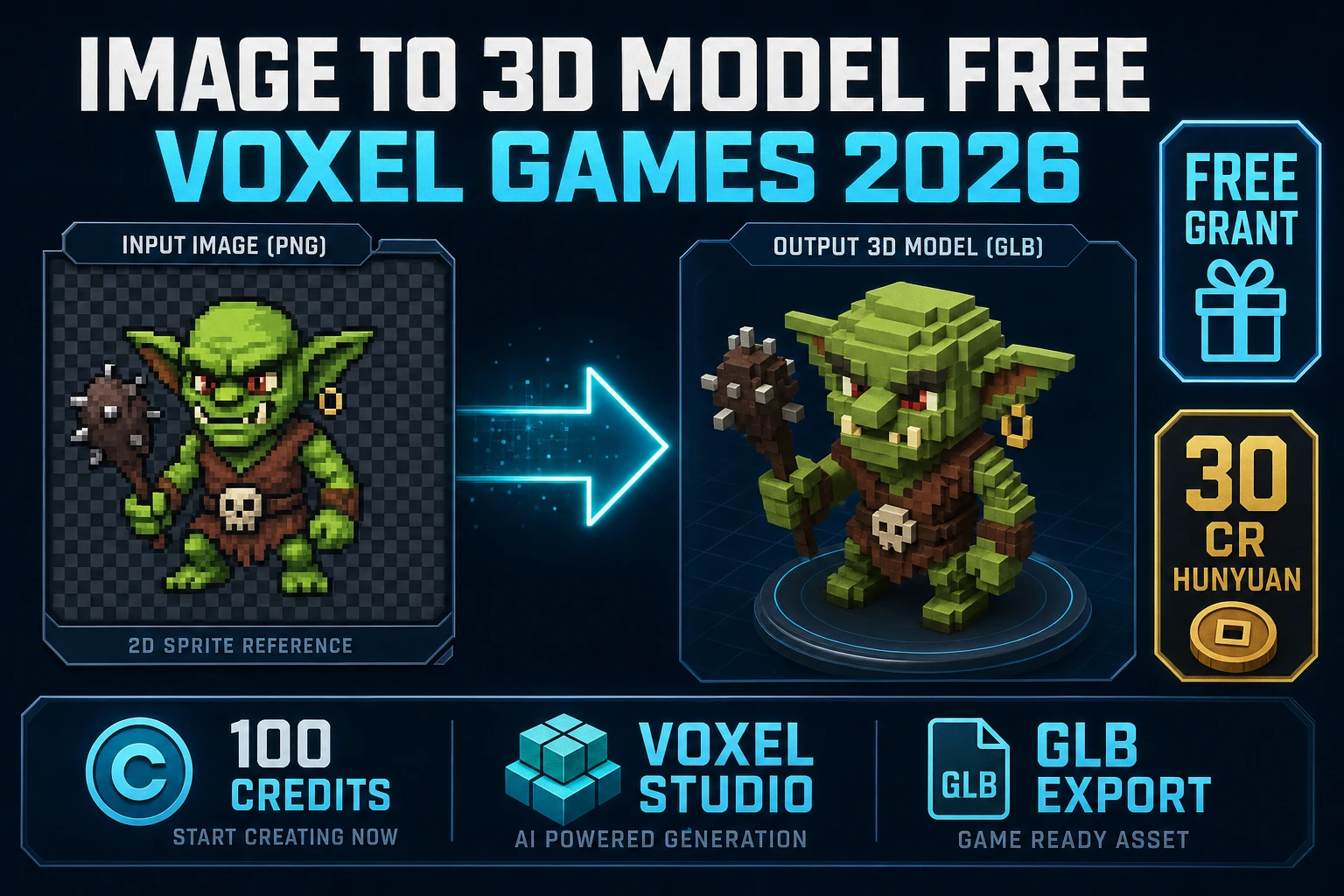
The honest stack to make a 2D platformer game in 2026 is six tools deep, all reachable from one Sorceress account. Verified against the live source on June 20, 2026, those six are WizardGenie for the run loop and jump physics, Quick Sprites for hero and enemy walk cycles, AI Image Gen for pickup icons and parallax background art, Tileset Forge for the level tile sets, Music Gen for biome loops, and SFX Gen for jump and pickup one-shots. Optional adds for a 2.5D platformer include 3D Studio for image-to-mesh hero builds and Auto-Rigging for the skeletal animation pass when the hero needs hand-animated combat moves; both are still reached from the same tab. Bundle pricing is one $49 Lifetime fee plus pay-once credit packs ($10 for 1,000 credits Starter, $20 for 2,000 Creator, $50 for 5,000 Plus, $100 for 10,000 Studio), verified against src/app/plans/page.tsx on June 20, 2026. New accounts ship with 100 starter credits, enough to draft the hero walk cycle and one tileset before topping up.
The reason this stack works for a 2D platformer specifically is that the genre’s content list is small, reusable, and tile-based. One Sorceress credit pool funds the code agent calls (the planner-executor pattern routes the heavy reasoning to Opus 4.7 or GPT-5.5 and the bulk typing to a cheap mixture-of-experts executor like DeepSeek V4 Pro or Kimi K2.5, cutting cost to roughly one-fifth of single-frontier billing) AND the asset generation calls in the same session. There is no need to buy an Aseprite seat to draw the hero; Quick Sprites covers the same handoff. There is no need to install FL Studio or Audacity to compose the music; Music Gen and the in-tab DAW Sound Studio ship the same loops. The dev never leaves the tab between code work and asset work, which is how a 2026 platformer scope finishes in two to four weeks instead of two to four months.
Step 1 — prompt WizardGenie for the platformer run loop and physics
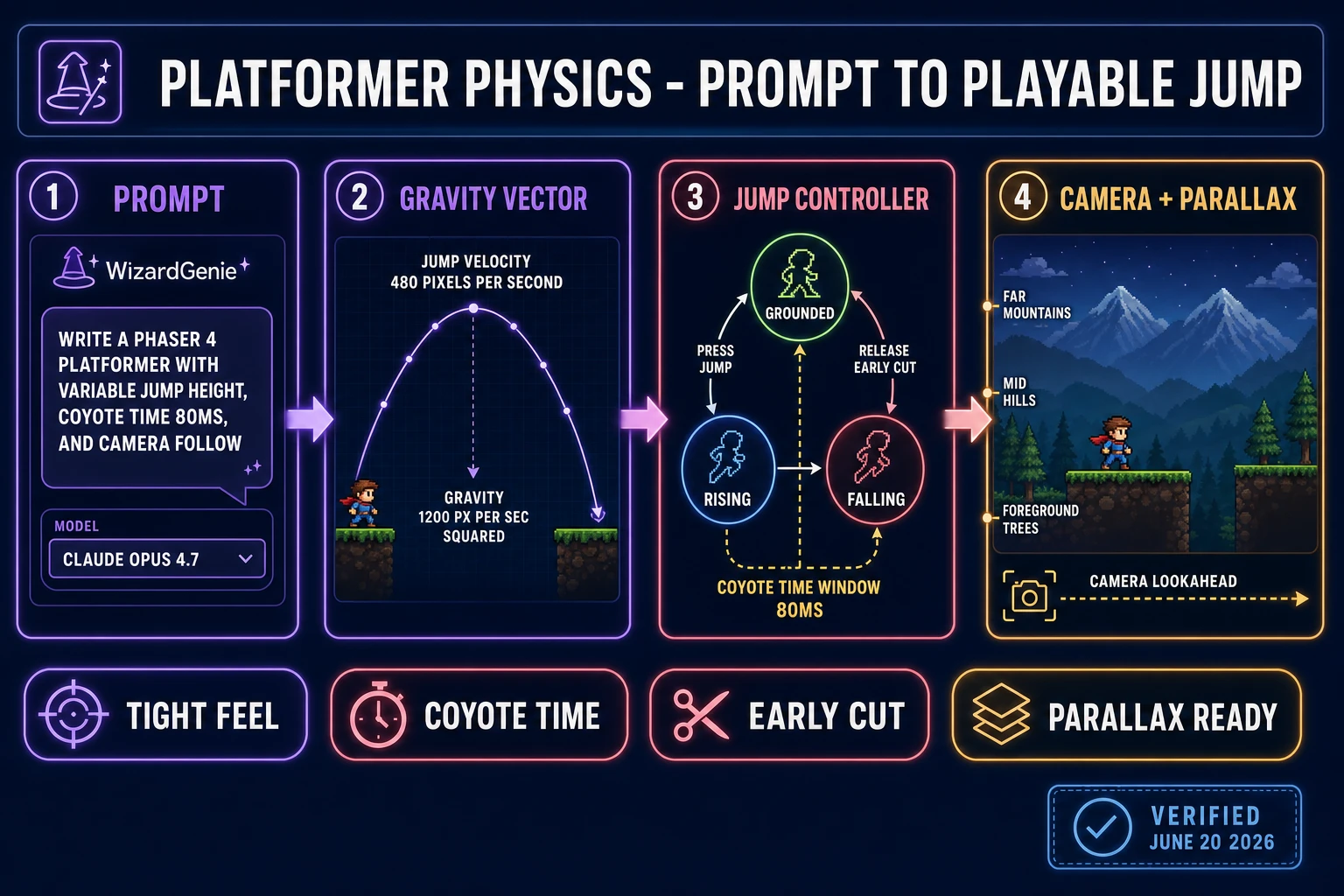
The first prompt to WizardGenie sets the run-loop and physics scaffold for the entire project. A reliable opening prompt for a 2026 dev looks like this: “Write a Phaser 4 (or Godot 4 / Unity 6) browser-tab 2D platformer scaffold with a side-scrolling camera that follows the hero, gravity 1200 px/s squared, jump velocity 480 px/s with variable jump height (release-to-cut), 80ms coyote time, 100ms jump buffering, a tilemap-based level loader, hazards that damage on contact, a coin pickup that increments a score counter, and a checkpoint-and-respawn loop on death.” Pick the Opus 4.7 model from the dropdown for this prompt — the physics tuning work (the gravity curve, the variable-jump-height release-to-cut, the coyote time tolerance, the jump buffer) wants the heavy reasoner, and Opus 4.7 ships at $5 input / $25 output per million tokens with a 1M context window (verified against the Sorceress source code on June 20, 2026). The first response will scaffold the project tree, the physics body, the input handler, and the death-and-respawn loop.
The second prompt iterates on the jump feel specifically because a platformer lives or dies on how the jump feels in the player’s hand. Prompts like “reduce coyote time to 60ms and add a 50ms input buffer for jumps pressed before landing” or “add a wall-slide that halves gravity when the hero is touching a wall and pressing into it” refine the controller without rewriting the whole loop. Switch to Sonnet 4.6 ($3/$15) or DeepSeek V4 Pro for the iteration phase — the cost ratio matters because a platformer feel typically takes 20 to 40 prompt rounds to feel right. Pair Opus 4.7 as the planner with DeepSeek V4 Pro or Kimi K2.5 as the executor and the whole pass costs roughly one-fifth of putting Opus on both sides. Acceptable executors per Sorceress’s guidance are DeepSeek V4 Pro, Kimi K2.5, MiniMax M2.7, Gemini 3.1 Flash, GPT-5.5 Mini, and Claude Haiku 4.5; never put a frontier-priced model on the typing side or the cost advantage disappears.