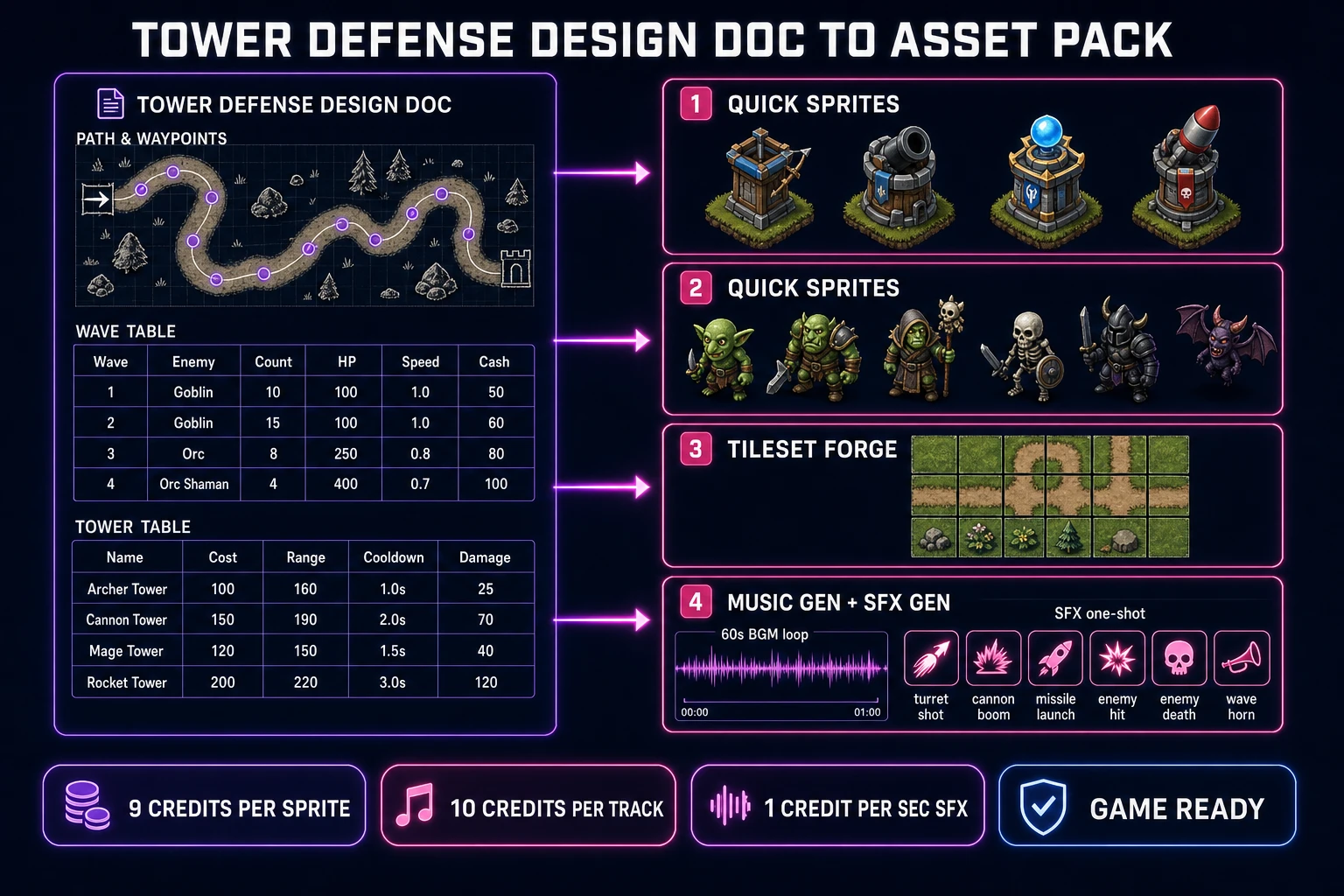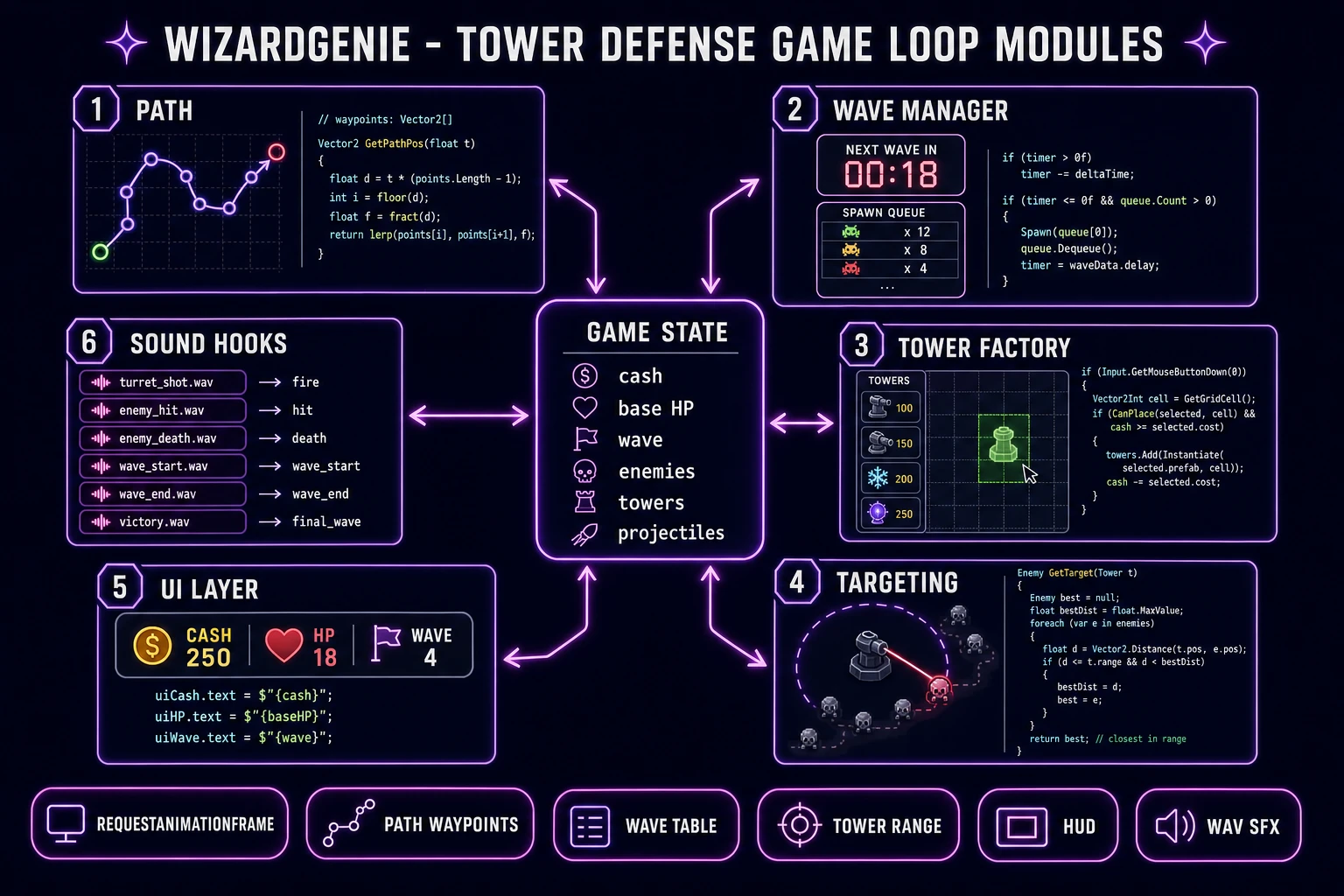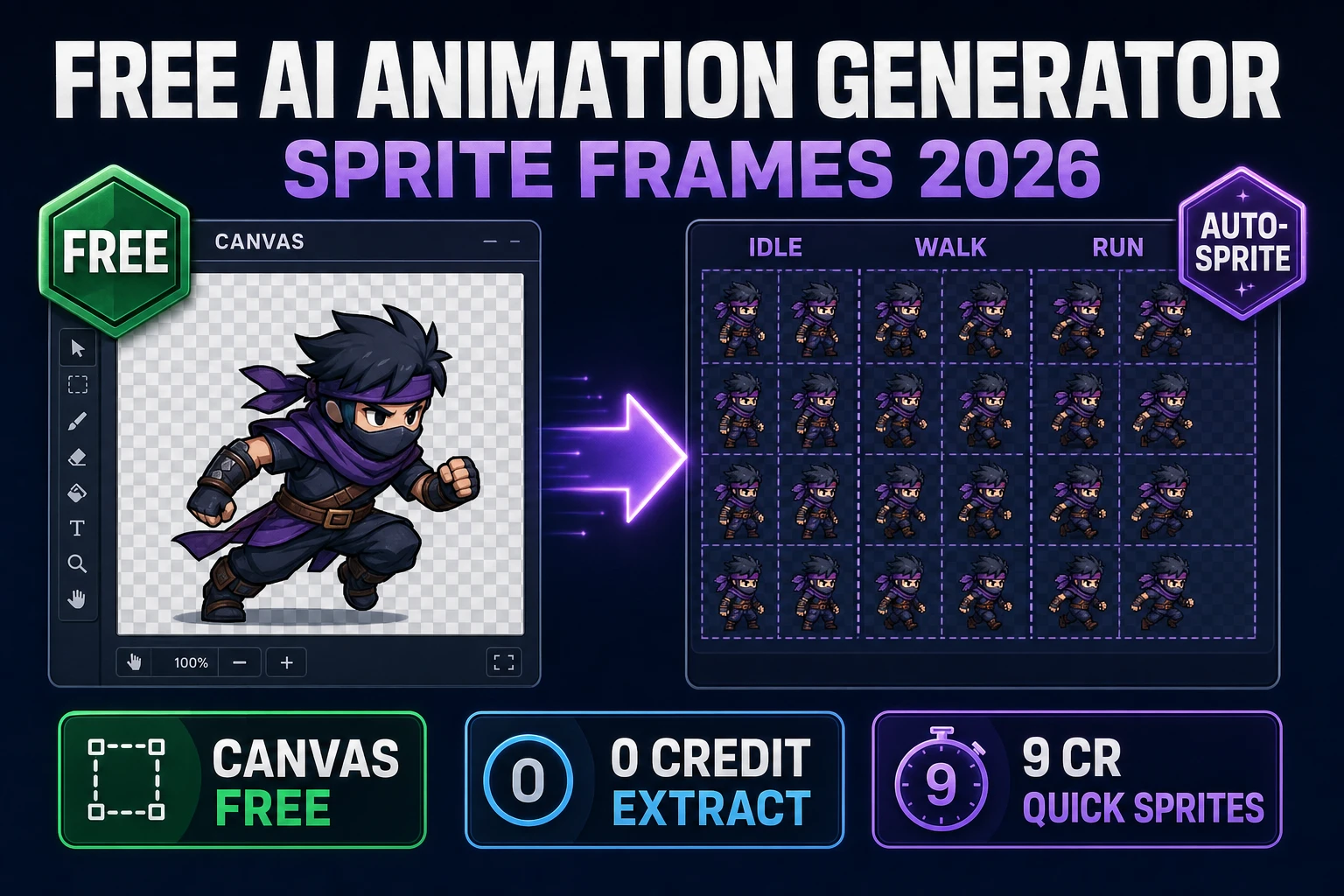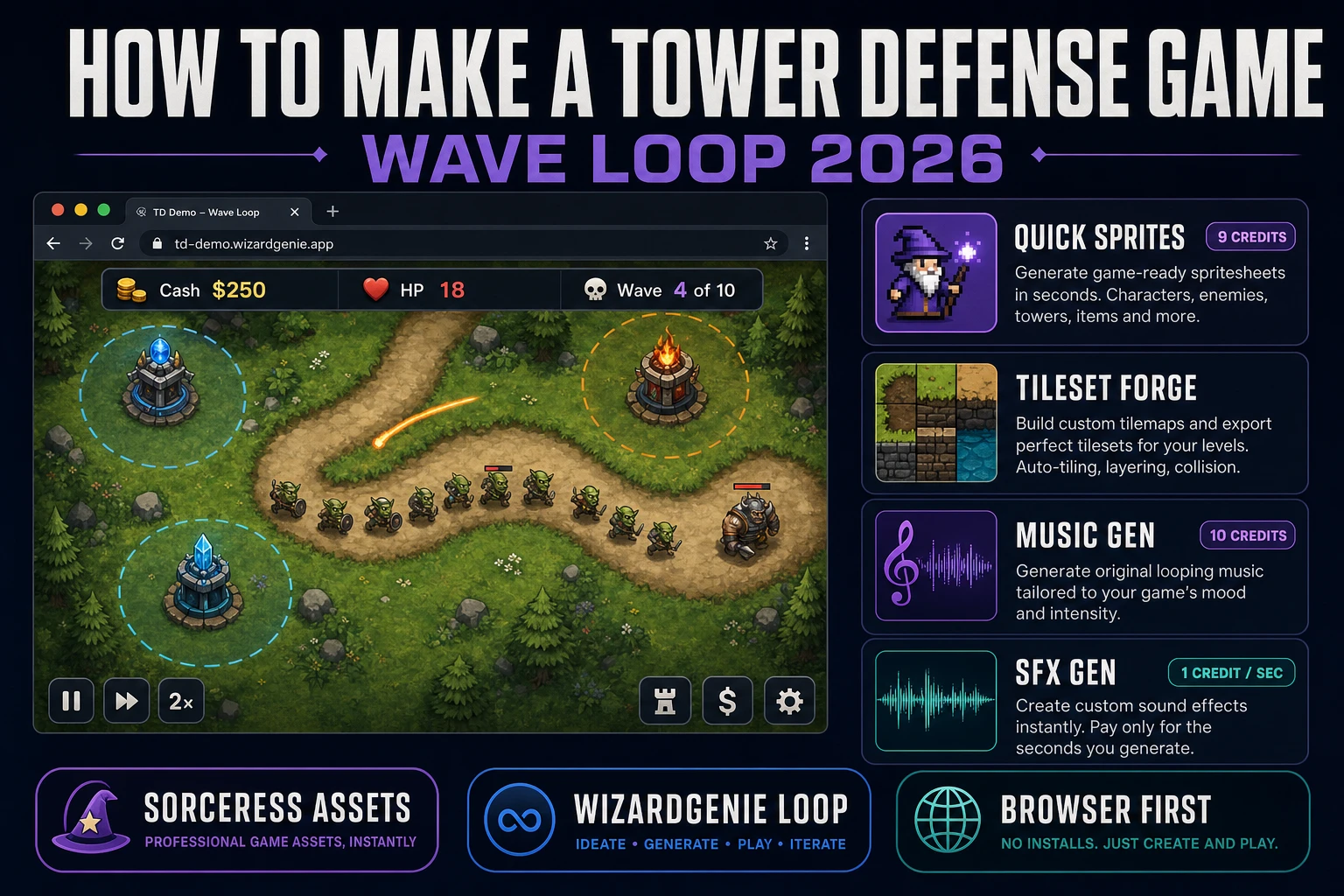
People searching how to make a tower defense game in 2026 want the same thing every year: a real explanation of the tower defense game loop and a concrete workflow that ends with a playable browser game they can share. Not a five-hour Unity course. Not a "top 10 tower defense games ever made" listicle. A working recipe. This guide is that recipe: what the genre actually needs, which engine to pick in 2026, and how to generate every sprite, tile, track, and sound effect with the Sorceress asset stack while WizardGenie writes the game loop.
How to make a tower defense game in 2026: the ingredients that actually matter
Tower defense is a strategy subgenre where the player places defensive structures along a path to stop waves of enemy attackers before they reach a base or exit. The genre traces back to Rampart (1990) and the 2007 Flash-era boom that gave us Desktop Tower Defense, Flash Element TD, and Fieldrunners, according to the Tower defense entry on Wikipedia. What a modern take needs, mechanically, is a small fixed set of ingredients: a path (or several) that enemies follow, a wave manager that spawns enemies over time with escalating difficulty, tower objects with range, cooldown, and damage, an economy where kills pay for towers and towers pay off in kills, a base HP or lives counter that ends the game if it hits zero, and a win condition (survive N waves, protect the base, hit a score).
Beginner posts on the search results page often confuse the genre with generic action games. Two things separate tower defense from every other 2D game a beginner might build. First, the player character is usually invisible — you are a placer, not a runner. Second, the loop has explicit build phases (mouse click to place a tower, no time pressure) alternating with wave phases (towers auto-attack, player watches or repositions). Every design decision downstream falls out of that build-wave rhythm.
The tower defense game loop in one minute (build wave attack repair)
Every tower defense game runs the same core loop, and understanding it in one minute is the difference between a real project and a stalled prototype:
- Build phase. Player has cash. Player clicks a valid grid tile to place a tower. Cash decreases. The tower has a range circle drawn on hover so the player can see coverage.
- Wave phase. A "Start Wave" button (or a timer) begins spawning enemies at the path start. Enemies follow the fixed path toward the base at a fixed speed.
- Attack sub-loop. Every frame, each tower looks at every enemy within range, picks a target (usually the one closest to the base), fires a projectile or applies instant damage, and starts a cooldown. Enemies that hit zero HP die and drop cash to the player. Enemies that reach the base subtract from base HP or lives.
- Repair / upgrade phase. Between waves the player spends new cash on more towers, upgrades, or repairs. Cash carries between waves; base HP does not fully refill.
- Loop escalates. Each wave is stronger than the last (more enemies, faster, tougher, sometimes airborne so ground-only towers miss). The game ends when base HP hits zero (lose) or the player survives the final wave (win).
The actual per-frame math sits inside a browser-standard animation loop. Every modern browser game drives its update step off the requestAnimationFrame API documented on MDN, which fires roughly 60 times per second in sync with the display refresh. Every tick, the loop walks each enemy along its path (usually a list of waypoints), each tower's cooldown counts down, and each active projectile moves toward its target.
Pick your engine in 2026: Phaser 4, Three.js, or WizardGenie (browser-first)
The engine question decides how much boilerplate you write vs how much you skip. Three honest 2026 answers, ranked by "playable game in a weekend":
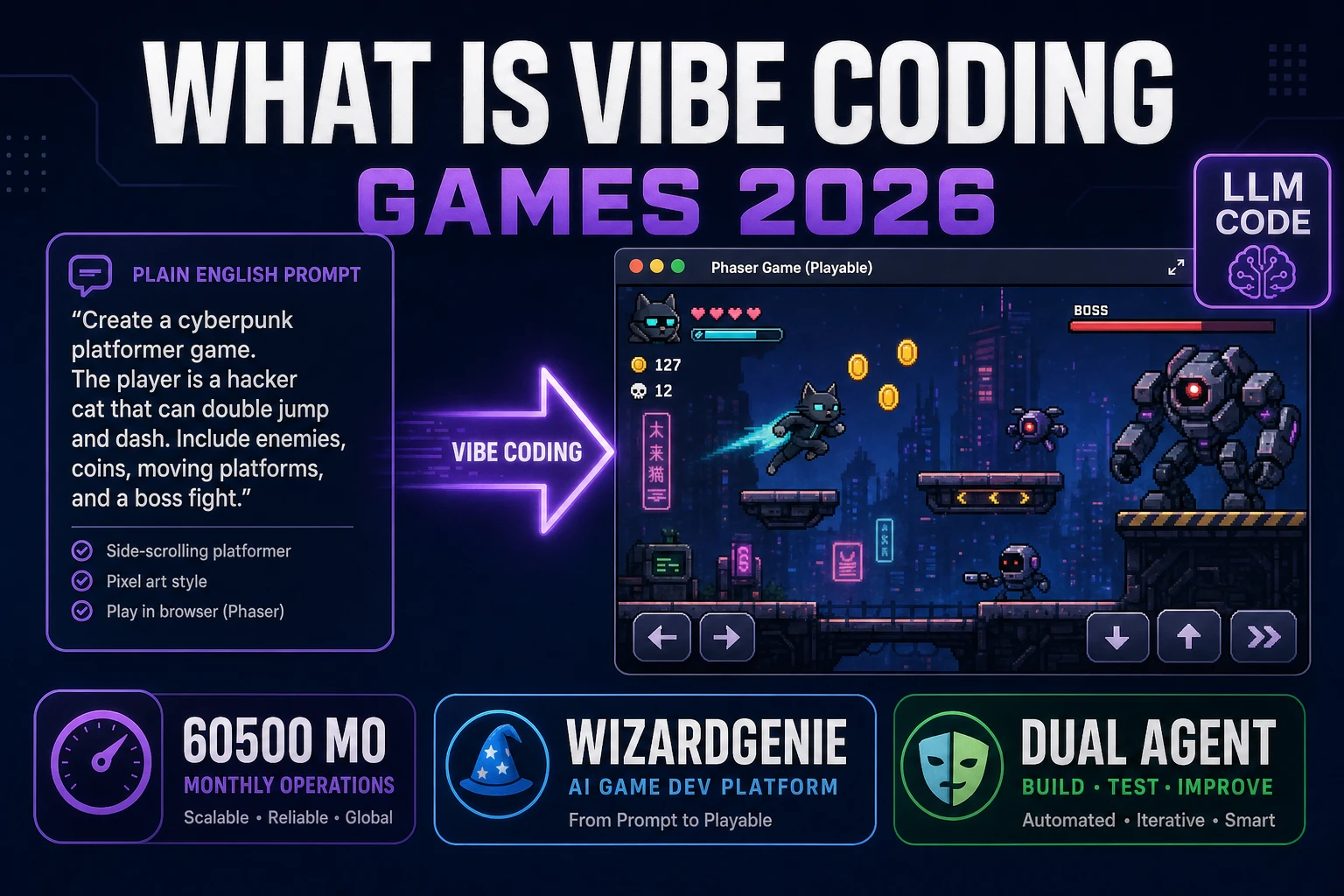
- WizardGenie (recommended for a first project). AI-powered game engine that runs in the browser and, on desktop, ships as a Windows installer. You describe the tower defense game in a paragraph; WizardGenie writes, runs, and iterates on the code in real time using its dual-agent Planner+Executor loop. The Planner (a top-tier reasoner) breaks the tower defense loop into tasks. The Executor (a cheap fast typer like DeepSeek V4 Pro) writes the actual JavaScript. Model lineup verified 2026-08-05 in
src/app/_home-v2/_data/tools.ts: Claude Opus 4.7, GPT-5.5, Gemini 3.1 Pro, DeepSeek V4 Pro, Kimi K2.5, Grok 4.2, MiniMax M2.7 — bring your own key or use the fallback trial key. - Phaser 4. Popular 2D HTML5 game framework. Tilemap support for the path, arcade physics for projectiles, group management for enemies and towers. Best if you want to write the game yourself and understand every collision check. The Phaser project site hosts the current stable docs and examples.
- Three.js. Only pick this if the tower defense you want is 3D — a Sanctum, Orcs Must Die!, or Anomaly-style first-person hybrid. The rendering is more expensive, the pathfinding math is trickier, and asset production takes longer. Not the first-project answer.
The rest of this guide assumes WizardGenie for the code side. Every step still applies unchanged if you swap in Phaser 4 by hand, but the "AI writes the loop" step becomes "you write the loop against the design doc."
Step 1 — design the path, waves, and economy on paper first
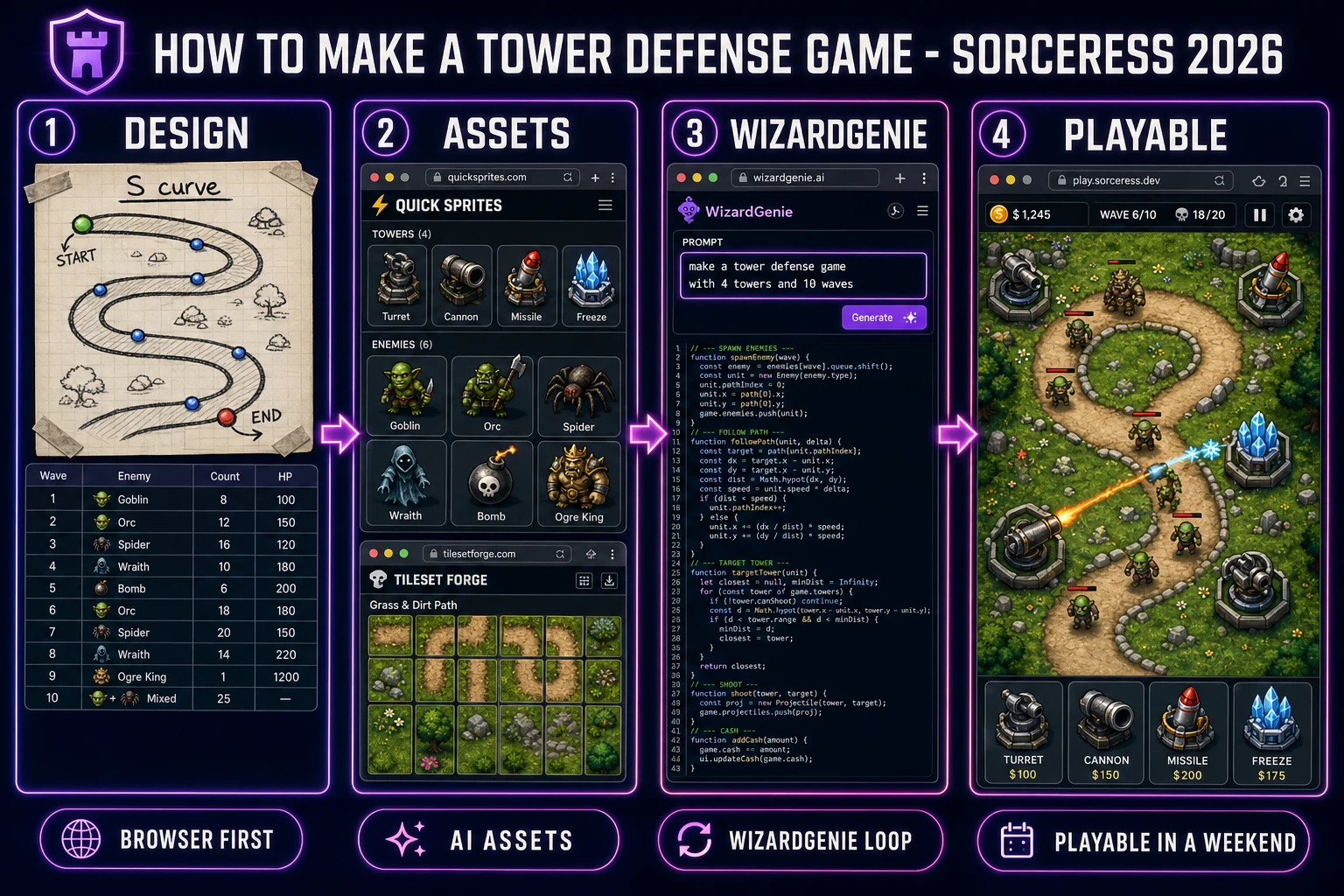
Skip this step and you will rewrite the game five times. Do it in 15 minutes on paper (or in a text file) and the AI code generation halves. The design doc needs four sections:
- Map + path. Grid size (typical: 20 wide by 12 tall at 32 or 48 pixel tiles), path shape (S-curve, spiral, straight-with-turns), start and end tiles. Beginners should start with one path; branching paths add code that is not worth writing in the first prototype.
- Wave table. A list of waves. For a first project, 10 waves is enough. Each row has: wave number, enemy type, count, spawn interval (seconds), HP, speed, cash-per-kill. Example: Wave 1: goblin, 10 enemies, 1s interval, 20 HP, 30 px/s, 5 cash each. Wave 5: orc, 15 enemies, 0.8s interval, 60 HP, 40 px/s, 10 cash. Wave 10 (boss): ogre king, 1 enemy, once, 800 HP, 20 px/s, 200 cash.
- Tower table. 3–4 tower types for a first pass. Turret (cheap, fast, low damage, ground only), cannon (medium cost, slow, splash damage), missile (expensive, long range, flies over water), freeze (utility, slows enemies in range). Each row: name, cost, range in tiles, damage, cooldown, targeting rule.
- Economy. Starting cash (typical: 100), base HP (typical: 20), interest between waves (optional: +5% cash per wave held). Cash-per-kill from the wave table needs to leave the player with roughly 1.2x the current tower cost after each wave — otherwise the difficulty curve breaks.
That is the whole design doc. Put it in a markdown file with two tables. WizardGenie parses tables well and will use them to seed the wave manager and the tower factory. A great secondary reference is the field guide in Turn a Prompt to Game AI Into a Playable Build, which walks the same "design doc first, code second" pattern for a different genre.