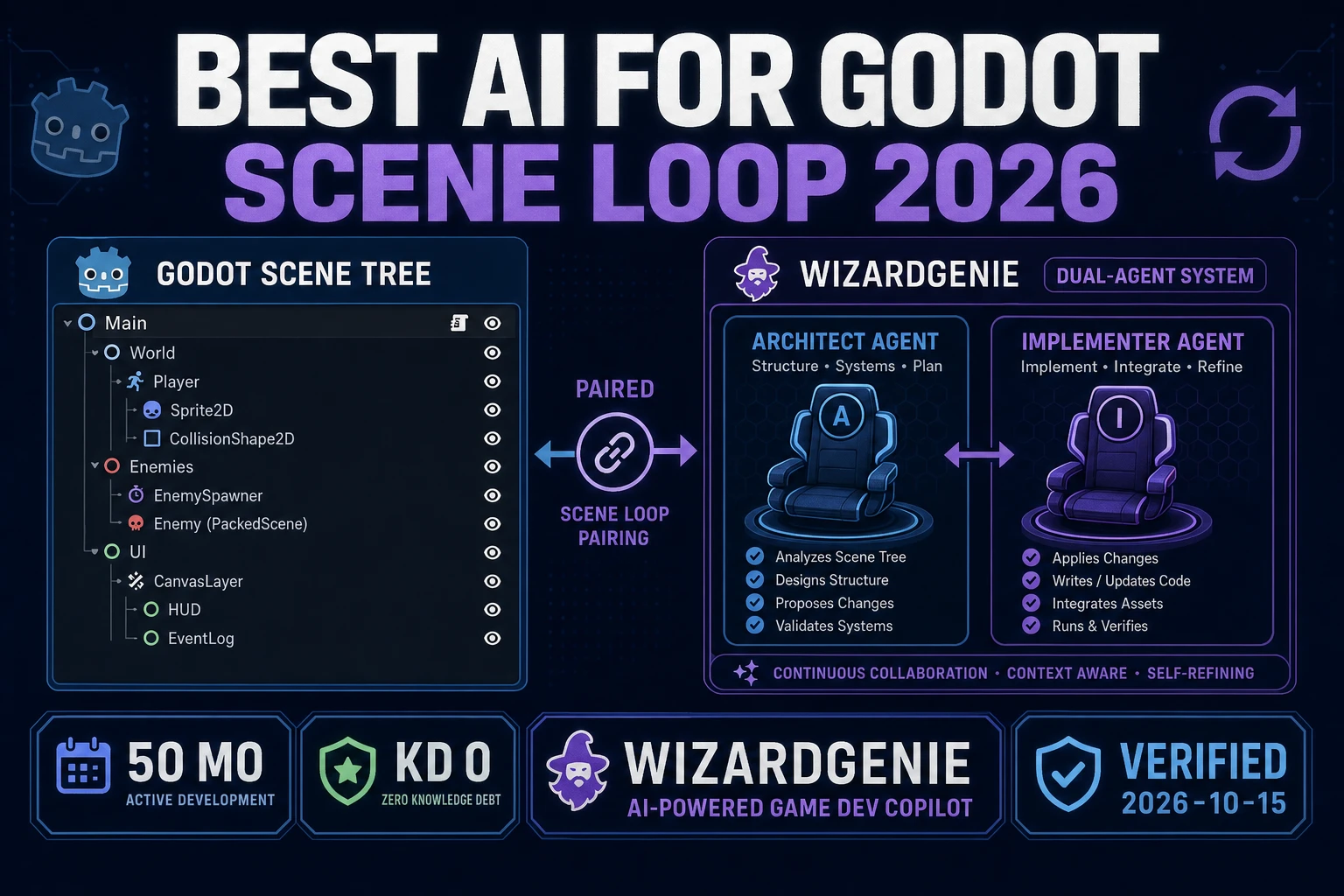
People who search best ai for godot usually already have an engine. What they lack is a pairing rule: which model thinks, which model types, and which scene is allowed to change before the next playtest. Pick the wrong seat and you rewrite the same CharacterBody2D three times. Pick the wrong runtime and you force an AI-native agent to fake a node tree it does not run.
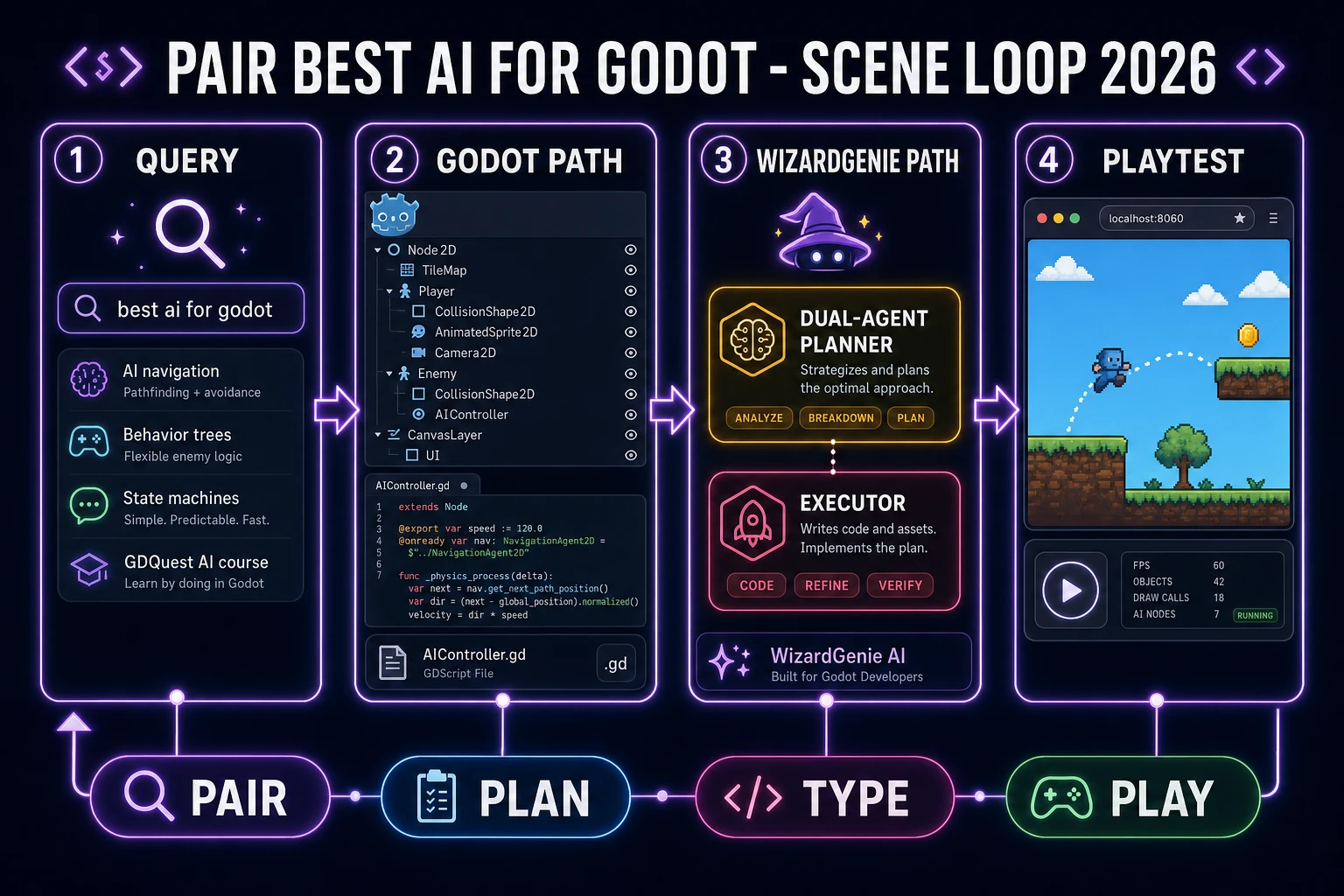
What best ai for godot searchers actually want
DataForSEO lists best ai for godot at 50 searches a month with KD 0 and informational intent (verified 2026-10-14 in tools/research-supplement.md, seed best ai for godot). Sibling phrases in the same cluster include best ai for godot coding (20/mo), best ai for coding in godot (10/mo), and best ai assistant for godot (10/mo). The head query is not “what is Godot” and it is not “paste my whole RPG pitch into chat.” It is “which AI pairing actually finishes a scene loop without burning the weekend budget?”
Wikipedia’s Godot (game engine) page (verified 2026-10-15) describes an MIT-licensed open-source engine with a hierarchy of nodes organized into reusable scenes, signal connections between nodes, and first-class scripting in GDScript, C#, and C++. The same page lists the current stable release as Godot 4.7.2 (18 August 2026). That matters because “best AI” advice that cites a three-year-old minor version is already stale. Wikipedia’s Video game development overview still frames the craft as design, production, programming, testing, and release — the AI seat only helps if it shortens one of those loops, not if it narrates all of them.
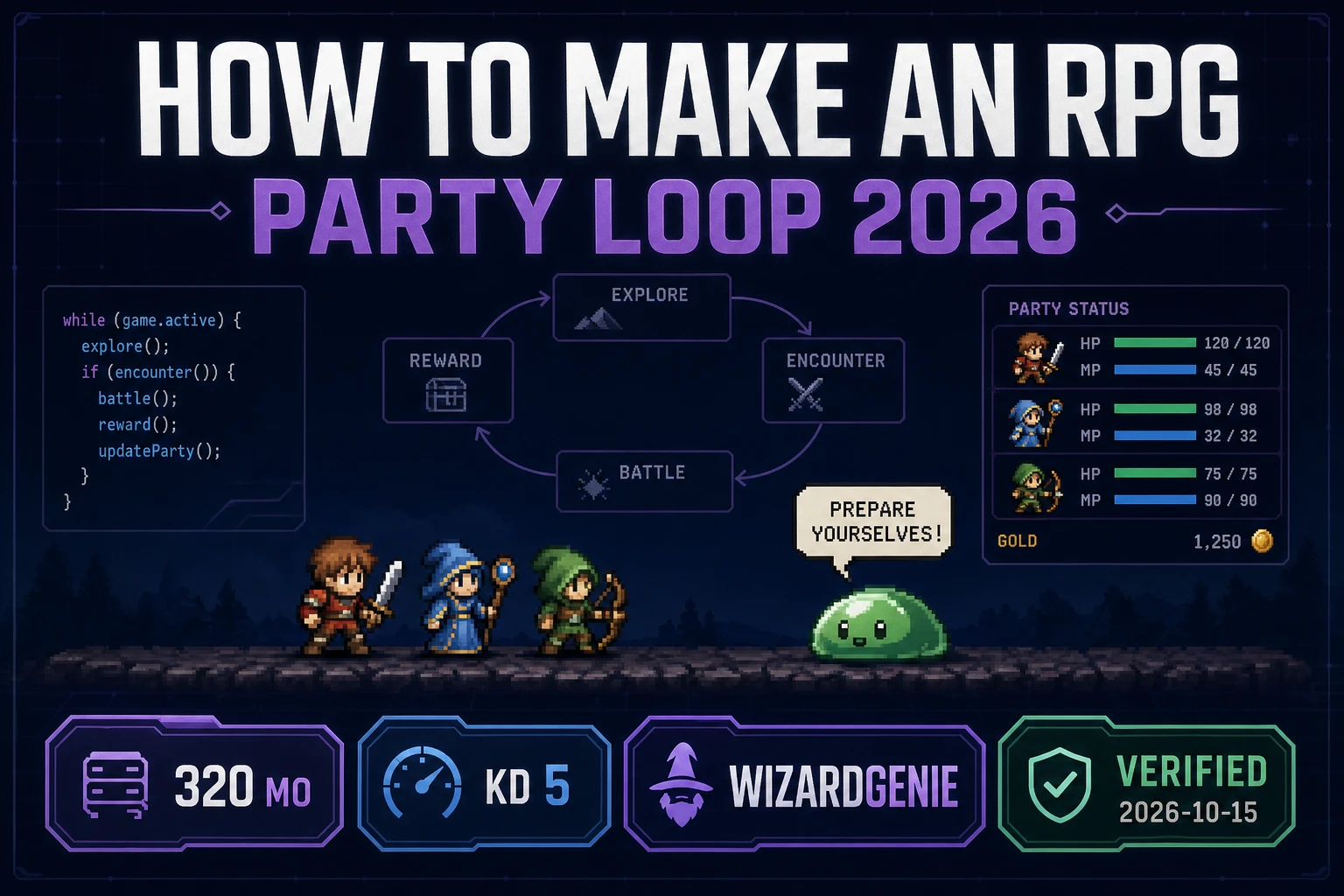
Sibling posts already cover Godot how-tos (how to make an RPG in Godot, 2D platformer in Godot). This comparison locks the commercial-intent “best AI” phrasing and forces an honest fork: stay inside Godot with a Planner+Executor assistant, or switch the playable code to an AI-native browser engine when dual-agent economics matter more than the node tree.
The verdict at a glance
| Dimension | Stay in Godot + AI assistant | WizardGenie dual-agent (Phaser / Three.js) |
|---|---|---|
| Runtime | Godot 4.7.2 editor + GDScript scenes | Phaser 2D or Three.js 3D inside WizardGenie |
| Best when | You need Godot export targets, node reuse, or an existing .tscn tree | You want AI-first coding with a built-in Planner+Executor split |
| AI seating | You pair Planner/Executor yourself in chat | Dual-agent is a first-class agent power in the product |
| Token economics | ~1/4 frontier cost only if Executor stays budget | Documented “roughly a quarter of the token cost” when seats are correct |
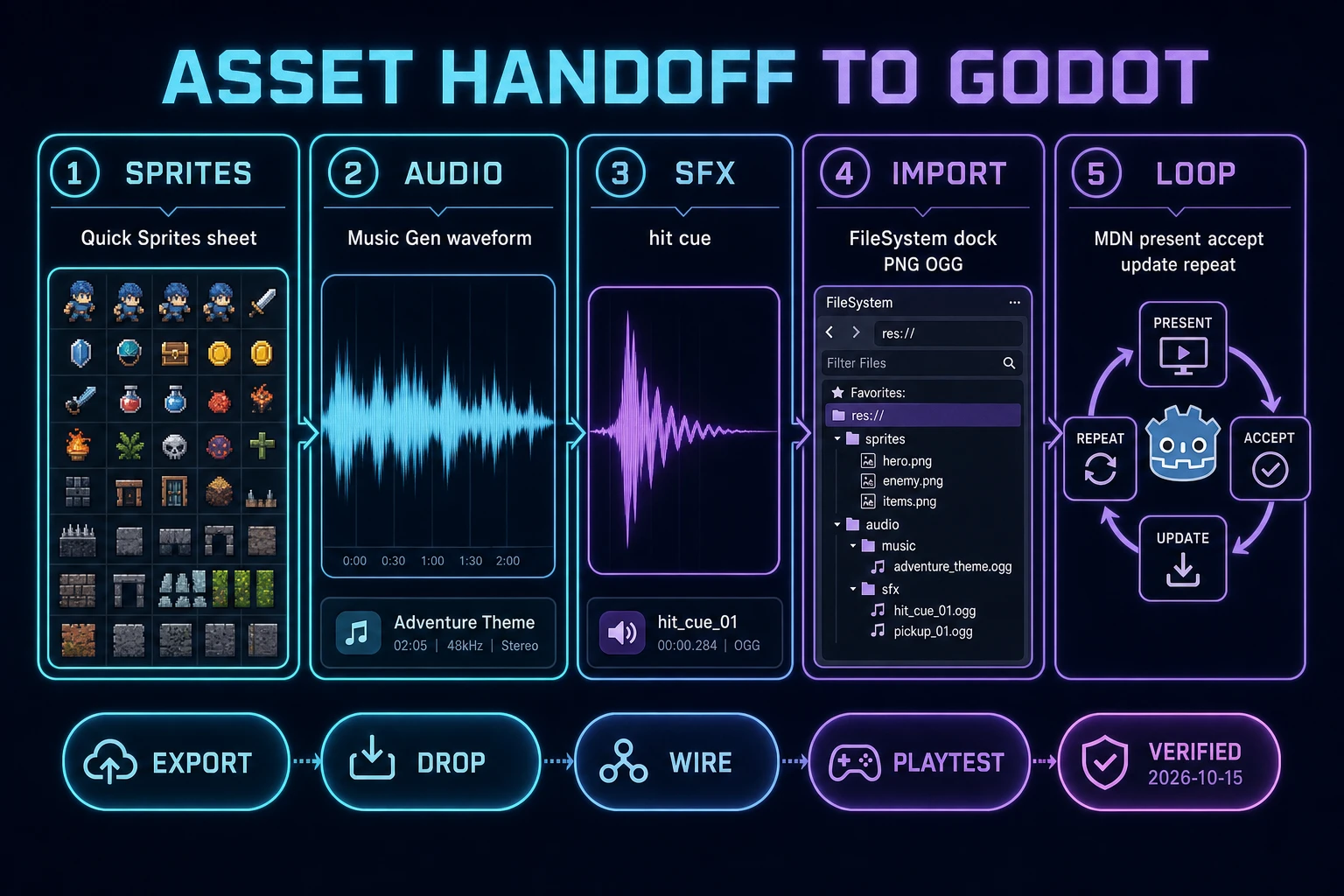
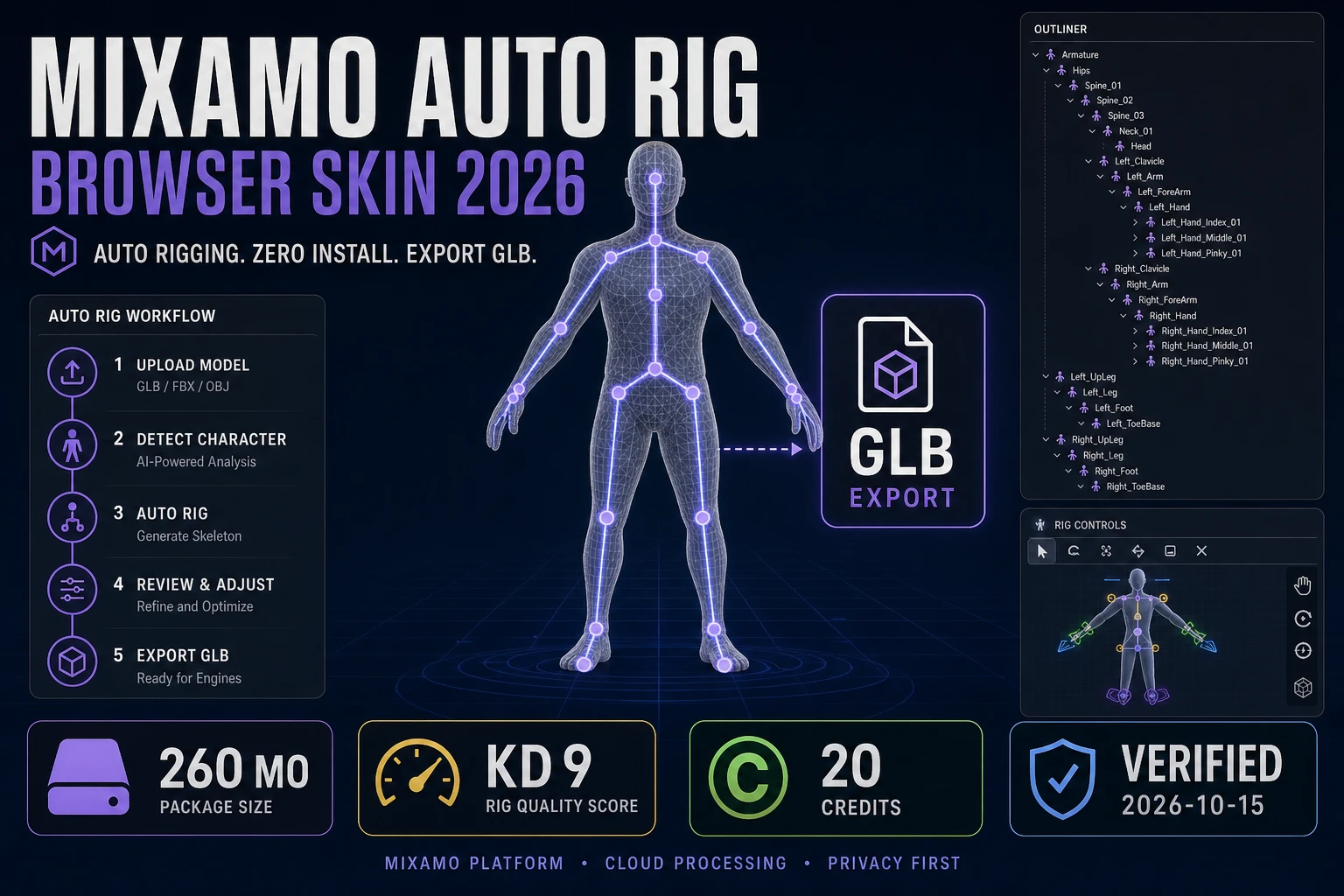
| Asset pipeline | Import Sorceress PNG/OGG/GLB into the FileSystem dock | Sorceress suite embedded in the editor palette |
| Honest limit | Generic assistants do not ship a Godot runtime | WizardGenie is not a Godot runtime |
What a Godot AI assistant must cover in the scene loop
MDN’s Anatomy of a video game still frames the job as a loop — present the scene, accept input, update state, repeat (verified 2026-10-15). Inside Godot that loop lives in scenes and signals, not in a vague “make my game better” prompt. A useful Godot AI assistant therefore has to:
- Name the scene file. One
.tscn/ one.gdper typing pass. Wider than that is a new Planner job. - Freeze the constitution. Gravity, collision layers, and input map stay locked unless the brief says otherwise.
- Write a done-when playtest. “Coyote time feels fair on gap B” beats “improve the player controller.”
- Reject expensive typers. Frontier models plan; budget models type.
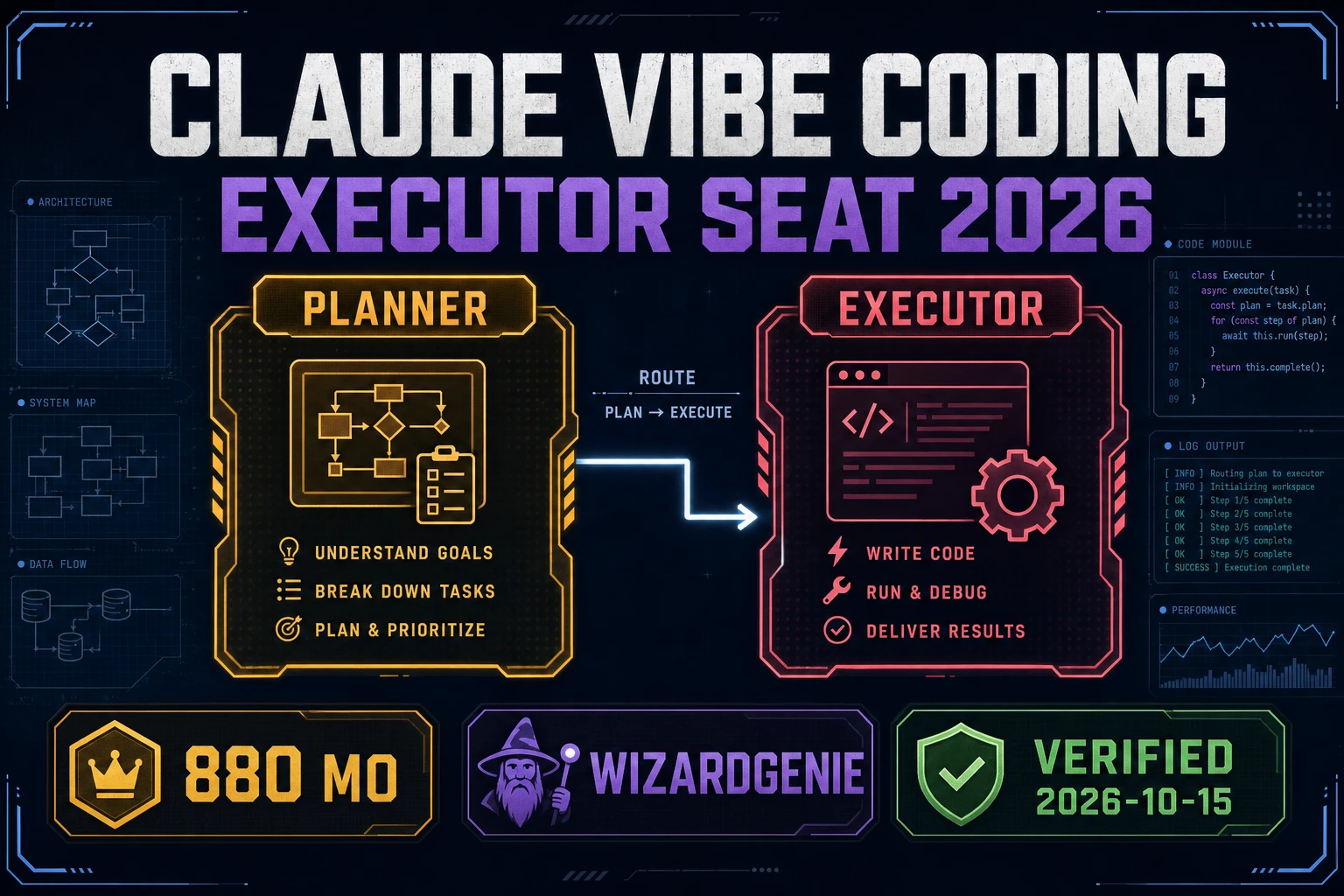
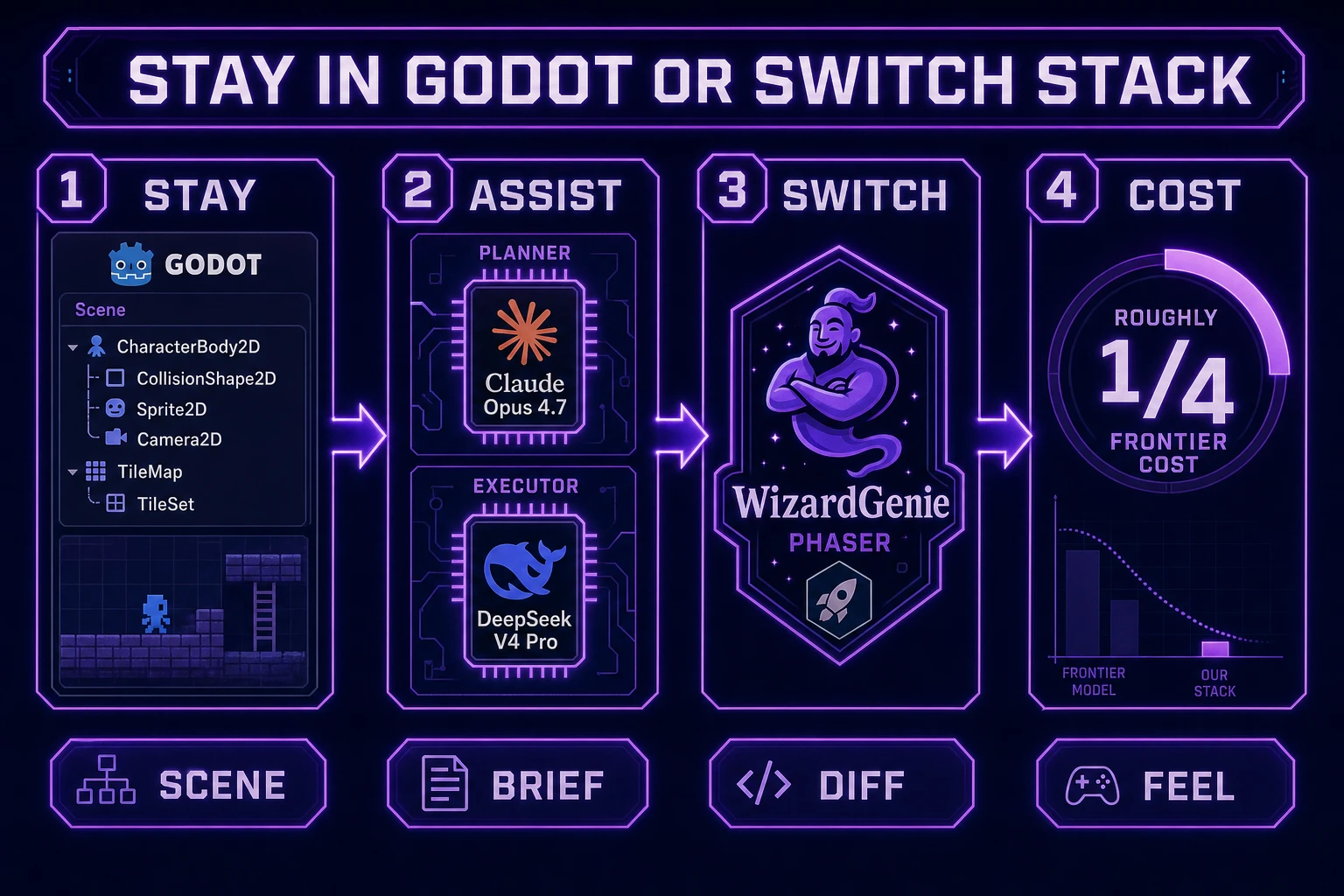
Acceptable Planner seats from Sorceress Code’s CODING_MODELS lineup (src/app/_home-v2/_data/tools.ts lines 767–775, verified 2026-10-15): Claude Opus 4.7, GPT-5.5, Gemini 3.1 Pro, Grok 4.2. Acceptable Executor seats on the same list: DeepSeek V4 Pro, Kimi K2.5, MiniMax M2.7. Putting Opus or GPT-5.5 on both chairs is not “best AI for Godot” — it is two frontier invoices for one diff.
A Planner brief that matches the Godot scene loop:
Goal: gap B feels unforgiving on keyboard.
Scene: res://player/player.tscn
Script: res://player/player.gd only.
Change: add 6-frame coyote time and 8-frame jump buffer.
Do not touch gravity, max speed, or enemy AI.
Done when: walking off ledge still allows jump for 6 frames
and pressing jump 8 frames early still queues the jump.
Playtest: run level-01 gaps A, B, and C three times each.
Hand that card to the Executor. You get a tiny GDScript diff, not a rewritten project. You playtest in the Godot editor. The “best AI” was the pairing, not the brand name on the Planner.