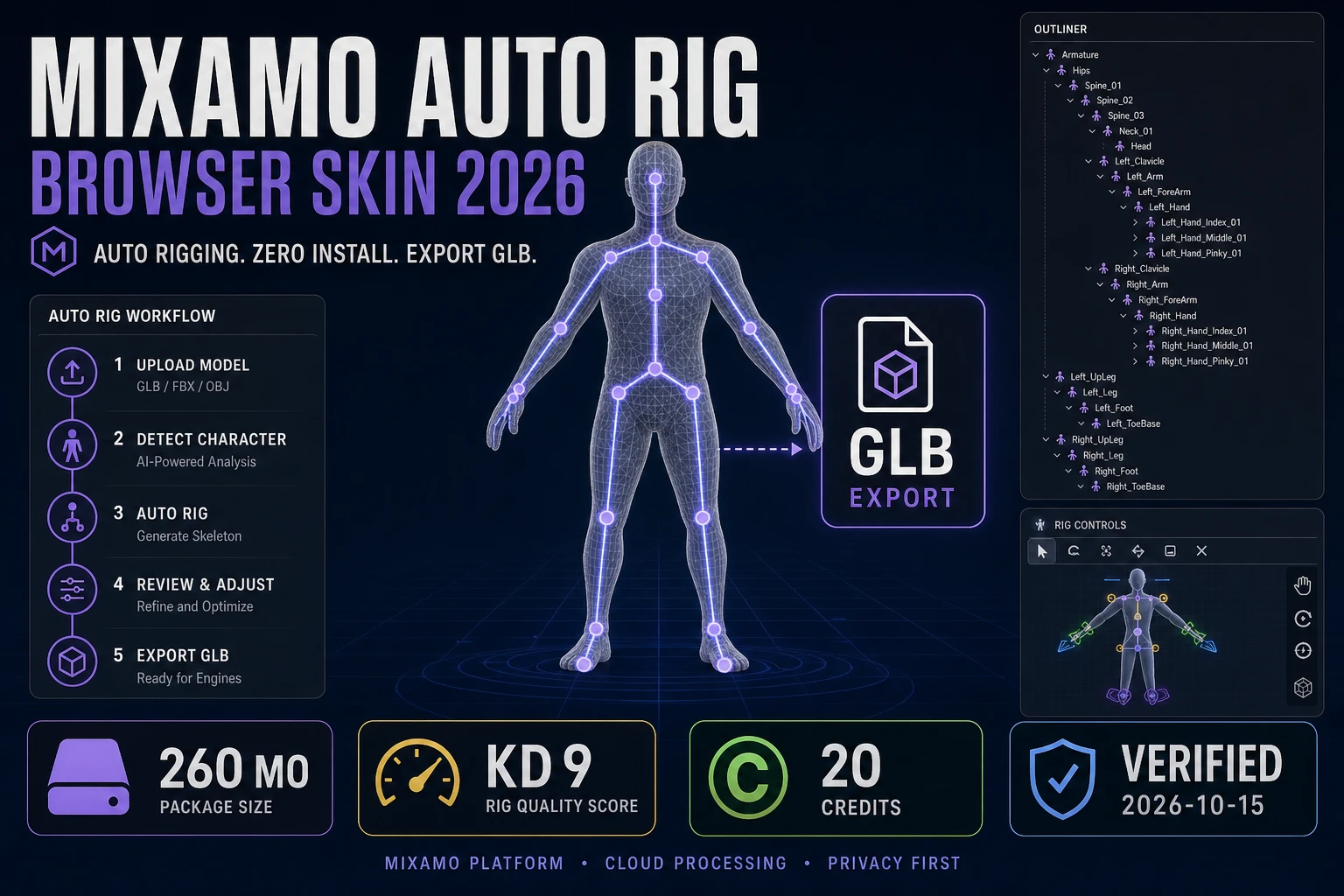
People who type mixamo auto rig into a search box are not shopping for a history lesson. They already picture the job: drop a standing humanoid mesh somewhere, get a skeleton that bends at the knees, keep the skin weights attached, and leave with a file an engine can pose. This post answers that transactional query with a browser skin path on Sorceress — what the search actually wants, how the Mixamo-shaped job maps to Auto-Rigging, the two bind routes, the weight check, and the GLB export — verified against live source and docs on 2026-10-15.
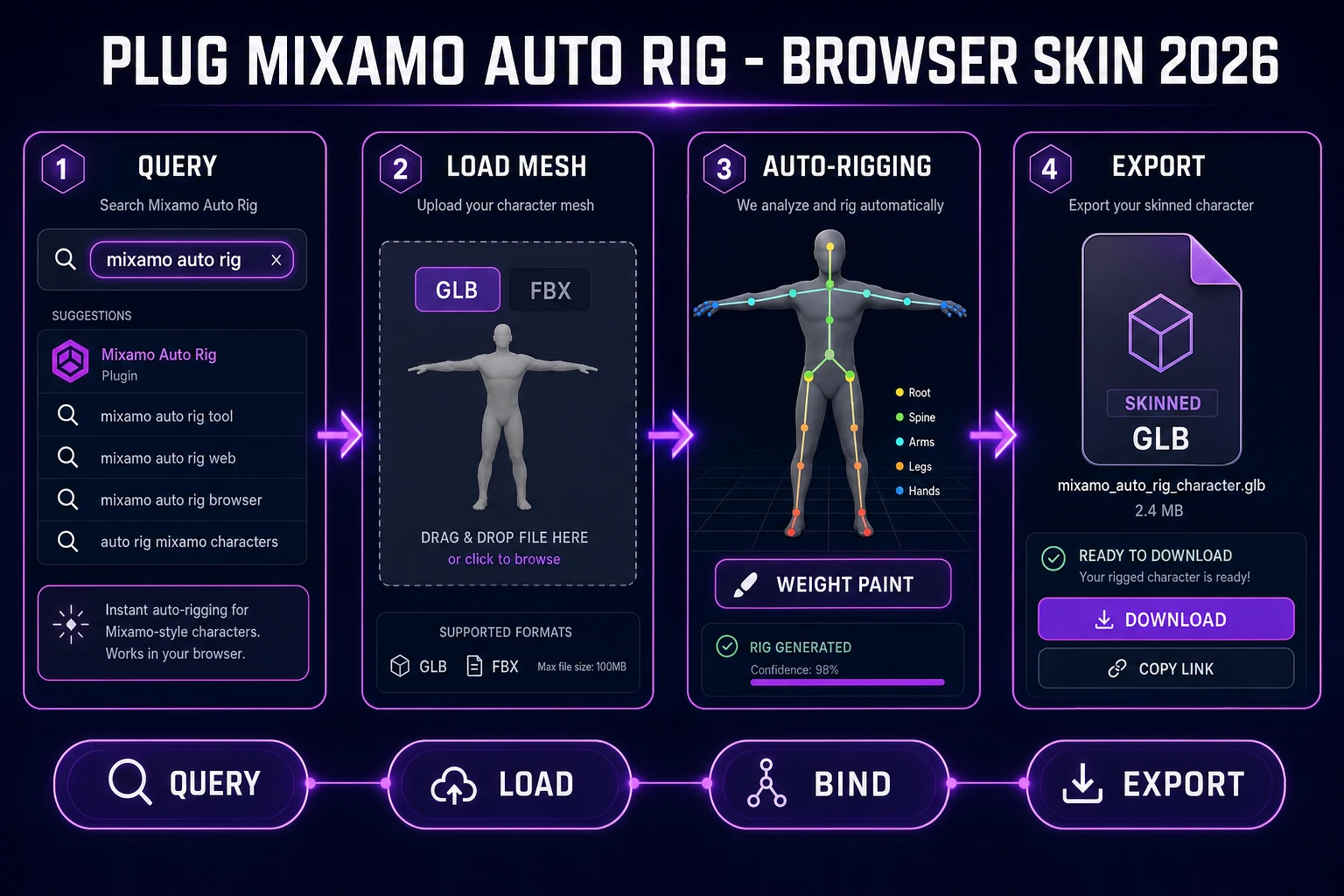
What a mixamo auto rig search actually wants
DataForSEO lists mixamo auto rig at 260 searches per month with KD 9 and transactional intent (tools/research-supplement.md, seed auto rig, verified 2026-10-14). Sibling phrases in the same table include auto rig (880/mo), mixamo auto rigger alternative (10/mo), and a thick Maya / Blender “auto rig pro” cluster that is a different product name entirely. The head query here is the bind job named after a familiar service, not a desktop add-on review.
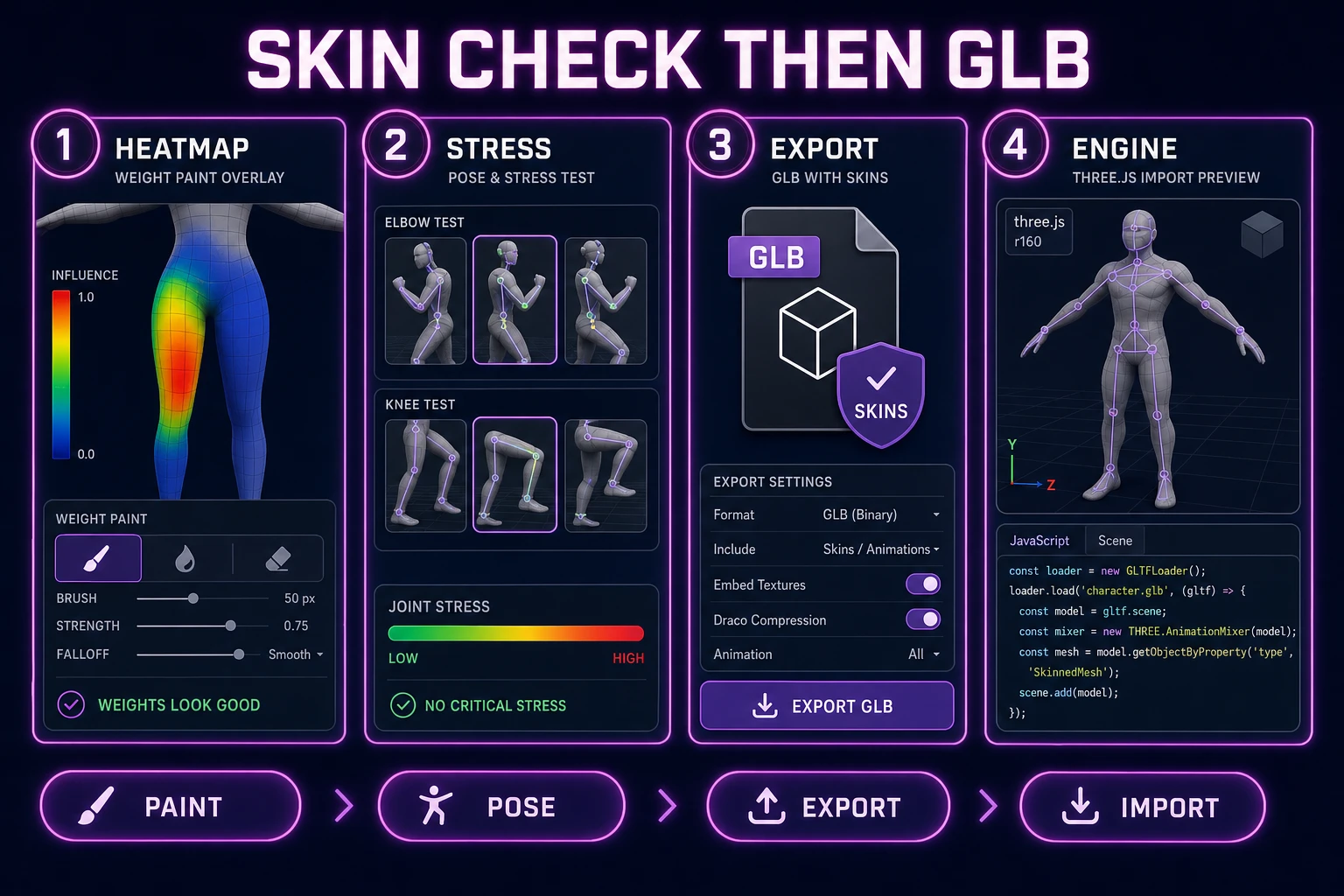
Wikipedia’s skeletal animation page (verified 2026-10-15) splits a character into a surface mesh and a hierarchical set of bones, then attaches vertices with blend weights so a thigh bone move also moves the thigh polygons. That mesh-plus-skeleton-plus-skin package is the real deliverable behind every mixamo auto rig click. An animation clip is optional later. If you skip the bind and drop a raw prop into a motion tool, the walk prompt fails for a boring reason: there is no skeleton to drive.
For jam and indie searchers, success looks practical: feet plant, knees crease, shoulders rotate, and the elbows do not melt into the torso when you raise an arm. Cosmetic wrinkles and muscle sims are not the bar. If your mesh is a spider or a wheeled robot, stop — humanoid auto-rig will not invent six good legs. That fork belongs on Procedural Walk.
Mixamo-shaped job vs the browser path
Naming Mixamo in the query usually means the searcher wants that shape of workflow: upload a biped, get an automatic humanoid skeleton, keep the skin, export something like FBX or GLB. It does not mean they must stay inside Adobe’s product. Hard Rule for this blog: we describe the job and ship the Sorceress answer; we do not deep-link competitors.
On Sorceress the dedicated surface is Auto-Rigging. The 3D & Animation home card badges it Pro and describes “Auto-rig humanoid 3D models + weight-paint refinement” (verified 2026-10-15 in src/app/_home-v2/_data/tools.ts). The live route is /rigging. The same bind panel also lives inside 3D Studio after you lift an image to a textured mesh.
Two related posts already cover nearby angles: Swap Mixamo Alternative (Browser Rig 2026) is the comparison / stack swap query, and Bind Auto-Rig (Character Skin 2026) is the general auto-rig how-to. This page stays on the mixamo auto rig phrasing — the transactional bind — so you can plug the job into the browser without re-reading a roundup.
If you still need a mesh, generate or upload through 3D Studio first, or pull a creature path from Voxel Studio when the cast is blocky. The bind step below assumes you already have a clean biped GLB, FBX, or OBJ.
Auto-Rigging steps for a mixamo auto rig bind
Open Auto-Rigging and load the mesh. Facts below are verified 2026-10-15 against src/lib/rigging/types.ts, src/components/studio/rig/AutoRigPanel.tsx, and src/lib/rigging/external-rig/autoRigPricing.ts.
- Prep the pose. Stand the character in a near T-pose or A-pose with arms clear of the torso. Delete floating props that are not welded to the body. Confirm the feet sit on the ground plane. If the mesh came from an image-to-3D lift, inspect the underside of the feet and the crotch — pinched geometry there is where weight paint fails first.
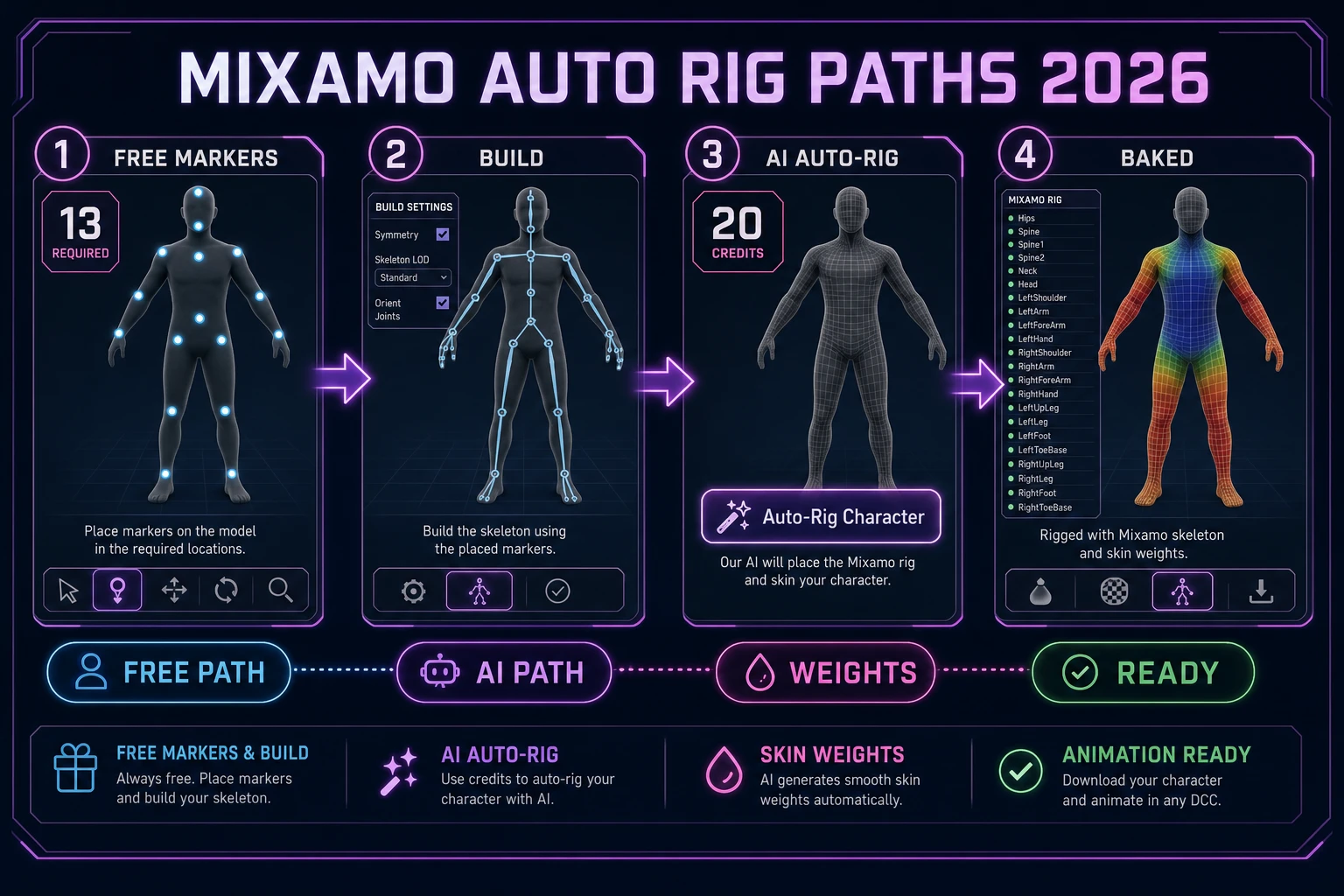
- Free marker path (primary). Place the thirteen required markers: pelvis, neck, chin, both shoulders, both elbows, both wrists, both knees, both ankles. Optional hip markers exist as helpers. Build the skeleton, then compute weights. No AI auto-rig credits burn on this route.
- AI auto-rig path (secondary). Click the button labeled Auto-Rig Character with the subtitle “Automatic · 20 credits”. The studio hands the mesh to an external humanoid rigger. What returns is a Mixamo-family named skeleton with weights already baked into the GLB, so you can skip Compute Weights after a clean success and go straight toward Animate.
- Orientation before a retry. A mesh facing the wrong way produces a backwards bind. Fix facing / yaw before you burn a second 20-credit attempt. Do not stack a second skeleton on top of a broken one.
AUTO_RIG_CREDITS.meshy = 20 is the flat cost for the UI AI auto-rig button. One credit equals one US cent on the top-up ledger in the same pricing file. Tripo still has a 40-credit entry in code but was removed from the UI in 2026-07 because it could only rig meshes it generated — users never see that button. Marker placement, skeleton build, and the studio’s own weight-paint path stay off the 20-credit line.
Skeleton profiles registered in the studio include UE mannequin, SMPL, DAZ G8, Mixamo, and Meshy families. AI auto-rig results land on a Mixamo-named humanoid set that still plays with Sorceress animation tools afterward — that is why a mixamo auto rig style bone list is a feature here, not a vendor endorsement.