Narrate an AI Dungeon Story Generator (Branching Quest 2026)

By Arron R.9 min read
An ai dungeon story generator in 2026 is a four-step browser pipeline: WizardGenie locks quest graphs and flags, batches branching node prose, AI Image Gen pair

Most jam RPGs die in the middle of act one: the combat loop works, the map loads, and then every corridor dumps the same three paragraphs of placeholder lore. Searchers typing ai dungeon story generator on July 11, 2026 want branching quest prose their engine can load — rooms, choices, fail states, endings — not a chat novel they have to reformat by hand. This guide covers the 2026 browser pipeline: WizardGenie locks the quest graph and batches node JSON, AI Image Gen pairs scene art, and Speech Gen plus Phaser 4.2 wire narration into play. Tool costs below are verified against the live Sorceress source on July 11, 2026.
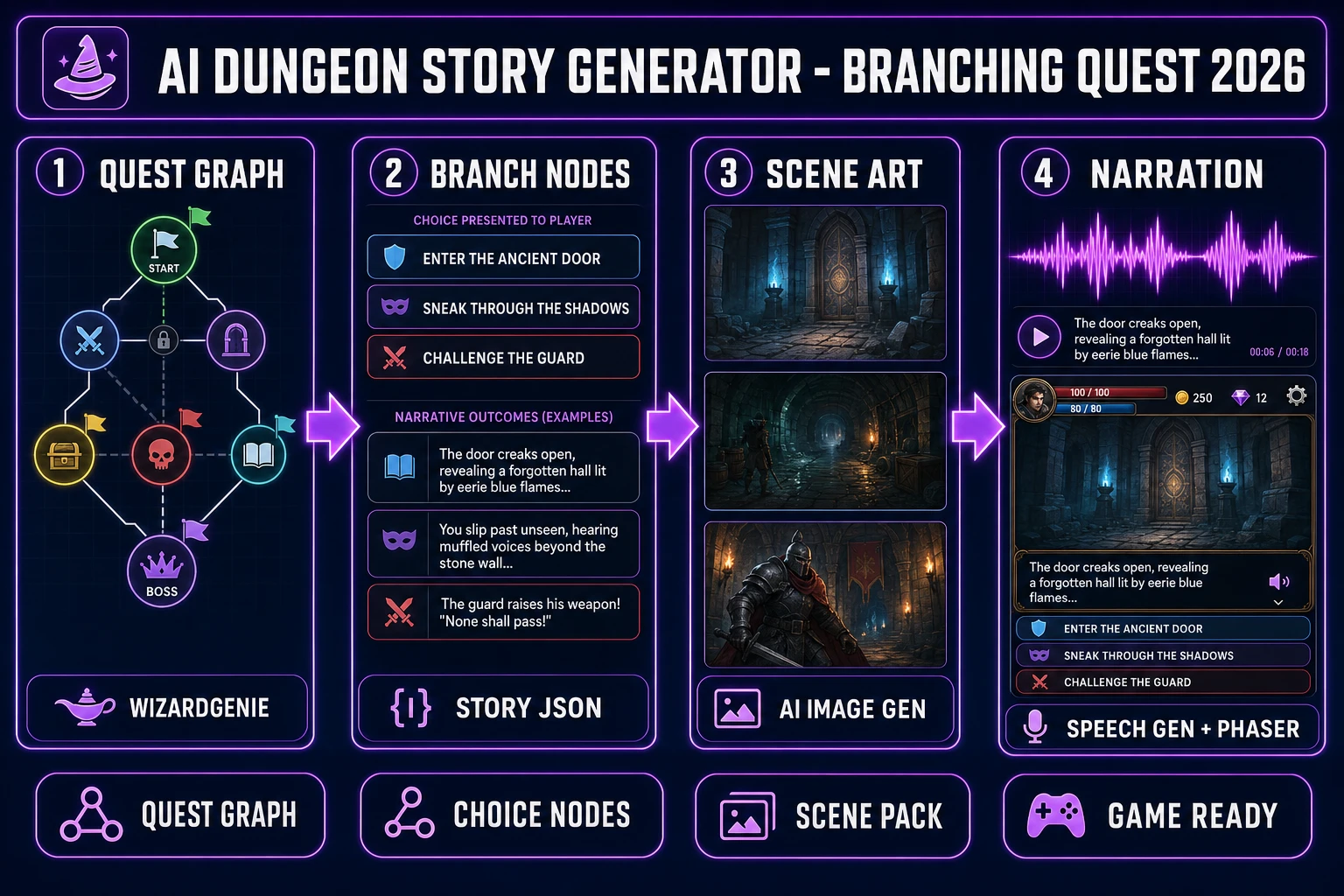
AI dungeon story generator in 2026, four-step browser pipeline from WizardGenie quest graph through branching nodes and AI Image Gen scenes to Speech Gen plus Phaser narration, verified July 11, 2026
An ai dungeon story generator in 2026 means four moves: quest graph in WizardGenie, batched choice nodes, scene packs in AI Image Gen, then Speech Gen narration wired into Phaser 4.2.

What an ai dungeon story generator outputs for branching quests

The phrase ai dungeon story generator (1,900/mo, KD 14 per DataForSEO probe-fresh-seeds-6.md verified July 11, 2026) targets a developer who needs a playable adventure spine, not a one-shot fiction dump. Sibling queries in the same cluster — ai text adventure (590/mo, KD 16), perchance ai text adventure (590/mo, KD 0), branching quest script, and indie RPG narrative pipeline — all describe the same deliverable: nodes with stable IDs, choice labels, flag writes, and next-node links your runtime can evaluate tonight.

Game pipelines need structured output. Ship a JSON array with id, text, choices[], setFlags, and nextId (or per-choice targets) so save files, UI, and audio folders reference the same keys. Pair that pack with the AI dialogue generator post when merchants and quest-givers need bark lines inside a room, and with the fantasy name generator post when named NPCs appear in those rooms. Storefront product naming is a different job — keep dungeon story nodes for the adventure spine that advances the run.

Why chat dumps stall production narrative trees

Interactive fiction has always been about state plus text: the player changes the world, and the world remembers. A blank chat window has no flag registry, no branch-and-bottleneck discipline, and no export schema. You get a pretty chapter, paste it into a spreadsheet, invent IDs by hand, and lose consistency the moment a playtester asks “what if I already opened the crypt?”

Choice-based IF patterns exist because unconstrained branching explodes. IFWiki’s catalogue of structures — time cave, gauntlet, branch-and-bottleneck, hub-and-spoke (Standard Patterns in Choice-Based Games, verified July 11, 2026) — is the design language an ai dungeon story generator should speak. Branch-and-bottleneck is the jam-friendly default: you fork for agency, then rejoin around shared plot beats so you can still finish the game. A chat dump almost always ships a time cave by accident — every choice invents a new ending you cannot afford to write, voice, or art.

Practical failure modes show up in playtests. Two rooms that contradict each other’s flags make the dungeon feel like pasted AI. A “choice” that always leads to the same next paragraph teaches players to stop reading. Treat the quest graph as production data: lock flags first, batch nodes second, reject any row that writes a flag the registry does not define. That discipline is what separates a usable ai dungeon story generator pipeline from a novelty paste.

The Sorceress ai dungeon story generator pipeline in four steps

Every shippable branching quest ships four runtime pieces regardless of art style: graph, nodes, scenes, and narration. In 2026 each maps to one Sorceress tool verified against the live catalog on July 11, 2026:

  • Quest graph + node batching: WizardGenie (coding on your API key) drafts flag registries, generates 20–80 story nodes, and exports JSON.
  • Scene packs: AI Image Gen (AI Credits badge) at 16:9 or 1:1 for room art; credit cost varies by model via getModelCredits in src/lib/models.ts (Z-Image at 3 credits for fast iteration, Nano Banana Pro at 18 for hero rooms).
  • Optional narration: Speech Gen (AI Credits) for node VO once prose stabilizes — HD at 0.5 credits per 1,000 characters, Turbo at 0.3 per 1,000, 1-credit minimum per render, voice clone 400 credits (verified in src/app/speech-gen/page.tsx on July 11, 2026).
  • In-game runtime: WizardGenie scaffolds a Phaser 4.2.0 scene that loads the JSON, evaluates flags, and plays matching MP3s.

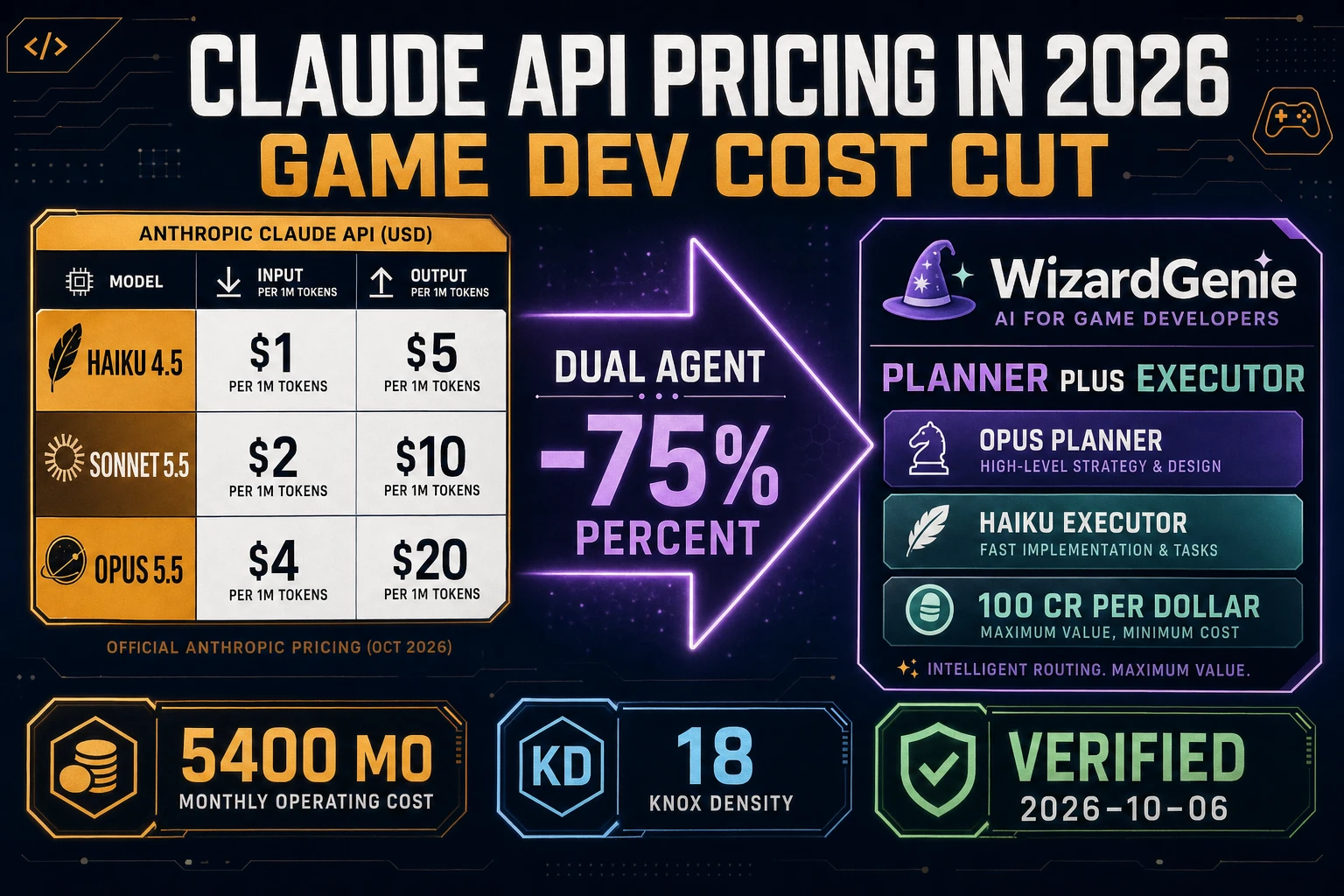
Pricing is a $49 lifetime unlock plus pay-as-you-go credit packs. Starter $10/1,000 credits, Creator $20/2,000, Plus $50/5,000, Studio $100/10,000. Verified against src/app/plans/page.tsx lines 46 and 51–54. New accounts ship with 100 starter credits. The Sorceress tools guide lists every tool in the catalog. WizardGenie model lineup verified July 11, 2026 against CODING_MODELS in src/app/_home-v2/_data/tools.ts: Claude Opus 4.7, Claude Sonnet 4.6, GPT-5.5, Gemini 3.1 Pro, DeepSeek V4 Pro, Kimi K2.5, Grok 4.2, MiniMax M2.7.
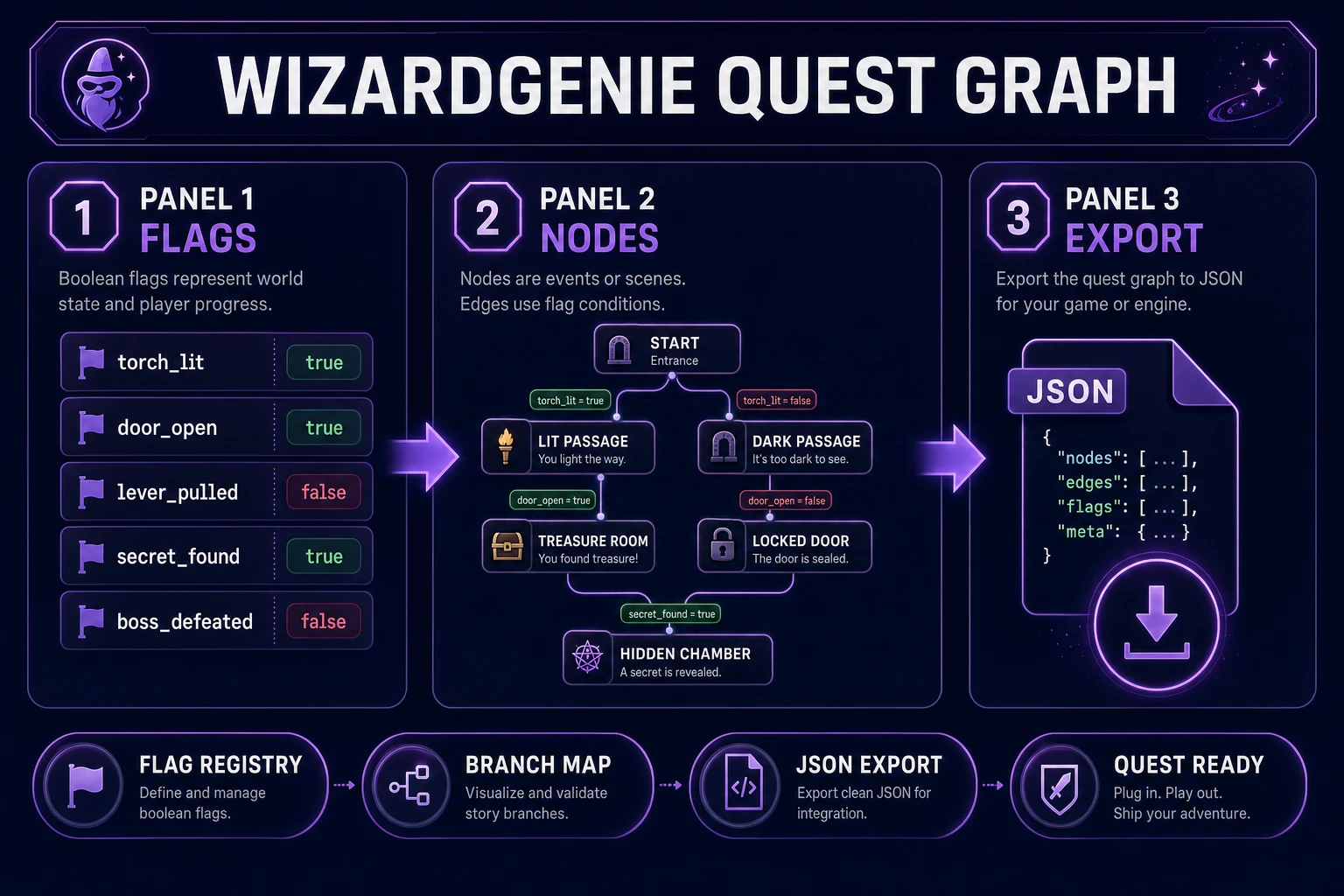
WizardGenie quest graph flags and branching node JSON export for an ai dungeon story generator workflow, verified July 11, 2026
WizardGenie locks the flag registry, maps branch-and-bottleneck nodes, and exports JSON before any scene or TTS credits are spent.

Step 1 — lock the quest graph and flags in WizardGenie

Open WizardGenie and prompt a graph first, not a chapter. Example: “I am building a Phaser 4.2 browser dungeon. Design a branch-and-bottleneck quest graph titled Ash Crypt Run with 24 nodes max. Flags: torch_lit, key_taken, trap_sprung, crypt_open, warden_alive. Structure: hub vestibule → two exploratory wings → bottleneck antechamber → boss crypt → three endings (escape, sealed, doomed). Output a markdown map of node IDs plus a flag registry table.”

Pick Claude Opus 4.7 or Gemini 3.1 Pro for the first graph pass. Topology benefits from the heavy reasoner. Iterate flag tweaks and renames with DeepSeek V4 Pro or Kimi K2.5 as the executor; never put a frontier model on the typing side for bulk node fills. Reject any later batch row that writes an undefined flag. If you also need full NPC bark trees after the spine locks, cross-link the dialogue generator sibling once rooms stabilize.

Keep the registry ruthless. Five flags beat fifteen when you are shipping a jam. Every extra boolean multiplies the test matrix: you must play through combinations, not just happy-path corridors. Write a one-line plain-English meaning next to each flag in the markdown table so future-you (or a collaborator) does not invent a second meaning mid-week. WizardGenie can hold that table in the project folder beside the JSON so graph edits and prose edits stay in sync.

Step 2 — draft node prose, choices, and fail states

With the graph locked, prompt WizardGenie: “Using the Ash Crypt Run map, generate JSON nodes with fields id, text (max 280 characters), choices[{label, nextId, requiresFlags, setFlags}], ending (bool). Tone: terse gothic, no second-person purple prose, no trademarked IP. Every choice must change a flag or advance the bottleneck. Include two fail-state leaves that rejoin the antechamber.” Save the file in data/quests/ash_crypt.json.

Audit the batch like production data. Read every choice label aloud — if two labels sound identical, rewrite. Deduplicate id strings. Keep IDs immutable once audio and art reference them; edit text only. Export a “jam twelve” subset for your first playable loop so you aren’t wiring 24 VO files on day one. Choice-based IF tooling (Twine, ink, ChoiceScript — see IFWiki Choice) uses the same node mental model; your JSON is just the engine-native form.

Fail states deserve the same care as victories. A trap that only prints “you die” and reloads wastes the graph you just designed. Prefer soft fails that set trap_sprung, return the player to a bottleneck with a scar, and keep the run alive. That is how branch-and-bottleneck earns its keep: agency without a combinatorial explosion of endings. When a node needs a named resident, pull display names from your fantasy name roster by npc_id instead of inventing a new spelling mid-sentence.

{
  "id": "crypt_ante_01",
  "text": "The antechamber reeks of wet stone. A brass key gleams on the altar. The east gate still holds.",
  "choices": [
    { "label": "Take the key", "nextId": "crypt_ante_02", "setFlags": { "key_taken": true } },
    { "label": "Force the gate", "nextId": "crypt_trap_01", "requiresFlags": { "key_taken": false }, "setFlags": { "trap_sprung": true } }
  ]
}
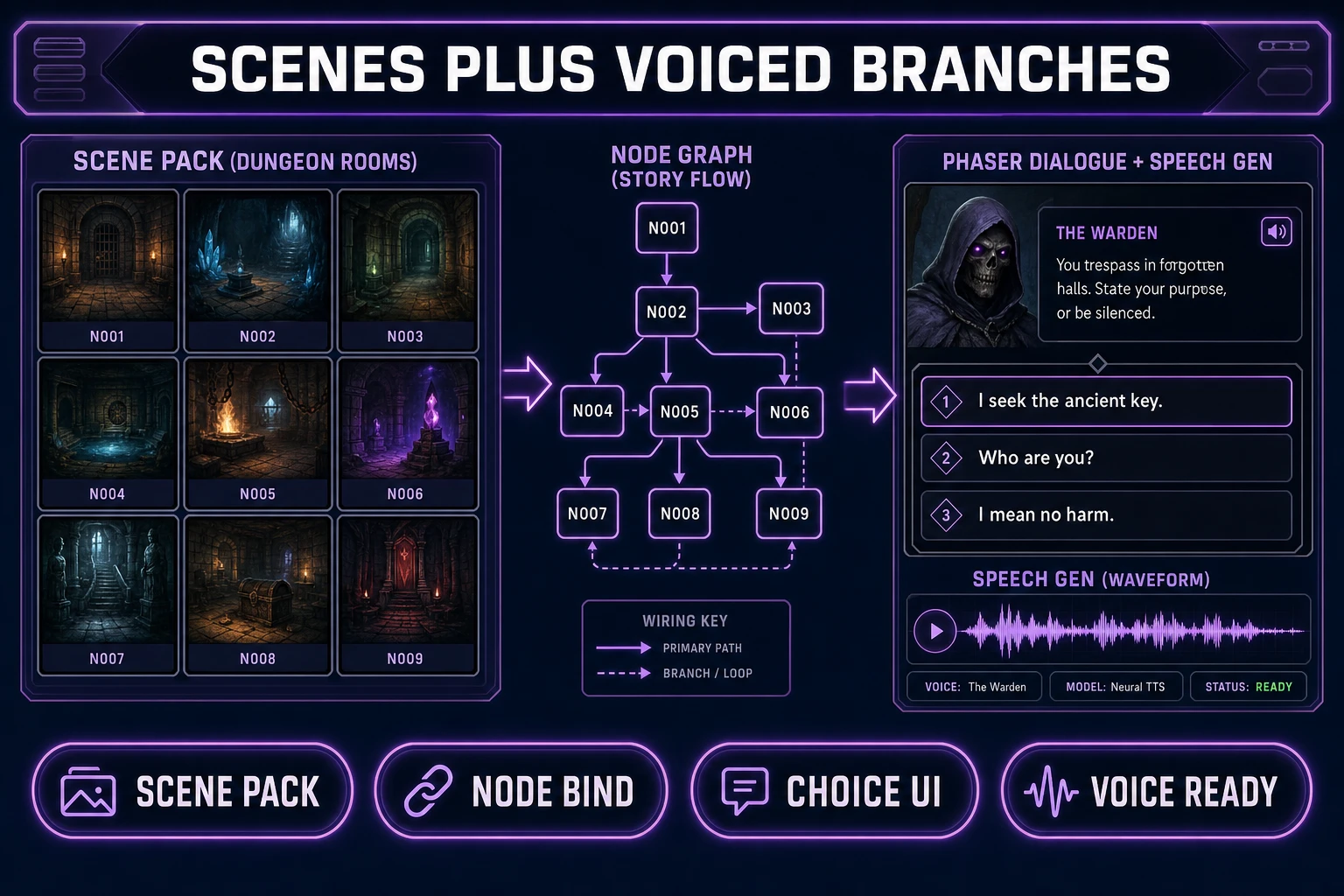
AI Image Gen dungeon scene pack bound to ai dungeon story generator node IDs with Speech Gen narration and Phaser 4.2 choice UI, verified July 11, 2026
Scene packs and voiced nodes close the ai dungeon story generator loop: art and MP3s keyed to the same JSON IDs Phaser 4.2 loads at runtime.

Step 3 — scene art, Speech Gen narration, and Phaser 4.2 wiring

Run each hub and bottleneck room through AI Image Gen with a locked style card (“candlelit sandstone crypt, painterly, no text, no UI chrome”). Name files to match node IDs (crypt_ante_01.webp). Z-Image at 3 credits is enough for iteration; spend Nano Banana Pro credits only on the three rooms players will screenshot.

Speech Gen at /speech-gen closes the gap between prose and ship. Verified against src/app/speech-gen/page.tsx on July 11, 2026: HD TTS costs 0.5 credits per 1,000 characters, Turbo costs 0.3 per 1,000, each render has a 1-credit minimum, and voice cloning costs 400 credits for a reference sample up to 4:59. For twelve jam nodes averaging 180 characters, expect roughly twelve credits on HD — one Starter pack covers a full voice pass with room to spare. Name MP3s to match id.

Shipping is where amateur pipelines die. Phaser 4.2.0 “Giedi” (released June 19, 2026, verified against phaser.io release notes on July 11, 2026) is the honest browser runtime. Ask WizardGenie: “Generate a Phaser 4.2 QuestScene that loads data/quests/ash_crypt.json, shows text plus choice buttons, evaluates requiresFlags against a flags registry, applies setFlags, swaps the background texture by node id, and plays audio/{id}.mp3 when present.” That single prompt turns your ai dungeon story generator output into a clickable loop.

Desktop and web WizardGenie both work for this pass — pick the surface you already use for coding. The agent writes the scene class into your project; you reload the browser tab and click through every choice once. Log any dead ends, missing textures, or silent audio keys, then feed that bug list back into WizardGenie as a patch prompt instead of regenerating the whole quest from scratch. Iteration on the graph beats regenerating pretty paragraphs.

What an ai dungeon story generator session costs on Sorceress in 2026

Pricing verified July 11, 2026 against src/app/plans/page.tsx (LIFETIME_PRICE = 49). Sorceress base unlock is $49 one-time for the full tool suite. AI credits are pay-as-you-go: Starter $10 for 1,000 credits, Creator $20 for 2,000, Plus $50 for 5,000, Studio $100 for 10,000. A single branching quest with twenty-four nodes, three hero scenes, and twelve voiced hubs typically burns twenty to sixty credits total — often under $1 on top of the lifetime unlock if you stay graph-first. WizardGenie coding and chat run on your own API keys, so the writing pass cost stays under your model provider’s billing, not Sorceress credits.

Compare that to renting a writing subscription plus a standalone TTS plan plus manual reformatting every time a flag changes. The integrated ai dungeon story generator path wins on both money and iteration speed: change flags.crypt_open, regenerate two nodes, re-render two MP3s, reload — done in minutes. Browse the full stack at Sorceress Tools Guide or see plans for credit tiers. For visual-novel scope with longer lines and CG triggers, the visual novel maker post covers that engine path; for tabletop NPC prep without a full quest graph, use the DnD NPC generator sibling.

The category shift is simple: an ai dungeon story generator in 2026 is not a novelty chapter spinner. It is a production pipeline — structured nodes, scene files, voiced hubs, engine-ready JSON — that respects how interactive fiction actually ships. Sorceress built the pieces to run that pipeline in one account; your job is to lock the flag registry before you ask for pretty prose.

Frequently Asked Questions

What is an ai dungeon story generator used for in game development?

An ai dungeon story generator drafts branching quest prose — rooms, choices, fail states, and endings — as structured nodes your game can load, not a one-shot chat novel. In the Sorceress pipeline (verified July 11, 2026) that means locking a quest graph in WizardGenie, pairing scene art in AI Image Gen, rendering narration in Speech Gen, and wiring nodes into Phaser 4.2.

Is an ai dungeon story generator free on Sorceress?

WizardGenie coding runs on your own API key (or the trial fallback key). AI Image Gen and Speech Gen spend AI Credits via the live credit math in src/lib/models.ts and src/app/speech-gen/page.tsx. New accounts ship with 100 starter credits; the lifetime unlock covers Pro tools (verified against src/app/plans/page.tsx LIFETIME_PRICE = 49 on July 11, 2026). You can iterate quest graphs in WizardGenie without burning image or TTS credits until node prose stabilizes.

How is an ai dungeon story generator different from an ai dialogue generator?

An ai dungeon story generator owns the quest graph: rooms, choices, flags, and endings. An ai dialogue generator owns NPC bark lines and conversation trees inside a scene. Use the dialogue sibling post when you need merchants and quest-givers to speak; keep dungeon story nodes for the adventure spine that advances the run.

Can I export an ai dungeon story generator pack for a browser game?

Yes. Ask WizardGenie for JSON with id, text, choices[], setFlags, and nextId fields, then scaffold a Phaser 4.2.0 scene that loads the file and advances on choice clicks. Phaser 4.2.0 (Giedi) released June 19, 2026 — verified against the official Phaser download page on July 11, 2026. Pair Speech Gen MP3s by node id for optional narration.

What does an ai dungeon story generator session cost on Sorceress in 2026?

Verified July 11, 2026 against src/app/plans/page.tsx. Base unlock is one-time. A minimal branching quest session typically burns 0–60 Sorceress credits for optional scene art and HD narration (Speech Gen HD is 0.5 credits per 1,000 characters with a 1-credit minimum per render in src/app/speech-gen/page.tsx), while WizardGenie coding stays on your API key — often under of Starter-tier credits on top of lifetime if you stay graph-first.

Sources

  1. Interactive fiction - Wikipedia
  2. Choice-based interactive fiction - IFWiki
  3. Standard Patterns in Choice-Based Games - IFWiki
  4. Phaser v4.2.0 release notes
Written by Arron R.·1,940 words·9 min read

Related posts