Forge a Fantasy Name Generator (RPG NPC Roster 2026)

By Arron R.8 min read
A fantasy name generator in 2026 is a four-step browser pipeline: WizardGenie locks culture phonology rules, batches JSON/CSV NPC name tables, AI Image Gen pair

A tavern full of “Zyx’qor the Blade” clones reads like a placeholder dump, not a world. Searchers typing fantasy name generator on July 11, 2026 want culture-consistent NPC names they can drop into an RPG roster, not a one-off novelty string. This guide covers the 2026 browser pipeline: WizardGenie locks phonology rules and batches name tables, AI Image Gen pairs portraits, and Phaser 4.2 dialogue (with optional Speech Gen) wires the names into play. Tool costs below are verified against the live Sorceress source on July 11, 2026.
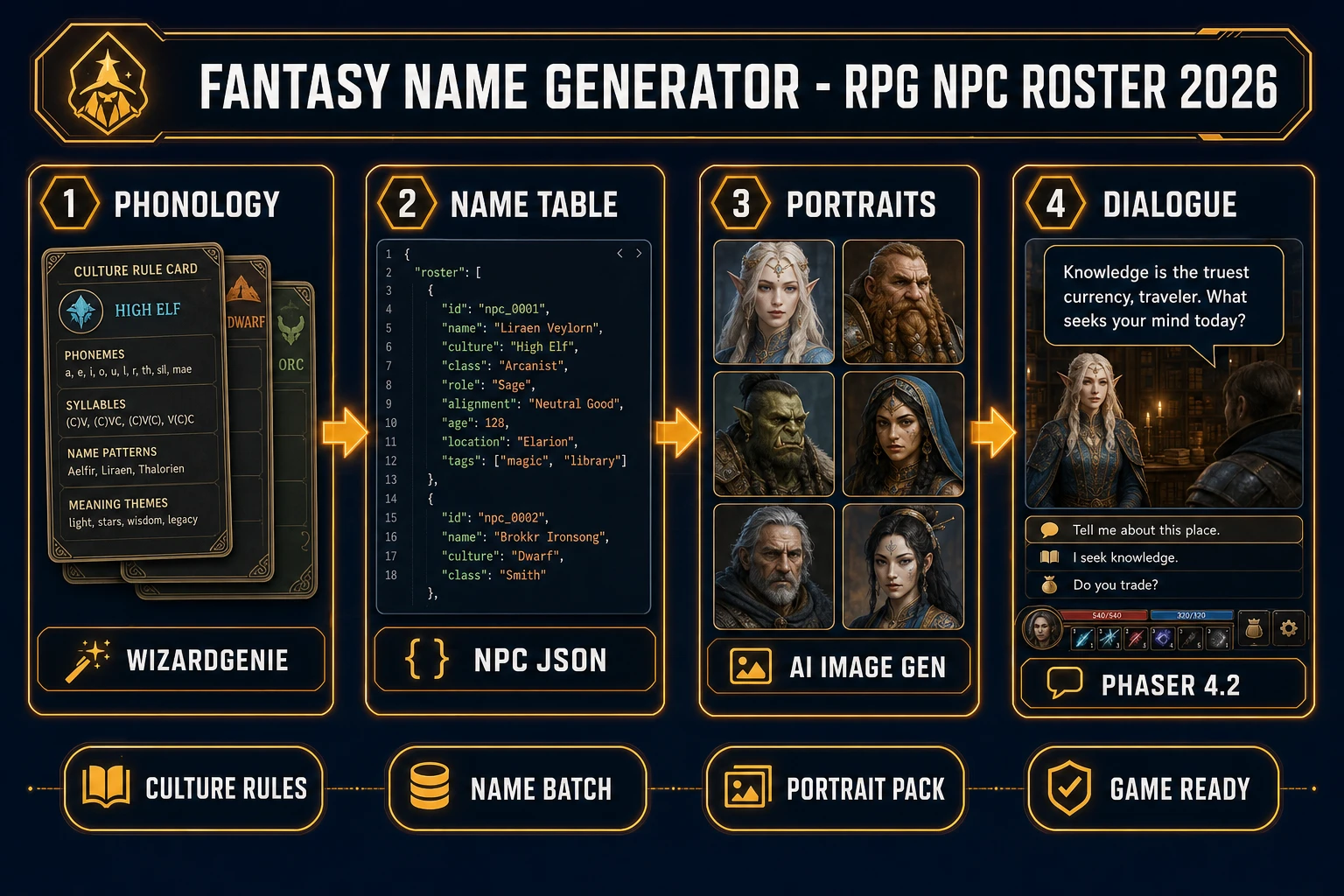
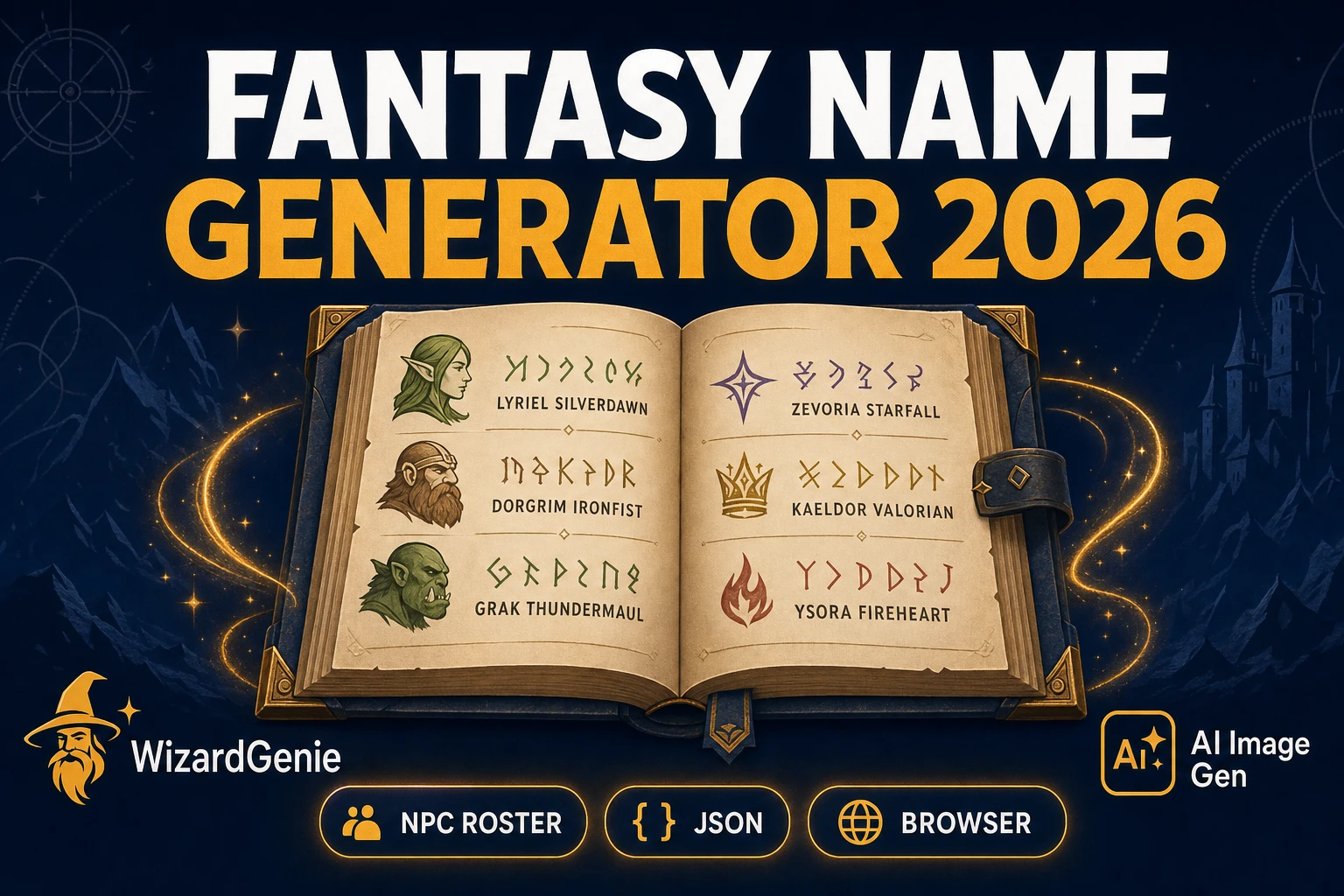
Fantasy name generator in 2026, four-step browser pipeline from WizardGenie culture phonology through JSON NPC tables and AI Image Gen portraits to Phaser 4.2 dialogue, verified July 11, 2026
A fantasy name generator in 2026 means four moves: culture phonology in WizardGenie, batched NPC name tables, portrait pairing in AI Image Gen, then Phaser 4.2 dialogue wiring.

What a fantasy name generator outputs for RPG rosters

The phrase fantasy name generator (135,000/mo, KD 20 per DataForSEO probe-fresh-seeds-4.md verified July 11, 2026) targets a developer or GM who needs first names, surnames, epithets, and place labels that feel like they share a language family. Sibling queries confirm the cluster: name generator fantasy (135,000/mo, KD 19), ai fantasy name generator (70/mo, KD 10), fantasy npc name list, and rpg character name generator all describe the same deliverable, a roster you can filter by culture, gender presentation, and role, then import as data.

Game pipelines need structured output, not a webpage of ten random strings. Ship a JSON array with id, culture, given, family, epithet, and display fields so quest scripts, save files, and dialogue trees reference stable keys. Pair that table with the DnD NPC generator and AI dialogue generator posts when you need personalities and lines after the names lock. Storefront naming is a different job. See the game name generator sibling if you are titling the product, not the blacksmith.

Why random syllable soup breaks immersion

Onomastics, the study of names, exists because names carry phonology, morphology, and social signal. Players notice when every “elf” name uses hard stops and every “orc” name uses soft vowels. Random consonant piles fail for the same reason bad constructed languages fail: there is no shared sound inventory, so nothing feels related.

Tolkien’s Elvish work is the classic counter-example. Quenya and Sindarin names follow documented roots and phonotactics rather than decorative syllable salad (Elvish languages of Middle-earth, verified July 11, 2026). You don’t need a full conlang for a jam RPG. You do need one phonology card per culture: allowed onsets, preferred endings, forbidden digraphs, and a short root list with meanings. That card is what turns a fantasy name generator from a toy into production data.

Practical failure modes show up in playtests, not in spreadsheets. Two merchants from the same village with unrelated sound patterns make the town feel procedurally pasted. A villain lieutenant whose name could swap into the elf roster without anyone noticing means your cultures aren’t carrying identity. Treat the phonology card as a lint rule: batch first, reject mismatches, regenerate only the failing rows. That discipline is what separates a usable fantasy name generator pipeline from a novelty click.

The Sorceress fantasy name generator pipeline in four steps

Every shippable NPC roster ships four runtime pieces regardless of art style: culture rules, name table, portrait bind, and dialogue wiring. In 2026 each maps to one Sorceress tool verified against the live catalog on July 11, 2026:

  • Culture phonology + batching: WizardGenie (coding on your API key) drafts rule cards, generates 50–500 name rows, and exports JSON/CSV.
  • Portrait packs: AI Image Gen (AI Credits badge) at 1:1 for headshots; credit cost varies by model via getModelCredits in src/lib/models.ts.
  • Optional spoken names: Speech Gen (AI Credits) for quest-giver VO lines once display names stabilize.
  • In-game dialogue: WizardGenie scaffolds Phaser 4.2 text boxes that pull display from your name table by id.

Pricing is a $49 lifetime unlock plus pay-as-you-go credit packs. Starter $10/1,000 credits, Creator $20/2,000, Plus $50/5,000, Studio $100/10,000. Verified against src/app/plans/page.tsx lines 46 and 51–54. New accounts ship with 100 starter credits. The Sorceress tools guide lists every tool in the catalog. WizardGenie model lineup verified July 11, 2026 against CODING_MODELS in src/app/_home-v2/_data/tools.ts: Claude Opus 4.7, Claude Sonnet 4.6, GPT-5.5, Gemini 3.1 Pro, DeepSeek V4 Pro, Kimi K2.5, Grok 4.2, MiniMax M2.7.
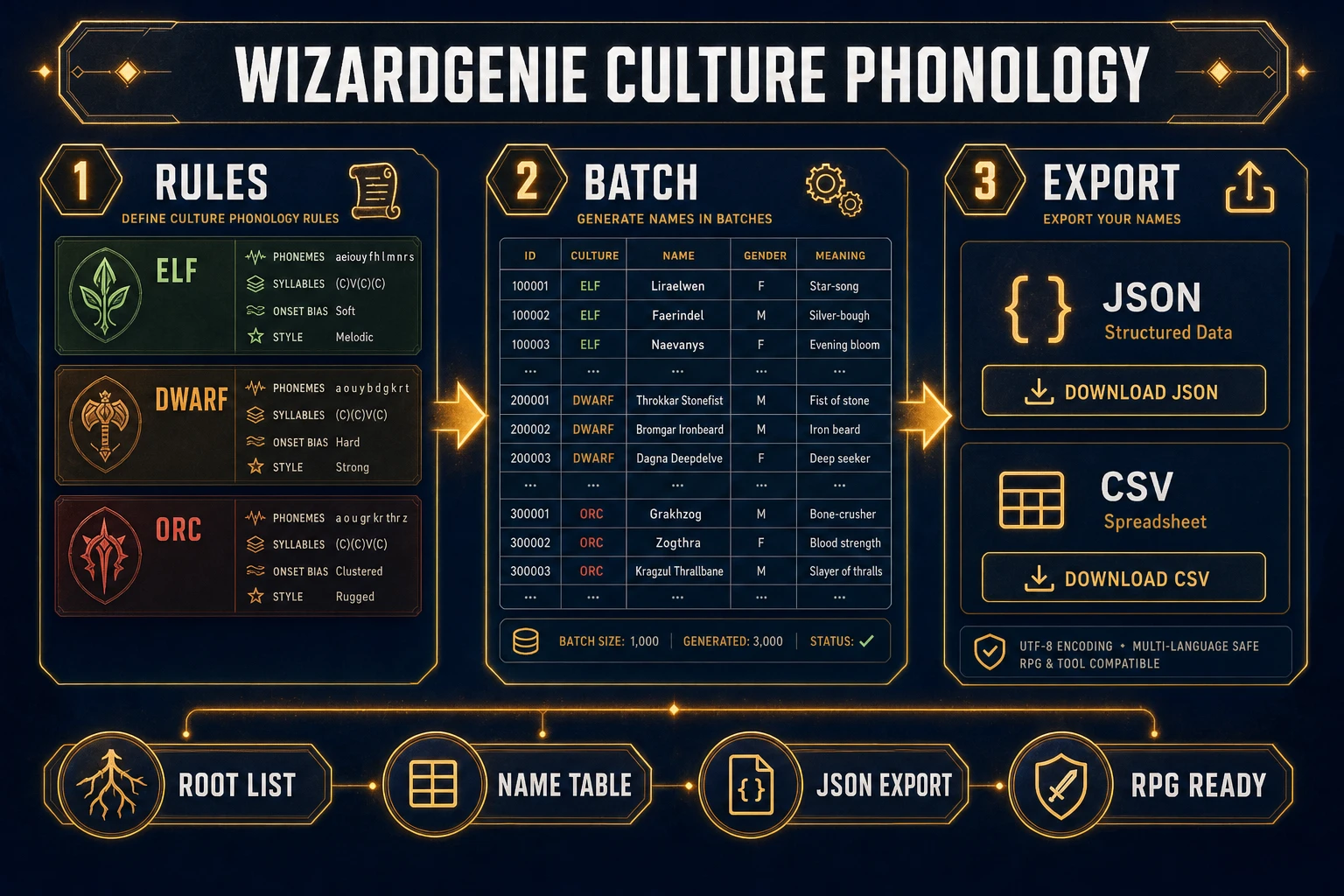
WizardGenie culture phonology cards and JSON NPC name table export for a fantasy name generator workflow, verified July 11, 2026
WizardGenie locks elf, dwarf, and orc phonology cards, batches the name table, and exports JSON/CSV before any portrait credits are spent.

Step 1 — lock culture phonology rules in WizardGenie

Open WizardGenie and prompt a phonology card first, not a list of names. Example: “Create three culture phonology cards for a fantasy RPG: High Elves (open vowels, liquids, -iel/-wen endings, roots for light/tree/star), Mountain Dwarves (hard stops, consonant clusters, -in/-or endings, roots for stone/forge/kin), Ash Orcs (guttural stops, short vowels, -uk/-akh endings, roots for ash/blood/raid). Output markdown tables: allowed consonants, preferred endings, forbidden digraphs, 12 seed roots with glosses.”

Pick Claude Opus 4.7 or Gemini 3.1 Pro for the first card pass. Phonology consistency benefits from the heavy reasoner. Iterate rule tweaks with DeepSeek V4 Pro or Kimi K2.5 as the executor; never put a frontier model on the typing side for bulk renames. Reject any later batch row that violates the card. If you also need full character sheets after naming, cross-link the AI character sheet generator post once identities stabilize.

Step 2 — batch NPC name tables as JSON + CSV

With phonology cards locked, prompt WizardGenie: “Using the High Elf / Mountain Dwarf / Ash Orc cards, generate 120 NPC names as JSON: fields id, culture, role, given, family, epithet, display. Roles: merchant, guard, quest_giver, villain_lieutenant, tavern. No trademarked Middle-earth names. Enforce phonology. Also emit the same rows as CSV.” Save both files in data/names/.

Audit the batch like production data. Sort by culture and read twenty names aloud. If two cultures share the same cadence, tighten endings. Deduplicate display strings. Keep id immutable once quest scripts reference it; rename via display only. Export a filtered “jam twenty” CSV for your first playable district so you aren’t scrolling 120 rows during dialogue wiring.

{
  "id": "npc_elv_017",
  "culture": "high_elf",
  "role": "quest_giver",
  "given": "Lirael",
  "family": "Thalorin",
  "epithet": "of the Silver Quill",
  "display": "Lirael Thalorin of the Silver Quill"
}
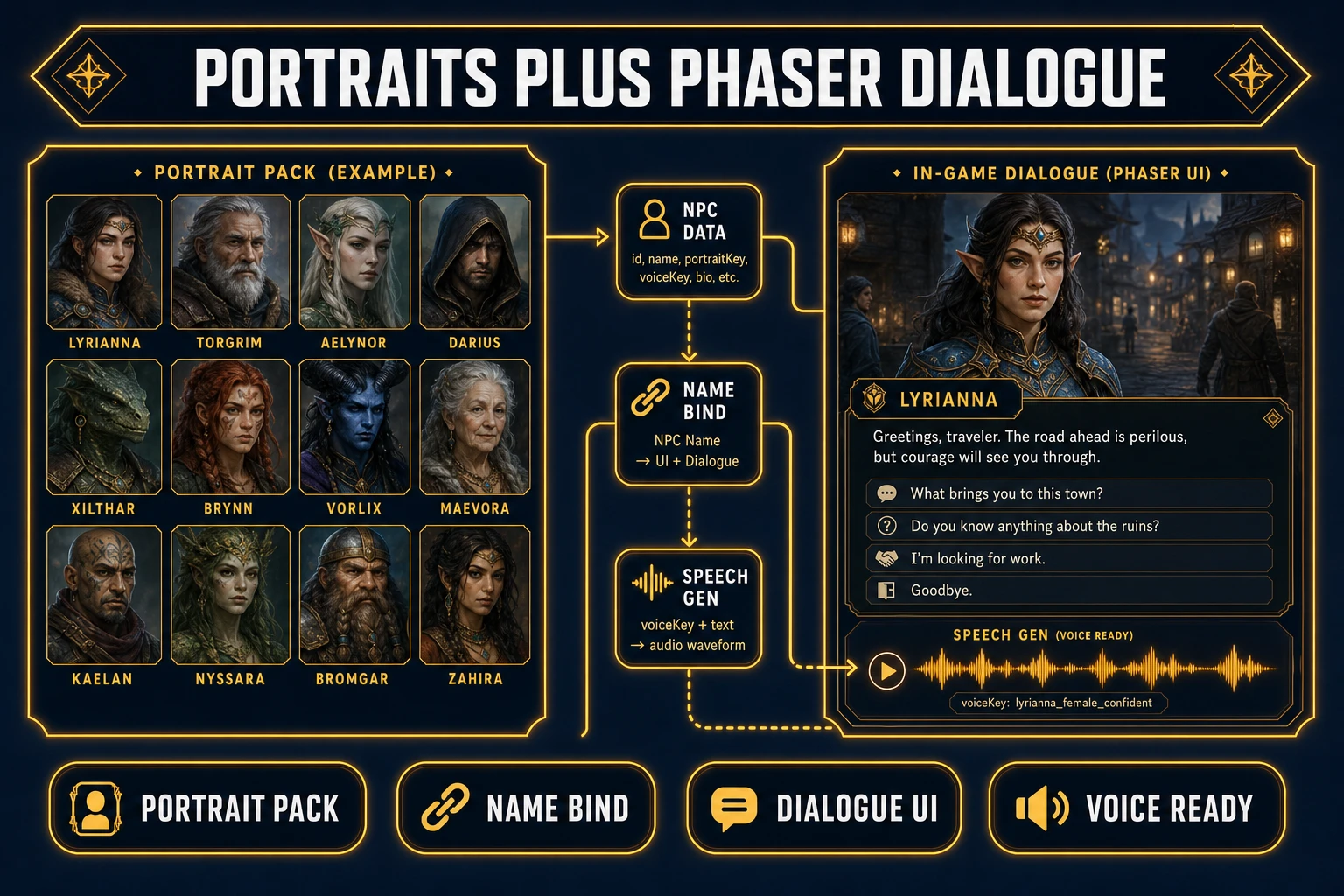
AI Image Gen NPC portrait pack bound to fantasy name generator display names and Phaser 4.2 dialogue UI, verified July 11, 2026
AI Image Gen paints headshots keyed to name-table IDs; Phaser 4.2 dialogue pulls the matching display string at runtime.

Step 3 — pair names with portraits in AI Image Gen

Open AI Image Gen, set a square aspect, and prompt headshots that match culture cues without copying copyrighted likenesses. Example: “stylized fantasy portrait, high elf scribe, silver ink stains, calm expression, soft teal lighting, bust only, plain backdrop, game NPC portrait, no text.” Name the file with the NPC id (npc_elv_017.webp) so art and data stay joinable.

Batch by culture so wardrobe and palette stay coherent: one elf lighting pass, one dwarf forge-warm pass, one orc ash-cold pass. GPT Image 2 and Nano Banana Pro are strong on readable faces inside the unified panel; Z-Image Turbo is useful when you need volume for background merchants. Optional: run one BG Remover pass if you need transparent busts for dialogue overlays. For monster-facing rosters instead of townsfolk, pair with the AI monster generator pipeline after humanoid names are done.

Step 4 — wire names into Phaser 4.2 dialogue + optional Speech Gen

Phaser 4.2.0 “Giedi” shipped June 19, 2026 (verified against phaser.io/news/2026/06/phaser-v4-2-0-released and phaser.io/download/phaser4 on July 11, 2026). Prompt WizardGenie: “Add Phaser 4.2 DialogueScene that loads data/names/npcs.json, looks up NPC by id, shows portrait sprite + display name as BitmapText, advances lines from a simple script map, exposes talkTo(npcId).” Pass portrait filenames that match id so the join stays boring and correct.

When a quest giver needs VO, open Speech Gen, paste the spoken line with the display name embedded once for clarity, pick a voice preset that matches culture tone, and save audio keyed to the same id. Speech Gen bills on character volume (live path verified in the Sorceress Tool API audio stack); keep name-table iteration free of VO until lines stick. Prefer DeepSeek V4 Pro or MiniMax M2.7 for dialogue-script tweaks after the first scaffold.

Keep the dialogue script map boring on purpose: npc_elv_017 maps to an array of line strings, and the scene only looks up display plus portrait texture. Don’t hard-code names inside Phaser source files. When a playtester asks to rename the scribe, you edit one JSON field and re-export audio if needed, instead of hunting string literals across scenes. That data-first habit is the real product of a fantasy name generator workflow in 2026.

What a fantasy name generator session costs on Sorceress in 2026

Cost math verified July 11, 2026. Base unlock: $49 lifetime. WizardGenie coding: your API key (or trial fallback). A minimal fantasy name generator session can stay at zero image credits if you ship JSON-only for the first playtest. A portrait-backed district typically burns 40–120 Sorceress credits ($0.40–$1.20 at Starter tier rates) for twenty headshots, optional BG Remover on a few busts, and optional Speech Gen on two quest lines. Compare that to commissioning a naming pass plus twenty portraits from freelancers. The fantasy name generator SERP reader is usually a solo RPG author optimizing for one shippable browser build.

Start with the 100 free credits only after the phonology cards and JSON audit pass. Generate the jam-twenty portrait pack next, wire Phaser dialogue, then spend credits on VO. The pricing page shows live credit tiers; the plans page mirrors the same $49 lifetime figure from source.

The verdict on fantasy name generator workflows in 2026

A fantasy name generator in 2026 is no longer a novelty webpage that prints ten unusable strings. WizardGenie locks culture phonology, batches JSON rosters, AI Image Gen binds portraits, and Phaser 4.2 dialogue (plus Speech Gen when needed) puts names in front of players. The technical spine is stable IDs and phonology cards; the art pass is what makes the roster feel inhabited.

Pick three cultures, write the cards, batch the table, paint the jam-twenty portraits, and prompt the DialogueScene until quest givers read as people instead of placeholders. Names reward calm consistency over maximal exoticism. AI generation now handles the slice that used to stall every solo RPG between “the quest works” and “the world sounds real.”

Frequently Asked Questions

What is a fantasy name generator used for in game development?

A fantasy name generator drafts culture-consistent first names, surnames, and titles for NPCs, quest givers, and faction leaders so your RPG roster sounds intentional instead of random syllable soup. In the Sorceress pipeline (verified July 11, 2026) that means locking phonology rules in WizardGenie, exporting JSON/CSV name tables, pairing portraits in AI Image Gen, and wiring display names into Phaser 4.2 dialogue - with optional Speech Gen for spoken lines.

Is a fantasy name generator free on Sorceress?

WizardGenie coding runs on your own API key (or the trial fallback key). AI Image Gen and Speech Gen spend AI Credits via the live credit math in src/lib/models.ts and the speech billing path. New accounts ship with 100 starter credits; the $49 lifetime unlock covers Pro tools (verified against src/app/plans/page.tsx LIFETIME_PRICE = 49 on July 11, 2026). You can iterate name tables in WizardGenie without burning image credits until you start portrait packs.

How is a fantasy name generator different from a game title generator?

A fantasy name generator targets in-world character and place names (elves, dwarves, orc warbands, tavern keepers). A game title generator targets storefront product names for Steam or itch pages. Sibling posts cover game name generator workflows separately - do not mix store titles into your NPC JSON or you will ship marketing copy as quest-giver names.

How do I keep fantasy names consistent across cultures?

Write one phonology card per culture before you batch: allowed consonants, preferred endings, forbidden digraphs, and 8-12 seed roots with meanings. Feed that card to WizardGenie and reject any batch row that breaks the rules. Tolkien-style constructed languages work because names obey phonology, not because syllables are pretty in isolation (see Elvish languages of Middle-earth on Wikipedia, verified July 11, 2026).

What does a fantasy name generator session cost on Sorceress in 2026?

Verified July 11, 2026 against src/app/plans/page.tsx. Base unlock is $49 one-time. A minimal roster session typically burns 0-40 Sorceress credits for optional portrait packs (model-dependent), WizardGenie coding on your API key, and optional Speech Gen billed per character volume - often under $0.50 of Starter-tier credits on top of lifetime if you stay name-table-first.

Sources

  1. Elvish languages of Middle-earth - Wikipedia
  2. Onomastics - Wikipedia
  3. Constructed language - Wikipedia
  4. Phaser v4.2.0 release notes
Written by Arron R.·1,709 words·8 min read

Related posts