Jam a Game Jam Theme Generator (Indie Brainstorm 2026)

By Arron R.8 min read
A game jam theme generator in 2026 is a constraint-to-prototype pipeline: paste the official theme into WizardGenie, let the dual-agent stack scaffold a Phaser

Forty-eight hours. One phrase. No second chances on scope. That is the contract every game jam participant signs — whether the theme arrives from a livestream reveal or a randomizer you spin at home. The bottleneck is never the phrase itself. It is the gap between reading “You are the villain” and having something a friend can actually play before the submission timer hits zero. This guide closes that gap with a browser-native pipeline verified against the live Sorceress source on July 5, 2026.
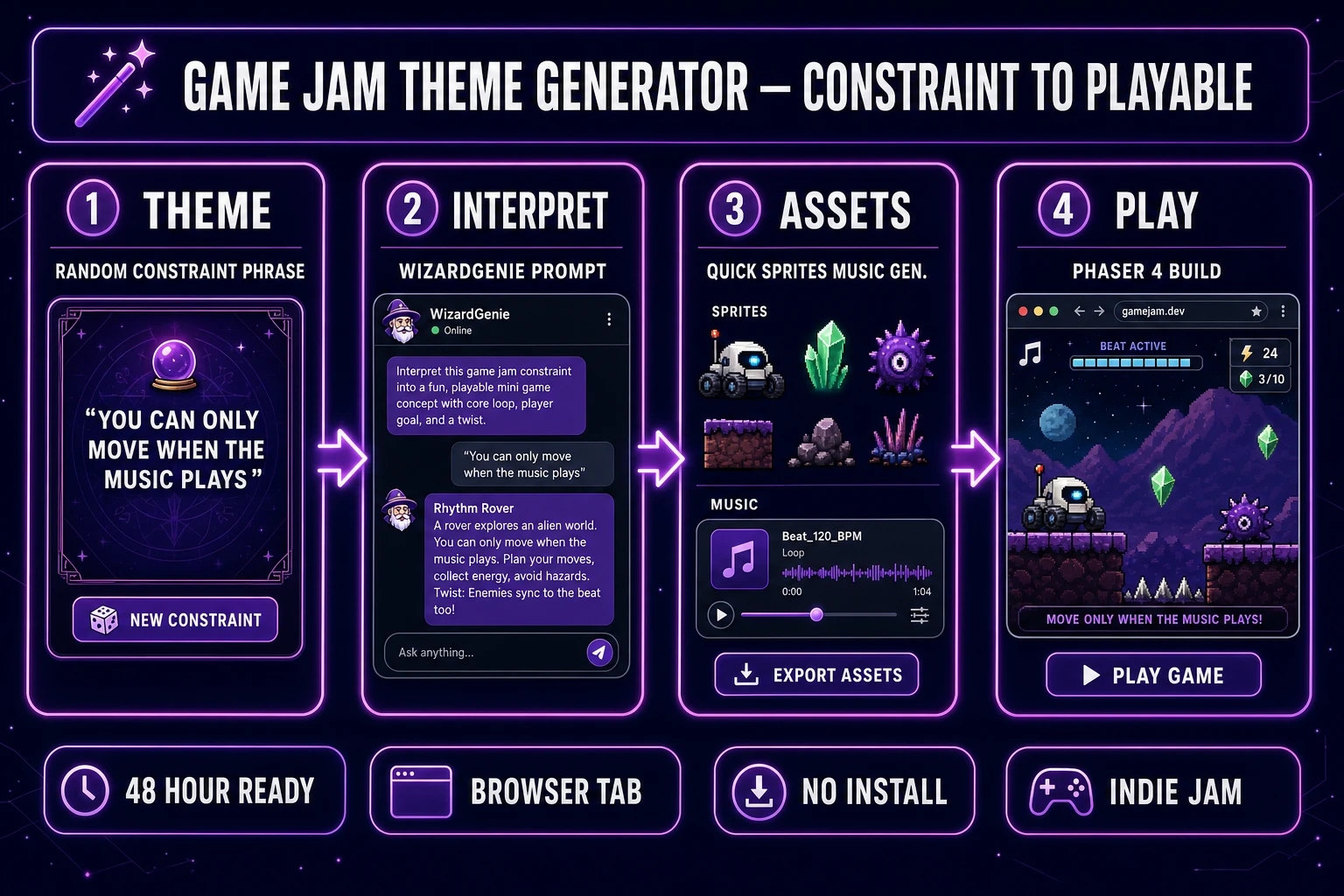
Game jam theme generator pipeline in 2026 — theme constraint through WizardGenie interpretation to Quick Sprites assets and a playable Phaser 4 build, verified July 5, 2026
A game jam theme generator is step one; the Sorceress stack turns the constraint into a playable Phaser 4.2 build before the 48-hour clock becomes the enemy.

What a game jam theme generator actually produces

The phrase game jam theme generator (320/mo, KD 0 per DataForSEO probe verified July 5, 2026) describes a tool — or a ritual — that outputs a single creative constraint every entry must obey. Official events like Global Game Jam reveal one global theme each year; Global Game Jam 2026 ran January 26 through February 1 with Prep Week January 19–23 and a theme reveal stream January 24–25 (verified against globalgamejam.org on July 5, 2026). Community jams such as Ludum Dare follow the same shape: one theme, fixed window, public submissions.

Random theme generators online simulate that reveal for solo practice. They output phrases like “Delayed consequence,” “Only one room,” or “The tool is the enemy” — deliberately vague so ten teams interpret them ten different ways. That ambiguity is the feature. A good game jam theme generator does not hand you a design document; it hands you a lens. Your job is to pick one interpretation fast, commit, and ship before doubt reopens the scope.

The sibling query video game idea generator (260/mo, KD 4) is broader — open-ended concepts without a deadline attached. Theme generators are tighter and time-boxed. Treat them as the first line of a WizardGenie prompt, not as a finished pitch.

Why theme-first brainstorming beats idea-first for jam weekends

Idea-first brainstorming feels productive because it produces paragraphs. Jam weekends punish paragraphs. You need a constraint narrow enough to kill feature creep on hour three and loose enough that three different genres still fit. Themes do that better than premade concepts because they force interpretation — the creative act happens in your head before a single file exists.

Three interpretation moves that consistently survive 48-hour scope:

  • Mechanic lens — the theme becomes one rule the player feels every second (“One button only” → single-input rhythm dodge).
  • Narrative lens — the theme becomes a role reversal or reveal (“You are the villain” → tower defense from the monster’s side).
  • Presentation lens — the theme becomes a visual or audio constraint (“Echo” → every action repeats after a delay).

Write the chosen lens in one sentence. That sentence is the seed for WizardGenie’s first prompt — not a pitch deck, not a Trello board. Jams reward the team that converts constraint to playable fastest, not the team with the prettiest design doc.

The Sorceress game jam theme generator pipeline in four layers

Every jam submission ships four layers regardless of engine: code, art, audio, and a shareable build. In 2026 each layer maps to one Sorceress tool verified against the live catalog on July 5, 2026:

  • Theme → codeWizardGenie with eight CODING_MODELS (Claude Opus 4.7, Sonnet 4.6, GPT-5.5, Gemini 3.1 Pro, DeepSeek V4 Pro, Kimi K2.5, Grok 4.2, MiniMax M2.7 per src/app/_home-v2/_data/tools.ts lines 734–742).
  • Art sprintQuick Sprites at 9 credits per generation (src/app/quick-sprites/page.tsx CREDITS_PER_GEN) plus AI Image Gen for concept frames and UI tiles.
  • Audio sprintMusic Gen at 10 credits per track and SFX Gen at 1 credit per second.
  • Scope checkTools guide and pricing page for credit math before the jam clock starts.

Cross-link the naming step in game name generator once you know the genre — title and theme should reinforce each other on the submission page. Cross-link the web-ship path in how to make a web game when you host the final build.
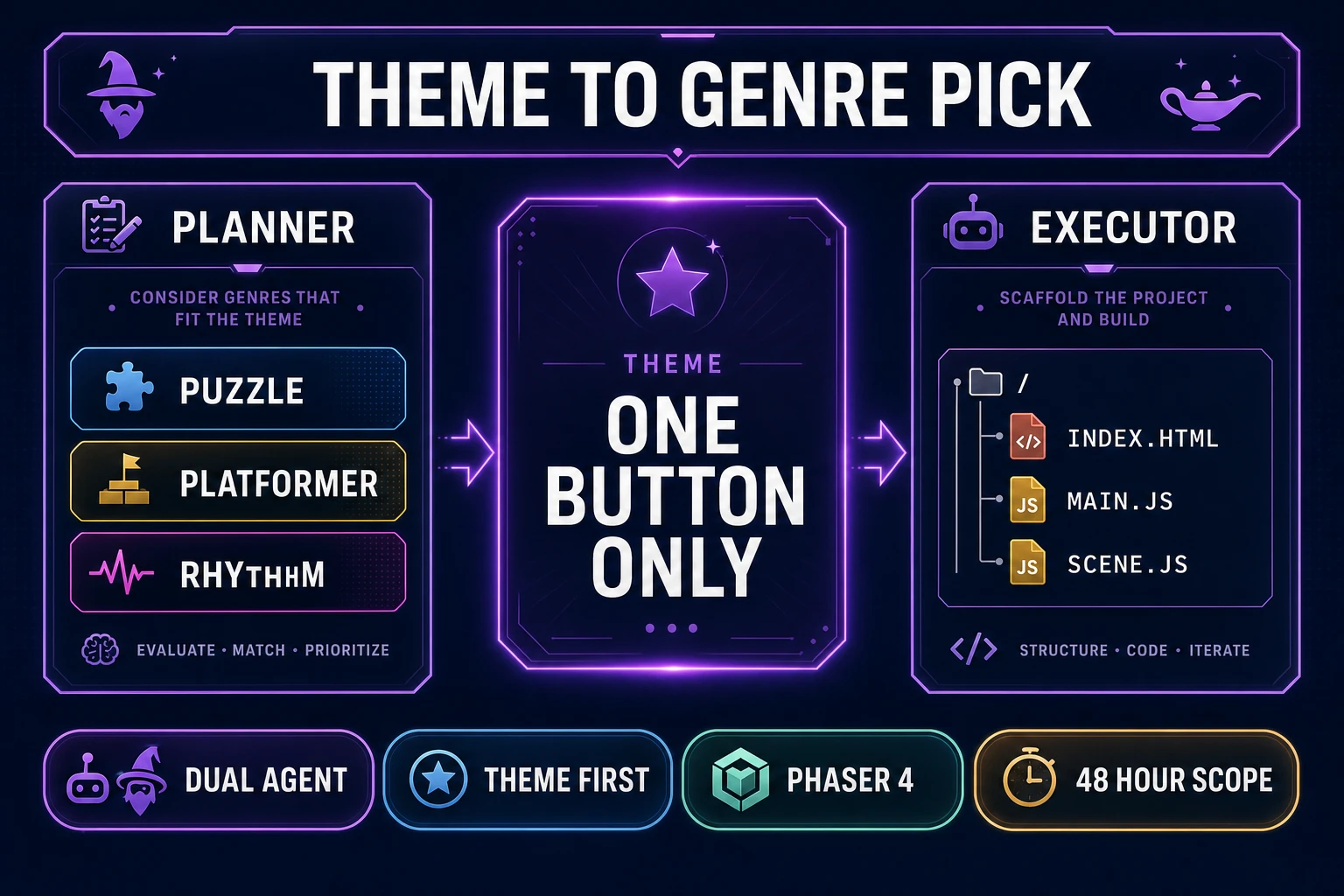
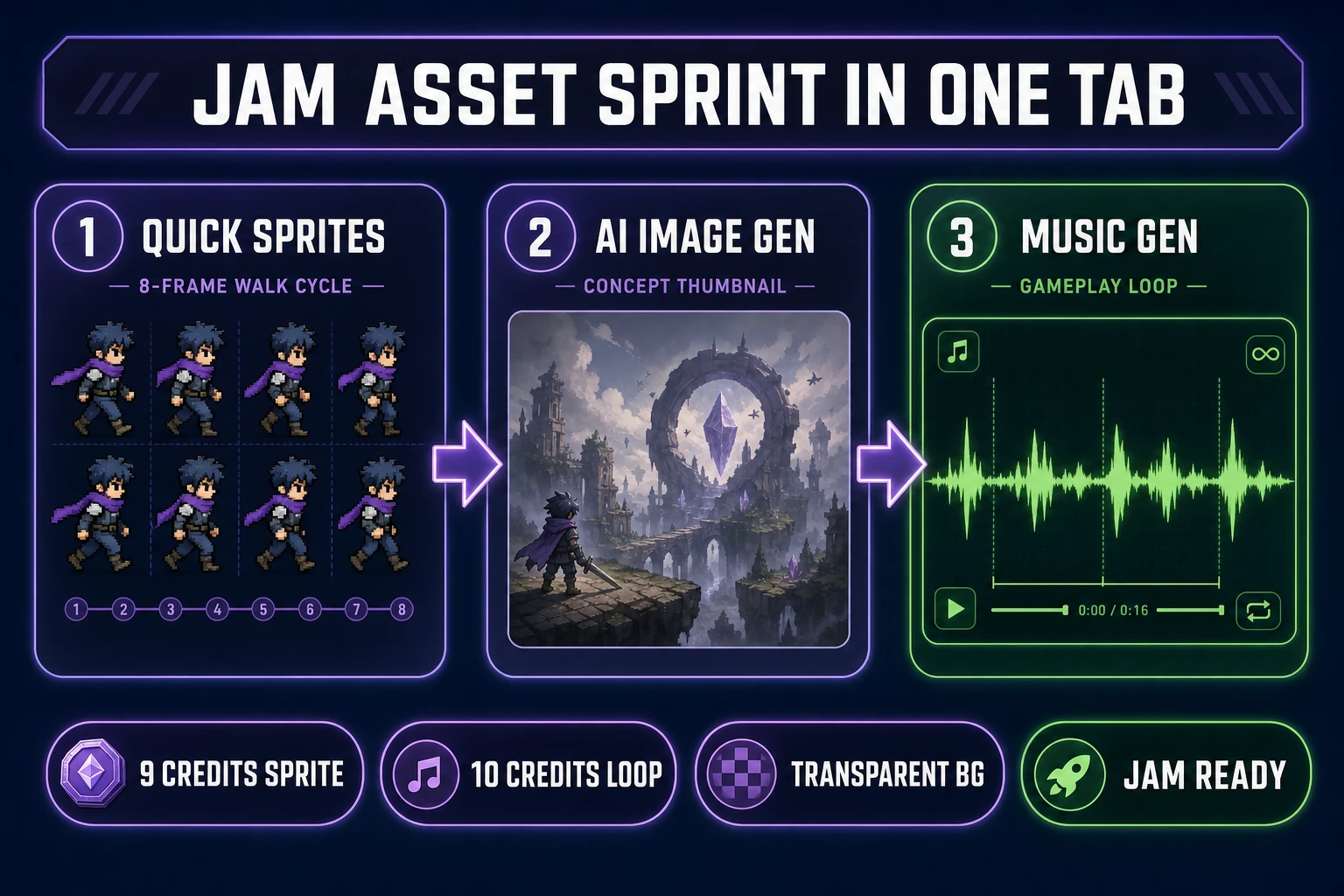
WizardGenie dual-agent Planner and Executor interpreting a game jam theme into genre pick and Phaser 4 file scaffold, verified July 5, 2026
Theme interpretation is a Planner job: Opus 4.7 or Gemini 3.1 Pro picks the genre and scene graph; DeepSeek V4 Pro or Kimi K2.5 types the bulk Phaser 4.2 files — roughly one-fifth the cost of a single frontier model on both sides.

Step 1 — spin a theme and write the one-sentence interpretation

Use any random game jam theme generator you trust — many community sites expose a single-button reveal. Copy the phrase verbatim into a notes field. Immediately answer: Which lens am I using, and what is the smallest playable proof? Example: theme “Delayed consequence” + mechanic lens → “Every player action fires twice — once now, once three seconds later.” That sentence is 22 words and already implies Phaser timers, duplicate sprites, and a single-room scope.

Reject interpretations that need more than one new system. If the theme pushes you toward multiplayer, procedural worlds, or a full RPG inventory, pick a narrower lens. The game jam theme generator gave you raw material; narrowing is your competitive advantage. Ludum Dare compo rules historically cap scope to assets you create during the jam — the same discipline applies to solo practice runs even when nobody audits your folder.

Step 2 — prompt WizardGenie with the theme baked into the scaffold

Open WizardGenie and paste a prompt that names the engine, the theme, and the proof-of-fun:

Build a Phaser 4.2 browser game for the jam theme "Delayed consequence."
Mechanic: every player action repeats after 3 seconds as a ghost copy.
Scope: one room, one enemy type, win on survive 60 seconds.
Output: index.html, main.js, assets/ folder references.

Pick Claude Opus 4.7 or Gemini 3.1 Pro for this scaffolding pass — scene graph architecture and timer wiring benefit from the heavy reasoner. The second round tightens feel: collision boxes, juice screenshake, game-over restart. Switch to DeepSeek V4 Pro or Kimi K2.5 for those iteration passes. WizardGenie’s dual-agent Planner + Executor pattern (described on the marketing page at src/app/wizard-genie/page.tsx lines 296–298) keeps frontier models on thinking and budget models on typing — the cost ratio that makes agentic jamming affordable across a full weekend.

Download the project tree when the core loop compiles. Do not polish code before art exists; gray boxes playtest mechanics fine. The Phaser 4.2.0 “Giedi” release shipped June 19, 2026 — verified against the official release feed on July 5, 2026 — and is the honest default for browser jam builds on Sorceress.

Step 3 — asset sprint with Quick Sprites and AI Image Gen

Hour six of a jam is when art debt kills momentum. Quick Sprites closes the gap: prompt a walk cycle and idle for the player ghost, export transparent PNG sprite sheets, drop filenames into the WizardGenie assets/ folder. Budget two to four generations at 9 credits each — enough for hero, enemy, and one pickup. Use AI Image Gen for a single background plate or title card if the theme has a presentation lens; one strong still beats five inconsistent tiles.

Keep palette consistent by reusing the same prompt tail across generations (“32-color limited palette, dark navy background, neon accent”). Run everything through BG Remover only if a concept frame arrives with a muddy backdrop — do not spend jam minutes fixing assets that should have been transparent from the generator. The asset sprint should finish in under ninety minutes so the remaining hours go to juice and submission packaging.

Game jam asset sprint — Quick Sprites walk cycle, AI Image Gen concept frame, and Music Gen loop in one Sorceress browser tab, verified July 5, 2026
The jam asset sprint fits in one tab: Quick Sprites for character frames (9 credits per gen), AI Image Gen for one hero background, Music Gen for a loop (10 credits per track).

Step 4 — score the build and ship before the game jam theme generator clock wins

Silent prototypes fail playtests even when mechanics work. Music Gen ships one loop at 10 credits — pick tempo to match the theme mood. SFX Gen batches the three sounds players hear most: jump, hit, UI confirm. Route layers through Sound Studio if levels need balancing. Prompt WizardGenie to wire Phaser sound objects with the exported filenames.

Test locally with any static server, fix input scale on mobile, then zip index.html plus assets/ for hosting. Write a two-sentence description that quotes the theme and states your interpretation lens — submission pages reward clarity. If the jam allows browser builds, the Sorceress web game hosting guide covers static deploy without a backend. Screenshot the title screen with the theme visible; judges skim hundreds of entries.

What a game jam theme generator weekend costs on Sorceress in 2026

Cost math verified July 5, 2026. Base unlock: $49 lifetime (src/app/plans/page.tsx LIFETIME_PRICE). Credit tiers: Starter $10/1,000, Creator $20/2,000, Plus $50/5,000, Studio $100/10,000. New accounts ship with 100 starter credits. WizardGenie coding runs on your own API key — the expensive variable is your model choice, not Sorceress credits.

Typical 48-hour jam burn: 150–400 Sorceress credits covering Quick Sprites (18–36 credits for two to four runs), Music Gen (10–20 credits for one to two loops), SFX Gen (5–15 credits), and optional AI Image Gen concept frames. That lands around $2–$4 of pay-as-you-go credits on top of the lifetime unlock — less than a single asset pack on many marketplaces. Start the jam on starter credits; top up only if the playtest exposes missing art layers.

The verdict on using a game jam theme generator with browser AI

A game jam theme generator is not a substitute for taste — it is a countdown trigger. The teams that place interpret fast, scaffold in WizardGenie before perfectionism sets in, and spend art minutes where players look (character, feedback, audio) instead of where judges never scroll (internal tooling). The Sorceress stack exists because the old jam pipeline — engine install, asset store spelunking, DAW detour, deploy confusion — eats the first twelve hours before the theme even becomes code.

Spin a theme tonight. Write one sentence. Prompt WizardGenie for a Phaser 4.2 loop. Fill Quick Sprites and Music Gen in a single tab. Host the zip. Repeat until the 48-hour constraint feels like a feature instead of a threat. The next Global Game Jam or Ludum Dare is months away; solo practice runs with a game jam theme generator are how you arrive ready instead of scrambling.

Frequently Asked Questions

What is a game jam theme generator used for?

A game jam theme generator produces a single creative constraint — a phrase like "You are the villain" or "One button only" — that every entry in a jam must obey. Official jams such as Global Game Jam reveal one global theme; local organizers and solo practice runs use random generators to simulate that moment. The Sorceress workflow treats the theme as the first prompt in WizardGenie rather than a dead-end word salad: interpret the constraint, pick a genre that fits, and scaffold a playable Phaser 4.2 prototype before the 48-hour clock matters.

How is a game jam theme generator different from a video game idea generator?

A video game idea generator (260/mo, KD 4 per DataForSEO probe verified July 5, 2026) outputs open-ended concepts — "underwater stealth RPG" or "time-loop cooking sim." A game jam theme generator outputs tighter constraints designed to force creative interpretation under time pressure. The skill overlap is brainstorming; the difference is scope. Use an idea generator when you have a blank week and no deadline. Use a theme generator when you have 48 hours and one phrase that must appear in your design doc.

Can WizardGenie build a full jam game from a theme in one session?

WizardGenie scaffolds a playable browser prototype — Phaser 4.2 scene graph, input handling, basic win/lose logic — from a theme-aware prompt in one or two agent rounds. It does not replace the jammer's design taste: you still choose which interpretation of the theme to pursue, which mechanics prove the constraint, and when to cut scope. The honest win is reaching a shareable build in hours instead of days. Pair WizardGenie with Quick Sprites for art and Music Gen for loops so the prototype feels finished in playtest, not just in compile.

Which WizardGenie model should run first on a jam theme?

Use Claude Opus 4.7 or Gemini 3.1 Pro for the first pass — theme interpretation, genre pick, and scene architecture benefit from the heavy reasoner. Switch to DeepSeek V4 Pro or Kimi K2.5 for iteration rounds that touch many files — acceptable executors per Sorceress guidance, never a frontier-priced model on the typing side. All eight CODING_MODELS (Opus 4.7, Sonnet 4.6, GPT-5.5, Gemini 3.1 Pro, DeepSeek V4 Pro, Kimi K2.5, Grok 4.2, MiniMax M2.7) were verified against src/app/_home-v2/_data/tools.ts lines 734–742 on July 5, 2026.

What does a minimal jam prototype cost on Sorceress credits in 2026?

Verified July 5, 2026 against src/app/plans/page.tsx (LIFETIME_PRICE = 49, CREDIT_TIERS). Base unlock: $49 one-time lifetime. WizardGenie coding runs on your own API key. A typical 48-hour jam burn is 150–400 Sorceress credits: two to four Quick Sprites runs at 9 credits each (CREDITS_PER_GEN per src/app/quick-sprites/page.tsx), one to two Music Gen loops at 10 credits each, a handful of SFX Gen one-shots at 1 credit per second, and optional AI Image Gen concept frames. That lands around $2–$4 of pay-as-you-go credits on top of the lifetime unlock — far below renting separate art, audio, and coding tools for a single weekend.

Sources

  1. Game jam (Wikipedia)
  2. Global Game Jam — What is a game jam?
  3. Phaser — Official documentation
  4. Ludum Dare — Official site
Written by Arron R.·1,712 words·8 min read

Related posts