Sol How to Make Sudoku (Browser Grid Logic 2026)

By Arron R.10 min read
How to make sudoku in 2026: generate a valid 9×9 grid with one solution, wire cell selection, pencil marks, and conflict highlights in WizardGenie, then add AI

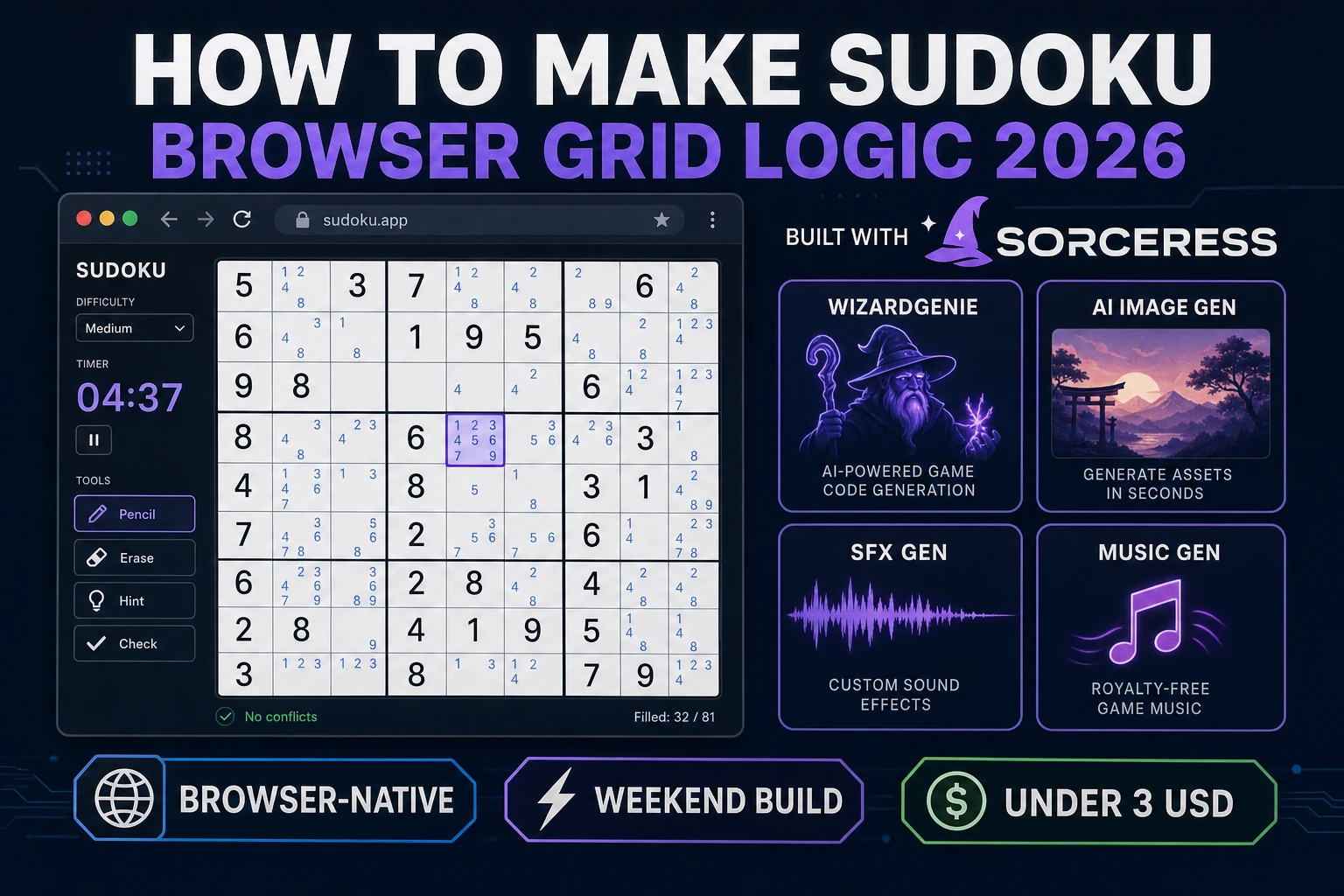
How to make sudoku is one of the quietest high-retention browser puzzles in 2026: an 81-cell grid, nine digits, three houses per cell, and a generator that must leave exactly one valid completion. The modern number puzzle spread globally after Wayne Gould pitched it to The Times in 2004, but the underlying Latin-square logic is older than the brand name. Most javascript sudoku tutorials stop at a hardcoded puzzle array and a red border on duplicate rows. The 2026 pipeline is different. A coding agent scaffolds the generator, pencil-mark layer, and conflict scanner from one prompt, and AI generation covers the grid chrome and focus audio. In a browser, that means WizardGenie for the logic loop, Sorceress AI Image Gen for the board frame and digit tiles, SFX Gen for place and error stings, and Music Gen for a calm puzzle bed. This guide is the honest end-to-end for how to make sudoku in 2026, in a browser, in a weekend.
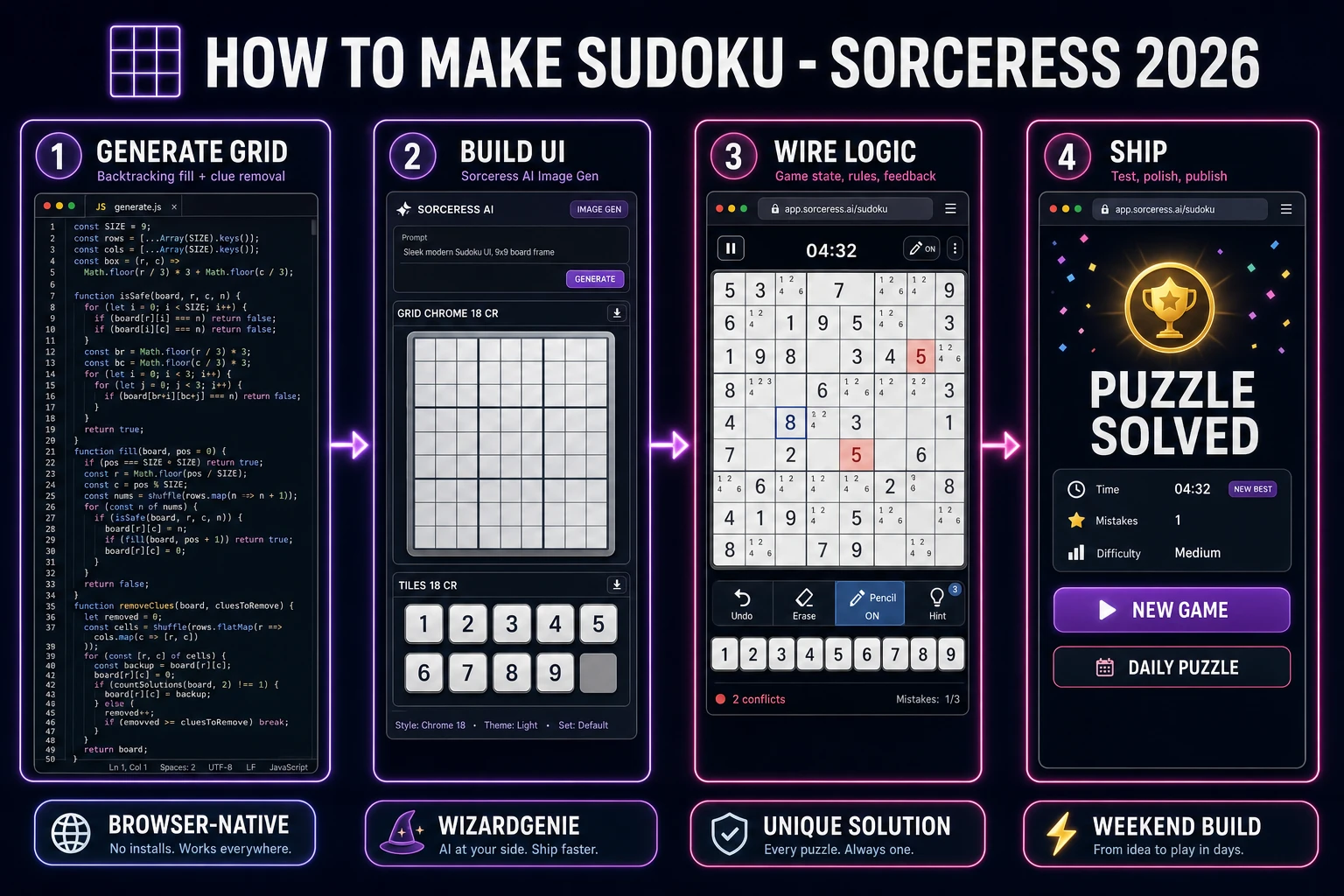
How to make sudoku browser pipeline: generate a valid 9x9 grid, wire cell selection and pencil marks in WizardGenie, and ship a browser build
The 2026 how to make sudoku browser recipe: generate a unique-solution grid, build the 9×9 UI with pencil marks, wire conflict highlights in WizardGenie, then add place/error stingers and a focus music bed.

What how to make sudoku actually means in 2026

The query “how to make sudoku” hides three intents. Some searchers want a printable PDF generator — export a puzzle, print it, solve on paper. That is a layout problem, not a game loop. A second intent is a sudoku solver javascript tool: paste a grid, watch backtracking fill the rest. Useful, but it is not playable. The third intent, and the one this guide targets, is a single-player browser sudoku game: a puzzle generator with a unique-solution guarantee, an interactive 9×9 grid, pencil marks, conflict highlighting, a timer, difficulty tiers, and optional daily seeds. That is a weekend build, it demos the whole Sorceress toolset, and it is the format most sudoku game tutorial searchers actually want — including teachers who later swap in a 4×4 junior mode for sudoku for kids.

The presentation contract is small and strict. A title screen shows the game name, a New Game button, a Difficulty picker (Easy, Medium, Hard), and optionally a Daily Puzzle toggle keyed to the UTC date. The play screen shows the 9×9 grid with 3×3 box dividers, bold givens that cannot be edited, a digit pad (1–9 plus Erase), a Pencil toggle, an Auto Notes button, remaining-error count or unlimited mistakes mode, and a running timer. On completion, freeze input, play a short flourish, show elapsed time and best time for that difficulty, and offer New Game or Daily. The Sudoku Wikipedia overview is still the cleanest rules summary: fill every row, column, and 3×3 box with digits 1–9 with no repeats.

The sudoku loop in one minute (select, enter, validate, check)

Five moving parts and nothing else, repeated per interaction. First, select — highlight the active cell with arrow keys or a tap, using KeyboardEvent for digits 1–9, Backspace, and arrow navigation. Second, enter — if pencil mode is on, toggle that digit in the active cell’s candidate set; if pencil mode is off, commit the digit to values[r][c] and clear pencil marks in the same row, column, and box. Third, validate — scan the three houses of the active cell for duplicate committed values and mark conflicts; optionally increment a mistake counter when the committed digit breaks a house rule. Fourth, check — win when all eighty-one cells are non-zero and every house is valid. Fifth, result — stop the timer, persist best times to localStorage, and show the completion card. That is the entire sudoku loop. Everything else — row-complete chimes, hint buttons that reveal one cell, symmetry-preserving clue removal, 4×4 junior grids — is polish layered after one honest round works.
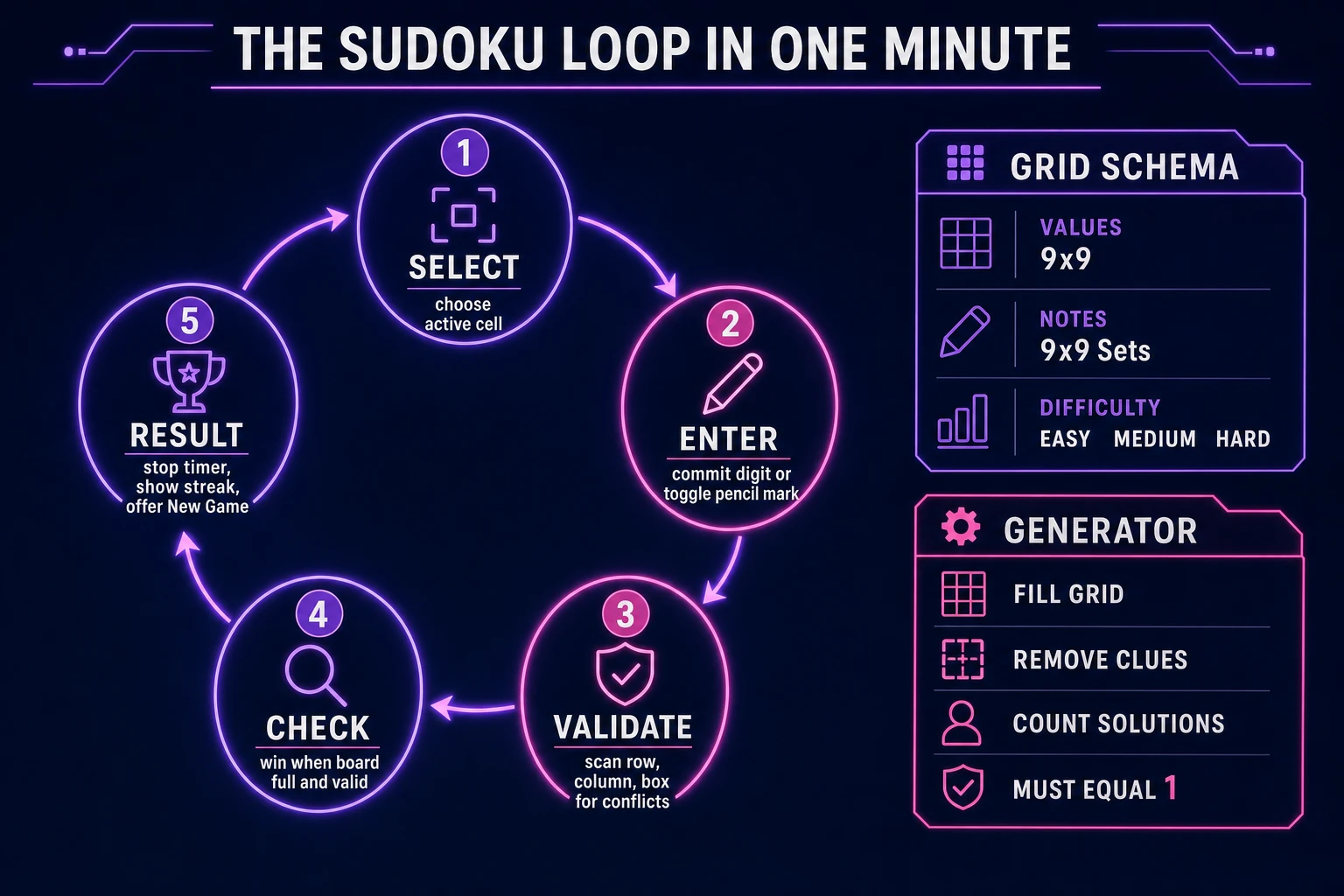
Sudoku game loop state machine diagram showing select, enter, validate, check, and result nodes with grid schema and generator panel
The sudoku loop: select a cell, enter a digit or pencil mark, validate houses for conflicts, then check for a completed valid board before the results card.

Pick your engine for how to make sudoku: vanilla DOM, canvas, or WizardGenie

Three good browser targets in 2026, each with a different trade-off. Vanilla JavaScript with a CSS grid is the honest default and the pick this guide recommends for a first build. Sudoku is eighty-one <button> or <div> cells in a 9×9 CSS grid, thick borders every third row and column for the 3×3 boxes, and a digit pad below. Total code footprint for a working sudoku puzzle maker is under 600 lines including the generator. No engine to install, ships as a single static HTML file, deploys anywhere. This is the stack most html5 sudoku and browser sudoku tutorials should have started with.

Canvas becomes the right pick if you want animated digit flips, particle bursts on row completion, or a handwritten-paper aesthetic drawn line-by-line. You still keep the digit pad in the DOM for accessibility; canvas only owns the board rendering. The cost is coordinate math for hit-testing and a resize handler.

Phaser 4.2.1 “Giedi” (verified 2026-08-19 on the official Phaser download page) becomes the right pick if you want tweens when digits snap into cells, shader-based highlight pulses on conflicts, or integrated audio timelines. Phaser’s Scene lifecycle maps onto title-play-results if you later add themed skins (space sudoku, wood-grain sudoku). For a first grid-logic game, Phaser is optional weight — use it when motion is the product, not when the product is a fair generator and a correct pencil-mark layer.

WizardGenie is not a separate rendering engine — it scaffolds whichever of the three you pick from a single natural-language prompt. WizardGenie ships as both a desktop app (Windows installer with auto-update, available to Early Access supporters and above) and a no-install web build. Its coding-model lineup covers Claude Opus 4.7, GPT-5.5, Gemini 3.1 Pro, DeepSeek V4 Pro, Kimi K2.5, Grok 4.2, and MiniMax M2.7 (verified 2026-08-19 in src/app/_home-v2/_data/tools.ts). For sudoku, any frontier model scaffolds the generator and UI in one prompt. Pair a frontier planner with a budget executor like DeepSeek V4 Pro or Kimi K2.5 for the typing pass — the Dual-agent pattern lands most projects at roughly one-fifth the single-frontier cost.

Step 1 — build a puzzle generator with unique-solution guarantee

Nothing else in the pipeline matters if the board has zero solutions or two. The standard sudoku generator javascript approach has three phases. Phase one: fill a complete valid 9×9 grid with backtracking — pick an empty cell, try digits 1–9 in shuffled order, recurse, backtrack on conflict. Phase two: remove clues from that complete grid while preserving uniqueness. Pick a random cell, zero it out, run a solver that counts solutions up to two. If the count is exactly one, keep the removal. If zero, undo. If two or more, undo. Stop when you reach the target clue count for the difficulty tier. Phase three: export the puzzle as an 81-character string or a JSON grid with a given flag per cell.

function countSolutions(grid, limit = 2) {
  let solutions = 0;
  function solve() {
    if (solutions >= limit) return;
    const cell = findEmpty(grid);
    if (!cell) { solutions++; return; }
    const [r, c] = cell;
    for (let d = 1; d <= 9; d++) {
      if (!isValidPlacement(grid, r, c, d)) continue;
      grid[r][c] = d;
      solve();
      grid[r][c] = 0;
    }
  }
  solve();
  return solutions;
}

Target clue counts that feel fair in playtesting: Easy 36–40 givens, Medium 28–35, Hard 22–27. For a Daily Puzzle mode, seed Math.random or a mulberry32 PRNG with the UTC date string so every player gets the same board that day. Unit-test the generator on one hundred seeds and assert countSolutions(puzzle) === 1 every time. That single assert is the difference between a sudoku puzzle maker people trust and one they abandon after the first impossible board.
Step 2 — wire cell selection, pencil marks, and conflict highlight in WizardGenie

With the generator solid, open WizardGenie. Drop in a bare index.html with a 9×9 grid container and a digit pad. Give the agent one paragraph: Build a browser sudoku game. Generate puzzles with unique-solution guarantee using backtracking fill and clue removal. Render an 81-cell grid with 3×3 box borders. Givens are bold and locked. Support pencil marks as corner notes in each cell. Highlight row, column, and box conflicts in red on committed duplicates. Accept input from a 1–9 digit pad and from keyboard digits and arrows. Include Easy/Medium/Hard clue targets, a timer, mistake counter, and localStorage best times. Daily mode seeds the generator with today’s UTC date. Feed that to any coding model and the scaffold lands in under five minutes.

The remaining afternoon is polish via follow-ups. Add Auto Notes to fill pencil marks for every empty cell. Add Highlight same digit when a committed cell is selected. Add Undo last commit for mistake-forgiving modes. Keep the commit handler pure:

function commitDigit(state, r, c, digit) {
  if (state.given[r][c] || state.values[r][c] === digit) return state;
  const next = cloneState(state);
  next.values[r][c] = digit;
  next.notes[r][c].clear();
  stripNotesInHouse(next.notes, r, c, digit);
  next.mistakes += breaksHouse(next.values, r, c) ? 1 : 0;
  next.won = isBoardFull(next.values) && !hasAnyConflict(next.values);
  return next;
}

Each follow-up is a prompt. Keep pencil marks as nine-bit Sets so serialization to localStorage stays compact. Test with a near-complete board, a board with a deliberate row duplicate, and a fresh puzzle — those three cases catch ninety percent of sudoku solver javascript UI bugs before players do.

Step 3 — AI Image Gen chrome, SFX Gen place and error, Music Gen focus bed

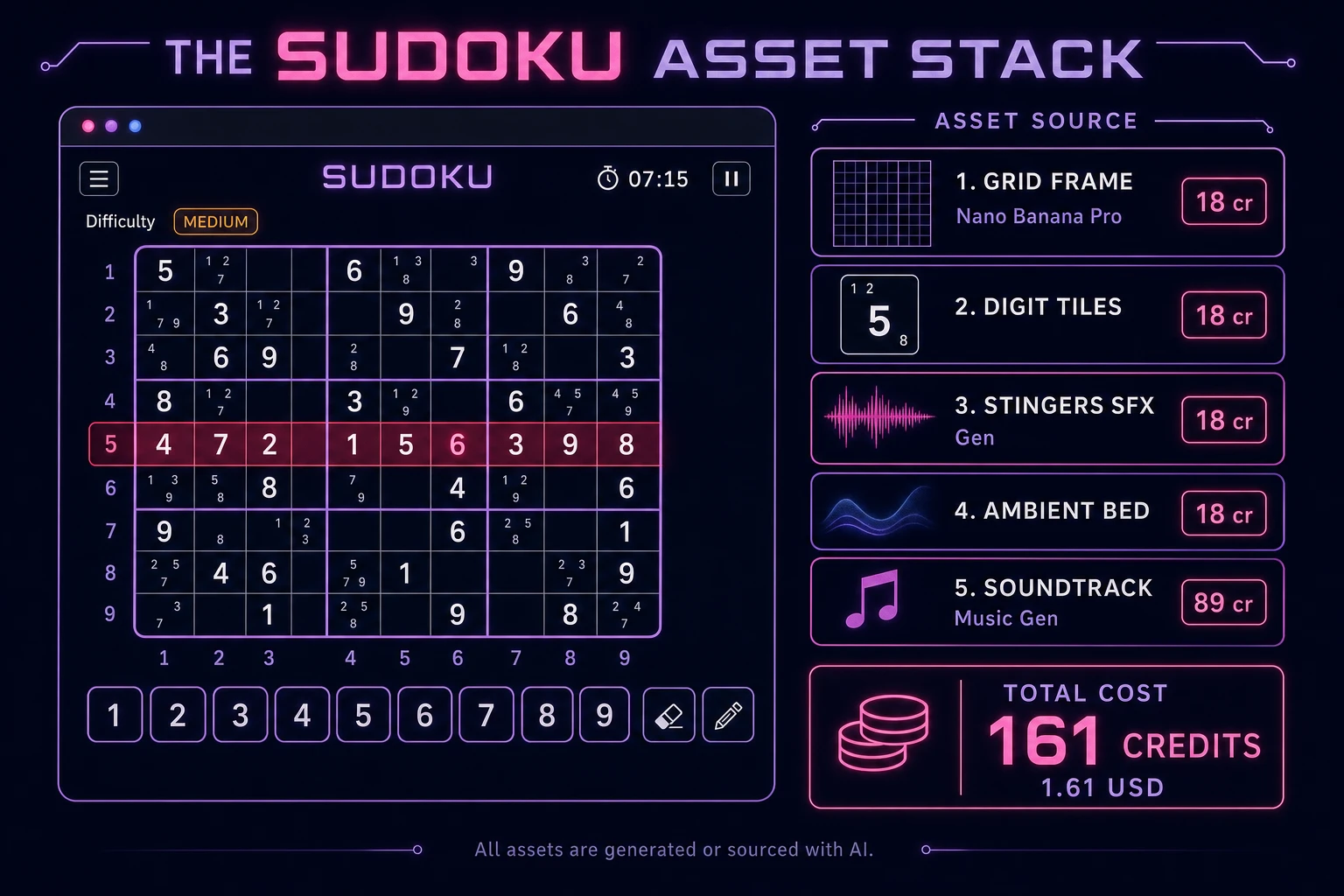
Open Sorceress AI Image Gen for the visual set. A sudoku game needs one grid frame (thick 3×3 dividers, subtle paper or dark-glass texture), digit-tile plates for the 1–9 pad in selected and unselected states, and optionally a title background. Nano Banana Pro at 18 credits per generation (verified 2026-08-19 in src/lib/models.ts line 303) holds style consistency when you use the grid frame as a reference for the tile set. Three passes at 18 credits is 54 credits or 0.54 USD for the visual core. Prompt the grid like “9x9 sudoku board frame, thick box dividers, minimal flat vector, soft shadow, transparent center cells, no digits, no text.”

Open SFX Gen. SFX Gen bills 1 credit per second (verified 2026-08-19 in src/app/sfx-gen/page.tsx line 23 as SEED_AUDIO_CREDITS_PER_SECOND = 1). Four clips cover a first sudoku game: place (0.3 seconds, soft tap), error (0.4 seconds, muted buzz), row-or-box complete (0.8 seconds, gentle chime), and win (2 seconds, bright resolve). Total roughly 6 credits or 0.06 USD. Add one 25-second ambient bed — quiet room tone or soft piano pad — at 25 credits or 0.25 USD.

Open Music Gen. Music Gen bills 10 credits per generation (verified 2026-08-19 in src/app/music-gen/page.tsx line 28 as MUSIC_CREDIT_COST = 10). Two tracks cover a first sudoku game: a title-menu loop (calm, curious, 60 seconds) and a focus bed (steady, non-distracting, 90 seconds) under active solving. Two tries per track budgets 40 credits or 0.40 USD. MP3 is fine for browser delivery; add 2 credits per WAV render if you need lossless (WAV_CREDIT_COST = 2, same file line 31).

Sudoku game asset stack showing a 9x9 browser grid next to asset tiles for grid chrome, digit tiles, stingers, ambient bed, and music tracks
The sudoku asset stack: grid frame and digit tiles from AI Image Gen, four short stingers plus an ambient bed from SFX Gen, and two focus tracks from Music Gen — the whole set costs under two dollars in Sorceress credits.

What a how to make sudoku project costs on Sorceress in 2026

Concrete asset and generation budget for a browser sudoku game — unique-solution generator, pencil marks, conflict highlight, timer, daily seed — from empty repo to zip-and-ship playable, all numbers verified 2026-08-19 against local Sorceress source:

  • Grid frame and title background (AI Image Gen): 3 passes at Nano Banana Pro 18 credits each = 54 credits (0.54 USD).
  • Digit-tile chrome (AI Image Gen): 2 variations at 18 credits each = 36 credits (0.36 USD). Selected and unselected pad states.
  • Stingers (SFX Gen): 4 clips at 1 credit per second, roughly 6 seconds total = 6 credits (0.06 USD). Place, error, house-complete, win.
  • Ambient bed (SFX Gen): 1 clip at 25 seconds = 25 credits (0.25 USD).
  • Background music (Music Gen): 2 tracks at 10 credits per generation, 2 tries each = 40 credits (0.40 USD).
  • WizardGenie coding time: effectively free on the Sorceress side. Model-side API cost for a 3-to-5-hour prompt session on a cheap Executor like DeepSeek V4 Pro is typically under 0.50 USD.
  • Total for one complete browser sudoku game: roughly 161 credits, or roughly 1.61 USD in Sorceress credits, plus under 0.50 USD in model API time. Under 2.50 USD end-to-end for a generator-backed sudoku with pencil marks and full audio.

Sorceress bills 100 credits per dollar at the standard rate (CREDITS_PER_DOLLAR = 100 in src/lib/models.ts line 69). New accounts start with 100 free credits (SIGNUP_GRANT = 100 in src/app/api/admin/credits/route.ts line 12), which covers the stingers, ambient loop, one music track, and part of the grid art outright — enough to prototype before you top up. The Sorceress Lifetime tier at 49 USD one-time (LIFETIME_PRICE = 49 in src/app/plans/page.tsx line 51) covers unlimited SFX Gen and Music Gen use forever, which matters if you ship difficulty variants or a daily-puzzle streak mode that needs fresh ambient loops each season.

For related browser puzzle pipelines that share this generator-first-scaffold-the-grid spine, the closest reads are Sweep How to Make Minesweeper (Browser Flag Grid 2026) for the sibling logic-grid cousin, Hang How to Make Hangman (Browser Letter Grid 2026) for another letter-and-cell grid weekender, Guess How to Make Wordle (Browser Guess Grid 2026) for the daily-seed word grid, Sum How to Make a Math Game (Browser Quiz Loop 2026) for classroom-adjacent logic, and Edu How to Make an Educational Game (Browser Lesson 2026) if you wrap sudoku inside a lesson map. The Sorceress Tools Guide is the master index for every tool this guide referenced. Under three dollars, one weekend, and how to make sudoku is a done deal.

Frequently Asked Questions

How do I guarantee a sudoku puzzle has exactly one solution?

Generate a complete valid grid first, then remove digits while re-counting solutions after each removal. Start from a full 9×9 board that satisfies row, column, and 3×3 box rules — backtracking fill is the standard approach. Shuffle which cells you try to erase, and after each removal run a solver that counts solutions up to two. If the count drops to zero, undo that removal. If it stays at one, keep going until you hit your target clue count (easy 36–40 givens, medium 30–35, hard 22–28). Never ship a puzzle whose solver returns zero or two-plus solutions. Unit-test the generator on one hundred seeds and assert every output has exactly one solution before you wire the UI.

Should a browser sudoku use pencil marks or only final digits?

Ship pencil marks on day one. A 9×9 grid without candidates forces players to keep notes on paper, which breaks the browser experience on phones. Store pencil marks as a 9×9 array of nine-bit Sets (one bit per digit 1–9) separate from the solved values array. Toggle pencil mode with P or a toolbar button. In pencil mode, tapping a digit adds or removes that candidate in the active cell without committing. Auto-fill pencil marks for all empty cells when the player taps Auto Notes — that one feature separates a toy from a playable sudoku game tutorial. Clear pencil marks in a row, column, or box when the player commits a final digit that eliminates those candidates.

What is the fastest way to highlight sudoku conflicts in JavaScript?

Keep two parallel structures: values[9][9] for committed digits (0 for empty) and notes[9][9] for pencil-mark Sets. On every commit, scan the active row, column, and 3×3 box for duplicate committed values — mark conflicting cells with a CSS class. For pencil marks, highlight cells whose notes contain a digit already committed in the same house. Do not run a full solver on every keystroke; house scans are O(9) and feel instant. Debounce a full-board validate only when the player taps Check or when all eighty-one cells are filled. Return a boolean isComplete && isValid from a pure function so WizardGenie can unit-test it without the DOM.

Can I make sudoku for kids with a smaller grid?

Yes. Wikipedia documents 4×4 and 6×6 variants used in introductory puzzles. A 4×4 sudoku uses four digits, four rows, four columns, and four 2×2 boxes — the same generator logic scales down if you parameterize GRID_SIZE and BOX_SIZE. Ship a Difficulty menu with Classic 9×9, Junior 4×4, and optionally Mini 6×6. The UI chrome scales with CSS grid-template; the generator and solver take size constants. Kids versions often allow four givens on a 4×4 board. Label the mode clearly on the title screen so searchers looking for sudoku for kids land on the right entry point without reading the full rules section.

How much does it cost to build sudoku on Sorceress?

A first-project browser sudoku with generator, pencil marks, conflict highlight, timer, and audio budgets like this against the 2026 Sorceress rate card (verified 2026-08-19 against local source). Grid chrome and title background: three AI Image Gen passes at Nano Banana Pro 18 credits each = 54 credits or 0.54 USD (src/lib/models.ts line 303). Digit-tile unused and selected variants: two passes at 18 credits = 36 credits or 0.36 USD. Four SFX clips at 1 credit per second (src/app/sfx-gen/page.tsx line 23) — place, error, row-complete, win — roughly 6 credits or 0.06 USD. One 25-second ambient bed = 25 credits or 0.25 USD. Two Music Gen tracks at 10 credits per generation (src/app/music-gen/page.tsx line 28) with two tries each = 40 credits or 0.40 USD. Total roughly 161 credits or 1.61 USD plus under 0.50 USD in coding-model API time. The free 100-credit signup grant (src/app/api/admin/credits/route.ts line 12) covers the stingers, ambient loop, and one music track outright.

Sources

  1. Sudoku - Wikipedia
  2. MDN - KeyboardEvent (digit and arrow-key input)
  3. MDN - Web Storage API (timer and streak persistence)
  4. Phaser 4.2.1 API Documentation
Written by Arron R.·2,326 words·10 min read

Related posts