Hatch an Image to 3D Model Free Workflow (Browser-Native)

By Arron R.11 min read
Image to 3D model free in 2026 splits into four very different deals: open-source local (TRELLIS / Hunyuan3D-2 on your own GPU), freemium daily caps, trial cred

Searches for an image to 3D model free path in 2026 mostly return four very different deals stacked into one results page, and a quarter of the listings are the trap pattern — free input form, paid output gate. This guide is the honest field map. We name the four shapes of free, rank every browser path on credit cost and quality, and show where Sorceress 3D Studio fits with its 100 starter credits and six-model picker. Every pricing fact below was verified against the live source on May 31, 2026.
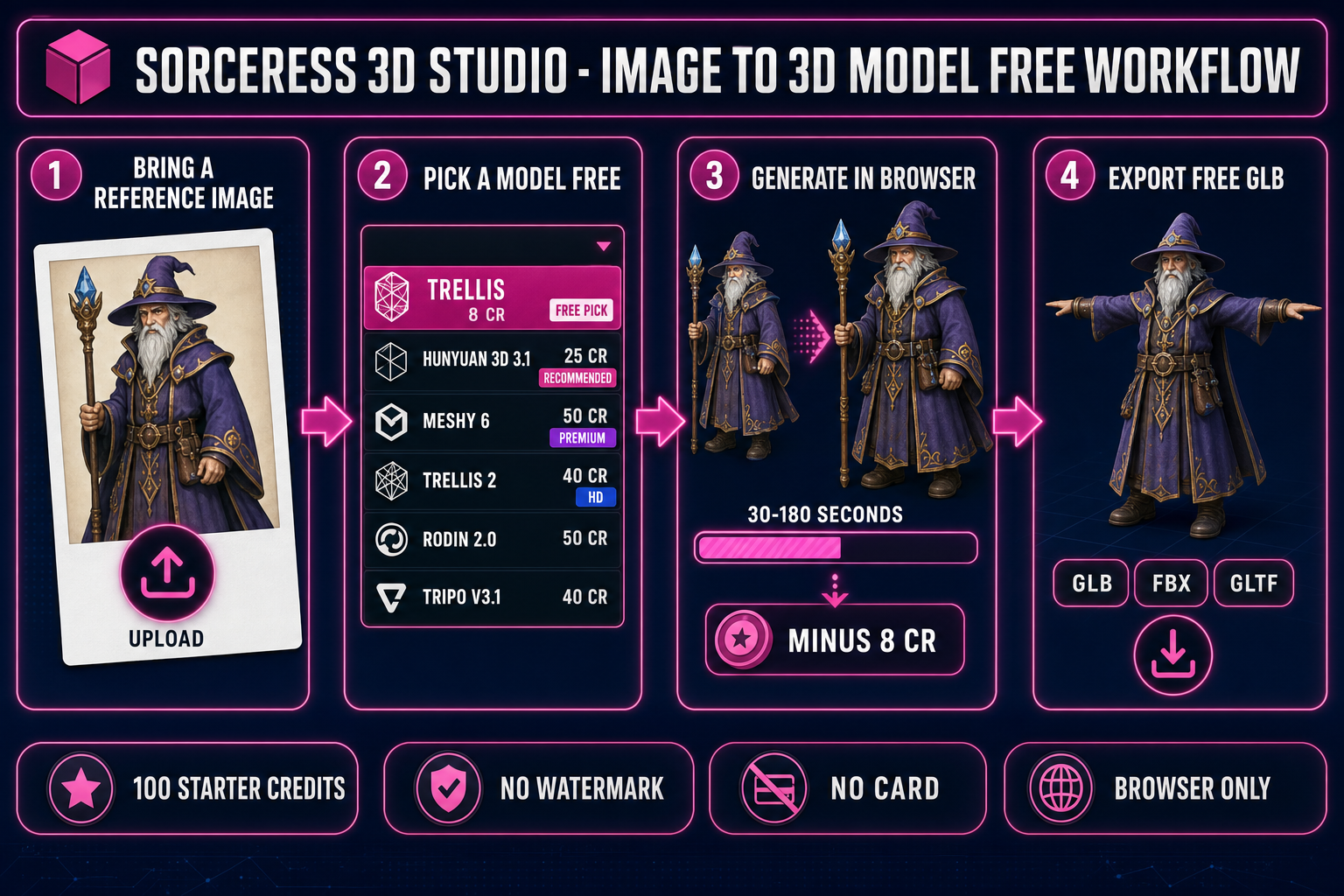
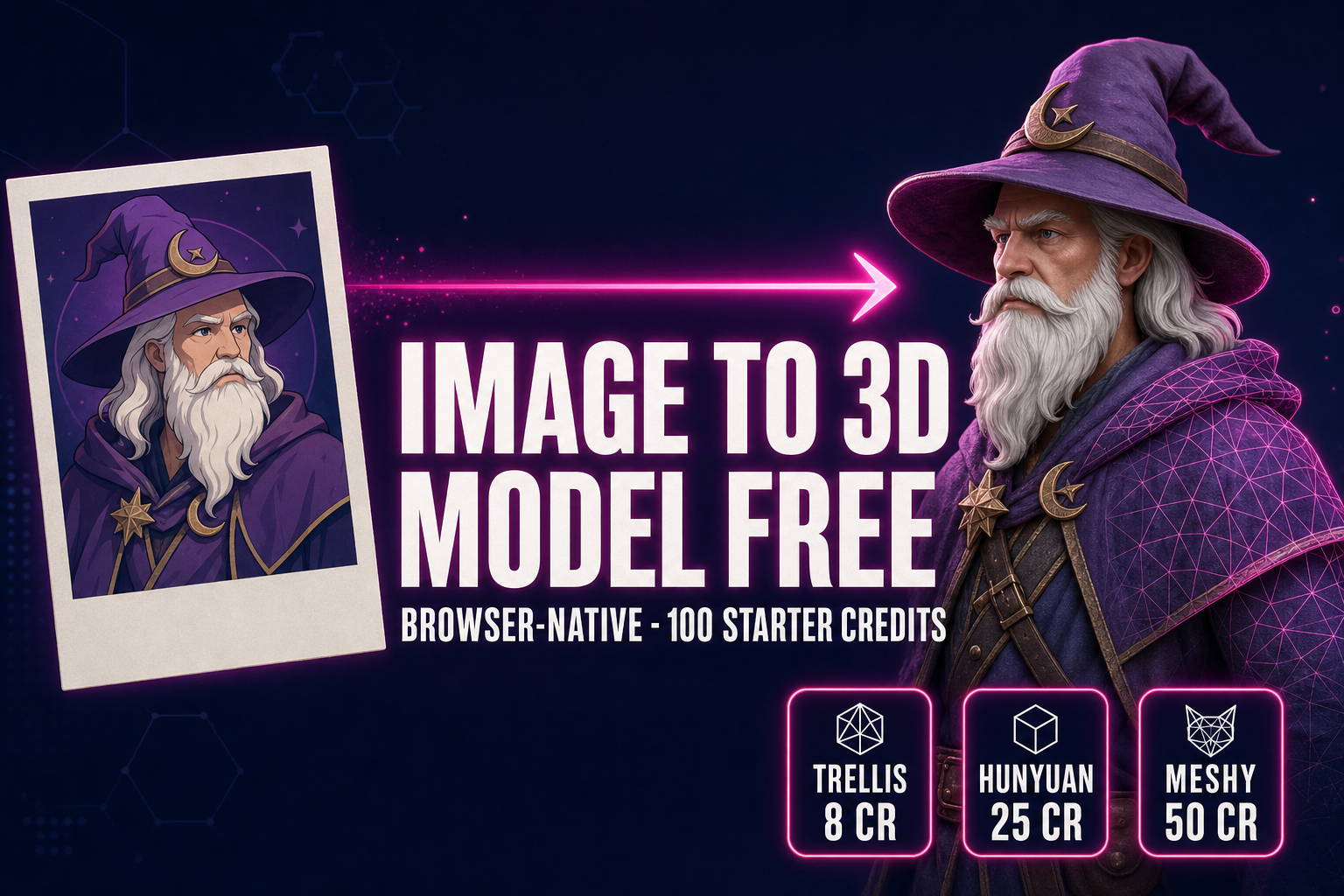
Image to 3D model free workflow - browser-native pipeline with 100 starter credits, six models, no card, no watermark
Sorceress 3D Studio bundles six image-to-3D backends behind one model picker, and the 100 starter credits at sign-up cover up to twelve generations on the cheapest model.

What “image to 3D model free” actually means in 2026

The phrase image to 3D model free hides four very different deals, and conflating them is how readers end up frustrated when the free tier evaporates ten minutes into a project. Naming the four shapes up front is the only honest way to compare:

  1. Open-source local. The model weights are public on GitHub or Hugging Face. You install the Python stack, download the weights, and run inference on your own GPU with zero ongoing cost and no daily cap. Forty-minute setup, 16–24GB VRAM, and you wear the dependency-management burden in exchange for unlimited free runs. Microsoft TRELLIS and TRELLIS.2 (both MIT License) and Tencent Hunyuan3D-2 (on github.com/Tencent-Hunyuan/Hunyuan3D-2) live in this category.
  2. Freemium with a daily cap. A hosted browser tool gives every account a fixed number of full-quality runs per day on the same output as paid runs. The cap resets every 24 hours and the trade-off is the daily ceiling never lifts. Tencent’s consumer-facing Hunyuan Global platform sits here, with the individual creator tier reported to allow up to 20 image-to-3D generations per day.
  3. Trial credits at sign-up. A one-time pool of full-quality credits is granted at account creation, no card on file, no watermark on the output. The trial converts you into a habitual user before any paywall appears, which is why this is the cleanest free deal on the market when the credit pool is large enough to finish a real project. Sorceress 3D Studio runs this path with 100 starter credits, no card required, no email-verification gate.
  4. Free-to-try with a paywall at the output. The trap. The input form is free, the preview thumbnail is free, but the actual mesh download is paid. Some implementations watermark or low-poly-degrade the free output to push users to upgrade. We do not list these tools in the ranking below because the deal is not actually free.

The first three shapes are all defensible answers, and the right pick depends on your hardware, your runway, and how much friction you can absorb before the project ships.

The 2026 image to 3D model free field, ranked by deal shape

Here is the field as of May 31, 2026, sorted by which deal matches which user.

Open-source local route. Pick this with a CUDA-capable GPU at 16–24GB VRAM and forty minutes for first-time setup. Microsoft TRELLIS ships a 1.2B-parameter image-to-3D pipeline and up to 2B-parameter text-to-3D weights under the MIT License. TRELLIS.2 scales to 4B parameters, the paper lands at arXiv 2512.14692, and reports 3-second / 17-second / 60-second generation on an H100 at 512³ / 1024³ / 1536³. Tencent open-sourced Hunyuan3D-2 at github.com/Tencent-Hunyuan/Hunyuan3D-2 with PBR materials, the VAE encoder, and training code in the public repo. Output is full-quality GLB — no cap, no watermark, no account.

Freemium daily-cap route. Pick this without a GPU when you only need a few generations per day. Tencent’s consumer-facing Hunyuan Global platform runs the same Hunyuan 3D family on hosted hardware with a free creator tier reported at up to 20 image-to-3D generations per day, resetting every 24 hours. Every run is full-quality with no watermark or topology degradation, the cleanest version of freemium on the market. The downside is the daily ceiling: 20 runs per day finishes a single character’s exploratory phase but cannot batch a 200-asset prop pass.

Trial credits route. Pick this if you want six different image-to-3D backends behind one browser interface, no install, no GPU, no daily cap, no watermark. Sorceress 3D Studio grants 100 starter credits to every new account at sign-up — no card on file, no email-verification gate. Verified against the home-v2 hero copy on May 31, 2026: “Try the tools free — get 100 starter credits on us.” The 100 credits buy 12 generations on the cheapest model, 4 generations on the recommended default, or 1–2 generations on the premium models. After the credits run out the path past zero is one cent per credit on no-expiry top-ups, or $49 one-time Lifetime Access for the suite’s non-AI tooling.
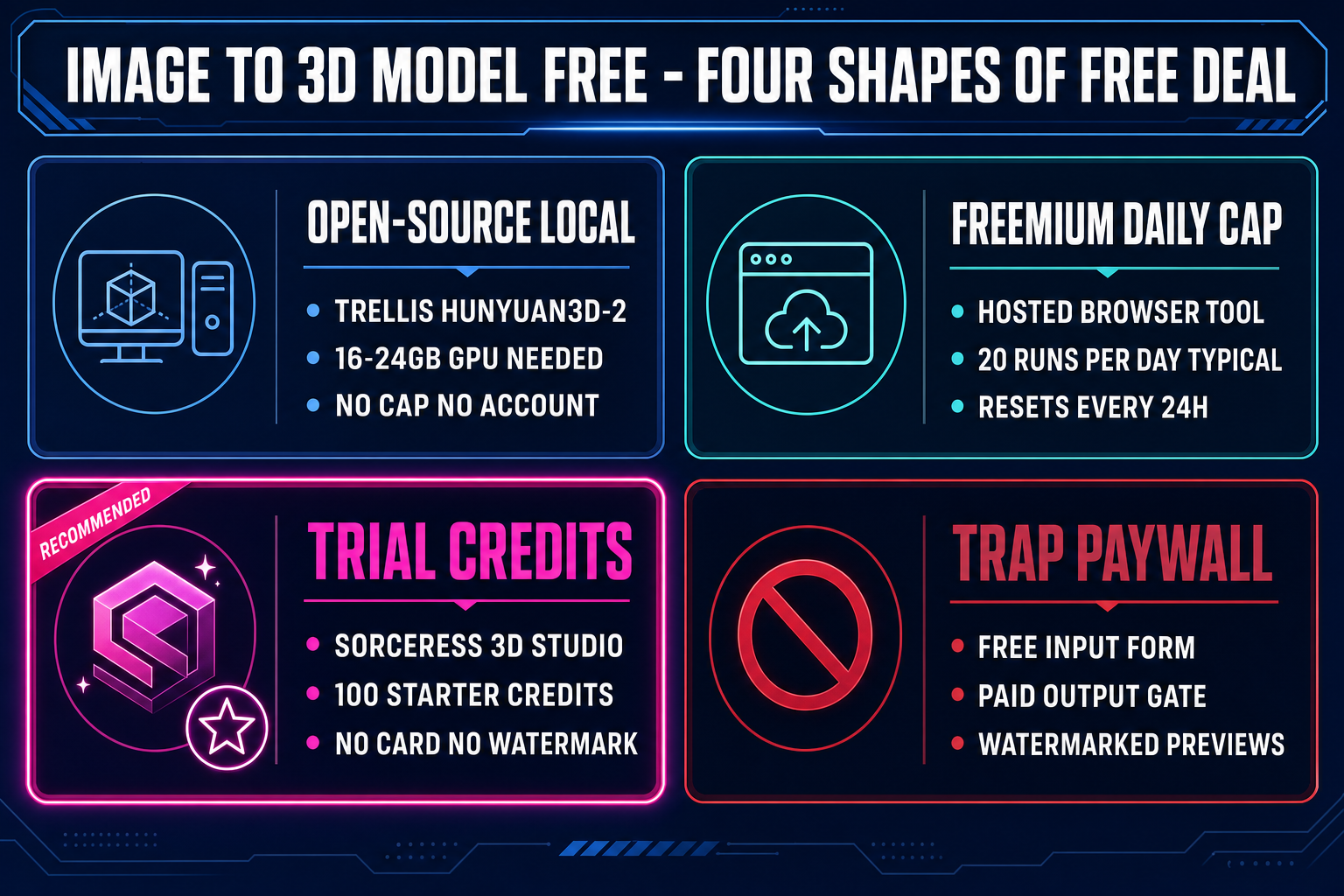
Four shapes of image to 3D model free deal compared - open-source local, freemium daily cap, trial credits, trap paywall
The four shapes of image to 3D model free deal. Open-source local has no cap but needs a GPU, freemium daily-cap is hardware-free but ceiling-bound, trial credits is the cleanest browser path, and the trap paywall is the pattern to skip.

Where Sorceress 3D Studio fits in the image to 3D model free landscape

The pitch is straightforward: every other browser-native free 3D pipeline runs one model. Sorceress 3D Studio bundles six and lets the model picker pick the right backend for the job on each generation. That matters because no single model is best at every task. A line-art reference needs a model that respects flat-shaded silhouettes; a photographic reference needs a model that bakes PBR materials cleanly; a stylised character needs topology built around a humanoid skeleton. Running all six behind one credit balance means you do not have to maintain six accounts, six API keys, and six pricing pages.

The free-tier mechanics are documented on the live plans page, verified May 31, 2026:

  • 100 starter credits at sign-up — the free entry point. No card on file, no watermark, no email-verification gate before generation.
  • One cent per credit on no-expiry top-ups: $10 for 1,000 credits, $20 for 2,000 (Creator tier), $50 for 5,000 (Plus tier), $100 for 10,000 (Studio tier).
  • $49 one-time Lifetime Access covers Auto-Sprite v2, True Pixel, Tileset Forge, Sprite Analyzer, and the publishing flow forever; AI generation still consumes credits on top.

The 100 starter credits cover exploratory work on a single character or a small prop set, not a 50-asset commercial pack. At one cent per credit, the price-per-mesh on the cheapest model lands at 8¢ per generation, materially cheaper than any other hosted image-to-3D pipeline at production volume.
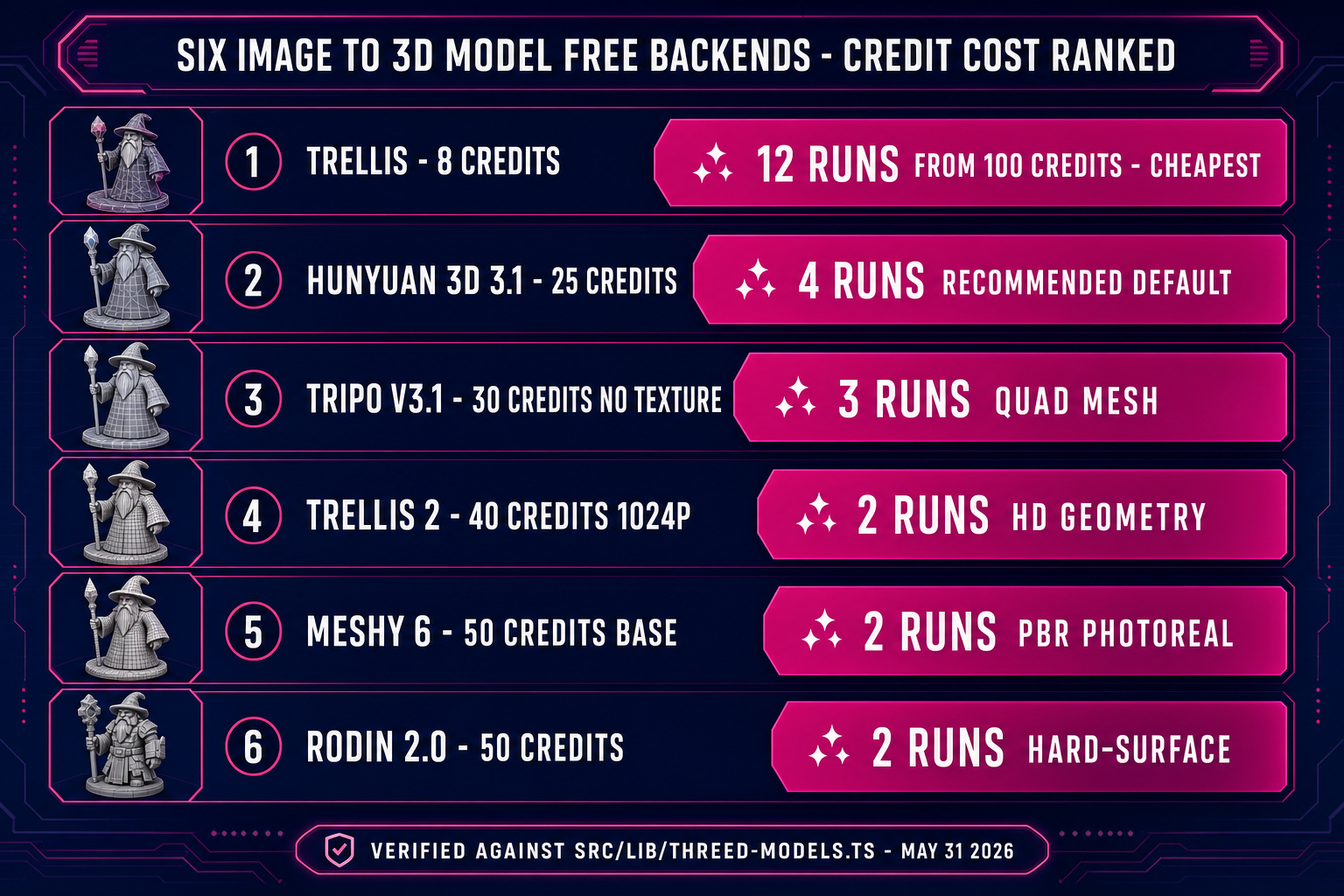
The six 3D model backends behind one credit balance

The model picker exposes six image-to-3D backends, each with a different credit cost, sweet spot, and quirks. Numbers below were verified against the canonical model registry in src/lib/threed-models.ts on May 31, 2026.

  • TRELLIS — 8 credits. The cheapest backend in the picker. Microsoft Research’s 1.2B image-to-3D model, MIT-licensed open-source, shipped as the workhorse for fast iteration on rough mesh exploration. Twelve runs from the 100 starter credits, which is more than enough room to settle on a shape before paying for textures.
  • TRELLIS 2 — 40 credits at 1024³ (35 at 512³, 45 at 1536³). The 4B-parameter follow-up. Reports 17-second generation on an H100 at 1024³ in the published TRELLIS.2 paper. Two runs from the starter pool at the default resolution. Pick when you need finer geometric detail than the 1.2B base.
  • Hunyuan 3D 3.1 — 25 credits. The recommended default in the picker. Tencent’s next-generation 3D model with PBR materials baked into the output by default. Four runs from the starter pool, which is the right shape for a character’s exploratory phase.
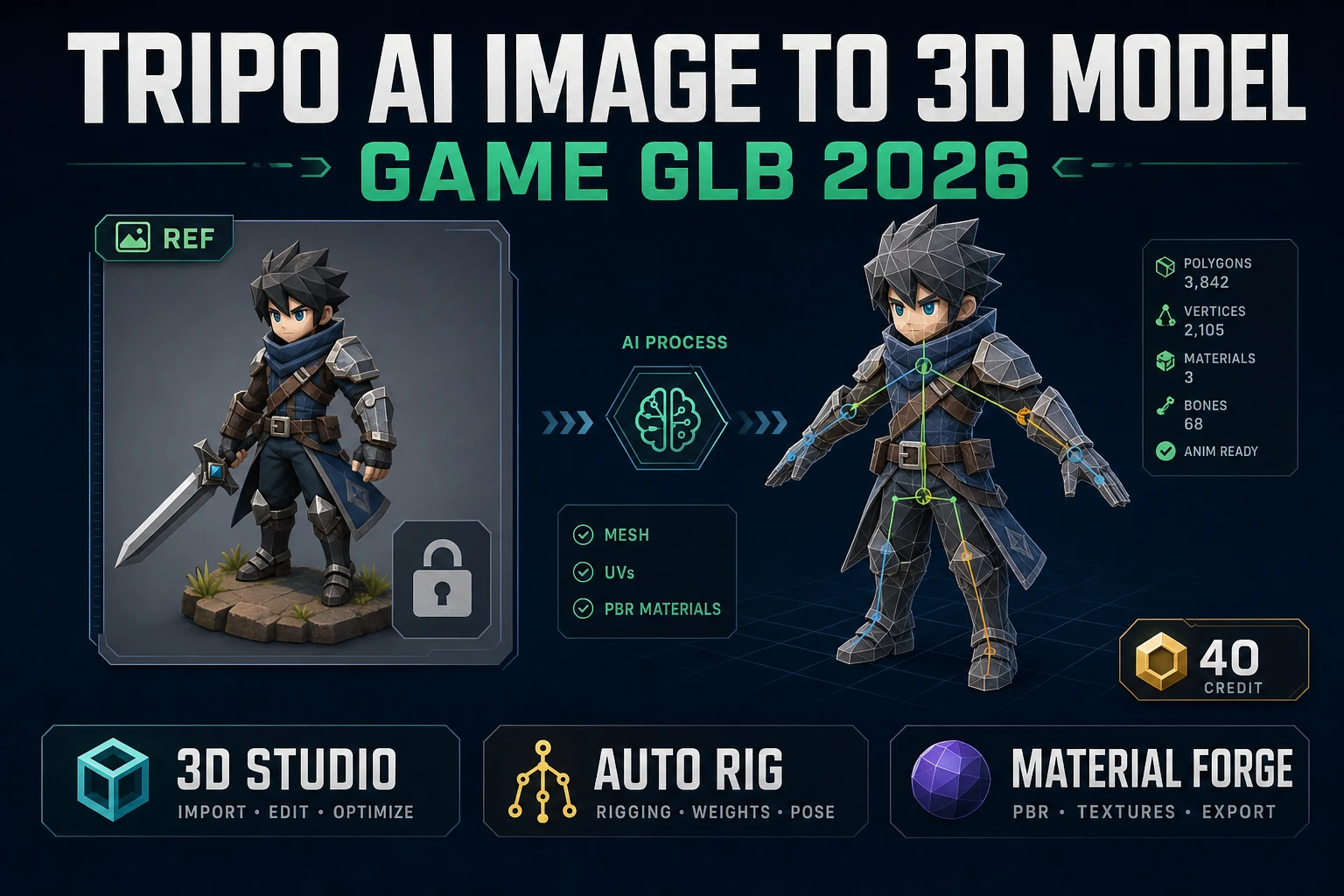
  • Tripo v3.1 — 30 credits no texture, 40 credits standard or HD texture, +5 credits with Quad mesh. Best-in-class for stylised characters and props with quad topology. The Quad Mesh option exports as FBX and saves a remeshing pass downstream when you plan to rig the asset.
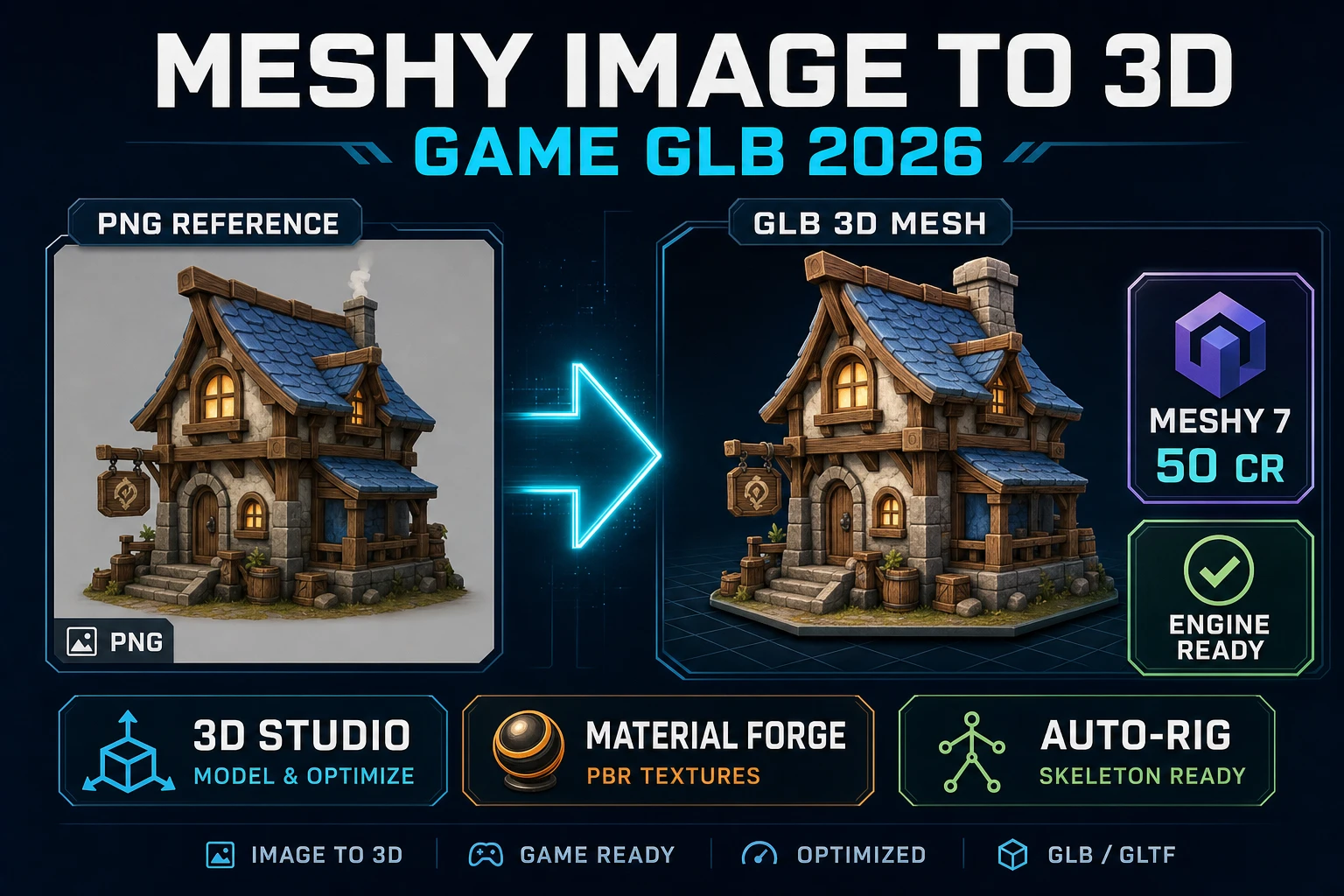
  • Meshy 6 — 50 credits base, +25 credits with texture, +13 credits with remesh. The premium photoreal path with PBR baking, multi-color 3MF support added in the January 18, 2026 release, and the strongest results on photographic references. One textured run from the starter pool.
  • Rodin 2.0 — 50 credits. Hyper3D’s second-generation pipeline. Strong on hard-surface and architectural assets with clean booleans, and the only backend in the picker with native USDZ export for Apple AR pipelines.
Six image to 3D model free backends inside Sorceress 3D Studio - credit cost ranking from TRELLIS 8 credits to Meshy 6 50 credits
Credit-cost ranking of the six image-to-3D backends inside Sorceress 3D Studio, verified against src/lib/threed-models.ts on May 31, 2026.

From reference image to a free GLB in five steps

The end-to-end flow on the free trial path inside 3D Studio:

  1. Sign up and claim the 100 starter credits. No card, no watermark, no email-verification gate. The credits land instantly. The same balance also unlocks AI Image Gen for source images, which is the cleanest way to feed the 3D pipeline a commercial-use-clear reference.
  2. Bring a reference image. A flat 2D character portrait, a clean three-quarter prop view, or a photograph you own. Image-to-3D delivers the highest quality-per-credit; text-to-3D rarely beats a single good reference. The sibling guide on lifting a 2D image to a 3D model walks through composition rules end-to-end.
  3. Pick a model in the picker. TRELLIS at 8 credits if you want fast iteration on shape. Hunyuan 3D 3.1 at 25 credits if you want a recommended default. Meshy 6 textured at 75 credits if you want photoreal PBR baking on the first try. The model card surfaces credit cost, supported input modes, and the parameter shape, so you can switch backends per generation without leaving the page.
  4. Generate. 30–180 seconds in the browser, depending on the backend. The credits are deducted on submission, not on completion, so a failed generation refunds. The output renders in the in-browser viewer with orbit / pan / zoom and a wireframe toggle so you can sanity-check topology before exporting.
  5. Export GLB, GLTF, or FBX. No additional credit cost. GLB is the binary glTF 2.0 container documented in the official Khronos glTF 2.0 specification, and it is the right pick for browser runtimes and the simplest path into game engines. FBX is the right pick once you want to auto-rig the character for skeletal animation.

The whole loop fits inside the 100 starter credits if you stick to TRELLIS for shape exploration and pay one Meshy 6 textured run for the final pass. The sibling guide on converting an image to a 3D model with GLB output covers the same flow on the broader head term.

When the image to 3D model free path breaks down

The free path is engineered to convert serious users to paid, and there are four scenarios where the trial breaks down before the project ships:

  • Volume. A 50-asset prop set burns 2,500 credits at the recommended default and 4,000 credits at the textured Meshy run. The 100 starter credits do not finish a serious commercial pack. The honest answer: budget for a top-up at the start of the project and treat the trial credits as exploration rather than production.
  • Iteration count. Settling on a character’s final shape often takes 10–15 generations. At Meshy 6 textured (75 credits), 100 starter credits buys 1 run, which is not enough to iterate. The fix: do shape exploration on TRELLIS at 8 credits per run, lock the silhouette, and only spend Meshy credits on the final pass.
  • Hardware-bound complexity. Some references need geometry the hosted models do not output cleanly — concave organic forms with thin features, glasswork, hair as separate geometry. The fix is the open-source local route: TRELLIS.2 at 4B parameters and 1536³ resolution captures detail no hosted free tier produces, and the technique paper at arXiv 2512.14692 documents the architecture in full.
  • Commercial source-image rights. If the input image is a screenshot of someone else’s artwork, the copyright on the source carries through to the generated mesh. The free pipeline does not launder upstream rights — the 3D reconstruction process described on Wikipedia’s 3D reconstruction page is a derivative-work transformation, not a clean-room one. The fix is to source-image cleanly: a photograph you own, a public-domain image, or an AI-generated reference from AI Image Gen on the same account, which produces commercial-use-clear outputs by default.

Five mistakes that ruin image to 3D model free output

  1. Feeding in a busy reference image. Multiple subjects, complex backgrounds, and dense compositions all confuse image-to-3D pipelines. Use a clean three-quarter view of a single subject on a neutral background — the same composition that works for image-to-video also works here, because both are polygon-mesh reconstruction problems.
  2. Picking the most expensive model on every run. The 100 starter credits evaporate fast. Use TRELLIS at 8 credits for shape exploration, switch to Hunyuan 3D 3.1 at 25 credits for the keeper, and only spend Meshy 6 textured (75 credits) on the final pass.
  3. Skipping wireframe inspection. The in-browser viewer has a wireframe toggle. Use it before exporting. Bad topology — long thin triangles, non-manifold geometry, internal ghost faces — will destroy any downstream rigging step. If the wireframe is broken, regenerate with a different seed or a different model rather than fix the mesh in Blender.
  4. Exporting the wrong format for the runtime. GLB for browser runtimes, FBX for engine pipelines that need skeletal animation, OBJ for static props in older tools, USDZ for AR. Sorceress 3D Studio exports all four with no additional credit cost; pick the format your runtime ingests cleanly rather than re-converting downstream.
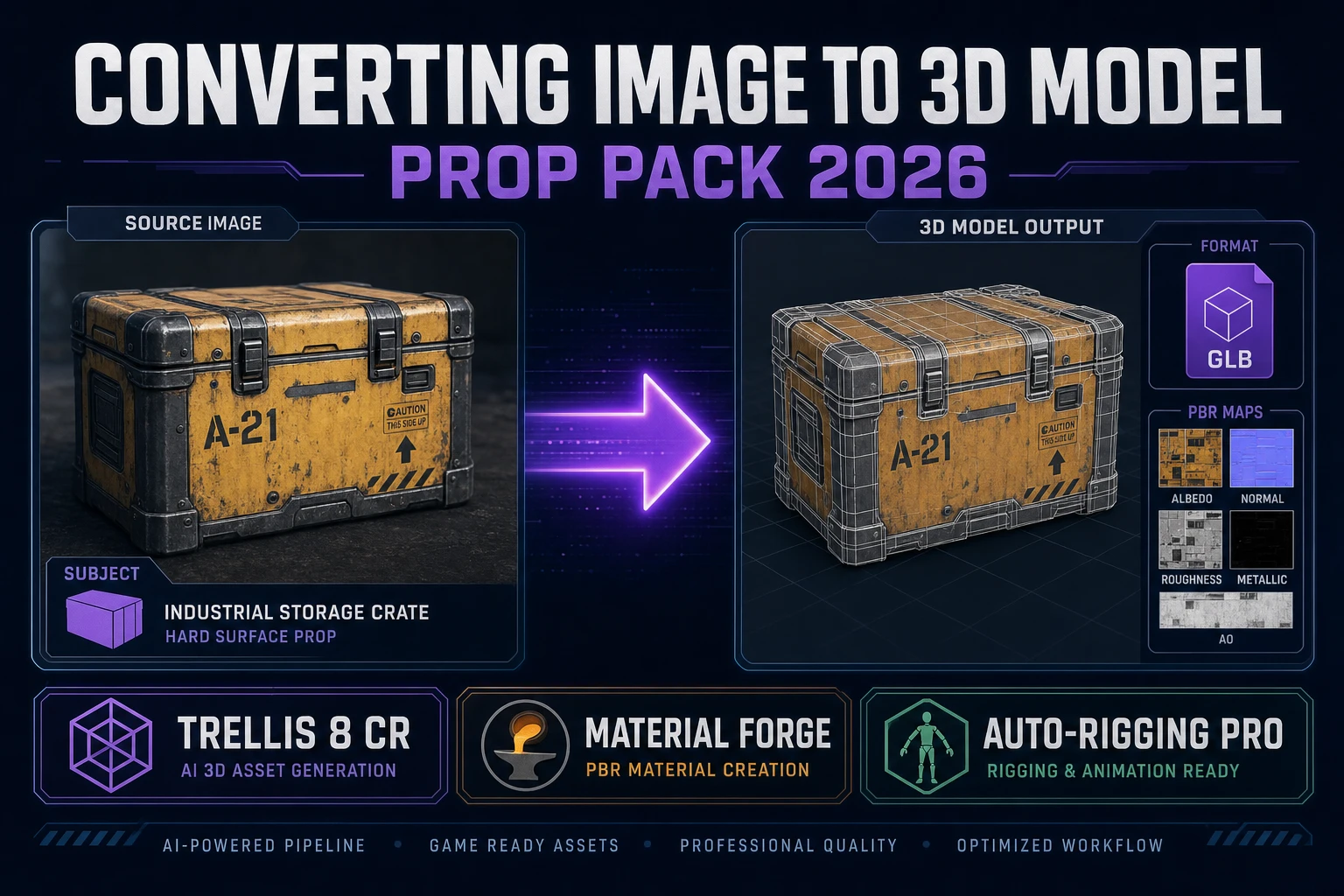
  5. Treating the free-tier output as production-ready. Even on Meshy 6 textured, the mesh is a starting point. Auto-rigging through Auto-Rigging and a PBR cleanup pass in Material Forge turn the AI mesh into a shippable asset. The companion full pipeline guide walks through the rigging and animation steps end-to-end.

The verdict on image to 3D model free in 2026

The honest answer to image to 3D model free in 2026 has three branches. With a CUDA-capable GPU, the open-source local route on TRELLIS, TRELLIS.2, or Hunyuan3D-2 is the long-run cheapest deal — zero ongoing cost, no caps, no accounts — and the underlying diffusion model approach is mature enough that the open weights match hosted output on most tasks. Without a GPU and only a handful of runs per day, the freemium daily-cap route on Hunyuan Global gives full-quality output up to 20 runs per day. For six AI 3D backends behind one model picker with no install, no GPU, no daily cap, and no watermark, Sorceress 3D Studio with 100 starter credits is the cleanest browser path. The deal that is never right is the trap pattern — free input, paid output — and the field is still littered with it.

Once you have your first GLB, the natural next steps are auto-rigging and a PBR pass in Material Forge, both on the same credit balance. The tools guide covers the end-to-end suite, the recent free AI 3D model generator field map ranks the same six models on the text-to-3D side, and the 2D-image lift guide goes deeper on per-backend differences.

Frequently Asked Questions

What does "image to 3D model free" actually mean in 2026?

It means four very different deals that the SERP conflates into one results page. First, free-as-in-open-source-local: model weights are public (Microsoft TRELLIS and TRELLIS.2 on GitHub under the MIT License, Tencent Hunyuan3D-2 on GitHub) and inference runs on your own 16-24GB GPU at zero ongoing cost. Second, freemium with a daily cap: a hosted browser tool gives every account a fixed number of full-quality image-to-3D runs per day on the same output as paid runs, and the cap resets every 24 hours. Third, trial credits at sign-up: a one-time pool of full-quality credits is granted at account creation with no card on file and no watermark on the output (Sorceress 3D Studio runs this path with 100 starter credits). Fourth, free-to-try with a paywall at the output: the input form and the preview thumbnail are free, the actual mesh download is gated behind payment. Conflating these four shapes is the single biggest source of frustration on the image to 3D model free search; naming them up front is the only honest way to compare the field.

Can I run an image to 3D model free with no sign-up at all?

Only via the open-source local route. Every hosted browser-based image to 3D model free tool requires an account so the vendor can attach the credit ledger to a profile row and stop you at the daily cap or the trial-credit limit. The closest you get to true no-sign-up generation is cloning Microsoft TRELLIS or TRELLIS.2 (MIT License, github.com/microsoft/TRELLIS and github.com/microsoft/TRELLIS.2) or Tencent Hunyuan3D-2 (github.com/Tencent-Hunyuan/Hunyuan3D-2) and running inference on your own CUDA-capable GPU. No account, no rate limit, no watermark, no upper bound on runs - but you wear the install burden (40-minute setup, dependency management, 16-24GB VRAM hardware requirement) in exchange. Every hosted path (Sorceress 3D Studio, Meshy, Tripo, Rodin, Hunyuan Global, Replicate-hosted TRELLIS) requires a sign-up before the first generation. The trade is convenience: hosted is 30-180 seconds in the browser with zero install cost; local is unlimited free forever once the install is alive.

How does the image to 3D model free path on Sorceress 3D Studio work end to end?

Sign up, claim 100 starter credits (no card on file, no email-verification gate before generation - verified against src/app/_home-v2/_components/HomeHero.tsx on May 31, 2026), upload a reference image to the 3D Studio panel at /3d-studio, pick a model in the six-model picker, generate. The credit cost depends on which backend you pick. TRELLIS is the cheapest at 8 credits per run (12 free runs from the starter pool). Hunyuan 3D 3.1 is the recommended default at 25 credits (4 runs). Tripo v3.1 at standard texture is 40 credits (2 runs). TRELLIS 2 at the 1024 default is 40 credits (2 runs). Meshy 6 with texture lands at 75 credits (1 run from the starter pool). Rodin 2.0 is 50 credits (2 runs). The credits are deducted on submission, not on completion, so a failed generation refunds. After the starter credits run out, the path past zero is one cent per credit on no-expiry top-ups ($10 / $20 / $50 / $100 tiers per the live plans page) or $49 one-time Lifetime Access for the suite's non-AI tools.

Which file formats can I export from the free tier of an image to 3D model pipeline?

Sorceress 3D Studio exports GLB, GLTF, and FBX on every run with zero additional credit cost on top of the generation that produced the mesh. GLB is the binary glTF 2.0 container - one self-contained file with the texture embedded, ideal for browser runtimes (Three.js, Babylon.js, PlayCanvas) and the simplest format for game engines. GLTF is the JSON-text variant of glTF 2.0 with the texture as a separate file, useful for editing materials by hand. FBX is the industry-standard skeletal-asset format for desktop engines, the most portable choice once you have rigged the character. Provider-specific extras: Meshy 6 also writes OBJ, STL, USDZ, and 3MF (multi-color 3D printing was added in the January 18, 2026 Meshy release). Rodin 2.0 writes GLB / FBX / OBJ / USDZ / STL. Tripo v3.1 writes GLB / FBX / OBJ / STL with Quad mesh forcing FBX. TRELLIS and TRELLIS.2 write GLB. Hunyuan 3D 3.1 writes GLB. The open-source local route can export anything Blender can save once the mesh is in memory. There is no resolution lock and no watermark on any of the free-tier export paths discussed here.

What is the catch with free-to-try image to 3D model tools that gate the output?

The free input form generates a low-resolution preview, the actual exportable mesh is paid, and the preview frequently looks worse than the real output to bait the upgrade click. Some implementations layer a watermark onto the free preview, others limit the polycount to a level too coarse for any production use, others gate texture baking behind payment so the geometry exports cleanly but the model is naked. The honest signal for spotting the trap pattern before sinking time into a generation: every credible image to 3D model free path lists the credit cost or daily cap up front on the model card, and every credible free output downloads as the same GLB or FBX that paid users get. If a tool refuses to show the credit cost up front, refuses to surface the export format until after generation, or watermarks the preview thumbnail, it is the trap pattern. Skip it. The three credible deal shapes (open-source local, freemium daily-cap, trial credits at sign-up) all expose the deal up front.

Does the image to 3D model free output have commercial-use rights?

Sorceress 3D Studio output is watermark-free and commercial-use-clear on every model in the picker, on both the trial credits and paid credits. The provider licenses (Meshy, Hyper3D / Rodin, Tripo, Tencent Hunyuan, Microsoft Research, fal.ai-hosted models) pass through to the user and the standard provider terms allow commercial use in games, apps, and standalone products without attribution. The only commercial-use catch is the source image: if you fed in a copyrighted photograph, a screenshot of someone else's artwork, or a still frame from a film, the copyright on the source carries through to the generated 3D model - the image to 3D model free pipeline does not launder upstream rights. The fix is source-image cleanly: a photograph you own, a public-domain image, or an AI-generated reference from Sorceress AI Image Gen on the same account, which produces commercial-use-clear outputs by default. Open-source local TRELLIS and Hunyuan3D-2 inherit the upstream license (MIT for TRELLIS / TRELLIS.2, custom-permissive for Hunyuan3D-2); the same source-image caveat applies.

When the image to 3D model free trial runs out, what is the cheapest path forward?

On Sorceress 3D Studio the next generation is blocked at submission with a top-up prompt - no watermarked tier kicks in, no usage degradation, no soft limit. Two paths past zero. First, top up at one cent per credit on a no-expiry plan: $10 for 1,000 credits (which buys 125 TRELLIS runs at 8 credits each, or 40 Hunyuan 3D 3.1 runs at 25 credits each, or 13 Meshy 6 textured runs at 75 credits each), $20 for 2,000 credits, $50 for 5,000 credits, $100 for 10,000 credits - verified against src/app/plans/page.tsx on May 31, 2026. Second, $49 one-time Lifetime Access which unlocks every non-AI-generative tool in the suite forever (Auto-Sprite v2, True Pixel, Tileset Forge, Sprite Analyzer, the publishing flow) but does not give you free AI runs - generation still consumes credits on top. On freemium daily-cap platforms the cap resets every 24 hours and you keep generating; the daily ceiling never lifts on the free tier. On open-source local there is no "runs out" - once you have the weights, every run is free until your GPU dies.

Sources

  1. 3D reconstruction (Wikipedia)
  2. Polygon mesh (Wikipedia)
  3. Diffusion model (Wikipedia)
  4. glTF 2.0 specification (Khronos Group)
  5. Microsoft TRELLIS (GitHub, MIT License)
  6. Microsoft TRELLIS.2 (GitHub, 4B parameters, MIT License)
  7. Tencent Hunyuan3D-2 (GitHub, open-source)
  8. TRELLIS.2 paper (arXiv 2512.14692)
Written by Arron R.·2,494 words·11 min read

Related posts