Frame a Title Screen Generator (Boot Art 2026)

By Arron R.7 min read
A title screen generator in 2026 is a four-step browser pipeline: AI Image Gen paints the hero backdrop, Canvas layers logo and menu chrome, BG Remover cleans s

Players judge an indie game in the first three seconds on the title screen — before a single level loads. Searchers typing title screen generator on July 10, 2026 want boot art with a readable logo, Start and Options buttons, and a backdrop that sells the genre without opening Photoshop. This guide covers the 2026 browser pipeline: AI Image Gen drafts the hero art, Canvas composites logo and menu chrome, and Phaser 4.2 runs the interactive title scene. Tool costs below are verified against the live Sorceress source on July 10, 2026.
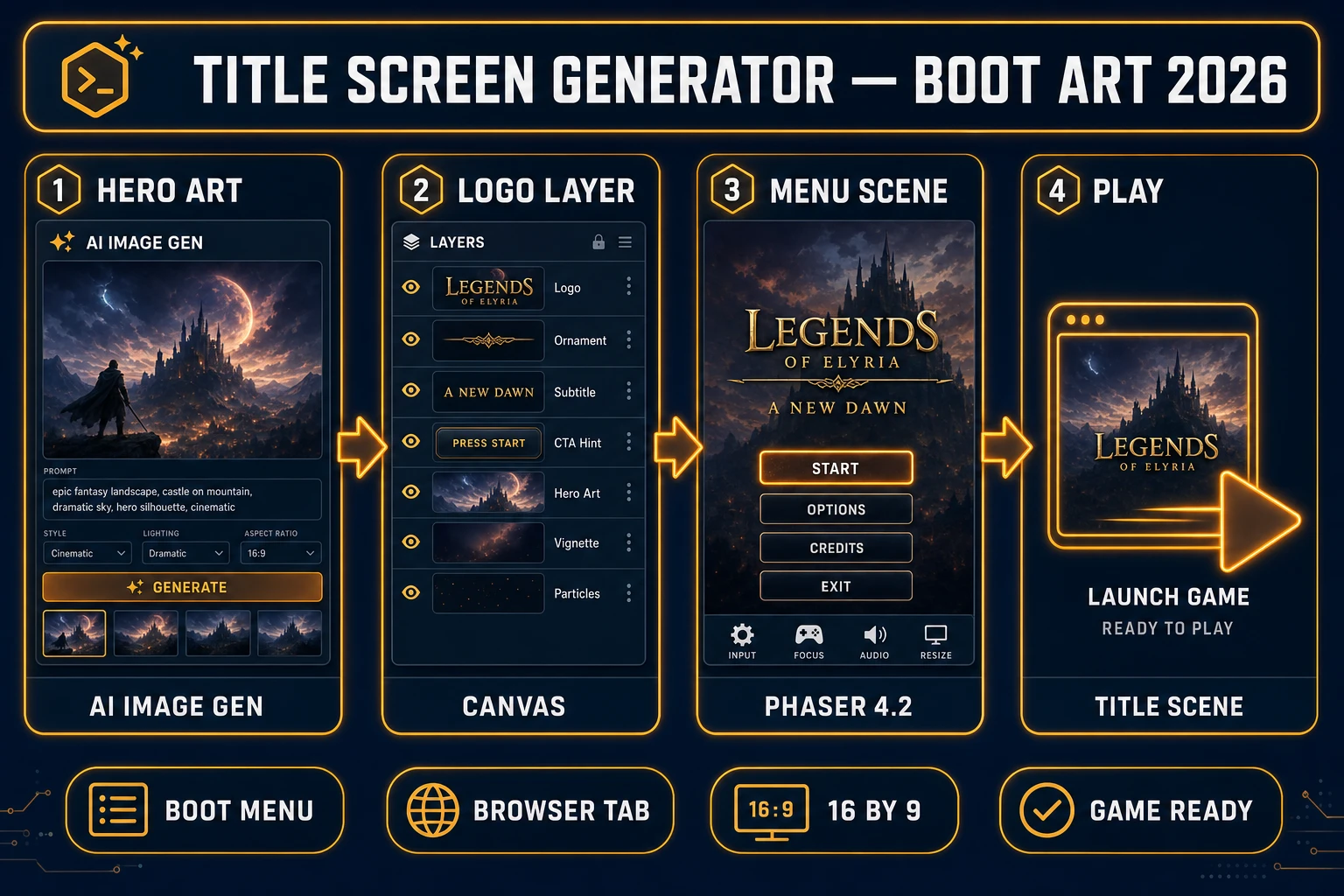
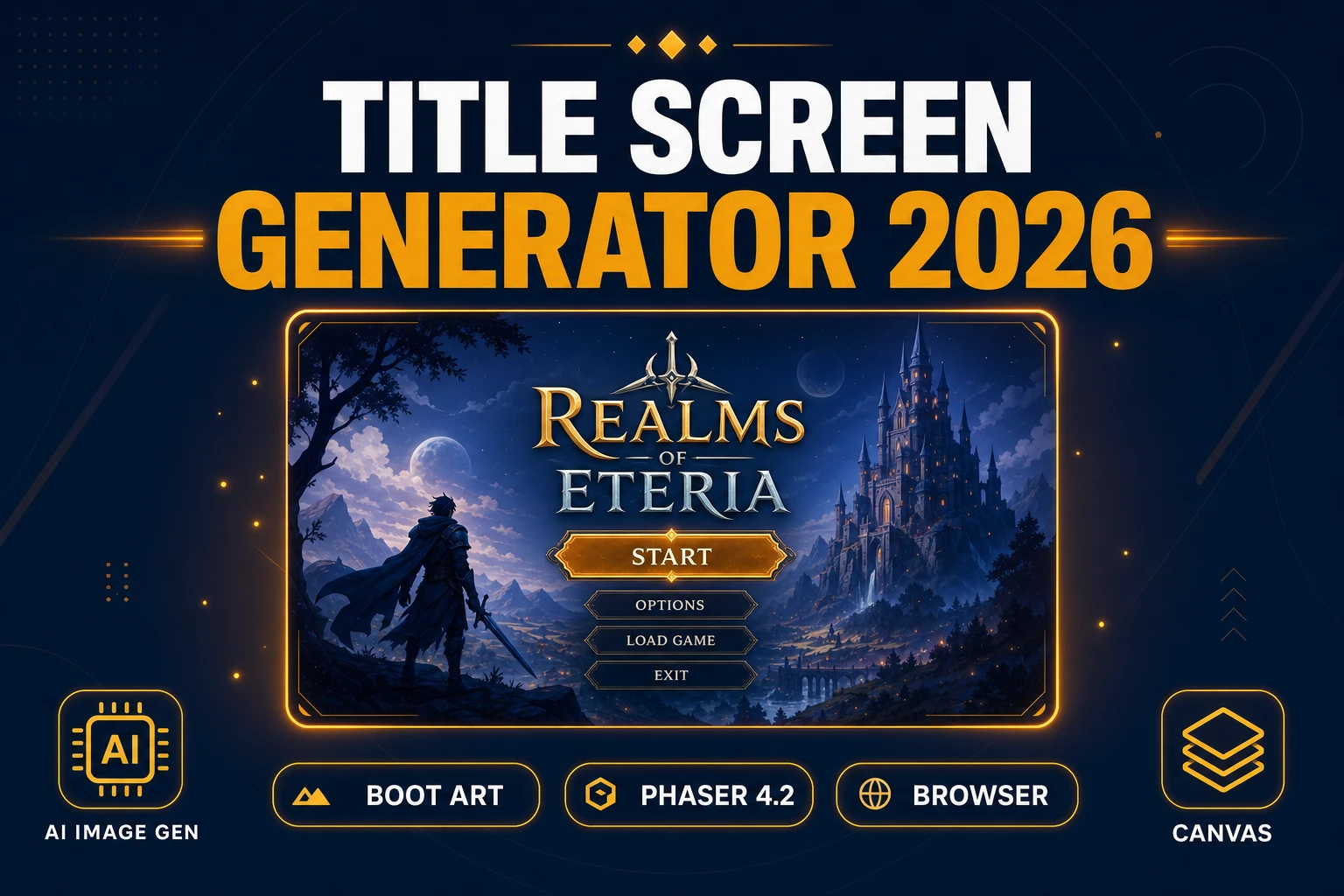
Title screen generator in 2026 — four-step browser pipeline from AI Image Gen hero backdrop through Canvas logo layers to Phaser 4.2 menu scene, verified July 10, 2026
A title screen generator in 2026 means four moves: hero backdrop in AI Image Gen, logo and button chrome in Canvas, menu scene wiring in Phaser 4.2, then playtest until Start feels obvious.

What a title screen generator outputs for game dev

The phrase title screen generator (30/mo, KD 17 per DataForSEO probe verified July 10, 2026 against probe-fresh-seeds-8.md) targets a developer who needs a polished title screen — the interactive menu with Start, Options, and Credits — not just a static logo card. Sibling queries confirm the cluster: video game title screen generator (10/mo), game title screen art, and ai title screen generator (10/mo) all describe the same deliverable: a full-viewport background, centred logotype, button row, and optional ambient motion that stays on screen until the player commits.

Title screens differ from splash screens and loading screens. A splash screen is the non-interactive publisher beat (see the Sorceress splash screen generator post shipped July 8, 2026). A loading screen tracks download progress (see game loading screen). The title screen sits after preload completes — it is where players choose to begin. In 2026 both the backdrop art and the menu markup batch inside one Sorceress account without leaving the browser tab.

Why placeholder menus kill first impressions

Gray-box title scenes — white text on a flat color, no logo, misaligned buttons — signal “jam prototype” even when the gameplay underneath is solid. Stream viewers screenshot title screens. Store-page trailers open on them. A placeholder menu tells the audience the project is not shippable yet, regardless of how polished level one plays.

The traditional bottleneck was never the Phaser button API. It was sourcing a widescreen hero backdrop that matches your pixel scale, hand-compositing a logo with readable contrast, and re-exporting when the art director wants a darker mood pass. AI Image Gen closes the backdrop layer; Canvas closes the compositing layer with grid-snapped alignment. Cross-link the logo discipline in game logo maker and the HUD context in boss health bar generator — title screens share the same readability rules as combat UI, just at launch instead of mid-fight.

The Sorceress title screen generator pipeline in four steps

Every shippable title menu ships four runtime pieces regardless of art style: hero backdrop, logo layer, button chrome, and scene code. In 2026 each maps to one Sorceress tool verified against the live catalog on July 10, 2026:

  • Hero backdrop artAI Image Gen at 16:9 aspect for widescreen mood paintings or pixel vistas; credit cost varies by model via getModelCredits in src/lib/models.
  • Logo and menu chrome compositingCanvas with the 16:9 Landscape preset (1920×1080 per src/app/canvas/page.tsx line 28), multi-layer export, no per-export credit charge.
  • Fringe cleanup on logo PNGs — optional BG Remover when imported logotype art carries halos around letter edges.
  • Interactive title sceneWizardGenie scaffolds Phaser 4.2 menu buttons and scene transitions; your API key covers coding credits.

Pricing is a $49 lifetime unlock plus pay-as-you-go credit packs — Starter $10/1,000 credits, Creator $20/2,000, Plus $50/5,000, Studio $100/10,000 — verified against src/app/plans/page.tsx lines 46 and 50. New accounts ship with 100 starter credits. The Sorceress tools guide lists every tool in the catalog.
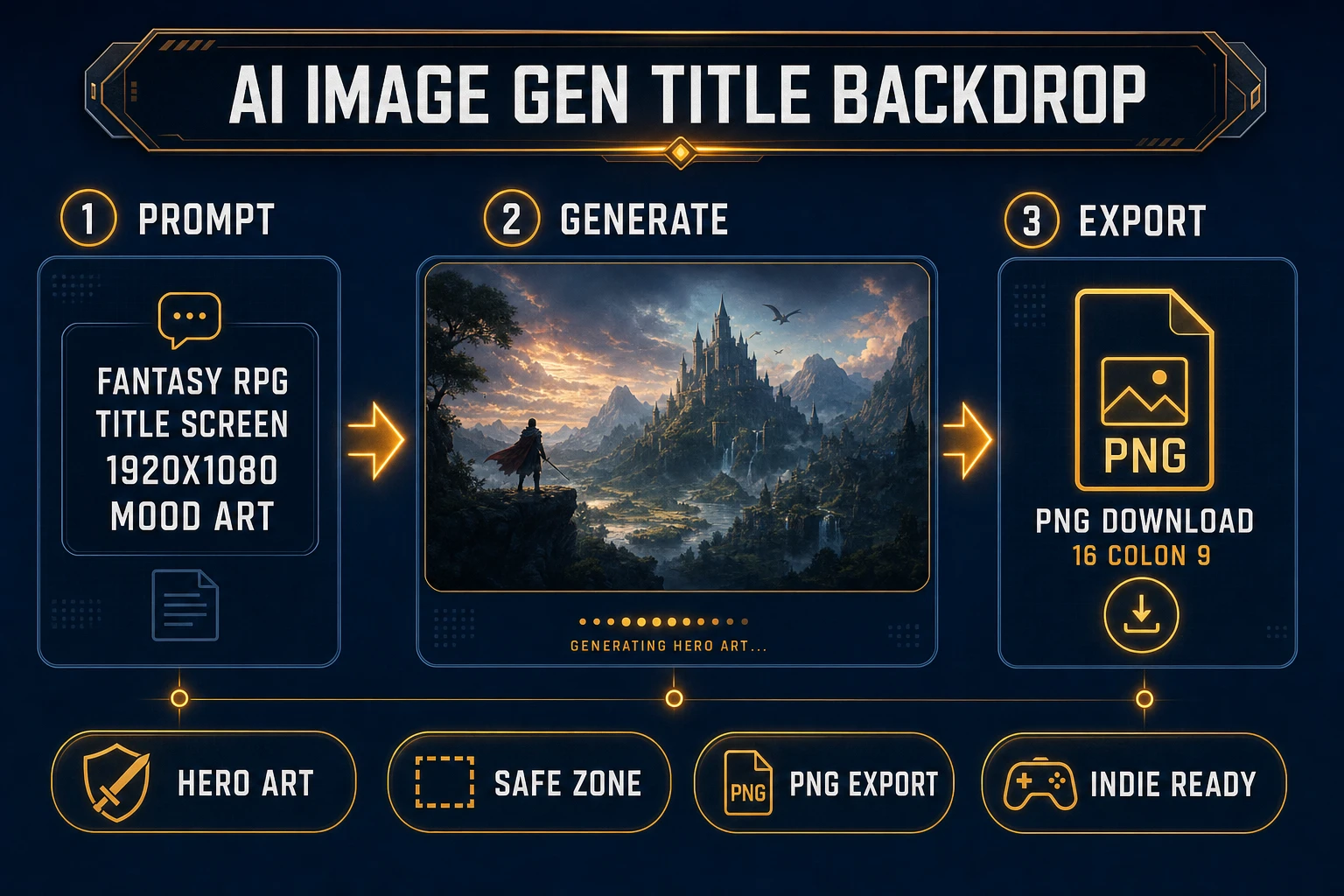
AI Image Gen pipeline generating a 1920x1080 fantasy RPG title screen hero backdrop for browser game boot art, verified July 10, 2026
AI Image Gen drafts the hero backdrop at 16:9 — prompt genre mood, export a PNG, and import directly into Canvas as the bottom layer.

Step 1 — generate hero backdrop art in AI Image Gen

Open AI Image Gen, pick a 16:9 aspect ratio, and prompt for widescreen title art with negative space where your logo will sit. Example for a fantasy RPG: “fantasy RPG title screen background, ruined castle silhouette at dusk, purple sky gradient, empty centre third for logo placement, cinematic wide shot, 1920×1080 mood art.” For pixel titles, add “pixel art, 32-bit era palette, no characters in centre frame” and pass the output through True Pixel if edges need palette locking.

Batch two to three variants before committing — one darker, one brighter, one with stronger horizon line — so you can compare logo contrast in Canvas without regenerating from scratch. Download the winner as PNG. Keep the centre third relatively calm; busy detail behind letterforms kills readability on stream captures and small laptop screens alike.

If your game already has a menu theme in mind from a jam doc, paste that one-line mood into every prompt so backdrop, logo, and button chrome stay coherent when you composite in the next step.
Step 2 — composite logo and menu chrome in Canvas

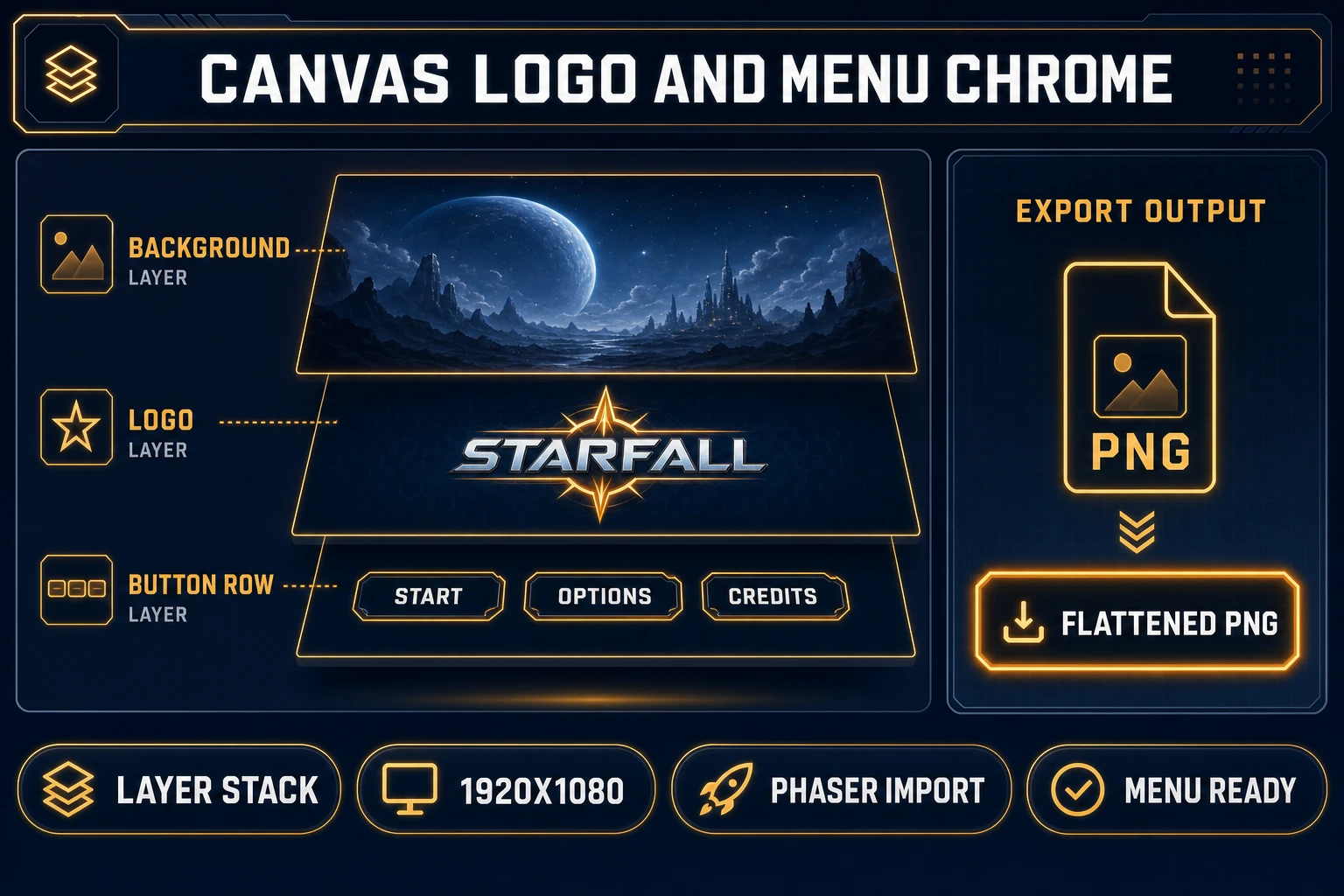
Open Canvas, select the 16:9 Landscape preset (1920×1080), and import your AI Image Gen backdrop as the bottom locked layer. Add a logo layer above it — either import a PNG from AI Image Gen (“pixel RPG game title logo, gold embossed letters, transparent PNG”) or paint logotype strokes with the brush tool at 800% zoom for crisp pixel edges.

Build a button row on a third layer: three equal rectangles for Start, Options, and Credits with 8px outlines matching your palette. Use Canvas alignment tools (centre horizontal, distribute evenly) so buttons sit on a consistent baseline. Lock the grid guide layer, export one flattened PNG for the static backdrop, and keep the logo and button layers separate if you plan animated fades in Phaser — separate PNGs import as distinct game objects with independent alpha tweens.

When logo PNGs carry light halos from generation, run one pass through BG Remover before re-importing into Canvas. The Canvas API layer stack in Sorceress handles opacity and crop without charging export credits.

Canvas layer compositing game title screen with background logo and Start Options Credits button row for Phaser import, verified July 10, 2026
Canvas stacks background, logo, and button chrome on separate layers — export flattened PNGs or keep layers split for independent Phaser tweens.

Step 3 — wire the title scene in Phaser 4.2 via WizardGenie

Phaser 4.2.0 “Giedi” shipped June 19, 2026 (verified against phaser.io/news/2026/06/phaser-v4-2-0-released and phaser.io/download/phaser4 on July 10, 2026). Open WizardGenie and prompt: “Add Phaser 4.2 TitleScene after PreloadScene: full-screen background image from title-bg.png, three interactive text buttons Start Options Credits centred at 60% viewport height, fade in logo over 800ms, on Start transition to GameScene with fade out 400ms.”

Pick Claude Opus 4.7 or Gemini 3.1 Pro for the first scaffold — scene order, input handlers, and transition timing benefit from the heavy reasoner. Iterate on hover states and keyboard focus with DeepSeek V4 Pro or Kimi K2.5 as the executor; never a frontier model on the typing side. Pass your Canvas button coordinates as pixel hints so WizardGenie aligns hit areas with the art you exported.

Wire ambient juice last: a slow parallax shift on the background layer (see parallax AI generator for layered backdrops) or a subtle particle drift along the horizon. Keep motion slow — title screens should feel calm, not chaotic.

Step 4 — tune readability, then ship the title screen build

Playtest contrast before polish: logo and buttons must stay legible at 1280×720 and on mobile landscape. If gold logotype vanishes against a bright sky, darken the backdrop layer in Canvas with a semi-transparent gradient overlay. Test keyboard navigation — Enter on Start, arrow keys between buttons — because browser games on laptops skip the mouse more often than you expect.

Audio anchors the menu: batch a looping theme in Music Gen and a soft button click in SFX Gen, then preload both in your PreloadScene so the title scene starts music on create(). For the broader boot sequence, chain this title scene after your splash screen fade and before your first gameplay level.

What a title screen generator session costs on Sorceress in 2026

Cost math verified July 10, 2026. Base unlock: $49 lifetime. Canvas: free to use. A minimal title screen typically burns 40–120 Sorceress credits ($0.40–$1.20 at Starter tier rates) covering two to four AI Image Gen runs for backdrop and optional logo art, zero Canvas export charges, optional BG Remover on one logo PNG, and WizardGenie coding on your own API key. Compare that to commissioning a single widescreen menu illustration — the title screen generator SERP reader is usually a solo dev optimizing for one shippable browser build.

Start with the 100 free credits, generate one 16:9 backdrop, composite logo and buttons in Canvas, prompt the TitleScene in WizardGenie with placeholder callbacks, then spend credits only on a second mood pass the playtest proves players notice. The pricing page shows live credit tiers; the how to make an idle game post covers a full genre loop when you need gameplay after the menu ships.

The verdict on title screen generator workflows in 2026

A title screen generator in 2026 is no longer a weekend hand-painting a 1920×1080 backdrop and aligning buttons by eye in an engine inspector. AI Image Gen batches the hero art, Canvas locks the layer stack, WizardGenie writes the Phaser scene, and Music Gen gives the menu a loop. The technical spine is scene order and contrast discipline; the art pass is what players remember when they decide whether to press Start.

Pick one genre mood — cozy farming sim, neon roguelike, space trader — generate the backdrop, composite the logo, prompt the menu scene, and playtest until Start reads clearly at a glance. Title screens reward calm composition and obvious affordances over ornate typography. AI generation now handles the slice that used to stall every solo dev between “the game runs” and “the game looks real.”

Frequently Asked Questions

What is the difference between a title screen and a splash screen?

A splash screen is the short publisher or engine logo beat before your game loads — usually one to three seconds with no interaction. A title screen is the interactive menu where players press Start, tweak Options, or quit. Sorceress covers both workflows: the Splash post (July 8, 2026) handles non-interactive boot branding; this title screen generator guide handles the menu layer with buttons, logo placement, and background art that stays on screen until the player chooses an action.

What resolution should a game title screen use in 2026?

For desktop browser games, 1920×1080 (16:9) is the practical default — the Canvas preset named 16:9 Landscape ships exactly that size (verified against src/app/canvas/page.tsx on July 10, 2026). Match your Phaser game config width and height so the title background scales without letterboxing. Portrait mobile titles can duplicate art at 1080×1920 using the 9:16 Portrait preset in the same Canvas picker.

Can AI Image Gen replace a hand-painted title screen logo?

Yes for gray-box and jam builds. Prompt AI Image Gen at /generate for stylised logotype art — for example 'pixel RPG game title logo, gold embossed letters, transparent PNG, 512 wide' — then import the PNG into Canvas on a dedicated logo layer above the background. For shipping commercial titles you may still want a vector logo from your brand kit; the Sorceress pipeline handles the backdrop, menu frame, and button chrome while your logo layer stays swappable without regenerating the whole scene.

How does a title screen generator differ from a loading screen workflow?

Loading screens stay visible while assets download and should reflect real loader progress — see the Load and Shift loading-screen posts on the Sorceress blog (verified July 10, 2026). A title screen generator workflow targets the static or lightly animated menu that appears after preload completes: hero backdrop, game logo, Start / Options / Credits buttons, and optional ambient particle or parallax motion. You wire the title scene in Phaser after your preload scene finishes, not during it.

What does a title screen generator session cost on Sorceress in 2026?

Verified July 10, 2026 against src/app/plans/page.tsx (LIFETIME_PRICE = 49) and the live image-model credit table. Base unlock is $49 one-time. A minimal title screen typically burns 40–120 Sorceress credits: one to three AI Image Gen runs for the hero backdrop and optional logo strip (model-dependent per getModelCredits in src/lib/models), zero Canvas export charges, optional BG Remover pass at model cost if your logo PNG has fringe pixels, and WizardGenie coding on your own API key. That lands around $0.40–$1.20 of pay-as-you-go credits on top of the lifetime unlock.

Sources

  1. Title screen (Wikipedia)
  2. Phaser v4.2.0 release notes
  3. Canvas API — MDN Web Docs
  4. Video game menu (Wikipedia)
Written by Arron R.·1,644 words·7 min read

Related posts