The singular ai tool for game development question in 2026 is not “which chat model?” but “which tool does coding plus assets plus assembly in one tab?” WizardG

The search for an ai tool for game development in 2026 hits a category where every result claims to be the singular integrated answer, yet almost every option handles only one of the five layers game development actually needs. Game development is a compound discipline — code plus art plus audio plus assembly plus export — and picking the wrong single tool means quietly assembling four other subscriptions to fill the gaps. The honest 2026 answer to “which one ai tool for game development?” is the tool that collapses coding plus every asset layer into one browser tab against one credit pool. Sorceress WizardGenie is built exactly for that collapse: a dual-agent Planner plus Executor at the code layer plus the full Sorceress asset pipeline embedded inside the editor, verified July 3, 2026 against the repository source.
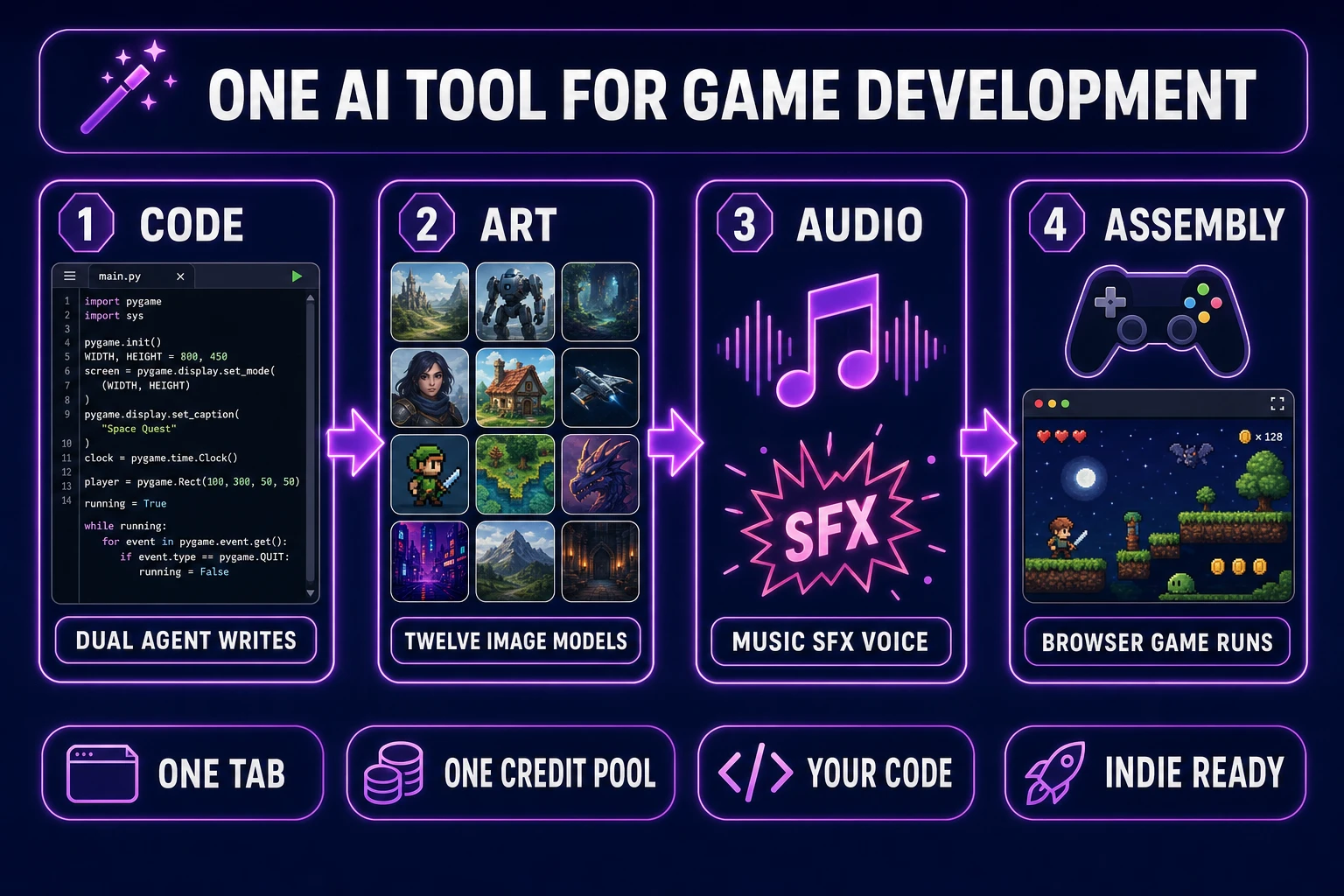
One ai tool for game development pipeline - four numbered panels for code, art, audio, and assembly with dual-agent Planner Executor architecture and Sorceress asset pipeline chips
The 2026 integrated ai tool for game development pattern: one browser tab covers code (dual-agent Planner plus Executor), art (12 image models plus sprite plus 3D plus rig), audio (music plus SFX plus voice), and assembly (browser game runs). Everything shares one credit pool.

What one ai tool for game development actually means in 2026

The SERP for ai tool for game development (singular) is intentionally different from the plural ai tools for game development. The plural query is a listicle intent — the searcher wants a roundup of many separate tools. The singular query is a workflow intent — the searcher wants ONE tool that handles the whole job. In 2026 those two SERPs pull different products to the top: the plural pulls comparison roundups, the singular pulls integrated platforms. Naming the category correctly matters because building a game on the plural interpretation means opening five browser tabs, running five credit accounts, and copy-pasting assets between them. Building a game on the singular interpretation means one tab, one account, one credit pool, and no copy-paste.

Game development traditionally lives on four hard layers. Code is the runtime logic (input handling, physics, game state, save systems). Art is the visual layer (character sprites, 3D models, environments, UI icons, particles). Audio is the sonic layer (music, sound effects, ambience, character voice). Assembly is the integration layer (scene composition, asset wiring, build export). A traditional indie stack solves those four layers with roughly four separate tools plus a game engine that ties them together: a code editor, an art tool, an audio tool, and an engine that assembles everything into a build. An ai tool for game development in the singular sense of the phrase is a tool that reduces those four layers to one interface, using AI agents to bridge the layers rather than requiring the developer to shuttle files between apps by hand. The output must still be a game that runs, so the tool has to solve every layer, not just the AI-shiny ones.

The multi-tool trap that most indie game-dev stacks fall into

Most indie developers arrive at game dev with a stack assembled from whatever tools they already know: a code editor, a general image generator, a separate 3D tool if the game needs 3D, a separate music tool, a DAW or SFX library, and a game engine that ties everything together. That stack is functional. It also fragments the workflow into five accounts, five bills, and five copy-paste cycles per asset. Every iteration forces a manual round trip: generate the image on site A, download it, upload it to the sprite tool on site B, drop the result into the engine on site C, wire the animation on site D, test the game, decide it is wrong, and repeat. On a single game feature (a new character with idle, walk, attack, and death animations plus matching SFX), that round trip repeats 20 to 50 times before the feature ships.

The 2026 plural-tools roundup covers those individual tools as separate options. The singular ai tool for game development question is the opposite: what happens when those five tools collapse into one? The copy-paste round trip disappears. The AI agent inside the integrated tool reads the current scene, requests a portrait from the image generator (inside the tool), pipes it into the sprite generator (inside the tool), drops the result into the running game (inside the tool), wires the animation (inside the tool), and hot-reloads the browser (still inside the tool). Twenty round trips become one prompt. That is the workflow collapse that motivates the integrated-tool category.
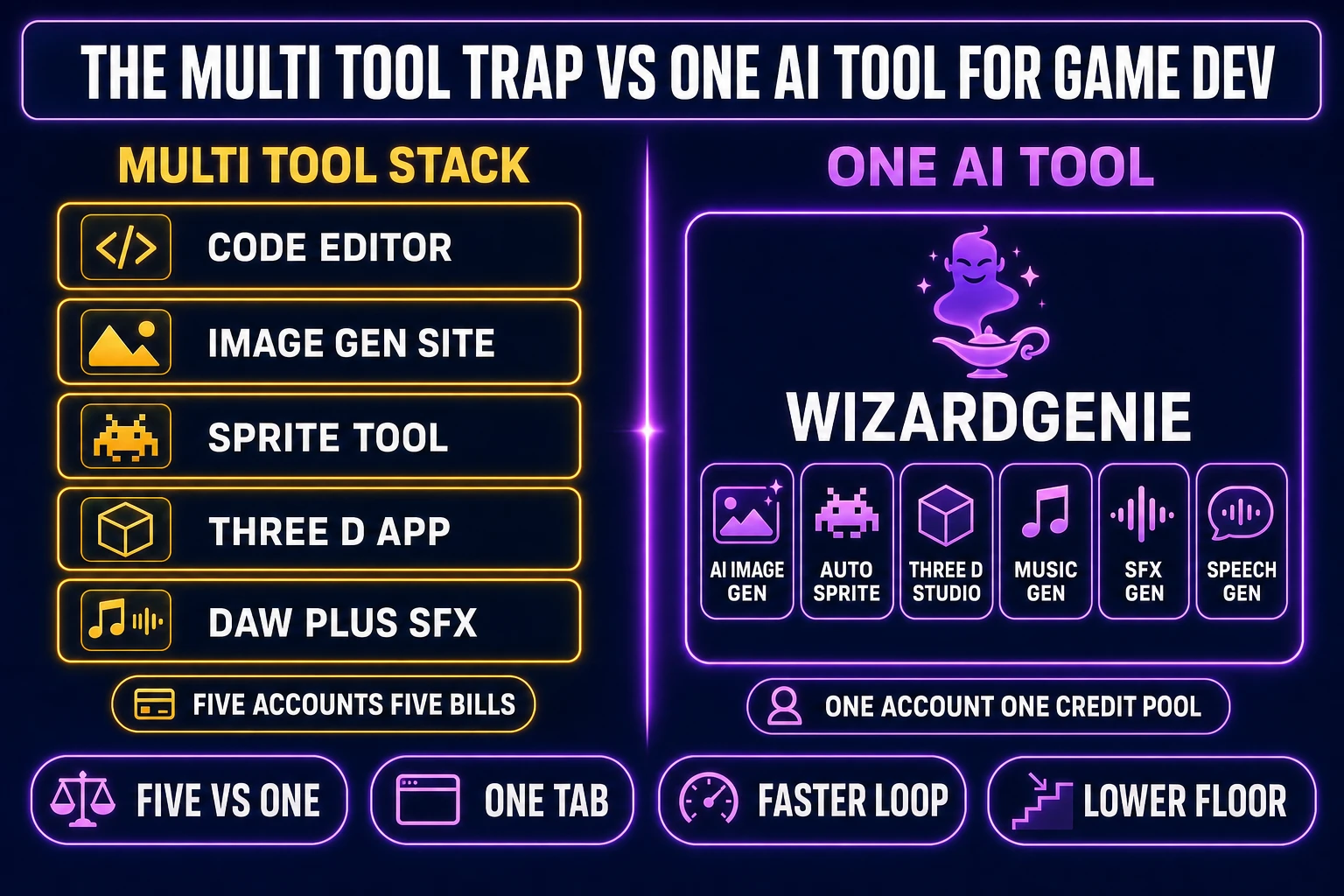
Multi-tool stack vs one ai tool for game development comparison - left column shows five separate boxes for code, image, sprite, 3D, and audio tools; right column shows WizardGenie as a single box with six inline asset-tool chips
The multi-tool trap versus the one-tool integrated pattern. Five accounts and five copy-paste cycles per asset on the left; one account, one credit pool, and one AI agent handling every asset request on the right. The workflow collapse is the actual value.

WizardGenie as the singular ai tool for game development

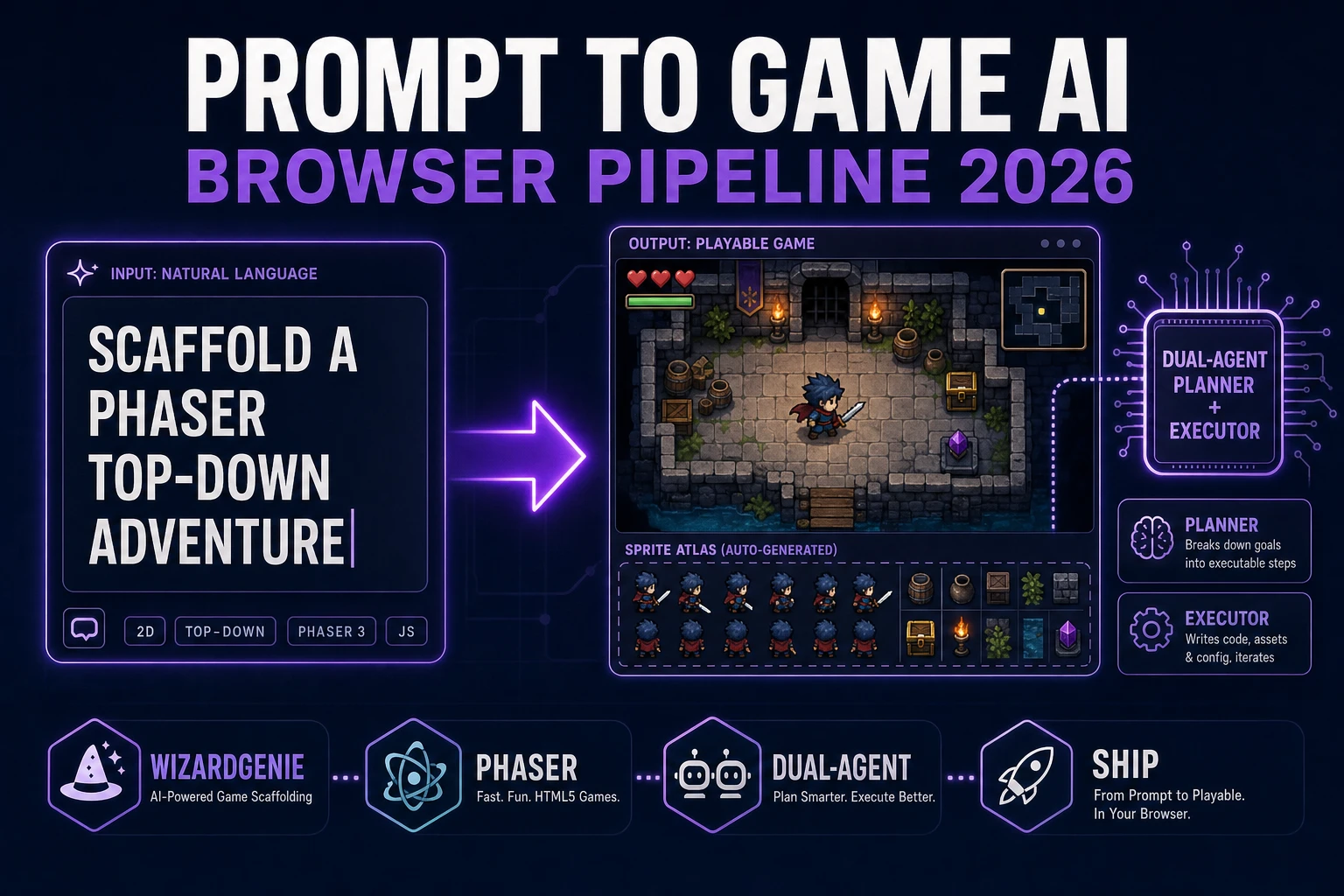
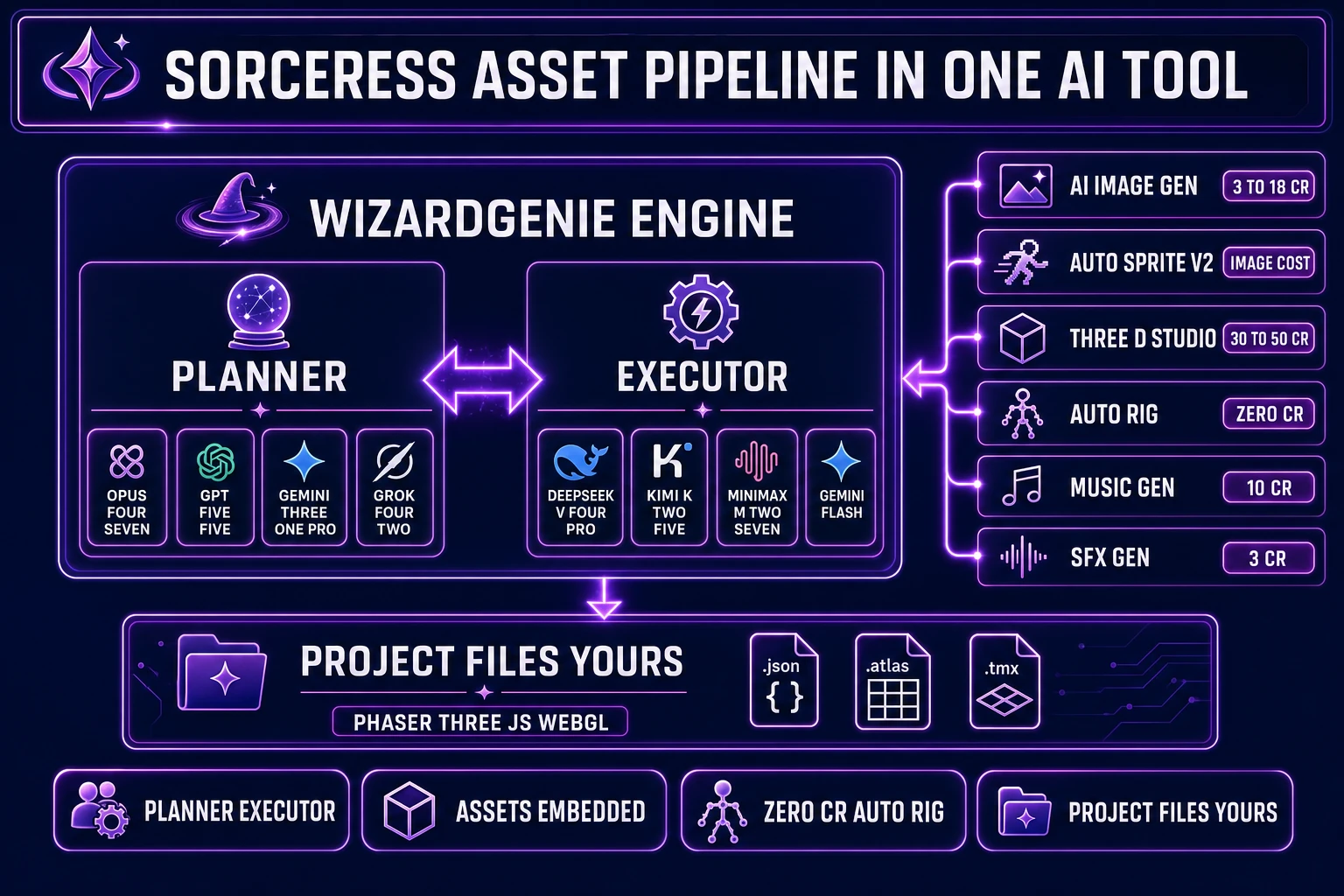
Sorceress WizardGenie is an integrated AI game engine, not a chat assistant that outputs code you paste elsewhere. Verified against src/app/wizard-genie/page.tsx line 295 on July 3, 2026, WizardGenie ships a dual-agent Planner plus Executor architecture: a top-tier reasoning model reads the game design brief, breaks the work into implementation steps, and hands each step to a cheap fast typing model that actually writes the code. The Planner reviews the Executor’s output before accepting it. Line 297 of the same file states the pattern verbatim: “A smart Planner thinks; a cheap Executor codes. Same quality at roughly a quarter of the token cost.”

The user picks which specific models fill each role from the CODING_MODELS lineup verified against src/app/_home-v2/_data/tools.ts lines 734 to 743 on July 3, 2026. Planner-eligible top-tier models: Claude Opus 4.7, Claude Sonnet 4.6, GPT-5.5, Gemini 3.1 Pro, and Grok 4.2. Executor-eligible cheap fast models: DeepSeek V4 Pro, Kimi K2.5, MiniMax M2.7, and (when it ships) Claude Haiku 4.5. This is a legitimate application of the standard multi-agent system pattern from computer-science literature, applied to coding: expensive reasoner thinks, cheap typer executes, expensive reasoner reviews. The economic point is that the token bulk of writing code (the Executor’s job) happens on the cheap model, while the Planner only spends tokens on the small strategic decisions where a frontier reasoner actually earns its cost.

The cost math is concrete. Claude Sonnet 4.6 runs approximately $3 per million input tokens and $15 per million output tokens (frontier tier). DeepSeek V4 Pro runs approximately $0.27 input and $1.10 output. On a WizardGenie session producing 200,000 tokens of Executor output (scaffolding, gameplay wiring, state machines), a single frontier model as sole coder costs $3 to $4 in raw token spend. The Planner-Executor split runs the Planner briefly (~10,000 Opus tokens for planning and review) and the Executor for the bulk (~200,000 DeepSeek V4 Pro tokens), landing the same session at $0.15 to $0.60. That is roughly a fifth of single-frontier cost, and it compounds hard across a full project. That is why an ai tool for game development shipping this pattern by default matters more than the raw benchmark ranking of any single model.
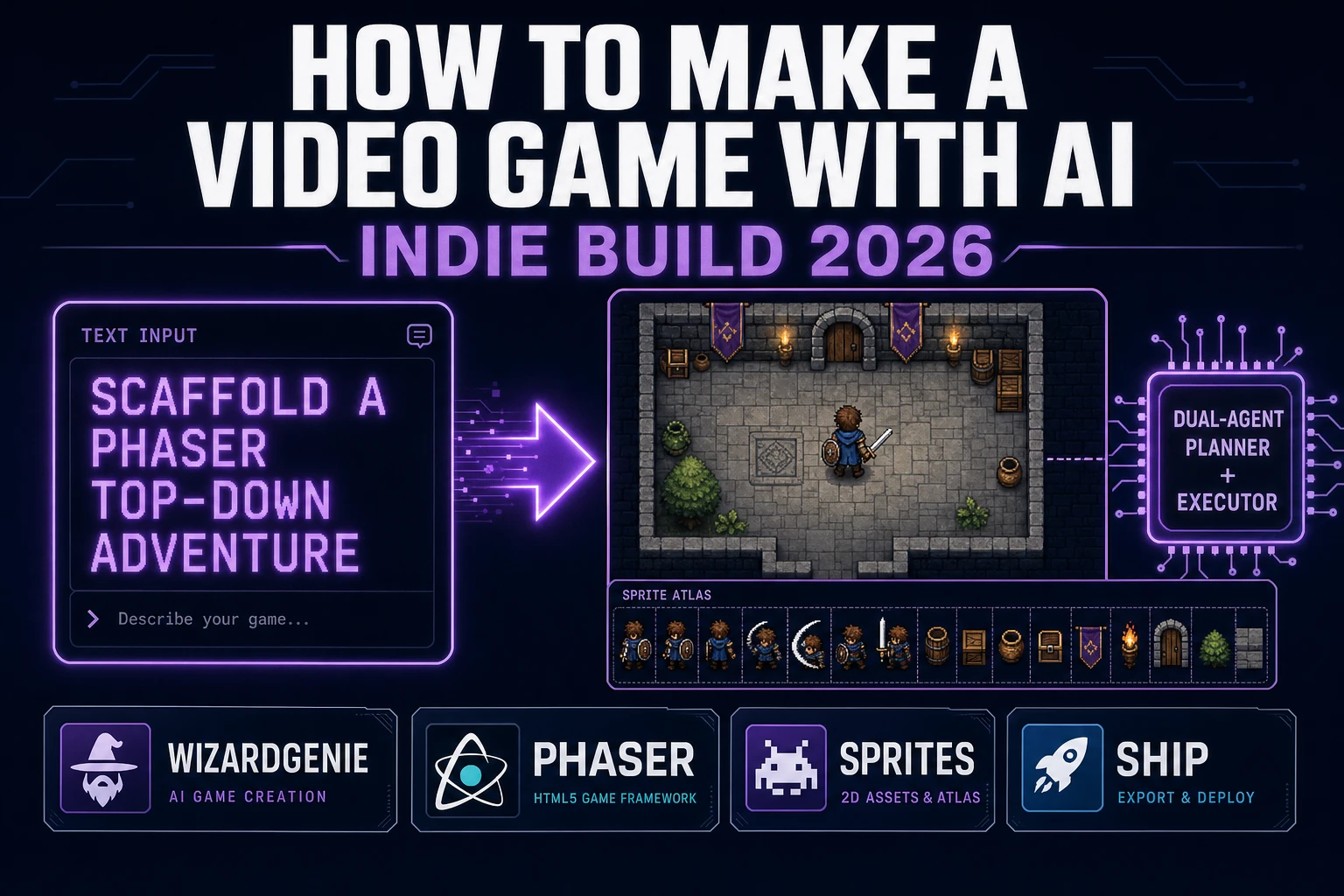
The Sorceress asset pipeline embedded in one ai tool for game development

The dual-agent code layer is only half of what makes WizardGenie the singular ai tool for game development. The other half is the embedded asset pipeline. Verified against src/app/wizard-genie/page.tsx lines 338 to 349 on July 3, 2026, the AI agent inside WizardGenie can call the following Sorceress tools directly without opening a separate tab.

AI Image Gen ships 12 flagship image models with per-generation credit costs verified against src/lib/models.ts: Z-Image at 3 credits, Wan 2.7 Image at 5, Flux 2 Pro at 6, Seedream 4.5 at 6, Seedream 5 Lite at 6, Nano Banana at 6, Grok Imagine at 6, GPT Image 1.5 at 7, GPT Image 2 at 7, Nano Banana 2 at 9, Wan 2.7 Image Pro at 10, and Nano Banana Pro at 18. Reference-image support is available on every model that exposes it in the underlying API, so a character can stay on-model across every art request in a session. Auto-Sprite v2 turns any generated character portrait into a sprite sheet with animation frames (idle, walk, run, attack) using the AI video pipeline to produce interpolated animation frames rather than a single static pose. 3D Studio lifts 2D concept art into 3D models via Pixal3D (browser-native, free during the current promo) plus paid image-to-3D models: Hunyuan 3D 3.1 at 30 credits, Tripo v3.1 at 40 to 50, Meshy 6 at 30 plus texture, Rodin 2.0 at 50, and Trellis 2 at 35 to 45. Auto-Rigging performs a 13-marker guided humanoid rig with zero credit cost (WebGL and WebGPU browser-native, verified against src/app/rigging/page.tsx).

Music Gen ships Suno V5.5 at 10 credits per generation (verified against src/app/music-gen/page.tsx line 26, MUSIC_CREDIT_COST = 10) plus lyric generation at 2 credits. SFX Gen ships Suno Sounds V5.5 and BytePlus Seed Audio 1.0 at 3 credits each (verified against src/app/sfx-gen/page.tsx line 24, SFX_CREDIT_COST = 3). Sound Studio writes Web Audio API code that synthesises ambience client-side at 1 credit per sound (verified against src/app/sound-creator/page.tsx line 28, SOUND_CREDIT_COST = 1). Speech Gen ships 17 voices with voice cloning for NPC dialogue and character narration. Tileset Forge turns generated art into engine-ready tilesets for 2D games.

The consequence is that the AI agent inside WizardGenie is not just writing code — it can spawn every art, audio, and rigging asset the game needs in the same session, on the same credit pool, without the developer opening a separate tab. When the prompt is “add a wizard boss to level 3,” the agent requests a character portrait from AI Image Gen, generates a sprite sheet via Auto-Sprite v2, wires an idle animation, requests a boss-fight music loop from Music Gen, requests three attack sound effects from SFX Gen, and drops all of it into the scene — then reports back with a preview of the running level. That is the full workflow collapse.

WizardGenie architecture with Planner Executor at the center and Sorceress asset pipeline column of six tools feeding into the engine with project files exported to Phaser Three.js and WebGL
The WizardGenie architecture at the singular ai tool for game development level: dual-agent Planner plus Executor in the center, full Sorceress asset pipeline embedded on the right (AI Image Gen, Auto-Sprite v2, 3D Studio, Auto-Rigging, Music Gen, SFX Gen), and real Phaser, Three.js, or WebGL project files as the output. Your code, your files, your project.

Where an ai tool for game development still needs human judgment

The category is not magic, and the honest limits matter more than the marketing sheets. Design taste still lives with the developer. An AI agent can implement a feature that looks like a competent version of the design brief, but distinguishing a merely-competent 2D platformer from a memorable one is a taste and design-craft problem the tool does not solve. The prompt-to-game path is only as good as the brief the developer wrote, and rewriting the brief is the highest-leverage activity on the project. Complex 3D physics, competitive multiplayer netcode with authoritative servers, and console-quality shaders sit at the edge of what current models handle reliably; expect to hand-edit code or bring in a human specialist on those layers.

Asset consistency across a long project is a work in progress. Reference-image locking works well within a session, but keeping a character on-model across a hundred generations over three months requires disciplined prompt hygiene and occasional manual touch-up. Sound-effect coverage is broad but not exhaustive; niche SFX may need supplementing with a licensed library. Every AI-generated asset should be reviewed for the license terms of the underlying model — Sorceress’s plans page covers commercial usage, but the developer is still responsible for confirming the specific asset license fits the intended distribution.

The cost of one ai tool for game development vs the five-subscription stack

The compounded cost delta between a singular ai tool for game development and a traditional multi-tool stack is real. Verified against src/app/plans/page.tsx lines 45, 49, and 56 on July 3, 2026, the Sorceress one-time Lifetime unlock is $49 (LIFETIME_PRICE constant) and covers the non-AI asset pipeline (Auto-Sprite v2, 3D Studio non-AI paths, Auto-Rigging, Procedural Walk, Tileset Forge). AI generation credits are pay-as-you-go from CREDIT_TIERS at line 49: Starter $10 for 1,000 credits ($0.01 per credit), Creator $20 for 2,000, Plus $50 for 5,000, Studio $100 for 10,000. WizardGenie access is via the Early Access pledge at $50 minimum for lifetime alpha and beta access to the desktop and browser AI game engine (WIZARDGENIE_PLEDGE_TIERS at line 56: $50 Early Access, $100 Champion, $250 Visionary, $500 Founding Patron).

A concrete indie project (a small 2D platformer with 3 characters, 5 levels, a music loop, and 30 SFX) consumes roughly 200 to 800 credits total. At $0.01 per credit that is $2 to $8 in AI generation. Add the $49 Lifetime unlock and $50 WizardGenie pledge (both one-time) and the total first-year cost lands near $100 to $110 for the full ai tool for game development stack. The comparable multi-tool stack: Adobe Photoshop $23 per month, Aseprite $20 one-time, Blender free, FL Studio Producer Edition $199 one-time or $10 per month rental, Audacity free, plus a separate AI coding subscription ($20 per month entry tier), plus a game-engine seat. Total first-year cost lands between $500 and $1,500 depending on tool picks. The integrated tool is not universally cheaper — if the developer already owns Photoshop and FL Studio outright, the delta narrows — but for a first-time indie without those specialised tools, the integrated stack is roughly a fifth to a tenth of the cost floor.

The verdict on the 2026 ai tool for game development matrix

The honest 2026 answer to “which one ai tool for game development?” depends on the shipping target and the developer’s existing skill stack. For a browser-first indie 2D or 3D title with a small team (one to five people), a jam entry, an educational project, or a rapid prototype that needs to iterate faster than five separate tools can support, an integrated ai tool for game development like Sorceress WizardGenie collapses the workflow into one browser tab with a dual-agent Planner plus Executor at the code layer and the full asset pipeline on tap. The workflow speed and cost floor are strictly better than a multi-tool stack for that shipping target. Real project files (Phaser 2D, Three.js 3D, vanilla WebGL) live on your filesystem in the desktop build or your account in the browser build; the game runs anywhere WebGL runs, which is essentially every modern device. For AAA console production, VR titles at consumer scale, or a project where a specific asset layer is the star and needs the deepest specialised tool available, the multi-tool stack still wins on ceiling.

Sibling posts: the full Sorceress stack overview covers every tool in the pipeline in more detail; the best-AI comparison covers the umbrella-tier lineup; the AI-in-game-development reality check covers honest limits by genre; the indie stack for game developers covers the workflow angle; and the AI game maker matrix covers pricing across categories. If your project matches the browser-first indie profile, wield an integrated ai tool for game development like WizardGenie today; if not, borrow the integrated tool for the fast layers and pair it with specialised tools for the slow ones.

Frequently Asked Questions

What exactly counts as an ai tool for game development in 2026 and how is it different from an AI coding agent?

An ai tool for game development in 2026 is a tool that handles more than just the code layer. Game development is a compound discipline: it needs code (the runtime logic), art (sprites, 3D models, textures), audio (music, sound effects, voice), and assembly (scene composition, asset wiring, build export). An AI coding agent like a bare vibe-coding editor solves only the code layer, so treating it as an ai tool for game development leaves four layers unsolved and forces the developer to bolt on five separate subscriptions (an image generator, a sprite-sheet tool, a 3D model service, a music generator, a sound-effect service). The 2026 category of ai tool for game development that Sorceress WizardGenie occupies collapses all five layers into one browser tab: the AI agent inside the editor writes the code, but it can also request images from AI Image Gen, 3D models from 3D Studio, music from Music Gen, sound effects from SFX Gen, ambience from Sound Studio, and character voices from Speech Gen on your behalf, all against the same shared credit pool. Verified July 3, 2026 against src/app/wizard-genie/page.tsx line 295 and the WizardGenie tools catalog in the same file (dual-agent Planner plus Executor architecture, asset-pipeline tool bindings).

How much does an ai tool for game development cost in 2026 if I want the full asset pipeline?

Cost math verified July 3, 2026 against src/app/plans/page.tsx line 45 and line 49. The one-time Sorceress Lifetime unlock is $49 (LIFETIME_PRICE constant, line 45) and covers the full non-AI asset pipeline including Auto-Sprite v2, 3D Studio, Auto-Rigging, Procedural Walk, and Tileset Forge for lifetime use with no monthly subscription. AI generation credits are pay-as-you-go from the standard Sorceress credit pool (CREDIT_TIERS at line 49): Starter $10 buys 1,000 credits ($0.01 per credit), Creator $20 buys 2,000, Plus $50 buys 5,000, and Studio $100 buys 10,000. An indie developer building a small 2D platformer typically consumes 200 to 800 credits over the entire project (roughly $2 to $8): about 30 image generations at 3 to 18 credits each (Z-Image at 3 up to Nano Banana Pro at 18 per src/lib/models.ts), 5 to 10 music loops at 10 credits each via Music Gen, 20 to 40 sound effects at 3 credits each via SFX Gen, and unlimited Auto-Rigging (zero credits, browser-native WebGL). WizardGenie access is currently via the Early Access pledge tier at $50 minimum for lifetime alpha and beta access to the desktop and browser AI game engine (WIZARDGENIE_PLEDGE_TIERS at line 56, tiers $50 Early Access Supporter, $100 Champion, $250 Visionary, $500 Founding Patron). The comparable multi-tool stack (Photoshop $23/mo, Aseprite $20 one-time, Blender free, FL Studio $99 one-time, Audacity free, plus a separate AI coding subscription at $20/mo minimum) runs $500 to $1,500 in first-year cost for a similar capability set, mostly locked into monthly rent.

Why does WizardGenie use a dual-agent Planner plus Executor pattern and what does that actually save?

Sorceress WizardGenie ships a dual-agent architecture verified against src/app/wizard-genie/page.tsx line 295 and line 297 on July 3, 2026: ‘Dual-agent Planner plus Executor’ and ‘A smart Planner thinks; a cheap Executor codes. Same quality at roughly a quarter of the token cost.’ A top-tier reasoning model (Claude Opus 4.7, GPT-5.5, Gemini 3.1 Pro, or Grok 4.2) acts as the Planner. It reads the game design brief, breaks the work into concrete implementation steps, and reviews the code the Executor produces. A cheap fast model (DeepSeek V4 Pro, Kimi K2.5, MiniMax M2.7, Gemini 3.1 Flash, GPT-5.5 Mini, or Claude Haiku 4.5 when it ships) is the Executor. It handles the token bulk of writing the actual code. This matters because on a typical game feature session (roughly 200,000 tokens of Executor output for scaffolding, gameplay wiring, and state-machine logic), running a single frontier model as the sole coder would cost roughly $3 to $4 in token spend at Anthropic Claude Sonnet 4.6 rates (approximately $3 input, $15 output per million tokens). The Planner-Executor split runs the Planner briefly (about 10,000 Opus tokens for planning and review) and the Executor for the bulk (about 200,000 DeepSeek V4 Pro tokens at roughly $0.27 input and $1.10 output per million tokens), landing the same session at $0.15 to $0.60 total. That is roughly a fifth of single-frontier cost, compounded across a real project. The CODING_MODELS lineup is verified against src/app/_home-v2/_data/tools.ts lines 734 to 743.

Can an ai tool for game development actually replace a game engine like Unity or Unreal?

Honest answer verified July 3, 2026: not for AAA-scale console production, and it does not try to. An ai tool for game development targets a specific segment of the game-dev market: browser-first indie 2D games, prototyping, jam entries, small commercial titles, education, and rapid iteration on gameplay ideas. WizardGenie’s runtime output is real project files in the Phaser (2D arcade and platformer), Three.js (3D scene), or vanilla WebGL (custom pipeline) frameworks. Those runtimes are legitimate ship targets for browser games and can be wrapped for Steam release via a WebView shell if desired, but they do not compete with Unreal Engine 5’s Nanite virtualised geometry or Unity’s mobile-optimized runtime for AAA titles. The relevant comparison is not ‘AI tool versus Unity’ but ‘integrated AI tool versus multi-tool stack for the same shipping target.’ For a browser-first indie 2D or 3D title, an integrated ai tool for game development like WizardGenie collapses the workflow that traditionally takes Unity or Godot plus Photoshop plus Aseprite plus Blender plus FL Studio plus Audacity plus a separate AI coding agent into one browser tab. That is the honest positioning: broader target market, faster iteration loop, lower cost floor, at the cost of not being the tool a AAA studio would pick for a 200-person console project.

What does the full Sorceress asset pipeline embedded inside one ai tool for game development actually deliver?

Verified July 3, 2026 against src/app/wizard-genie/page.tsx lines 338 to 349 (embedded-tool bindings), src/lib/models.ts (image models with credit costs), and each individual tool page. The AI agent inside WizardGenie can call the following Sorceress tools directly without asking the developer to open a separate tab. AI Image Gen ships 12 flagship image models with per-generation credit costs: Z-Image at 3 credits, Wan 2.7 Image at 5, Flux 2 Pro at 6, Seedream 4.5 at 6, Seedream 5 Lite at 6, Nano Banana at 6, Grok Imagine at 6, GPT Image 1.5 at 7, GPT Image 2 at 7, Nano Banana 2 at 9, Wan 2.7 Image Pro at 10, and Nano Banana Pro at 18. Auto-Sprite v2 turns any generated image into a sprite sheet with animation frames. 3D Studio ships Pixal3D (browser-native, free during the current promo) plus paid image-to-3D models (Hunyuan 3D 3.1 at 30 credits, Tripo v3.1 at 40 to 50, Meshy 6 at 30 plus texture, Rodin 2.0 at 50, Trellis 2 at 35 to 45). Auto-Rigging performs a 13-marker guided humanoid rig with zero credit cost (WebGL and WebGPU browser-native, verified against src/app/rigging/page.tsx and src/lib/rigging/*). Music Gen ships Suno V5.5 at 10 credits per generation (src/app/music-gen/page.tsx MUSIC_CREDIT_COST = 10). SFX Gen ships Suno Sounds V5.5 and BytePlus Seed Audio 1.0 at 3 credits each (src/app/sfx-gen/page.tsx SFX_CREDIT_COST = 3). Sound Studio writes Web Audio API code that synthesises ambience client-side at 1 credit per sound (src/app/sound-creator/page.tsx SOUND_CREDIT_COST = 1). Tileset Forge turns generated art into tilesets. Speech Gen ships 17 voices with voice cloning for character dialogue. Every asset flows into the same project without a copy-paste round trip.

What is the honest downside of picking one ai tool for game development instead of assembling a multi-tool stack?

Two honest downsides worth naming. First, a single integrated tool does not have the best-in-class ceiling of every specialised competitor at every layer. Aseprite is a stronger pixel-art editor than any AI image generator plus sprite-sheet tool for high-end pixel-art work; Blender has deeper 3D-modeling and animation features than any browser 3D tool for complex character work; a professional DAW like FL Studio has deeper mixing and mastering than Music Gen for a soundtrack you want to sell as a stand-alone album. If a specific layer is the star of your project (a beautifully hand-drawn pixel-art platformer, a Blender-authored cinematic 3D showcase), the specialised tool at that layer will beat the integrated tool at that layer alone, and the integrated ai tool for game development is not the right pick for that specific layer. Second, an integrated tool is a single-vendor dependency. If Sorceress raises credit prices, changes the WizardGenie licensing terms, or sunsets a specific asset tool, the project depends on that single company continuing to operate. The multi-tool stack diversifies that risk across five vendors. The honest verdict: pick an integrated ai tool for game development when workflow speed, cost floor, and browser-native iteration matter more than best-in-class ceiling at every layer. Pick a multi-tool stack when a specific layer is the star of the project and you want the deepest tool at that layer regardless of the assembly cost.

Sources

  1. Video game development (Wikipedia)
  2. Game engine (Wikipedia)
  3. Phaser (game framework) (Wikipedia)
  4. Three.js (Wikipedia)
  5. WebGL (Wikipedia)
  6. Multi-agent system (Wikipedia)
  7. Web Audio API (Wikipedia)
Written by Arron R.·2,497 words·11 min read

Related posts