Tap the Best Free AI Model for Coding (Indie 2026)

By Arron R.13 min read
The best free AI model for coding in 2026 is three models stacked: Claude Sonnet 4.6 on claude.ai for quality, DeepSeek V4 Pro on chat.deepseek.com for volume,

Type best free ai model for coding into Google on June 28, 2026 and the top results are mostly listicles that quietly assume you will accept a $20-per-month subscription before you finish the article. The honest indie answer is shorter and stranger: every frontier vendor — Anthropic, OpenAI, Google, DeepSeek, Moonshot, xAI — ships a real free tier in 2026, but every one of those tiers is hard-capped tight enough that you cannot ship a full game on pure vendor-free access. The combination that actually gives an indie dev a usable runway is the eight-model picker inside WizardGenie plus the 100 starter credits every new Sorceress account gets at signup, verified June 28, 2026 against src/app/api/admin/credits/route.ts and each vendor’s live free-tier documentation. This piece is the honest map.
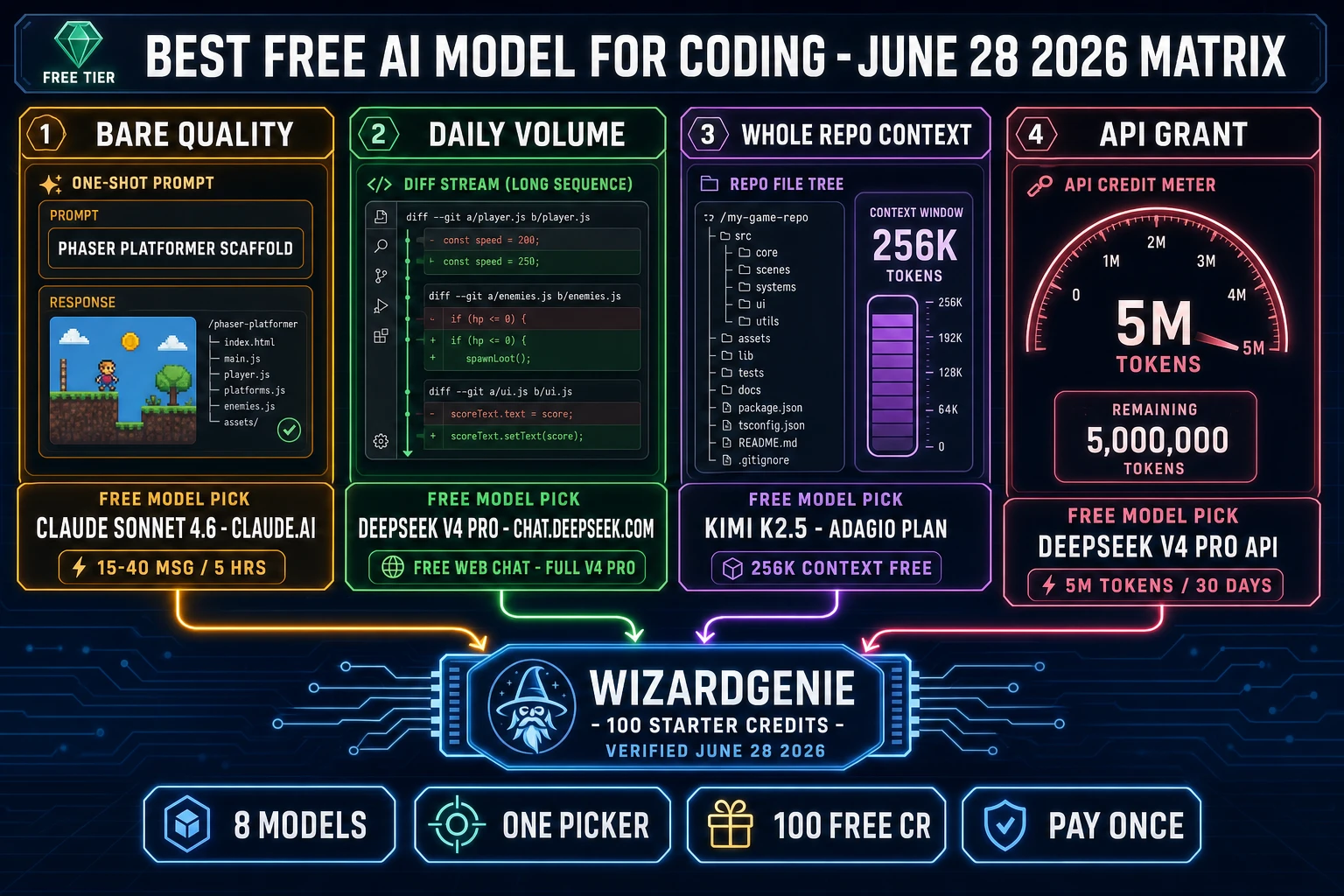
Best free ai model for coding in 2026 - free-tier matrix for Claude Sonnet 4.6, GPT-5.x, Gemini Flash, DeepSeek V4 Pro, Kimi K2.5, Grok 3, and MiniMax M2.7 mapped against the WizardGenie 100-starter-credit indie path verified June 28, 2026
The honest 2026 free-tier matrix. Every frontier vendor ships some free path; none of them ship enough free to finish a game. The 100 starter credits in WizardGenie close the gap.

What “best free ai model for coding” actually means in mid-2026

Readers searching for the best free ai model for coding in 2026 are asking a question with three honest answers stacked on top of each other. The first answer is the bare leaderboard pick — which free-accessible model writes the cleanest code on a single prompt. The second is the daily-flow pick — which free tier lasts long enough to support an hour of edits before locking out. The third is the indie-build pick — which free path can plausibly ship a real game without forcing a subscription before the first playable build.

Those three answers do not point at the same model. The model that wins a one-shot SWE-bench prompt is almost never the model whose free tier holds up for an eight-hour project session, and neither of those is the model an indie dev should actually rely on when the goal is a finished game rather than a sample prompt. The sister piece at Choose the Best AI Model for Coding Right Now walks the paid current-state ranking. This post walks the harder free question.

The framing matters because in 2026 the gap between “has a free tier” and “has a useful free tier for game dev” widened sharply. Three things happened in the last six months: Google killed the free tier for Gemini Pro on April 1, 2026, OpenAI tightened the GPT-5.x free cap to roughly 10 messages per five-hour window with silent auto-downgrade to GPT-4o mini, and Anthropic kept Claude Opus 4.7 entirely paid while leaving Sonnet 4.6 and Haiku 4.5 on the free side. The free coding-AI market is now genuinely split into “chat-window free” (limited messages on a vendor chat page) and “API-credit free” (small one-time grants like DeepSeek’s 5M tokens). Each one solves a different slice of the indie problem.

The eight WizardGenie coding models — and which ones have a free path in 2026

Verified June 28, 2026 against src/app/_home-v2/_data/tools.ts CODING_MODELS, the live picker inside WizardGenie and the lower-level Sorceress Code chat-and-diff interface ships these eight frontier large language models, with the free-tier status of each verified against the vendor’s own current documentation:

  • Claude Opus 4.7 (Anthropic, tag Top tier) — No free tier. Opus has stayed paid-only across the entire 4.x cycle. Free claude.ai accounts get Sonnet 4.6 and Haiku 4.5 only; verified June 28, 2026 against the Anthropic free-plan documentation.
  • Claude Sonnet 4.6 (Anthropic, tag Fast + smart) — Free on claude.ai. Roughly 15–40 messages per rolling five-hour window, with usage governed by an unpublished rolling allowance rather than a fixed daily cap. Pro is defined as “at least 5x the free per-session usage” in Anthropic’s own pricing copy.
  • GPT-5.5 (OpenAI, tag Frontier) — Limited free on chatgpt.com. Roughly 10 GPT-5.x messages per rolling five-hour window, with silent auto-downgrade to GPT-4o mini after the cap. Free users who opted out of personalized ads see roughly half that — 5 messages per three-hour window. No free GPT-5.5 API access.
  • Gemini 3.1 Pro (Google, tag 1M context) — No free tier. Pro models (Gemini 2.5 Pro, 3 Pro, 3.1 Pro) all went paid-only April 1, 2026. Free Gemini API access is limited to Flash and Flash-Lite variants at 10–30 RPM and 1,500 RPD. The 2M context window that makes Gemini Pro useful is paid-only as of today.
  • DeepSeek V4 Pro (DeepSeek, tag Budget) — Free web chat + 5M-token API grant. The web chat at chat.deepseek.com runs V4 Pro and V4 Flash for free with fair-use throttling. New API accounts get a one-time 5M-token grant valid for 30 days, no credit card. Open-weights MIT-licensed model; the cheapest credible paid rate at $0.435 input / $0.87 output per million tokens.
  • Kimi K2.5 (Moonshot, tag 256K coding) — Free Adagio plan. Roughly 30–50 messages per day on K2.5 chat with the full 256K context window, six agent tasks per month, no Agent Swarm. Paid Moderato tier starts at $19/month for higher limits.
  • Grok 4.2 (xAI, tag 2M context) — Limited free on grok.com. Roughly 10 Grok 3 Turbo messages per rolling two-hour window on the free plan, with a separate Grok 4 trial of approximately 5 messages per 12-hour window. Free users do not get the multi-agent 2M-context variant.
  • MiniMax M2.7 (MiniMax, tag Agent-ready) — Free chat available. The tool-calling specialist ships a free chat tier; usage limits track the standard frontier-vendor pattern of a few dozen messages per rolling window.

Five of the eight have a real free path. Three do not. The free path covers different slices: Sonnet 4.6, Kimi K2.5, and DeepSeek V4 Pro are the strongest free options for actual coding work, GPT-5.x and Grok 3 are usable but tighter, and Opus 4.7 plus Gemini 3.1 Pro require payment in any form.

The honest free-tier matrix — verified June 28, 2026

The free-tier landscape rotates faster than the paid one. The numbers below were re-verified against each vendor’s live documentation today, June 28, 2026, because the May matrix is already wrong on at least three rows.

Model Free surface Roughly how much Reset window Free-tier ceiling
Claude Sonnet 4.6 claude.ai chat ~15–40 messages Rolling 5 hours No Opus 4.7, no Claude Code
Claude Haiku 4.5 claude.ai chat ~30–60 messages Rolling 5 hours Smaller model than Sonnet
GPT-5.x chatgpt.com chat ~10 messages Rolling 5 hours Auto-downgrade to GPT-4o mini after cap
Gemini 3.5 Flash API + AI Studio 15 RPM / 1,500 RPD Per minute + per day Pro models paid-only since April 1
DeepSeek V4 Pro chat.deepseek.com + 5M-token API grant Unlimited chat / 5M tokens API Fair use / 30-day grant Server-busy throttling at peak
Kimi K2.5 kimi.com Adagio plan ~30–50 messages/day Daily 6 agent tasks/month, no Agent Swarm
Grok 3 Turbo grok.com + x.com ~10 messages Rolling 2 hours No Grok 4 Heavy, no DeepSearch
MiniMax M2.7 Vendor chat Tens of messages/day Rolling daily Limited agent-tool quota

Two patterns jump out of that matrix. First, none of the free chat tiers ship the same model behind the paid API — Claude free is Sonnet not Opus, ChatGPT free is GPT-5.x with silent fallback to a smaller mini, Gemini free is Flash not Pro. Second, the only vendor that ships its strongest model on the free chat surface is DeepSeek, which has been quietly the most generous free coding option in the market since V4 Pro launched in April. The cost to the vendor is real; the value to the indie dev is also real.
The best free ai model for coding by job — and what each free tier breaks

Free-tier choice in 2026 is dominated by which constraint hits first. The right pick for an indie dev shipping a real game changes based on whether the limiter is daily volume, reasoning quality, or context size.

  • Bare quality, single prompt. The free-tier winner is Claude Sonnet 4.6 on claude.ai. Sonnet on the free side handles full game scaffolds at quality close to the paid Sonnet experience — the model is identical, only the message budget differs.
  • Daily volume, long session. The free-tier winner is DeepSeek V4 Pro at chat.deepseek.com. The free web chat does not silently downgrade, does not cap at 10 messages per five hours, and routes to the full V4 Pro rather than a smaller fallback. Server-busy throttling exists at peak, but a focused two-hour coding session usually clears.
  • Whole-repo context. The free-tier winner is Kimi K2.5 on kimi.com. The Adagio free plan ships the same 256K context window that paid users get, which is enough to drop an entire small Phaser or Three.js project into one prompt without truncation. No other free tier ships 256K context.
  • API-first workflow. The free-tier winner is DeepSeek V4 Pro, with the 5M-token one-time grant. That is roughly 20 hours of coding-agent work at typical session sizes, enough to get a real project past the early-prototype wall before the grant expires.
  • Long context inside a coding agent. No free tier wins this. Gemini 3.1 Pro and Grok 4.2 multi-agent are paid-only above the Flash and Grok-3-Turbo entry tiers; the genuinely 1M+ context window is not available free for either provider in 2026.

What breaks each tier matters as much as what wins it. Sonnet 4.6 free runs out of messages roughly an hour into a focused session. GPT-5.x free silently swaps to GPT-4o mini after about 10 messages, which most users do not notice until the code quality drops. Gemini Flash is fine for chat but cannot run the 2M-context whole-repo pattern that makes Gemini Pro useful. Grok 3 Turbo gives ten messages before locking out for two hours. The pattern is clear: every vendor designed the free tier to demonstrate quality, not to support a full game-dev day.

The 100-starter-credit angle — how Sorceress gives indie devs a real free runway

The honest gap in the vendor free-tier landscape is the eight-hour-coding-day shape. None of the vendor chat surfaces supports it without paid escalation; the API free grants run out before a real project is past prototype; the free pro models are gone everywhere except DeepSeek. The path that actually closes the gap for an indie game dev in 2026 is the 100 starter credits Sorceress grants every new account on signup, verified June 28, 2026 against src/app/api/admin/credits/route.ts at the SIGNUP_GRANT = 100 constant.

The math works because WizardGenie routes the same eight coding models through one shared credit pool. A turn with DeepSeek V4 Pro inside WizardGenie costs a small fraction of a credit at the underlying $0.435 / $0.87 per million tokens rate; a turn with Sonnet 4.6 costs noticeably more; an Opus 4.7 reasoning turn costs the most. The picker is per-message, so a frugal indie dev can do the heavy planning on Opus 4.7 for a single turn, route the next twenty typing turns to DeepSeek V4 Pro, and stretch 100 credits across a multi-day session. That is a different shape of free runway than any single-vendor free tier.

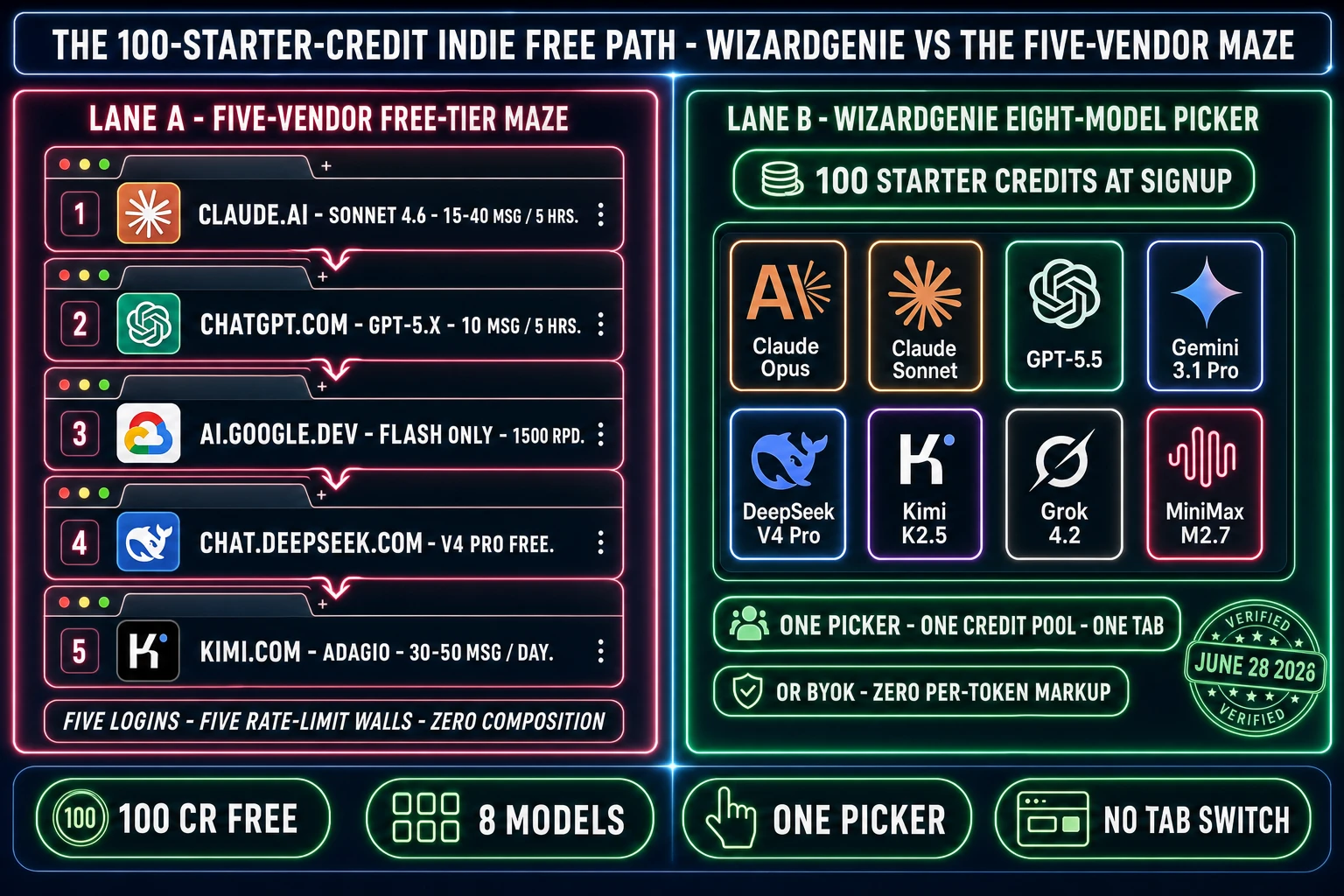
The longer-term math is also better than the vendor-by-vendor alternative. A naive indie stack of free vendor accounts — Claude free, ChatGPT free, Gemini Flash free, DeepSeek web chat, Kimi Adagio — gives you five logins, five rate-limit walls, five different message pools, and zero way to compose the models against each other. The 100-credit WizardGenie path collapses those five logins into one tab, one picker, and one credit balance. The pay-once credit tiers — Starter $10 for 1,000 credits, Creator $20 for 2,000, Plus $50 for 5,000, Studio $100 for 10,000 — never expire, so when 100 starter credits run out, $10 buys 1,000 more without a recurring subscription. The $49 Lifetime fee unlocks every tool tab including 3D Studio, Quick Sprites, Music Gen, and the rest of the tool catalog as a one-time payment.

The bring-your-own-key endpoint is the third free path. Indie devs who already pay DeepSeek or Kimi directly can route their existing API keys through WizardGenie at zero per-token markup; the picker becomes a free interface layer on top of the developer’s own paid API access. That is structurally different from the vendor chat surfaces, which keep the model and the interface coupled.

The 100-starter-credit indie free path in WizardGenie - Sorceress signup grants 100 credits to the eight-model coding picker, comparison against naive five-vendor free-tier stack with five rate-limit walls and zero composition between models, verified June 28, 2026 against src/app/api/admin/credits/route.ts SIGNUP_GRANT constant
The 100-starter-credit path collapses the five-vendor free-tier maze into one picker, one credit pool, and one tab. Verified June 28, 2026 against src/app/api/admin/credits/route.ts.

Planner+Executor on a budget — pairing a free planner with a cheap executor

The Planner+Executor pattern matters more on a budget than on an unlimited credit balance. The mechanics are mechanical: the typing side of any long agent session burns roughly 90% of the tokens, the planning side burns the other 10%, and the per-token cost on a frontier reasoner sits roughly 10x to 30x above the same tokens on a budget model. Routing the typing to a cheap model collapses total session cost to roughly one-fifth of single-frontier cost with planning quality intact.

On a 100-starter-credit budget, that ratio is the difference between a six-hour project session and a sixty-minute one. The right pairings inside WizardGenie route the heavy reasoning to an acceptable Planner — Claude Opus 4.7, GPT-5.5, Gemini 3.1 Pro, or Grok 4.2 — and the typing side to an acceptable Executor: DeepSeek V4 Pro, Kimi K2.5, MiniMax M2.7, Gemini 3.1 Flash, GPT-5.5 Mini, or Claude Haiku 4.5 when the project benefits from staying inside one tokenizer family. The hard rule is that Sonnet, Opus, GPT-5.5, and Gemini Pro never sit on the typing side — that pairing erases the cost advantage the pattern exists to deliver. The sister piece at Best Vibe Coding Tools for Building Games walks the full Planner+Executor playbook.

The free-tier composition of that pattern is the interesting one for indie devs. The Planner role can route to Sonnet 4.6 on the free claude.ai surface for the planning turns — one turn per major decision, which lands inside the 15–40 messages per five-hour window comfortably — while the typing turns route to DeepSeek V4 Pro on its free web chat or under the 5M-token API grant. The credits the indie dev spends inside WizardGenie cover the orchestration and the model swaps; the underlying inference is split across vendors’ free surfaces. That is a real free runway for shipping a game.

What “free” actually costs you in shipped games

The honest framing on the free path: it has costs, just not invoiced ones. Switching browser tabs to copy a long Sonnet 4.6 response from claude.ai into your editor, then opening chat.deepseek.com for the next typing turn, then back to claude.ai for the architecture cross-check, is a real tax on attention. The free path also breaks at the moment a project actually needs the heaviest model — the genuine Opus 4.7 or Gemini 3.1 Pro turn — because those have no free surface in 2026.

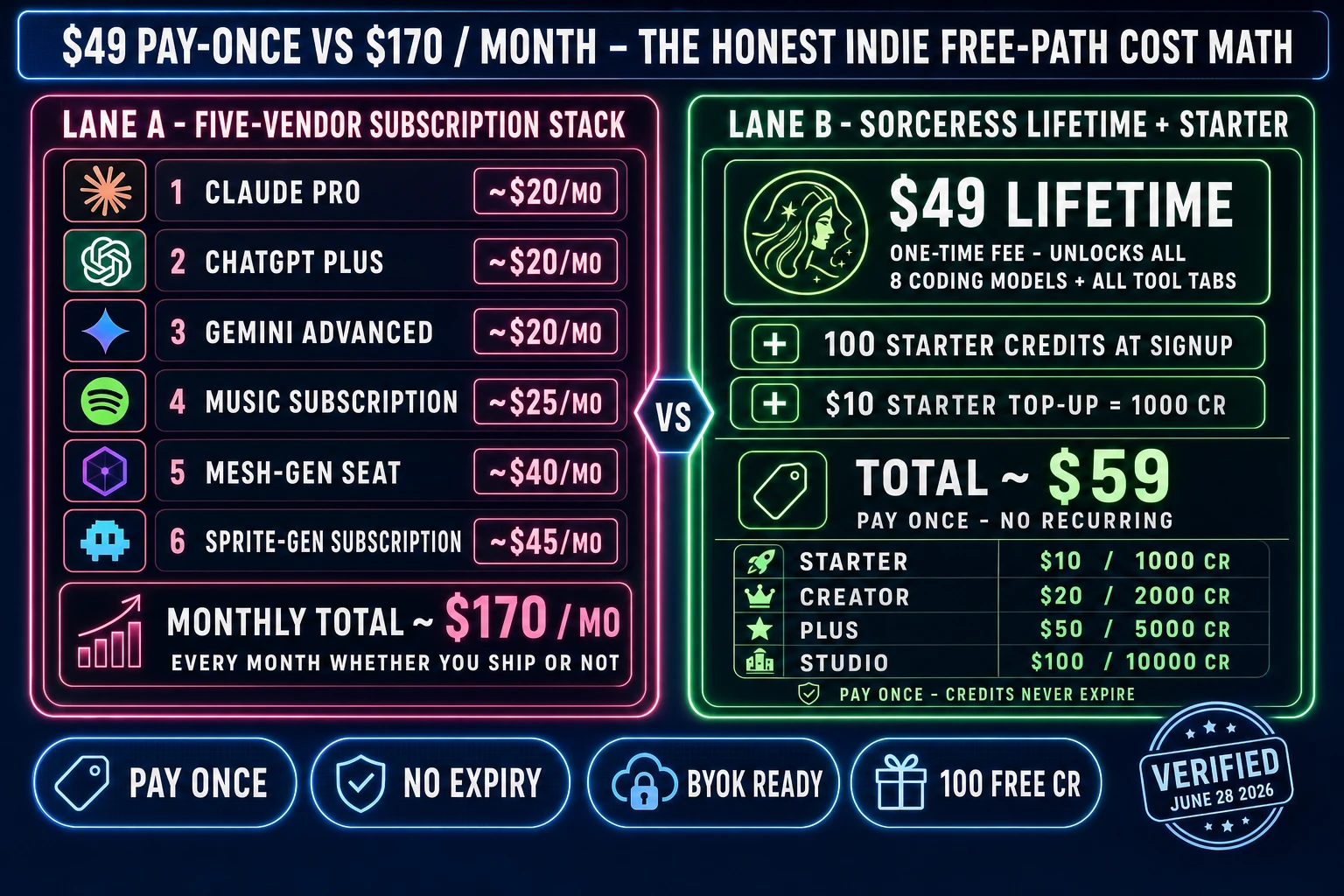
The $49 Lifetime fee plus the 100 starter credits removes the tab-switching tax and unlocks every tool tab including AI Image Gen for sprites, 3D Studio for image-to-3D, Music Gen for soundtracks, and the rest of the catalog. The naive subscription alternative — Claude Pro at $20 per month, ChatGPT Plus at $20 per month, Gemini Advanced at $20 per month, plus a music subscription, plus a mesh-generation seat, plus a sprite-generator subscription — lands roughly $170 every month, every month, whether the dev ships a game or zero games. The $49 one-time fee plus pay-once credits is structurally cheaper for any project that takes more than three months to ship.

Free is real. Free is also bounded. The right move for an indie dev who actually wants to ship a game is to use the 100 starter credits and the vendor free tiers in parallel: 100 credits in WizardGenie covers the orchestration and the heavy planner turns, the free vendor surfaces cover the daily typing turns, and the $10 Starter top-up sits in reserve for the project session where free runs out at hour seven.

Free path cost comparison for indie game dev in 2026 - left lane shows five-vendor free-tier subscription stack at $170 per month with tab-switching tax and rate-limit walls, right lane shows Sorceress 100 starter credits + $49 Lifetime + $10 Starter top-up totaling $59 pay-once with no recurring fee, verified June 28, 2026 against src/app/plans/page.tsx LIFETIME_PRICE and CREDIT_TIERS constants
The honest cost math. $59 pay-once beats $170 per month recurring for any indie project longer than three months. Verified June 28, 2026 against src/app/plans/page.tsx LIFETIME_PRICE = 49 and CREDIT_TIERS.

The verdict on the best free ai model for coding in 2026

The honest answer changes by job. For pure quality on a free chat surface, Claude Sonnet 4.6 on claude.ai is the best free ai model for coding in 2026, full stop — the model is identical to the paid Sonnet, only the message budget differs. For daily volume without silent downgrades, DeepSeek V4 Pro at chat.deepseek.com is the best free ai model for coding because the free web chat routes to the full V4 Pro rather than a smaller fallback, and the 5M-token API grant adds a real runway for indie projects. For whole-repo context inside a free tier, Kimi K2.5 on the Adagio plan is the only choice that ships a real 256K context window without payment.

The unifying answer for an indie game dev is to use all three — through the WizardGenie picker — rather than pick just one. The 100 starter credits at signup cover the orchestration, the eight-model picker handles the routing without tab-switching, and the pay-once credit tiers replace recurring subscriptions when the free runway runs out. That is the honest 2026 free path. Verified June 28, 2026.

Frequently Asked Questions

What is the best free AI model for coding in 2026?

Verified June 28, 2026 against each vendor's live free-tier documentation, the best free AI model for coding in 2026 depends on the constraint that hits first. For pure quality on a free chat surface, Claude Sonnet 4.6 on claude.ai is the winner because the free-tier model is identical to paid Sonnet (only the message budget differs at roughly 15-40 messages per rolling 5-hour window). For daily volume without silent downgrades, DeepSeek V4 Pro at chat.deepseek.com is the winner because the free web chat routes to the full V4 Pro rather than a smaller fallback model. For whole-repo context inside a free tier, Kimi K2.5 on the Adagio plan is the only free tier shipping a real 256K context window without payment.

Is Claude Opus 4.7 available on the free tier in 2026?

No. Verified June 28, 2026 against the Anthropic free-plan documentation, Claude Opus 4.7 has stayed paid-only across the entire 4.x cycle. Free claude.ai accounts receive Claude Sonnet 4.6 and Claude Haiku 4.5 access only, capped at roughly 15-40 messages per rolling 5-hour window. The free tier does not include Opus 4.7, Claude Code, or Projects without the Pro subscription ($20/month) or higher tiers.

Is Gemini 3.1 Pro free on the API in 2026?

No. Verified June 28, 2026 against the Gemini API pricing documentation, Google removed all Pro models (Gemini 2.5 Pro, 3 Pro, and 3.1 Pro) from the free tier on April 1, 2026. Free Gemini API access is now limited to the Flash and Flash-Lite variants at approximately 15 RPM and 1,500 RPD for Flash, 30 RPM for Flash-Lite. The 2M context window that makes Gemini 3.1 Pro genuinely useful for whole-repo work is paid-only as of today, requiring paid Cloud Billing at $2 per million input tokens and $12 per million output tokens for the first 200K tokens of context.

How much does the ChatGPT free tier give you in 2026?

Verified June 28, 2026 against the OpenAI Help Center and third-party usage trackers, the ChatGPT free tier gives roughly 10 GPT-5.x messages per rolling 5-hour window. After the cap, ChatGPT silently auto-downgrades to GPT-4o mini for the rest of the window. Free users who opted out of personalized ads see a further-reduced cap of approximately 5 messages per 3-hour window. The auto-downgrade is silent (no toast or banner), which is why many free users complain about ChatGPT 'getting dumber' mid-session - they have not been told they are now talking to a different model.

Does DeepSeek V4 Pro have a free tier in 2026?

Yes. Verified June 28, 2026 against the DeepSeek API documentation, DeepSeek offers two free paths. The consumer web chat at chat.deepseek.com is completely free for individual users with no subscription or paywall, running DeepSeek V4 Pro and V4 Flash with fair-use throttling during peak hours. The DeepSeek API also gives every new account a one-time 5-million-token grant valid for 30 days, no credit card required. After the grant, the API operates on pay-as-you-go: V4 Pro is $0.435 per million input tokens (cache miss) and $0.87 per million output tokens, the cheapest credible frontier coding model rate in the market today.

How many free credits does Sorceress give new accounts in 2026?

Verified June 28, 2026 against src/app/api/admin/credits/route.ts at the SIGNUP_GRANT = 100 constant, every new Sorceress account receives 100 starter credits at signup. Those credits route through one shared pool that covers all eight coding models in the WizardGenie picker (Claude Opus 4.7, Sonnet 4.6, GPT-5.5, Gemini 3.1 Pro, DeepSeek V4 Pro, Kimi K2.5, Grok 4.2, MiniMax M2.7) plus every other Sorceress tool tab. When the 100 starter credits run out, the pay-once credit tiers ($10 for 1,000 credits, $20 for 2,000, $50 for 5,000, $100 for 10,000) never expire, so there is no recurring subscription pressure.

Can the Planner+Executor pattern run on free tiers in 2026?

Yes, with caveats. The free-tier composition routes the Planner role to Claude Sonnet 4.6 on the free claude.ai surface for one architectural decision per major task (which lands inside the 15-40 messages per 5-hour window), then routes the typing turns to DeepSeek V4 Pro on its free web chat or under the 5M-token API grant. The credits an indie dev spends inside WizardGenie cover the orchestration and the model swaps. The hard rule, per Sorceress's vibe-coding skill, is that Sonnet 4.6, Opus 4.7, GPT-5.5, or Gemini 3.1 Pro must never sit on the typing side - that pairing erases the roughly 1/5-of-single-frontier cost advantage that makes the pattern worth deploying.

What does the free-tier game-dev path actually cost in 2026?

The free path has real costs that are not invoiced. Switching browser tabs between claude.ai, chat.deepseek.com, kimi.com, and the indie dev's editor is a real attention tax that adds 10-20 minutes of friction per coding hour. The free path also breaks at the moment a project needs the heaviest model - the genuine Opus 4.7 or Gemini 3.1 Pro turn - because those have no free surface in 2026. The $49 Lifetime fee plus 100 starter credits at Sorceress removes the tab-switching tax and unlocks every tool tab including AI Image Gen, 3D Studio, Quick Sprites, and Music Gen as a one-time payment. Verified June 28, 2026 against src/app/plans/page.tsx LIFETIME_PRICE = 49 and CREDIT_TIERS.

Sources

  1. Large language model - Wikipedia
  2. Mixture of experts - Wikipedia
  3. Open-source software - Wikipedia
  4. Software agent - Wikipedia
  5. Phaser (game framework) - Wikipedia
  6. Three.js - Wikipedia
  7. Indie game development - Wikipedia
  8. MIT License - Wikipedia
Written by Arron R.·2,873 words·13 min read

Related posts