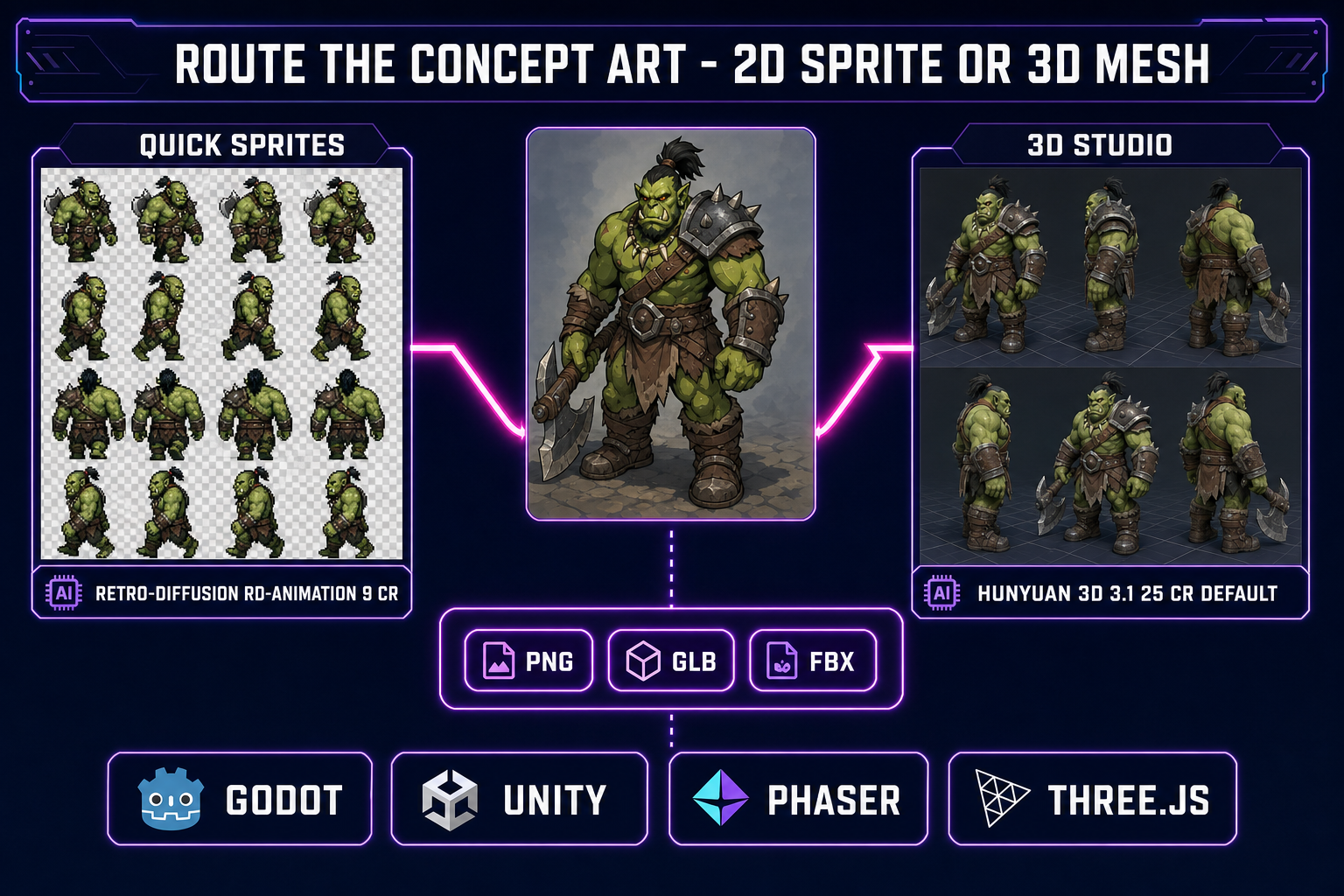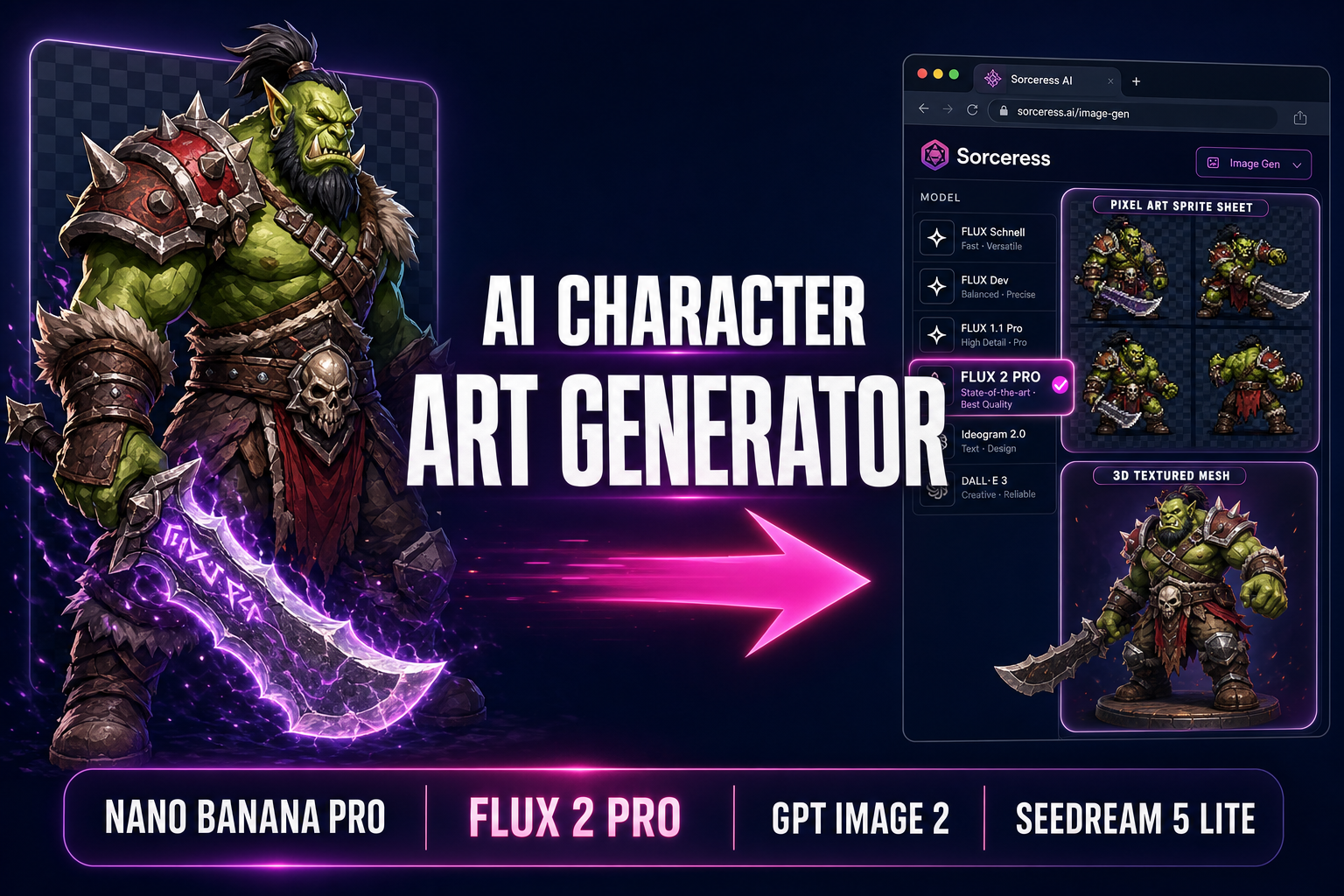
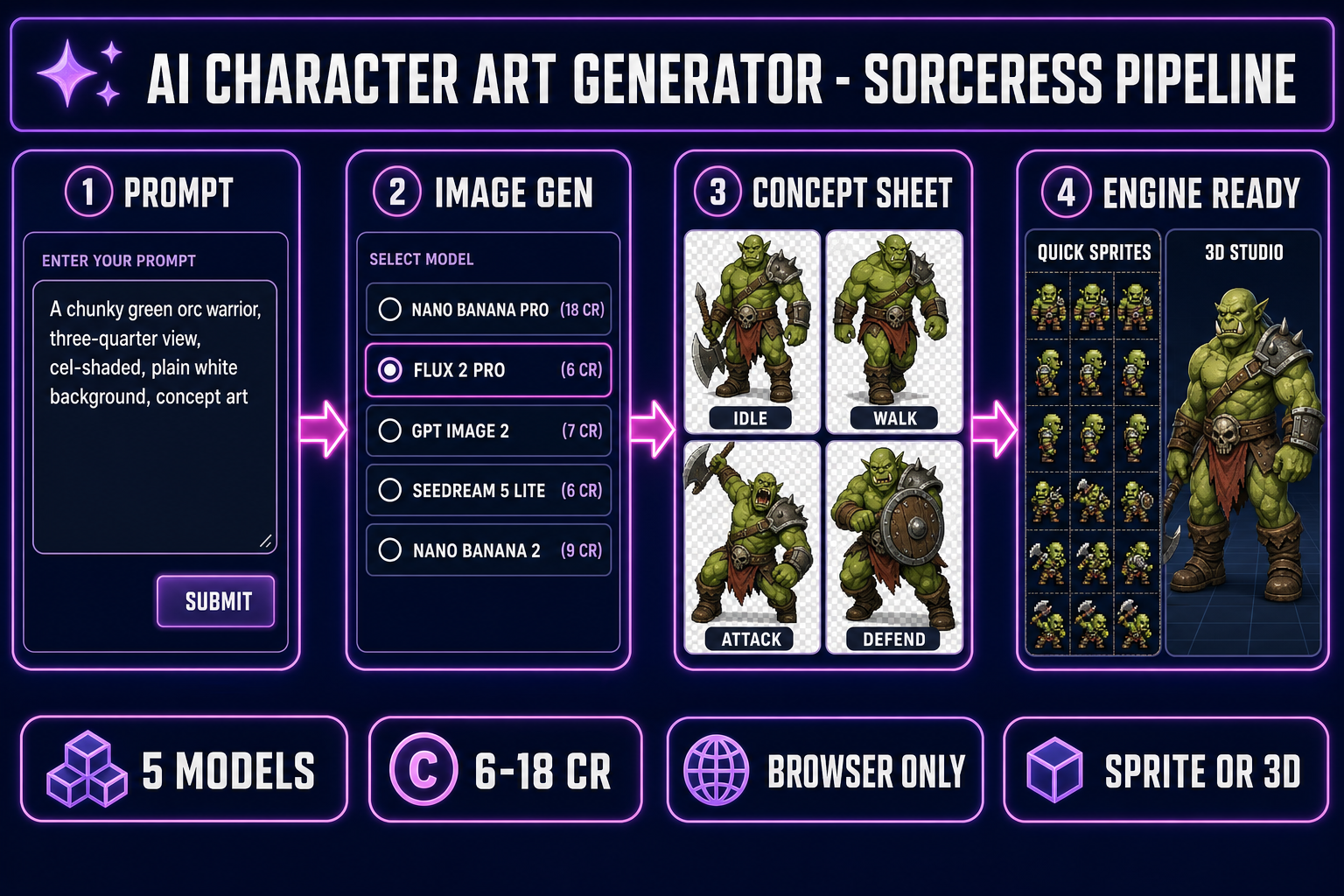
A 2026 AI character art generator is the difference between a solo indie dev shipping a vertical slice on a one-month deadline and the same dev staring at an empty Photoshop canvas for the third week in a row. The Sorceress workflow is the cleanest browser path: a single prompt into AI Image Gen produces a concept-art piece of your character, and one click routes it into either Quick Sprites for an animated 2D sheet or 3D Studio for a textured GLB mesh. This guide walks the workflow end-to-end, every model version and credit cost verified May 25, 2026 against the live source.
What an AI character art generator actually does in 2026
The phrase covers a sharp, narrow workflow. The input is a text prompt that describes a character — body type, costume, weapon, expression, pose, art style, camera angle, background. The output is a finished character illustration at a chosen aspect ratio, usually somewhere between 1024×1024 and 4K, with the subject on a transparent or plain-color background. The illustration is a single image, not a turnaround, not a sprite sheet, not a 3D mesh — those are downstream products of a separate routing step covered later in this post. The illustration itself, though, is the kind of thing a small studio would have paid a freelance concept artist three days for in late 2024. In May 2026, the same illustration is one prompt and roughly 30 seconds away.
The technology under every modern AI character art generator is a diffusion or rectified-flow transformer trained on hundreds of millions of paired image-and-caption examples. The model learns the relationship between words ("orc warrior", "cel-shaded", "three-quarter view") and pixels (chunky silhouette, hard cel-shaded color boundaries, 35-to-45-degree off-front camera angle). The 2026 generation of models adds a separate reasoning pass on top — Nano Banana Pro is built on the Gemini 3 Pro vision-language model, GPT Image 2 ships a thinking-mode option for richer workflows, and Seedream 5 Lite adds chain-of-thought reasoning over a multimodal unified architecture. The result is a model that does more than match keywords to pixels — it reads the full intent of a long prompt and stages composition, lighting, anatomy, and color before the first pixel is laid down.
The hard part of using an AI character art generator well, in 2026, is not the model. It is choosing the right model for the job, writing the prompt that locks the character, and routing the output into the next pipeline step without losing the look. The rest of this post walks each piece.
The five image models inside Sorceress AI Image Gen (and which is the best AI character art generator)
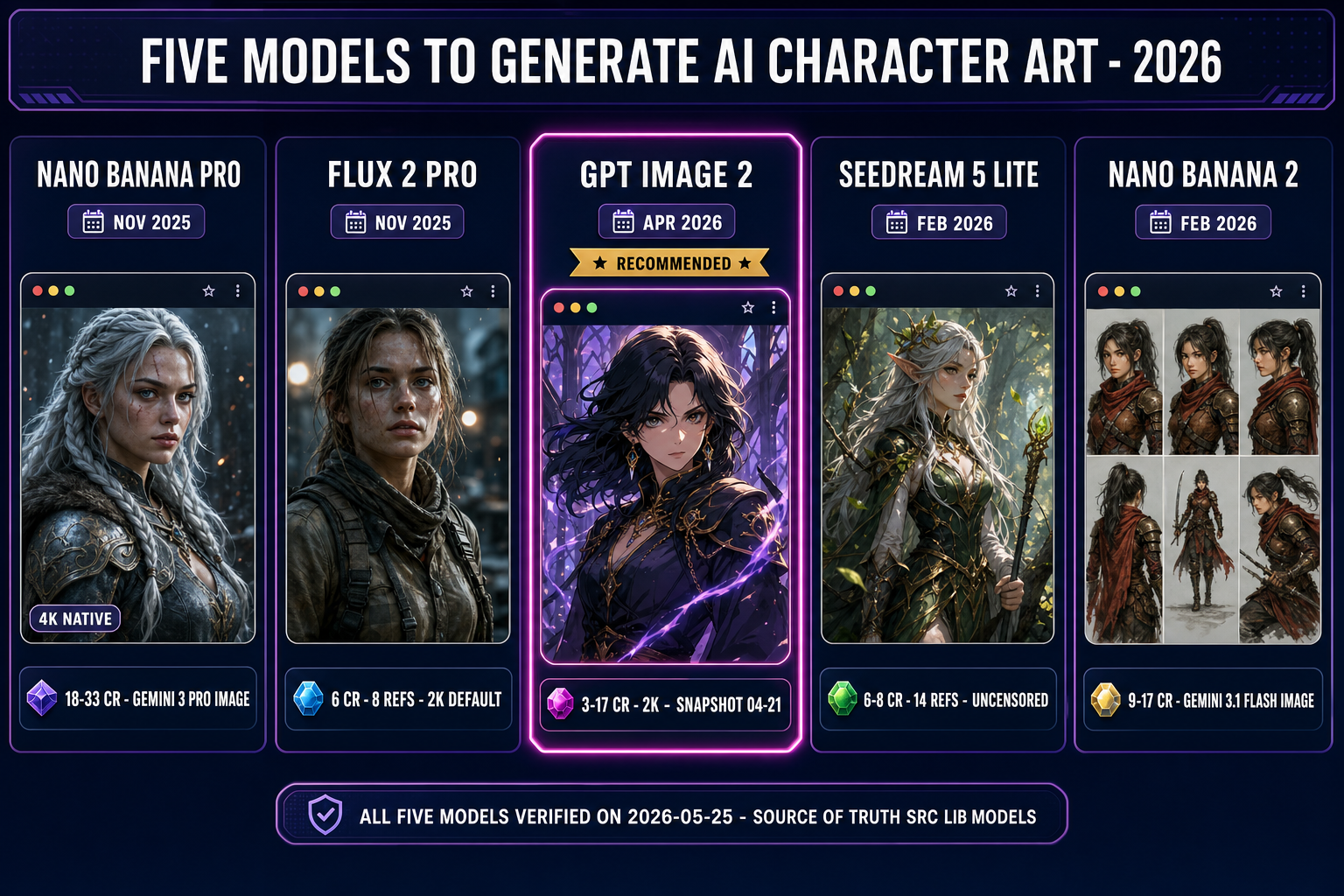
Sorceress AI Image Gen ships every top 2026 image model in a single picker. The lineup is verified against the IMAGE_MODELS registry in src/lib/models.ts on 2026-05-25 — five models that work as a serious AI character art generator, plus a handful of cheaper or specialized models for non-character work. The five character workhorses are Nano Banana Pro, Flux 2 Pro, GPT Image 2, Seedream 5 Lite, and Nano Banana 2. Each has a distinct strength.
Nano Banana Pro — the 4K text-friendly pick (18 credits 2K, 33 credits 4K)
Nano Banana Pro is the Gemini 3 Pro Image model — released November 20, 2025, model ID gemini-3-pro-image-preview, verified May 25, 2026. The headline features for an AI character art generator workflow are native 4K output (3840×2160), legible embedded text in multiple languages, and the strongest reasoning-driven composition in the panel. For a turnaround sheet where each pose needs a legible text label ("IDLE", "WALK", "ATTACK"), Nano Banana Pro is the only model that reliably renders the labels readable at full resolution. The Sorceress credit cost is 18 credits at 1K or 2K resolution and 33 credits at 4K — verified against the getCredits function on line 221 of src/lib/models.ts. Up to 8 reference images supported per generation.
Flux 2 Pro — the photorealistic-character workhorse (6 credits + 3 per reference)
Flux 2 Pro from Black Forest Labs was released November 25, 2025 as the production tier of the FLUX.2 family — verified active on Replicate on 2026-05-25. The FLUX 2 line shipped four tiers — Pro (production API), Flex (developer variant), Dev (32B open-weight on Hugging Face), and Klein (Apache 2.0 distilled, sub-second on consumer GPUs, the open-weight bundle released January 15, 2026). The Pro tier closes the gap between generated and real photographic imagery — it is the photorealism leader in the 2026 lineup. For character art that needs to feel grounded in real lighting and real materials (leather armor, brass buckles, weathered fabric), Flux 2 Pro is the workhorse. The Sorceress cost is 6 credits base plus 3 per reference image, up to 8 reference images supported, default 2K resolution — verified against lines 91 to 117 of src/lib/models.ts. Aspect ratios cover 16:9, 1:1, 9:16, 21:9, 4:3.
GPT Image 2 — the stylized-illustration pick (3 to 17 credits by quality)
GPT Image 2 (openai/gpt-image-2 on Replicate) was released April 21, 2026 — the snapshot alias gpt-image-2-2026-04-21 locks the version. The model jumped to the top of the Image Arena leaderboards within hours of launch with a 242-point lead in text-to-image. The headline gain for an AI character art generator workflow is the structured-generation strength — diagrams, infographics, posters, comics, character turnaround sheets all render with cleaner composition and stronger multi-edit prompt adherence. Aspect ratios in the Sorceress picker are 1:1, 3:2, and 2:3, with the 3:2 ratio matching the home-v2 explainer aspect that the rest of the Sorceress visual brand uses. The credit cost scales with quality — 3 credits low, 7 credits medium, 17 credits high — verified against lines 320 to 328 of src/lib/models.ts. Up to 10 reference images, opaque background by default (transparent unsupported per the Replicate model card).
Seedream 5 Lite — the uncensored character pick (6 credits 2K, 8 credits 3K)
Seedream 5 Lite from the ByteDance Seed team was released February 13, 2026 with a chain-of-thought reasoning step layered over the multimodal unified architecture introduced in Seedream 4.0 the prior September. The model is the most lenient in the panel on safety filtering — for character art in adult, horror, or grimdark fantasy verticals where the other models refuse the prompt or sanitize the output, Seedream 5 Lite is the open-restrictions pick. The Sorceress integration sets nsfw_checker: false on every call (verified against line 165 of src/lib/models.ts), 14 reference images supported, default 2K, optional 3K mode at 8 credits. Aspect ratios cover 16:9, 1:1, 9:16, 21:9, 4:3, 3:2, 2:3 — the widest support in the panel.
Nano Banana 2 — the fast-iteration pick (9 credits 1K, 17 credits 4K)
Nano Banana 2 is the Gemini 3.1 Flash Image Preview model — released February 26, 2026 per the Gemini API release notes, model ID gemini-3.1-flash-image-preview. The model is positioned as the new go-to default for all-around image generation in the Gemini family, with Nano Banana Pro reserved for premium 4K and text-heavy jobs. For an AI character art generator workflow where the iteration loop matters — running 20 prompt variations to land the character silhouette before committing to the hero pose — Nano Banana 2 is the right pick. The Sorceress cost is 9 credits at 1K (default), 12 credits at 2K, 17 credits at 4K, verified against lines 245 to 253 of src/lib/models.ts. Up to 14 reference images supported.
The browser pipeline to generate a character with an AI character art generator (and route it into an engine)
The entire workflow runs in a single browser tab. No local install, no GPU at home, no upstream account at OpenAI or Black Forest Labs or ByteDance or Google. The AI Image Gen panel routes every model through one unified credit budget on the Sorceress account. Every signed-in user gets 100 starter credits — at the 6-credit average for Flux 2 Pro or Seedream 5 Lite, that covers roughly 16 character-art generations before the meter clicks over to paid credits at one cent per credit.
The architecture is intentionally narrow at the generator step. The Image Gen panel does one thing: it accepts a prompt and optional reference images, runs the chosen model, and returns a downloadable PNG. The downstream routing — sprite extraction, 3D lift, animation — happens in separate Sorceress tools that compose with the Image Gen output without a manual file-format conversion step. The full pipeline from prompt to engine asset is two clicks: generate, then route.