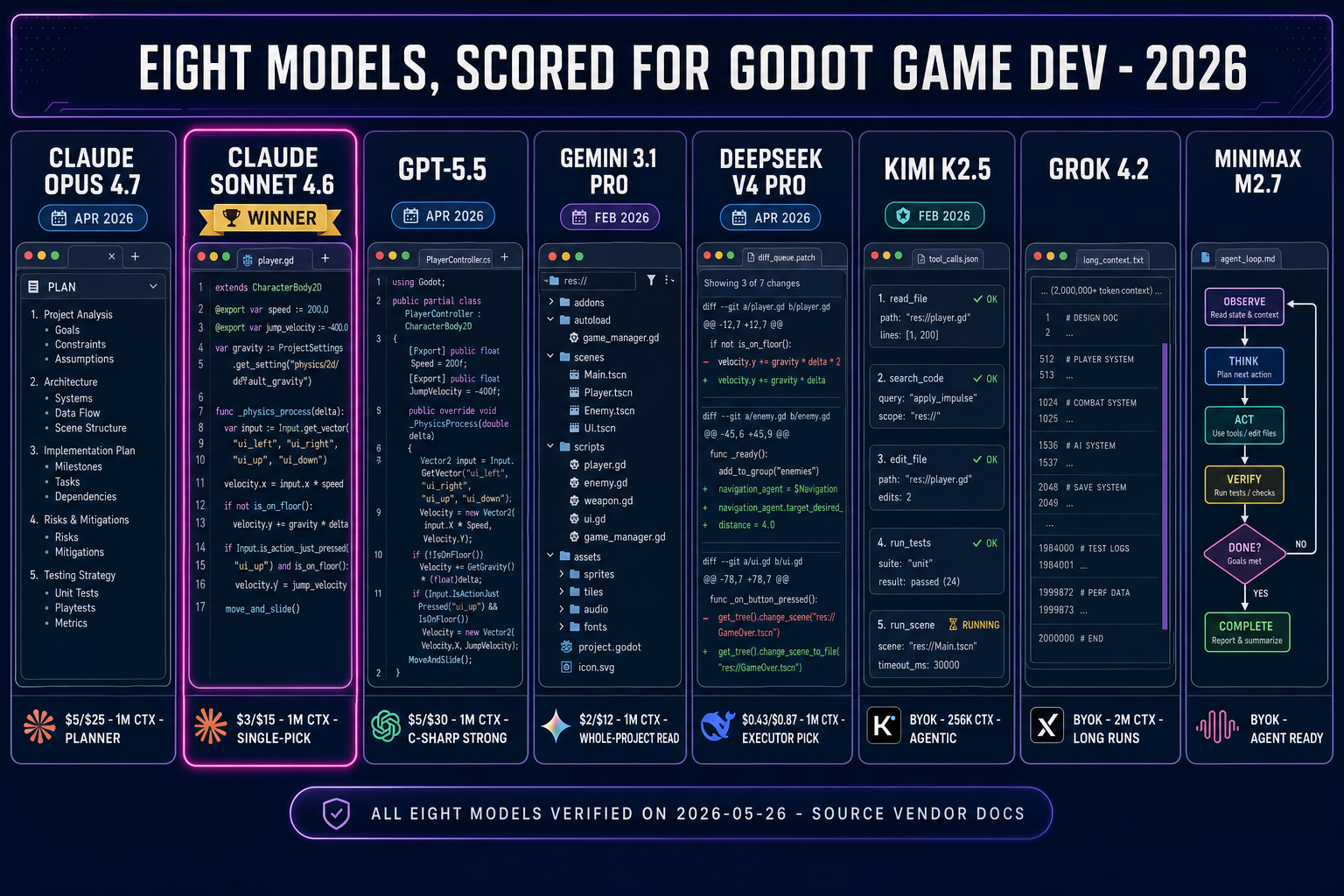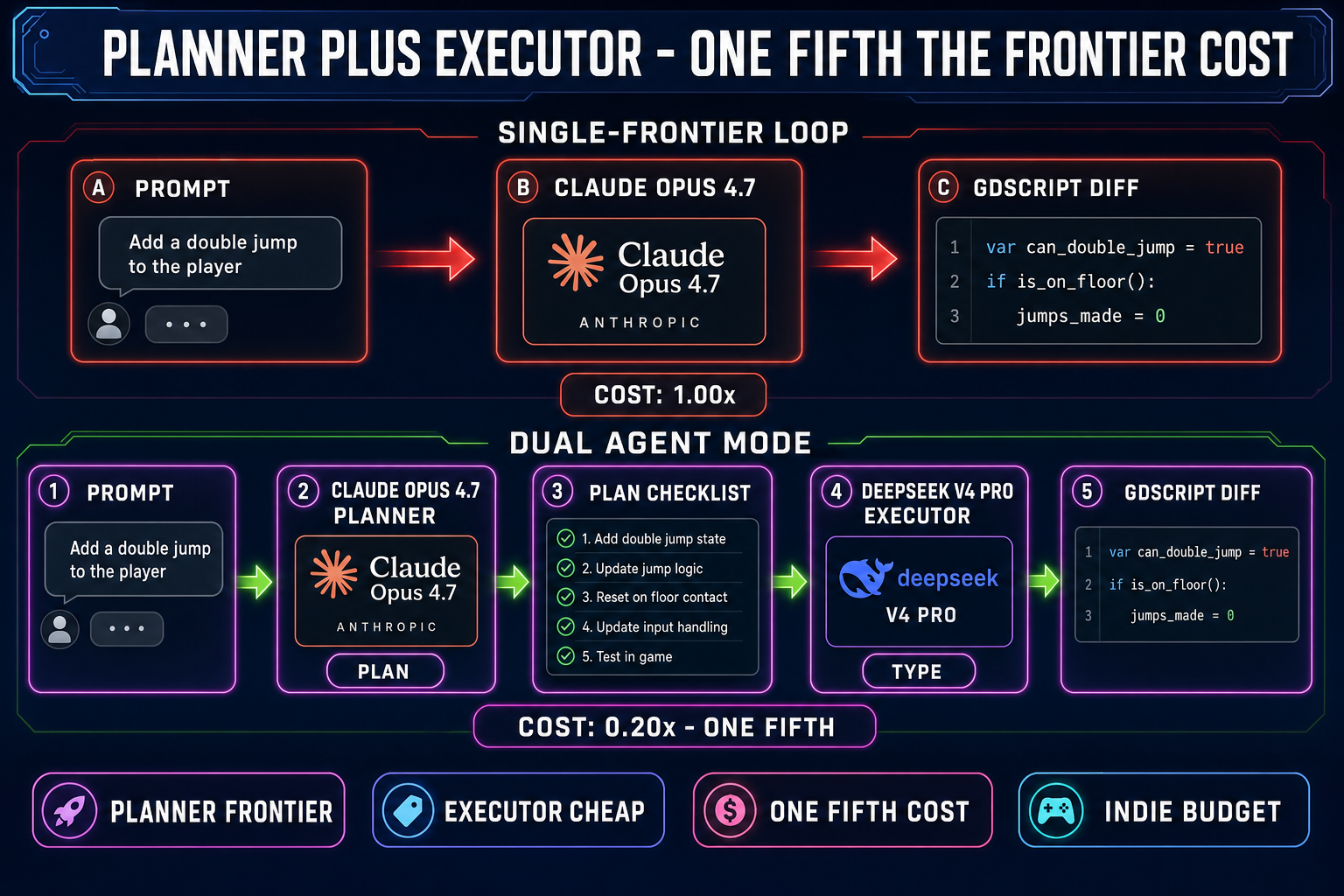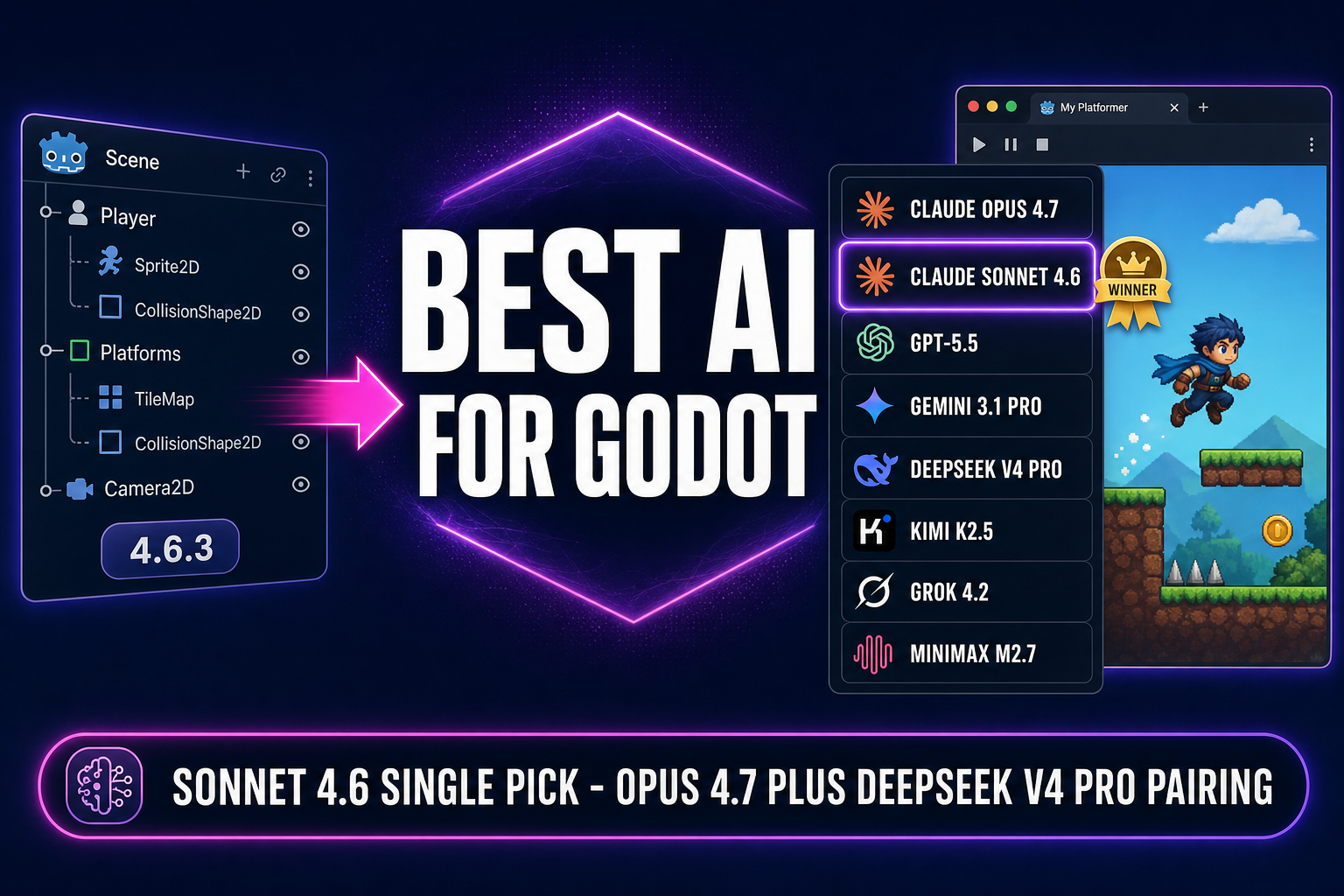
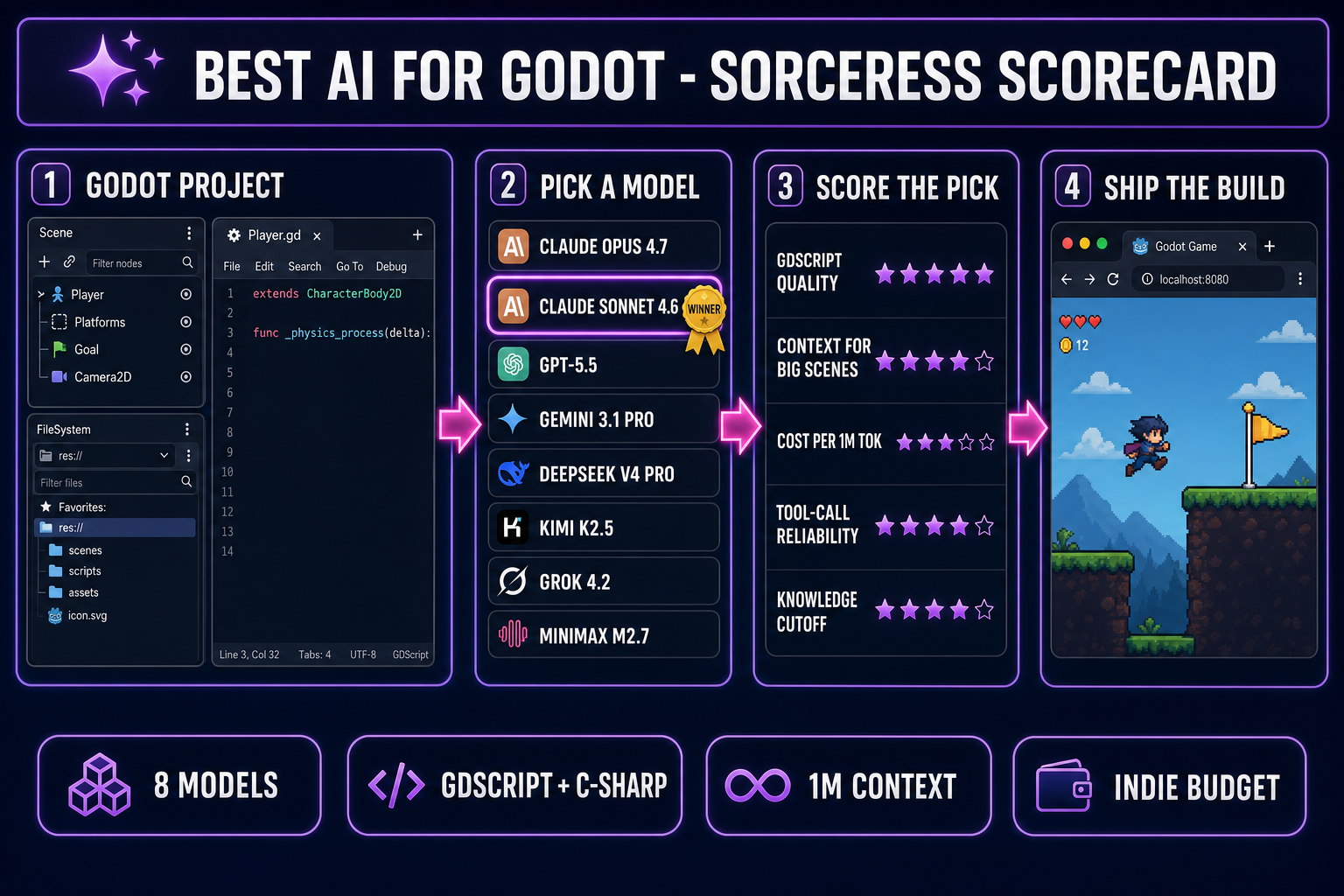
The question "what is the best AI for Godot game dev in 2026?" arrives in three flavors — single-model pick, planner-plus-executor pairing, and engine-aware whole-project review — and the honest answer changes depending on which one the reader is asking. This piece scores all three. Eight frontier coding models are graded head-to-head on real Godot work: GDScript fluency, tres-scene context handling, indie-budget cost, tool-call reliability, and how cleanly each one survives a fifty-file Godot project without losing the scene tree. Every price and version was re-verified on May 26, 2026 against Anthropic, OpenAI, Googl’ Vertex AI docs, DeepSee’ pricing page, and Moonsho’ Kimi model list.
The single-model pick: Claude Sonnet 4.6 is the best AI for Godot in 2026
If the reader wants one model and one model only, the best AI for Godot in 2026 is Claude Sonnet 4.6. The model prices at $3 per million input tokens and $15 per million output tokens with a 1M-token context window and a 128K maximum output, verified against the Anthropic pricing page on May 26, 2026. Sonnet 4.6 is in the WizardGenie picker, in every published Godot projec’ recommended list, and on most working Godot devs' shortlists by April 2026. The reason it wins is not raw raw GDScript fluency — every frontier model handles GDScript reasonably because GDScript reads like Python and every frontier model is overtrained on Python. The reason is the combination of three properties that the other seven models in the picker each get partially right: 1M context that holds a full Godot project without truncation, the lowest hallucination rate in the picker on multi-step tool calls (which matters when the agent is editing five files and one resource at once), and a price point that lets indie devs leave the agent running on a long planner-plus-executor session without watching the bill burn.
The next-best single-model pick is Claude Opus 4.7 ($5 input and $25 output per million tokens, 1M context, released April 16, 2026 per Anthropi’ launch post). Opus 4.7 wins outright on the hardest debugging sessions — the ones where Sonnet circles a bug for three turns before catching it — and on long-horizon agentic work, where Anthropi’ xhigh effort level produces noticeably more careful diffs. The honest reason Sonnet wins the single-model crown anyway is the 67-percent price gap. On most Godot work, the quality differential between Sonnet 4.6 and Opus 4.7 is in the 5-to-10 percent range; on cost it is 67 percent. For an indie game dev who has to ship the build and pay for the API calls themselves, the lower-cost frontier is the right floor pick. For a senior gameplay programmer running the hardest debugging session of the month, Opus 4.7 earns the upgrade for that session only.
Why Godot is a different language target than Unity or Unreal
Picking the best AI for Godot is a slightly different problem than picking the best AI for Unity or Unreal because the three engines speak different primary languages and ship different scene formats. Godo’ primary language is GDScript, a Python-flavored language with strict static typing in 4.x, signals as a first-class publish-subscribe construct, the @onready decorator for scene-tree-ready property initialization, and a tres/tscn scene format that is human-readable text with explicit resource references. Unit’ primary language is C#. Unrea’ primary language is C++ plus Blueprints (a visual graph that compiles down). Every frontier model handles all three, but GDScript has narrower public training corpora than C# or C++, so model quality on GDScript-specific idioms varies more than on the other two.
The practical implication for picking the best AI for Godot: the differentiator is not "does the model write valid GDScript syntax" — every model in the WizardGenie picker does — but "does the model write idiomatic Godot 4.x GDScript that uses signals, @onready, exported variables, and custom Resource classes the way a working Godot dev would write them." That second test is where the eight-model field separates. The Sonnet 4.6 and GPT-5.5 picks consistently emit the right idioms; the older or smaller models often write GDScript that runs but reads like translated Python, missing the Godot-native conventions that the engine community treats as correct style. On a fifty-file Godot project, the difference compounds across every refactor.
Godo’ current stable release as of May 26, 2026 is version 4.6.3, released May 20, 2026, verified against godotengine.org. Godot 4.7 is in beta. The 4.x knowledge cutoff matters because GDScript syntax changed materially between Godot 3.x and 4.x (the @onready decorator, the type-hint syntax, the signal-connection signature). Models with a knowledge cutoff before mid-2024 write Godot 3.x-flavored GDScript when prompted for Godot work; models cut off after late 2024 write Godot 4.x. GPT-5.5 (December 2025 cutoff per developers.openai.com) and Sonnet 4.6 (March 2025 cutoff per Anthropic) both clear the bar for current Godot work. Older models in the picker do not, and the post will flag that explicitly per model below.
The eight-model field in the WizardGenie picker
The WizardGenie coding model picker ships eight models in 2026, verified against src/app/_home-v2/_data/tools.ts in the live source on May 26, 2026. The lineup, in picker order, is: Claude Opus 4.7, Claude Sonnet 4.6, GPT-5.5, Gemini 3.1 Pro, DeepSeek V4 Pro, Kimi K2.5, Grok 4.2, and MiniMax M2.7. Each model is selectable per-prompt, and any pair can be wired as the planner and executor sides of WizardGeni’ Dual Agent Mode. The selection rail lives at the top of every chat session inside WizardGenie; the same lineup is documented on the marketing page for cross-reference.
The sibling tool, Sorceress Code, ships a tighter five-model picker, verified against src/app/code/page.tsx lines 1102 to 1147: Claude Opus 4.6, DeepSeek Reasoner, GPT-5 Nano, GPT-5.2 Codex, and Kimi K2.5 via NVIDIA NIM. Sorceress Code is the bring-your-own-key local-disk IDE; the user pastes their own Anthropic, DeepSeek, OpenAI, or NVIDIA API key into the settings and the requests go directly to the model vendor with no Sorceress markup. WizardGeni’ picker is broader because the runtime can route through bundled credits as well as user keys. For pure Godot work, both tools cover the realistic options; the choice between them is the choice between W’ hot-reloading browser preview and Sorceress Cod’ local-disk file ownership.
The honest 2026 verified specs for each model in the WizardGenie Godot picker, with prices in $ per million tokens (input / output) and context windows in tokens:
- Claude Opus 4.7 — $5 / $25 per Mtok, 1M context, 128K max output, released April 16, 2026, knowledge cutoff March 2025 (verified against anthropic.com on May 26, 2026). Best for: planner role in Dual Agent Mode, hardest GDScript debugging sessions.
- Claude Sonnet 4.6 — $3 / $15 per Mtok, 1M context, 128K max output, knowledge cutoff March 2025. Best for: single-model floor pick for Godot work, default for everyday GDScript writing and refactor.
- GPT-5.5 — $5 / $30 per Mtok, 1,050,000-token context, 128K max output, released April 23, 2026, knowledge cutoff December 2025 (verified against developers.openai.com on May 26, 2026, snapshot
gpt-5.5-2026-04-23). Best for: mixed GDScript and C# Godot projects, strongest on switching languages mid-conversation. - Gemini 3.1 Pro — $2 / $12 per Mtok up to 200K context, $4 / $18 per Mtok above 200K, 1M context (per Vertex AI docs on May 26, 2026), public preview release February 19, 2026. Best for: whole-project review across 50-to-200-file Godot projects, lowest base price up to the 200K cliff.
- DeepSeek V4 Pro — $0.435 / $0.87 per Mtok cache-miss (cache-hit input is $0.003625), 1M context, 384K max output, released April 2026, 75-percent discount made permanent on May 25, 2026 per DeepSee’ announcement (verified against api-docs.deepseek.com on May 26, 2026). Best for: executor side of Dual Agent Mode, indie-budget single-model option for straightforward GDScript work.
- Kimi K2.5 — Moonshot, 256K context, 1T-parameter MoE with 32B active, BYOK via NVIDIA NIM in Sorceress Code or Moonshot direct in WG. Best for: agentic tool-call orchestration, long-horizon agent runs that stay under the 256K ceiling. (Moonshot has since released Kimi K2.6 with 300 parallel sub-agents and 4,000 coordinated steps per the kimi.com blog on May 26, 2026; the WG picker still references K2.5 as of this verification, K2.6 is the upstream upgrade path.)
- Grok 4.2 — xAI, 2M context (largest in the picker), BYOK. Best for: very long agent runs over a whole Godot project plus referenced art assets, the multi-million-token use cases that exceed every other picke’ headroom.
- MiniMax M2.7 — agent-ready tag, BYOK. Best for: cheap executor alternative to DeepSeek V4 Pro when the projec’ API key inventory steers around DeepSeek for compliance or geographic reasons.