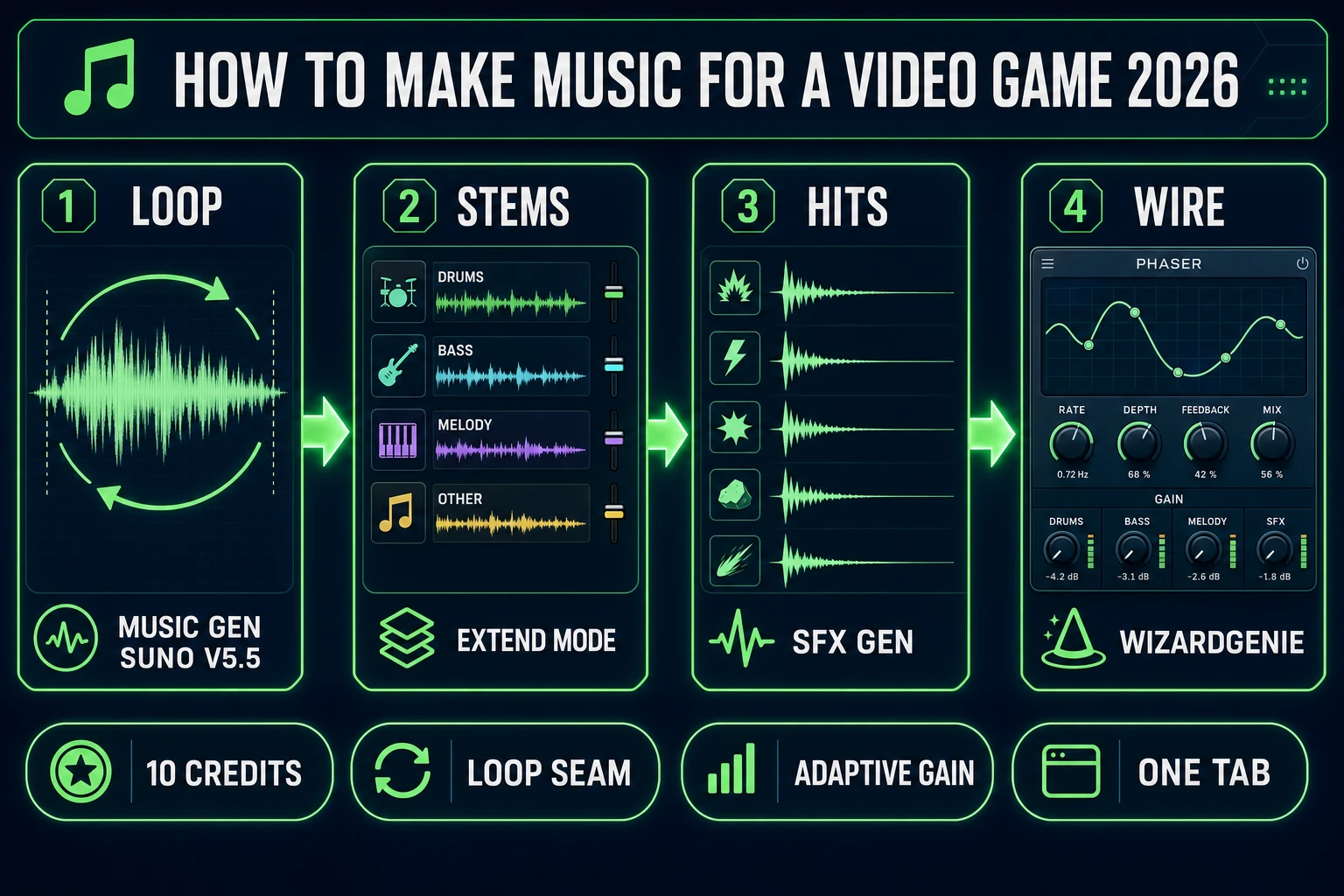
Search how to make music for a video game on July 14, 2026 and the SERP splits into FL Studio piano-roll tutorials, “import any MP3” Unity cheat sheets, and vibe posts that treat a single render as a soundtrack. None of those paths answer the indie question — what is the honest toolchain from empty prompt to a loopable bed that actually responds when combat starts? This guide answers that. The 2026 answer is a four-layer browser pipeline: Music Gen writes Suno V5.5 loop bases, extend mode builds stem variants, SFX Gen adds short hits, and WizardGenie wires adaptive gain into a Phaser 4.2 scene. Every credit cost and model name below is verified against the live Sorceress source on July 14, 2026.
What “how to make music for a video game” actually means in 2026
The phrase how to make music for a video game (320/mo, KD 13 per DataForSEO research-supplement.md and probe-fresh-seeds-7.md, verified July 14, 2026) targets a reader who needs a playable score — not a concert piece. Sibling queries confirm the cluster: how to make game music (320/mo, KD 0), how to make video game music (320/mo, KD 13), and how to make music for game all point at the same systems with slightly different word order. Craft taste still matters (motif, headroom, seam quality — covered in the sibling how to make good video game music post), but this article is the production path: which tool builds the base, how stems appear, where hits live, and how the engine swaps intensity.
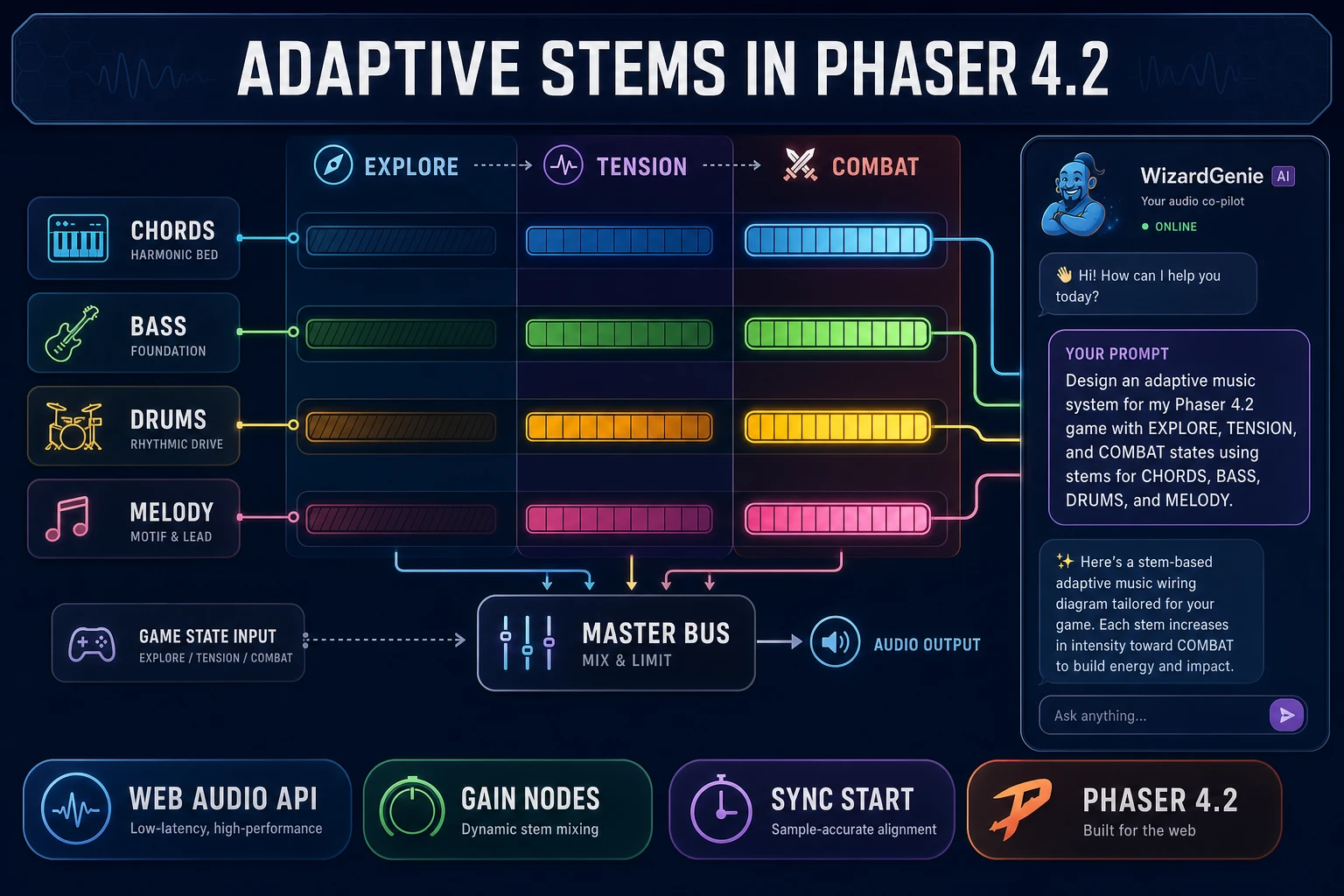
Video game music is a constrained craft. Tracks must loop without a seam, sit under SFX and voice, and ideally support adaptive music so intensity follows game state. A first ship does not need an eight-stem AAA system. It needs one exploration bed, one tension/combat variant that shares tempo and key, and a handful of one-shot hits for UI and boss reveals.
Why DAW-first and “one render” workflows stall playable scores
A DAW-first path is powerful and also a trap for day-one indies. You spend an evening fighting plugins before any loop reaches the game. A “one render” path is faster and worse: you drop a full-loudness two-minute track under gameplay, the loop clunks every restart, and combat never intensifies because there is only one bed. Both paths fail the same test — does the music still feel right after forty minutes inside the build?
Browser AI flips the sequence. Generate short loopable bases first, prove them in headphones against a gray-box level, then harden seams and stems. Music Gen’s create and extend modes exist for that order. SFX Gen fills the hits Music Gen should not own (button clicks, boss stings, foot scrapes). WizardGenie owns the wiring — GainNodes, trigger zones, cool-downs — so you are not hand-rolling Web Audio from scratch on night one. Cross-link the rhythm-game angle in how to make a music game when the gameplay itself is chart-driven rather than a score underneath an action loop.
The Sorceress how to make music for a video game pipeline in four steps
Every short soundtrack needs four layers: loopable bases, stem variants, one-shot hits, and engine wiring. In 2026 each layer maps to one Sorceress surface verified against the live catalog on July 14, 2026:
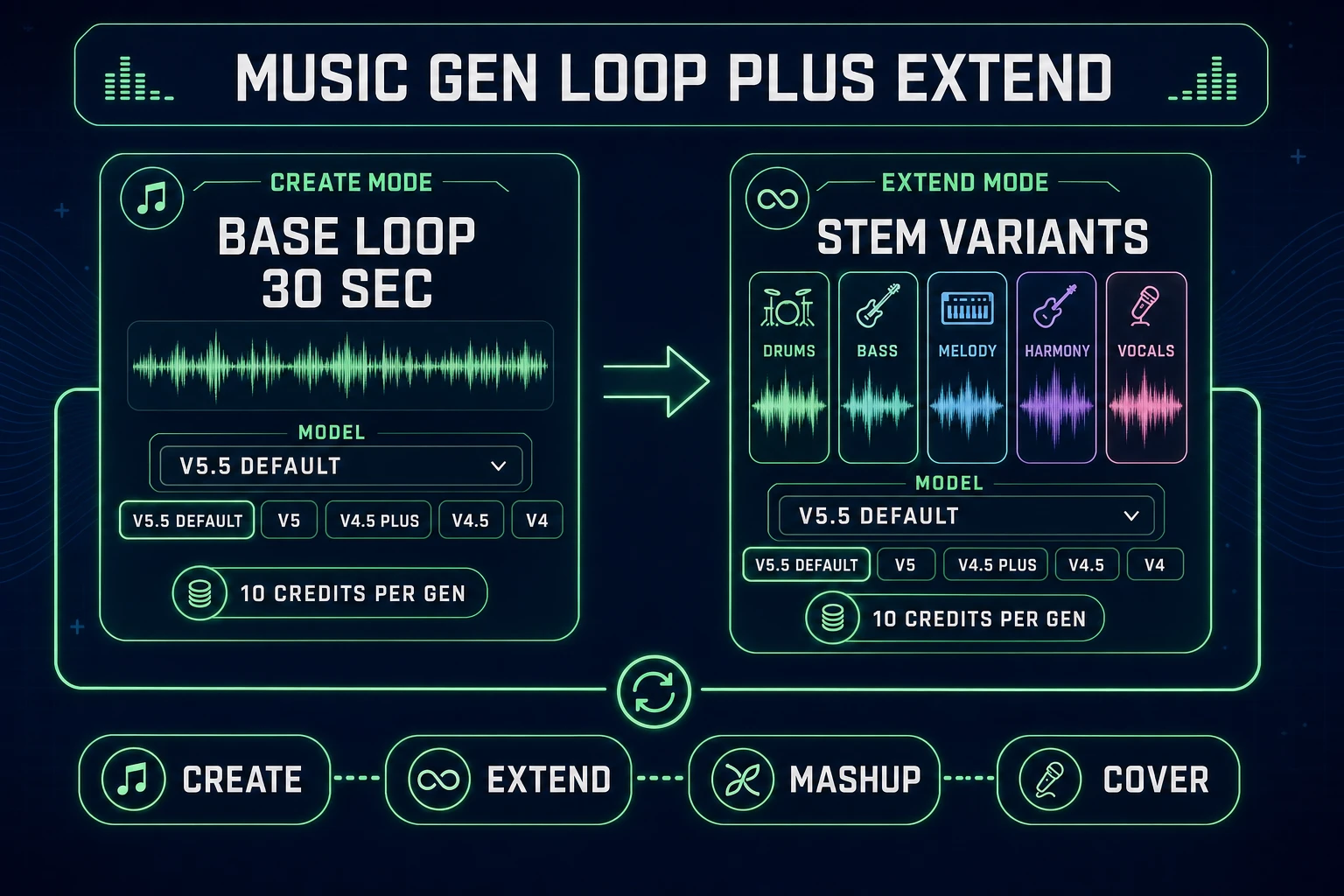
- Loopable bases — Music Gen with Suno models V5.5 (default), V5, V4.5+, V4.5, and V4 at
MUSIC_CREDIT_COST = 10credits per generation (src/app/music-gen/page.tsxline 26). Modes: create, extend, mashup, uploadCover (lines 386–392). Lyrics sets cost 2 credits (LYRICS_CREDIT_COST). - Stem variants — same Music Gen extend mode: re-prompt the accepted base for drums-forward, bass-forward, and melody-forward passes that share tempo and key.
- Hits and stingers — SFX Gen at 1 credit per second of completed audio (
SEED_AUDIO_CREDITS_PER_SECOND = 1insrc/app/sfx-gen/page.tsx). - Adaptive wiring — WizardGenie with eight CODING_MODELS (Claude Opus 4.7, Sonnet 4.6, GPT-5.5, Gemini 3.1 Pro, DeepSeek V4 Pro, Kimi K2.5, Grok 4.2, MiniMax M2.7 per
src/app/_home-v2/_data/tools.tslines 734–742) targeting Phaser 4.2.
Pricing is a $49 lifetime unlock plus pay-as-you-go credit packs — Starter $10/1,000 credits, Creator $20/2,000, Plus $50/5,000, Studio $100/10,000 — verified against src/app/plans/page.tsx lines 46–55. New accounts ship with 100 starter credits. The Sorceress tools guide lists every pairing; plans shows live tiers.