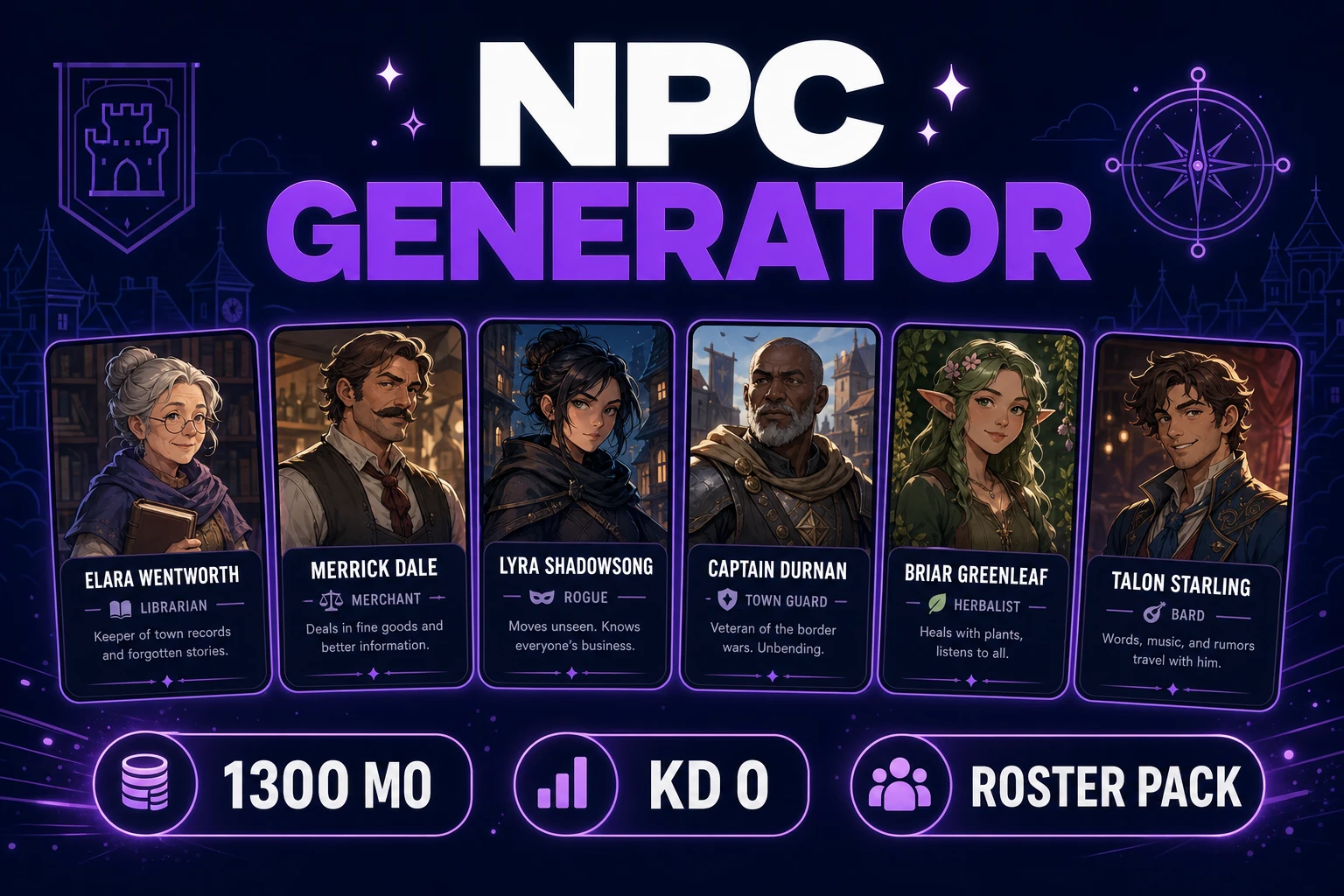
Blank name lists stall the moment you need a shopkeeper with a secret and a greeting that matches their face. Searchers typing npc generator want a reusable non-player character roster — roles, bios, portraits, and short voice lines — not another one-off chat dump. This guide covers the 2026 browser pipeline: WizardGenie locks the town cast and exports bio JSON, AI Image Gen stamps the faces, and Speech Gen cuts greeting lines you can play on first contact. Tool costs and model credits below are verified against the live Sorceress source on July 16, 2026.
What an npc generator outputs for indie roster packs
The phrase npc generator (1,300/mo, KD 0 per DataForSEO probe-fresh-seeds-2.md verified July 16, 2026) targets indie designers who need a town cast before the first playable build. Sibling queries confirm the cluster: npc character generator (1,300/mo, KD 0), 5e npc generator (880/mo, KD 0), and npc generator 5e (880/mo, KD 0) all describe the same hunger — a packed roster that already knows who sells rope, who hates the mayor, and who says what when you click Talk.
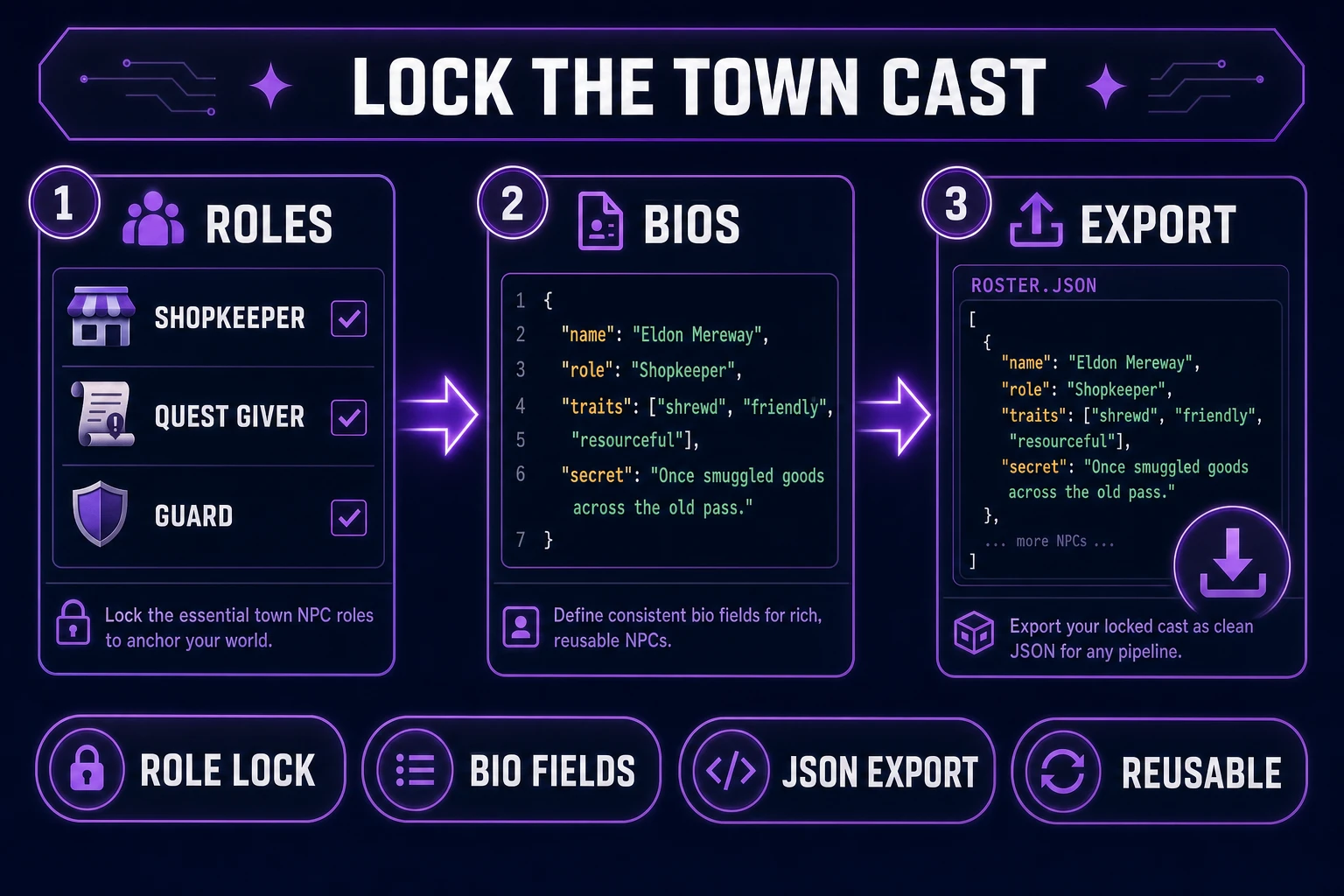
For a shippable indie pack that deliverable is production data: display name, role tag, three personality traits, one secret, one catchphrase, optional combat or barter stats, a consistent face, and a short greeting VO. One-off “invent a cool NPC” prompts stall the moment you need twelve names that share a world tone. Keep 5e combat sheets and challenge ratings in the sibling DnD NPC generator guide when the character must survive a tabletop round; keep player-character fillable cards in the dnd character sheet generator post; route dialogue bust emotion packs through the ai portrait generator flow when you need more than a single face stamp.
Why one-off NPC prompts stall town casts
A single chat reply solves one character. A town needs a cast. Without locked roles, every regenerate invents a new setting, a new naming dialect, and a new art style. Without a shared JSON schema, your Phaser scene cannot load the roster — you end up copy-pasting prose into hard-coded strings. Without a face prefix and a greeting script, the NPC that looked warm in the portrait sounds like a different person when the VO plays.
The traditional bottleneck was never “can AI invent names.” It was locking a readable role list for the settlement, translating each role into a bio the game can parse, and attaching a face plus a voice so players recognize the cast on the second visit. WizardGenie closes the roster layer; AI Image Gen closes the face layer; Speech Gen closes the greeting layer. Cross-link naming pools in the fantasy name generator post and dialogue trees in the ai dialogue generator guide when you expand beyond first-contact lines.
The Sorceress npc generator pipeline in four steps
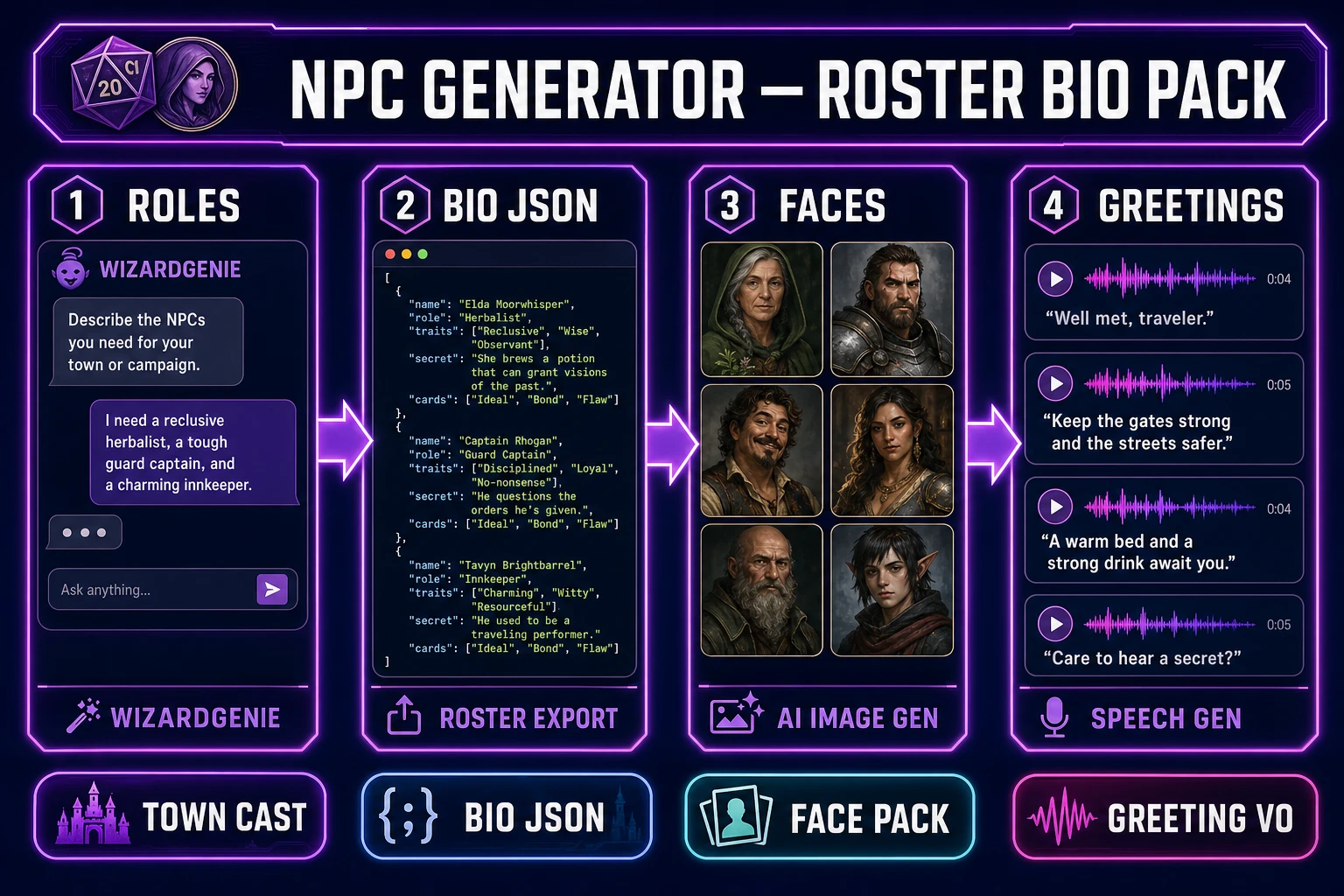
Every shippable roster pack ships four runtime pieces: locked roles, bio JSON, faces, and greetings. In 2026 each maps to one Sorceress tool verified against the live catalog on July 16, 2026:
- Roles + bio JSON — WizardGenie scaffolds a browser roster (plain HTML or Phaser 4.2) and writes name, role, traits, secret, catchphrase, and optional stats from your town brief; coding runs on your own API key.
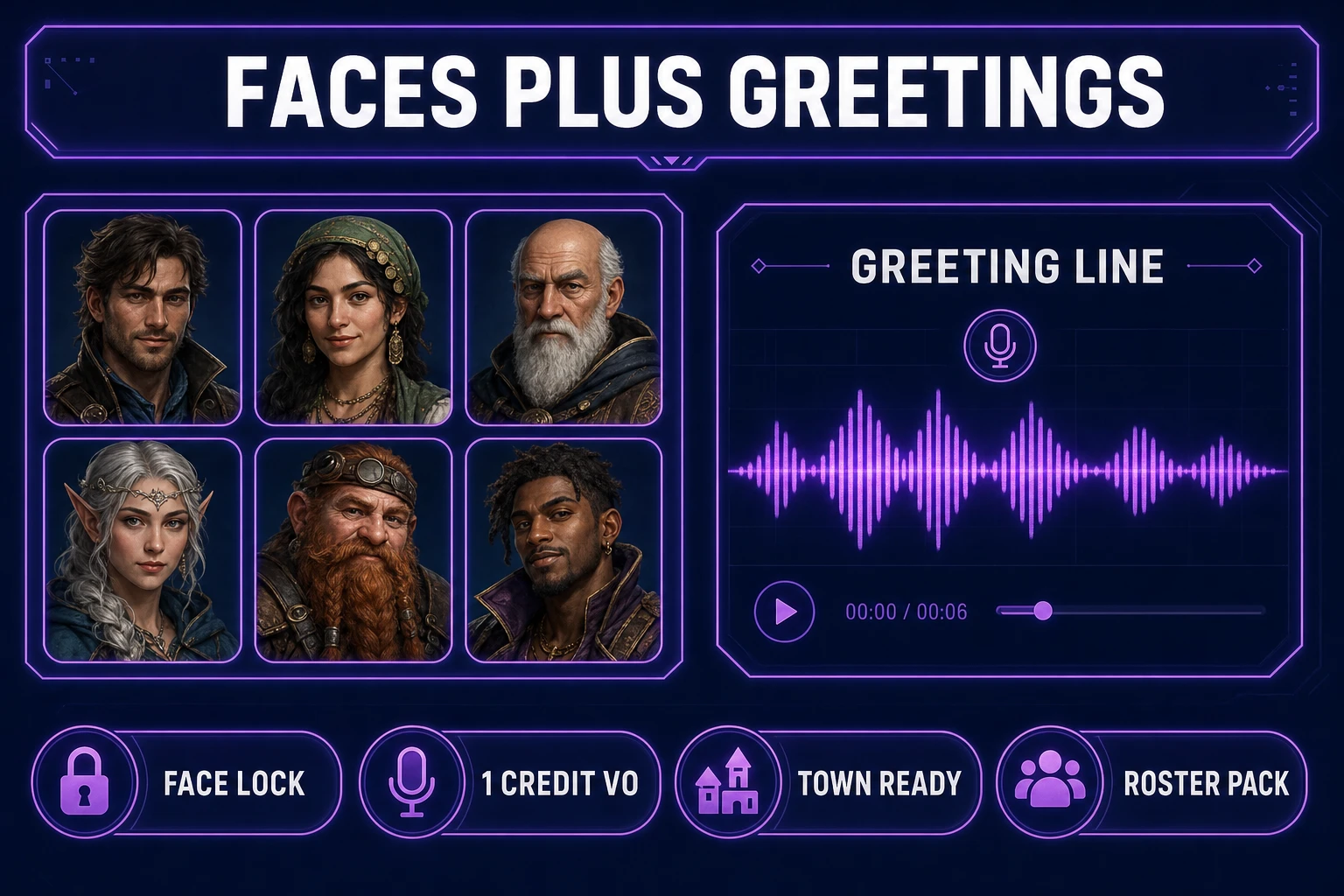
- Face stamps — AI Image Gen (AI Credits) with models such as GPT Image 2 (5 credits at 1K) and Nano Banana Pro (18 credits at the 1K/2K default) via the unified panel; credit cost varies by model via
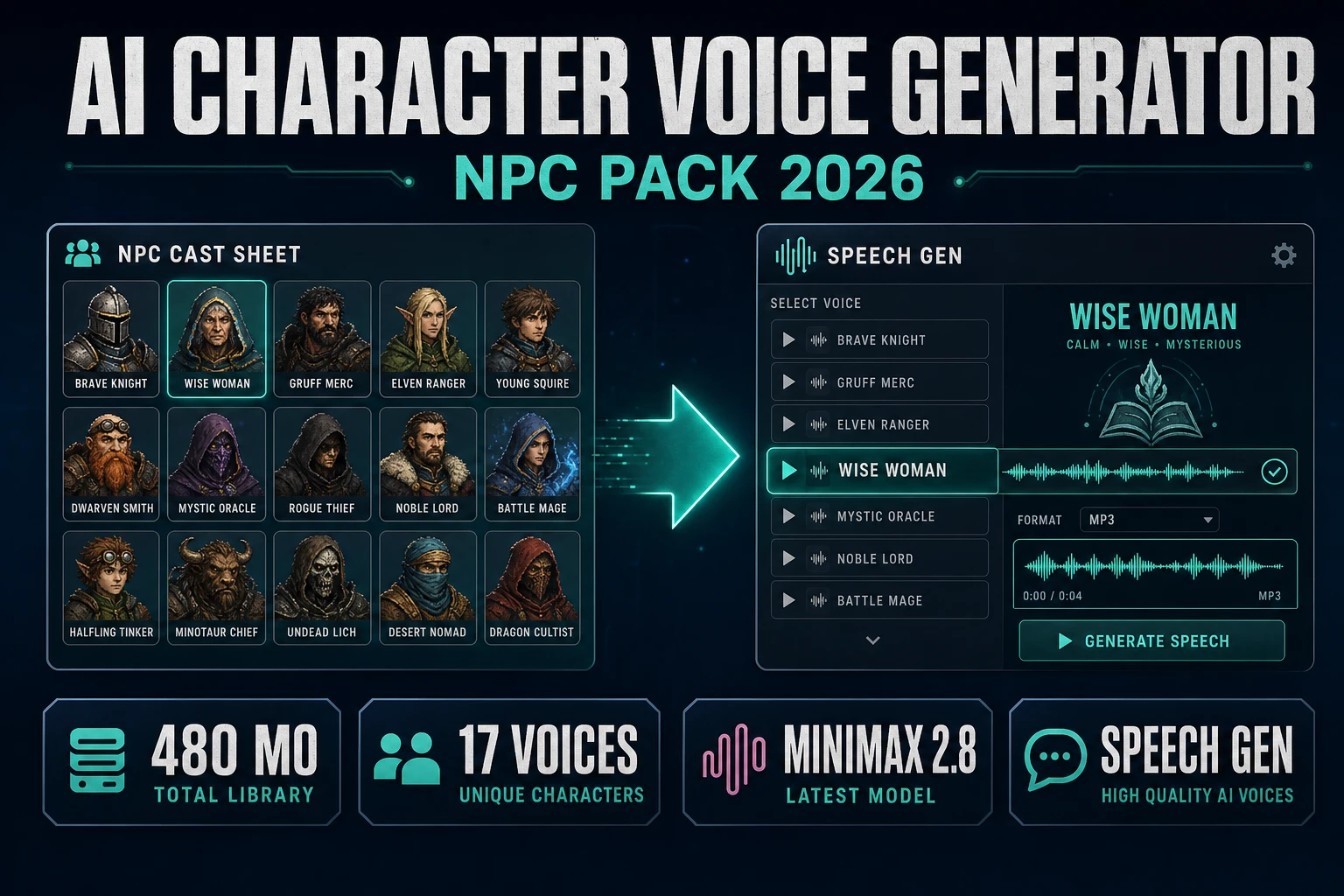
getModelCreditsinsrc/lib/models.ts. - Greeting VO — Speech Gen (AI Credits) at HD 0.5 credits per 1,000 characters or Turbo 0.3 per 1,000 (min 1 credit), verified in
src/app/speech-gen/page.tsx. - Optional in-game mirror — the same JSON roster can feed a Phaser talk menu or character-select strip if you later wire the town into a browser RPG.
Pricing is a $49 lifetime unlock plus pay-as-you-go credit packs — Starter $10/1,000 credits, Creator $20/2,000, Plus $50/5,000, Studio $100/10,000 — verified against src/app/plans/page.tsx lines 51–54 and the $49 one-time badge. New accounts ship with 100 starter credits. The Sorceress tools guide lists every tool in the catalog.