Mint a Game Title Generator (Storefront Name Pack 2026)

By Arron R.8 min read
A game title generator in 2026 is a four-step storefront pack: lock genre and banned words in WizardGenie, score a shortlist against store rules, stamp key-art

A working build with a placeholder codename dies the moment you open a Steam or itch listing form. Searchers typing game title generator want the public storefront string — short enough for a store card, speakable in a trailer, and distinct from shipped commercial titles — not another random adjective-noun mash. This guide covers the 2026 browser pipeline: WizardGenie locks genre, tone, and banned words, scores a shortlist against storefront rules, and AI Image Gen stamps key-art companions so you can freeze the winner before the listing goes live. Tool costs and model credits below are verified against the live Sorceress source on July 16, 2026.
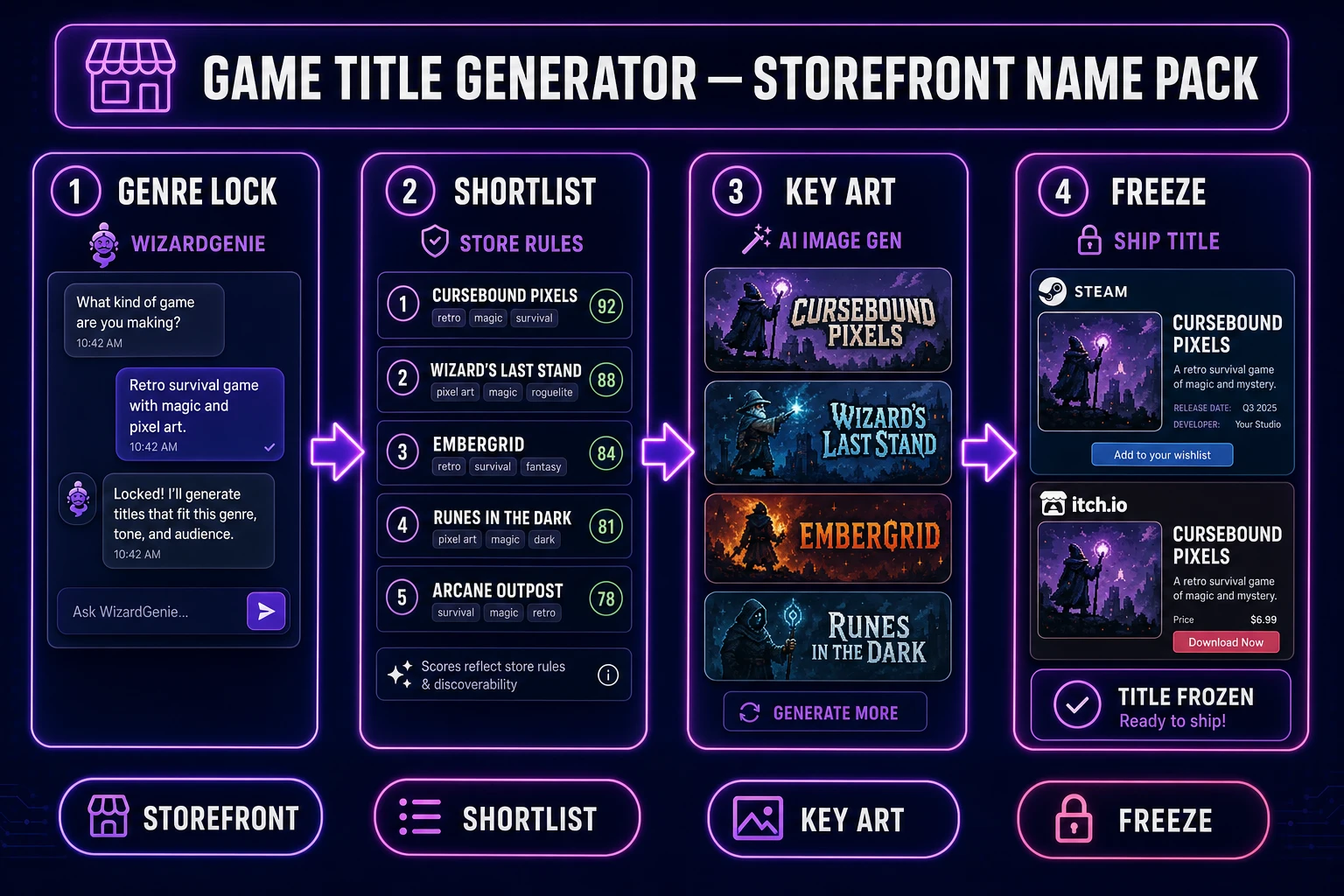
Game title generator in 2026 — four-step storefront pipeline from WizardGenie genre lock through shortlist scoring, AI Image Gen key art, and frozen Steam or itch title, verified July 16, 2026
A game title generator in 2026 means four moves: lock genre and banned words in WizardGenie, score a shortlist against store rules, stamp key-art companions in AI Image Gen, then freeze the winner for the listing.

What a game title generator outputs for indie storefronts

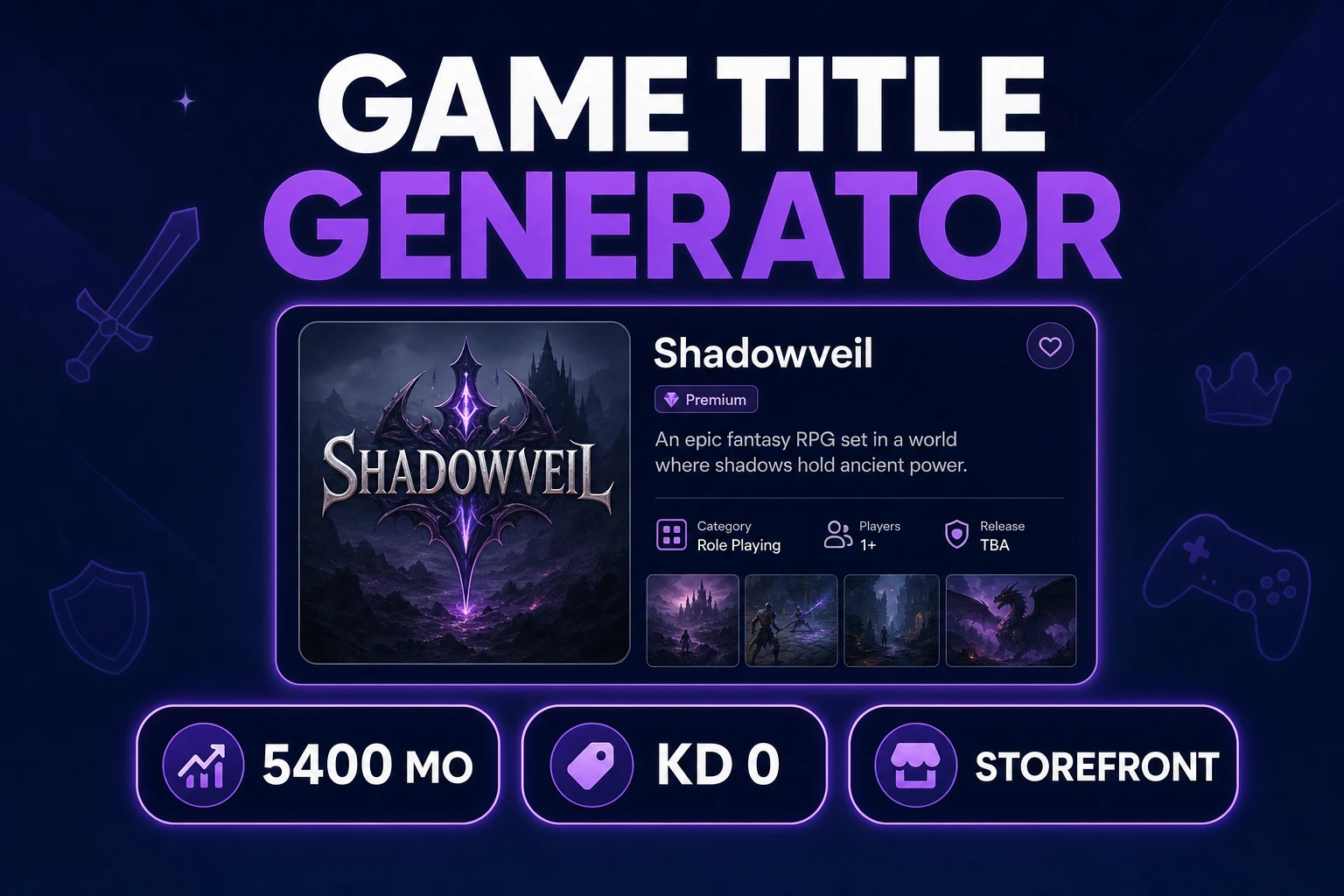
The phrase game title generator (5,400/mo, KD 0 per DataForSEO probe-fresh-seeds-3.md verified July 16, 2026) targets indie designers who need a public marketing title before the store page ships. Sibling queries confirm the cluster: video game title generator (880/mo, KD 0), board game title generator (210/mo, KD 0), and name for game generator (5,400/mo, KD 0) all describe the same hunger — a scored shortlist that already knows how the title fits a capsule, a trailer VO, and a search box.

For a shippable storefront pack that deliverable is production data: primary title, optional subtitle, syllable count, tone-fit note, store-fit note (card length, pronounceability), collision note, and a key-art companion prompt. One-off “give me cool titles” prompts stall the moment you need five candidates that share a genre dialect and survive a Steam capsule crop. Keep early project codenames in the sibling game name generator guide when you are still brainstorming; keep boot screens in the title screen generator post; route logo marks through the game logo maker flow when the wordmark must stand alone as an icon.

Why project codenames stall Steam and itch listings

A codename solves the repo and the Discord channel. A storefront title solves video game marketing: the string on the capsule, the words a streamer says aloud, and the query a player types after hearing the name once. Without locked genre and banned words, every regenerate invents a new tone. Without store-fit scoring, you pick a poetic six-word title that truncates on the card. Without a key-art pass, the title that read third-best in chat often wins once you see it on a capsule mock.

The traditional bottleneck was never “can AI invent words.” It was locking a readable brief for the listing, translating that brief into a shortlist the team can vote on, and attaching key art so the vote happens with eyes on the store card — not on a chat bubble. WizardGenie closes the shortlist layer; AI Image Gen closes the companion layer. Cross-link jam ideation in the game idea generator post when the concept is still fluid; mint the storefront title only after the pitch is stable enough to list.

The Sorceress game title generator pipeline in four steps

Every shippable storefront name pack ships four runtime pieces: locked brief, scored shortlist, key-art companions, and a frozen winner. In 2026 each maps to one Sorceress tool verified against the live catalog on July 16, 2026:

  • Brief + shortlist JSONWizardGenie scaffolds a browser shortlist UI (plain HTML or Phaser 4.2) and writes title, subtitle, syllableCount, toneFit, storeFit, and collisionNote from your genre brief; coding runs on your own API key.
  • Key-art companionsAI Image Gen (AI Credits) with models such as GPT Image 2 (5 credits at 1K) and Nano Banana Pro (18 credits at the 1K/2K default) via the unified panel; credit cost varies by model via getModelCredits in src/lib/models.ts.
  • Optional logo route — when the winner needs a standalone mark, hand the same string into the game logo maker pipeline instead of re-prompting from scratch.
  • Optional boot art — when the listing also needs an in-game title card, reuse the winner in the title screen generator flow so store page and first frame agree.

Pricing is a $49 lifetime unlock plus pay-as-you-go credit packs — Starter $10/1,000 credits, Creator $20/2,000, Plus $50/5,000, Studio $100/10,000 — verified against src/app/plans/page.tsx lines 50–54 and the $49 one-time badge. New accounts ship with 100 starter credits. The Sorceress tools guide lists every tool in the catalog.
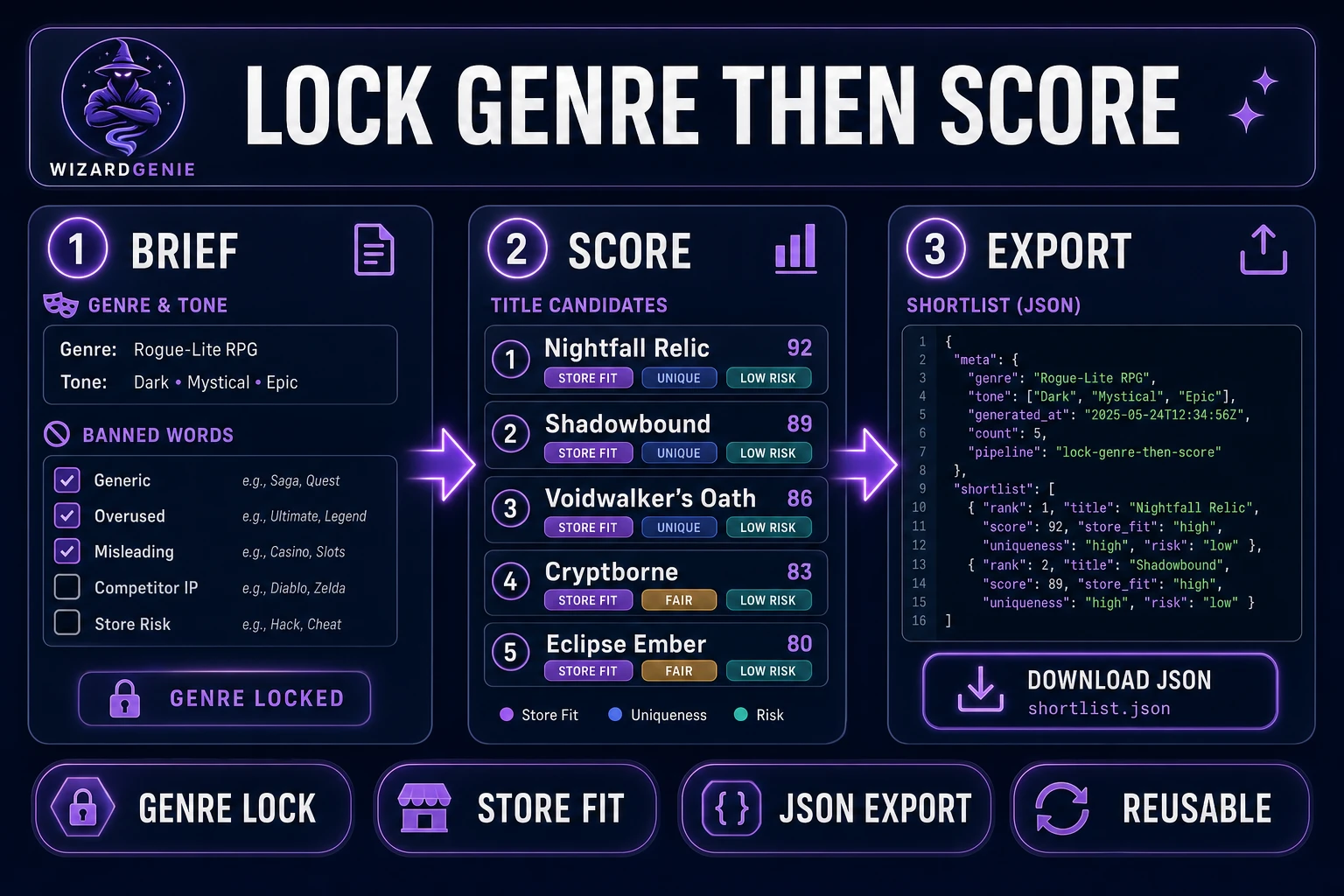
WizardGenie lock pipeline for a game title generator — genre brief to store-fit scoring to shortlist JSON export, verified July 16, 2026
WizardGenie turns a locked genre brief into scored title cards — title, subtitle, syllables, store fit, collision note — then exports JSON your listing checklist can load.

Step 1 — lock genre, tone, and banned words in WizardGenie

Open a plain text note and write the storefront brief before you touch a prompt field: genre (“2D solarpunk roguelike”), tone (“hopeful, not grimdark”), three reference titles that anchor the dialect, five banned patterns (“no ‘X of Y’,” “no -ia endings,” “no colonial-fantasy nouns,” “no six-word poetry,” “no numbers in the title”), and the hard length rule (“≤28 characters so the Steam capsule does not truncate mid-word”). That card is the production bible. Without it, every regenerate invents a new brand.

Open WizardGenie and prompt something concrete: “Build a game title generator shortlist for a 2D solarpunk roguelike. Emit JSON with keys title, subtitle, syllableCount, toneFit, storeFit, and collisionNote. Generate 24 candidates in four buckets: mechanical two-word titles, single-word titles with optional subtitle, verb-plus-noun action titles, and place-name titles. Enforce ≤28 characters on the primary title. Flag any name that collides with a shipped commercial video game you already know about. Rank the top eight for store-card fit.”

Pick Claude Opus 4.7 or Gemini 3.1 Pro for the first scaffold — shortlist schema and store-fit scoring benefit from the heavy reasoner. Iterate on renames and bucket edits with DeepSeek V4 Pro or Kimi K2.5 as the executor; never put a frontier model on the typing side. The coding lineup (Claude Opus 4.7, Claude Sonnet 4.6, GPT-5.5, Gemini 3.1 Pro, DeepSeek V4 Pro, Kimi K2.5, Grok 4.2, MiniMax M2.7) is verified against src/app/_home-v2/_data/tools.ts CODING_MODELS on July 16, 2026.

Save the storefront brief as a reusable system note at the top of the chat (“genre: solarpunk roguelike; tone: hopeful; max chars: 28; banned: X of Y, -ia”). Paste that note into every follow-up so new candidates stay on-brand. If you later localize the listing, keep one shared English winner and generate language-specific subtitles in a second pass — that is how a game title generator stays coherent across storefront locales instead of inventing twelve unrelated brands.

Step 2 — score a shortlist against storefront rules

A brand only works when the title signals the correct expectation on a store card. Score every candidate on five storefront rules before you vote: (1) character length under your hard cap, (2) pronounceability in a five-second trailer line, (3) Googleability (a unique enough string that a streamer mention is findable), (4) genre-tone fit against your three reference titles, and (5) collision risk against shipped commercial games and household brands. WizardGenie can fill those fields in the JSON; you still do the final manual checks.

Nothing in a game title generator replaces a proper trademark clearance opinion from a lawyer. What the AI-first shortlist honestly does is eliminate the obvious collisions before the lawyer’s clock starts. Ask WizardGenie to flag titles that share a name with a shipped commercial video game, a well-known board game, or a household brand outside gaming that it already knows about. Survivors still need a domain pass, a live Steam/itch search, and a trademark database check in real browser tabs.

Trim to five finalists before you spend image credits. If two titles tie on store fit, keep both — the key-art pass in the next step often reorders the ranking once the wordmark sits on a capsule crop. That reorder is exactly why scoring and key art belong in the same session instead of a week apart.

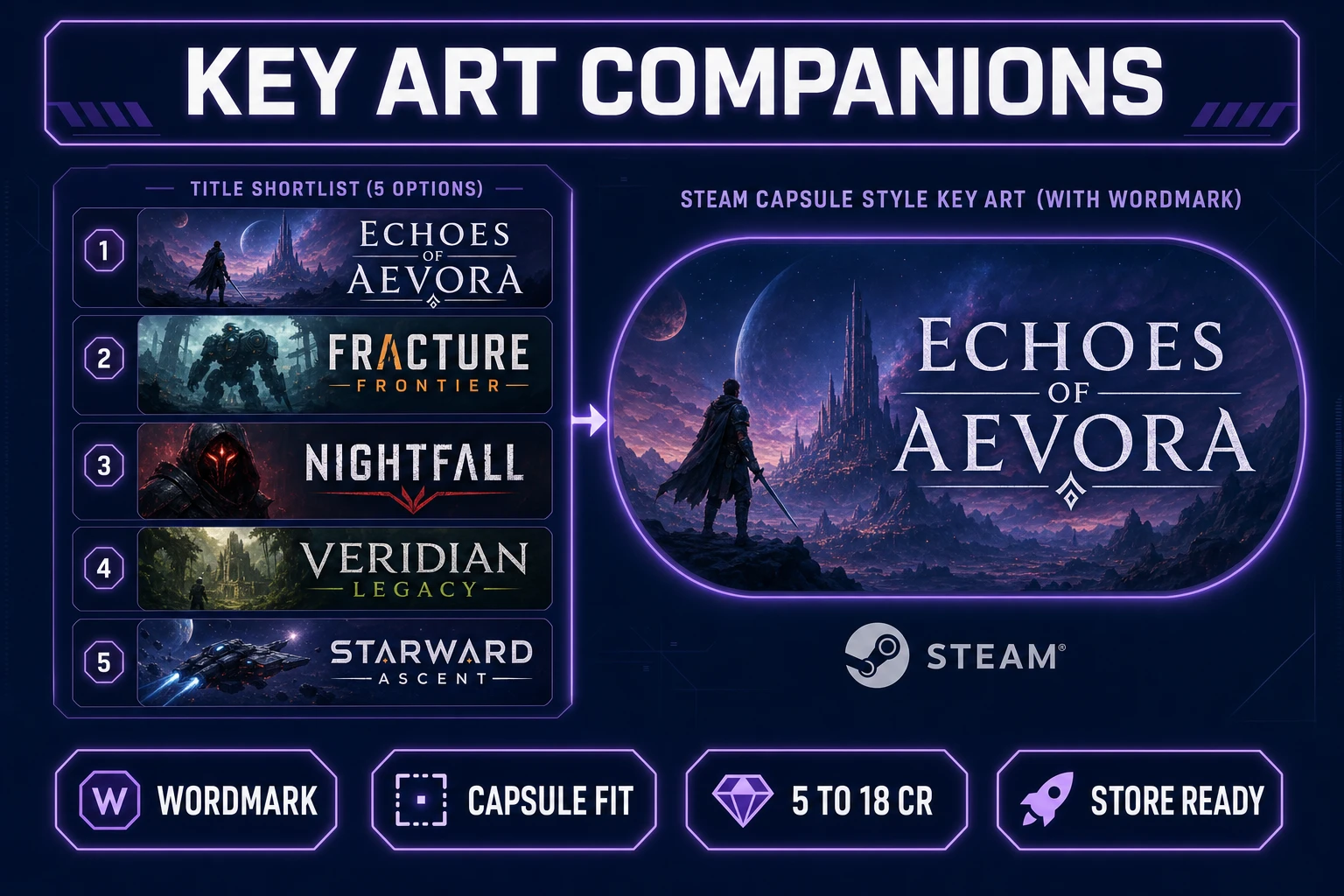
AI Image Gen key-art companions for a game title generator storefront name pack, verified July 16, 2026
AI Image Gen stamps capsule-ready key-art companions for each finalist so the vote happens on a store card, not on a chat bubble.

Step 3 — stamp key-art companions in AI Image Gen

Open AI Image Gen, pick a storefront-friendly aspect (16:9 for a header banner, 1:1 or 2:3 for a capsule-adjacent crop), and paste a reusable key-art prefix from the brief. Example: “indie Steam capsule key art, clean flat vector, title wordmark integrated, high contrast silhouette, no tiny illegible text, 2026 store page aesthetic.” Append each finalist’s title string so every stamp shares the same production look while the wordmark changes.

Prefer GPT Image 2 (5 credits at 1K; higher at 2K/4K) or Nano Banana Pro (18 credits at 1K/2K default) when you need legible wordmarks; use Z-Image (3 credits) when you are still hunting composition. Costs verified in src/lib/models.ts on July 16, 2026. Lay the five finalist capsules on one desk and vote with eyes on the card. It is common for the chat ranking to flip here — the title that read second-best often wins once the wordmark is cropped to capsule width.

If you also need a circular store icon or app-tile mark, route the winner through the game logo maker post so capsule and icon agree. In-game boot art lives in the title screen generator guide — do not burn a full boot sequence before the storefront string is frozen.

When you wire a browser demo later, Phaser 4.2.0 “Giedi” shipped June 19, 2026; patch 4.2.1 landed July 9, 2026 (verified against phaser.io/news/2026/06/phaser-v4-2-0-released on July 16, 2026). Keep the shortlist JSON as the source of truth; keep the winning PNG filename next to the frozen title so marketing and build scripts stay aligned.

What a game title generator session costs on Sorceress in 2026

Cost math verified July 16, 2026. Base unlock: $49 lifetime. A minimal five-finalist storefront pack typically burns 15–90 Sorceress credits ($0.15–$0.90 at Starter tier rates) covering one to three AI Image Gen key-art passes per title, with WizardGenie coding on your own API key. Compare that to commissioning five custom capsule mockups plus a naming consultant for a jam — the game title generator SERP reader is usually freezing a listing title before the weekend build.

Start with the 100 free credits, lock one storefront brief, export twenty-four candidates, score to five, stamp five key-art companions, then spend credits only on the second language pack the storefront proves you need. The pricing page shows live credit tiers; the plans page mirrors the same $49 lifetime figure from source. Cross-link the early codename brainstorm in the game name generator guide when the project is still pre-listing.

The verdict on game title generator workflows in 2026

A random-word table is an icebreaker. A game title generator is a storefront engine with scored shortlists and key art. Lock genre and banned words in WizardGenie, score against store rules until five finalists survive, stamp key-art companions in AI Image Gen, freeze the winner for Steam and itch, and keep the same string for logo and boot art later. That is the honest 2026 path from “working title TBD” to a listing players can find after one stream mention.

Frequently Asked Questions

What does a game title generator output for indie storefronts?

A game title generator for storefronts produces a scored shortlist of marketing titles — not project codenames — plus optional subtitle lines, syllable notes, and a key-art companion prompt. On Sorceress that maps to WizardGenie for the shortlist JSON and AI Image Gen for capsule-ready wordmark or key-art stamps.

How is a game title generator different from a game name generator?

A game name generator (see the sibling Coin post) is the early brainstorm for project codenames and jam icebreakers. A game title generator focuses on the public storefront string that must fit Steam and itch cards, survive pronunciation in trailers, and avoid collisions with shipped commercial titles. Use the name pass first; mint the storefront title when you are ready to list.

Can WizardGenie build a game title generator shortlist in the browser?

Yes. Prompt WizardGenie for a shortlist UI or JSON export with fields title, subtitle, syllableCount, toneFit, storeFit, and collisionNote. Use Claude Opus 4.7 or Gemini 3.1 Pro for the first scaffold, then DeepSeek V4 Pro or Kimi K2.5 as the executor. The coding lineup is verified against src/app/_home-v2/_data/tools.ts CODING_MODELS on July 16, 2026.

What does AI Image Gen cost for storefront key-art companions?

Verified July 16, 2026 against src/lib/models.ts: GPT Image 2 starts at 5 credits (1K), Nano Banana Pro at 18 credits (1K/2K default), Z-Image at 3 credits for fast drafts. A five-title key-art pass typically burns 15–90 credits depending on model and retries.

What does a game title generator session cost on Sorceress in 2026?

Verified July 16, 2026 against src/app/plans/page.tsx. Base unlock is $49 one-time. A typical storefront title session burns 15–90 Sorceress credits for key-art companions; WizardGenie coding runs on your own API key. New accounts ship with 100 starter credits. Credit packs: Starter $10/1,000, Creator $20/2,000, Plus $50/5,000, Studio $100/10,000.

Sources

  1. Video game marketing — Wikipedia
  2. Brand — Wikipedia
  3. Trademark — Wikipedia
  4. Phaser v4.2.0 release (Giedi)
Written by Arron R.·1,856 words·8 min read

Related posts