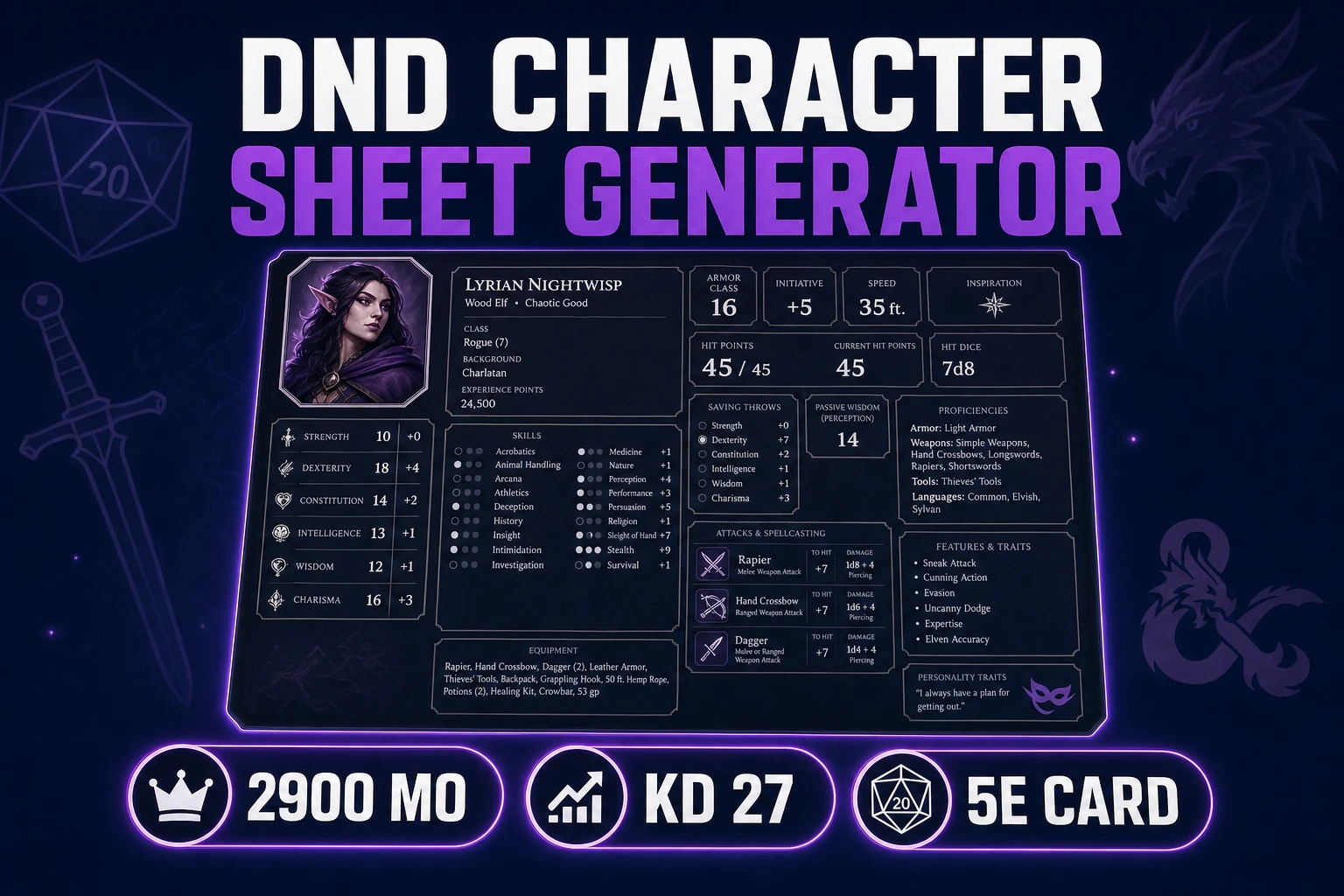
Fill a DnD Character Sheet Generator (Tabletop Card 2026)

By Arron R.8 min read
A dnd character sheet generator in 2026 is a four-step browser pipeline: lock the PC brief in WizardGenie, fill 5e ability scores and skills onto a printable ca

Session zero stalls the moment every player opens a blank PDF and starts hunting for which box holds Insight. Searchers typing dnd character sheet generator want a filled character sheet — ability scores with modifiers, skills, HP, AC, equipment notes, and a face in the portrait slot — not another empty form. This guide covers the 2026 browser pipeline: WizardGenie locks the PC brief and fills the 5e fields, AI Image Gen stamps the portrait, and Speech Gen cuts a one-line intro you can play at the table. Tool costs and model credits below are verified against the live Sorceress source on July 16, 2026.
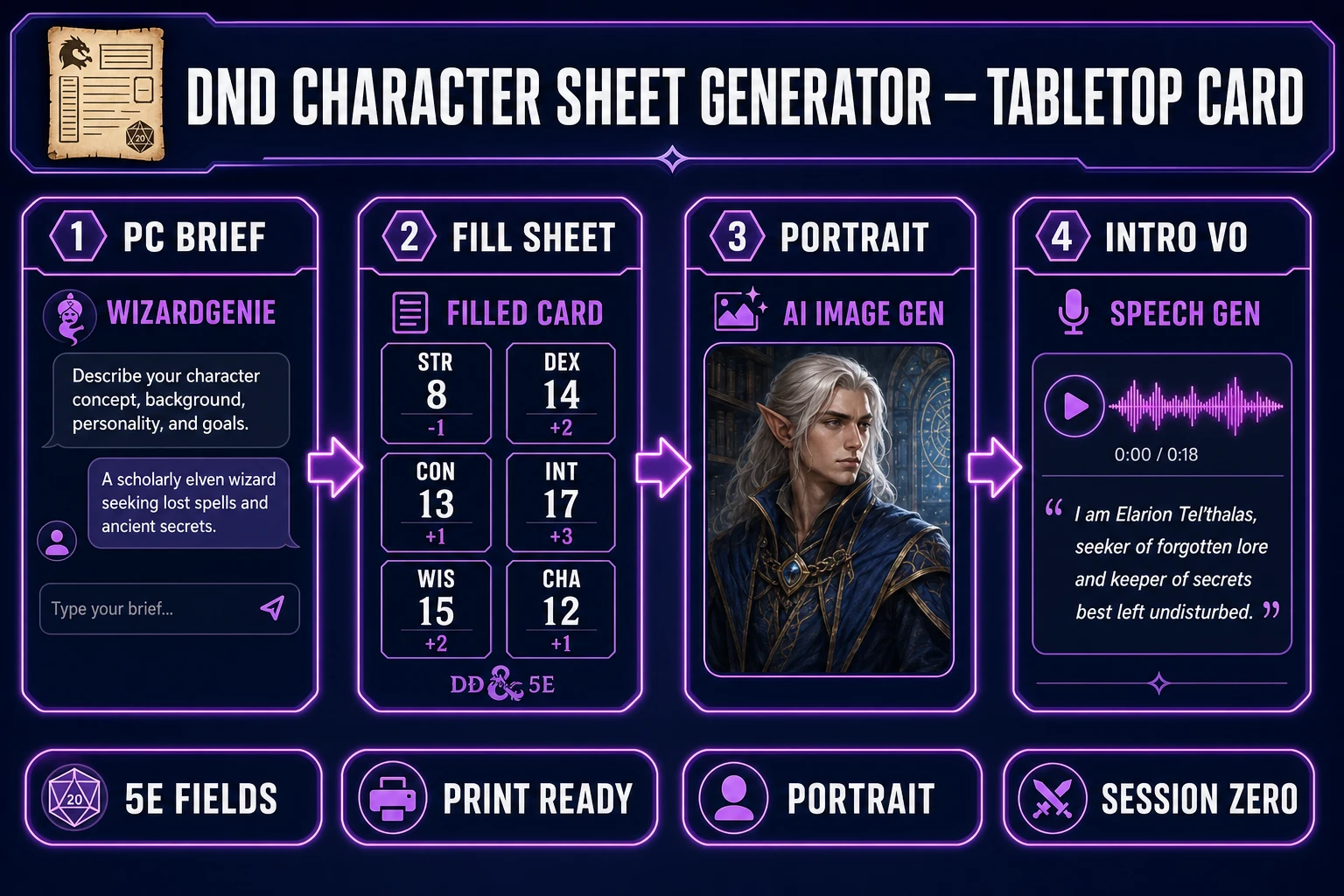
DnD character sheet generator in 2026 — four-step browser pipeline from WizardGenie PC brief through filled 5e card, AI Image Gen portrait, and Speech Gen intro VO, verified July 16, 2026
A dnd character sheet generator in 2026 means four moves: lock the PC brief in WizardGenie, fill the 5e card, stamp a portrait in AI Image Gen, then cut an intro line in Speech Gen.

What a dnd character sheet generator outputs for tabletop night

The phrase dnd character sheet generator (2,900/mo, KD 27 per DataForSEO probe-fresh-seeds-4.md verified July 16, 2026) targets dungeon masters and players who need a playable sheet before dice hit the table. Sibling queries confirm the cluster: dungeons and dragons character sheet generator (2,900/mo, KD 13), d and d character sheet generator (2,900/mo, KD 30), character sheet generator (390/mo, KD 14), and 5e character sheet generator (140/mo, KD 8) all describe the same hunger — a card that already knows Strength through Charisma, not a blank grid.

For tabletop night that deliverable is a production pack: filled ability scores with modifiers, skill list, hit points, armor class, a short personality block, a portrait that matches the brief, and optionally a spoken intro line. Art-only pipelines (multi-view turnaround sheets) stall the moment someone asks “what’s my Perception bonus?” Pair art turnarounds from the sibling ai character sheet generator post when you also need front/side/three-quarter frames for a digital RPG, and keep town-cast NPCs in the DnD NPC generator guide when the sheet is for a shopkeeper instead of a player character.

Why blank PDFs stall session zero

Official blank sheets solve storage, not decisions. Players still have to invent ability scores, derive modifiers, pick skills, and remember which box is Passive Perception. Static fillable PDFs save handwriting and still leave every mechanical choice to the player. Neither path reads the campaign pitch (“low-magic coastal heist, level 3 start”) and returns a coherent class + score array that fits the tone.

The traditional bottleneck was never printing. It was locking a readable character concept, translating that concept into the six ability scores that drive Dungeons & Dragons checks and saves, and attaching a face plus a voice so the table remembers who showed up. WizardGenie closes the fill layer; AI Image Gen closes the portrait layer; Speech Gen closes the intro layer. Cross-link roster naming in the fantasy name generator post and session-running tips in the AI dungeon master guide when you batch a full party.

The Sorceress dnd character sheet generator pipeline in four steps

Every shippable tabletop card ships four runtime pieces regardless of edition flavor: locked brief, filled sheet fields, portrait, and intro VO. In 2026 each maps to one Sorceress tool verified against the live catalog on July 16, 2026:

  • PC brief + filled fieldsWizardGenie scaffolds a fillable browser sheet (plain HTML or Phaser 4.2) and writes ability scores, skills, HP, and AC from your pitch; coding runs on your own API key.
  • Portrait stampAI Image Gen (AI Credits) with models such as GPT Image 2 (5 credits base) and Nano Banana Pro (18 credits at the 1K/2K default) via the unified panel; credit cost varies by model via getModelCredits in src/lib/models.ts.
  • Intro VOSpeech Gen (AI Credits) at HD 0.5 credits per 1,000 characters or Turbo 0.3 per 1,000 (min 1 credit), verified in src/app/speech-gen/page.tsx.
  • Optional in-game mirror — the same JSON card can feed a Phaser character-select screen if you later port the party into a browser RPG.

Pricing is a $49 lifetime unlock plus pay-as-you-go credit packs — Starter $10/1,000 credits, Creator $20/2,000, Plus $50/5,000, Studio $100/10,000 — verified against src/app/plans/page.tsx lines 46 and 51–54. New accounts ship with 100 starter credits. The Sorceress tools guide lists every tool in the catalog.
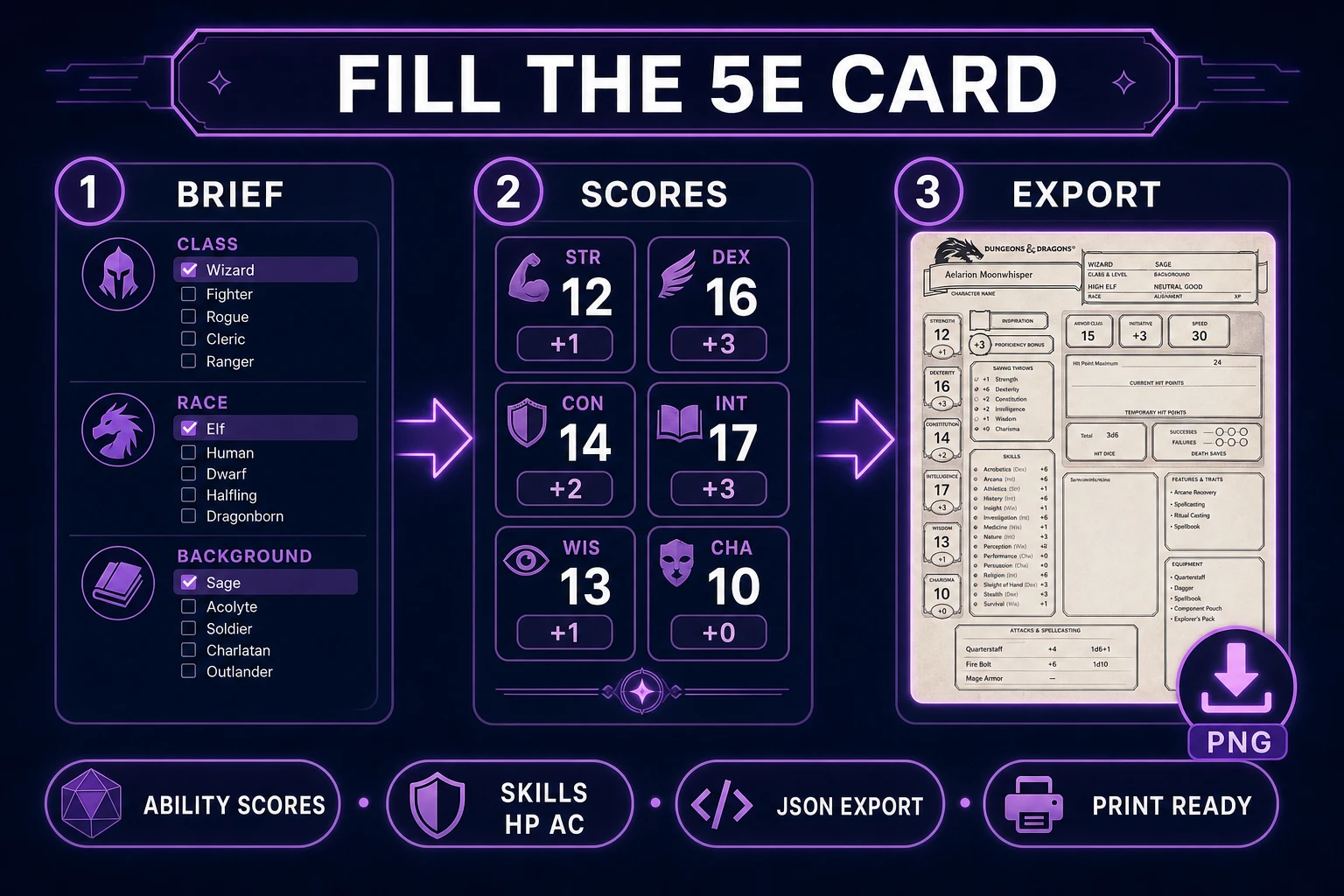
WizardGenie fill pipeline for a dnd character sheet generator — PC brief to ability scores to printable card export, verified July 16, 2026
WizardGenie turns a locked PC brief into filled 5e fields — ability scores with modifiers, skills, HP, and AC — then exports JSON plus a print-ready card layout.

Step 1 — lock the PC brief in WizardGenie

Open a plain text note and write the brief before you touch a prompt field: level band, class fantasy (“swashbuckling rogue who smuggles tide charts”), three personality traits, one bond, one flaw, equipment vibe, and three forbidden traits (“no edgelord loner,” “no neon cyberpunk armor,” “no dump-stat Constitution”). That card is the production bible. Without it, every regenerate invents a new character.

Open WizardGenie and prompt something concrete: “Build a fillable dnd character sheet generator for one level-3 coastal rogue. Use the standard array (15, 14, 13, 12, 10, 8), assign scores to match a Dexterity-primary smuggler, derive modifiers, list skills with proficiency where appropriate, set HP and AC for light armor, and emit both a printable HTML card and a JSON blob with keys for name, class, level, abilities, skills, hp, ac, equipment, personality.”

Pick Claude Opus 4.7 or Gemini 3.1 Pro for the first scaffold — form layout, modifier math, and JSON schema benefit from the heavy reasoner. Iterate on score swaps and skill picks with DeepSeek V4 Pro or Kimi K2.5 as the executor; never put a frontier model on the typing side. The coding lineup (Claude Opus 4.7, Claude Sonnet 4.6, GPT-5.5, Gemini 3.1 Pro, DeepSeek V4 Pro, Kimi K2.5, Grok 4.2, MiniMax M2.7) is verified against src/app/_home-v2/_data/tools.ts CODING_MODELS on July 16, 2026.

Save the brief as a reusable system note at the top of the chat (“campaign: low-magic coastal heist; starting level: 3; tone: dry humor, no grimdark”). Paste that note into every follow-up so score tweaks stay on-world. If you are filling four player cards for the same table, keep one shared campaign note and one per-PC brief — that is how a dnd character sheet generator stays coherent across a party instead of inventing four unrelated settings.

Step 2 — fill ability scores, skills, HP, and AC

A role-playing game character sheet is only useful when the numbers agree with each other. Ask WizardGenie to show its work: “For each ability score, print score and modifier. For each skill, print governing ability + proficiency if trained. Recalculate HP from Constitution modifier and class hit die. Recalculate AC from Dexterity and armor.” Reject any card where modifiers disagree with scores — that is a generator bug, not a style choice.

Export the JSON as the source of truth (party/mira_tidechart.json). Keep the printable HTML or PNG as the table handout. If you later want a digital RPG mirror, pass the same JSON into a Phaser 4.2 character-select scene so the in-game sheet and the paper sheet stay one object. Phaser 4.2.0 “Giedi” shipped June 19, 2026 (verified against phaser.io/news/2026/06/phaser-v4-2-0-released and the GitHub v4.2.0 release tag on July 16, 2026).

Do not invent homebrew ability names in the first pass. Stick to Strength, Dexterity, Constitution, Intelligence, Wisdom, and Charisma so the card drops into any 5e-compatible VTT without a translation layer. Homebrew subclasses can wait until the core card is locked.

When the table wants point-buy instead of the standard array, say so explicitly in the prompt and ask WizardGenie to list the point spend next to each score. When someone wants 4d6-drop-lowest, ask for six rolls with the discarded die shown. Either method is fine — the sheet only needs a transparent trail from method → scores → modifiers so nobody argues mid-session about how a +3 appeared.

Step 3 — stamp the portrait and cut the intro VO

Open AI Image Gen, pick a portrait-friendly aspect (3:4 or 1:1), and paste the brief’s face lines as a reusable prefix. Example: “tabletop RPG character portrait bust, young human smuggler, salt-stiff hair, brass compass earring, clean cel shading, neutral gray backdrop, shoulders in frame, front-facing, character sheet header art.” Prefer GPT Image 2 (5 credits base) or Nano Banana Pro (18 credits at 1K/2K default) when you need legible costume edges; use cheaper iteration models when you are still hunting the face. Costs verified in src/lib/models.ts on July 16, 2026.

Drop the winning PNG into the sheet’s portrait slot. Then open Speech Gen and paste a single intro line from the personality block — under two hundred characters keeps the clip short and the bill at the one-credit floor for HD/Turbo. Play the clip once at session zero when the player introduces themselves; that alone sticks the character better than reading the Ideal/Bond/Flaw boxes aloud.

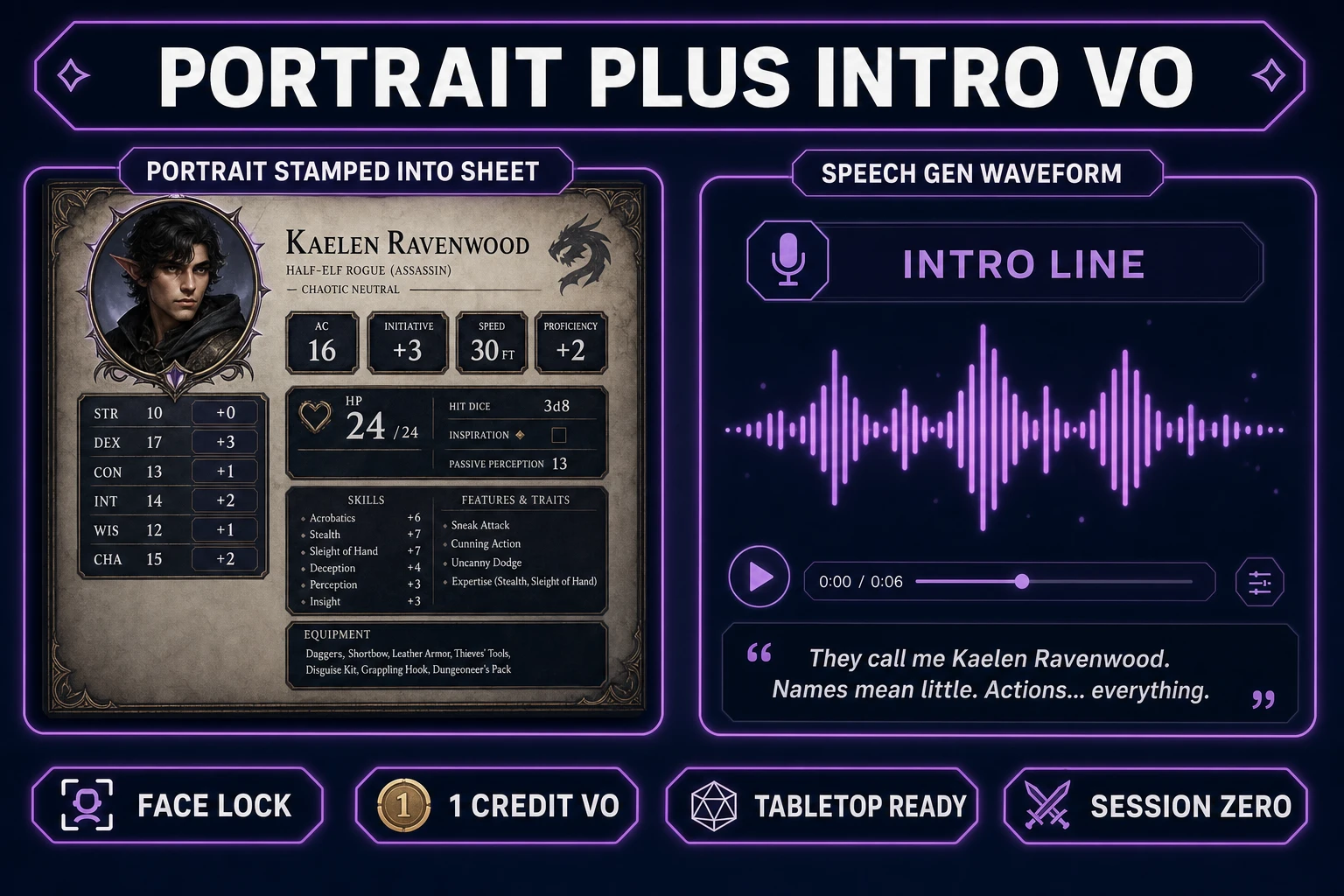
AI Image Gen portrait stamp and Speech Gen intro VO for a dnd character sheet generator tabletop card, verified July 16, 2026
AI Image Gen stamps the portrait into the sheet header; Speech Gen cuts a one-credit intro line you can play when the character sits down at session zero.

If you also need circular HUD icons for a digital party list, route a tight-head crop through the sibling ai avatar generator flow so sheet portrait and roster icon agree. Dialogue busts that need emotion variants live in the ai portrait generator guide.

Skip voice cloning for session-zero intros unless the same PC will recur across a long campaign with many pre-recorded lines. Cloning costs 400 credits on the live Speech Gen page (VOICE_CLONE_CREDITS in src/app/speech-gen/page.tsx, verified July 16, 2026). A preset voice plus a locked script is enough for one greeting; save the clone budget for recurring patrons and villains from the DnD NPC generator pipeline.

What a dnd character sheet generator session costs on Sorceress in 2026

Cost math verified July 16, 2026. Base unlock: $49 lifetime. A minimal single-PC card typically burns 10–40 Sorceress credits ($0.10–$0.40 at Starter tier rates) covering one to three AI Image Gen portrait runs plus one Speech Gen credit for the intro line, with WizardGenie coding on your own API key. Compare that to commissioning a custom character illustration plus a hand-filled sheet for a one-shot — the dnd character sheet generator SERP reader is usually a DM optimizing for four playable cards before Friday.

Start with the 100 free credits, lock one brief, fill one card, stamp one portrait, cut one intro, then spend credits only on the second PC the table proves they will play. The pricing page shows live credit tiers; the plans page mirrors the same $49 lifetime figure from source.

The verdict on dnd character sheet generator workflows in 2026

A blank PDF is storage. A dnd character sheet generator is a decision engine with a face and a voice. Lock the brief in WizardGenie, fill the 5e fields until modifiers agree with scores, stamp the portrait in AI Image Gen, cut the intro in Speech Gen, and export JSON plus a print-ready card. That is the honest 2026 path from “who are you playing?” to a sheet that survives first contact with the dice.

Frequently Asked Questions

What does a dnd character sheet generator output?

A dnd character sheet generator for tabletop night produces a filled player-character card: name, class/level, the six ability scores with modifiers, skills, HP/AC, equipment notes, and a portrait slot. On Sorceress that maps to WizardGenie for the fillable 5e fields, AI Image Gen for the portrait, and Speech Gen for a short intro VO you can play at session zero.

How is a dnd character sheet generator different from an ai character sheet generator?

A dnd character sheet generator fills tabletop RPG fields (ability scores, skills, HP, AC) so the sheet is playable at the table. An ai character sheet generator (see the sibling Draft art-sheet post) produces multi-view art turnarounds for game sprites and concept packs. Use the DnD sheet for session zero; use the art sheet when you need front/side/three-quarter reference frames.

Can WizardGenie build a fillable dnd character sheet generator in the browser?

Yes. Prompt WizardGenie for a Phaser 4.2 or plain HTML fillable sheet that stores STR/DEX/CON/INT/WIS/CHA, derived modifiers, skills, HP, and AC in JSON, then exports a printable PNG or PDF-friendly layout. Phaser 4.2.0 Giedi shipped June 19, 2026 (verified July 16, 2026). Use Claude Opus 4.7 or Gemini 3.1 Pro for the first scaffold, then DeepSeek V4 Pro or Kimi K2.5 as the executor.

What does Speech Gen cost for a character intro line?

Speech Gen on /speech-gen bills from the live page math in src/app/speech-gen/page.tsx (verified July 16, 2026): HD at 0.5 credits per 1,000 characters (min 1 credit), Turbo at 0.3 credits per 1,000 characters (min 1). A short intro line is almost always 1 credit. Voice cloning is a separate 400-credit path when you need a locked NPC voice across sessions.

What does a dnd character sheet generator session cost on Sorceress in 2026?

Verified July 16, 2026 against src/app/plans/page.tsx. Base unlock is $49 one-time. A single PC card typically burns 10–40 Sorceress credits for one to three AI Image Gen portrait passes plus 1 Speech Gen credit for the intro line; WizardGenie coding runs on your own API key. New accounts ship with 100 starter credits.

Sources

  1. Dungeons & Dragons — Wikipedia
  2. Character sheet — Wikipedia
  3. Role-playing game — Wikipedia
  4. Phaser v4.2.0 release (Giedi)
Written by Arron R.·1,830 words·8 min read

Related posts