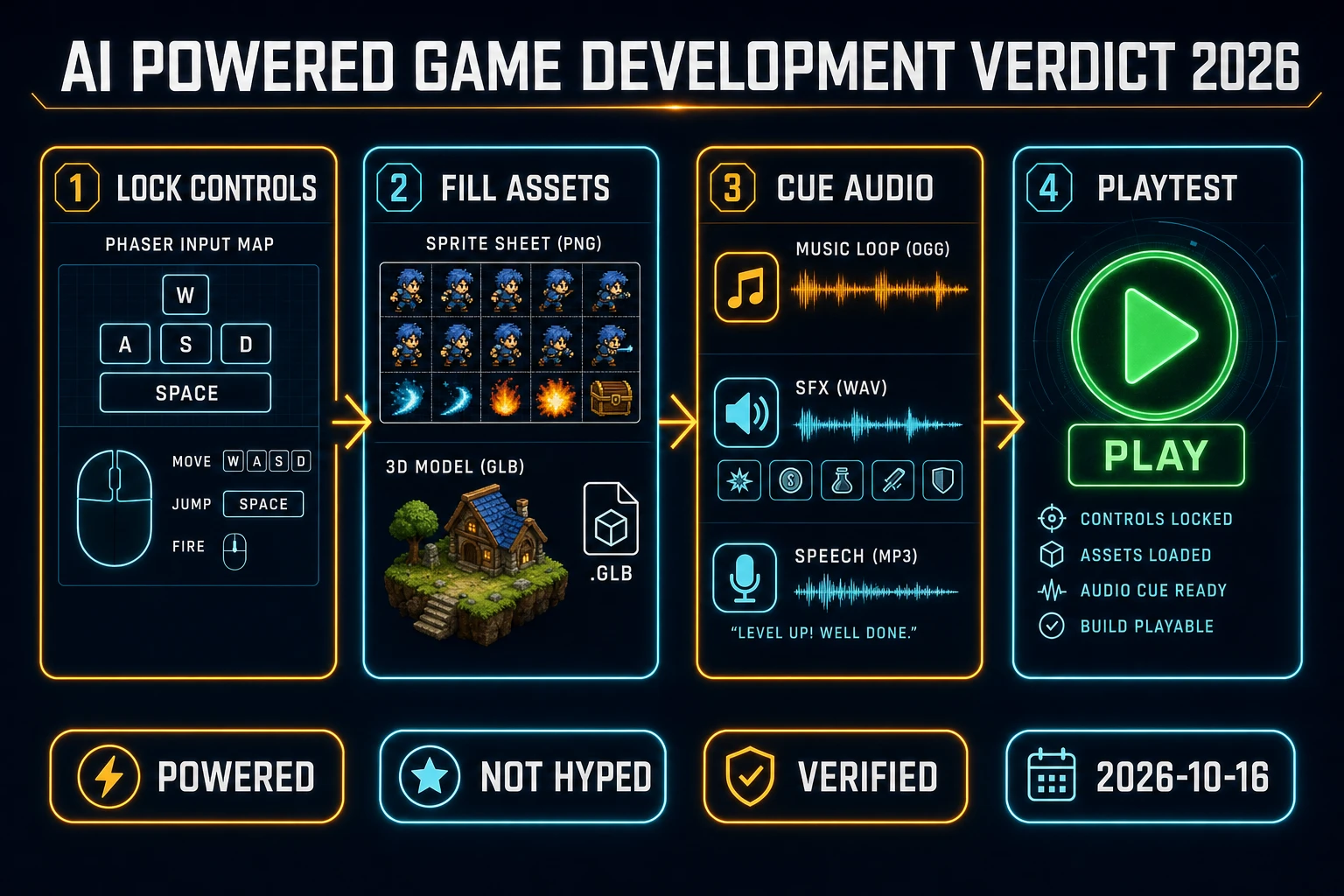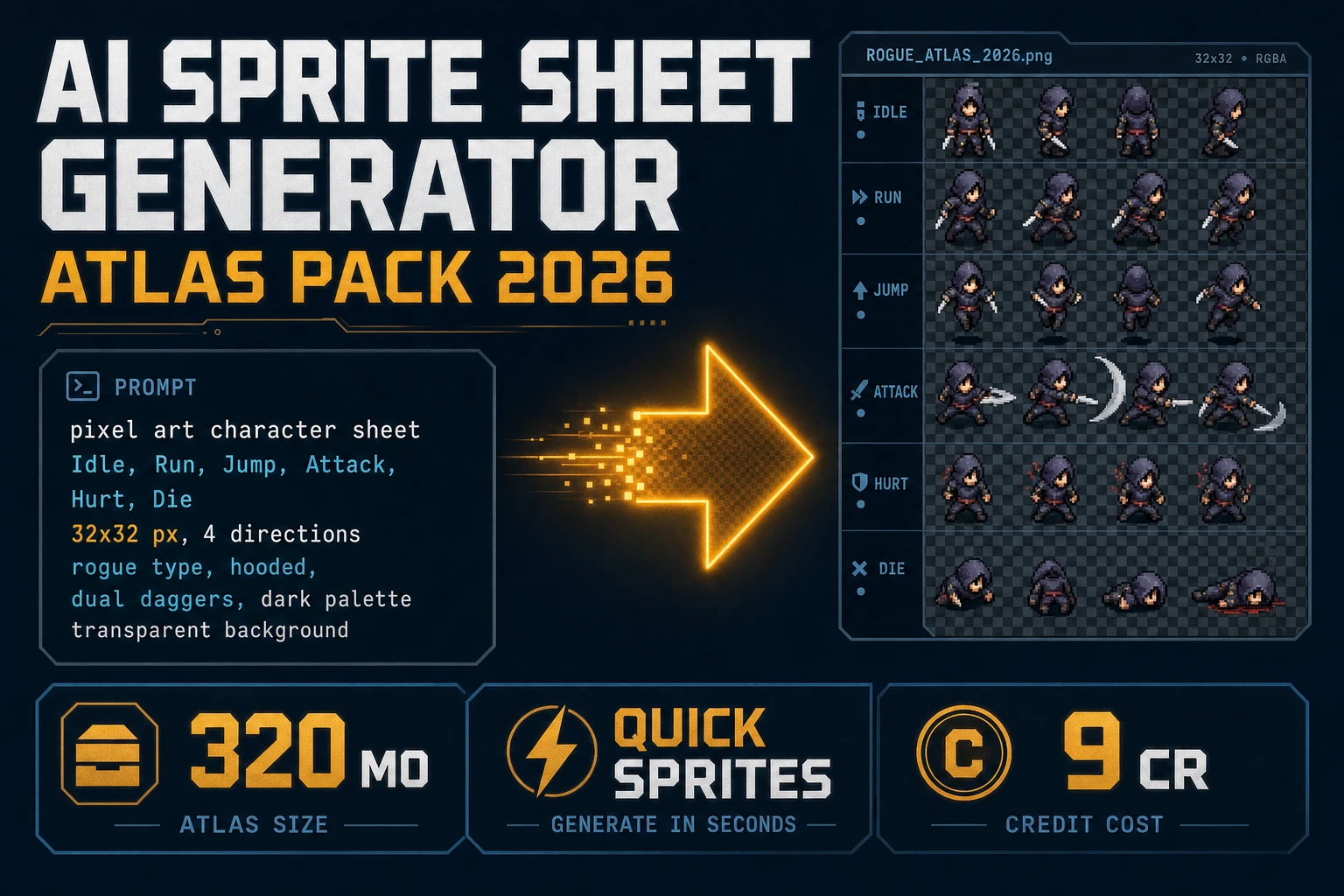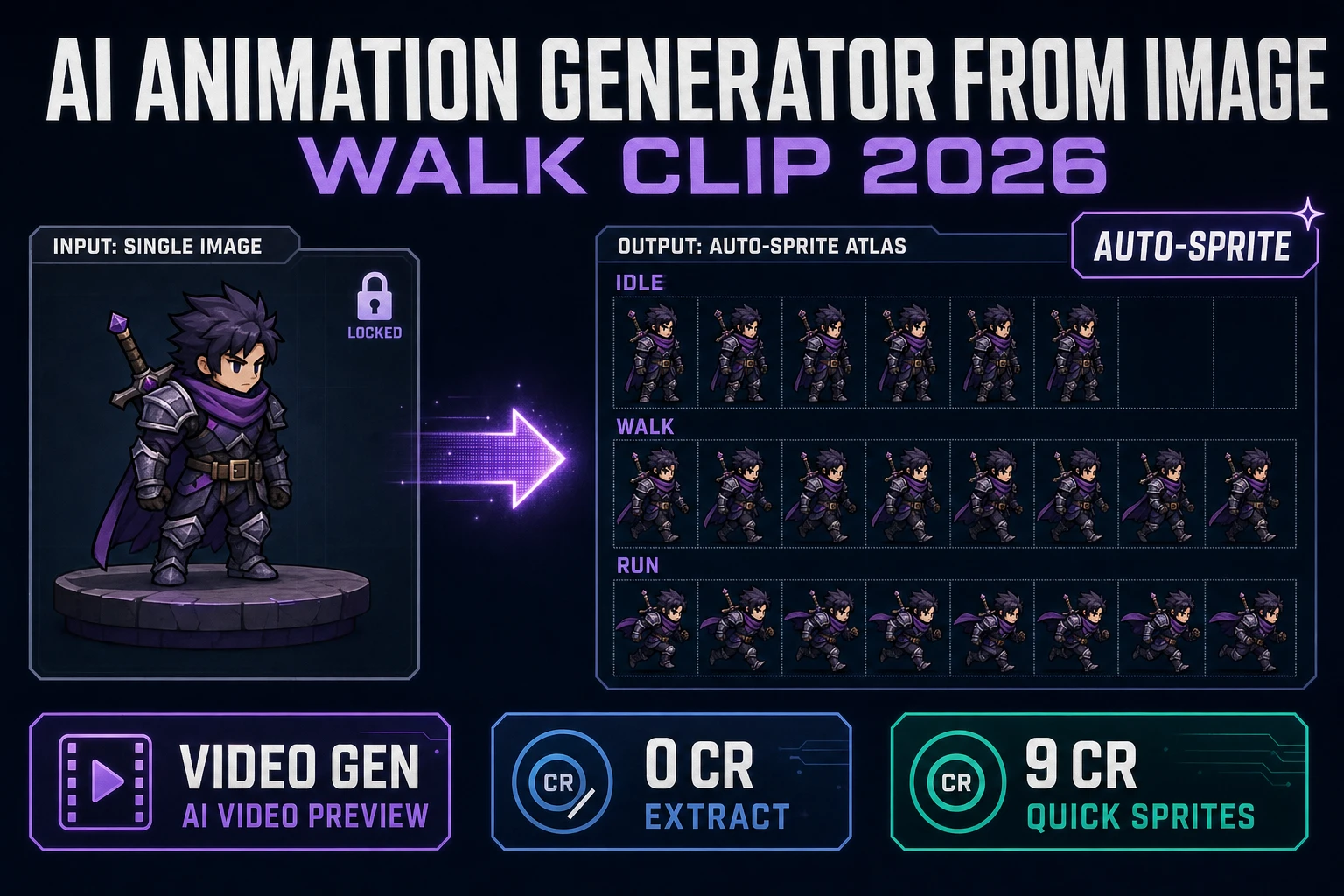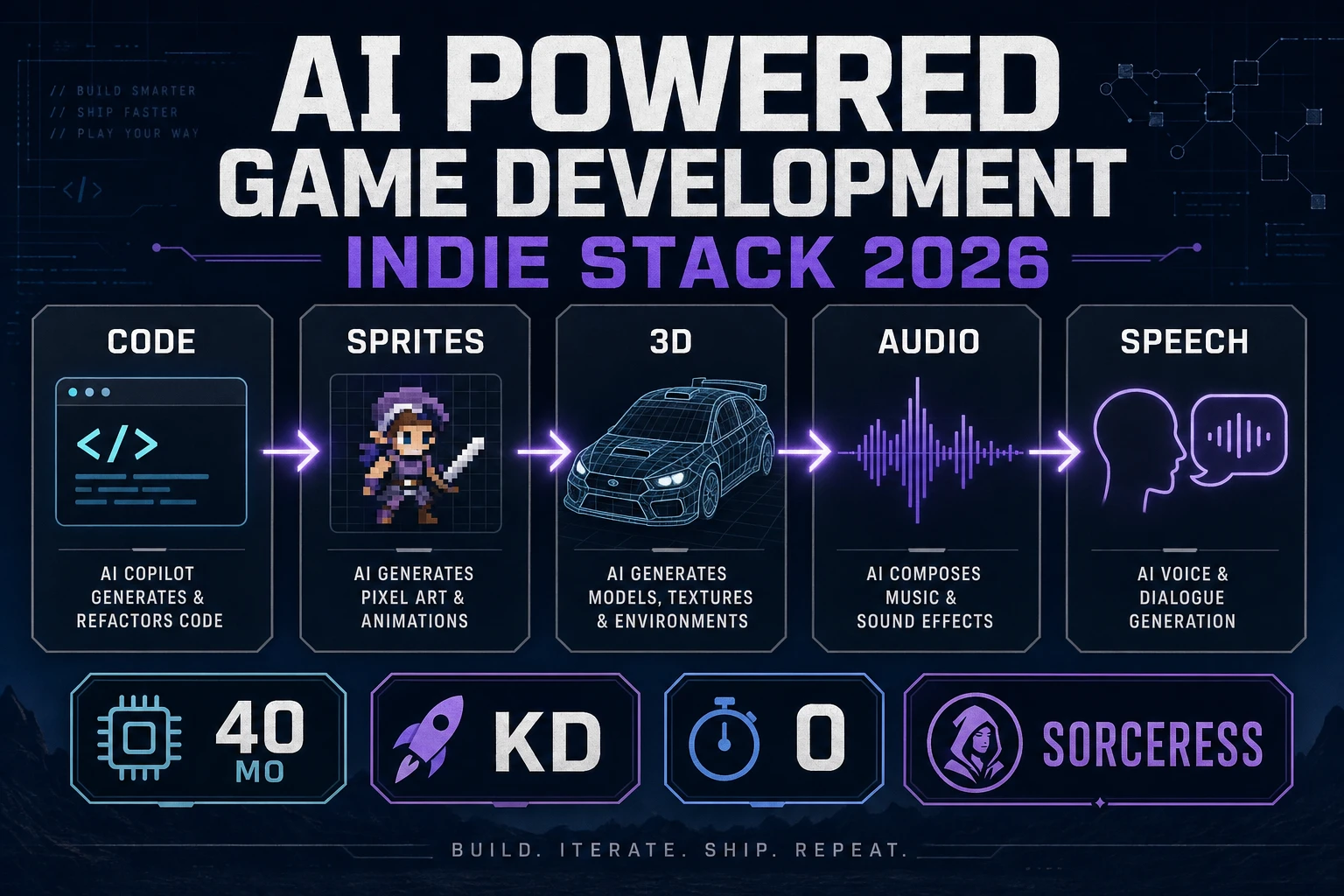
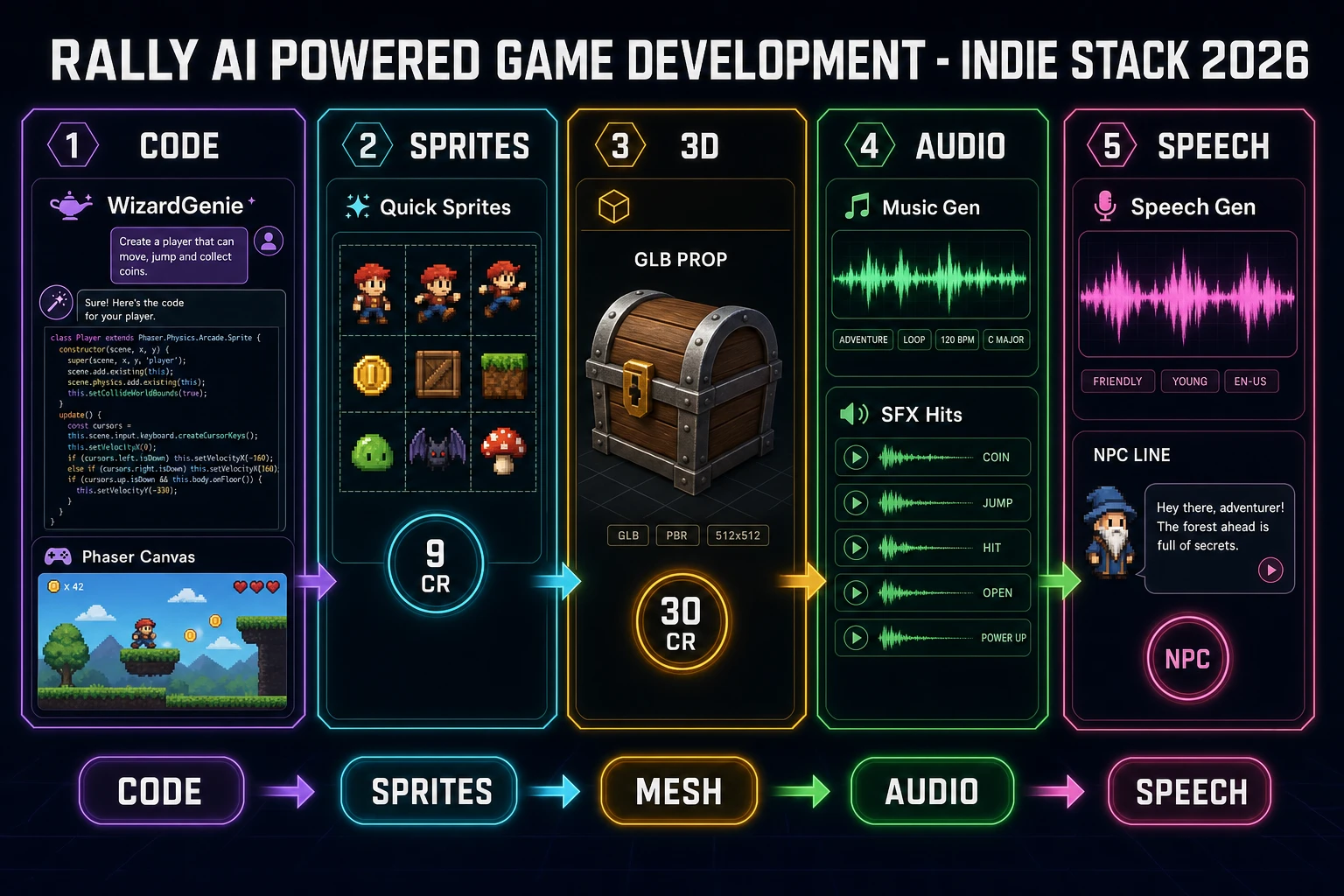
Commercial searchers who type ai powered game development are not hunting another vendor ranking. They want to know whether generative models can push a shippable indie loop — code that runs, art that drops into an atlas, meshes that load as GLB, audio that cues on events — without five overlapping subscriptions. This listicle rallies that stack by shipping job. Every credit number and tool path below was verified against Sorceress source and neutral docs on 2026-10-16.
What AI powered game development searchers actually want
DataForSEO lists ai powered game development at 40 searches a month, KD 0, commercial intent (verified 2026-10-16 in tools/research-output.md). Sibling umbrella phrases include ai in video game development (40/mo, KD 0) and ai assisted game development (30/mo, KD 29). Readers landing here usually already tried a chat window for code and now want powered outputs they can forecast: a sprite sheet at a flat credit cost, a textured prop, a loopable bed, a spoken NPC line.
Adjacent Sorceress posts cover nearby angles — AI game development tools maps the surfaces, AI in game development covers the umbrella phrase, and Falcom AI game development covers disclosure culture. This page stays on the powered commercial framing: which job does AI actually drive, and what does the first pass cost?
Phaser’s documentation (verified 2026-10-16 at docs.phaser.io) still frames web 2D honestly: HTML5, WebGL/Canvas, JavaScript or TypeScript, browser-first, not a full 3D console engine. MDN’s 3D games on the Web primer (verified 2026-10-16) points at WebGL plus libraries such as three.js when you leave pure 2D. The stack below assumes that split: Phaser for the playable loop, glTF/GLB for 3D props (Khronos glTF, verified 2026-10-16).
1. Code power — WizardGenie for the playable loop
WizardGenie is the coding seat of ai powered game development on Sorceress. The home card (verified 2026-10-16 in src/app/_home-v2/_data/tools.ts) describes it as the AI-native game engine at the heart of the suite: describe the game, and WizardGenie writes, runs, and iterates in real time. It drives the same frontier coding roster the suite advertises — Claude Opus 4.7, GPT-5.5, Gemini 3.1 Pro, DeepSeek V4 Pro, Kimi K2.5, Grok 4.2, MiniMax M2.7 — with your own API key or a trial path.
Use a Planner+Executor split when cost matters: keep the expensive reasoner on planning, put a cheap fast model (DeepSeek V4 Pro, Kimi K2.5, MiniMax M2.7, or GPT-5.5 Mini) on the typing seat. That is the whole economic point of dual-agent mode. Never put Opus, Sonnet, GPT-5.5 full, or Gemini 3.1 Pro on the typing seat — those belong on the plan side when you need them at all. WizardGenie ships as both a Windows desktop installer and a web app at /wizard-genie/app; pick whichever fits the machine you have tonight.
A practical first session: prompt a one-screen Phaser loop (player, one enemy, score, restart), playtest in the preview, then freeze the control scheme before you generate art. Swapping sprites under a stable input map is cheap; rebuilding collision after every art pass is not. Deeper code-path write-ups: how to make a video game with AI and Sorceress Code when you want the model picker outside the game-engine shell.
What this seat is not: an arcade auto-publisher. Export or host the Phaser build yourself. What it is: inspectable JavaScript you can playtest, then feed with assets from the seats below.
2. Sprite power — Quick Sprites, Image Gen, True Pixel
When the code seat needs characters, tiles, and UI chrome, stay in the Sprites & 2D group instead of bouncing to a separate art SaaS.
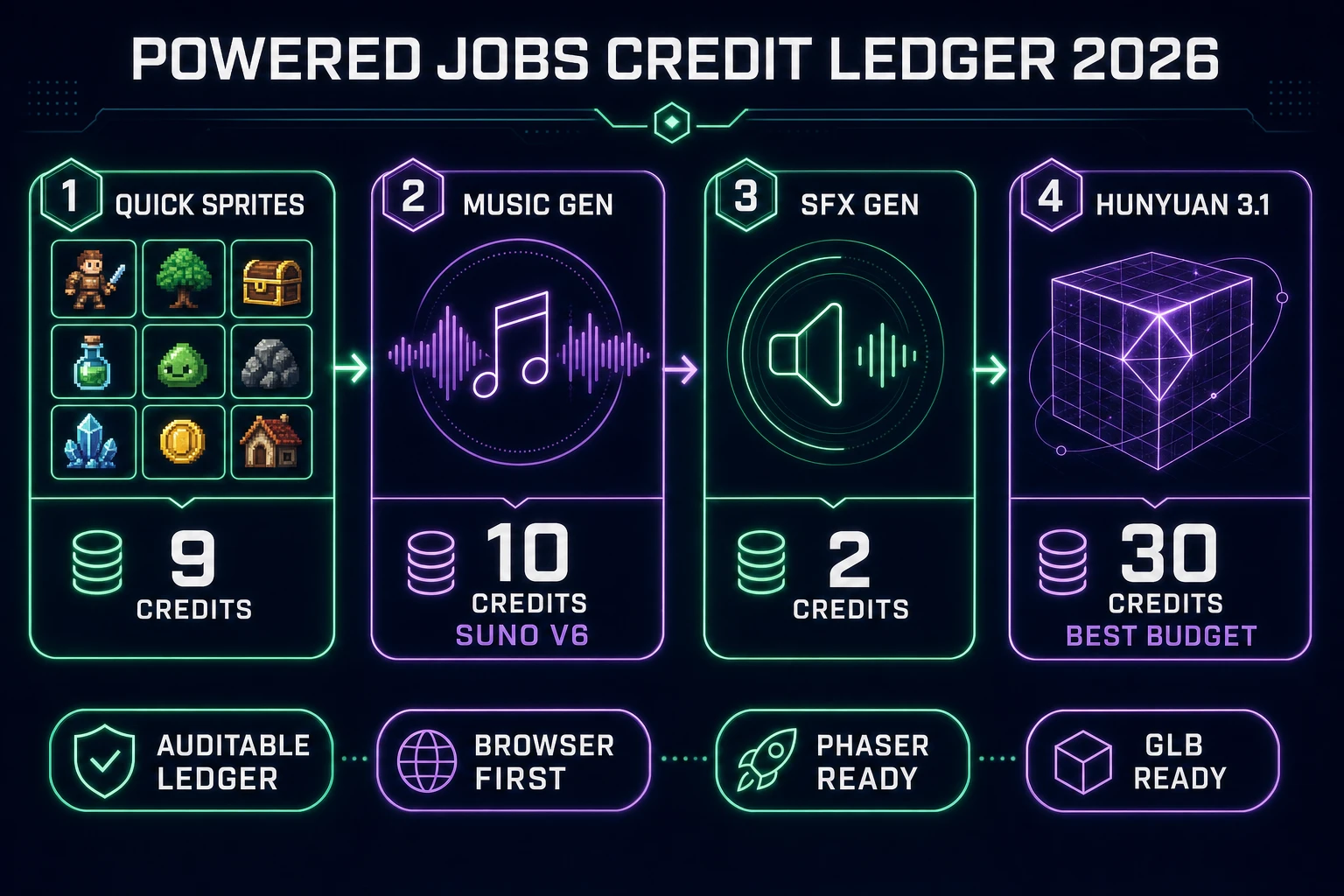
- Quick Sprites — AI-generated animated pixel sprite sheets. Flat
CREDITS_PER_GEN = 9insrc/app/quick-sprites/page.tsx(verified 2026-10-16). Best first stop for walk / idle / attack sheets that drop into Phaser. - AI Image Gen — concept art and reference plates. The home model roster includes Nano Banana Pro, Nano Banana 2.1, GPT Image 2, Seedream 5 Lite, Flux 2 Pro, Z-Image Turbo, and Grok Imagine (verified 2026-10-16). Nano Banana 2.1 retail is 9 / 12 / 17 credits at 1K / 2K / 4K.
- True Pixel — image-to-pixel-art quantization when you already have a painted plate and need a grid-snapped sheet.
Optional finishers in the same family: BG Remover for clean plates, Tileset Forge for tileable floors and walls, Auto-Sprite v2 when you have a keyed clip to sheet. Keep palette lock consistent across enemies in one biome; mixed palettes read as “downloaded from five packs.”
Order of operations that wastes the fewest credits: (1) lock silhouette and palette on a still in Image Gen or True Pixel, (2) sheet the animation in Quick Sprites, (3) strip leftover background with BG Remover only if the sheet still has a plate. Generating a full animated sheet first, then discovering the palette fights the tileset, is how 9-credit retries stack into a bad afternoon. For atlas anatomy, see AI sprite sheet generator and how to make a sprite sheet.