Knit How to Make Pixel Art Games (Browser Pack 2026)

By Arron R.8 min read
How to make pixel art games as a browser pack: freeze one palette, generate roster sheets in Quick Sprites (9 credits), polish in True Pixel, scale with image-r

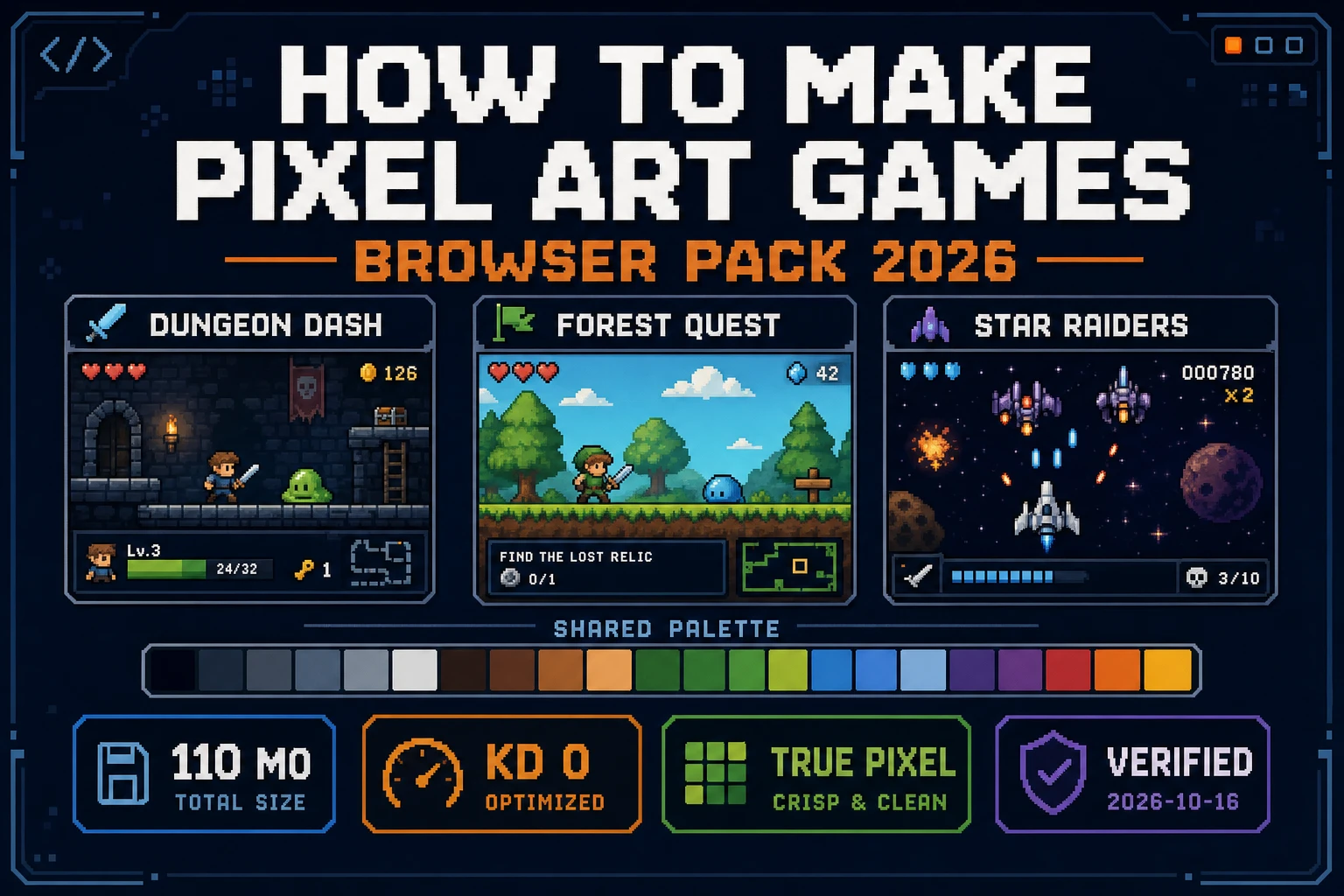
One pixel jam looks charming. Three jams that each invent a new palette, cell size, and walk timing look like three different studios arguing in a folder. Searchers typing how to make pixel art games are usually past the “draw one hero” fantasy — they want a reusable browser pack so the second and third games inherit the first. Lock the pack. Clone the loop. Grow themes later.
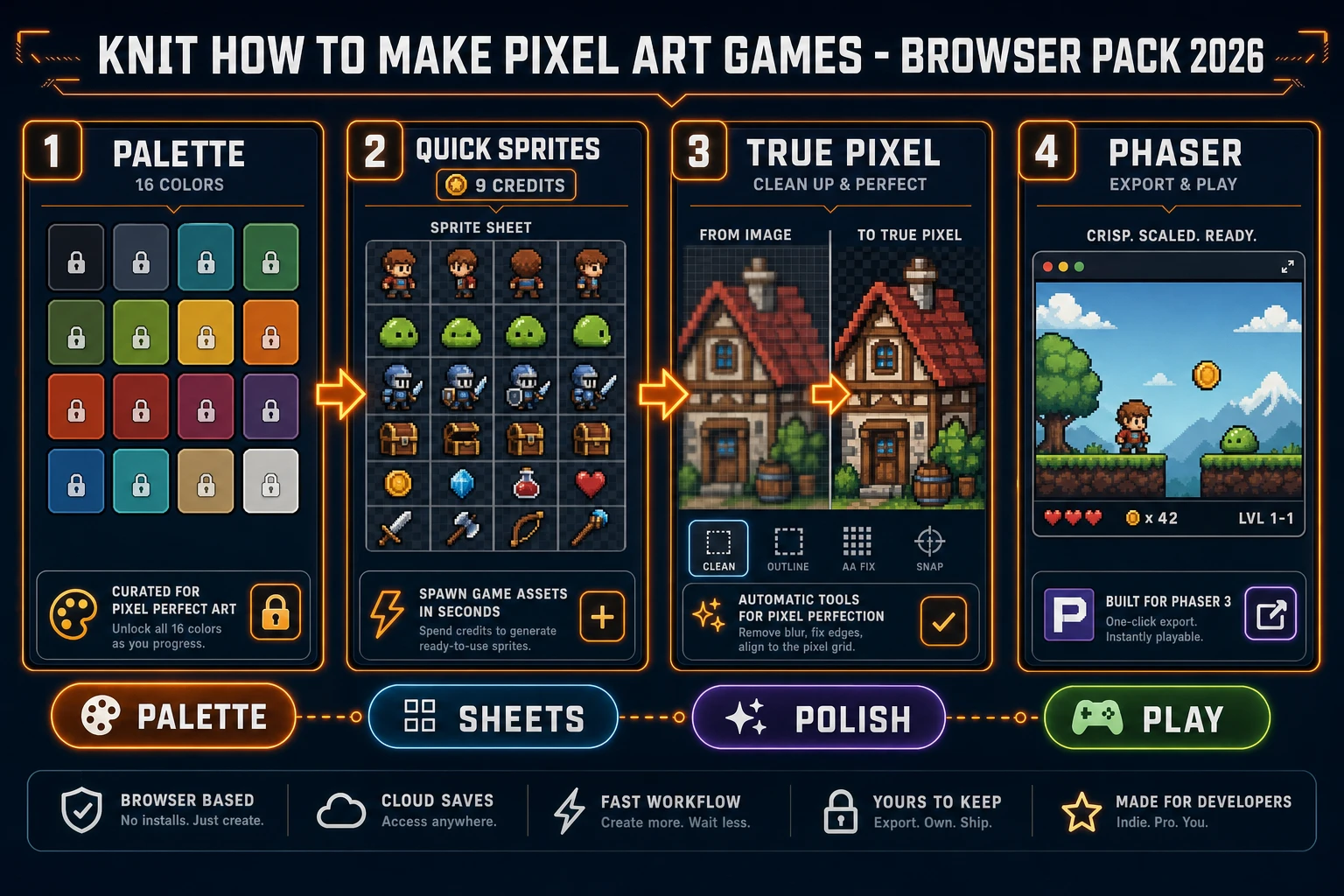
How to make pixel art games browser pack pipeline 2026
One palette, shared sheet sizes, True Pixel polish, crisp Phaser scale — then a playable loop per game.

What searchers typing how to make pixel art games actually want

DataForSEO lists how to make pixel art games at 110 searches a month with KD 0 and informational intent (verified 2026-10-16 in tools/research-supplement.md, seed how to make pixel art). Sibling phrases in the same cluster include how to make pixel art for games (110/mo, KD 24), how to make pixel art game (110/mo, KD 0), and the broader head how to make pixel art (2,400/mo, KD 7). This page targets the plural-games phrasing. A shipped singular post already covers “a pixel art game” as one finished jam; the job here is portfolio consistency — the same visual contract across several small titles.

Wikipedia’s Pixel art article (verified 2026-10-16) defines the form as digital images edited at the pixel level, historically tied to limited palette and resolution hardware. That constraint is the feature. When you learn how to make pixel art games as a series, you are choosing those limits once so every later sheet and tile set still reads as the same world family.
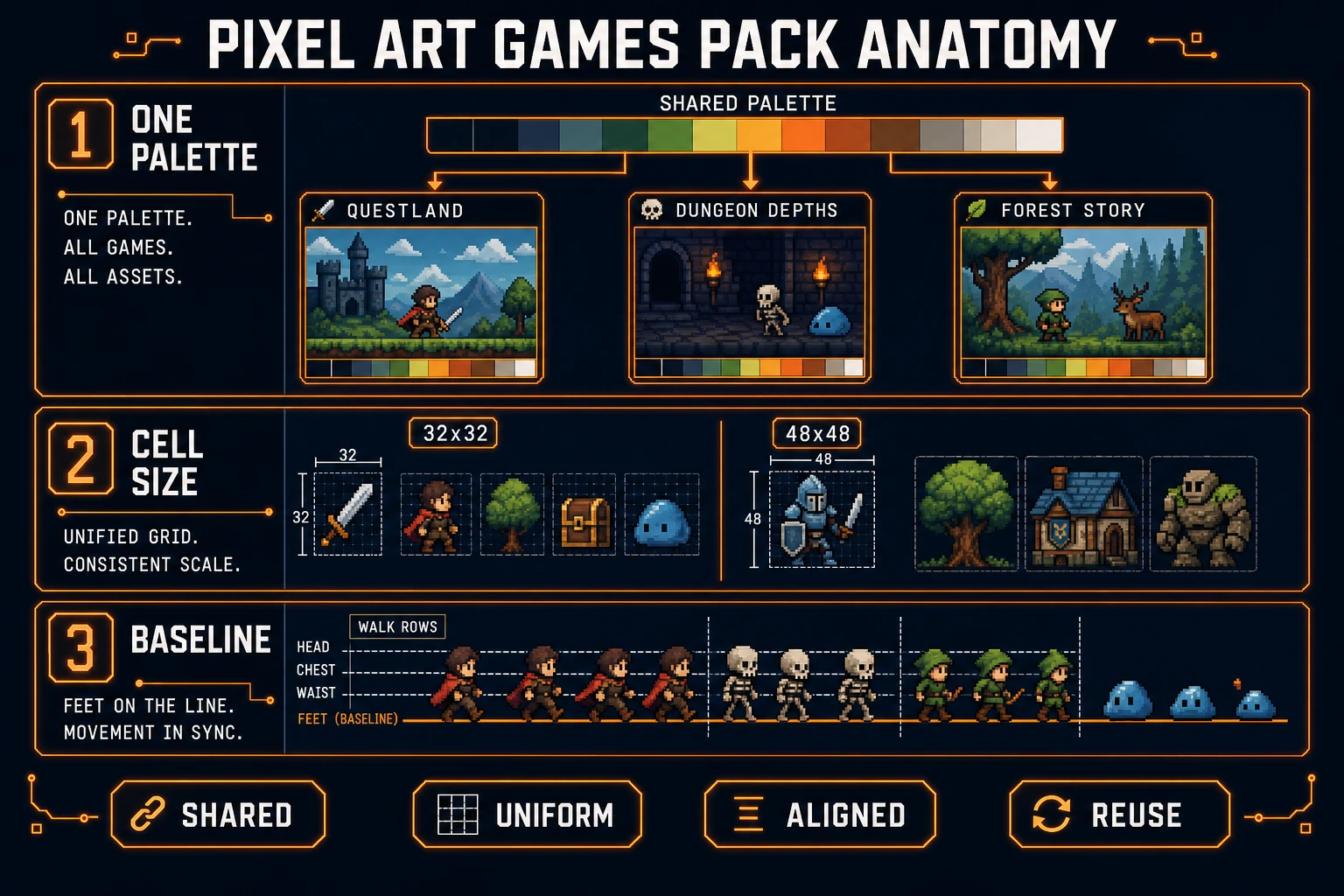
Shared palette and cell sizes across multiple pixel art games
Three tiny games, one swatch strip, two allowed cell sizes — the pack stays readable.

Palette lock before the first sheet

Skip “pretty hero, muddy NPC.” Freeze a palette card before you prompt anything:

  • Color count — sixteen colors is enough for a jam family; thirty-two if you need UI chrome. Write the hex list in a text file and paste it into every prompt.
  • Key colors — one skin midtone, one outline, one ground, one danger accent. Everything else is support.
  • Value ladder — dark outline, mid fill, one highlight. Soft gradients fight the Wikipedia definition of pixel-level editing.

Canvas on Sorceress is the Free in-browser editor (badge: "Free" in src/app/_home-v2/_data/tools.ts, verified 2026-10-16). Use it to crop references, composite a palette strip, and export a flat PNG you can attach as a style board. Do not invent a second palette mid-weekend because a new enemy “needs more teal.” Retint inside the locked set or the pack collapses.

Acceptance tests for the palette lock:

  • Can you identify every character at 1× without reading labels?
  • Does the danger accent appear in both the player VFX and the enemy telegraph?
  • Does UI text stay readable on the darkest ground color?

If any test fails, fix the swatches before you spend credits on sheets. How to make pixel art games without a locked palette is how you get three unfinished art styles and zero ships.

Sheet pack with Quick Sprites

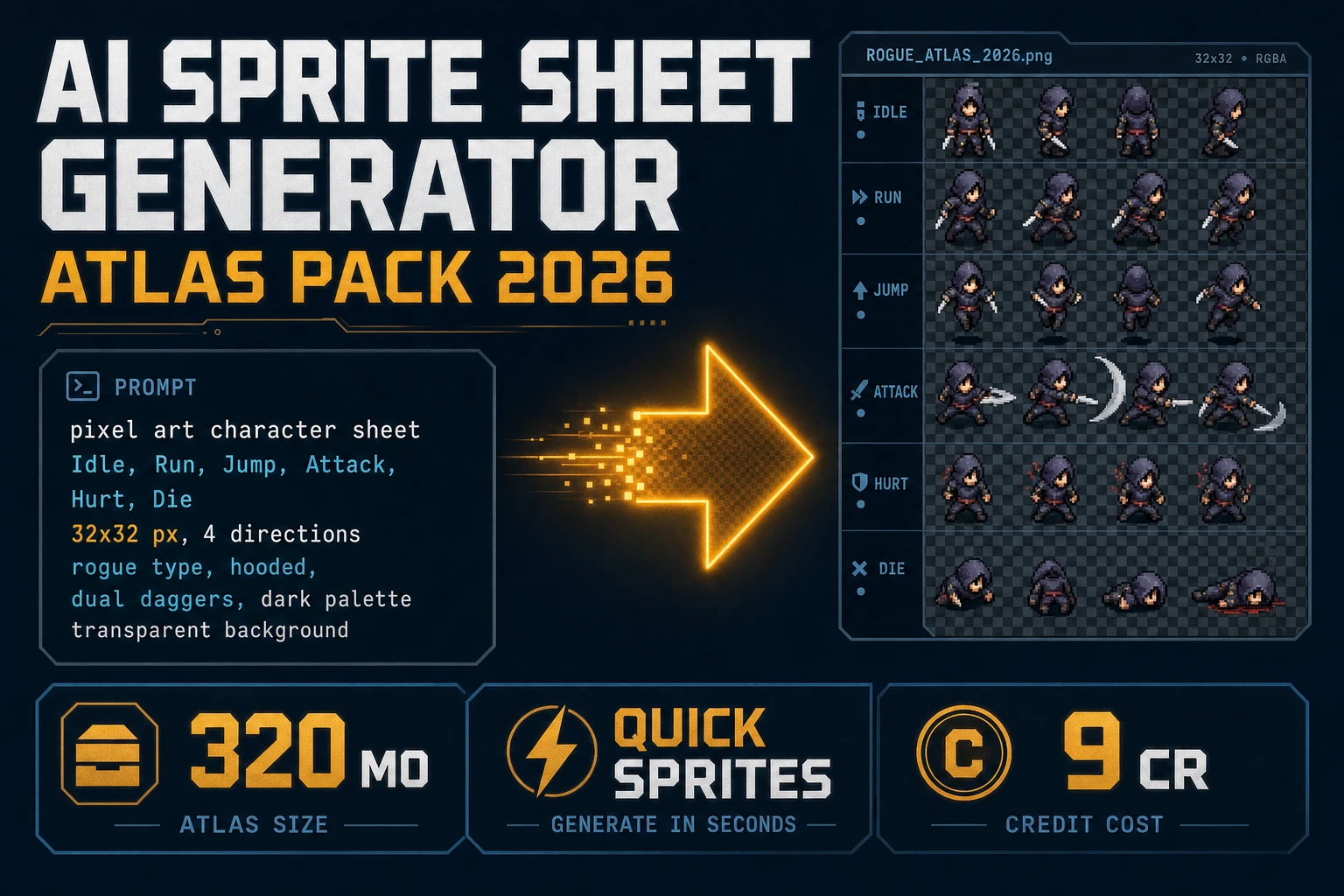
Quick Sprites bills CREDITS_PER_GEN = 9 per successful call against Retro Diffusion MODEL_ID = retro-diffusion/rd-animation (src/app/quick-sprites/page.tsx lines 20–21, verified 2026-10-16). The home card badges it AI Credits on the Sprites & 2D row. Signup grant is 100 credits (SIGNUP_GRANT in src/app/api/admin/credits/route.ts line 12, verified 2026-10-16) with CREDITS_PER_DOLLAR = 100 (src/lib/models.ts line 73, verified 2026-10-16) — about eleven atlas packs before a top-up.

Pick styles that keep cell size consistent across games:

  • Four Angle Walking — 48×48 only, four directions × four walk frames. Use for heroes that must turn on a grid.
  • Small Sprites — 32×32 only, six rows (Right, Left, Arms, Look, Surprise, Lay Down). Use for townsfolk and enemy fillers.
  • VFX Effects — selectable 24–96 px (default 64×64) for fire, explosions, lightning.

Those labels live in ANIMATION_STYLES and STYLE_ROW_LABELS in src/app/quick-sprites/page.tsx (verified 2026-10-16). Keep Spritesheet PNG on. One atlas pack rule: never mix 32×32 and 48×48 in the same sheet file — engines slice by uniform frameWidth / frameHeight.

Prompt pattern that survives cloning into game two and game three:

Palette: [paste hex list]. Outline: 1px dark.
Style: Small Sprites 32x32, transparent BG, spritesheet PNG.
Subject: slime enemy, two eyes, no text, feet on baseline.
Same silhouette family as previous jam slime; no new colors.

Generate the hero once, then generate fillers with the same palette line. For how to make pixel art games as a series, the sheet pack is inventory you reuse — not a one-off art drop.

Folder discipline matters as much as prompt craft. Keep a single pack/ tree: palette.txt, heroes/, fillers/, vfx/, and a manifest.json that lists cell size, style id, and which jam folders may import each file. When game three needs a new slime color, add a tint row inside the locked palette instead of a new atlas size. Cross-check sheets in Sprite Analyzer frame-by-frame before you wire animations — a one-pixel baseline drift between Right and Left rows is enough to make a “finished” pack feel drunk in motion.

Budget the first eleven generations from the signup grant like a shop list: one Four Angle hero, four Small Sprites fillers, two VFX bursts, and four retries. Retries exist for silhouette readability, not for “one more hat.” If a generation fails the 1× readability test, rewrite the subject line; do not expand the palette to paper over a muddy fill.
True Pixel polish and reference cleanup

True Pixel converts image or video into pixel-art sprites and sprite sheets with chroma keying, clean outlines, edge cleanup, and batch processing (home card + Pro badge in src/app/_home-v2/_data/tools.ts, verified 2026-10-16). Use it when you already have a photo, AI portrait, or captured clip that must join the locked pack.

Practical polish path:

  1. Key the plate (Corridor path credits scale as Math.max(1, Math.ceil(frameCount / 10) * (maxDim > 512 ? 2 : 1)) in getCkCreditCost, src/app/pixel-art/page.tsx line 2414–2416, verified 2026-10-16 — typically 1 credit per ten frames at ≤512).
  2. Downscale to the pack’s cell size (32 or 48), not an arbitrary “looks fine” size.
  3. Quantize to the locked palette so the import does not introduce rogue pinks.
  4. Export a transparent PNG sheet and name it with the game id + role (jam02-slime-walk.png).

True Pixel is the converter; Quick Sprites is the from-prompt generator. How to make pixel art games cleanly usually needs both: invent roster sheets from text, force photographic refs through the same grid and palette. Pair them with Forge AI Sprite Sheet Generator when you need atlas packing detail, and with How to Make a Pixel Art Game when you are finishing a single title instead of a pack.

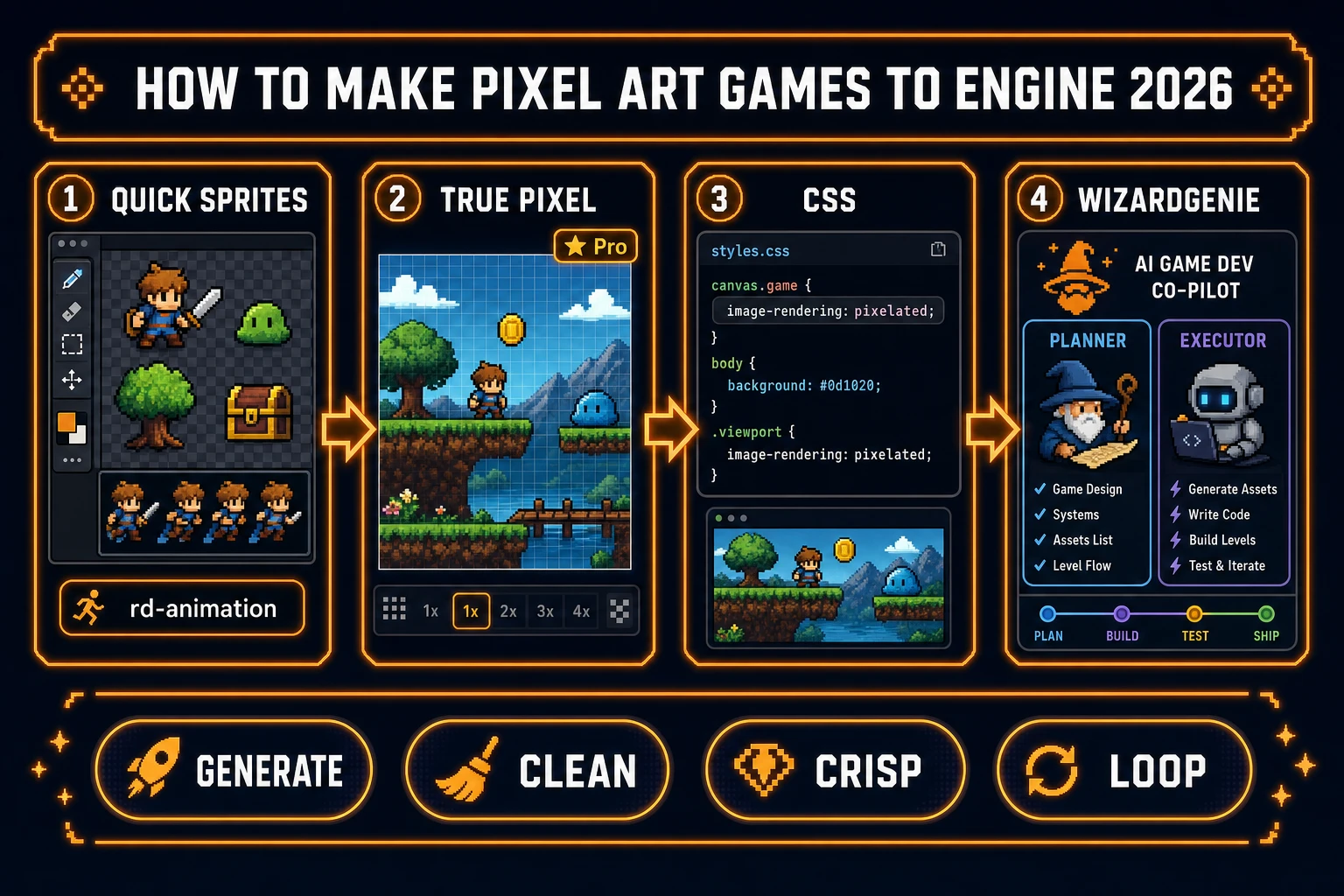
Quick Sprites True Pixel crisp scale and WizardGenie loop for pixel art games
Generate, clean, nearest-neighbor scale, then Dual-agent the playable loop.

Engine crisp scale for how to make pixel art games

Blurry upscales kill the genre more often than weak prompts. MDN’s Crisp pixel art look with image-rendering guide (verified 2026-10-16) shows the fix: set image-rendering: pixelated on img and canvas so each source pixel maps to a hard block on screen. Prefer integer scale factors (2×, 3×, 4×). Non-integer CSS sizes and fractional drawImage destinations reintroduce mush.

Phaser is a free, open-source HTML5 2D framework with WebGL and Canvas rendering, actively developed for over eleven years and commercially maintained by Phaser Studio Inc (docs verified 2026-10-16). Stable download at the time of writing is Phaser v4.2.1 “Giedi” (released 9 July 2026 per phaser.io/download/stable, verified 2026-10-16). Load a uniform grid with load.spritesheet and match frameWidth / frameHeight to the Quick Sprites cell size.

this.load.spritesheet('slime', 'assets/jam02-slime-walk.png', {
  frameWidth: 32,
  frameHeight: 32,
});
// CSS on the game canvas:
// canvas { image-rendering: pixelated; }

Keep camera zoom on integers. If you zoom to 2.5× “because it fills the monitor,” you are undoing the MDN technique. How to make pixel art games that still look sharp on a 4K panel is mostly discipline after export — not a new model.

Playable loop with WizardGenie Dual-agent

Art packs do not ship. Loops do. WizardGenie runs on desktop (Windows installer with native filesystem access) and on the web at /wizard-genie/app. Dual-agent Planner + Executor is documented as “A smart Planner thinks; a cheap Executor codes” (src/app/wizard-genie/page.tsx, verified 2026-10-16). Seat models the economic way: frontier Planners (Claude Opus 4.7, GPT-5.5, Gemini 3.1 Pro, Grok 4.2) and budget Executors (DeepSeek V4 Pro, Kimi K2.5, MiniMax M2.7) from CODING_MODELS in src/app/_home-v2/_data/tools.ts (verified 2026-10-16). Never put Sonnet, Opus, GPT-5.5, or Gemini Pro on the typing side.

Example Planner brief for game one of the pack:

Goal: one-room pixel jam feels fair on keyboard.
Runtime: Phaser 4.2.1, single scene room-01.
Assets: jam01-hero.png (48x48 four-angle), jam01-slime.png (32x32).
Change: move, jump or bump, collide, win flag, restart.
Palette and cell sizes are frozen — do not regenerate art.
Done when: stranger finishes the loop twice without soft-lock.
Playtest: load sheets with nearest-neighbor CSS; reject blurry scale.

Clone that brief for game two with new room geometry and the same asset naming scheme. WizardGenie does not auto-publish to an arcade; export the build and host where you want. The win condition for how to make pixel art games as a pack is three honest loops that share a look — not one unfinished epic.

Common Dual-agent failure modes while the pack is young:

  • Executor regenerates art — the brief forgot “assets are frozen.” Add an explicit “do not call image tools; load existing PNGs only” line.
  • Soft blur at scale — canvas CSS missing image-rendering: pixelated. Treat that as a playtest gate, not a polish pass.
  • Mixed frame sizes — one scene loads 32×32 and 48×48 from the same spritesheet key. Split keys per cell size.
  • Megaprompt rewrite — the Executor rebuilds the whole scene graph when you asked for a door flag. Narrow Files allowed and reject the diff.

Weekend shape that respects the pack:

  1. Friday — freeze palette + allowed cell sizes; write the naming scheme.
  2. Saturday morning — Quick Sprites roster (hero + two fillers + one VFX).
  3. Saturday night — True Pixel any photo refs; Canvas crops; verify 1× readability.
  4. Sunday — WizardGenie Dual-agent for one Phaser loop; stop when the door or flag works.

The verdict

How to make pixel art games in a browser pack is a systems problem dressed as art. Lock sixteen colors and two cell sizes. Generate sheets in Quick Sprites at nine credits each. Force refs through True Pixel. Scale with MDN’s image-rendering: pixelated rule inside Phaser 4.2.1. Scaffold each title’s loop in WizardGenie Dual-agent without reseating a frontier model as Executor. Facts above verified 2026-10-16 against DataForSEO tables, Wikipedia, MDN, Phaser docs, and Sorceress source. Ship the pack; leave the genre bible for later.

Frequently Asked Questions

What does how to make pixel art games mean versus one game?

How to make pixel art games (plural) targets a reusable browser pack: one palette, shared sheet sizes, and a loop recipe you can clone into several jams. DataForSEO lists how to make pixel art games at 110/mo, KD 0 (verified 2026-10-16 in tools/research-supplement.md). The singular how to make a pixel art game is a sibling phrase already covered on this blog; this page stays on portfolio-scale consistency.

Which tools belong in a how to make pixel art games browser pack?

Quick Sprites generates animated sheets at CREDITS_PER_GEN = 9 against retro-diffusion/rd-animation (src/app/quick-sprites/page.tsx, verified 2026-10-16). True Pixel (/pixel-art) converts image or video into pixel-art sprites with chroma key and palette cleanup (Pro badge in tools.ts). Canvas (/canvas) is the Free in-browser editor for crops and composites. WizardGenie Dual-agent scaffolds the Phaser loop.

How do I keep pixel art sharp when learning how to make pixel art games?

Export transparent PNG sheets at a fixed cell size, then scale with nearest-neighbor. MDN’s crisp pixel art guide (checked 2026-10-16) shows image-rendering: pixelated on img and canvas. Phaser v4.2.1 “Giedi” (released 2026-07-09, phaser.io/download/stable checked 2026-10-16) loads uniform grids with load.spritesheet — match frameWidth/frameHeight to the cell size.

Is how to make pixel art for games the same query?

Close sibling. DataForSEO lists how to make pixel art for games at 110/mo, KD 24, and how to make pixel art game at 110/mo, KD 0 (verified 2026-10-16). This article answers the plural-games phrasing with a pack workflow; asset-for-engine tips still apply to the “for games” intent.

What should I playtest first after I how to make pixel art games assets?

One closed loop per game: move, collide, win or lose, restart. MDN’s Anatomy of a video game frames present–accept–update–repeat. If the loop is soft or blurry at 3× scale, fix physics and image-rendering before generating a second roster.

Sources

  1. Pixel art — Wikipedia
  2. Crisp pixel art look with image-rendering — MDN
  3. What is Phaser? — Phaser Docs
  4. Phaser v4.2.1 Giedi stable download
Written by Arron R.·1,777 words·8 min read

Related posts