Rank the Best Image to 3D Model AI (Six-Model Test)

By Arron R.12 min read
Best image to 3D model AI in 2026 splits across six backends, each best at one job: TRELLIS for cheapest shape iteration, Hunyuan 3D 3.1 for the recommended def

Searches for the best image to 3D model AI in 2026 surface a dozen single-vendor pages, each insisting that its one backend is the right answer. The honest answer is that no single backend wins every test. The right pick depends on whether you need cheap shape iteration, photoreal PBR baking, clean quad topology, hard-surface accuracy, HD geometric detail, or a recommended all-around default. This article runs the same six tests across the six image-to-3D backends inside Sorceress 3D Studio and ranks the winner per scenario. Every credit cost and capability below was verified against the live source on May 31, 2026.
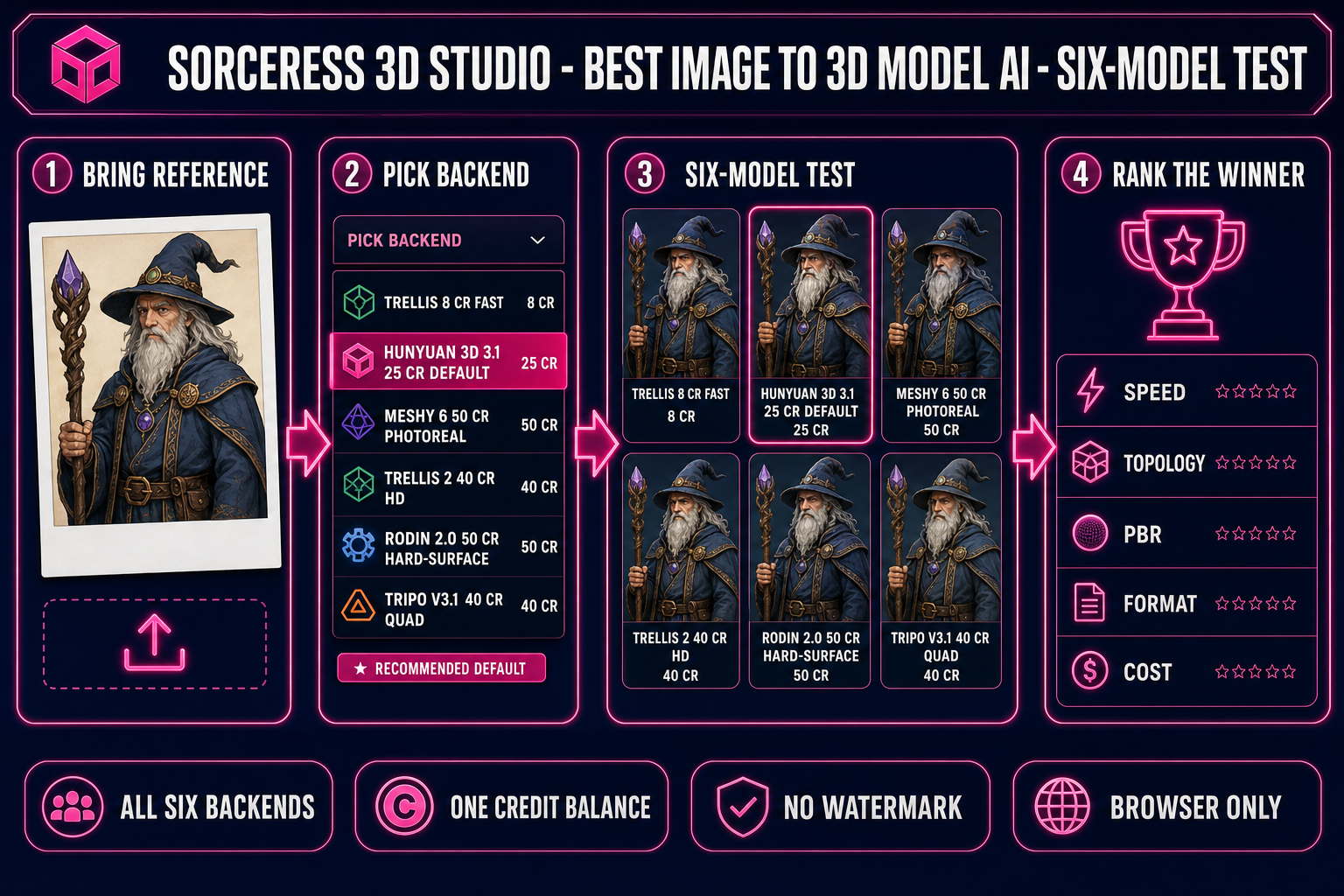
Best image to 3D model AI six-model test - browser-native pipeline ranking TRELLIS Hunyuan Meshy Rodin Tripo TRELLIS 2 by speed topology PBR format and cost
Sorceress 3D Studio bundles six image-to-3D backends behind one model picker, so the best image to 3D model AI test is one credit balance instead of six accounts.

What “best image to 3D model AI” actually means in 2026

The phrase best image to 3D model AI hides a category mistake. There is no single ranking, because the dimensions a 3D mesh is graded on are independent of each other. Six axes drive the practical decision when you sit down to convert a reference image into a usable 3D asset:

  1. Geometric fidelity. Does the mesh capture the silhouette, depth cues, and concave detail of the source image? Concave organic forms and thin features (hair, glasswork, fingers) separate the strong models from the weak ones.
  2. Topology. Clean quad flow vs noisy triangle soup. Polygon-mesh topology decides whether the asset can be rigged or subdivided, and is the single largest determinant of downstream pain.
  3. PBR material baking. Albedo, metallic, roughness, and normal maps that survive new lighting in a game engine. The technical primitive is well documented on the physically based rendering Wikipedia page.
  4. Speed. 3 seconds vs 60 seconds matters when you iterate on shape ten times before committing to a textured pass. The end-to-end practical latency on hosted infrastructure is always slower than the published benchmark.
  5. File format coverage. GLB for browser runtimes, FBX for skeletal pipelines, USDZ for Apple AR, 3MF for multi-color 3D printing. The right rule is to match the format to the runtime, documented in the official Khronos glTF 2.0 specification.
  6. Credit cost per generation. A 50-asset prop pack at 50 credits per model is 2,500 credits where the same pack at 8 credits is 400 credits — the difference between a viable trial and a budget burn.

The honest pitch from this article is that the best image to 3D model AI is not one backend. It is the picker that lets you switch backends per generation and the credit balance that follows you across all six.

The six contenders for best image to 3D model AI in 2026

The Sorceress 3D Studio picker exposes six image-to-3D backends as of May 31, 2026, verified against src/lib/threed-models.ts. Each backend has a sweet spot, a credit cost, and a quirk that decides when it is the right pick.

  • TRELLIS — 8 credits. Microsoft Research’s 1.2B-parameter image-to-3D model, MIT-licensed open-source on github.com/microsoft/TRELLIS. The cheapest backend in the picker. Twelve runs from the 100 starter credits granted at sign-up.
  • Hunyuan 3D 3.1 — 25 credits. Tencent’s next-generation 3D model with PBR materials baked in by default. The recommended default in the picker (the only backend with a star icon). Four runs from the starter pool.
  • Tripo v3.1 — 30 credits no texture, 40 credits standard or HD texture, +5 credits with Quad mesh. Best-in-class for stylised characters and props that need quad topology. Quad mode forces FBX format output.
  • TRELLIS 2 — 35 credits at 512³, 40 credits at 1024³ (default), 45 credits at 1536³. Microsoft Research’s 4B-parameter follow-up at github.com/microsoft/TRELLIS.2. The technical paper lands at arXiv 2512.14692 and reports 3-second / 17-second / 60-second generation on an H100 at the three resolutions.
  • Meshy 6 — 50 credits base, +25 credits with texture, +13 credits with remesh. The premium photoreal path. The January 18, 2026 Meshy 6 release added multi-color 3MF support, and the Multi-Color Printing feature went live on MakerWorld via Bambu Lab AMS hardware in March 2026.
  • Rodin 2.0 — 50 credits. Hyper3D’s second-generation pipeline. Strong on hard-surface and architectural assets. The only backend in the picker with native USDZ export for Apple AR. Mesh density tiers: High at 50K faces (Quad), Medium at 18K, Low at 8K, Extra-Low at 4K.

The open-source local route — running TRELLIS, TRELLIS.2, or Tencent Hunyuan3D-2.1 on your own GPU — is the long-run cheapest deal at zero ongoing cost, but the 16–24GB VRAM hardware requirement and forty-minute install pass the cost from credits to hardware. The image to 3D model free workflow guide covers the four shapes of free deal in detail. This article focuses on the hosted pick.
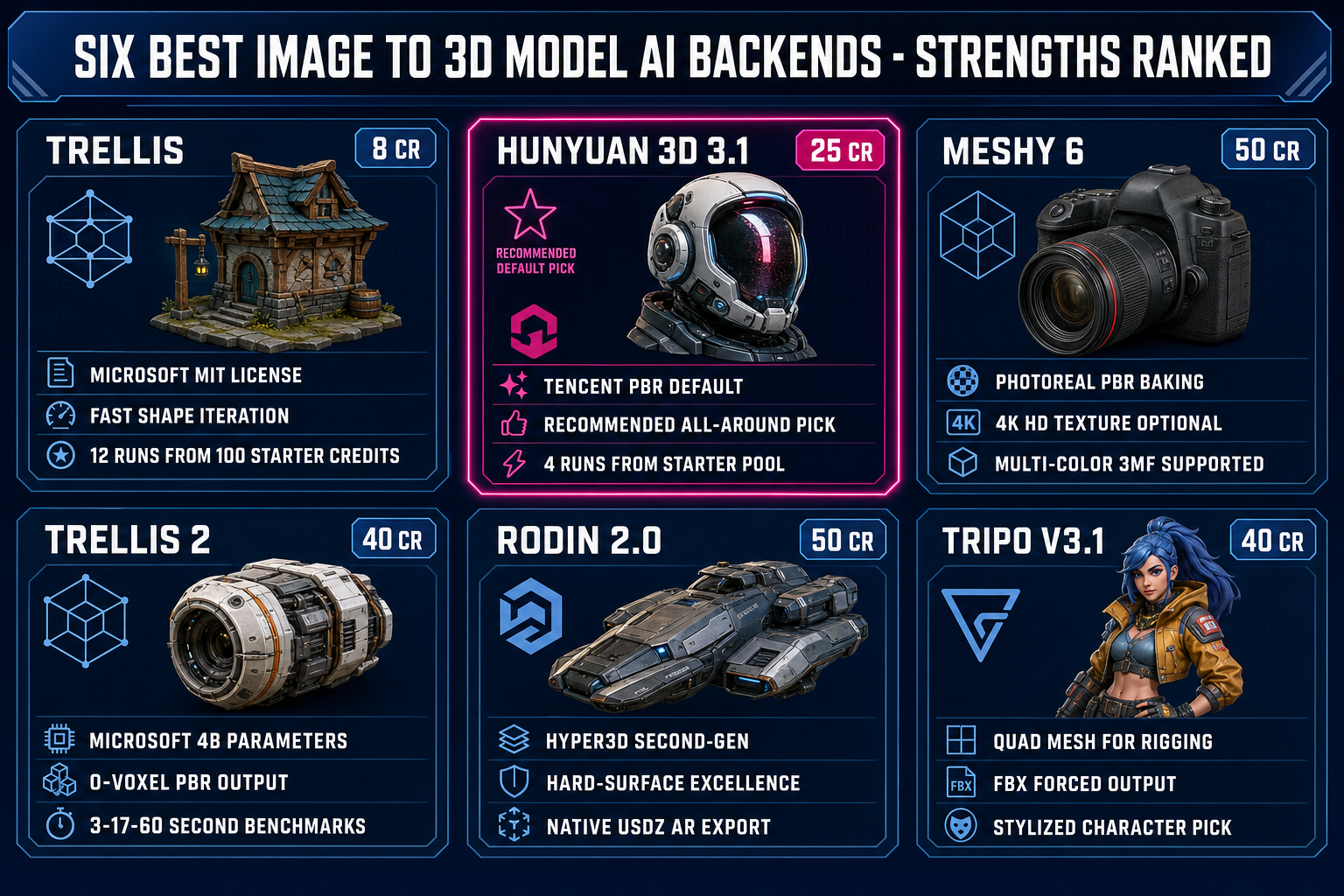
Six best image to 3D model AI backends compared - TRELLIS Hunyuan 3D 3.1 Meshy 6 TRELLIS 2 Rodin 2.0 Tripo v3.1 strengths ranked
The six best image to 3D model AI backends inside Sorceress 3D Studio, with credit costs and per-backend strengths verified against src/lib/threed-models.ts on May 31, 2026.

Test 1 — Speed: which best image to 3D model AI generates fastest

Microsoft TRELLIS.2 publishes the cleanest benchmark for the speed test. The official microsoft/TRELLIS.2 repository reports about 3 seconds end to end on an NVIDIA H100 at 512³ (2 seconds shape, 1 second material), about 17 seconds at 1024³ (10 plus 7), and about 60 seconds at 1536³ (35 plus 25). Hosted browser performance through Sorceress 3D Studio adds queue latency and image upload time on top, so the practical end-to-end is slower than the H100 benchmark.

Hosted speed in practice, end-to-end from submission to the GLB landing in the in-browser viewer, lands roughly as follows on May 31, 2026:

  • TRELLIS: ~30 seconds. The cheapest and fastest practical pick on the hosted side for shape iteration.
  • Hunyuan 3D 3.1: 30–60 seconds. The fastest practical pick when full PBR is needed.
  • Tripo v3.1: 60–90 seconds at standard texture.
  • TRELLIS 2: 30–90 seconds depending on resolution (3 seconds, 17 seconds, 60 seconds plus hosted overhead).
  • Meshy 6: 60–180 seconds when textures are baked, depending on input complexity.
  • Rodin 2.0: 60–180 seconds with PBR materials enabled.

The honest takeaway: when you are still settling on shape, run TRELLIS at 8 credits and 30 seconds per iteration; when the shape is locked, switch to a slower textured backend for the final pass. Burning 60-second-per-generation Meshy 6 runs on shape iteration is the most common credit-budget mistake in this category.

Test 2 — Topology: which best image to 3D model AI gives clean meshes

Topology is the second axis where the per-backend differences are sharpest. The Sorceress 3D Studio picker exposes three topology-relevant options across the six backends: triangle vs quad output, polycount target, and remesh.

The ranking on the topology axis on May 31, 2026:

  1. Tripo v3.1 with Quad Mesh. Forces FBX output and ships clean quadrilateral faces ideal for subdivision and skeletal animation. The +5 credit surcharge ($0.05 worth of credits) is worth it on every character bound for a rigging pass. Verified against src/lib/threed-models.ts line 183 on May 31, 2026.
  2. Rodin 2.0 in Quad mode (default). Mesh density tiers: High = 50K, Medium = 18K, Low = 8K, Extra-Low = 4K faces. Pick High mesh density at generation time and decimate downstream rather than asking Rodin to ship a low-poly mesh.
  3. Meshy 6 with Quad topology + Remesh. Two flags, +13 credits for remesh on top of base. Retopologizes triangle output into a uniform mesh suitable for animation.
  4. TRELLIS 2 with Remesh enabled (default true). Rebuilds mesh topology for cleaner triangles. Slower but produces better results for animation, rigging, and 3D printing.
  5. Hunyuan 3D 3.1. Triangle mesh only, no quad option exposed. Topology is acceptable for static props but needs a Blender retopology pass before rigging.
  6. TRELLIS. Triangle mesh only, with a mesh simplification slider (0.90–0.98). Best for rough shape exploration; not the right pick when topology matters.

For best image to 3D model AI on the rigging-first axis, the order is unambiguous: Tripo v3.1 (Quad) wins, Rodin 2.0 (Quad mode) is second, Meshy 6 (Quad + Remesh) is third. The companion auto-rigging guide walks through the rigging step that consumes the FBX output of any of these three.
Test 3 — PBR materials: which best image to 3D model AI bakes textures cleanest

PBR baking is the third axis, and the ranking depends on the source image. The decision splits on whether the input is a photographic reference, an illustrative reference, or a hard-surface object.

The PBR-axis ranking, broken out by input shape:

  • Photographic input: Meshy 6 wins. The pipeline ships albedo, metallic, roughness, and normal at 2K by default, and the optional hd_texture flag pushes base color to 4K (4096 by 4096) per the Meshy 6 launch notes from January 18, 2026. Pair Meshy 6 with the +25 texture flag and the +13 remesh flag for the cleanest production output at 88 credits per generation.
  • Illustrative input: Hunyuan 3D 3.1 wins. The Hunyuan3D 2.1 technical report documents the multi-view diffusion approach in Hunyuan3D-Paint-v2-1 (2B parameters) that produces illumination-invariant albedo maps surviving new lighting cleanly. The PBR maps come on by default at 25 credits per generation with no flag toggling.
  • Hard-surface input: Rodin 2.0 wins. The Material flag exposes PBR / Shaded / All / None modes, with metallic reflections that survive direct lighting better than the diffusion-based competitors. 50 credits per generation.
  • Open-source local: TRELLIS.2 ships PBR via the field-free O-Voxel structure described in the arXiv 2512.14692 paper. PBR maps are baked into the GLB output at 4B parameters.
  • Tripo v3.1. Adequate PBR via the explicit PBR flag, but the texture quality lags Meshy 6 and Hunyuan 3D 3.1 on photographic input. Pick Tripo for topology, not for materials.
  • TRELLIS. Texture maps only, no full PBR. The simplification slider trades polycount for fidelity. Pick TRELLIS for shape, not for materials.

The honest rule: photographic input plus PBR-priority output goes to Meshy 6, illustrative input plus PBR-priority output goes to Hunyuan 3D 3.1, hard-surface input goes to Rodin 2.0. Once the textured mesh exists, the Material Forge tool can re-bake or augment PBR maps without consuming a fresh 3D generation credit.

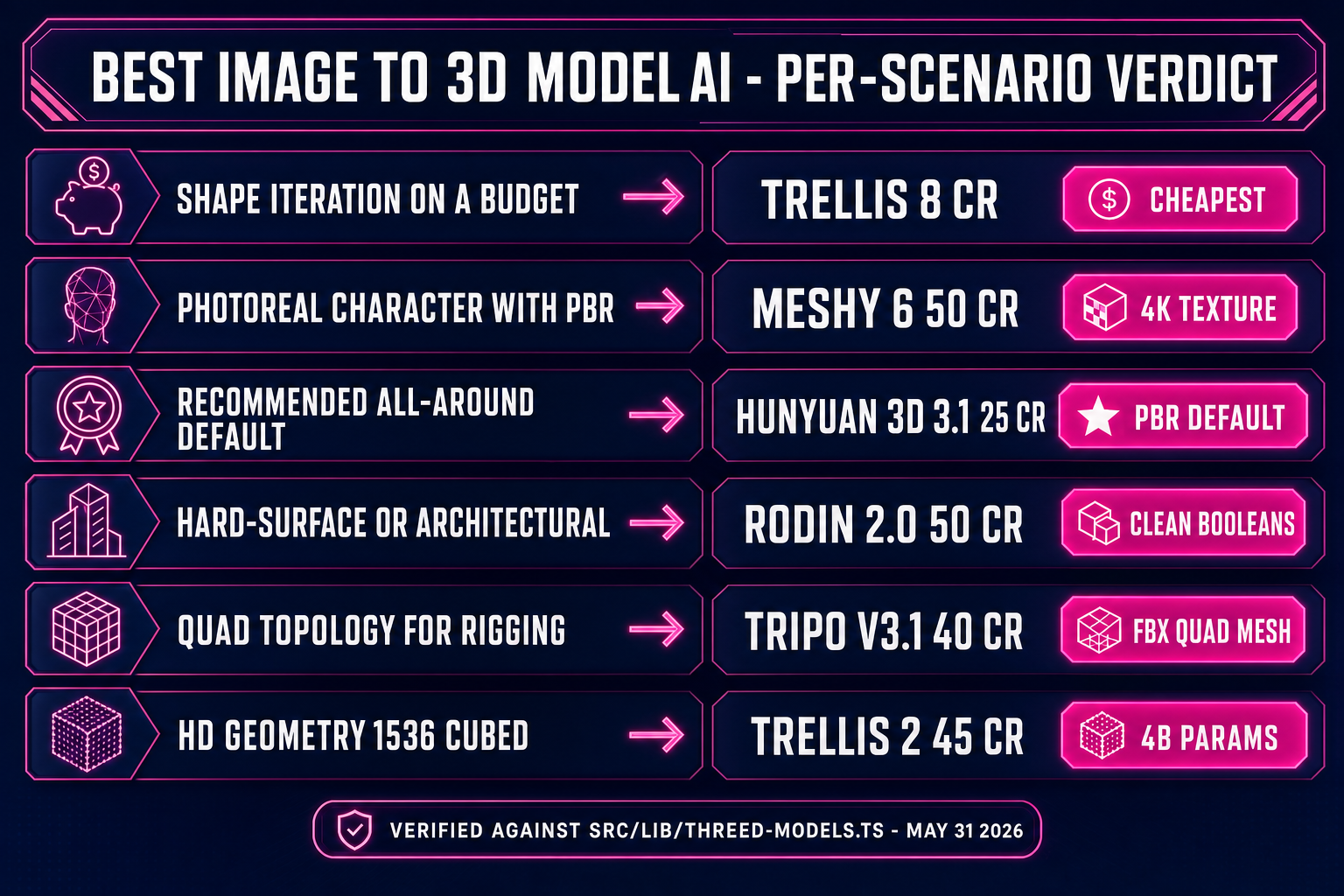
Best image to 3D model AI per-scenario verdict - shape iteration TRELLIS, photoreal Meshy 6, recommended default Hunyuan 3D 3.1, hard-surface Rodin 2.0, quad topology Tripo v3.1, HD geometry TRELLIS 2
The per-scenario verdict on the best image to 3D model AI in 2026, with each backend mapped to the use case it wins.

Test 4 — File format and runtime fit for game engines

Every backend in the picker exports GLB by default, and Sorceress 3D Studio re-exports GLTF (the JSON-text variant of glTF 2.0) on every model with no additional credit cost. The per-backend extras decide which best image to 3D model AI picks the right runtime.

  • Meshy 6: GLB, OBJ, FBX, STL, USDZ, and 3MF. The widest format coverage in the picker. The 3MF format requires explicit request via the target_formats parameter and is only generated when explicitly specified per the official Meshy API docs. The March 17, 2026 announcement made Meshy 6’s Multi-Color Printing live on MakerWorld with Bambu Lab AMS compatibility.
  • Rodin 2.0: GLB, FBX, OBJ, USDZ, and STL. Native USDZ for Apple AR is the killer feature here.
  • Tripo v3.1: GLB, FBX, OBJ, and STL. Quad Mesh option forces FBX output (the clean rigging path).
  • Hunyuan 3D 3.1: GLB. Convert downstream when other formats are needed.
  • Microsoft TRELLIS and TRELLIS 2: GLB. Same downstream conversion rule as Hunyuan 3D 3.1.

The right format-matching rule:

  • GLB: Browser runtimes (Three.js, Babylon.js, PlayCanvas) and the simplest format for any modern game engine. The default pick when in doubt.
  • FBX: Skeletal animation pipelines. Pair with Tripo v3.1 Quad Mesh for the cleanest rigging output.
  • USDZ: Apple AR Quick Look. Pair with Rodin 2.0 for native export.
  • 3MF: Multi-color 3D printing on Bambu Lab AMS hardware. Pair with Meshy 6 with the multi-color flag.
  • OBJ: Static props in older tools. Adequate but lossy for animated assets.
  • STL: Single-color 3D printing. Lossy for color but the universal slicer format.

Test 5 — Credit cost: best image to 3D model AI for production volume

The credit-cost ranking is the most concrete axis, because the costs are pinned to src/lib/threed-models.ts in the live source. Verified against the registry on May 31, 2026:

  1. TRELLIS: 8 credits flat. 12 runs from the 100 starter credits.
  2. Hunyuan 3D 3.1: 25 credits flat (recommended default). 4 runs from the starter pool.
  3. Tripo v3.1: 30 credits no texture, 40 credits with standard or HD texture, +5 credits with Quad mesh. 2–3 runs from the starter pool depending on configuration.
  4. TRELLIS 2: 35 credits at 512³, 40 credits at 1024³ (default), 45 credits at 1536³. 2 runs from the starter pool at the default resolution.
  5. Meshy 6: 50 credits base, +25 credits with texture (default true), +13 credits with remesh. The full textured + remeshed run lands at 88 credits, or 1 run from the starter pool.
  6. Rodin 2.0: 50 credits flat. 2 runs from the starter pool.

The 100 starter credits granted at sign-up cover exploratory work on a single character or a small prop set. At one cent per credit on no-expiry top-ups (verified against the live plans page: $10 for 1,000, $20 for 2,000, $50 for 5,000, $100 for 10,000), the price-per-mesh on the cheapest model lands at 8 cents per generation, materially cheaper than any single-vendor hosted image-to-3D pipeline at production volume.

The economics shift sharply when you scale: a 50-asset prop pack at TRELLIS (8 credits each, 400 credits, $4) is half the cost of the same pack at Hunyuan 3D 3.1 (25 credits each, 1,250 credits, $12.50), one-fifth the cost at Meshy 6 textured (75 credits each, 3,750 credits, $37.50), and one-eleventh the cost at Meshy 6 textured plus remeshed (88 credits each, 4,400 credits, $44). The right production-pack rule is shape-iterate on TRELLIS until the silhouette is locked, then ship the keepers through the textured backend that fits the scenario.

The picker exposes one default with a star icon: Hunyuan 3D 3.1 at 25 credits per generation. The default was set deliberately, verified against src/lib/threed-models.ts line 221 (RECOMMENDED_MODELS set) on May 31, 2026. The reasoning:

  • PBR baking by default. No flag toggling required. The arXiv 2506.15442 paper documents the multi-view diffusion approach.
  • Mid-priced. 25 credits is the median credit cost in the picker, so the default never burns the starter pool on a single run.
  • Format-flexible. GLB output works in every modern runtime; downstream conversion to FBX or USDZ is one click in any 3D tool.
  • Stylized + photographic both work. The model handles both input shapes cleanly without a different flag set per category.

Hunyuan 3D 3.1 is the right default for someone who has not run image-to-3D before, who wants one credit-balance to cover all scenarios, and who has not yet picked a topology axis to optimize for. Once you know which axis you care about (cheapest, photoreal, hard-surface, quad topology, HD geometry), the picker lets you switch backends per generation without leaving the page or rotating accounts.

The verdict on the best image to 3D model AI in 2026

The honest answer to best image to 3D model AI in 2026 is one ranking per axis:

  • Cheapest: TRELLIS at 8 credits.
  • Recommended default: Hunyuan 3D 3.1 at 25 credits.
  • Photoreal PBR: Meshy 6 at 50–88 credits.
  • Quad topology for rigging: Tripo v3.1 with Quad mesh at 45 credits.
  • Hard-surface or architectural: Rodin 2.0 at 50 credits.
  • HD geometry, 1536³: TRELLIS 2 at 45 credits.

The single-vendor hosted alternatives each rank one backend and force an account, an API key, and a separate credit balance per platform. The Sorceress 3D Studio design solves that fragmentation: one credit balance, one model picker, one browser tab, six backends. The 100 starter credits granted at sign-up cover the first round of testing on every backend without a card on file (verified against src/app/_home-v2/_components/HomeHero.tsx on May 31, 2026), which is the right budget for finding which best image to 3D model AI suits the asset you are about to ship.

Once the GLB lands, the natural next steps are auto-rigging on the FBX or GLB, a PBR pass in Material Forge, and animation through 3D Studio’s Animate tab. The companion lift a 2D image to 3D model guide walks through composition rules for the input image, the full pipeline guide covers rigging and animation end to end, the image to 3D model free workflow guide ranks the four shapes of free deal, and the free AI 3D model generator field map ranks the same six backends on the text-to-3D side. The tools guide covers the full Sorceress suite that converts a generated mesh into a shippable game-ready asset.

Frequently Asked Questions

What makes one image to 3D model AI better than another in 2026?

Six dimensions, ranked by how much they affect the finished asset. First, geometric fidelity - does the mesh capture the silhouette, depth cues, and concave detail of the source image. Second, topology - clean quad flow vs noisy triangle soup, because rigging and subdivision both depend on topology. Third, PBR material baking - albedo, metallic, roughness, and normal maps that survive lighting in a game engine. Fourth, speed - 3 seconds vs 60 seconds matters when you iterate on shape ten times before committing to a textured pass. Fifth, file format coverage - GLB for browser runtimes, FBX for skeletal pipelines, USDZ for AR, 3MF for multi-color 3D printing. Sixth, credit cost per generation, because a 50-asset prop pack at 50 credits per model is 2,500 credits where the same pack at 8 credits is 400 credits - the difference between a viable trial and a budget burn. The honest answer to best image to 3D model AI is that no single backend wins all six; the right pick depends on which dimension matters most for the asset you are making.

Which image to 3D model AI is the cheapest to run in 2026?

Inside Sorceress 3D Studio, TRELLIS at 8 credits per generation is the cheapest. The 100 starter credits granted at sign-up cover 12 TRELLIS runs end to end, which is enough to dial in shape on a character before paying for the textured final pass on a more expensive backend. The next cheapest in the picker is Hunyuan 3D 3.1 at 25 credits (the recommended default, 4 runs from the starter pool), then Tripo v3.1 at 30 credits with no texture (3 runs), TRELLIS 2 at 40 credits at the 1024 default (2 runs), and Meshy 6 / Rodin 2.0 tied at 50 credits base (2 runs each, with Meshy adding 25 for textures and 13 for remesh on top). Verified against src/lib/threed-models.ts on May 31, 2026. The open-source local route on Microsoft TRELLIS, Microsoft TRELLIS.2, and Tencent Hunyuan3D-2.1 is the long-run cheapest deal at zero ongoing cost - but the 16 to 24GB VRAM hardware requirement and forty-minute install pass the cost from credits to hardware.

Which image to 3D model AI has the best PBR material output?

Meshy 6 is the strongest baseline for PBR material baking when the source is a photographic reference. The pipeline ships albedo, metallic, roughness, and normal maps at 2K resolution by default, with the optional HD texture flag pushing base color to 4K (4096 by 4096) per the Meshy 6 launch notes from January 18, 2026. Tencent Hunyuan3D-2.1 and the embedded Hunyuan 3D 3.1 inside Sorceress 3D Studio also bake PBR by default and use a multi-view diffusion approach (Hunyuan3D-Paint-v2-1) to produce illumination-invariant albedo maps that survive new lighting cleanly per the arXiv 2506.15442 technical report. Microsoft TRELLIS.2 produces field-free O-Voxel PBR meshes with metallic and roughness baked into the GLB output, verified against the official microsoft/TRELLIS.2 GitHub repository. Rodin 2.0 ships PBR via the material flag (PBR / Shaded / All / None) and is unusually strong on hard-surface reflections. The honest rule: photographic input plus PBR-priority output goes to Meshy 6, illustrative input plus PBR-priority output goes to Hunyuan 3D 3.1, hard-surface input goes to Rodin 2.0.

Which image to 3D model AI gives the cleanest topology for rigging?

Tripo v3.1 with the Quad Mesh option is the strongest in the picker for topology that survives a rigging pass. Quad mesh forces FBX format output and ships clean quadrilateral faces ideal for subdivision and skeletal animation, at a five-credit surcharge on top of the base price (verified against src/lib/threed-models.ts on May 31, 2026). Meshy 6 also exposes a Quad topology option and a Remesh flag (+13 credits) that retopologizes triangle output into a uniform mesh suitable for animation. Rodin 2.0 ships Quad mode by default - High mesh density at 50K faces, Medium at 18K, Low at 8K, Extra-Low at 4K - and the Quad / Raw toggle lets you pick triangle vs quad per generation. Microsoft TRELLIS and TRELLIS 2 ship triangle meshes by default with a mesh simplification slider; pair them with a downstream remesh pass in Blender or the Sorceress optimization tools when topology matters more than raw geometry. For best image to 3D model AI on the rigging-first axis, the order is Tripo v3.1 (Quad) then Rodin 2.0 (Quad mode) then Meshy 6 (Quad + Remesh) then everything else.

Which image to 3D model AI is fastest end to end?

Microsoft TRELLIS.2 at 512 cubed reports about 3 seconds end to end on an NVIDIA H100 (2 seconds shape, 1 second material) per the official microsoft/TRELLIS.2 GitHub repository. At 1024 cubed it lands at about 17 seconds (10 plus 7), and at 1536 cubed at about 60 seconds (35 plus 25). Hosted browser performance through Sorceress 3D Studio adds queue latency and image upload time, so the practical end to end is closer to 30 seconds at the cheapest backend (TRELLIS) and 30 to 60 seconds at the recommended default (Hunyuan 3D 3.1). Meshy 6 and Rodin 2.0 cluster around the 60 to 180 second range when textures are baked, depending on input complexity and the queue depth at submission. Tripo v3.1 sits in the middle at 60 to 90 seconds for standard texture. The fastest practical pick on the hosted side for shape iteration is TRELLIS at 8 credits and 30 seconds; the fastest practical pick when full PBR is needed is Hunyuan 3D 3.1 at 25 credits and 30 to 60 seconds. The slowest with the highest fidelity is TRELLIS 2 at 1536 cubed at the 60 to 90 second mark.

What file formats does the best image to 3D model AI export in 2026?

Every backend in the Sorceress 3D Studio picker exports GLB by default, with the binary glTF 2.0 container documented in the Khronos Group glTF 2.0 specification. GLB is the right pick for browser runtimes (Three.js, Babylon.js, PlayCanvas) and the simplest format for game engines. Per-backend extras: Meshy 6 also writes OBJ, FBX, STL, USDZ, and 3MF (multi-color 3D printing was added in the January 18, 2026 Meshy 6 release per the Meshy launch blog and made live on MakerWorld via Bambu Lab AMS in March 2026). Rodin 2.0 writes GLB, FBX, OBJ, USDZ, and STL. Tripo v3.1 writes GLB, FBX, OBJ, and STL with the Quad Mesh option forcing FBX output. Hunyuan 3D 3.1 writes GLB. Microsoft TRELLIS and TRELLIS 2 write GLB. Sorceress 3D Studio also re-exports GLTF (the JSON-text variant of glTF 2.0) as a separate format on every model with no additional credit cost. The right rule is to match the format to the runtime: GLB for browsers, FBX for skeletal pipelines, USDZ for Apple AR, 3MF for multi-color 3D printing on Bambu Lab AMS hardware.

Where does Sorceress 3D Studio fit in the best image to 3D model AI ranking?

Sorceress 3D Studio is the only browser tool that bundles all six backends behind one credit balance and one model picker. Every other hosted image to 3D model AI ranks one backend (Meshy on Meshy, Rodin on Hyper3D, Tripo on Tripo, Hunyuan on the Tencent Hunyuan Global platform). That single-vendor design means you maintain six accounts, six API keys, and six pricing pages to test which best image to 3D model AI suits each asset. The Sorceress design lets you switch backends per generation without leaving the page or topping up six separate balances. The economics: 100 starter credits at sign-up cover 12 TRELLIS shape iterations or 4 Hunyuan 3D 3.1 textured runs or 2 Meshy 6 textured passes (verified against src/app/_home-v2/_components/HomeHero.tsx and src/lib/threed-models.ts on May 31, 2026). After the starter pool, top-ups are one cent per credit on no-expiry tiers ($10 for 1,000 credits, $20 for 2,000, $50 for 5,000, $100 for 10,000), or $49 one-time Lifetime Access for the suite's non-AI tools. The honest pitch is that the best image to 3D model AI is not one backend - it is the picker that lets you switch.

Sources

  1. 3D reconstruction (Wikipedia)
  2. Polygon mesh (Wikipedia)
  3. Physically based rendering (Wikipedia)
  4. glTF 2.0 specification (Khronos Group)
  5. Microsoft TRELLIS (GitHub, MIT License)
  6. Microsoft TRELLIS.2 (GitHub, 4B parameters, MIT License)
  7. Tencent Hunyuan3D-2.1 (GitHub, open-source PBR)
  8. TRELLIS.2 paper (arXiv 2512.14692)
  9. Hunyuan3D 2.1 paper (arXiv 2506.15442)
Written by Arron R.·2,747 words·12 min read

Related posts