The search for an ai game maker in 2026 hits a SERP that pretends every product is the same thing. It is not. Four categories share the query today, each solves a different problem, and picking wrong wastes a month. Google AI Studio Build mode with the Antigravity coding agent is a free full-stack prompt-to-app builder. Rosebud AI is a paid credit-based browser prototyper with a hosted output. Ludo AI is an ideation and asset-concept tool that never actually builds the game. Sorceress WizardGenie is an integrated engine with a dual-agent Planner plus Executor and the full Sorceress asset pipeline embedded inside the editor. This article walks the honest fit test for each, with prices verified against every vendor’s live page on July 2, 2026 and every Sorceress claim verified against source code in this repository on the same date.
What an ai game maker actually delivers in 2026
The category label “ai game maker” hides three product shapes that are only superficially related. The first is the browser-native prompt-to-app builder that also happens to be able to build games. Google AI Studio’s Build mode is the current reference example: you type “a multiplayer neon snake game where players collect orbs on a grid,” the Antigravity coding agent scaffolds a full-stack React app with Firebase Auth and Firestore for real-time multiplayer, and the result runs on a live URL you can share with playtesters. The second shape is the browser-native prompt-to-prototype builder that generates short playable games and hosts them on the vendor’s own domain. Rosebud AI is the clearest example here: it will produce a playable game from a prompt, but the free-tier output stays on rosebud.ai unless you upgrade to a paid tier for commercial rights and Windows executable export. The third shape is the AI-inside-the-engine product where the agent writes real project files you own from generation one, works with the full asset pipeline in the same tab, and can hand-edit the code in a real editor when the AI gets something wrong. WizardGenie is that shape.
Ludo AI is a fourth product often mis-shelved under “ai game maker” but does not belong to the category at all. Ludo generates game concepts, market-trend analyses, asset stubs, and one-page design documents. It does not build a playable game. Every serious comparison table (per the Summer Engine 2026 free-AI-game-makers roundup and the AI Gearbase 2026 Ludo review) parks Ludo as an ideation tool, not a builder. That distinction matters because half the traffic on the ai game maker query lands on Ludo, tries to build something, and bounces confused. The honest positioning: Ludo helps you decide what to make; the other three help you make it.
The single most useful mental filter for the 2026 AI game maker query is: does the tool output a game I can run outside its own website? Google AI Studio does (deployable to Firebase Hosting or Cloud Run in your own Google Cloud project). WizardGenie does (real Phaser, Three.js, or vanilla WebGL project files saved to your local filesystem or your Sorceress account). Rosebud AI free tier does not (games stay on rosebud.ai URLs; commercial export requires a paid plan). Ludo AI does not build a game to begin with. If the roadmap is Steam release or self-hosted itch.io, only the code-yours platforms survive that filter.
The 2026 ai game maker pricing matrix, verified July 2
Every price below was verified against the vendor’s live pricing page or public plan documentation on July 2, 2026. Prices in this category shift monthly, so treat this as a snapshot; before you commit to any subscription, verify against the vendor’s current My Plan page.
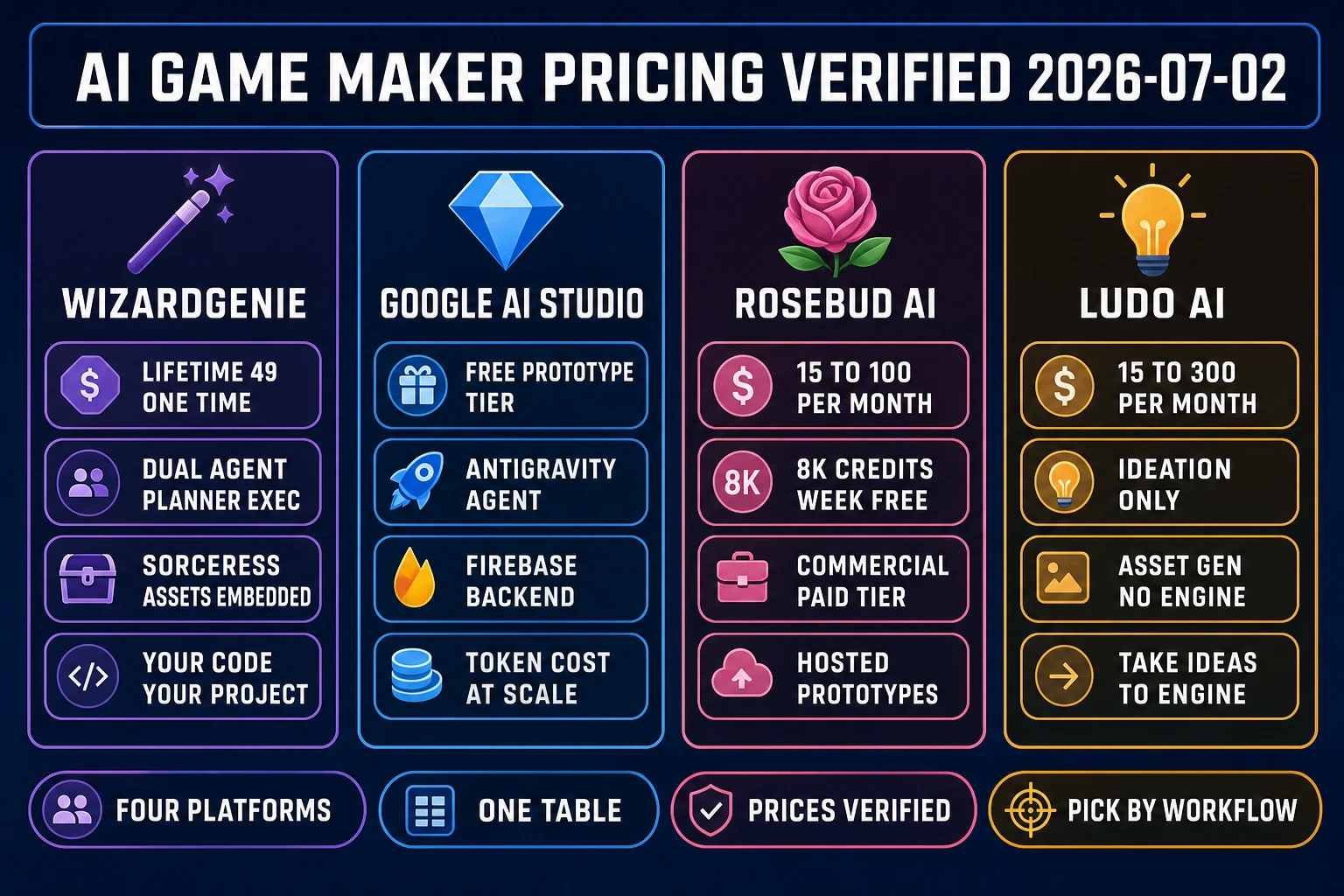
Google AI Studio Build mode is free for prototyping using the Antigravity coding agent. Full-stack apps deploy to Firebase Hosting with the standard Firebase Spark free tier for backend (Firebase Auth, Firestore, Cloud Run), and moving to production incurs token-based Gemini API costs and Firebase Blaze pay-as-you-go beyond the free tier. This is the only major browser-native AI game maker in 2026 that offers a genuinely usable free path from prototype to a small production-scale app. Real-time multiplayer, database persistence, and hosted URLs all work on the free tier for small projects (per the Firebase Blog announcement of the Google AI Studio integration and the official Google AI Studio Build documentation).
Rosebud AI offers a free tier of 8,000 credits per week for personal non-commercial use, sufficient for prototyping small browser games hosted on rosebud.ai. Commercial rights and Steam Windows executable export require a paid plan: Indie at $15 per month with 100,000 credits, 10x Dev at $30 per month with 300,000 credits, Pro at $50 per month with 1,000,000 credits, or Scale at $100 per month with 2,000,000 credits. Credits are consumed on generation, iteration, character updates, and asset requests, and Rosebud explicitly notes that credit consumption varies by prompt complexity. The Pro and 10x Dev tiers are the entry points for anyone planning to sell a game or ship to a store outside rosebud.ai.
Ludo AI has no free plan, only a 30-credit trial. Annual billing (which the vendor discounts up to 35 percent versus monthly) runs $15 per month with 3,000 credits per year on the Indie plan, $35 per month with 12,000 credits per year on the Pro plan, and $300 per month with 120,000 credits per year on the Studio plan. Ludo is priced per credit for asset generation and per seat for team access; the tool is aimed at studios doing pre-production ideation, not indie devs who want to ship a game. If your goal is a playable build, Ludo is a spend that never gets you closer to it.
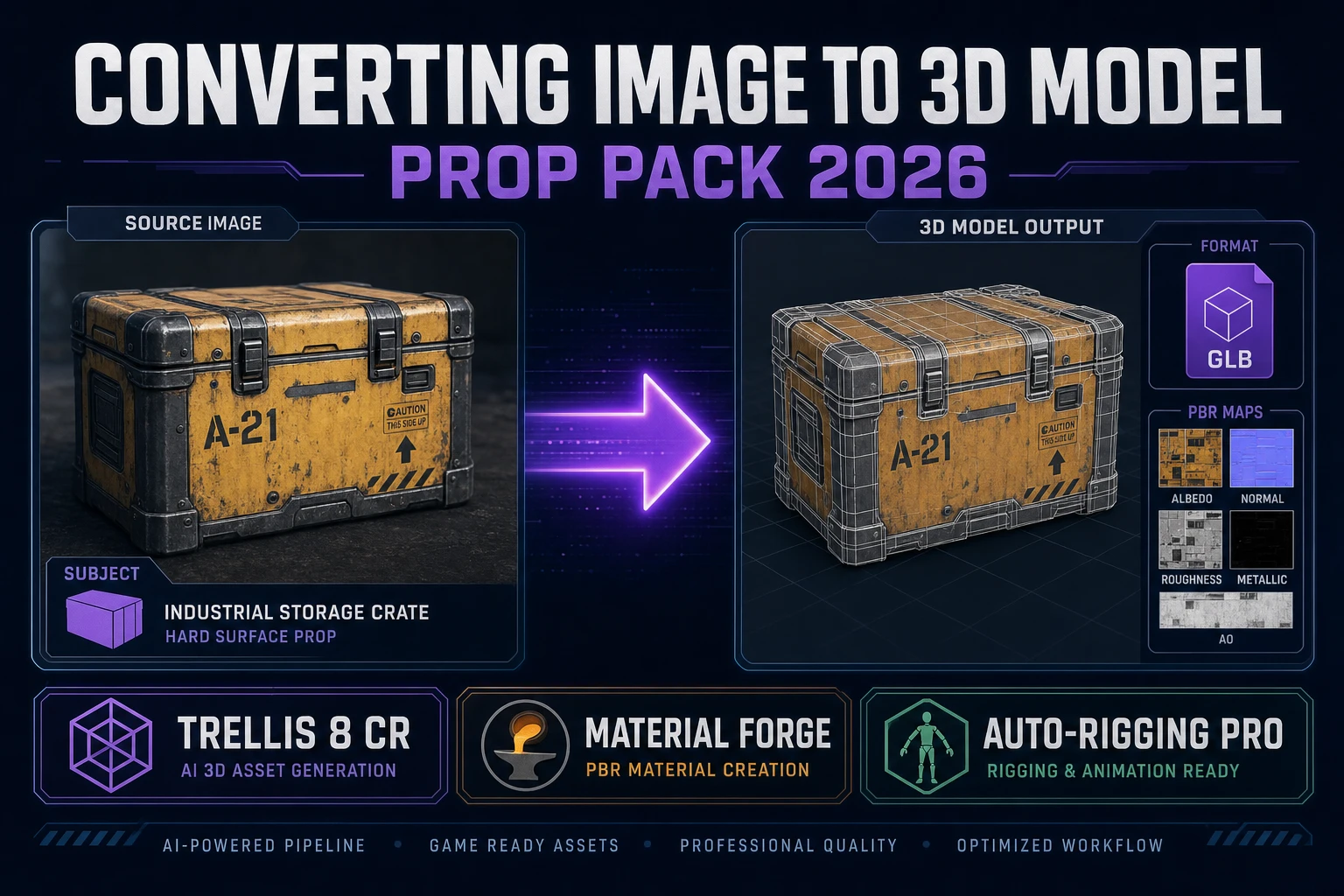
Sorceress WizardGenie is available today via the Early Access Supporter pledge at $50 minimum (Champion at $100, Visionary at $250, Founding Patron at $500), all of which unlock lifetime access to the desktop and browser AI game engine and every future update (verified against WIZARDGENIE_PLEDGE_TIERS in src/app/plans/page.tsx line 56 on July 2, 2026). AI generations inside WizardGenie draw from the standard Sorceress credit pool: Starter $10 for 1,000 credits ($0.01 per credit), Creator $20 for 2,000, Plus $50 for 5,000, Studio $100 for 10,000 (verified against CREDIT_TIERS at line 49 of the same file). The separate one-time $49 Sorceress Lifetime unlock covers the full non-AI asset pipeline (Auto-Sprite v2, 3D Studio, Auto-Rigging, Procedural Walk, Tileset Forge, and everything in the LIFETIME_TOOLS list at line 106) but does not include AI generation credits.
The browser-native ai game maker: WizardGenie with a dual-agent Planner plus Executor
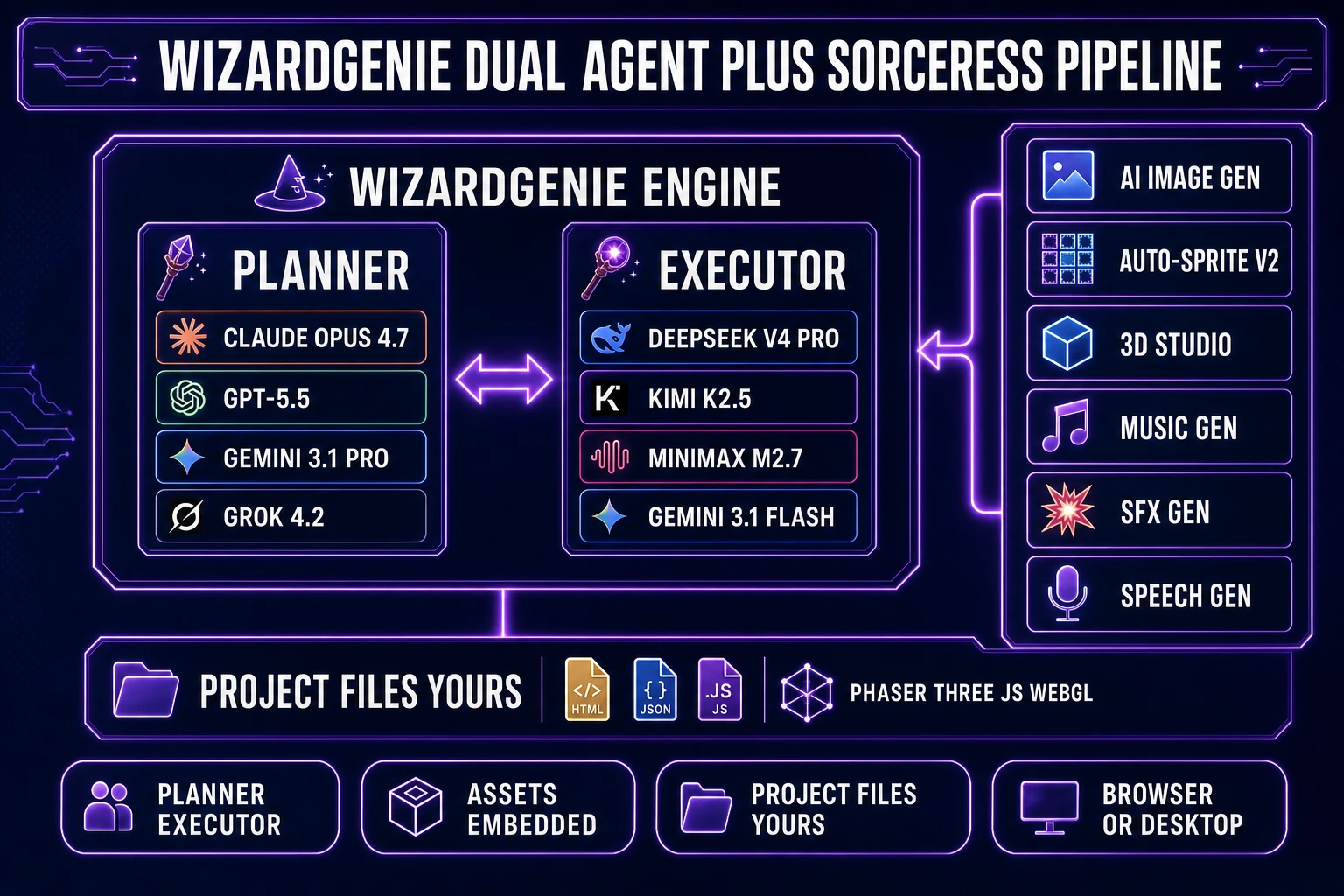
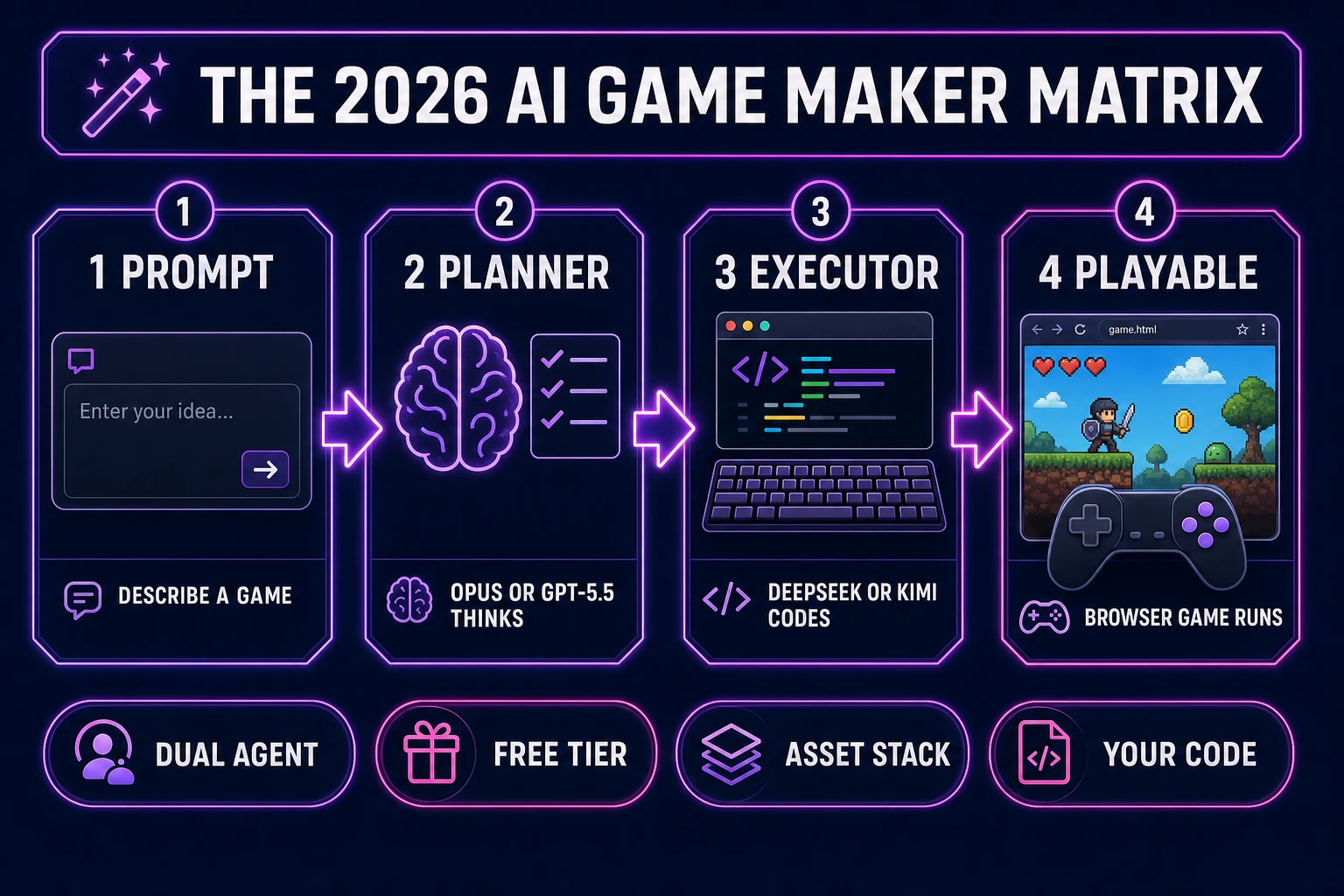
WizardGenie is an integrated engine, not a standalone AI chat that outputs code. The AI is a resident agent inside the editor. It reads the current scene, the current script files, the current asset browser state, the current running game (yes, the game is running while the agent works), and it can make targeted edits with knowledge of the whole project. When a prompt says “add a jump animation triggered by spacebar,” the agent finds the player controller script, adds the input handler, wires it to the sprite’s existing animation state machine, hot-reloads the browser game, and reports back — without you touching a file. The economic reason this works at reasonable cost is the dual-agent architecture.
Verified against src/app/wizard-genie/page.tsx line 295 on July 2, 2026: WizardGenie splits the workload between a Planner (top-tier reasoner) and an Executor (cheap fast typer). The Planner reads the design brief, breaks the work into concrete implementation steps, and hands each step to the Executor to actually type the code, then reviews the Executor’s output before accepting it. The user picks which specific models fill each role from the CODING_MODELS lineup in src/app/_home-v2/_data/tools.ts lines 734 to 743, verified July 2, 2026: Planner-eligible models are Claude Opus 4.7, Claude Sonnet 4.6, GPT-5.5, Gemini 3.1 Pro, and Grok 4.2; Executor-eligible cheap models are DeepSeek V4 Pro, Kimi K2.5, MiniMax M2.7, and (when it ships) Claude Haiku 4.5. The pattern is essentially the standard multi-agent system topology applied to coding: expensive reasoner thinks, cheap typer executes, expensive reasoner reviews.
The cost math is the point. Anthropic Claude Sonnet 4.6 input and output run about $3 and $15 per million tokens (frontier-tier). DeepSeek V4 Pro runs about $0.27 and $1.10. On a WizardGenie session that generates ten game features (roughly 200,000 tokens of Executor output for scaffolding, gameplay wiring, asset hookup, and state-machine logic), running a single frontier model as the sole coder would cost around $3 to $4 in raw token spend. The Planner-Executor split runs the Planner briefly (10,000 Opus tokens for planning and review) and the Executor for the bulk (200,000 DeepSeek tokens for the actual code), landing the same session at $0.15 to $0.60 depending on the exact Planner and Executor picks. That is roughly a fifth of the single-frontier cost, compounded across a full game project. WizardGenie’s src/app/wizard-genie/page.tsx line 297 states the pattern as: “A smart Planner thinks; a cheap Executor codes. Same quality at roughly a quarter of the token cost.” The actual math today (with the DeepSeek V4 Pro executor priced against Sonnet 4.6) trends closer to a fifth than a quarter, but the direction is right and the compounded savings over a real project are what matter.
The other WizardGenie feature that reshapes the AI game maker experience is switch models freely. If the Executor gets a physics interaction wrong on Kimi K2.5, one click swaps to DeepSeek V4 Pro for the retry; if the Planner is stuck on a design decision, one click swaps Opus for GPT-5.5 to try a different reasoner. No AI game maker on the current SERP offers model choice at this granularity; Rosebud, Ludo, and Google AI Studio each ship one model and lock you into its strengths and weaknesses.