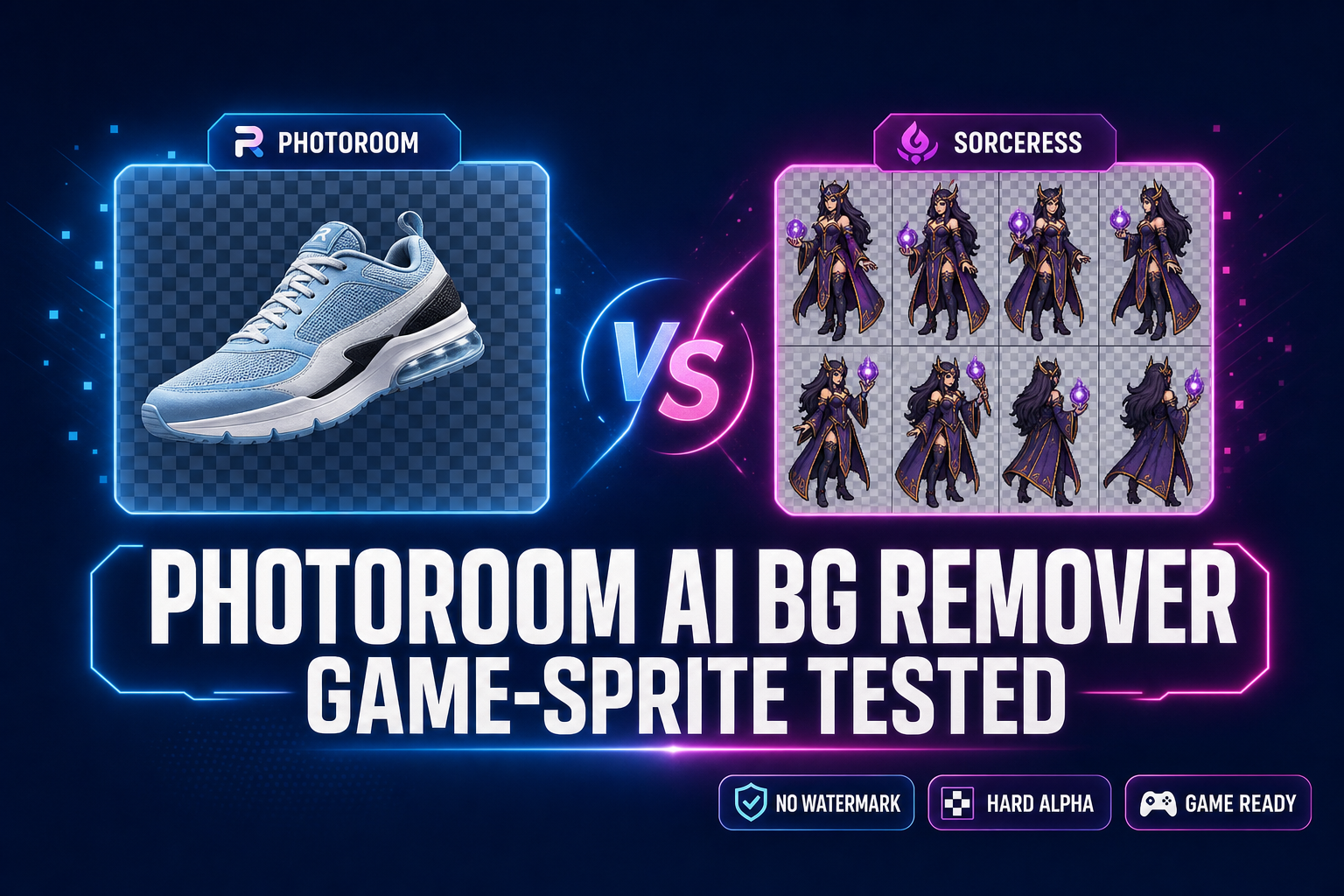
Photoroom AI Background Remover (Game-Sprite Tested)

By Arron R.12 min read
The Photoroom AI background remover is tuned for product photos and ecommerce listings. Sorceress BG Remover is tuned for game sprites - 3 credits per image, ha

If the goal is a single product photo on a transparent background for a Shopify listing, the Photoroom AI background remover is one of the slickest browser tools shipping in 2026 — drag, wait two seconds, drop the cutout onto a marketing template. The friction shows up only when the next step is “now do it eight more times for the walk cycle” or “now load this into Phaser as a sprite atlas”. Game sprites have two requirements product photos do not: batch processing on a starter plan (because every character ships with eight to twenty frames) and hard-alpha edges (because soft halos render as visible glow against tile backgrounds in the engine viewport). Below is what the Photoroom AI background remover actually does in 2026, where it stops, and where the Sorceress BG Remover picks up the rope. Verified May 27, 2026 against the live photoroom.com pricing and help pages and the Sorceress source at src/app/bg-remover/page.tsx.
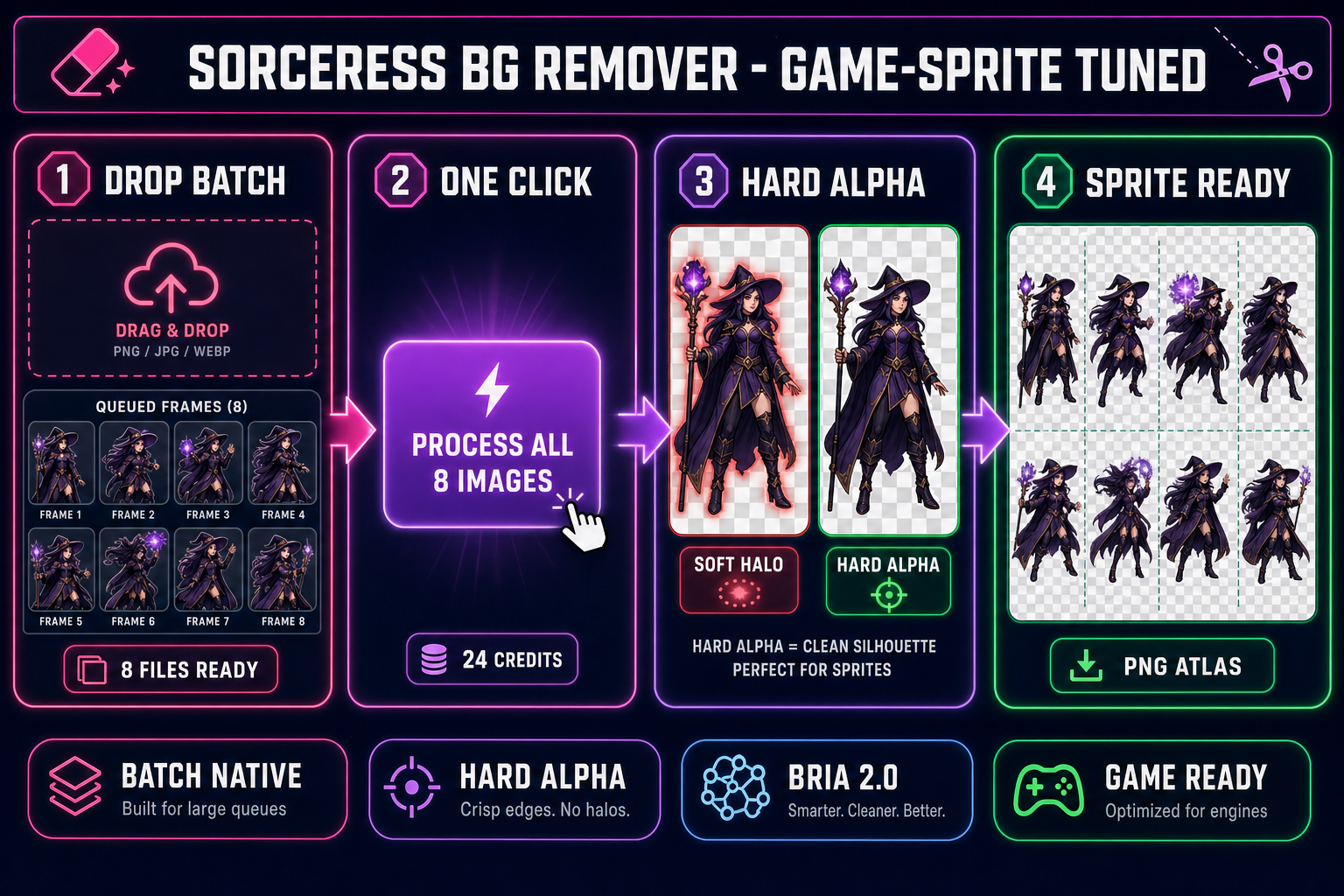
Sprite-sheet pipeline inside Sorceress BG Remover - drop a batch of eight frames, click process all, get hard-alpha cutouts, export as a sprite-ready PNG atlas - on a dark navy background with magenta and purple accents
The game-sprite-tuned alternative to the Photoroom AI background remover: multi-file batch input on a starter plan, hard-alpha output, and a one-click hand-off into a sprite atlas. Verified May 27, 2026.

What the Photoroom AI background remover actually does in 2026

The Photoroom AI background remover is the cutout endpoint inside Photoroom, a browser-first photo editor built around ecommerce listings, product catalogues, and social commerce. It accepts a single image, runs a proprietary segmentation model against the subject, and returns a transparent PNG with the background masked out. Verified May 27, 2026 against the live photoroom.com/pricing page and the Photoroom help centre, the technical envelope is:

  • File formats: JPEG, JPG, PNG, and WebP inputs across the web app.
  • Output: a transparent PNG, watermarked on the free plan and clean on every paid tier.
  • Speed: the cutout completes in roughly one to two seconds for a typical product photo.
  • Refinement tools: a Magic Retouch brush inside the Photoroom editor for manual edge cleanup, plus a Shadow Studio for product-photo soft shadows.
  • Account: a free Photoroom account is required; the cutout itself runs on the Free plan but the watermark removal needs a paid tier.
  • Free-tier export cap: 250 exports per month, watermarked, restricted to non-commercial use per the live terms on May 27, 2026.

The model behind the cutout is tuned for Photoroom’s dominant use case — product photos, fashion catalogues, marketplace listings, and headshots going onto a marketing canvas. For that job it is genuinely excellent. The friction starts showing up in two specific places: the watermark and commercial-rights ceiling on the free plan, and the batch-mode gate that puts multi-file processing behind a paid subscription.

Photoroom pricing in 2026 — free, Pro, and the API

Pricing verified May 27, 2026 against photoroom.com/pricing and photoroom.com/api/pricing. The tier ladder relevant to indie game devs:

  • Free: 250 exports per month. Exports carry a Photoroom watermark and the terms restrict the output to non-commercial use. A game-asset PNG with a watermark is not shippable in a paid title.
  • Pro — $13.99/mo (annual) or $19.99/mo (monthly): removes the watermark, unlocks commercial rights, and enables Batch Mode with 500 batch exports per month.
  • Max — $26.99/mo (annual): 1,500 batch exports per month, multi-user seats.
  • Ultra — starts at $59.99/mo (annual): 5,000 batch exports per month and scales up to 50,000.
  • API (Basic): $0.02 per image for the Remove Background endpoint, monthly subscription required, free tier of 10 calls per month, sandbox mode returns 1,000 watermarked calls.

The headline number for a game dev is the gating: on the Free plan there is no batch endpoint at all, and the watermarked PNG cannot ship in a commercial game. The first tier that actually clears both bars is Pro at $13.99/mo — a perfectly reasonable line item for a working studio, and a steep ramp for the indie running on credit-pack economics.

The verdict at a glance — Photoroom vs Sorceress BG Remover for game sprites

Comparison verified May 27, 2026 against the live photoroom.com pages and against src/app/bg-remover/page.tsx in the Sorceress source.

DimensionPhotoroom AI background removerSorceress BG Remover
Free-tier costFree, 250 exports/mo, watermarked, non-commercial3 credits per image from a 100-credit starter pack
First commercial tierPro at $13.99/mo (annual)Included on every account, no subscription floor
WatermarkYes, on Free planNone on any tier
Batch processingPro and up only, 500–50,000 exports/moNative multi-file queue on every account
API price$0.02 per image, monthly subscription required3 credits per image, no subscription floor
Edge styleSoft (product-photo tuned)Hard (silhouette-tuned via Bria 2.0 RMBG)
Sprite-sheet hand-offManual download & re-importDirect drag into Quick Sprites / Canvas / WizardGenie
3D bridgeNoneCutout flows into 3D Studio for image-to-mesh
Best atProduct photos, fashion listings, marketplace cataloguesSprite-sheet frames, NPC portraits, image-to-3D source

The verdict in one line: Photoroom wins for ecommerce-shaped marketing renders; Sorceress wins for game-asset packs. The two tools are complementary and the right pick depends entirely on what comes after the cutout.
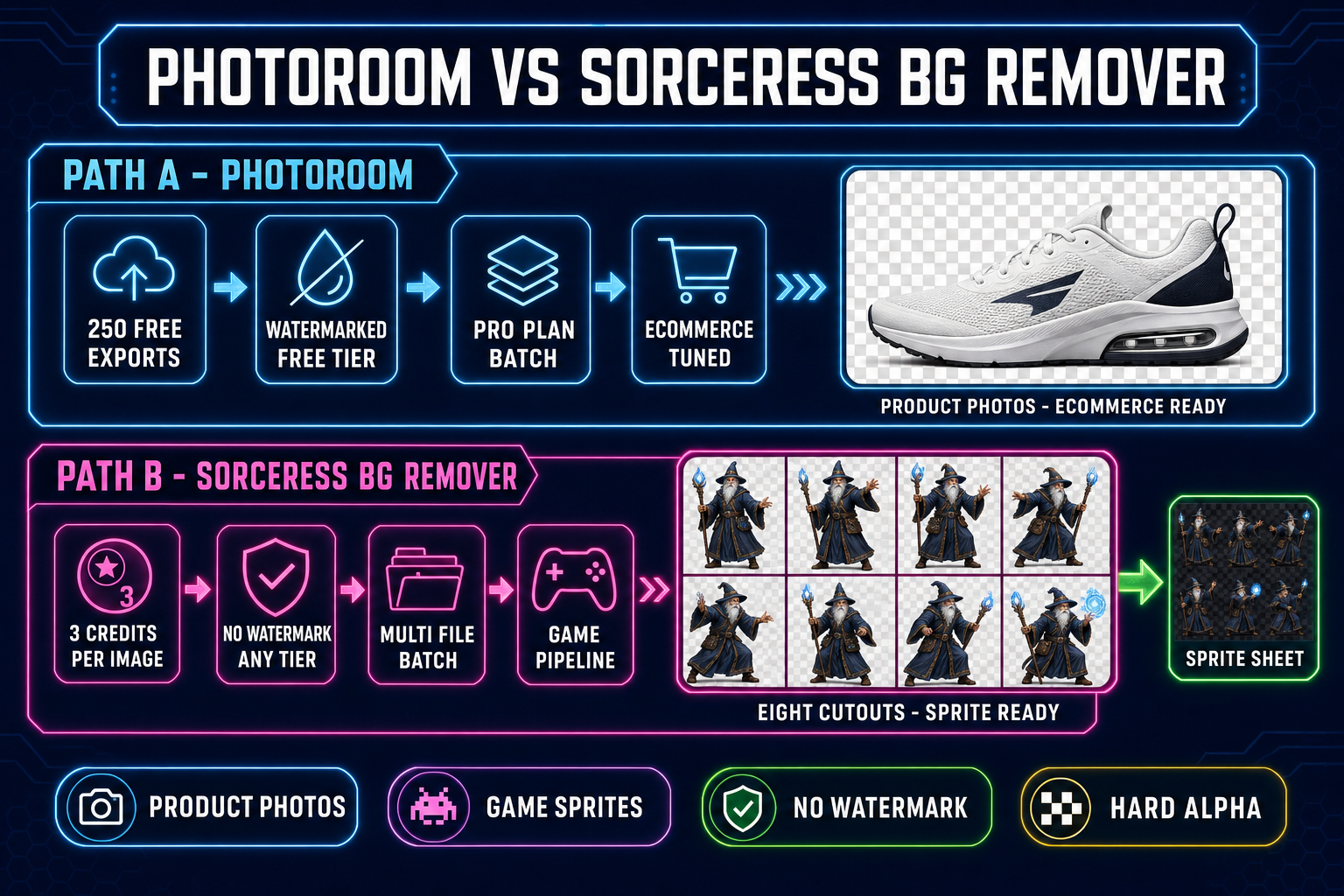
Side-by-side comparison diagram of Photoroom versus Sorceress BG Remover - top lane shows Photoroom with a single product sneaker cutout tuned for ecommerce - bottom lane shows Sorceress with eight character cutouts arranged into a sprite sheet - both lanes labelled with their distinct strengths
One image at a time vs eight images at a time. The Photoroom AI background remover is tuned for product-photo and ecommerce renders; the Sorceress BG Remover is tuned for the game-asset pack that lives downstream.

Where the Sorceress BG Remover wins for game sprites

Three honest places the Sorceress side pulls ahead, all rooted in game-sprite economics rather than image quality on a single render.

1. Native multi-file batch on every account. Verified May 27, 2026 against src/app/bg-remover/page.tsx (the handleProcessAll handler, pendingFiles queue, and batchProgress state): drop eight frames into the upload zone, click Process All, and the queue runs against the bria/remove-background Replicate model with a live progress bar. Every Sorceress account — including the 100-credit starter — gets the same batch endpoint. The Photoroom AI background remover gates batch behind Pro and up — the Free tier has zero batch exports, and even the entry-level paid plan tops out at 500 batches per month. For an eight-frame walk cycle on Sorceress that is one click; on Photoroom Free that is eight uploads, eight downloads, eight watermarked PNGs you cannot ship, and eight filename collisions to clean up by hand.

2. Hard-alpha edges from Bria 2.0 RMBG. The Sorceress BG Remover routes every removal through the bria/remove-background endpoint on Replicate — the production version of Bria’s RMBG model, tuned for object silhouettes rather than portrait edges. The result is a clean alpha channel where each pixel is either fully opaque or fully transparent. That matters because of how engines handle alpha compositing: a sprite with a soft halo of half-transparent pixels gets rendered with the halo composited over whatever tile is behind it, producing a faint glow against the level background. The Photoroom AI background remover uses a product-photo-tuned soft edge that looks great on a marketing canvas and looks like a glitch in a game viewport.

3. Direct hand-off into the asset pipeline. The cutout output is stored on your Sorceress account as a Backblaze B2 URL (verified against the upload helper inside src/app/bg-remover/page.tsx), which means the next step is a drag, not a re-upload. Inside WizardGenie you drag the cutout straight into an agent session for code-side integration. Inside the broader Sorceress UI you drag it into Canvas for manual sprite-sheet layout, or into Quick Sprites for an animated walk cycle, or into 3D Studio for image-to-mesh conversion. Photoroom stops at the local download (or a cloud copy inside the Photoroom workspace).
Why hard-alpha matters more for sprites than for product photos

A product photo is rendered exactly once at the resolution it was shot. A game sprite is rendered every frame inside the engine, scaled by the camera, blended over a tile background, and re-composited dozens of times per second. The technical primitive that determines how the silhouette shows up against the level is the PNG alpha channel: the per-pixel opacity value the engine reads alongside the RGB color.

If the cutout has hard alpha — every pixel either 255 or 0, with anti-aliasing handled by the engine’s sub-pixel rasterizer — the silhouette stays crisp at every camera distance. If the cutout has soft alpha — a one-to-three-pixel ring of half-transparent pixels — that ring shows up as a faint glow against any tile darker than the original photo background, and as a subtle cyan or magenta fringe against any tile lighter than the original. The same artifact that haunted late-90s pre-rendered sprites is the artifact a product-photo-tuned cutout introduces today.

The fix that production game-asset tools converged on is to bias the alpha mask hard: any pixel under roughly 50% transparency snaps to 0, any pixel over snaps to 255, and the engine handles smoothing at render time. The Sorceress BG Remover bakes that bias into the bria/remove-background output. The Photoroom AI background remover does not, because for product-photo and marketing renders the soft edge is the right answer — it makes a sneaker silhouette blend into a Shopify hero, where a hard-cut silhouette would look like a clipping mistake.

The full game-sprite workflow with the Sorceress BG Remover

Six concrete steps, end-to-end, from raw character art to a sprite-sheet drop into Phaser. Verified May 27, 2026 against the source at src/app/bg-remover/page.tsx, src/app/quick-sprites/page.tsx, and the 3D Studio pipeline.

  1. Generate eight character poses. In Sorceress AI Image Gen, lock a reference image of your hero into the chosen model and generate eight poses (idle, walk, run, jump, attack, cast, hit, victory). Pose selection covered in the reference-image character workflow.
  2. Drop the eight frames into the BG Remover queue. Open /bg-remover, drag the eight PNGs into the upload zone (or drop them in from the WizardGenie Explorer for a desktop session). The queue accepts a multi-file drop on the starter pack — no Pro upgrade required.
  3. Click Process All 8 Images. The queue runs against the bria/remove-background endpoint in parallel. The progress bar (batchProgress state in the source) shows current / total. Each cutout costs 3 credits, so the eight-frame pack is 24 credits — well inside the 100-credit starter pack.
  4. Verify the alpha edge. The lightbox view renders each cutout against a transparent checker pattern. Zoom in on the silhouette; the edge should be a hard line, not a soft ring. If a frame still has a halo (rare but possible on hair detail), use the eraser brush in Canvas to clean it up before the sprite-sheet step.
  5. Lay the eight cutouts into a sprite sheet. Drop the cutouts into Quick Sprites for an automated walk-cycle layout (verified against src/app/quick-sprites/page.tsxMODEL_ID = 'retro-diffusion/rd-animation', CREDITS_PER_GEN = 9, animation styles include four_angle_walking at 48×48 px and small_sprites at 32×32 px). Or drop them into Canvas for manual grid arrangement and pixel-perfect alignment.
  6. Load the sprite sheet in Phaser. The output is a single PNG texture atlas the engine reads in one call:
// Phaser 4 - load and play the sprite sheet
this.load.spritesheet('hero', '/assets/hero_walk.png', {
  frameWidth: 48,
  frameHeight: 48,
});

this.anims.create({
  key: 'hero-walk-right',
  frames: this.anims.generateFrameNumbers('hero', { start: 0, end: 7 }),
  frameRate: 12,
  repeat: -1,
});

const hero = this.physics.add.sprite(100, 100, 'hero');
hero.play('hero-walk-right');

The whole path lands in roughly four minutes inside a single browser tab. For a deeper sprite-sheet walkthrough, see the sprite-sheet how-to; for the head-term comparison against other cutout tools, see the one-click BG remover write-up, or the Adobe Express comparison for the soft-edge alternative.

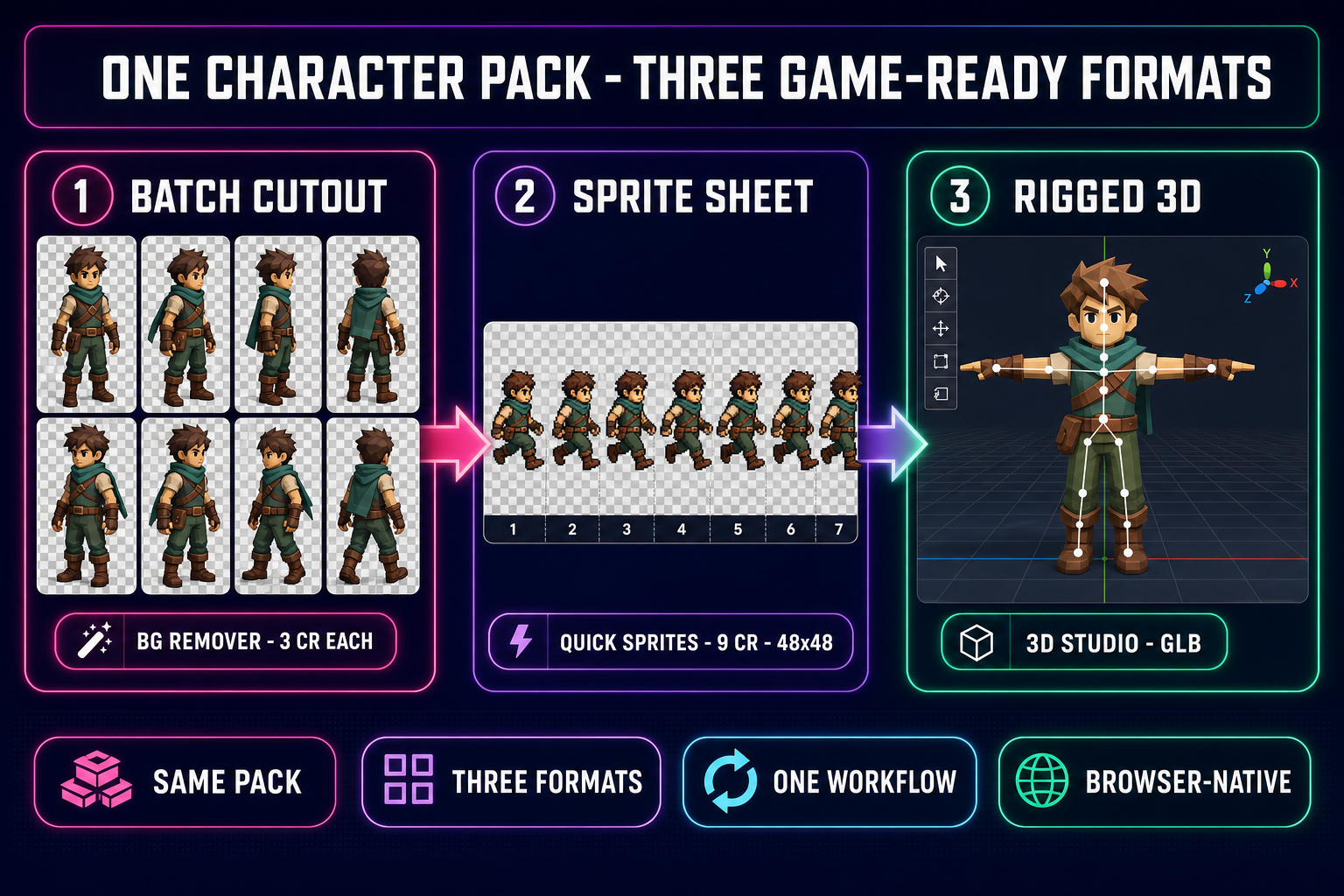
Diagram showing one character pack transformed into three game-ready formats - eight cutout frames from BG Remover at 3 credits each, an 8-frame walk cycle sprite sheet from Quick Sprites at 9 credits and 48 by 48 pixels, and a rigged 3D model in T-pose from 3D Studio - on a dark navy background with magenta, purple, and emerald accents
One eight-frame character pack, three game-ready outputs. The cutout step feeds the sprite sheet and the 3D model alike, which is what makes batch-native background removal worth the credits.

The math — credits vs subscription vs minutes-of-clicking

Free tools are not actually free if the workflow is wrong for the job. For a full character pack, the relevant ratio is cash and credits spent against minutes of human clicking saved. A representative project: one hero, eight poses for the walk cycle, four NPCs at four poses each. That is twenty-four cutouts.

On the Photoroom AI background remover, twenty-four cutouts on the Free plan is twenty-four uploads, twenty-four watermarked PNGs you cannot ship in a commercial game, and roughly ten minutes of focused clicking that you cannot leave unattended. To clear the watermark and unlock batch, you step up to Pro at $13.99/mo (verified May 27, 2026), which gives you the 500-batch-per-month allowance — comfortably above twenty-four cutouts, but a recurring subscription that runs whether you ship a character pack this week or not.

On the Sorceress BG Remover, twenty-four cutouts is one drag-and-drop, one click on Process All, and a 30-second wait while the parallel batch resolves. Cost: 72 credits (well inside the 100-credit starter), and roughly forty seconds of human attention. No subscription floor, no watermark, no commercial-rights asterisk.

The choice is not credits-vs-free. It is “a $13.99/mo subscription plus the minutes-per-frame on the Free tier” against “forty seconds and a one-time credit deduction”. For a recurring ecommerce listing business the Photoroom subscription pays for itself; for a sprite pipeline that ships in bursts, the credit model is closer to how indie studios actually budget.

Pick the Photoroom AI background remover if…

  • The job is product photography, fashion catalogues, or marketplace listings.
  • The next step lives inside the Photoroom editor (templates, brand kits, social-post scheduling) or inside Shopify, Etsy, or Amazon listing tooling.
  • You already pay for Pro or Max for the ecommerce side of the studio, so batch and commercial rights are sunk cost.
  • The output is going onto a marketing canvas where a soft, photo-friendly silhouette edge is correct.
  • You need the Photoroom-specific extras — Magic Retouch, Shadow Studio, ID Photo, product-photo lighting templates — that bundle with the cutout.

Pick the Sorceress BG Remover if…

  • The job is eight or more cutouts at a time — sprite frames, NPC portraits, item icons, enemy roster art.
  • The output feeds a sprite-sheet, a tile atlas, or a 3D mesh, not a Discord banner or a Shopify listing.
  • You need hard-alpha edges for clean compositing inside an engine viewport.
  • The next step is also a Sorceress step (Quick Sprites, Canvas, 3D Studio, WizardGenie agent session).
  • You want the cutouts stored on your account as URLs so the asset board persists between sessions, without a recurring subscription bill.
  • You want commercial rights and a clean PNG on every output, including the very first one on a starter account.

What both tools still miss

Three honest gaps that neither side has solved yet, worth knowing before you commit a project.

Per-pixel mask correction at the cutout step. Photoroom ships Magic Retouch and a manual brush inside the editor. Sorceress does not ship a brush at the cutout step — the fix-up path is to open the result in Canvas and use the eraser there. Neither workflow yet automates “detect and restore the silhouette pixels the model misclassified as background” on the cutout endpoint itself.

Anti-aliased silhouette preservation on extreme edges. Both models occasionally over-bias the alpha mask on hair, antennae, glass, and motion-blur trails. On a typical character render the failure rate is below 5% of frames; the manual cleanup case above is the same fix.

Per-frame sprite alignment. Cutting out the background does not align eight frames to the same pixel grid. The Sorceress workflow handles alignment in Quick Sprites or Canvas; Photoroom has no equivalent endpoint. A standalone cutout tool, even a great one, only solves the first half of “sprite ready”.

Use the Photoroom AI background remover when the goal is a product-photo or marketing render and the tool that comes next is the Photoroom editor or a marketplace listing. Use the Sorceress BG Remover when the goal is a game-asset pack and the tool that comes next is a sprite sheet, a 3D mesh, or an agent session. The two tools live at the opposite ends of the cutout-quality spectrum on purpose — the right pick is the one tuned for the job downstream.

Frequently Asked Questions

Is the Photoroom AI background remover free for game devs?

Partially. Verified May 27, 2026 against the live photoroom.com/pricing page: the Free plan allows 250 exports per month, but the exports are watermarked and restricted to non-commercial use. A game-asset PNG with a Photoroom watermark is not shippable in a commercial game. To remove the watermark and unlock commercial rights you need a Pro plan (verified at $13.99/mo on May 27, 2026), which also unlocks Batch Mode and 500 batch exports per month. The Free plan is fine for prototyping a single hero portrait; the paid plan is the floor for actually shipping cutouts.

How much does the Sorceress BG Remover cost per image?

Three credits per image. Verified May 27, 2026 against src/app/bg-remover/page.tsx (BG_REMOVER_CREDITS = 3). A new Sorceress account ships with a 100-credit starter pack, which covers 33 cutouts before any top-up - enough for four characters worth of eight-frame walk cycles. Each generation calls the bria/remove-background model on Replicate, returns a PNG with a clean alpha channel, uploads it to Backblaze B2, and stores the URL on your account so you can re-download or drag it into another Sorceress tool later. No watermark on any tier. Commercial rights apply to every output.

Does the Photoroom AI background remover support batch processing?

Yes, but only on paid plans. Verified May 27, 2026 against help.photoroom.com: Batch Mode is gated behind Pro, Max, and Ultra plans. The Free tier has zero batch exports. Pro ships 500 batch exports per month, Max 1,500, Ultra starts at 5,000 and scales up to 50,000. You can drop up to 250 images per batch across all platforms. The catch for indie game devs is the gating - a hobbyist on the Free plan has to upload eight walk-cycle frames one at a time. The Sorceress BG Remover (verified against the handleProcessAll handler and batchProgress state in src/app/bg-remover/page.tsx) accepts a multi-file drop on the same starter credit pack every account gets, no tier gating.

Why does alpha-channel quality matter more for game sprites than for product photos?

A product photo is rendered once at the resolution it was shot. A game sprite is rendered every frame inside the engine, scaled by the camera, blended over a tile background, and re-composited dozens of times per second. If the cutout has a soft halo of half-transparent pixels around the silhouette, those pixels show up as a visible glow against the tile in the engine viewport - the artifact that haunted late-90s pre-rendered sprites. The fix is a hard alpha edge: every pixel is either fully opaque or fully transparent, with anti-aliasing handled by the engine at render time. The Bria 2.0 RMBG model the Sorceress BG Remover uses is tuned for that hard edge on object silhouettes, which is why it is the recommended path for game-asset work. The Photoroom AI background remover targets product-photo silhouettes where a softer edge actually helps the photo blend onto a marketing canvas.

Can I send the cutout straight into a sprite sheet without re-uploading?

Inside Sorceress, yes. The BG Remover output is stored on your account as a Backblaze B2 URL - from there you can either drag it into the WizardGenie Explorer for an agent session, drop it into Canvas for manual sprite-sheet layout, or kick it into Quick Sprites for an animated walk cycle (verified against src/app/quick-sprites/page.tsx - MODEL_ID is retro-diffusion/rd-animation, CREDITS_PER_GEN is 9, animation styles include four_angle_walking at 48 by 48 pixels). The Photoroom AI background remover exports a PNG to your local filesystem (or the Photoroom cloud space) and stops there - every downstream step (sprite-sheet layout, walk-cycle animation, 3D conversion) is a separate tool you bring yourself.

What about the Photoroom API for automation?

Photoroom ships a Remove Background API at $0.02 per image (verified May 27, 2026 against photoroom.com/api/pricing - the Basic plan). For a studio processing 50,000+ images per year, that is a reasonable line item. The catch for indie game devs is the floor: API access requires a monthly subscription, the free tier is 10 calls per month, and the sandbox mode (1,000 free calls) returns watermarked output. The Sorceress BG Remover is simpler for the indie pack-of-eight workflow: pay 3 credits per cutout from a 100-credit starter, no monthly minimum, no sandbox watermark. For high-volume automation the Photoroom API is the right call; for the indie use case of cleaning up a character pack before drag-into-Quick-Sprites, Sorceress is the cleaner endpoint.

Which tool should I pick for a one-off marketing render?

Photoroom, often. The Photoroom AI background remover is fast, browser-based, and the rest of the Photoroom editor lets you drop the cutout straight onto a Steam page hero, a Discord banner, or a press-kit thumbnail without leaving the tab (250 free exports per month with a watermark, or 500 batch exports per month on the Pro plan at $13.99/mo). For a single marketing image it is a clean workflow. The Sorceress BG Remover only earns its credits when the next step is also a game-asset step - eight frames of a walk cycle, a roster of NPC portraits, or a 3D mesh built from the cutout. Different tools, different jobs.

Sources

  1. Alpha compositing - Wikipedia
  2. Image segmentation - Wikipedia
  3. Texture atlas (sprite sheet) - Wikipedia
  4. Sprite (computer graphics) - Wikipedia
  5. Portable Network Graphics - Wikipedia
Written by Arron R.·2,644 words·12 min read

Related posts