Hop How to Make a Platformer Scratch (Jump Loop 2026)

By Arron R.8 min read
How to make a platformer Scratch starts with one stage, gravity, and a jump you can feel. Master that loop, then grow into a Phaser browser build with WizardGen

Most first platformers die the same way: a player that floats, a jump that fires mid-air forever, and platforms that look solid until the costume overlaps them. Searchers typing how to make a platformer scratch are usually one afternoon away from that mess — and one honest jump loop away from something fun. Start with the loop. Grow the art later.
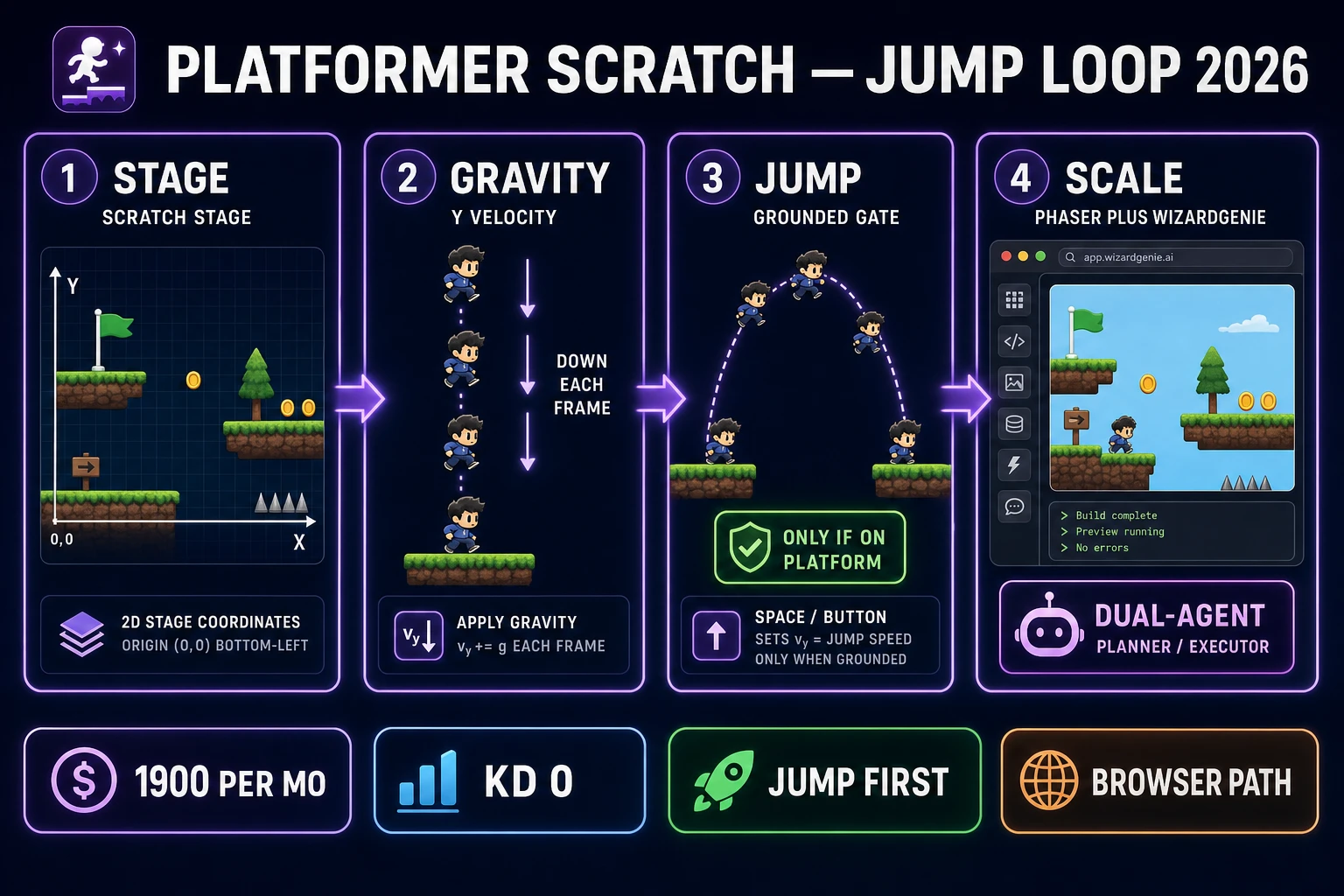
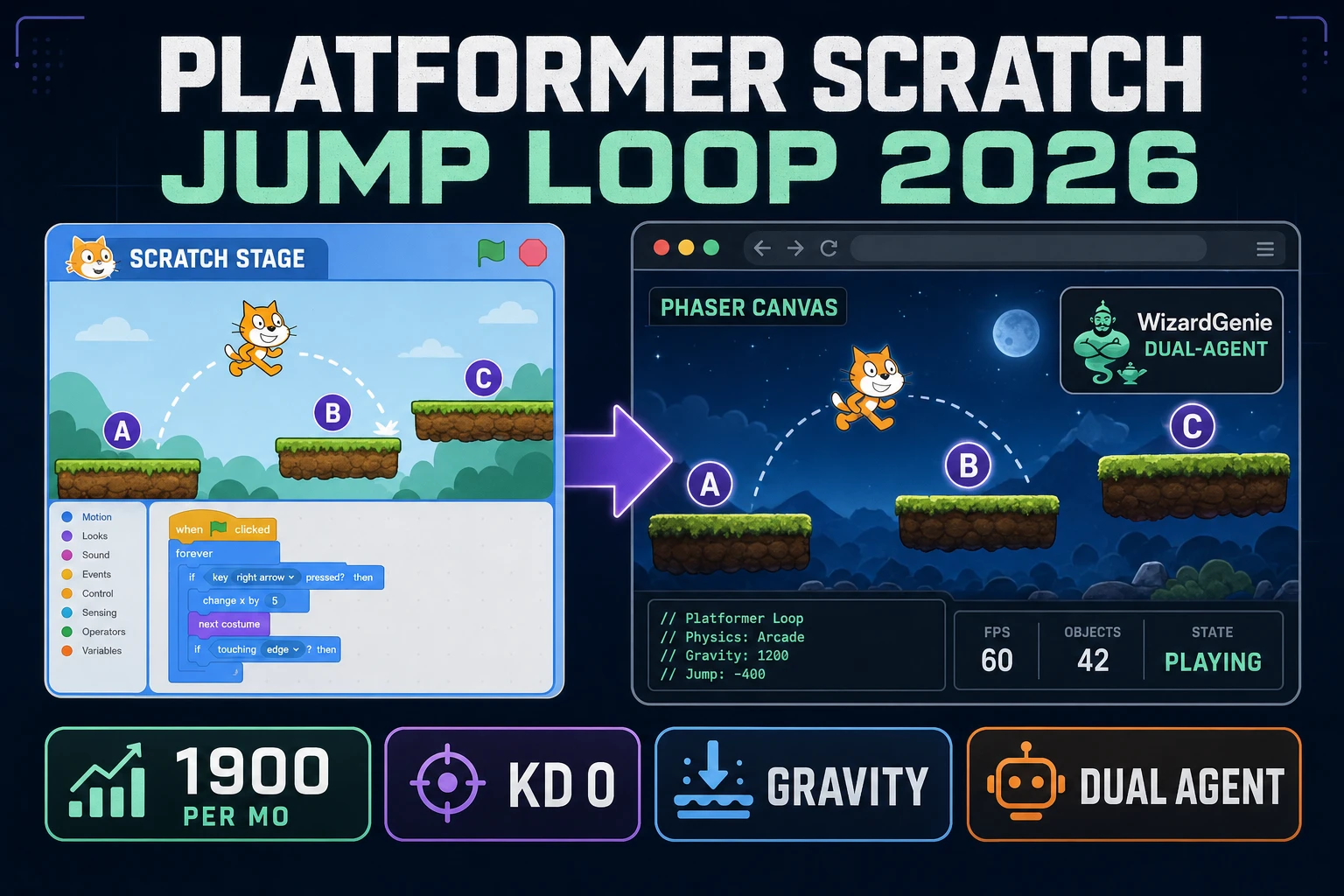
How to make a platformer Scratch jump loop pipeline 2026
Stage, gravity, grounded jump, then a browser handoff: the same loop with better tooling.

What searchers typing how to make a platformer scratch actually want

DataForSEO lists how to make a platformer scratch at 1,900 searches a month with KD 0 and informational intent (verified 2026-10-12 in tools/research-supplement.md, seed how to make a platformer). Sibling phrases in the same cluster include how to make a platformer game on scratch (1,900/mo, KD 0), how to make a platformer in scratch (1,900/mo, KD 0), and the looser head term how to make a platformer (320/mo, KD 0). The preposition variants already have posts on this blog; this page targets the high-volume natural phrasing without “in/on.”

Wikipedia’s platform game article (verified 2026-10-12) defines the genre by uneven terrain and suspended platforms that require jumping and climbing, with walking, running, jumping, attacking, and climbing as the common movement set. Scratch is where millions of learners first meet that shape. Wikipedia’s Scratch page (verified 2026-10-12) describes a block-based language aimed primarily at ages 5–16, with Scratch 3.0 as the current online editor (stable release 2 January 2019), a stage with x/y coordinates centered at 0,0, and block categories that include Motion, Looks, Events, Control, Sensing, and Variables. You do not need every category on day one. You need gravity, a grounded jump, and three platforms you can fail on.

The platformer loop in plain English

MDN’s Anatomy of a video game still frames the job as a loop: present the scene, accept input, update state, repeat (verified 2026-10-12). For a jumper that means:

  1. Present — draw the player and platforms at their current positions.
  2. Input — left/right each frame; jump only on the press edge while grounded.
  3. Update — add gravity to vertical velocity, move the player, resolve platform collisions, set grounded true/false.
  4. Repeat — forever (Scratch green-flag loop) or requestAnimationFrame / Phaser’s update.

Feel lives in the update step. Gravity too weak and the character moon-walks. Gravity too strong and gap B becomes a punishment. Jump impulse too high and you skip the puzzle. The win condition for today is not “finished game.” It is “gap B feels intentional.”
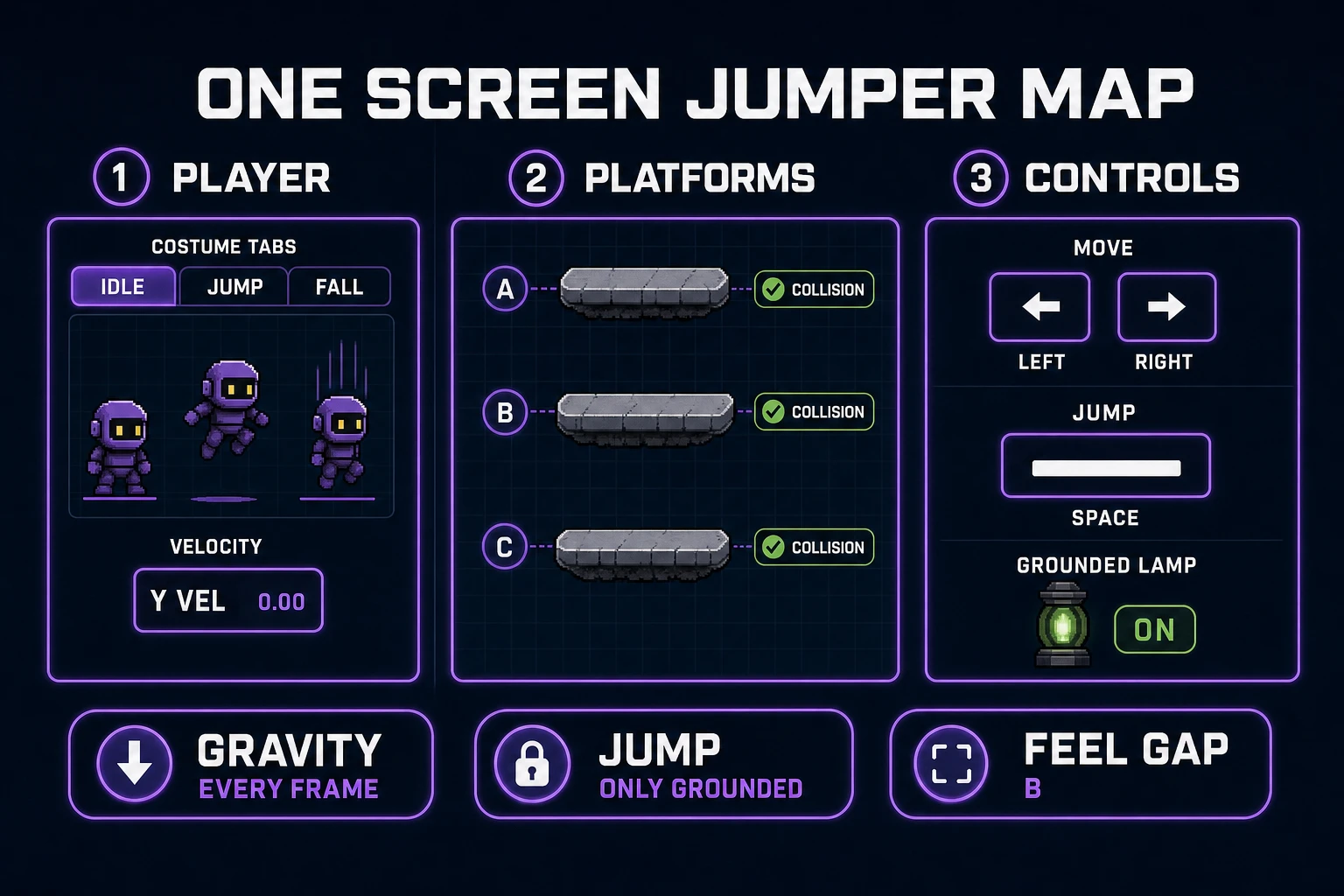
One-screen Scratch platformer map with player platforms and controls
One backdrop, one player, platforms A–C, grounded jump only — enough to learn the genre.

Scratch stage and script map for a one-screen jumper

Build the smallest fair stage before you touch scrolling. On the Scratch stage (center 0,0 per Wikipedia’s Scratch article, verified 2026-10-12):

  • Player sprite — one costume for idle/run is enough. Add a second costume for jump only after the physics feels right.
  • Platform sprites — three wide rectangles at different heights. Name them mentally A (start), B (the mean gap), C (goal ledge).
  • Variables — y vel, grounded (0/1), optional jump buffer frames.

Script shape (describe the blocks; do not paste a whole project):

  1. When green flag clicked → go to start x/y → set y vel to 0 → set grounded to 0 → forever: run the loop below.
  2. Each frame: if right arrow, change x by a small positive step; if left arrow, change x by a small negative step.
  3. Each frame: change y vel by a negative gravity constant (try −1 first), then change y by y vel.
  4. Collision: if touching a platform and y vel ≤ 0, snap to the platform top, set y vel to 0, set grounded to 1; else set grounded to 0.
  5. Jump: if space pressed and grounded = 1, set y vel to a positive impulse (try 12) and set grounded to 0.

Playtest order: walk on A, fall off A, land on A, clear gap B, stand on C. If you can air-jump forever, your grounded flag is wrong. If you sink into platforms, snap y before the next gravity tick. If gap B is impossible, lower gravity or raise the impulse — do not widen the platform as your first fix, or you will never learn the feel budget.

Optional quality upgrades once the basics work: a 4–6 frame coyote window (still allow jump shortly after leaving a ledge), an 6–8 frame jump buffer (queue jump if pressed slightly early), and a variable jump cut (reduce y vel when space is released on the way up). Those three tricks are why console platformers feel fair. Scratch can express them with timers and boolean flags; you do not need an engine install to learn them.

Common failure modes while you are still on the Scratch stage:

  • Infinite air jumps — you set grounded from “touching platform” without checking that you are falling or standing. Require y vel ≤ 0 (or a “feet sensor” costume offset) before granting grounded.
  • Sticky walls — horizontal motion still runs while overlapping a platform side. Separate X resolution from Y resolution: move X and push out, then move Y and push out.
  • Jitter on landing — gravity keeps applying after snap. Zero y vel on land and skip gravity for that frame.
  • Unfair gap B — you tuned jump height with a full-bar press, then players release early. Add the jump cut so short taps make short hops and full holds clear B.

Keep enemies out until those four are gone. A goomba on a broken jump teaches rage, not game design.
When Scratch stops scaling (and that is fine)

Scratch is an educational tool with a huge community — Wikipedia notes more than 123 million projects shared and over 103 million users on the official site statistics as of 15 February 2023 (verified 2026-10-12). It is the right place to learn Events, clones, and costume swaps. It is a harder place to keep a multi-scene campaign, deterministic physics shared with future collaborators, or a git-friendly codebase an AI agent can edit in tiny diffs.

Honest stop rules:

  • You want camera scroll across rooms and your scripts are a nest of broadcasts.
  • You need pixel-perfect collision that Scratch’s “touching color” cannot express cleanly.
  • You want to version player.js, run a playtest checklist, and reject megaprompt rewrites.

When you hit those walls, keep the loop you learned. Change the runtime. Phaser is a fast, free, open-source HTML5 2D framework with WebGL and Canvas rendering, actively developed for over eleven years and commercially maintained by Phaser Studio Inc (docs.phaser.io, verified 2026-10-12). It is 2D-first by design — perfect for the same side-view jumper you just prototyped on the Scratch stage.

Browser handoff: Phaser plus WizardGenie Dual-agent

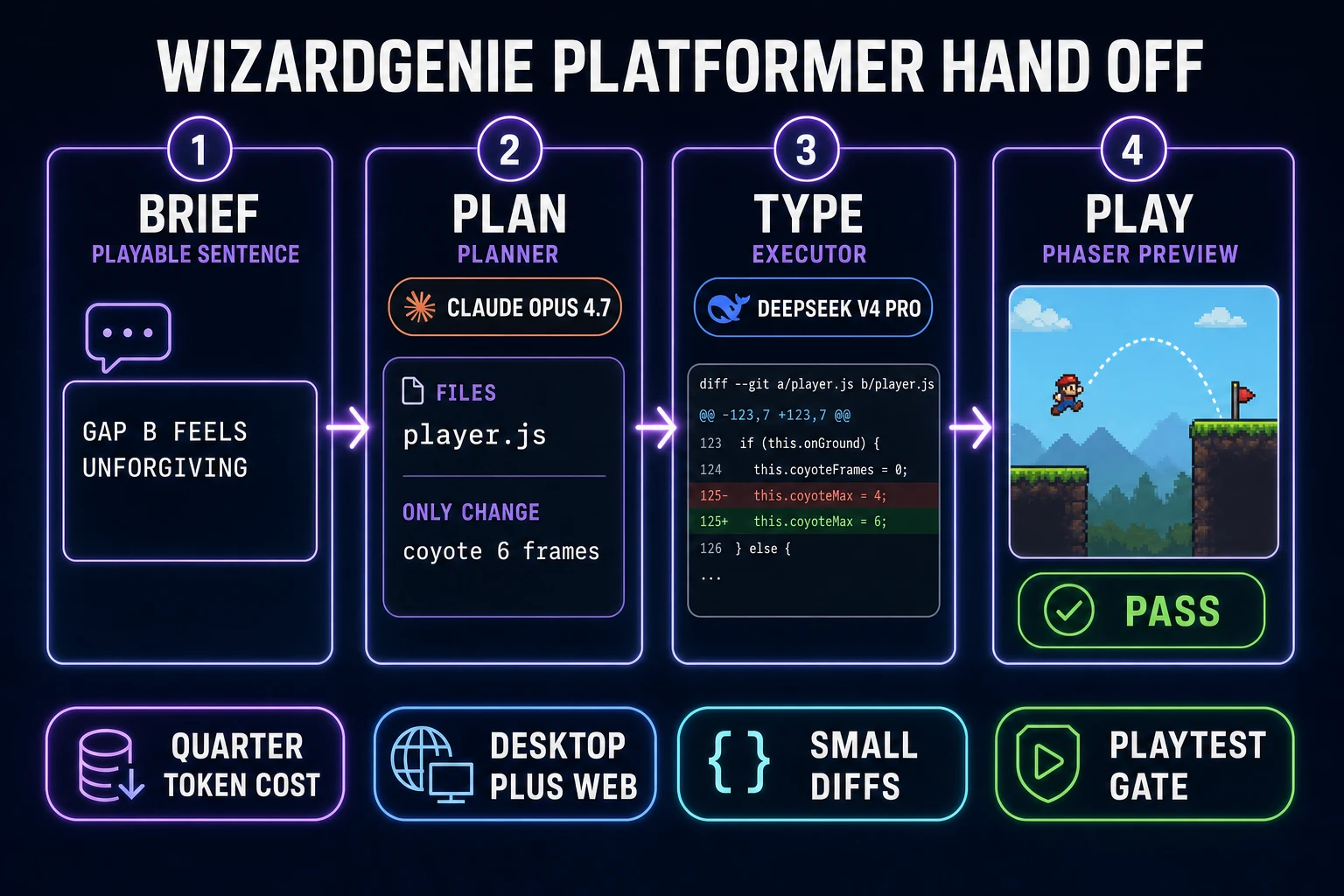
WizardGenie is available on desktop (Windows installer with native filesystem access) and on the web at /wizard-genie/app. Dual-agent Planner + Executor is documented in source as “A smart Planner thinks; a cheap Executor codes. Same quality at roughly a quarter of the token cost” (src/app/wizard-genie/page.tsx lines 297–299, verified 2026-10-12).

Seat models the way the economics require. Planners come from the frontier set in Sorceress Code’s lineup — Claude Opus 4.7, GPT-5.5, Gemini 3.1 Pro, Grok 4.2 (CODING_MODELS in src/app/_home-v2/_data/tools.ts lines 767–776, verified 2026-10-12). Executors stay on budget seats — DeepSeek V4 Pro, Kimi K2.5, MiniMax M2.7. Never put Sonnet, Opus, or GPT-5.5 on the typing side; that erases the cost reason Dual-agent exists.

Example Planner brief that preserves your Scratch lessons:

Goal: gap B feels fair on keyboard.
Runtime: Phaser 3, single scene level-01.
Files allowed: src/player.js only.
Change: add 6-frame coyote time and 8-frame jump buffer.
Do not touch gravityScale, maxRunSpeed, or enemy AI.
Done when: walking off ledge still allows jump for 6 frames
and pressing jump 8 frames early still queues the jump.
Playtest: clear gaps A, B, and C three times each.

Hand that to the Executor. Read the diff. Playtest before the next prompt. That is the same grounded-jump discipline you practiced with Scratch blocks — only now the loop lives in files you can ship on the web. WizardGenie does not auto-publish to an arcade; export the build and host where you want.

A practical weekend shape that respects both tools:

  1. Friday — Scratch one-screen jumper. Freeze gravity and jump impulse numbers on a sticky note.
  2. Saturday morning — scaffold a Phaser scene with a rectangle player and static platforms matching A–C. Port the sticky-note numbers before you touch art.
  3. Saturday night — WizardGenie Dual-agent for coyote + buffer only. Reject any diff that rewrites gravity.
  4. Sunday — swap rectangles for Quick Sprites sheets, add Music Gen bed and SFX Gen jump hit, then stop. Ship a buildable folder, not a perfect campaign.

If the agent proposes a full rewrite of the scene graph, say no. The Scratch lesson was that one honest loop beats a pile of costumes. The browser lesson is the same with a better file tree.

WizardGenie Planner Executor handoff for a Phaser platformer
Scratch teaches the feel; Dual-agent keeps the feel while the codebase grows.

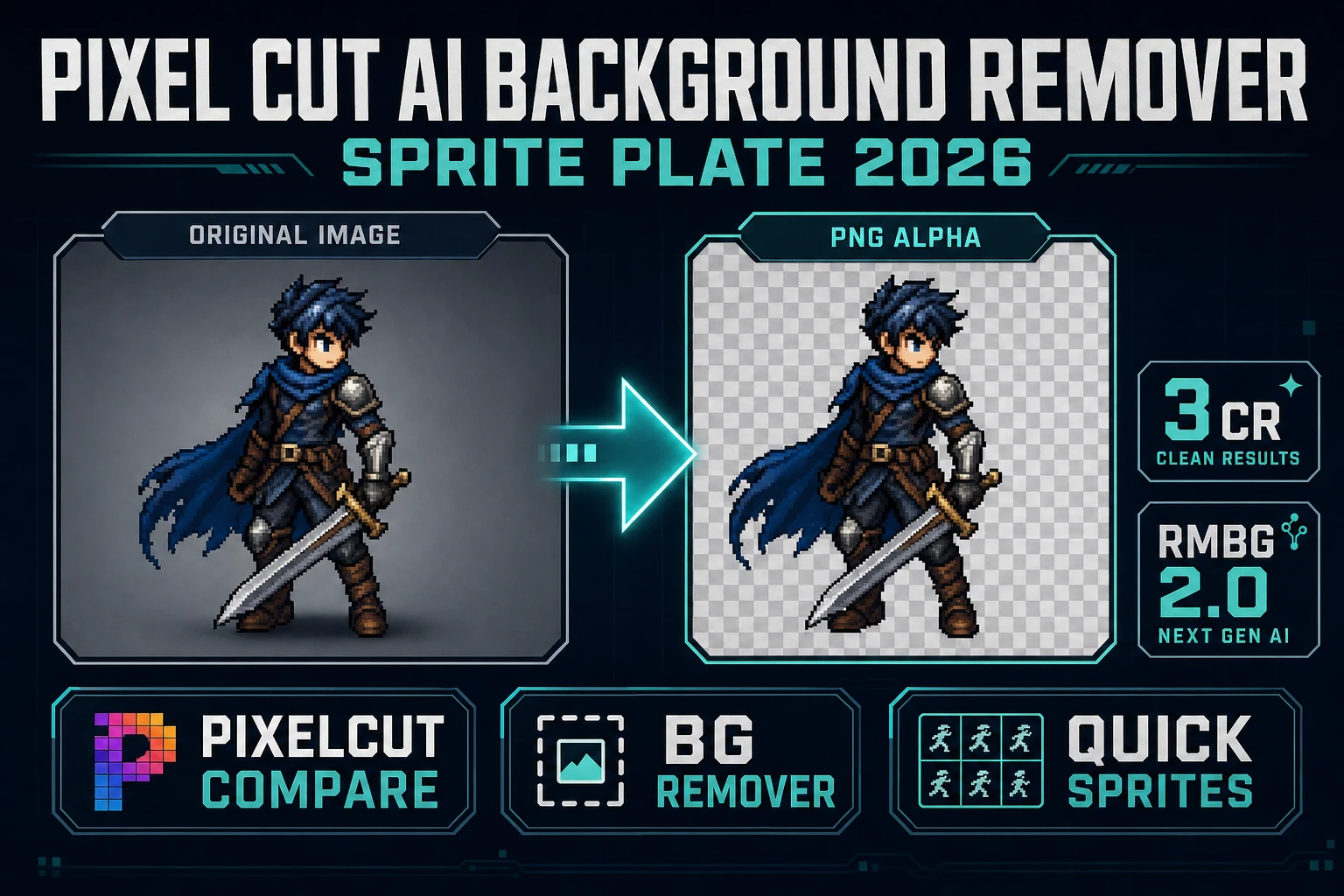
AI sprites, tiles, and audio once the jump is honest

Art is not the blocker for how to make a platformer scratch — feel is. Once gap B is fair, dress the loop without rewriting physics:

  • Quick Sprites — animated sheets at CREDITS_PER_GEN = 9 (src/app/quick-sprites/page.tsx line 21, verified 2026-10-12). Use as Scratch costumes or Phaser textures.
  • Tileset Forge — tileable ground and brick so platform A–C share a palette.
  • Music Gen — loop bed at MUSIC_CREDIT_COST = 10 (src/app/music-gen/page.tsx line 33, verified 2026-10-12).
  • SFX Gen — jump/land hits; Suno Sounds path is a flat 2 credits (SUNO_SOUNDS_CREDIT_COST in src/lib/sorceress-tools/audio/sfx.ts line 34, verified 2026-10-12).

Signup grant on Sorceress is 100 credits (SIGNUP_GRANT in src/app/api/admin/credits/route.ts line 12, verified 2026-10-12), with CREDITS_PER_DOLLAR = 100 (src/lib/models.ts line 69, verified 2026-10-12). That is enough to kit a jam prototype without buying a seat first — still spend the first hour on jump feel, not on regenerating hats.

For adjacent reading: how to make a platformer in Scratch with AI assets, browser platformer AI loop, 2D platformer in Godot, and how to make a video game with AI. The tools guide maps the rest of the suite on Sorceress.

The verdict: ship checklist

How to make a platformer scratch is solved when a stranger can clear gap B on the first or second try and blame themselves, not your gravity constant. Checklist:

  1. One screen, three platforms, no enemies.
  2. Gravity every frame; jump only while grounded (then add coyote/buffer).
  3. Playtest gaps A–C ten times before adding a second costume.
  4. When Scratch scripts fight you, port the same loop to Phaser with a locked WizardGenie brief.
  5. Spend credits on sprites and audio after the controller is frozen.

Scratch teaches the genre. Phaser ships the web build. WizardGenie Dual-agent keeps the diffs small enough that the jump you tuned on day one still feels like yours on day seven. Hop the gap. Then grow the world.

Frequently Asked Questions

What does how to make a platformer scratch usually mean?

People typing how to make a platformer scratch want a jump-and-run on Scratch’s stage: a player sprite, gravity, a jump they can feel, and platforms that stop a fall. DataForSEO lists the phrase at 1,900 searches a month with KD 0 (verified 2026-10-12). It is a loop problem first, not an art problem.

What is the smallest Scratch platformer that still feels fair?

One backdrop, one player costume, three platform costumes or clones, gravity every frame, and a jump that only fires when grounded. Wikipedia’s platformer article centers the genre on jumping between uneven terrain and suspended platforms (verified 2026-10-12). If gap B feels unfair, fix jump feel before you add enemies.

When should I leave Scratch for a browser Phaser build?

When you need longer levels, tighter input buffering, reusable scenes, or a codebase an agent can edit in small diffs. Phaser is a free open-source HTML5 2D framework with WebGL and Canvas rendering, actively maintained for over eleven years by Phaser Studio Inc (docs.phaser.io, verified 2026-10-12). Scratch remains excellent for learning the loop; Phaser is where that loop becomes a shippable web game.

How does WizardGenie help after I learn the Scratch jump loop?

WizardGenie’s Dual-agent Planner + Executor mode is documented as “A smart Planner thinks; a cheap Executor codes. Same quality at roughly a quarter of the token cost” (src/app/wizard-genie/page.tsx, verified 2026-10-12). Keep frontier models on the Planner seat and budget models (DeepSeek V4 Pro, Kimi K2.5, MiniMax M2.7) on the Executor seat, then playtest every merge.

Can I use AI art while still learning how to make a platformer Scratch?

Yes for costumes and audio, carefully for code. Quick Sprites costs 9 credits per generation (src/app/quick-sprites/page.tsx), Music Gen costs 10 credits per track (src/app/music-gen/page.tsx), and Suno Sounds SFX costs 2 credits (src/lib/sorceress-tools/audio/sfx.ts) — all verified 2026-10-12. Import cutouts as costumes or Phaser textures, but keep the jump controller under your eyes.

Sources

  1. Platform game — Wikipedia
  2. Scratch (programming language) — Wikipedia
  3. Anatomy of a video game — MDN Web Docs
  4. What is Phaser? — Phaser Docs
Written by Arron R.·1,835 words·8 min read

Related posts