Define Vibe Coding Meaning (For Indie Game Devs)

By Arron R.14 min read
Vibe coding meaning, in plain English: a coding loop where the developer describes intent and an LLM agent writes the code, iterates on errors, and ships the bu

The vibe coding meaning is one of those phrases that seems to mean something different every time it surfaces — somewhere between a punchline, a workflow, and a $400M revenue line. The honest definition is narrower and more useful than any of those framings. This piece walks through where the term came from, what Andrej Karpathy actually wrote, why Collins English Dictionary made it Word of the Year for 2025, what Lovable's revenue trajectory says about the loop in 2026, how the meaning shifts the moment the project on your screen is a game instead of a SaaS dashboard, and why the games-first version of the loop matters for an indie dev in 2026. Verified May 25, 2026 against the live Wikipedia entry, the Karpathy thread on Thread Reader App, the New Stack agentic-engineering follow-up, and TechCrunch's Lovable ARR coverage.
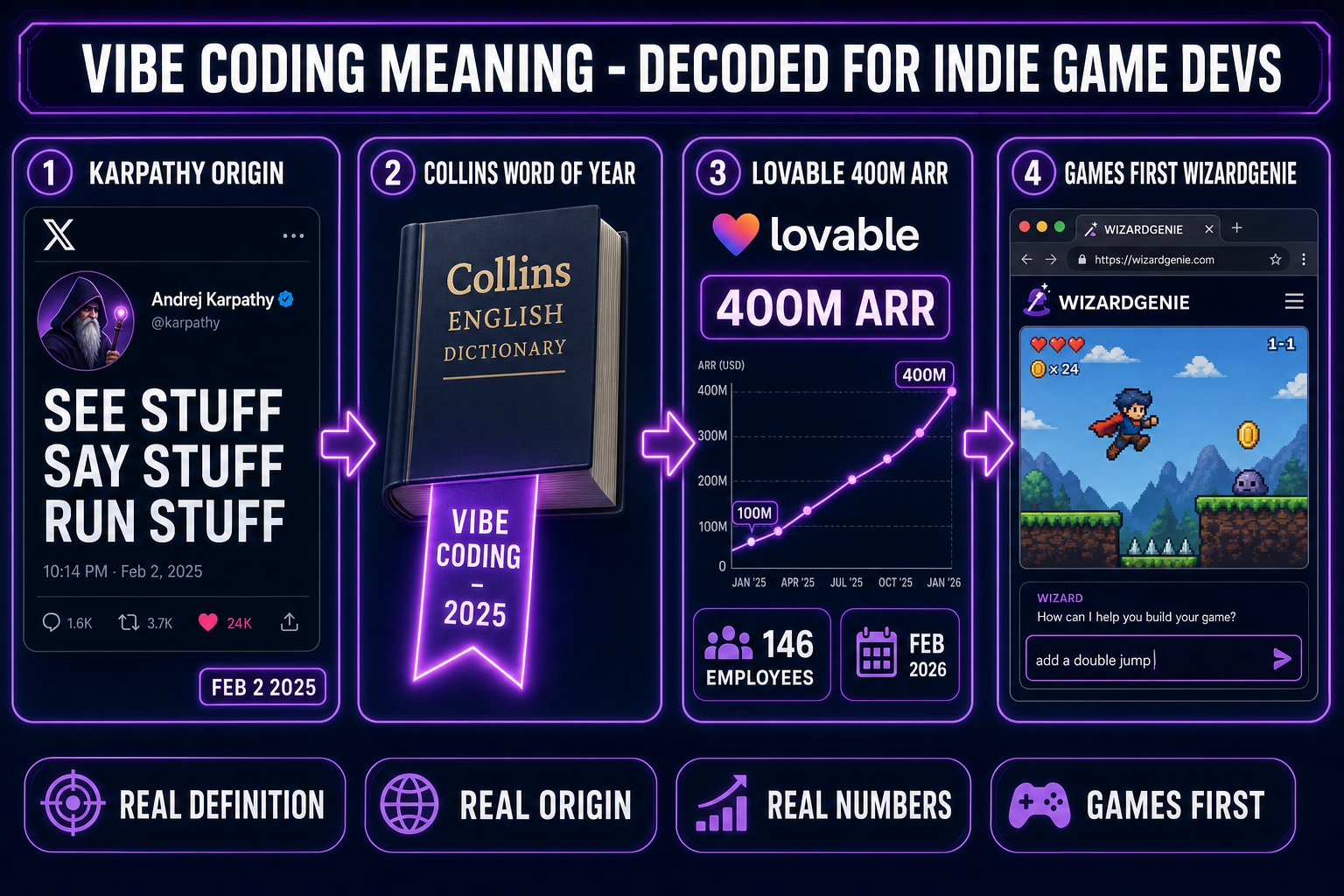
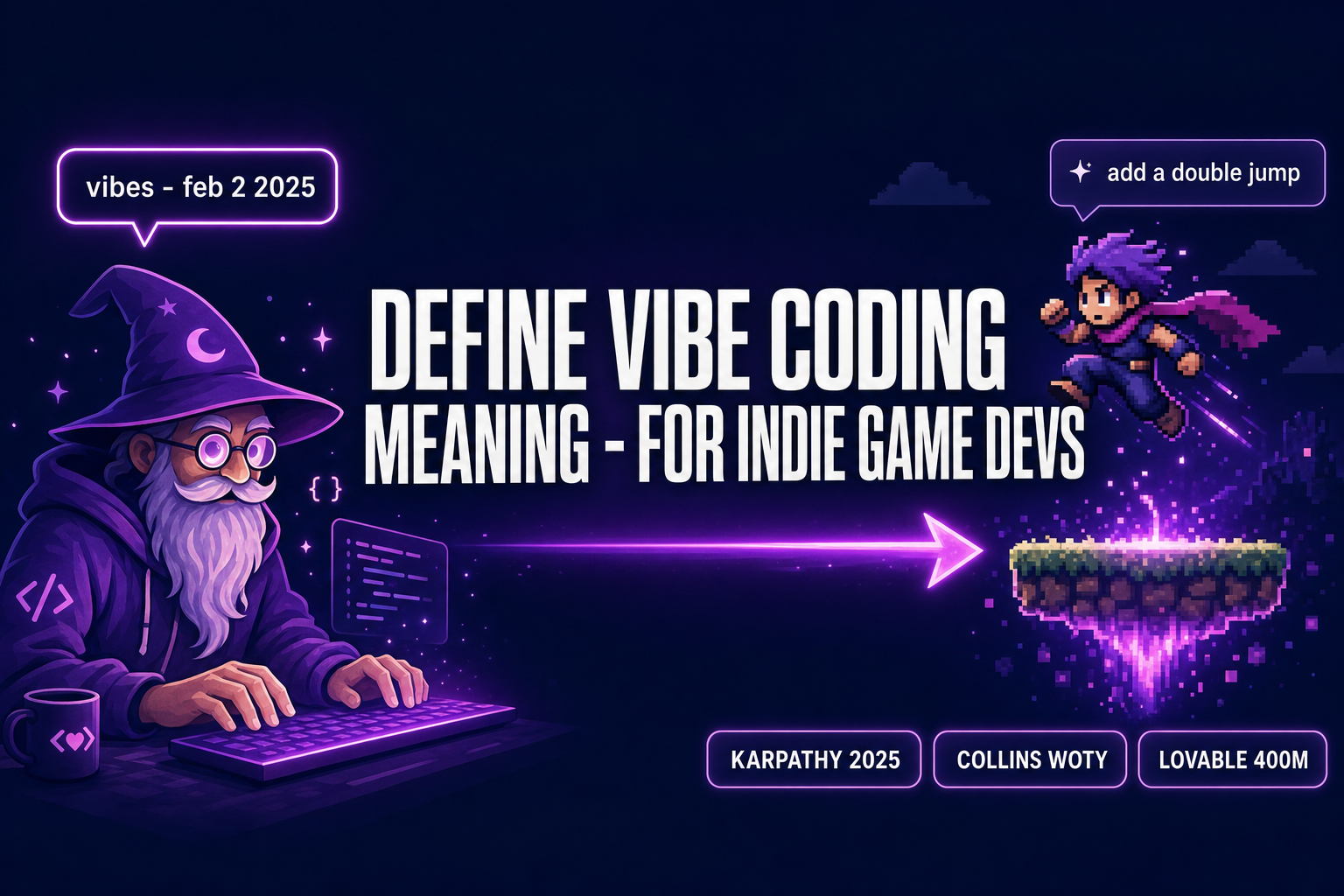
Four panels visualizing the vibe coding meaning for indie game devs — Karpathy's February 2 2025 origin tweet, Collins Word of the Year 2025, Lovable's $400M ARR with 146 employees, and a games-first WizardGenie browser tab with a pixel platformer character mid-jump
The vibe coding meaning, decoded in four panels — origin, dictionary crown, revenue receipt, and the games-first version of the loop. Hero image generated with GPT Image 2. Sources: Wikipedia and TechCrunch.

The vibe coding meaning Karpathy actually wrote

Every later definition of the vibe coding meaning is a remix of one tweet. On February 2, 2025, Andrej Karpathy — co-founder of OpenAI and former AI leader at Tesla — posted, in plain Bay Area English: "There's a new kind of coding I call vibe coding, where you fully give in to the vibes, embrace exponentials, and forget that the code even exists." The same post then walked through the mechanics: he was using Cursor Composer with Anthropic's Sonnet model and SuperWhisper voice input; he asked the editor for "the dumbest things" like "decrease the padding on the sidebar by half"; he hit "Accept All" without reading diffs; on errors he would "copy paste them in with no comment, usually that fixes it." The closing line is the one the dictionaries ended up loving: "I just see stuff, say stuff, run stuff, and copy paste stuff, and it mostly works."

That paragraph is the canonical vibe coding meaning. It is more specific than how the term gets used in marketing copy — it is not "AI writes code" in general, it is the loop where the human stays in the role of intent and taste while the model handles the typing, the iteration, and most of the error fixing. Karpathy's tweet pulled over 4.5 million views and was cited in MIT Technology Review within ten weeks. That two-month media chain is what turned a personal-workflow note into a generation's working definition.

The detail most coverage of the vibe coding meaning leaves out is Karpathy's own warning in the same thread: the loop, in his words, is "not too bad for throwaway weekend projects" — the explicit caveat is that the original definition described a low-stakes, throwaway-build mode, not a production-software discipline. Anyone using the term in 2026 should keep that nuance attached.

Why the vibe coding meaning landed in dictionaries (Collins WOTY 2025)

The reason the vibe coding meaning stuck culturally is not that the phrase was witty — it is that, by early 2025, a large fraction of working developers had already been coding this way for six months and nobody had a word for it. The Karpathy tweet supplied the missing label and the cultural validation chain stacked up fast: Merriam-Webster listed vibe coding in March 2025 as a slang and trending entry, MIT Technology Review's explainer landed in April, and Collins English Dictionary named vibe coding its Word of the Year for 2025. Almost no other developer term — agile, microservices, serverless — has assembled that chain that quickly. The Word of the Year is a particularly strong signal because Collins's lexicographers track usage across news, broadcast, and social over a calendar year and pick the term that defines the period; for 2025 they picked the one developers had been quietly using all year.

For an indie game developer, the dictionary entry matters less than the underlying claim it endorses: this is a real workflow, not a marketing fiction. Anything that lands in Collins as Word of the Year by year-end has been used widely enough that the people you would hire, the people you would partner with, the people you would learn from on YouTube and X all share the same vocabulary by the time you read the term in a job ad. The vibe coding meaning is a shibboleth as much as a definition — knowing it locates you on the 2026 indie-dev map.

What the vibe coding meaning means for the 2026 economy (Lovable's $400M ARR)

The economic receipt for the vibe coding meaning is Lovable's revenue trajectory. The Stockholm-based vibe coding company crossed $400M in annual recurring revenue in February 2026, adding $100M in a single month, with 146 full-time employees, per TechCrunch's March 11 reporting. The public ARR trail is exactly what the meme implies: $100M in July 2025, $200M in November 2025, $300M in January 2026, $400M crossed in February 2026. Eight million users by late 2025. More than half of the Fortune 500 on the customer roster. Around 200,000 new vibe coding projects created per day on a platform whose entire on-ramp is a chat box that asks "what do you want to build?"

That single data set forces the vibe coding meaning to expand beyond Karpathy's "throwaway weekend project" qualifier. Lovable's revenue did not come from throwaway projects — it came from full-stack web apps that paying enterprise customers are running in production. The 2026 vibe coding meaning therefore has to account for both ends of the spectrum: the throwaway-loop (Karpathy's original framing) and the production-loop (Lovable's $2.7M ARR per employee receipt). Both are real; both are the same loop; the discipline applied on top is what separates them.

For game studios — independent or otherwise — the relevant number is the 200,000-projects-per-day figure. That is the rate at which non-developers are now successfully shipping working software through a chat interface, on a platform whose target was never games specifically. The corresponding question for indie game dev is no longer "can a prompt-driven loop ship serious software" but "what is the games-first version of that loop, and where does it live?" That is the question WizardGenie was built to answer.
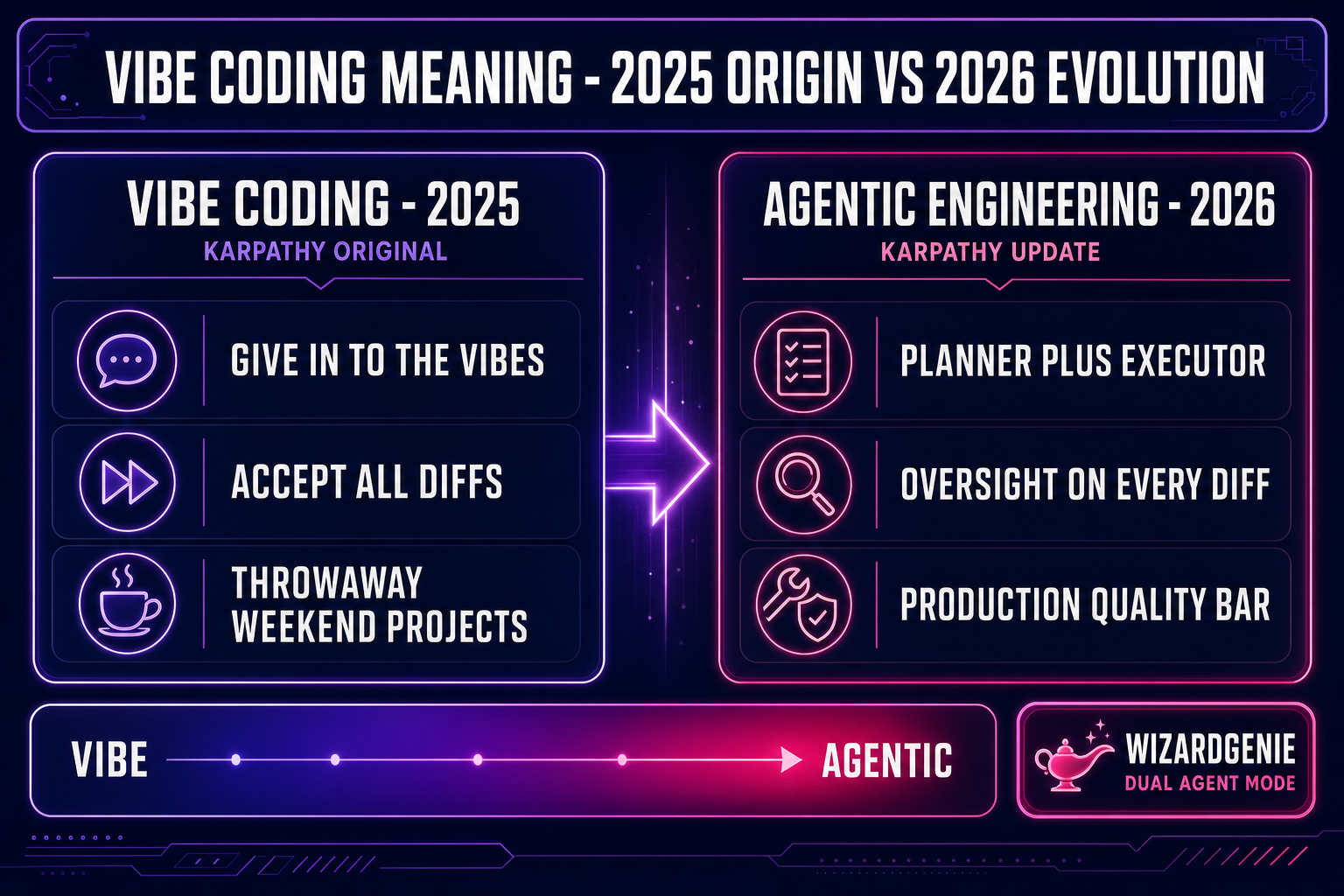
Side-by-side comparison diagram of the vibe coding meaning in 2025 versus its agentic engineering evolution in 2026 — left panel showing give-in-to-the-vibes accept-all-diffs throwaway-weekend-projects, right panel showing planner-plus-executor oversight-on-every-diff production-quality-bar
The vibe coding meaning evolved between 2025 and 2026 — Karpathy's own follow-up post relabelled the disciplined version as agentic engineering. The loop did not change; the bar moved up. Diagram generated with GPT Image 2.

Vibe coding meaning vs agentic engineering — Karpathy's own update

The cleanest reading of the 2026 vibe coding meaning comes from the person who coined the original term. In a follow-up X post in February 2026 — covered in The New Stack's "Vibe coding is passé" piece — Karpathy described his original tweet as "a shower of thoughts throwaway tweet" and proposed agentic engineering as the more disciplined sibling term for the 2026 version of the loop. His exact framing: "agentic because the new default is that you are not writing the code directly 99 percent of the time, you are orchestrating agents who do and acting as oversight; engineering to emphasize that there is an art and science and expertise to it." The vibe coding meaning, in other words, did not stop being valid — it forked. The throwaway-loop kept the original name. The production-loop got a new one.

The practical reading for an indie game dev: when someone in 2026 talks about vibe coding, listen for which fork they mean. If they mean a Karpathy-style "see stuff, say stuff, copy-paste stuff" loop on a weekend prototype, the throwaway-loop term applies and the right tool is whichever chat-box-plus-runtime sits in front of you. If they mean shipping a finished game with checkpoints, code review, and a planner-plus-executor architecture, agentic engineering is the more honest label and the discipline matters more than the velocity. Both are still vibe coding in the original sense; the meaning has just earned a second adjective.
The vibe coding meaning is not no-code, low-code, or AI autocomplete

The vibe coding meaning gets confused with three adjacent ideas, and the confusion costs hours when an indie game dev picks the wrong tool. None of these three are vibe coding:

  • No-code is not the vibe coding meaning. No-code tools (drag-and-drop website builders, form composers, flowchart-based logic editors) compile the user's visual choices to a fixed runtime. The user never writes or owns source code. Vibe coding emits real source code in a real programming language — TypeScript, Python, JavaScript, GDScript, whichever fits — and that source code is what runs and what ships. The reader of a vibe-coded codebase reads the same language a hand-coded codebase uses.
  • Low-code is not the vibe coding meaning either. Low-code tools provide a small DSL plus visual scaffolding; the developer extends the visual graph with snippets of real code. Vibe coding has no scaffolding — the agent emits the whole file, the whole project, the whole repo, structured the same way a human-written project would be structured.
  • AI autocomplete is not the vibe coding meaning either. Autocomplete (Copilot's tab-complete, Tabnine, the Cursor inline suggestion box) waits for the developer to type a prefix and predicts the next token. The developer is still typing. Vibe coding, in Karpathy's definition, is what happens when the developer has stopped typing — the agent owns the keyboard and the developer owns the chat box.

That third distinction is the most often-missed. Many of the workflows in 2026 that get described as vibe coding are still autocomplete-shaped, where the developer is typing and the model is suggesting. The Karpathy-original vibe coding meaning specifically requires the developer to be off the keyboard most of the time. Tools that ship that pattern by default — a chat box, an agent loop, a hot-reloading runtime, no inline tab-complete required — are the ones that match the original definition. WizardGenie ships that pattern; Sorceress Code ships that pattern; Lovable ships that pattern; Cursor's Composer mode ships that pattern (its inline suggestion mode does not).

Inside the vibe coding meaning when the project is a game

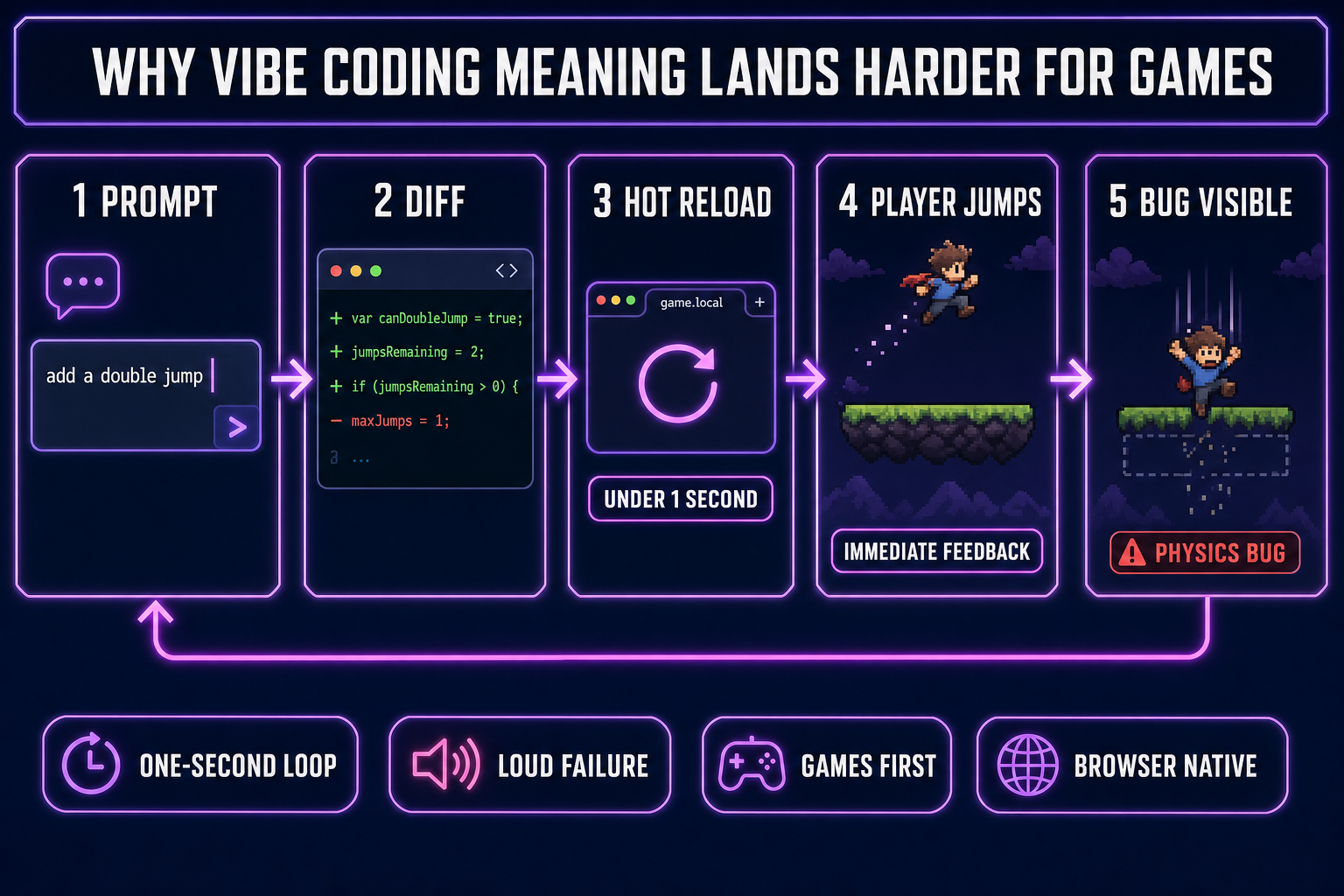
The vibe coding meaning is identical whether the project on your screen is a SaaS dashboard or a platformer — describe intent, accept the diff, run, iterate — but the failure mode is structurally different in a way that matters for indie game dev. SaaS failures are silent: a wrong number in a dashboard, an N+1 database query, a session bug at user 50, a quietly corrupted file upload. The bug is usually visible only after the fact, in a metric or a customer complaint, days or weeks later. Game failures are loud and immediate: the player jumps, the player falls through the floor, the bug is on screen in one second.

That single property is the secret reason the vibe coding meaning lands harder for games than for SaaS. Loud failures are easier to vibe-code against than silent ones because the feedback loop closes in real time. The meme version of the loop — "the agent declared it works, then the build crashed at user 50" — does not apply the same way to a game, because there is no user 50; there is just the developer, jumping their own character, watching the bug surface in the same second they accepted the diff. The Karpathy "copy-paste the error back" step happens at human reaction time instead of at incident-postmortem time.

For that reason, the right tool for a vibe coding meaning that points at a game project is one that hot-reloads the playable build on every accepted edit. WizardGenie's whole architecture is built around this — every diff accepted in the chat re-runs the game in an embedded preview, runtime errors surface as inline diagnostics in the chat, the player-falls-through-floor bug becomes a visible test the developer can describe back to the agent in plain English. The agent then patches the physics, the collision, the camera, whatever the actual cause turned out to be, and the loop closes again. Read the long-form vibe coding explainer for the broader argument; the short version is that games show their bugs faster than SaaS, and that property compounds with the vibe coding loop in a way that nothing in the SaaS world replicates.

Five-panel diagram of the vibe coding loop for games — prompt to add a double jump, code diff, hot reload under one second, player jumps the platform, bug surfaces immediately and loops back to the prompt — labelled with one-second loop and loud failure pills
The vibe coding meaning for indie game devs in five panels — the loud-failure feedback loop closes in under a second, which is why the same loop ships games faster than it ships SaaS. Diagram generated with GPT Image 2.

A real WizardGenie session: vibe coding meaning, applied

The fastest way to make the vibe coding meaning concrete for a game project is to walk through one short session. Open WizardGenie in a browser tab. Type the first prompt: "make a small browser platformer with one player character, three platforms, a goal flag, and arrow-key controls." Hit enter; the agent writes the project, runs it in the embedded preview, and the platformer is playable in the same tab in roughly thirty seconds. The developer has not opened a single file. That is the Karpathy original loop, applied to a game.

The second prompt — "add a double jump that triggers on the second space-bar press while the player is in the air" — is where the vibe coding meaning starts proving itself for games. The agent emits a diff to the player controller, the build hot-reloads, the developer presses space twice, the character double-jumps, the bug-or-feature is observable in one second. If the second jump is too floaty, the third prompt is "make the second jump 70 percent the height of the first." Iteration loop closes again. This is the throwaway-loop version of the vibe coding meaning, and for prototype work it is the right level of discipline.

The same session converts to the production-loop — the agentic-engineering version of the vibe coding meaning — by enabling Dual Agent Mode. The frontier planner (Claude Opus 4.7, GPT-5.5, Gemini 3.1 Pro, or Grok 4.2) reads the existing code, writes the plan as a checklist, and only then hands the diff queue to a cheap executor (DeepSeek V4 Pro, Kimi K2.5, MiniMax M2.7). The developer reviews the plan before any file gets touched. The cost ratio versus a single-frontier loop is roughly 1/5; the architecture stops sprawling because the planner sees the whole project before any new files appear. The full per-task model picks live in the eight-model comparison post.

Five myths about the vibe coding meaning, decoded

Five claims circulate about the vibe coding meaning that are either wrong or partially wrong. Decoding each one in honest terms:

  1. Myth: vibe coding means the AI writes the whole game with zero human input. No. The vibe coding meaning has always required the human in the loop — Karpathy's original tweet has the human typing prompts, accepting diffs, and copy-pasting errors back. The meaning is "human owns intent, model owns typing," not "human owns nothing." Posts that describe a fully autonomous agent shipping a finished game are describing a different (and currently mostly fictional) workflow.
  2. Myth: vibe coding only works for toy projects. Lovable's $400M ARR is the most direct counter-example. The same loop has shipped enterprise software running for paying customers; it has shipped indie games published on itch.io; it has shipped working game-jam entries inside the 48-hour window. The vibe coding meaning does not cap project complexity — discipline does.
  3. Myth: senior developers hate vibe coding. Mostly they do not. The senior-dev critique is more specific: they dislike vibe-coded code being merged into production without review, and they dislike the term "vibe engineer" because engineers traditionally take responsibility for the systems they ship. The same senior developers run the same loop themselves and call it agent-assisted development. The disagreement is about review discipline, not whether to use the AI. See the Linus Torvalds vibe-coding piece for the detailed version of this point.
  4. Myth: vibe coding is dangerous because the AI deletes your files. The AI does not delete your files; the loop you wired around the AI does, when it does not stamp a savepoint before destructive edits. The fix is checkpointing — every prompt that produces an edit creates a recoverable snapshot, every snapshot is one-click revert. WizardGenie ships this by default; Sorceress Code keeps a tool-call timeline that makes destructive edits independently reversible. With the right defaults, the meme cannot happen.
  5. Myth: vibe coding requires a frontier model on every prompt and is therefore too expensive. Only if you wire it wrong. The dual-agent pattern — frontier planner plus cheap executor — produces equivalent quality at roughly 1/5 the cost of a single-frontier loop. The hard rule is that the executor must actually be cheap (DeepSeek V4 Pro, Kimi K2.5, MiniMax M2.7); putting Claude Sonnet, Claude Opus, or GPT-5.5 on the typing side erases the cost win.

The verdict — what the vibe coding meaning is for indie game devs in 2026

The honest 2026 vibe coding meaning, for an indie game developer reading this and deciding whether to adopt the workflow, is this: a coding loop where you describe the game in plain English, an LLM agent writes the code, a hot-reloading runtime shows you the result in under a second, and you iterate by playing the build and describing what you want changed. The Karpathy throwaway-loop applies for prototypes; the agentic-engineering production-loop applies for the finished build. Both are valid, both ship games, both shorten the indie cycle from weeks to days when the discipline is right. The vibe coding meaning has earned its dictionary entry, its $400M ARR receipt, and its Word of the Year crown by being a real description of how a real loop works — not a marketing line.

For the indie game dev specifically, the right next move is concrete: open WizardGenie, type the smallest playable prompt you can describe ("a browser platformer with one player and three platforms"), watch the loop close in thirty seconds, then iterate from there. The vibe coding meaning is a verb more than a noun — you understand it after the first session, not before. Pair the loop with the dual-agent discipline (see the vibe-coding-tools comparison) and you have the production version. Skip the discipline and you have the throwaway version. Either is a finished game faster than the pre-2025 indie cycle ever shipped one.

Frequently Asked Questions

What is the simplest definition of vibe coding meaning?

The simplest vibe coding meaning is this: a coding workflow where the developer describes what they want in plain English, an LLM agent writes the code, the developer runs it, and on any error the developer copy-pastes the error back to the agent until the build works. The phrase comes from Andrej Karpathy's February 2, 2025 X post, where he wrote: "There's a new kind of coding I call vibe coding, where you fully give in to the vibes, embrace exponentials, and forget that the code even exists." Karpathy described his own loop as "see stuff, say stuff, run stuff, copy paste stuff, mostly works." That sentence is the working definition every dictionary, every news outlet, and every meme has been remixing for the last fifteen months. The vibe coding meaning is not "AI writes any code at all" — it is specifically the loop where the human stays in the role of taste, intent, and oversight, and the model stays in the role of typing the code.

Where did the vibe coding meaning come from originally?

The vibe coding meaning was coined by Andrej Karpathy, co-founder of OpenAI and former AI leader at Tesla, in an X post on February 2, 2025. The post pulled over 4.5 million views, was cited in MIT Technology Review within ten weeks, became the slang and trending entry at Merriam-Webster in March 2025, and was crowned Collins English Dictionary Word of the Year for 2025. Karpathy was describing his own workflow at the time, using Cursor Composer with Anthropic's Sonnet model and SuperWhisper voice input. In a follow-up post in February 2026, Karpathy himself called the original tweet a "shower of thoughts throwaway" and proposed agentic engineering as the more disciplined sibling term — which is why current writing on the vibe coding meaning splits the field into two: vibe coding for the throwaway-loop, agentic engineering for the production-discipline version.

What is the difference between vibe coding meaning for SaaS and for game development?

The vibe coding meaning is identical in both contexts — describe intent, accept the diff, run, iterate — but the failure mode is different. For a SaaS app the failure shows up silently in a dashboard a week later (a wrong number, an N+1 query, a session bug at user 50). For a game the failure is loud and immediate (the player jumps, the player falls through the floor, the bug is visible in one second). Loud failures are easier to vibe-code against than silent ones because the feedback loop closes in real time. That single property is why the same prompt-driven loop produces useable game prototypes faster than it produces useable enterprise software, and it is why a tool like WizardGenie, which hot-reloads the game on every accepted edit, lands harder than a generic SaaS-shaped agent for indie game work.

Is the vibe coding meaning the same as no-code or low-code?

No — the vibe coding meaning is structurally different from no-code and low-code. No-code tools give the user a visual interface (drag-and-drop blocks, form builders, flowchart editors) that compiles to a fixed runtime. Low-code tools give the user a small DSL plus visual scaffolding. Vibe coding gives the user a chat box and a running interpreter or compiler — the agent emits real source code in a real programming language (TypeScript, Python, JavaScript, GDScript, whichever fits the project), and that source code is what runs and what ships. The reader of a vibe-coded codebase reads the same language a hand-coded codebase uses. The difference from traditional coding is who types the code, not what the code is. That distinction is why vibe coding can target arbitrarily complex projects (Lovable's $400M ARR was earned on full-stack web apps, not no-code sites), and why it composes cleanly with version control, code review, and testing the same way hand-written code does.

Does the vibe coding meaning include tools beyond Cursor?

Yes. Karpathy's original tweet referenced Cursor Composer with Sonnet, but the vibe coding meaning is tool-agnostic. By 2026 the loop runs in Cursor, Claude Code, GitHub Copilot Workspace, Replit, Lovable, Bolt, Windsurf, Cline, Aider, and game-specific environments like Sorceress WizardGenie. The Sorceress angle is that the loop generalises from prompt-to-app to prompt-to-game when the agent already knows the game-engine surface area (Phaser scene management, Three.js renderers, sprite sheets, collision, asset loading). WizardGenie is the games-first vibe coding environment — same describe-and-iterate loop, but the model is primed on the libraries that ship browser games, and the feedback loop closes by hot-reloading a playable build instead of a SaaS dashboard.

Why did Karpathy say vibe coding is "passé" in 2026?

He did not say vibe coding stopped working. He said the vibe coding meaning evolved. In a February 2026 follow-up X post, Karpathy proposed agentic engineering as the better term for the more disciplined 2026 version of the loop, where the developer keeps oversight, reviews diffs, and structures the agent's work as a planner-plus-executor. His exact framing: "agentic because the new default is that you are not writing the code directly 99 percent of the time, you are orchestrating agents who do and acting as oversight; engineering to emphasize that there is an art and science and expertise to it." The vibe coding meaning still applies to the throwaway-weekend-project version of the workflow; agentic engineering is the production-grade sibling. For game developers the practical answer is to use the discipline regardless of the label — review the diff, run the build, write the failing test before the happy path.

Which AI model is best for vibe coding a game in 2026?

There is no single winner. The standard 2026 lineup that Sorceress WizardGenie and Sorceress Code both expose is eight models: Claude Opus 4.7, Claude Sonnet 4.6, GPT-5.5, Gemini 3.1 Pro, Grok 4.2, DeepSeek V4 Pro, Kimi K2.5, and MiniMax M2.7. The right pick is role-dependent. Frontier reasoning models — Opus 4.7, GPT-5.5, Gemini 3.1 Pro, Grok 4.2 — are the right choice for the planner role, where the model decomposes the prompt into a checklist of file edits. Cheap fast typers — DeepSeek V4 Pro, Kimi K2.5, MiniMax M2.7 — are the right choice for the executor role, where the model emits diffs to apply. The dual-agent pattern (frontier planner plus cheap executor) is the structural answer to the frontier-coding-is-too-expensive critique; the cost ratio versus a single-frontier loop is roughly 1/5. The full breakdown lives in the eight-model comparison post.

Sources

  1. Vibe coding (Wikipedia)
  2. Karpathy's original vibe coding tweet (February 2, 2025, via Thread Reader App)
  3. Vibe coding is passé. Karpathy has a new name for the future of software (The New Stack)
  4. Lovable says it added $100M in revenue last month alone, with just 146 employees (TechCrunch, March 11 2026)
  5. What is vibe coding, exactly? (MIT Technology Review, April 16 2025)
  6. Vibe Coding (Know Your Meme)
  7. Simon Willison on Karpathy's vibe coding
Written by Arron R.·3,089 words·14 min read

Related posts