Cue a Character AI Voice Generator (Game NPC Pipeline)

By Arron R.17 min read
A character AI voice generator in 2026 has three layers: a preset voice library, an emotion tag per line, an optional clone for the named cast. Sorceress Speech

The 2026 search for a character AI voice generator has two distinct audiences. The first is an indie game developer staring at a script of 600 NPC dialogue lines, a budget that does not stretch to a voice-acting studio, and a calendar that says ship in eight weeks. The second is a hobbyist running a tabletop campaign, a visual-novel author, or a vibe-coder prototyping a fighting game who just wants every named character to actually sound like a character instead of an unread text box. Both groups land on the same answer: a text-to-speech engine that ships with character-archetype preset voices, supports voice cloning for the named cast, and exposes emotion tags so the same voice can sound calm, angry, or fearful at runtime. This post walks the full pipeline from a single dialogue line to a fully voiced game build, names the actual tools that produce each layer in 2026, and shows where Sorceress Speech Gen fits the indie workflow that historically required a paid studio session. Every model version, credit cost, and capability claim in this post was verified against the live Sorceress source on June 7, 2026.
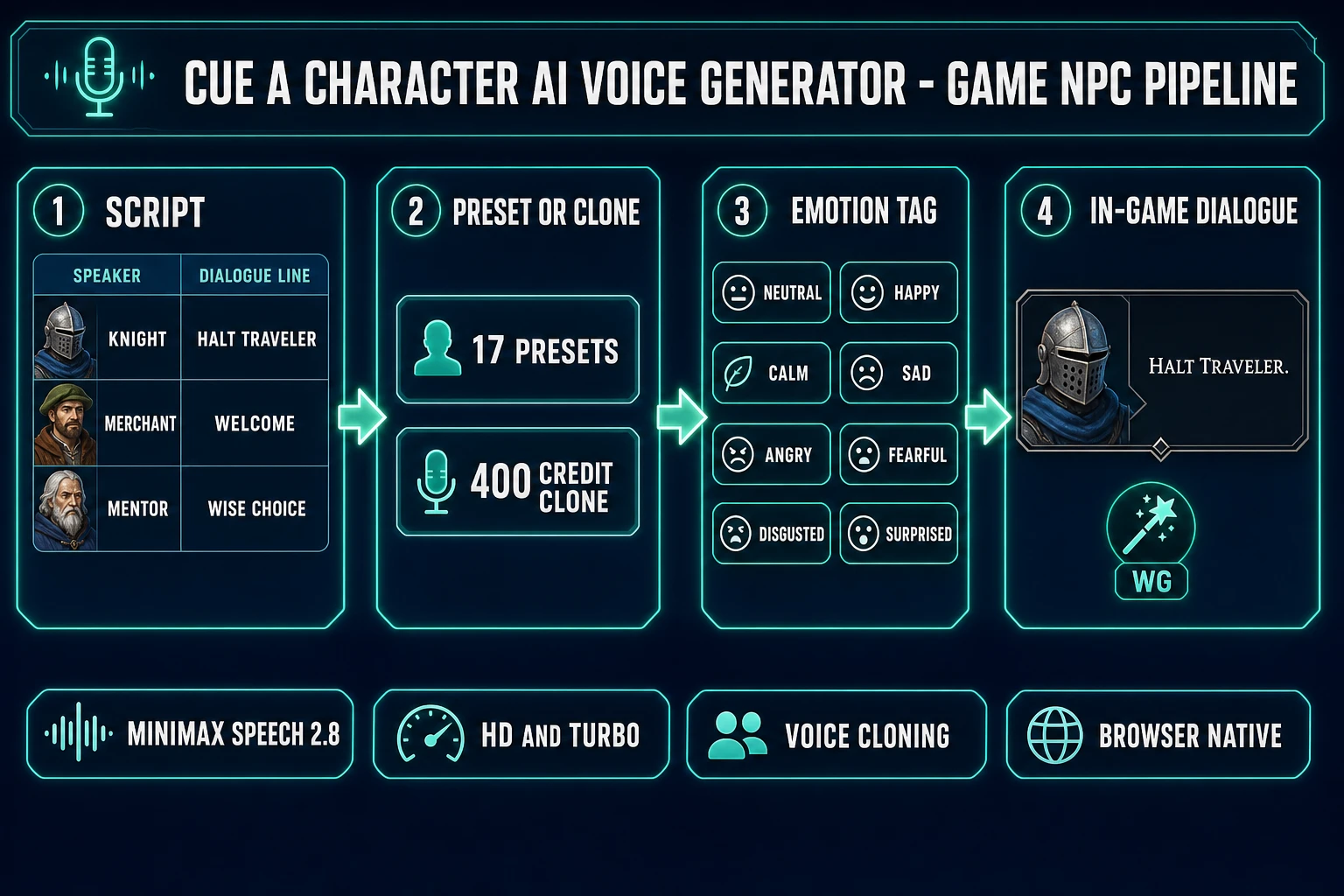
Character AI voice generator game NPC pipeline - 4-step path from dialogue script to preset voice or voice clone to emotion-tagged audio to in-game dialogue trigger
The character AI voice generator pipeline for game NPCs in 2026: pick a preset voice or clone a custom one in Speech Gen, tag emotion per line, batch-render the script, and trigger lines from the dialogue system WizardGenie writes for you.

What a character AI voice generator actually does in 2026

A character AI voice generator is a text-to-speech engine wrapped in three game-specific affordances: a library of preset voices that match common character archetypes (gruff knight, wise mentor, cheerful merchant, calm narrator), an emotion-tag layer that lets the same voice deliver the same line happy, sad, angry, or fearful, and a voice-cloning step that captures a custom voice from a short audio sample. The text-to-speech (TTS) primitive itself is described in the Speech synthesis Wikipedia entry — a deep model maps a sequence of phonemes plus pitch, duration, and energy targets to a sequence of audio samples, with mel-spectrogram or codec-token intermediates depending on the architecture. The 2026 generation of TTS models reads in under 250 ms end-to-end, replicates a target voice from 10–30 seconds of reference audio, and supports inline emotion tags or sound tags (laughs, sighs, breaths) without retraining.

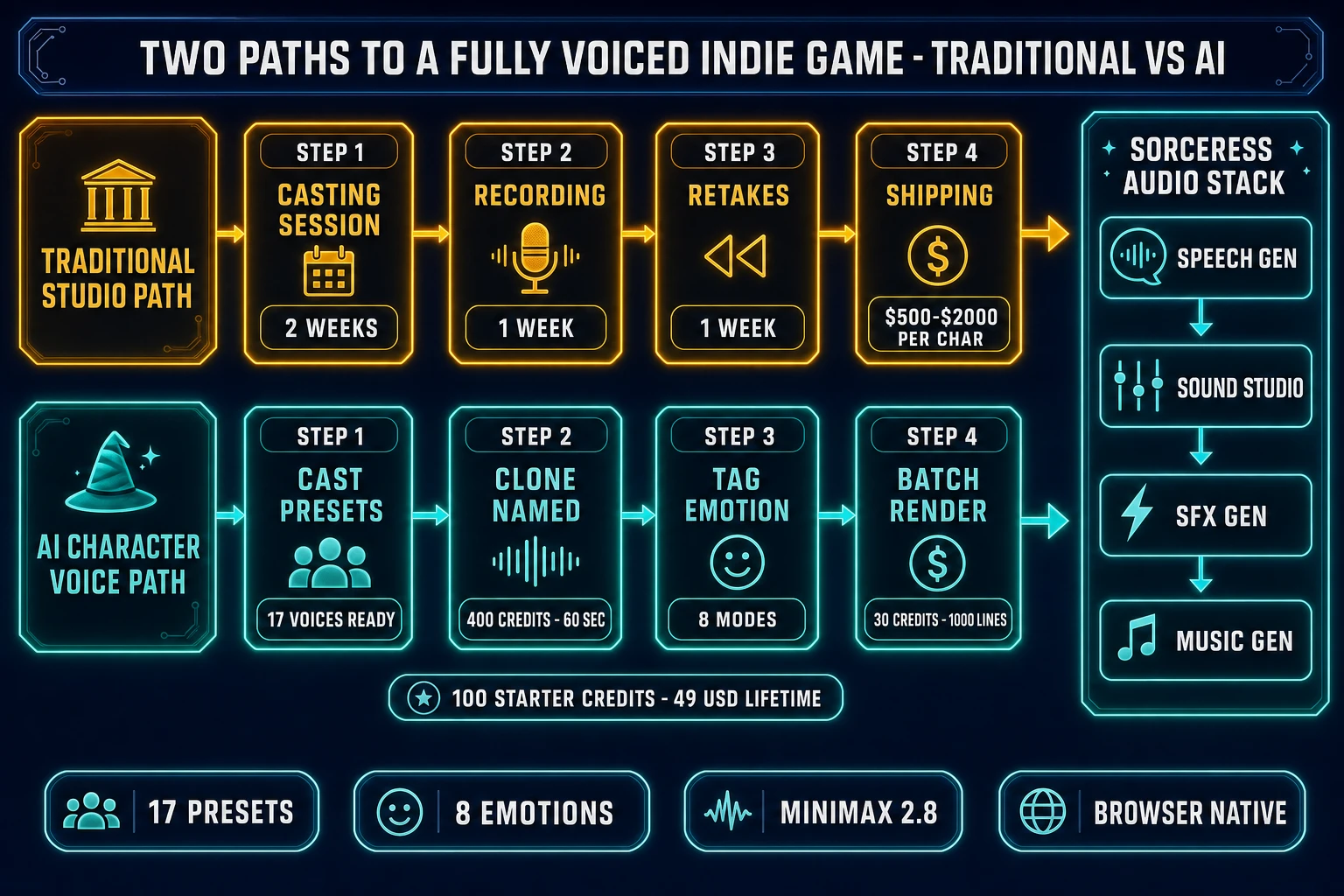
What this means for game development, per the Voice acting in video games Wikipedia entry: the historical bottleneck for indie voice acting was studio time. A single named character with 50 dialogue lines required a casting session, a recording session, retakes, and post-processing — commonly $500–$2000 per character at the indie tier. A character AI voice generator replaces every step except the final dialogue-review pass. The dialogue writer types the line, picks a preset voice or selects a cloned voice, tags the emotion, and renders. Iteration that used to take days now takes seconds.

The reader landing on “character ai voice generator” in 2026 is almost always asking three questions: can it sound non-robotic, can it stay consistent across a hundred lines, and can I afford to voice every named NPC. The honest answer to all three in 2026 is yes — with caveats around cloning ethics, hardware-output latency for real-time dialogue, and the practical difference between batch-script rendering and runtime streaming. The rest of this post unpacks each of those caveats and shows where the Sorceress Speech Gen path fits.

The three building blocks of every character voice (voice, emotion, clone)

Every 2026 character AI voice generator decomposes into the same three layers, and treating them as three separate decisions makes the indie pipeline tractable. The layers are universal across the major TTS rails (MiniMax Speech 2.8, Fish Audio, ElevenLabs, OpenAI tts-1-hd) — the differences sit in voice library size, emotion-tag fidelity, and voice-clone sample length, not in the underlying architecture.

  • The voice — either a preset (a model-trained voice with a stable identity, typically described by gender, age range, and archetype: deep voice man, young knight, wise woman, lively girl) or a clone (a custom voice trained from a reference audio sample). Sorceress Speech Gen ships 17 preset voices verified against src/app/speech-gen/page.tsx lines 156–174 on June 7, 2026: nine male presets (Deep Voice Man, Casual Guy, Patient Man, Young Knight, Determined Man, Decent Boy, Imposing Manner, Elegant Man, Friendly Person) and eight female presets (Wise Woman, Calm Woman, Inspirational Girl, Lively Girl, Lovely Girl, Abbess, Sweet Girl, Exuberant Girl). The naming scheme is deliberate — every preset reads like a character archetype, not a voice actor.
  • The emotion — a per-line tag that bends the voice toward a specific delivery without changing the underlying voice identity. The same Young Knight preset can deliver “Halt, traveler!” as Neutral, Happy, Angry, or Fearful. Sorceress Speech Gen exposes eight emotion modes verified against page.tsx lines 179–188: Neutral, Happy, Calm, Sad, Angry, Fearful, Disgusted, Surprised. The same eight emotion taxonomy maps directly to the MiniMax Speech 2.8 platform rail per platform.minimax.io/docs/guides/models-intro (seven user-facing emotions plus a Neutral default).
  • The clone — a custom voice trained from a recorded sample. The 2026 cloning floor has dropped to a 10–30 second reference per the MiniMax Speech 2.8 launch announcement; Sorceress Speech Gen allows samples up to 4 minutes 59 seconds per MAX_CLONE_DURATION = 299 at page.tsx line 32, which lets the cloner train against a wider dynamic range and a richer prosody footprint. The trade-off is sample size capped at 20 MB per MAX_CLONE_SIZE at line 33 (the front-end auto-trims and converts to MP3 before upload). One clone costs 400 credits per VOICE_CLONE_CREDITS at line 31 — a single capital expense, not a per-line cost.

The mistake every newcomer makes is collapsing the three layers into one. They search “best character ai voice generator,” pick a single preset, render the entire script through it, and ship a flat game. The right pipeline treats each named NPC as a voice-plus-emotion-plus-(optional)-clone tuple, decided per character at script-prep time, and reused across every line that character speaks. Voicing 20 named NPCs with 50 lines each — 1,000 lines — on the Sorceress HD rail at an average 60 characters per line is 60,000 chars × (0.5 credits / 1,000 chars) = 30 credits, plus zero if every voice is a preset or 400 credits per cloned voice. That is the math indie voice acting has been waiting for.

The 17 preset voices inside Sorceress Speech Gen (game-archetype cast)

The preset library inside Speech Gen at /speech-gen is curated for game-character work. Verified on June 7, 2026 against the live source at src/app/speech-gen/page.tsx lines 156–174, the 17 presets break into the archetype categories every dialogue writer recognizes: the warrior (Deep Voice Man, Determined Man, Imposing Manner, Young Knight), the everyman (Casual Guy, Friendly Person, Patient Man), the youngster (Decent Boy, Lively Girl, Lovely Girl, Inspirational Girl, Sweet Girl, Exuberant Girl), the elder or mentor (Wise Woman, Abbess, Calm Woman), and the polished noble (Elegant Man). Each preset is a model-trained stable identity — the same voice every time you generate, with no drift across a 1,000-line script.

The casting workflow that fits an indie RPG: assign each named NPC to one preset at script-prep time, store the voice_id alongside the character name in your dialogue spreadsheet, and treat the preset library as a casting catalogue rather than a generic TTS pool. A working assignment for a 12-NPC small-village RPG: tavern owner = Patient Man, blacksmith = Imposing Manner, knight captain = Young Knight, wizard mentor = Wise Woman, abbess = Abbess, traveling merchant = Casual Guy, young apprentice = Decent Boy, princess = Inspirational Girl, court jester = Friendly Person, royal narrator = Elegant Man, village girl = Sweet Girl, retired adventurer = Determined Man. Twelve named NPCs assigned without burning a single voice-clone credit — the preset library handles the entire cast.

Per emotion the per-line cost stays the same. The EMOTIONS array (lines 179–188) supports Neutral, Happy, Calm, Sad, Angry, Fearful, Disgusted, and Surprised. The tavern owner welcomes a returning player with Patient Man + Happy. The same tavern owner warns about bandits with Patient Man + Fearful. The same character delivers a quest reward with Patient Man + Calm. Three lines, three deliveries, one voice identity locked across all of them. The cost of swapping the emotion is zero — no extra credits, no separate rendering call — because the emotion tag is part of the same /api/speech-gen request payload per the front-end source at page.tsx line 661 (const res = await fetch('/api/speech-gen', { ... })).
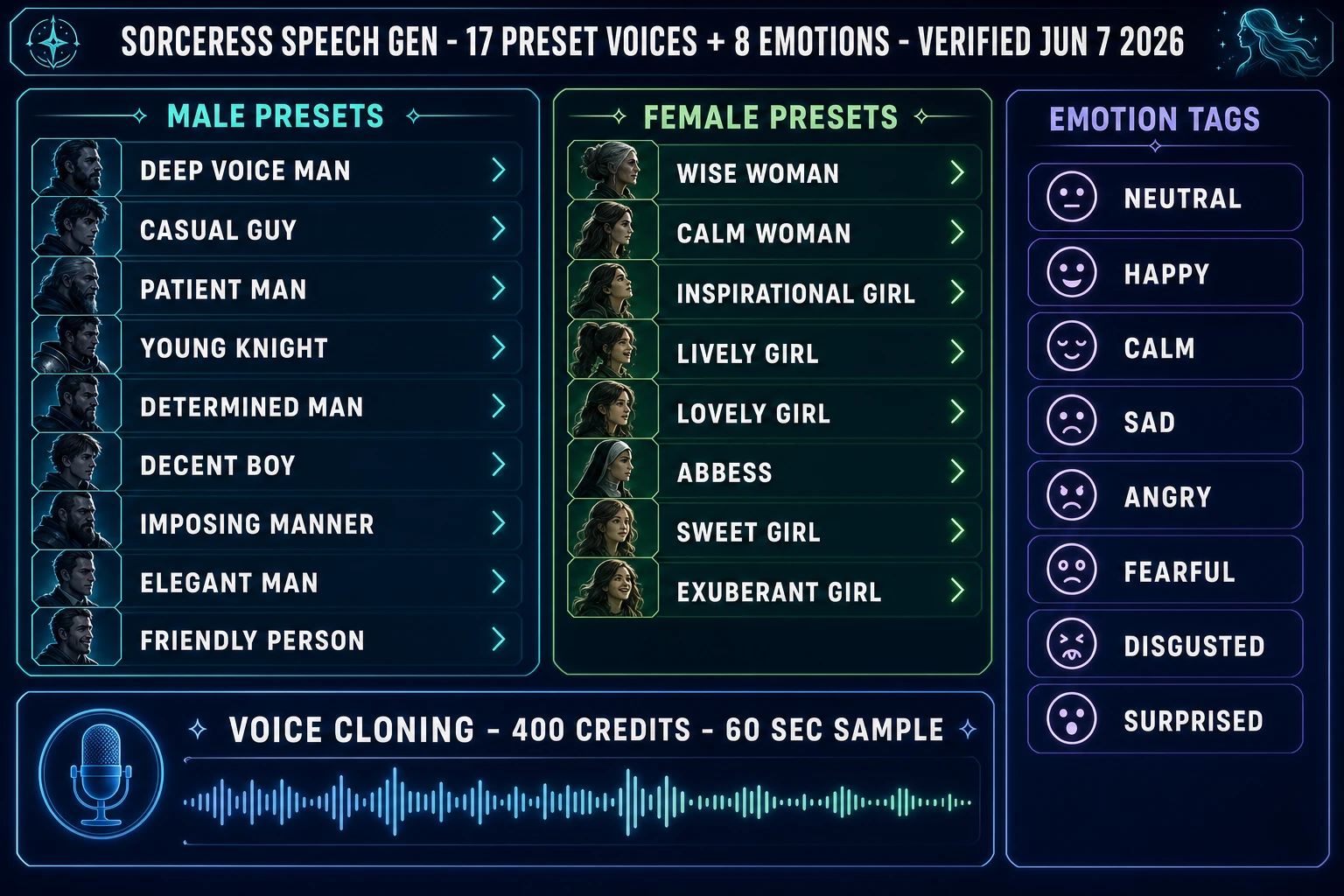
Sorceress Speech Gen 17 preset voices arranged by archetype with the 8 emotion tags and the voice cloning panel beside the Game NPC dialogue spreadsheet
The cast catalogue inside Sorceress Speech Gen. 17 preset voices map cleanly to game archetypes; the 8-emotion tag layer bends each preset per line; the voice clone panel handles the named cast that needs a custom voice identity.

Voice cloning: one 30-second recording, unlimited lines (400 credits)

Voice cloning is the second half of the character AI voice generator stack and the part that separates a generic-sounding game from one that has a distinct vocal identity. The clone captures the timbre, breathiness, accent, and prosody of a reference voice from a short audio sample and stores the result as a reusable voice_id that behaves like a preset for every later generation. The technique sits on top of the speech-synthesis chain described in the Voice cloning Wikipedia entry — a speaker-embedding network extracts a fixed-length representation of the reference voice, and the downstream TTS model conditions every later output on that embedding.

The Sorceress voice-clone UX (verified at src/app/speech-gen/page.tsx lines 42–104, the processCloneAudio helper) is engineered to remove every barrier a non-audio-engineer would hit. The front-end accepts MP3 or M4A, accepts any other format by transparently transcoding through the Web Audio API plus the lamejs Mp3Encoder, auto-trims samples longer than 4 minutes 59 seconds (MAX_CLONE_DURATION = 299), and rejects anything past 20 MB (MAX_CLONE_SIZE). The clone cost is 400 credits flat per VOICE_CLONE_CREDITS at line 31 — a one-time capital cost per voice identity, not a per-line cost. After cloning, every TTS render using the cloned voice_id falls back to the standard per-1K-char rate: $0.50 per 1K chars HD per CREDITS_PER_1K_HD at line 28, or $0.30 per 1K chars Turbo per CREDITS_PER_1K_TURBO at line 29, with a 1-credit floor per generation per MIN_TTS_CREDITS at line 30.

The recording side of the workflow benefits from a teleprompter script the page ships at page.tsx line 114 onward. The script is roughly 60 seconds of varied speech designed to expose the voice across the full pitch and prosody range: rising intonation for questions, falling intonation for statements, emphasized syllables, common phonemes, and conversational fillers. The 2026 cloning-quality floor improves with longer samples up to about 90 seconds; beyond that, additional reference audio buys diminishing returns. For a named protagonist with 200 lines, the practical recommendation is one 60–90 second clone session against the teleprompter script, stored as a single voice_id, used across every line that character speaks.

The ethics layer matters and the post should not hand-wave it. A voice clone is a derivative of the reference voice — the cloned voice carries the speaker’s identity, and the speaker has a moral and (in many jurisdictions) legal claim on that derivative. The 2026 indie-game rule of thumb: clone voices you own (your own recorded voice for the protagonist, your co-developer’s for the rival, your audio-engineer friend’s for the mentor), or clone with an explicit written license from the speaker. Never clone a celebrity voice or a public-figure voice without consent — both the platform terms of service and the speaker’s likeness rights will end the project.
The MiniMax Speech 2.8 rail under the hood (HD vs Turbo, sound tags)

Sorceress Speech Gen runs on top of the MiniMax Speech 2.8 model family, verified at src/app/speech-gen/page.tsx line 583 where the front-end posts the model key minimax-speech-2.8-hd for HD generations and minimax-speech-2.8-turbo for Turbo generations against the Sorceress server route. The 2.8 generation was released on January 23, 2026 per the official MiniMax launch announcement (verified June 7, 2026 via WebSearch); the prior-generation 2.6 is still in the platform documentation as a legacy option but 2.8 is the current production rail. The two relevant variants and their actual capabilities per the live MiniMax platform documentation:

  • speech-2.8-hd — the studio-grade variant. Ultra-realistic prosody, native sound-tag support for vocal emotes (laughs, sighs, breaths), 40 languages, 7 emotions per the platform docs models-intro page. Best for batch-script rendering where audio quality matters more than render latency — cutscenes, narration, fully-voiced dialogue trees. The Sorceress HD rate is 0.5 credits per 1K chars per CREDITS_PER_1K_HD at line 28.
  • speech-2.8-turbo — the real-time variant. Sub-250 ms end-to-end latency per the Together AI listing, sub-300 ms time-to-first-token, full streaming support. Best for real-time NPC barks, dynamic dialogue that responds to player input, AI dungeon-master applications, and any case where the player hears the response inside the next gameplay tick. The Sorceress Turbo rate is 0.3 credits per 1K chars per CREDITS_PER_1K_TURBO at line 29 — 40% cheaper than HD because the model variant is smaller.

The 2.8 generation introduces a feature worth calling out: native sound tags. The launch announcement and the Together AI listing both describe Sound Tags as a text-injection system for vocal emotes — you inline a tag inside the text payload (the docs show patterns like (sighs), (laughs), (breathes)) and the model renders the emote inline with the surrounding speech, without a separate API call or a sound-effect overlay. For game dialogue this is the difference between an NPC reading “Are you serious right now?” flat versus the same line with a heavy sigh before the question — a vocal performance cue that previously required a voice actor.

The 60% prosody improvement over 2.6 (validated by blind A/B testing with native speakers per the Together AI product page) shows up in practice as fewer robotic syllable transitions, more natural pauses at punctuation, and better emphasis on stressed words. The honest tradeoff: HD costs ~67% more per character than Turbo and renders slightly slower. The right default for batch-rendering a script is HD; the right default for real-time NPC dialogue is Turbo. For a game with both batch cutscenes and runtime barks, ship both rails in the same project and route each line through the variant that matches the latency target.

How to use a character AI voice generator for your game NPCs

The end-to-end pipeline for how to use a character AI voice generator inside an indie game build, mapped to the actual Speech Gen UI and the rest of the Sorceress stack, walks through five concrete steps. The pipeline assumes a dialogue script already exists as a spreadsheet or a JSON file with columns for character_id, line_id, text, and emotion — the standard format every indie dialogue tree maps to (per the Dialogue tree Wikipedia entry).

  1. Cast every named NPC against the preset library. Open Speech Gen, audition each preset against a single test line (“Welcome, traveler — the inn closes at sundown”), and assign the best fit to each character. Save the assignment as a character_id → voice_id table next to the dialogue script. For 12–15 NPCs the 17-preset library handles the entire cast without a single clone.
  2. Clone the protagonist and the named rival if the design calls for distinct vocal identities the preset library cannot deliver. Record 60–90 seconds of the target voice against the teleprompter script, upload as MP3 or M4A under 20 MB, pay 400 credits per voice, and store the returned voice_id in the same character table.
  3. Tag emotion per line in the script. Every dialogue line gets an emotion tag from the eight available (Neutral, Happy, Calm, Sad, Angry, Fearful, Disgusted, Surprised). Add a (sigh) or (laugh) sound-tag inline where the performance demands it — the 2.8 HD rail will render the emote naturally inside the surrounding speech.
  4. Batch-render the script. The simplest batch-render loop is a script that walks the dialogue spreadsheet, posts each row to /api/speech-gen with the matched voice_id + emotion, and saves the returned MP3 to a vo/<character_id>/<line_id>.mp3 path. For a 1,000-line script at 60 chars per line on the HD rail: 60,000 chars × 0.5 / 1,000 = 30 credits total for the entire game’s voiced dialogue if no clones are involved, or 30 + (400 × cloned_voices) credits if the protagonist and rival are cloned.
  5. Run the trim/master pass. Open Sorceress Sound Studio at /sound-creator for the per-clip trim, fade-in/fade-out, and a gentle limiter pass before the clips drop into the game build. The SFX Editor at /sfx-editor handles per-clip edits for voice clips that need a noise floor adjustment, an EQ tilt, or a per-character mastering preset applied across the entire character’s line library.

The optional sixth step is ambient music behind dialogue scenes. Sorceress Music Gen at /music-gen generates the underscore (10 credits per generation for a 90-second track, two variations returned), and SFX Gen at /sfx-gen handles the dialogue-beat SFX (footsteps approaching, a door creaking open, a sword draw) that punctuate the VO lines. The four audio tools share one credit pool and a unified browser UI — the indie audio pipeline that used to require five separate desktop apps now lives behind one set of tabs.

Two paths to a fully voiced indie game - traditional voice acting studio path versus character AI voice generator path showing the cost time and iteration deltas
Two paths to a fully voiced indie game. The traditional studio path runs $500–$2000 per character with multi-week turnaround; the character AI voice generator path runs ~$0 per preset-voiced character or one 400-credit clone, with seconds-not-weeks iteration.

Wiring the generated lines into a dialogue trigger system (WizardGenie)

The rendered audio files are inert until a dialogue trigger system loads them, picks the right line for the right narrative beat, and plays them through a Web Audio context that respects the player’s volume settings. WizardGenie at /wizard-genie/app is the AI-native vibe-coding harness inside Sorceress that writes the dialogue trigger system from a single paragraph prompt. Verified June 7, 2026 against src/app/_home-v2/_data/tools.ts lines 373–386, WizardGenie ships as both a browser tab at /wizard-genie/app and a Windows desktop client with auto-updater and native filesystem access.

The vibe-coding prompt that produces a working dialogue trigger system: “Build a browser dialogue system in HTML5 and the Web Audio API. Load a JSON dialogue script with character_id, line_id, text, emotion, and audio_url fields. Render the speaker portrait and the line text in a dialogue box. Play the audio file through a single AudioContext when the line triggers, respecting a master VO volume slider. Advance to the next line on a click or after the audio finishes plus a 500 ms beat. Support branching choices where a choice has a next_line_id per option.” A frontier model running through WizardGenie produces a working scaffold in 30–90 seconds. Iterate from there: ask for a per-character voice-pitch slider for player accessibility, ask for a subtitle layer, ask for a per-line skip button, ask for a save-progress field.

WizardGenie drives all eight frontier coding rails per tools.ts lines 734–743 (Claude Opus 4.7, Claude Sonnet 4.6, GPT-5.5, Gemini 3.1 Pro, DeepSeek V4 Pro, Kimi K2.5, Grok 4.2, MiniMax M2.7). The Dual-agent Planner + Executor mode is the right setup for the dialogue-trigger build because the architecture half (state machine, event bus, audio context lifecycle) needs the Planner’s reasoning depth and the typing half (JSON parser, event handlers, DOM bindings) needs only an executor that types reliable boilerplate. Pair Claude Opus 4.7 or GPT-5.5 or Gemini 3.1 Pro on the Planner side with DeepSeek V4 Pro or Kimi K2.5 or MiniMax M2.7 or GPT-5.5 Mini on the Executor side. The split drops long-session cost to roughly one-fifth of single-frontier billing because the typing side runs on a model that costs roughly $0.27 input / $1.10 output per million tokens versus $3 / $15 for a frontier reasoner. Never put a frontier-priced model on the Executor side — that erases the cost advantage and signals you have not actually thought about the pattern.

The starter terms verified against src/app/plans/page.tsx on June 7, 2026: the lifetime plan is $49 for the non-AI Sorceress tools (line 44, LIFETIME_PRICE = 49); credit packs are $10 / 1,000 Starter, $20 / 2,000 Creator, $50 / 5,000 Plus, $100 / 10,000 Studio (lines 46–51, CREDIT_TIERS), all no-expiry. New accounts receive 100 starter credits, which covers the entire voice rendering for a 200-line short-story-length game on the HD rail without burning into a paid pack. For developers who want the same browser harness without the game-specific asset panels, Sorceress Code exposes the same eight cloud rails for general projects.

The verdict on the best character AI voice generator for indie games

The verdict on the best character AI voice generator for indie games in 2026 is shaped by the studio-time bottleneck collapsing. The 2.8 generation of TTS rails (MiniMax Speech 2.8, Fish Audio, ElevenLabs, OpenAI tts-1-hd, others) produces dialogue that passes most blind listening tests, supports voice cloning from a 10–90 second sample, exposes emotion tags inline with the text payload, and renders fast enough to support real-time NPC barks at sub-250 ms latency on the Turbo variants. The hardware cost is zero, the per-line cost is fractions of a cent, and the iteration loop is seconds. The remaining indie-game work — casting decisions, emotion tagging, dialogue-tree authoring, the audio mix — is creative work, not infrastructure work.

The pragmatic path for a beginner asking for a character AI voice generator: open Sorceress Speech Gen, audition the 17 preset voices against a single test line, assign each named NPC to the best preset, clone the protagonist and the rival from your own 60-second voice recordings, batch-render the dialogue script at the HD rail for cutscenes and the Turbo rail for runtime barks, run the trim/master pass in Sound Studio, and ask WizardGenie to write the dialogue trigger system from a single prompt. That pipeline goes from zero to a fully voiced 1,000-line indie game inside a weekend for under 500 credits of audio render plus 400 credits per cloned voice. The same pipeline a decade ago required a $20,000 voice-acting budget and a six-month studio schedule. For deeper reading on the surrounding cluster, the AI voice for games piece covers the broader NPC-dialogue workflow, the NPC bios with an AI character description generator covers the writing half of the pipeline, the how to make a music game piece covers the rhythm-game audio path, the how to make game music in minutes covers the underscore generation, and the best vibe-coding tools for building games piece compares the browser-native harnesses head-to-head. The plans page covers the credit math; the Sorceress tools guide maps every panel to the dialogue-pipeline step it owns. On the technical primitives, the Speech synthesis Wikipedia entry covers the TTS architecture, the Voice cloning Wikipedia entry covers the speaker-embedding chain, the Voice acting in video games Wikipedia entry covers the historical studio workflow, the Non-player character Wikipedia entry covers the NPC definition, and the Web Audio API on MDN covers the playback context the dialogue trigger runs against.

Frequently Asked Questions

What is a character AI voice generator in 2026?

A character AI voice generator is a text-to-speech engine wrapped in three game-specific affordances: a library of preset voices matched to common character archetypes (gruff knight, wise mentor, cheerful merchant, calm narrator), an emotion tag per line that bends the same voice toward Happy, Sad, Angry, or Fearful delivery without changing the underlying voice identity, and a voice-cloning step that captures a custom voice from a 10 to 90 second reference audio sample and stores the result as a reusable voice_id. Sorceress Speech Gen at /speech-gen runs on the MiniMax Speech 2.8 rail (released January 23, 2026), ships 17 preset voices, 8 emotion modes, HD and Turbo variants, and 400-credit voice cloning verified against src/app/speech-gen/page.tsx on June 7, 2026. The pipeline replaces the studio-time bottleneck that historically priced indie voice acting at 500 to 2000 dollars per character.

How many preset voices does Sorceress Speech Gen ship?

Sorceress Speech Gen ships 17 preset voices verified against src/app/speech-gen/page.tsx lines 156 to 174 on June 7, 2026: nine male presets (Deep Voice Man, Casual Guy, Patient Man, Young Knight, Determined Man, Decent Boy, Imposing Manner, Elegant Man, Friendly Person) and eight female presets (Wise Woman, Calm Woman, Inspirational Girl, Lively Girl, Lovely Girl, Abbess, Sweet Girl, Exuberant Girl). The naming scheme is deliberately archetype-led so the casting workflow maps directly to common game characters. A 12-NPC small-village RPG can be cast entirely against the preset library without spending a single voice-clone credit; reserve the 400-credit clones for the protagonist, the named rival, or any character that needs a vocal identity the preset library cannot deliver.

How does voice cloning work in Sorceress Speech Gen?

Voice cloning in Sorceress Speech Gen accepts an MP3 or M4A audio sample (other formats auto-transcode through the Web Audio API and the lamejs Mp3Encoder), auto-trims anything past 4 minutes 59 seconds per MAX_CLONE_DURATION at line 32, and rejects samples larger than 20 MB per MAX_CLONE_SIZE at line 33. The reference sample is uploaded, the platform extracts a speaker embedding that captures the timbre, breathiness, accent, and prosody of the source voice, and stores the result as a reusable voice_id. Cost is 400 credits flat per VOICE_CLONE_CREDITS at line 31, a one-time capital expense per voice identity. After cloning, every later TTS render using the cloned voice_id falls back to the standard per-1K-char rate (0.5 credits HD or 0.3 credits Turbo). The teleprompter script the page ships at line 114 onward is roughly 60 seconds of varied speech designed to expose the voice across the full pitch and prosody range.

What is the difference between MiniMax Speech 2.8 HD and Turbo?

MiniMax Speech 2.8 HD is the studio-grade variant: ultra-realistic prosody, native sound-tag support for vocal emotes (laughs, sighs, breaths), 40 languages, 7 emotions, best for batch-script rendering where audio quality matters more than render latency. Sorceress prices HD at 0.5 credits per 1K chars per CREDITS_PER_1K_HD at line 28 of src/app/speech-gen/page.tsx. MiniMax Speech 2.8 Turbo is the real-time variant: sub-250 ms end-to-end latency per the Together AI listing, sub-300 ms time-to-first-token, full streaming support, best for runtime NPC barks and dynamic dialogue that responds to player input. Sorceress prices Turbo at 0.3 credits per 1K chars per CREDITS_PER_1K_TURBO at line 29, 40 percent cheaper than HD. For a game with both batch cutscenes and runtime barks, ship both rails in the same project and route each line through the variant that matches the latency target.

How many emotions does Sorceress Speech Gen support per line?

Sorceress Speech Gen exposes 8 emotion modes verified against page.tsx lines 179 to 188: Neutral, Happy, Calm, Sad, Angry, Fearful, Disgusted, and Surprised. The emotion is tagged per line and bends the same voice toward a specific delivery without changing the underlying voice identity, which means the same Young Knight preset can deliver the same line as Happy, Angry, Fearful, or Surprised across different narrative beats. The cost of swapping the emotion is zero, no extra credits, no separate rendering call, because the emotion tag is part of the same /api/speech-gen request payload per page.tsx line 661. The 2.8 generation also introduces native sound tags such as parenthesized (sighs), (laughs), or (breathes) that inject inline vocal emotes inside the text payload, rendered as part of the surrounding speech without a separate sound-effect overlay.

How much does it cost to voice a full indie game with a character AI voice generator?

For a 1,000-line indie game with 12 named NPCs cast entirely against the preset library, 60 chars per line average, rendered on the HD rail: 1,000 lines times 60 chars equals 60,000 chars, then 60,000 divided by 1,000 times 0.5 equals 30 credits total, equivalent to 30 cents on the Sorceress Starter pack. Cloning two named characters (the protagonist and the rival) adds 2 times 400 equals 800 credits, equivalent to 8 dollars at the Starter rate. Total cost for the full game's voiced dialogue is approximately 8 dollars, against a traditional studio cost of 12 times 500 to 2000 dollars equals 6,000 to 24,000 dollars. New accounts receive 100 starter credits per the plans page line 44, enough to render the full dialogue for a 200-line short-story-length game on the HD rail without spending a paid credit. The credit packs at lines 46 to 51 are Starter 10 dollars / 1000 credits, Creator 20 dollars / 2000, Plus 50 dollars / 5000, Studio 100 dollars / 10000, all no-expiry.

How do I wire generated voice lines into a dialogue system?

WizardGenie at /wizard-genie/app writes a working browser dialogue trigger system from a single paragraph prompt. The prompt that produces a working scaffold: Build a browser dialogue system in HTML5 and the Web Audio API. Load a JSON dialogue script with character_id, line_id, text, emotion, and audio_url fields. Render the speaker portrait and the line text in a dialogue box. Play the audio file through a single AudioContext when the line triggers, respecting a master VO volume slider. Advance to the next line on a click or after the audio finishes plus a 500 ms beat. Support branching choices where a choice has a next_line_id per option. WizardGenie drives all 8 frontier coding rails per src/app/_home-v2/_data/tools.ts lines 734 to 743 (Claude Opus 4.7, Claude Sonnet 4.6, GPT-5.5, Gemini 3.1 Pro, DeepSeek V4 Pro, Kimi K2.5, Grok 4.2, MiniMax M2.7). The Dual-agent Planner plus Executor mode pairs an expensive reasoner for the architecture half with a cheap executor (DeepSeek V4 Pro, Kimi K2.5, MiniMax M2.7, or GPT-5.5 Mini) for the typing half, dropping long-session cost to roughly one-fifth of single-frontier billing.

What are the ethics rules for cloning voices for game characters?

A voice clone is a derivative of the reference voice. The cloned voice carries the speaker's identity, and the speaker has both a moral and (in many jurisdictions) a legal claim on that derivative. The 2026 indie-game rule of thumb is to clone voices you own (your own recorded voice for the protagonist, your co-developer's for the rival, your audio-engineer friend's for the mentor) or to clone with an explicit written license from the speaker. Never clone a celebrity voice or a public-figure voice without consent. Both the platform terms of service and the speaker's likeness rights will end the project, and increasingly in 2026 the legal liability is on the studio that shipped the build, not on the underlying TTS provider. For a teleprompter-script recording session with a friend, a one-page assignment of cloning rights signed before the recording is the right baseline.

Sources

  1. Speech synthesis (Wikipedia)
  2. Voice cloning (Wikipedia)
  3. Voice acting in video games (Wikipedia)
  4. Non-player character (Wikipedia)
  5. Dialogue tree (Wikipedia)
  6. Web Audio API (MDN)
  7. Mel-frequency cepstrum (Wikipedia)
  8. Text-to-speech (Wikipedia)
Written by Arron R.·3,826 words·17 min read

Related posts