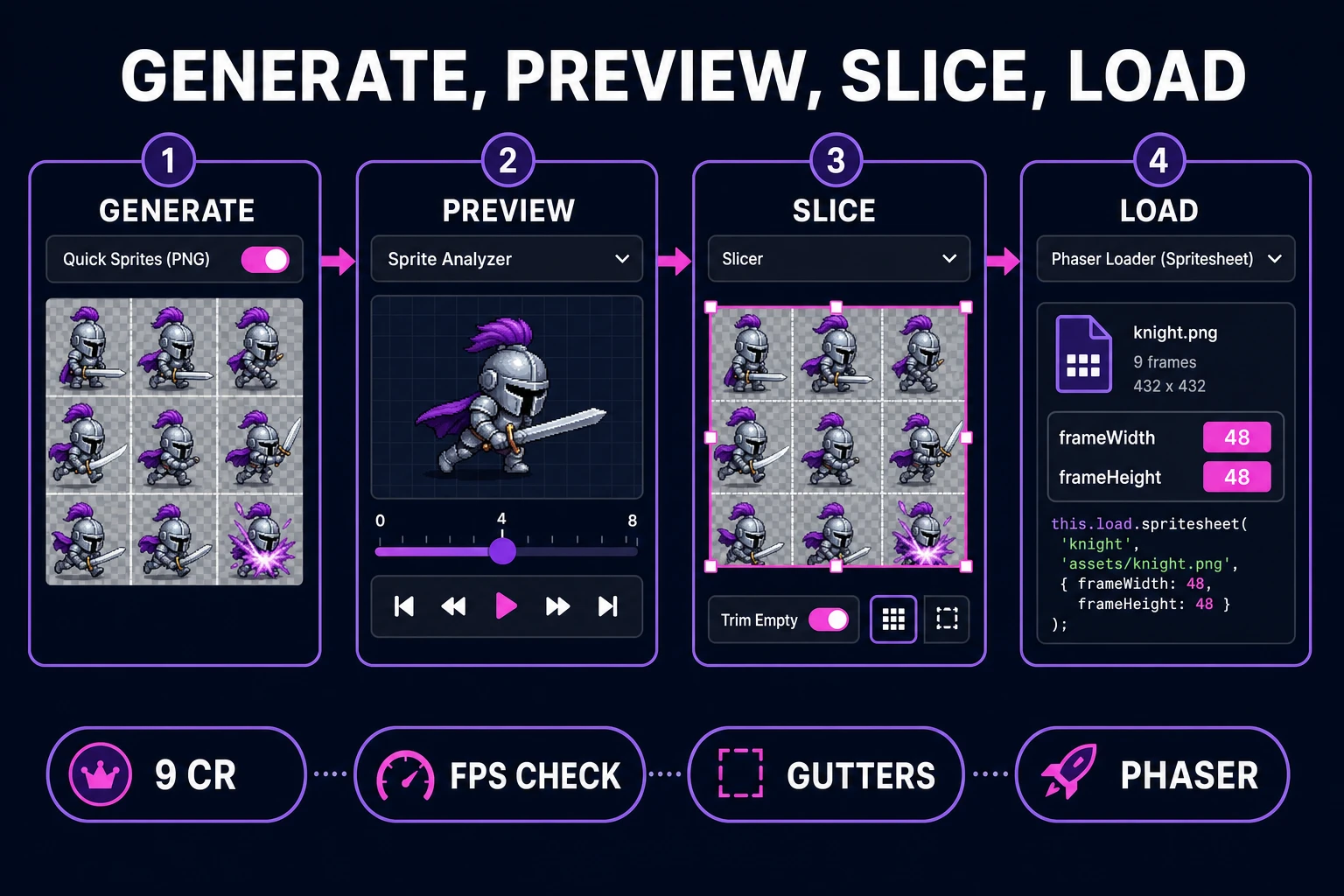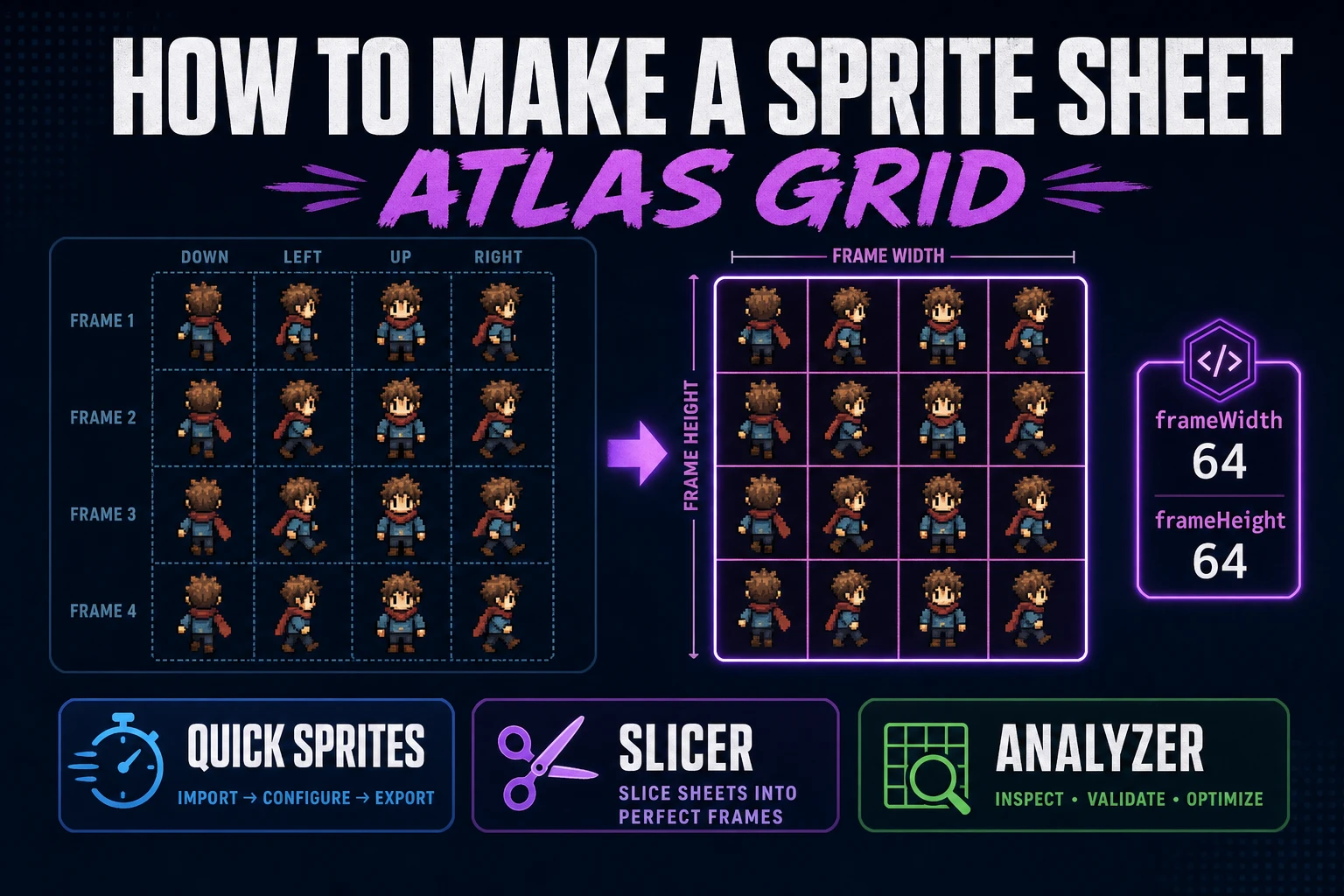
A playable cast dies in the gap between "I drew a character" and "the engine can animate it." How to make a sprite sheet is the missing contract: same frame size, same row order, one PNG the loader can slice without guessing. This guide packs that atlas in the browser with Quick Sprites, preview timing in Sprite Analyzer, and clean custom grids in Slicer when a hand layout needs surgery. Credit costs and animation styles below were verified against src/app/quick-sprites/page.tsx on July 22, 2026.
What how to make a sprite sheet must lock first
DataForSEO lists how to make a sprite sheet at 590 monthly searches with KD 2 in research-supplement.md, verified July 22, 2026. Sibling tails like how to make a sprite sheet for godot or how to make a sprite sheet in aseprite already have their own posts; this page owns the engine-agnostic head term: a fixed-size frame atlas you can drop into any 2D runtime.
Wikipedia’s sprite sheet / texture atlas page (live-checked July 22, 2026) describes an image that stores many smaller images so the GPU treats them as one unit. For games that definition tightens: every cell shares width and height, rows encode direction or state, and columns encode time. A sprite is still a 2D bitmap composited into a larger scene—if your cells disagree about size, the compositor cannot save you.
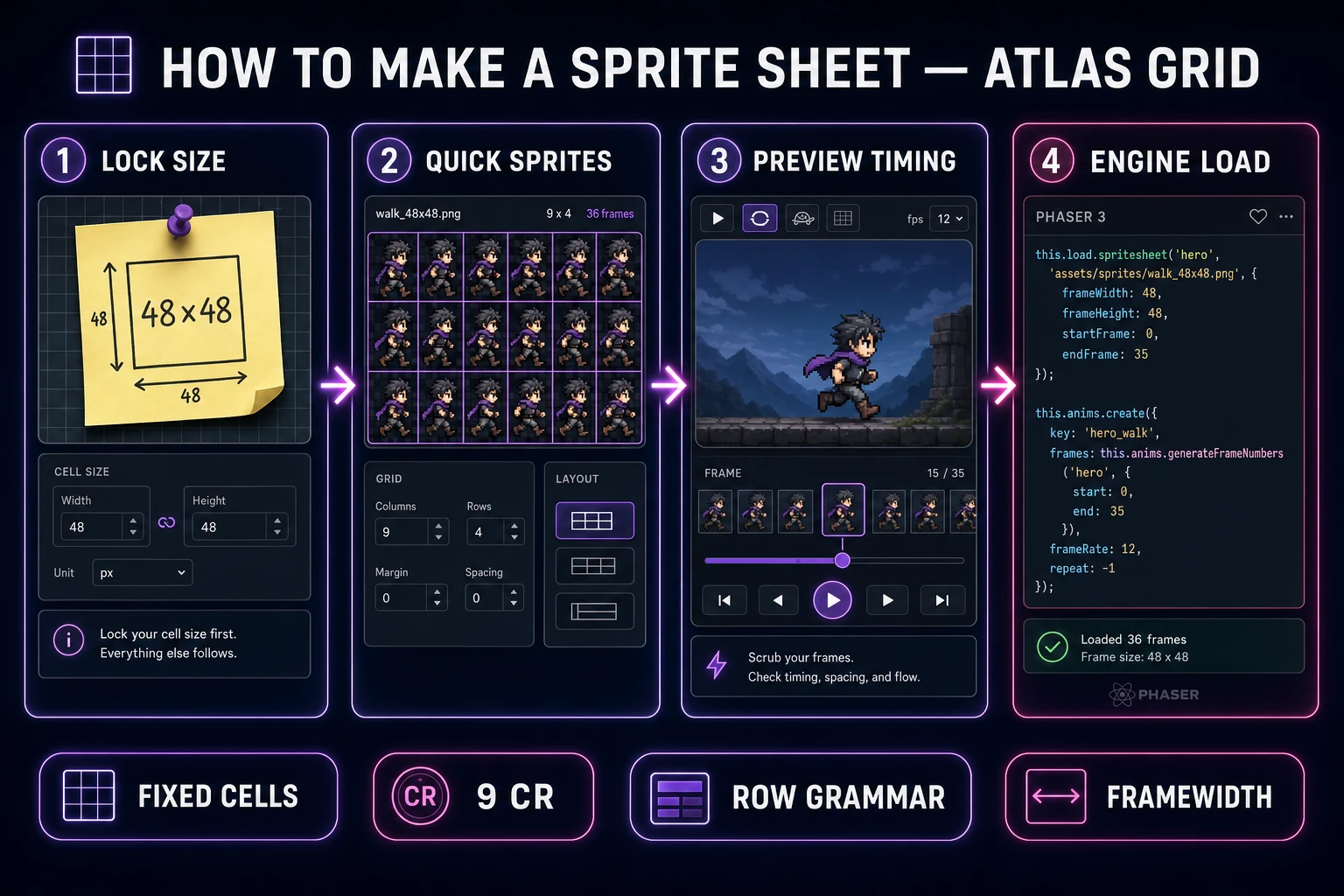
Write three decisions on a sticky note before you generate anything:
- Frame size: 32×32, 48×48, or 64×64 for the hero—pick one and keep props on the same modulus.
- Row grammar: which row is idle, walk-down, walk-left, walk-right, walk-up—write it once and never invent a fifth convention mid-jam.
- Transparency rule: true alpha on a clean matte, or one keyed color—never mixed mattes inside one sheet.
Those three lines are the atlas contract. Skip them and you will “finish” a walk cycle, then redraw when the enemy sheet arrives at a different cell size, then redraw again when the UI icon refuses to sit next to either. The redo tax is what makes people quit sprite packing—not the first hour of careful frames.
Also decide what you will not animate yet. A how-to-make-a-sprite-sheet session that tries to invent walk, run, attack, hurt, and death in one sitting almost always ships muddy compromises. One idle column set and one four-direction walk pack is a complete first milestone.
Choose fixed frames vs packed atlas
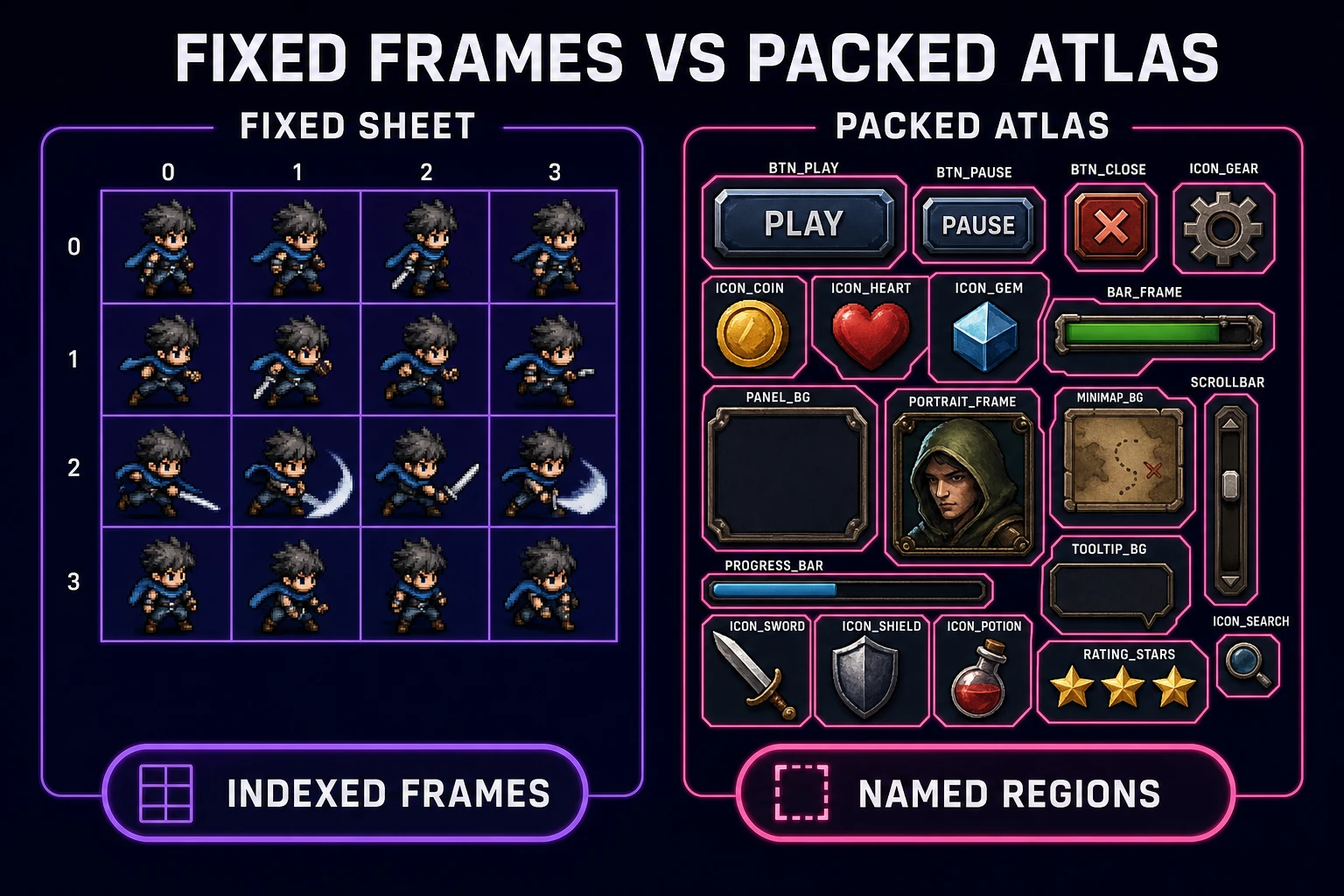
Engines speak two dialects. A fixed sprite sheet uses uniform cells addressed by integer indices. A texture atlas packs irregular regions addressed by names. Phaser’s loader docs draw the line clearly (verified July 22, 2026 on docs.phaser.io): this.load.spritesheet expects every frame to be the exact same size, while a texture atlas packs frames to minimize empty space and references them by name.
For indie jams, start with fixed frames. Uniform grids are easier to generate, easier to debug, and easier to hand-edit when one pose fails. Packed atlases win later when you have dozens of uneven UI icons and you care about GPU memory. Do not optimize packing before you have a readable walk cycle.
Quick Sprites is built for the fixed-grid dialect. It returns a PNG spritesheet (toggle on by default) with rows of directional frames at a locked pixel size. That matches what LoaderPlugin#spritesheet wants: you pass frameWidth and frameHeight, then animate with frame numbers. If you later need irregular crops—logo fragments, HUD chips, mixed prop sizes—route that image through Slicer instead of forcing everything into one walk grammar.
Generate a walk pack in Quick Sprites
Open Quick Sprites when you need simple retro-style pixel characters and effects as ready grids. The page uses model retro-diffusion/rd-animation at 9 credits per generation (CREDITS_PER_GEN in source, verified July 22, 2026). Keep Spritesheet (PNG) selected so you get an atlas instead of a lone GIF preview.
Pick a style that matches your locked frame size:
- Four Angle Walking — consistent 4-direction, 4-frame walking for humanoids at 48×48 only.
- Small Sprites — 4-direction walking plus arm movement, looking, surprised, and laying down at 32×32 only.
- VFX Effects — fire, explosions, lightning, and similar hits at 64×64 (source notes 24–96px 1:1 for this style).
Prompt like a sheet, not like a portrait. Name the job, the silhouette, and the motion: “chunky knight, round shield, four-direction walk, flat colors, no soft anti-alias.” Avoid cinematic lighting language that invents soft gradients the engine will blur further. Quick Sprites is honest about its lane: simple retro pixel sprites—not painterly concept art. If you already have a painted hero and only need quantization, pivot to True Pixel and assemble the grid afterward.
Generate one style at a time. Batching four conflicting moods in one credit burn wastes the 9-credit unit. When a sheet lands, download the PNG with the spritesheet toggle still on, then name the file with the contract baked in: hero_walk_48_4dir.png. Future-you will thank present-you when three sheets collide in the assets folder.