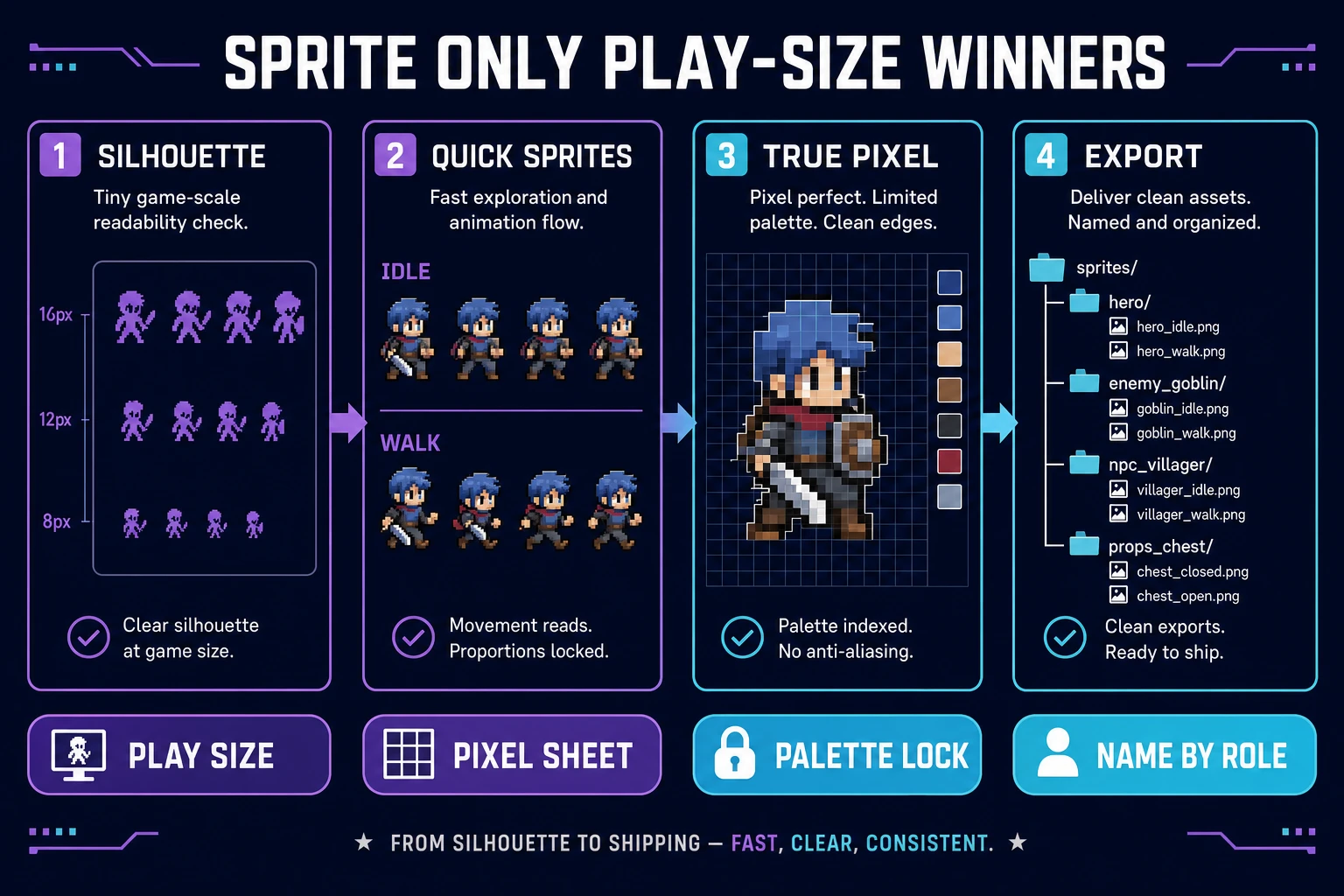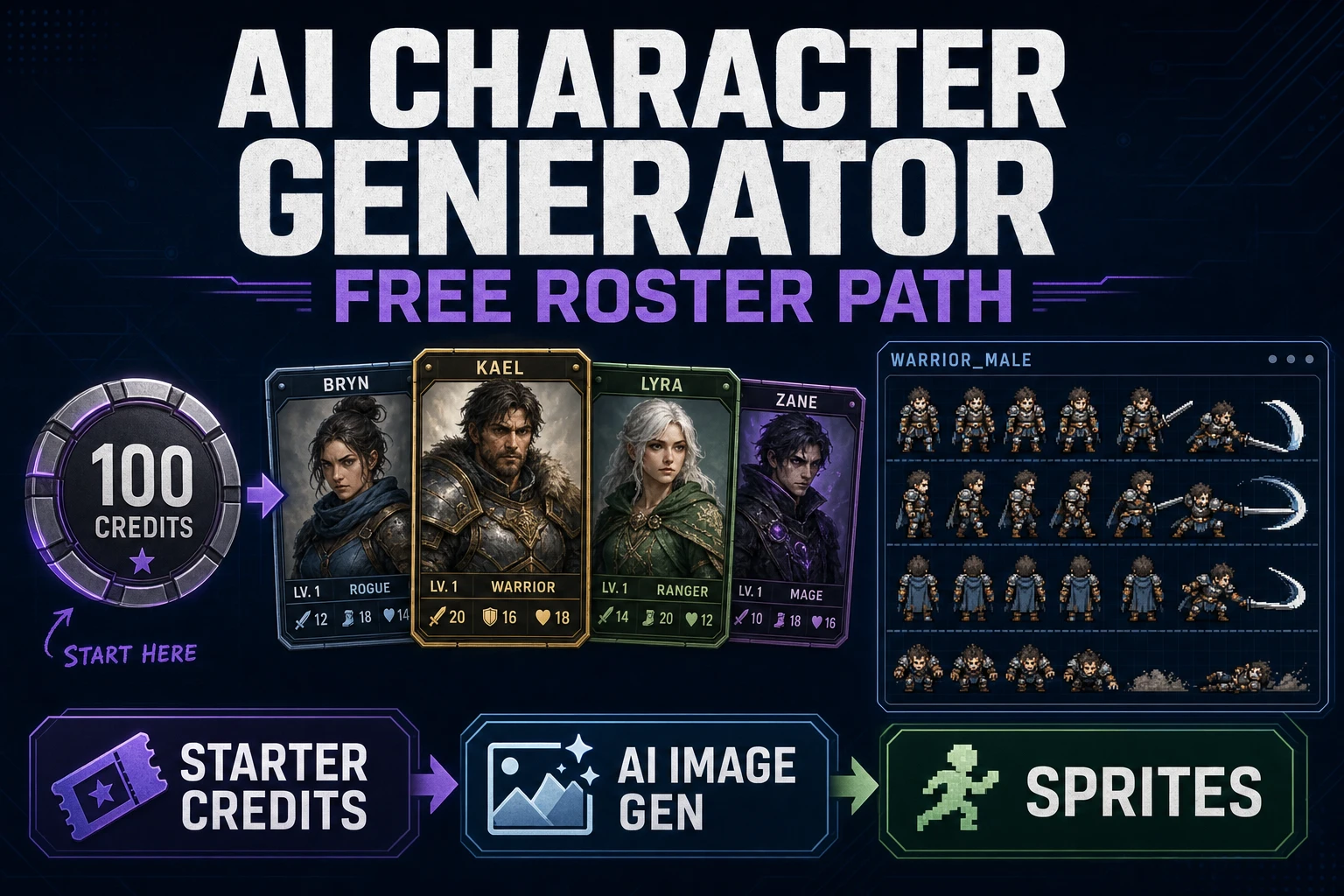
Most “free character AI” searches dump a pretty portrait and stop. A game cast needs the opposite: shared proportions, reusable props, and frames that still read when they are thirty-two pixels tall. An ai character generator free path only works when you treat starter credits like a budget for a model sheet, not a mood board.
Indies burn free quotas on face close-ups because that is what social feeds reward. Engines reward readable shapes in motion. If you cannot tell the herbalist from the grunt at play size, the gallery score does not matter. This guide keeps the free runway pointed at continuity: one cast language, cheap drafts, expensive locks only for winners.
What an ai character generator free search actually needs
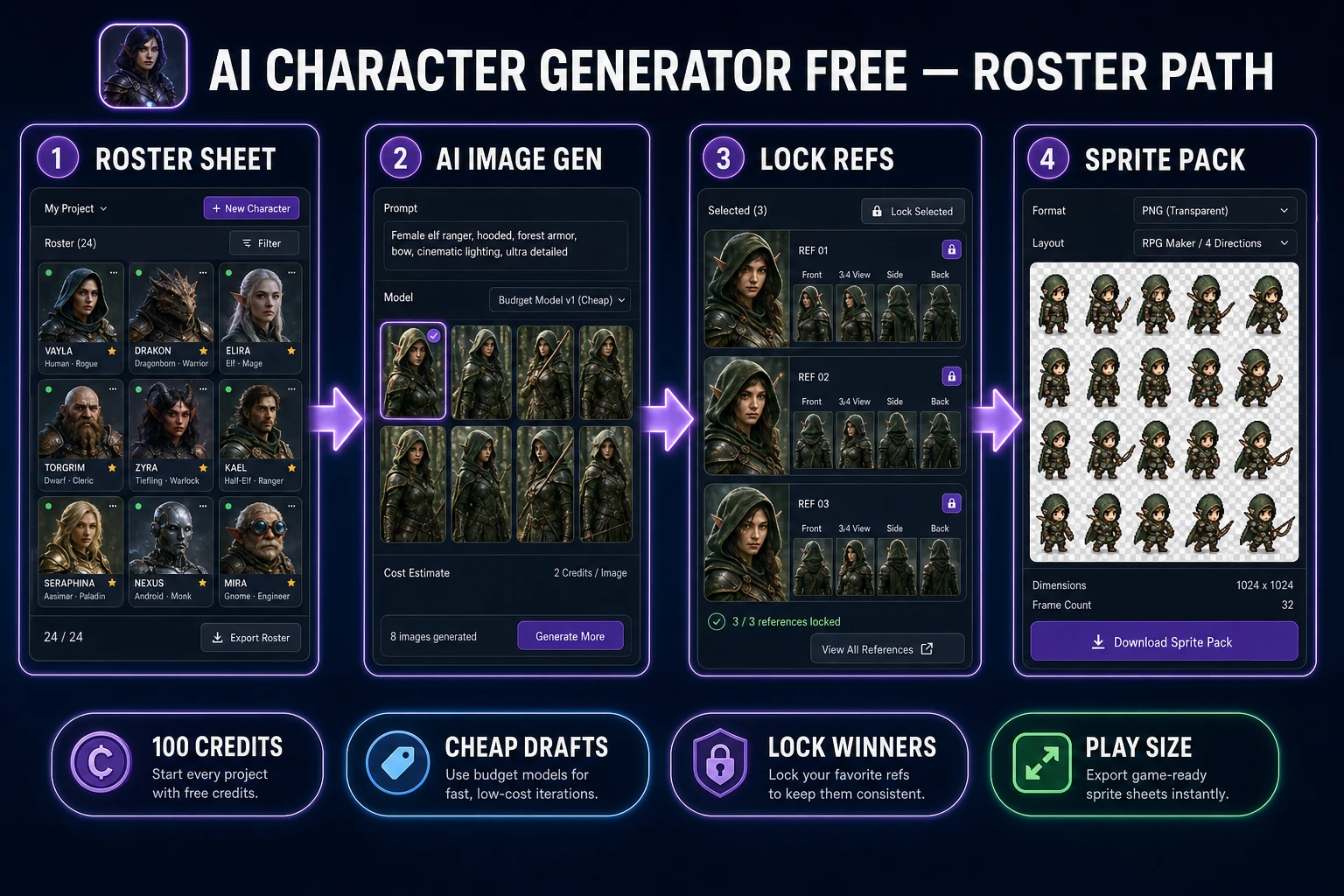
Searchers typing ai character generator free usually want three things at once: zero install, no credit card on day one, and art they can drop into a jam. Portrait chatbots fail the third test. Game characters fail when each prompt invents a new head shape, palette, and camera height.
On Sorceress, the honest free entry is the OAuth signup grant. Google, Discord, and GitHub signups receive 100 starter credits (SIGNUP_GRANT in src/app/api/admin/credits/route.ts, verified July 22, 2026). That is not unlimited generation — it is a fixed runway. Open AI Image Gen, write a cast sheet first, and refuse to spend those credits on random beauty shots.
A sibling pipeline for paid roster work lives in Spawn a Character Generator AI. This article is the free-budget edition: same continuity rules, stricter model picks.
\nIf you already burned part of the grant on portraits, stop and write the four-field sheet before the next click. Recovering continuity mid-spend is cheaper than finishing a mismatched cast.
Spend starter credits on a roster sheet, not random portraits
Before you click Generate, open a blank note and lock four fields for every role:
- Silhouette family — tall lanky hero, squat merchant, wide-shouldered grunt.
- Palette budget — three to five named colors the whole cast shares.
- Signature prop language — belts, scarves, horns, or none.
- Camera + lighting — front three-quarter, soft key from left, flat game lighting.
Those four lines are your production model sheet. Studios use the same idea to keep characters “on model” across artists; Wikipedia’s model sheet entry is the classic reference. If a free render breaks any of the four, delete it even when it looks prettier alone.
Write one card each for hero, support NPC, and enemy family. Keep sentences short enough to paste as a reusable prompt prefix. Consistency beats novelty when credits are capped. A jam cast that shares language ships faster than a gallery of unrelated “best takes.”
Pick cheap models first, then lock a winner
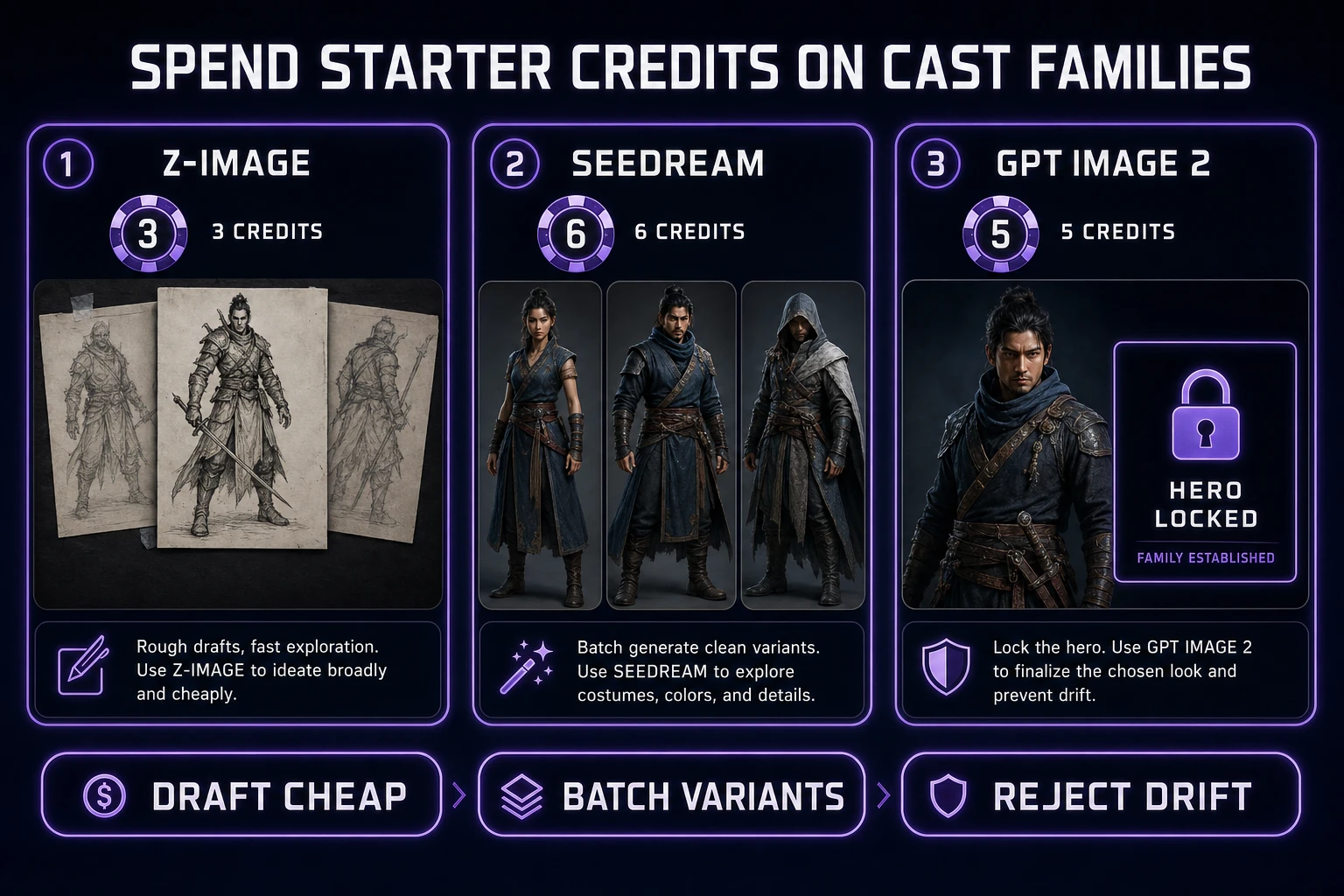
Credit costs below were verified July 22, 2026 against src/lib/models.ts (1 credit ≈ $0.01 via CREDITS_PER_DOLLAR = 100):
- Z-Image — 3 credits. Best first pass for silhouette and costume blocking.
- GPT Image 2 — 5 credits base. Stronger edges when a draft is almost right.
- Seedream 4.5 / Seedream 5 Lite / Nano Banana / Flux 2 Pro — 6 credits base. Flux adds +3 credits per reference image when you lock a winner.
- Nano Banana Pro — 18 credits at default 1K/2K. Hero finals only, not exploration.
A thrifty free session looks like this: eight Z-Image drafts (24 credits) across three roles, two GPT Image 2 refinements (10), one Flux 2 Pro lock with a single reference (+6 base +3 ref = 9). That is roughly 43 credits — under half the starter grant — and you still have runway for sprites and retries.
For reference-locked continuity after the free sprint, see Create With a Consistent Character AI Image Generator.