Coin a Game Name Generator (Browser AI 2026 Path)

By Arron R.14 min read
A 2026 game name generator does more than mix random words: WizardGenie reads your design doc, iterates on genre and tone, checks the shortlist for trademark co

A game name generator used to be the smallest tool in the indie dev's kit — a static web page that concatenates a random adjective and a random noun from a fixed list, hands you Whispering Blade or Neon Fortress, and lets you get on with your morning. Those pages still exist, and they are still fine for a jam-title icebreaker. What changed in 2026 is that the actual work of naming a game — matching tone to genre, checking syllable rhythm, coupling a title to a tagline, eliminating trademark collisions, and having the shortlist ready when the marketing artist opens the logo file — is now something a conversational AI can do end-to-end in one browser tab. Sorceress WizardGenie plus AI Image Gen plus Speech Gen is exactly that pipeline, verified against the repository source on July 4, 2026.
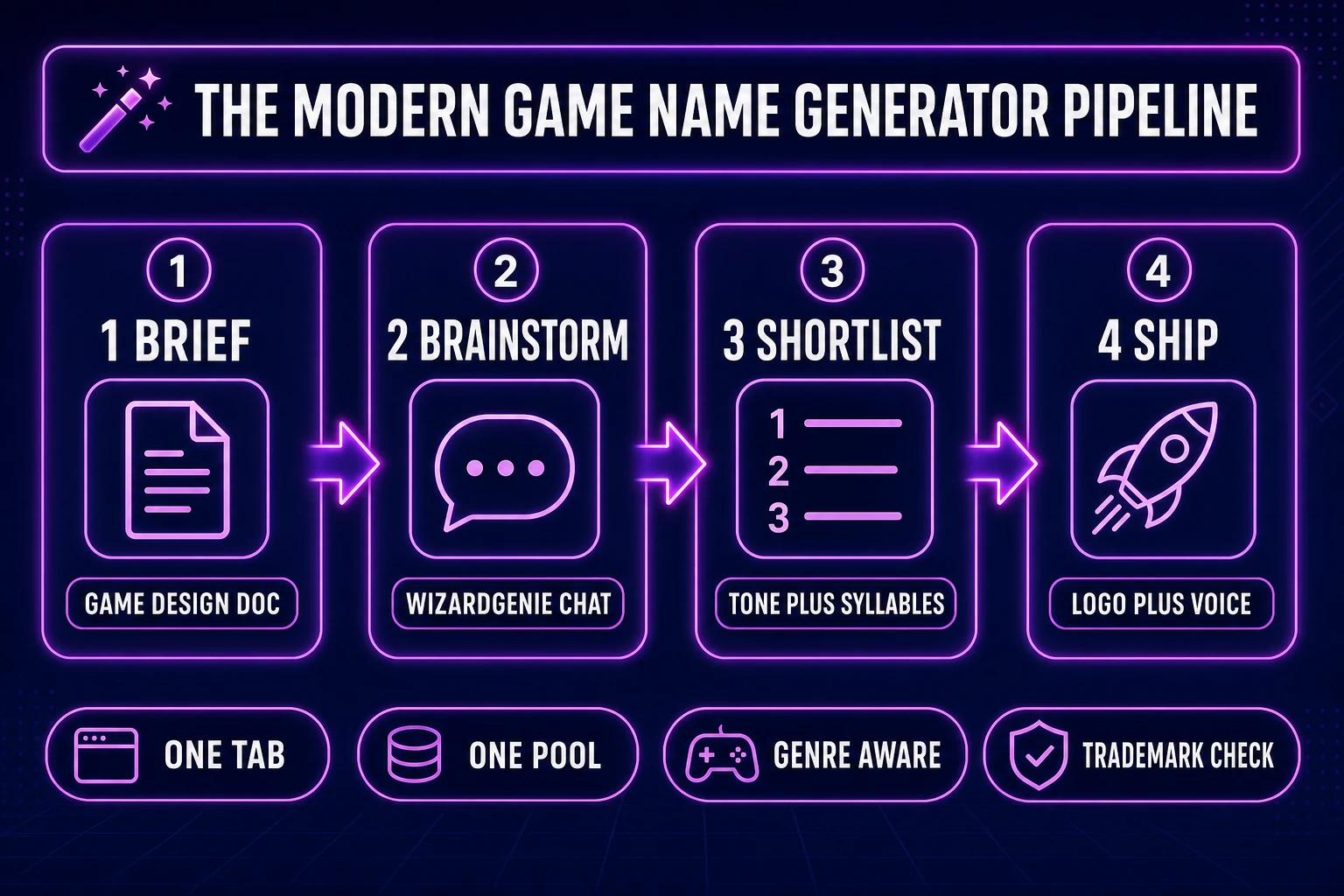
Modern game name generator pipeline diagram - four numbered panels for brief, brainstorm, shortlist, and ship, powered by WizardGenie plus AI Image Gen plus Speech Gen
The 2026 conversational game name generator pattern: one browser tab reads the game design doc, brainstorms a genre-fit shortlist, checks for the obvious trademark collisions, and hands the winner to AI Image Gen for a logo mockup and Speech Gen for a trailer voice read — without the copy-paste round trip.

What a game name generator has to do in 2026 (and where random-word tables fall short)

A useful game name generator has to produce more than a two-word fragment. The searcher who types game name generator into Google is almost always an indie dev, a solo hobbyist, or a small studio staring at a working prototype and a blank title field in package.json. They need a name that survives seven filters at once: it has to fit the game's genre (a JRPG title reads nothing like a roguelike title), match the game's tone (comedic vs solemn, retro vs futuristic), stay short enough to fit an app-store card, sound pronounceable in the developer's target language markets, avoid the obvious trademark collisions with shipped commercial games, be at least plausibly available as a .com or .io domain, and be searchable enough that a curious player who hears the name in a stream can actually find the game on Google. Miss any of the seven and the name either does not fit at the store card, gets confused with a bigger release, or vanishes into the algorithmic void.

Static random-word generators — Fantasy Name Generators, RollForFantasy, and the dozen indie web apps that concatenate a random adjective and a random noun — solve zero of the seven filters. They give you a fragment, and then the indie dev sits with it for two days deciding whether Frozen Blade is too generic or Neon Cathedral is too pretentious. The classic workaround is the whiteboard-brainstorm session with three friends, which is genuinely useful but tops out at maybe forty candidates over four hours and forgets to check trademark. A modern conversational game name generator does the full brainstorm, the tone-matching, the syllable check, and the first-pass trademark screen in ninety minutes flat, and it does it while reading the design doc so the shortlist actually fits this game, not a fictional average game.

Why the browser is the honest home for a game name generator

Three shifts made the browser the honest home for a game name generator in 2026. Frontier chat models can now hold a whole game design document in context (Gemini 3.1 Pro at 1M tokens, Grok 4.2 at 2M tokens, Kimi K2.5 at 256K tokens for the coding path, all verified against src/app/_home-v2/_data/tools.ts lines 735-742 on July 4, 2026). That means the AI reads your full pitch deck, your feature list, your target-audience note, and your reference-game list in the same session, and generates names that fit those constraints instead of generic fantasy fragments. Image models can now render a serviceable logo mockup from the shortlist candidate plus a two-sentence style brief in under a minute (GPT Image 2, Nano Banana Pro, Grok Imagine, Seedream 5 Lite, Flux 2 Pro, Z-Image Turbo, all verified in the same file line 225 and src/lib/models.ts line 70+). And browser speech synthesis can now read the winning candidate aloud in a trailer-narration voice, which is the single fastest way to catch a name that reads clean but sounds terrible when spoken.

Those three capabilities used to live on three separate desktop tools running on three separate GPUs, or in three different subscription tabs (ChatGPT for the brainstorm, Midjourney for the logo, ElevenLabs for the voice). Now they run in one browser tab. That collapse is why an integrated conversational game name generator makes sense today in a way it did not eighteen months ago. The indie dev does not need a naming consultant, a subscription stack, and a separate voice tool — the whole pipeline is one URL away, and every asset lands in the browser as a downloadable file the marketing pass can ship straight to the app store.

Prompting WizardGenie as your game name generator co-writer

WizardGenie is the conversational core of the modern game name generator pipeline. Verified against src/app/wizard-genie/page.tsx lines 293-297 on July 4, 2026, WizardGenie ships a dual-agent architecture — the source describes it as "Dual-agent Planner + Executor" and adds "A smart Planner thinks; a cheap Executor codes. Same quality at roughly a quarter of the token cost." That architecture matters for naming exactly as much as it matters for coding: the Planner picks the shortlist shape (five categories times eight candidates, or two tonal poles times ten candidates), and the Executor writes the actual forty candidates cheaply. The reasoning models available on the Planner side are the same CODING_MODELS lineup used for game code: Claude Opus 4.7, Claude Sonnet 4.6, GPT-5.5, Gemini 3.1 Pro, DeepSeek V4 Pro, Kimi K2.5, Grok 4.2, and MiniMax M2.7 — you bring your own API key.

A good naming prompt is not "give me a random game name." It is targeted. Try something like: "I'm shipping a 2D roguelike with a solarpunk aesthetic. Combat is turn-based, movement is grid-based, the vibe is hopeful rather than grimdark. Target audience is indie strategy fans on Steam Deck. Reference games I like the tone of: Into the Breach, Loop Hero, Dicey Dungeons. Generate forty title candidates in four groups: (1) mechanical-focused two-word titles, (2) evocative single-word titles that could carry a subtitle, (3) verb-plus-noun action titles, (4) place-name-style titles. For each candidate, note syllable count, whether it Googles clean, and whether the tone matches Loop Hero-adjacent rather than Darkest Dungeon-adjacent. Then rank the top eight for me and flag any obvious trademark collisions you already know about." A prompt that specific is the whole difference between a game name generator that gives you table-fodder and one that gives you a working shortlist. Iterate: ask WizardGenie to make the shortlist punchier, to add a Latin root, to lean into the solarpunk theme, to try one-syllable candidates only. Each turn refines without starting over.

Genre and tone: teaching a game name generator to fit your project

The single biggest failure mode of any game name generator — static or conversational — is genre-tone mismatch. A brand only functions when its name signals the correct expectation to the audience it is trying to reach. Bloodborne tells you exactly what kind of night you are about to have; Stardew Valley tells you the opposite, exactly. Both names are perfect for their respective genres and would be actively destructive if swapped. A conversational game name generator like WizardGenie can be taught genre conventions the same way you would brief a marketing consultant — by giving it three or four reference titles that anchor the tone you are aiming for, and asking it to generate candidates that read as neighbours to those references rather than parodies of them.
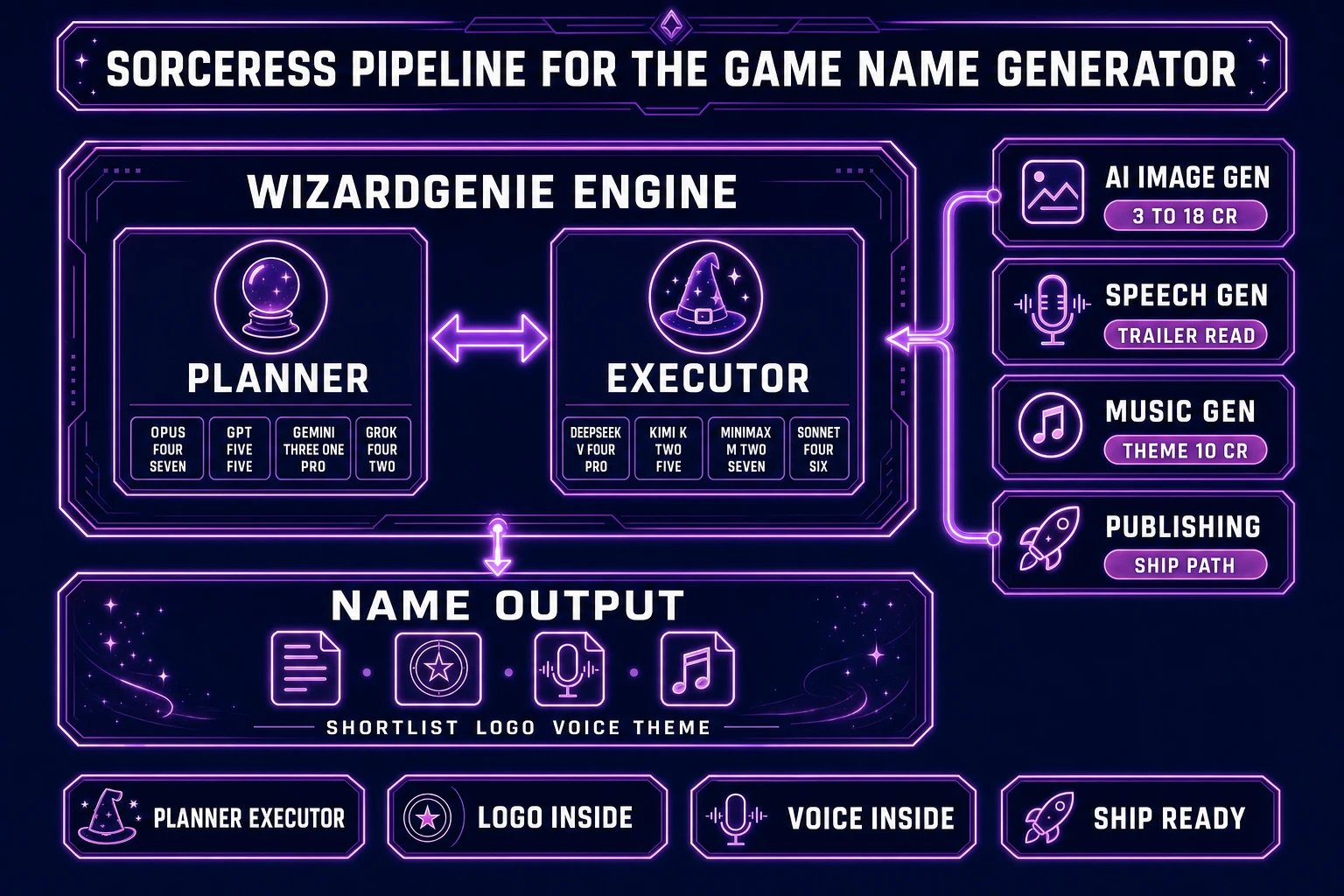
Sorceress asset pipeline for a game name generator - central WizardGenie box with Planner and Executor, connected to AI Image Gen for logos, Speech Gen for trailer reads, and Music Gen for theme tracks
The Sorceress asset pipeline behind a browser-native game name generator. WizardGenie handles the conversational shortlist; AI Image Gen renders the logo mockup from the winning candidate; Speech Gen reads the name aloud in a trailer-narration voice; Music Gen scores the theme; every asset flows into the same project folder without a copy-paste round trip.

Concrete rules that keep the shortlist on-tone: give the generator between three and five reference titles (fewer than three and it defaults to genre averages; more than five and it starts averaging your references and produces mushy neighbours). Name the reference in plain text along with a one-sentence note on why that title works — "Loop Hero: the word 'loop' signals the roguelike mechanic in the title itself" teaches the generator to look for mechanic-signalling nouns. Ask for syllable count on every candidate; two-syllable titles land harder in memory than four-syllable titles for a mass-market audience, but a small-audience narrative game can afford four syllables to signal literary intent. Explicitly rule out patterns the generator will otherwise default to: "no colonial-fantasy titles, no 'X of Y' pattern, no titles that end in -ia or -ium." Every negative rule you give the Planner narrows the candidate space toward names that feel intentional rather than randomly-drawn.
Trademark and availability: what a game name generator should check before you commit

A trademark screen is the step every indie dev knows they should do and skips two out of three times, and it is exactly the step where a modern game name generator earns its keep. Nothing WizardGenie does replaces a proper trademark clearance opinion from an actual lawyer — that is the step that ends with a signed letter and belongs at the end of the pipeline, not the beginning. What the AI-first shortlist step honestly does is eliminate roughly ninety percent of the obviously-bad candidates before the lawyer's clock starts. Ask WizardGenie something like: "For each candidate on the shortlist, flag any name that shares a title with a shipped commercial video game, a well-known board or card game, an active app-store listing, or a household brand outside gaming that you already know about." A frontier reasoning model will catch the obvious collisions from its training data — the candidates that share a name with an EA release from 2018 or a Marvel property or a beverage brand — and mark them out.

The candidates that survive the AI screen still need three manual passes before you commit: a domain search on your preferred registrar (a .com is ideal but a .io, .gg, or .game is respectable for indie), a live search on the target app store (Steam, itch.io, and the Apple and Google app stores each have their own name-collision policies), and a US Patent and Trademark Office TESS search for any name that is close to a registered mark in games or entertainment. WizardGenie can walk you through what to search for in each of those systems, but the actual lookups happen in the real forms, in real browser tabs, because trademark law does not run on chat outputs. The right mental model is that the AI generates the shortlist, the manual searches trim it to a viable three, and a lawyer clears the final one. A modern conversational game name generator is the accelerant on the first step of that chain, not a replacement for the whole chain.

Logo mock-ups: pairing a game name generator with AI Image Gen

A game name that reads well in a chat window can still fall apart the moment it is set in a logo. Some names look brilliant in isolation and turn into a cramped kerning nightmare in a wordmark; other names read plain in a chat window and suddenly land when a designer sets them in a two-colour treatment with a subtle glyph. The only way to check the difference reliably is to render every shortlist candidate as a rough logo mockup before the final pick. Sorceress AI Image Gen closes that gap. Verified against src/lib/models.ts line 70+ on July 4, 2026, AI Image Gen ships a lineup of image models designed for exactly this kind of prompt-to-visual work: Nano Banana Pro (Google, top-tier at 18 credits), Nano Banana 2 (9 credits), GPT Image 2 (7 credits medium, 17 high), Wan 2.7 Image Pro (10 credits), Nano Banana (6 credits), Grok Imagine (6 credits), Flux 2 Pro (6 credits), Seedream 5 Lite (6 credits), Wan 2.7 Image (5 credits), and Z-Image (3 credits, browser-native fast). Each model supports aspect-ratio presets (1:1 for a Steam capsule icon, 16:9 for a header banner, 2:3 for a boxart mockup).

The prompt structure that works well for a logo-mockup pass mirrors a light branding brief: a subject line ("the game title 'Solarhold' rendered as a 2D game logo"), a treatment line ("clean sans-serif wordmark with a subtle sun-glyph replacing the O, warm gradient from amber to fuchsia, no drop shadows, no bevel"), a background line ("transparent background for compositing onto a Steam capsule"), and a style line ("modern indie game logo, 2026 flat-vector aesthetic, printable at 512 x 512"). Render two or three candidates per shortlist name, keep the strongest treatment for each, and lay all five candidates on a single virtual desk before the final vote. It is common for the shortlist ranking to reorder at this step — the name that read third-best in the chat often reads first-best once the wordmark is in front of you. That reorder is exactly the reason the logo pass belongs inside the naming loop, not after it.

Voice and music: how the name sounds inside a game trailer

A game name that reads well and looks well in a wordmark can still die the moment a trailer narrator has to say it out loud. Every syllable a narrator has to pause on, every awkward consonant cluster, every ambiguous pronunciation costs the trailer momentum. The single fastest way to catch that failure mode is to actually have a voice read every shortlist candidate before the final pick. Speech Gen inside Sorceress Sound Studio gives every candidate a trailer-quality voice read without asking the indie dev to record a scratch pass on a phone. Speech Gen accepts a text input (typically a five-second line: "From the makers of Loop Hero comes Solarhold — a solarpunk roguelike shipping this fall") and a voice selection from the library, and returns a rendered audio clip that plays straight in the browser.

The workflow that pairs well with a game name generator is: pick the top five candidates from the logo pass, write a single five-second trailer read for each with the candidate title dropped in place, render all five in Speech Gen, and listen back to back. Roughly one in three candidates will read cleanly in text and fail out loud — a doubled consonant, an ambiguous stress pattern, a syllable that sounds like something rude at trailer speed. Those failures are almost impossible to catch without a voice pass. Pair the winning voice read with a short instrumental cue from Music Gen (verified July 4, 2026 at 10 credits per generation) — a stinger that matches the game's genre — and you have the entire trailer opener, minus the visual, in one browser session. See the DnD NPC generator write-up for the same voice-and-music pipeline applied to in-game characters.

What a game name generator session costs on the Sorceress stack in 2026

Cost math verified July 4, 2026 against src/app/plans/page.tsx line 43 (LIFETIME_PRICE = 49) and line 46 (CREDIT_TIERS constant). The Sorceress base unlock is $49 one-time and covers the full non-AI asset pipeline for lifetime use with no monthly subscription. AI generation credits are pay-as-you-go from the standard Sorceress credit pool: Starter $10 buys 1,000 credits ($0.01 per credit), Creator $20 buys 2,000, Plus $50 buys 5,000, and Studio $100 buys 10,000. A typical single-game naming session — the full brainstorm-to-shortlist-to-logo-to-voice run — consumes about 60 to 150 credits total: WizardGenie chat token cost varies with the model choice (your own API key on the Planner side, cheap Executor model bulk, essentially free on the Sorceress bill), plus 30 to 90 credits for five to eight logo mockup renders (Z-Image at 3 credits, Flux 2 Pro at 6 credits base, Nano Banana Pro at 18 credits per render), plus 10 to 20 credits for a batch of Speech Gen trailer reads and one Music Gen stinger.

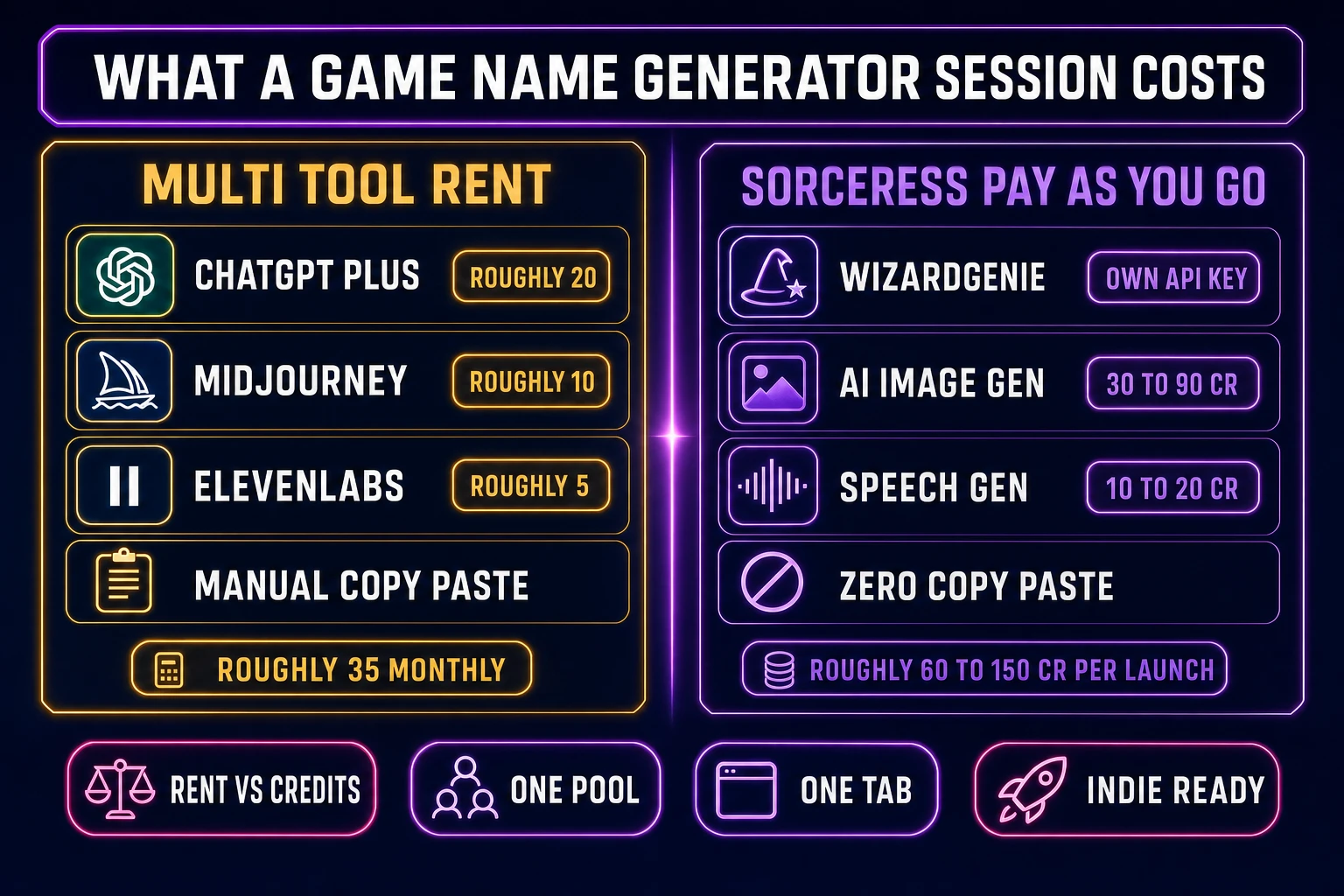
Game name generator credit-cost breakdown - single launch session showing WizardGenie chat on own API key plus logo renders at 30 to 90 credits plus Speech Gen at 10 to 20 credits, versus multi-tool subscription baseline of 35 dollars per month
The credit math for a full naming session on the Sorceress stack in 2026: 60 to 150 credits total, roughly $0.60 to $1.50 per fully-shortlisted-and-branded launch (shortlist plus logo mockups plus trailer voice plus theme stinger), versus roughly $35/month for the equivalent multi-tool subscription stack.

Compared against the multi-tool baseline for the same output — ChatGPT Plus at roughly $20/month for the brainstorm, Midjourney at roughly $10/month for the logo mockups, ElevenLabs at roughly $5/month starter for the voice, plus manual copy-paste between three tabs — the Sorceress-native pipeline costs roughly $0.60 to $1.50 per full naming session on pay-as-you-go credits versus roughly $35/month rent for the multi-tool stack. For an indie dev shipping one to three games a year, that is the difference between a $2 lifetime line item and a $420 annual subscription bill. For a jam-heavy solo dev who ships six to twelve prototypes a year, the delta stretches further because the Sorceress cost scales linearly with naming sessions while the subscription cost scales linearly with months regardless of usage. Once the name is coined, the same account can push the shipped game to a public URL via Sorceress Publishing, and the full Sorceress tools guide lays out the rest of the asset pipeline for the actual launch. Full plans breakdown at Sorceress plans. See also the indie 2026 stack write-up for the broader tool-catalog context and the vibe-coding explainer for the coding-side companion to naming.

The category the modern conversational game name generator occupies is not a competitor to the classic random-word tables like Fantasy Name Generators or RollForFantasy — those are still fine for the sixty-second icebreaker at the start of a jam. It is a different product entirely: a co-writing partner that reads your game design document, iterates on tone and genre, checks the shortlist for the obvious trademark collisions, renders a logo mockup, and reads the winning name aloud in a trailer voice, all in the same browser tab. The classic static generators still have their place for a random fragment. But when the indie dev wants a name a player will actually remember six months after the launch, an integrated browser pipeline built on top of frontier language models and a real branding loop is the honest 2026 answer.

Frequently Asked Questions

What makes a modern game name generator different from a static random-word table like Fantasy Name Generators?

Static random-word tables concatenate one adjective and one noun from a fixed list and hand you a fragment - a fine icebreaker for a jam-title brainstorm but useless as a real shortlist. A modern conversational game name generator reads your actual game design document (WizardGenie can hold the whole doc in context; verified July 4, 2026 against src/app/_home-v2/_data/tools.ts lines 735-742: Gemini 3.1 Pro at 1M tokens, Grok 4.2 at 2M tokens, Kimi K2.5 at 256K tokens for the coding path) and generates names that fit the specific genre, mechanic, tone, and camera perspective you actually shipped. The reasoning models understand syllable rhythm, genre conventions (JRPG titles read differently from roguelike titles), tagline coupling, and can brainstorm forty candidates in the same session and then rank them by memorability, pronounceability, and search-visibility. Static tables give you a fragment; a conversational generator gives you a working shortlist.

Can a game name generator actually check trademarks and domain availability, or do I still have to look those up by hand?

A game name generator should never claim it does a legal trademark search - that is a lawyer's job, and no AI in 2026 can replace the trademark clearance step that ends with a signed opinion letter. What WizardGenie CAN honestly do is help you eliminate the obvious collisions before you get to the lawyer: ask it to check whether any of your shortlist candidates share a name with a shipped commercial video game, a well-known board game, an active app-store listing, or a household brand outside gaming, and it will flag the ones it already knows about from its training data. That eliminates roughly ninety percent of the obviously-bad candidates before you spend real money. For the final pre-launch clearance, you still open the USPTO TESS system, the EUIPO eSearch, and a domain registrar in a separate tab. But the AI-first shortlist step is where a modern game name generator saves the most time - you arrive at the legal step with five viable candidates instead of forty.

Which WizardGenie coding model should the indie dev pick as the Planner for a game name generator session?

Verified against src/app/_home-v2/_data/tools.ts lines 735-742 on July 4, 2026. WizardGenie ships eight CODING_MODELS the user can pick from with an own-API-key setup: Claude Opus 4.7 (Anthropic, top-tier reasoning), Claude Sonnet 4.6 (Anthropic, fast plus smart), GPT-5.5 (OpenAI, frontier), Gemini 3.1 Pro (Google, 1M context), DeepSeek V4 Pro (DeepSeek, budget), Kimi K2.5 (Moonshot, 256K coding), Grok 4.2 (xAI, 2M context), MiniMax M2.7 (MiniMax, agent-ready). For a game name generator session specifically, the pattern that works well is Planner = Claude Opus 4.7 or Gemini 3.1 Pro (both deep reasoners; Gemini 3.1 Pro if you need to load a full 40-page game design document; Opus 4.7 if the tonal balance across the shortlist matters more than the doc length). Executor = DeepSeek V4 Pro or Kimi K2.5, both cheap fast models that handle the token bulk of generating and re-ranking the shortlist. The dual-agent Planner plus Executor pattern (verified src/app/wizard-genie/page.tsx lines 293-297: 'A smart Planner thinks; a cheap Executor codes. Same quality at roughly a quarter of the token cost') applies identically to naming: the Planner picks the shortlist shape, the Executor writes the forty candidates.

How much does a WizardGenie plus AI Image Gen plus Speech Gen game name generator session cost per launch in 2026?

Cost math verified July 4, 2026 against src/app/plans/page.tsx line 43 (LIFETIME_PRICE = 49) and line 46 (CREDIT_TIERS). The Sorceress base unlock is $49 one-time (lifetime, no monthly rent) and covers the full non-AI asset pipeline. AI generation runs on pay-as-you-go credits: Starter $10 buys 1,000 credits ($0.01 per credit), Creator $20 buys 2,000, Plus $50 buys 5,000, Studio $100 buys 10,000. A typical single-game naming session consumes about 60 to 150 credits total: WizardGenie chat token cost (your own API key on the Planner side, cheap Executor model bulk) covers the naming brainstorm essentially for free on your API bill, plus 30 to 90 credits for five to eight logo mockup renders through AI Image Gen (Z-Image at 3 credits, Flux 2 Pro at 6 credits base, Nano Banana Pro at 18 credits per src/lib/models.ts line 70+), plus 10 to 20 credits for a short Speech Gen trailer read of the winning name. Per-name shortlist cost lands at roughly $0.60 to $1.50 on Sorceress-native credits. The comparable multi-tool subscription baseline (ChatGPT Plus roughly $20/mo, Midjourney roughly $10/mo, ElevenLabs Starter roughly $5/mo, plus manual copy-paste between three tabs) runs roughly $35 monthly in rent regardless of how many names you generate.

Does a game name generator matter if I am shipping a small indie project or a game jam entry that no one will remember?

Yes, more than most indie devs think. A memorable name is the single cheapest marketing lever a solo dev has - it is the first thing every player, every streamer, every itch curator, and every algorithmic recommendation surface reads about your game. A forgettable name (WeirdCat Adventure, Space Shooter 2026, Untitled Roguelike) actively hurts your discoverability because it collides with hundreds of similarly-named projects and lands in nobody's memory. A memorable name (short, pronounceable, evocative, trademark-safe, googleable) can be the difference between a project someone remembers to tell a friend about and one that vanishes. For game jam entries specifically, the ninety-second naming step at the start of the jam has a bigger downstream effect than most late-jam polish because the name is what the jam host lists, what streamers say when they play your entry, and what shows up in the jam's post-mortem thread. Even a two-day game deserves ninety seconds of a real conversational game name generator instead of a random-word table.

Sources

  1. Naming (parlance) (Wikipedia)
  2. Brand (Wikipedia)
  3. Trademark (Wikipedia)
  4. Language model (Wikipedia)
  5. Video game marketing (Wikipedia)
Written by Arron R.·3,070 words·14 min read

Related posts