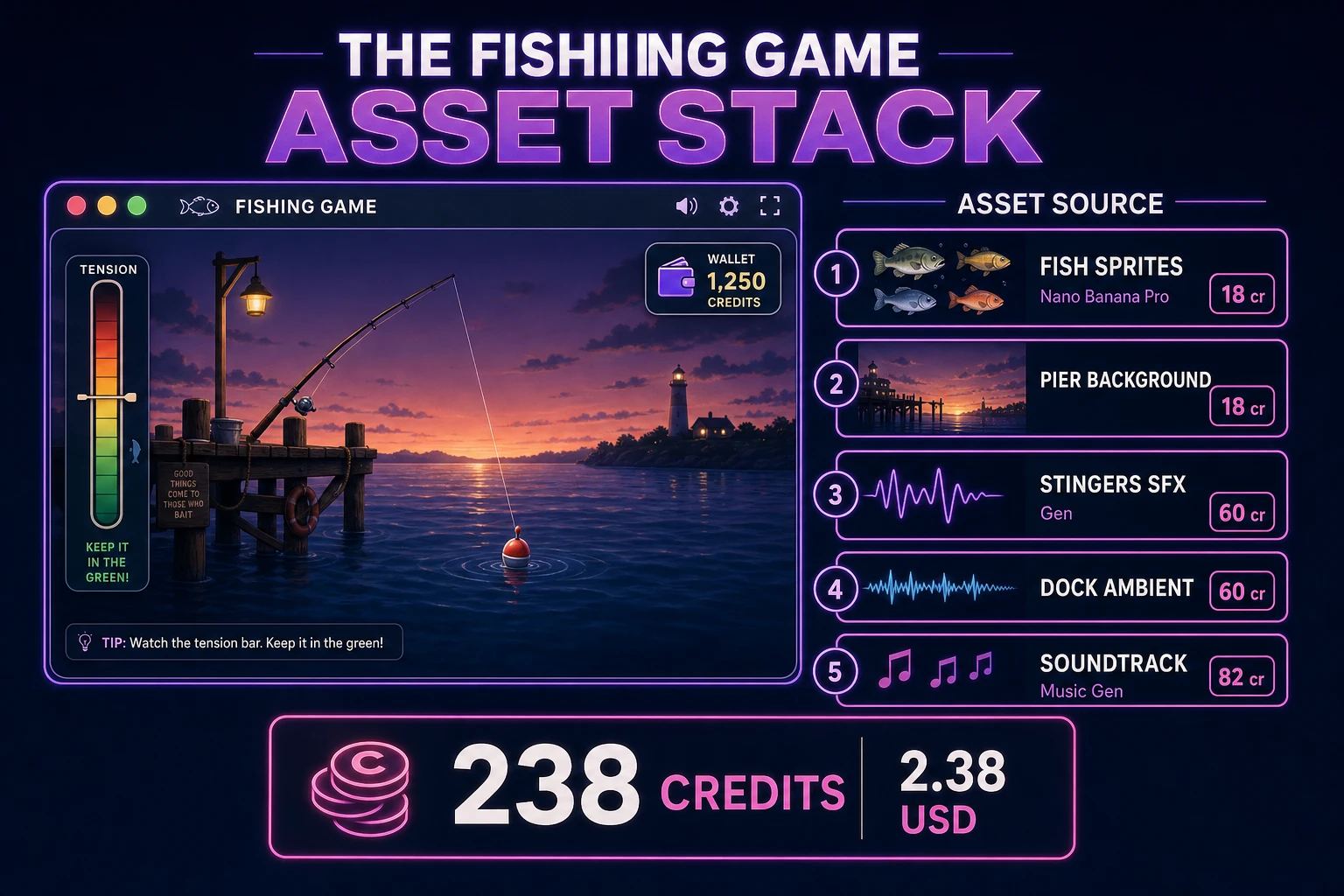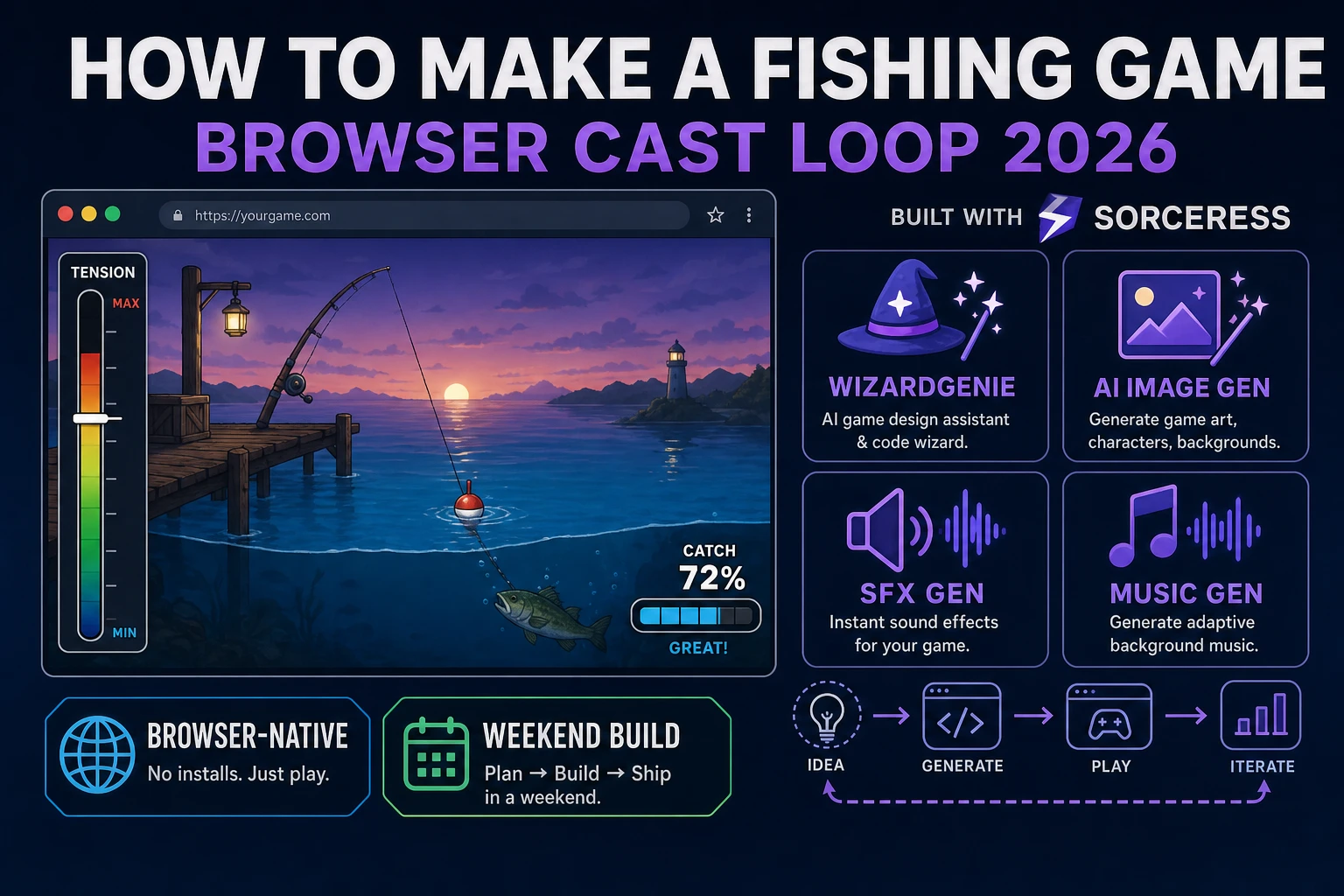
How to make a fishing game is a quieter weekend than a shooter and a tighter loop than a full sim. Wikipedia’s fishing video game page still starts with William Engel’s text-only Gone Fishin’ (1977) and David Crane’s Atari 2600 Fishing Derby (1980), the first fishing title with graphics. The genre’s contract has barely moved since: pick bait, cast, wait for a bite, then fight the line. What did change is the tutorial quality. Almost every javascript fishing walkthrough still stops at “click the water, increment a score.” A 2026 browser fishing game is a rarity table, a power-bar cast, a bite timer, and a reel tension minigame that works with a mouse or a finger. In a browser that means WizardGenie for the loop, Sorceress AI Image Gen for fish and pier art, SFX Gen for splash and reel, and Music Gen for a dock bed. This is the honest end-to-end for how to make a fishing game in 2026, in a browser, in a weekend.
What how to make a fishing game actually means in 2026
The query “how to make a fishing game” hides three intents. Some searchers want a fishing minigame they can drop into a larger project, the way farm-life sims have done since Harvest Moon on the Super NES. Wikipedia groups those as optional collection loops inside action-adventure and simulation games, not as standalone products. A second intent is an idle fishing game: tap once, AFK while bites accrue, sell the haul. That is a cousin of a clicker and a one-day toy. The third intent, and the one this guide targets, is a single-player browser fishing game: a pier, a cast-and-reel game with a tension bar, a small fish roster with rarity, a bait shop that actually changes catch weights, and a coin sink that buys better rods. That is a weekend build, it demos the whole Sorceress toolset, and it is the format most first-time fishing-rod-game builders actually want.
The presentation contract is small and strict. A title screen shows the game name, a Play button, a rod picker (Starter, Fiberglass, Graphite), and a bait picker (Worm, Spinner, Fly). The play screen shows water on the bottom two-thirds, a pier silhouette, a bobber, a power bar for the cast, and a wallet. After a bite, a vertical tension bar takes over: keep the marker in the sweet zone until the catch meter fills, or the line snaps. A results card shows species, weight, coins, and Cast Again. Wikipedia’s gameplay section is still the cleanest rules summary: choose bait, cast, hook-set on a signal, then reel with some kind of button or analog fight. A first fishing game tutorial that ships that loop honestly will teach you more than a half-built open world with twelve unfinished lakes.
The fishing game loop in one minute (cast, wait, bite, reel)
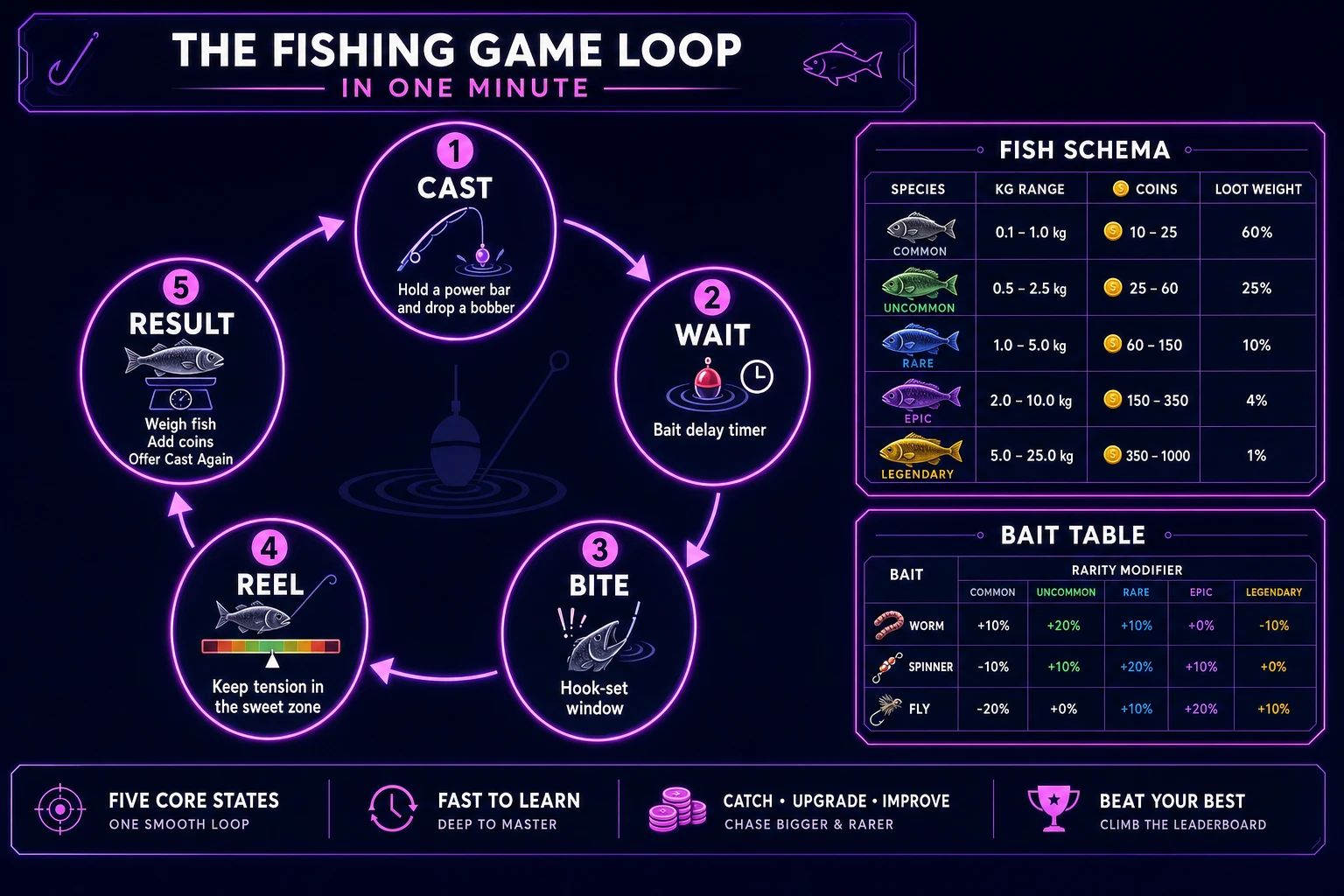
Five moving parts and nothing else, in strict order per cast. First, cast — hold a power bar, release near the peak, drop a bobber at a distance that scales with power and rod length. Second, wait — a bite timer sampled from the bait’s delay range; the bobber idles, maybe a nibble twitch. Third, bite — a short hook-set window. Click (or tap) inside it to hook; miss and the fish leaves. Fourth, reel — a tension minigame. The fish tugs on a curve; the player’s pointer position is the counter-force. Stay in the sweet zone to fill a catch meter; over-tension snaps the line. Fifth, result — weigh the fish, add coins, optionally sell, then Cast Again. That is a cast and reel game. Everything else — a collection log, weather that shifts rarity, an idle fishing game AFK ticker — is polish.
Drive the wait and tug with a crypto-backed roll so a short session cannot feel rigged. Sample delays and species with crypto.getRandomValues, not Math.random(), and never shuffle a table with Array.sort(() => Math.random() - 0.5). Map the reel fight to Pointer Events so the same handler covers mouse, pen, and touch; set touch-action: none on the play canvas so the browser does not steal the drag as a scroll. Autosave wallet, rod, bait, and the collection log to localStorage. Keep the core loop tight, ship one full catch end-to-end, and only then layer polish. A first browser fishing game that ships six honest species and a fair tension bar will outplay a lake with forty undrawn fish.
Pick your engine for how to make a fishing game: Phaser 4, vanilla Canvas, or WizardGenie
Three good browser targets in 2026, each with a different trade-off. Vanilla JavaScript with Canvas is the honest default and the pick this guide recommends for a first build. A fishing minigame is a background blit, a bobber sprite, a power bar, and a tension bar. Total code footprint for a working fishing game is under 500 lines and ships as a static HTML file. No engine to install, no build step, deploys to GitHub Pages, Netlify, or Vercel with a drag-and-drop. This is the stack most javascript fishing and browser fishing game tutorials should have started with.
Phaser 4.1.0 (verified 2026-08-18 on the official API docs) becomes the right pick if you want Arcade Physics on the bobber, a tweened nibble, particle splashes, or an audio timeline so the reel loop crossfades into the catch sting. Phaser’s Scene lifecycle maps onto title-dock-fight-results if you scale up to multiple piers. For a first cast-and-reel game, Phaser is optional weight — use it when motion is the product, not when the product is a fair rarity table and a correct snap check. Searchers who land here for phaser fishing usually want that animated water; give them a stacked PNG water overlay first, then offer Phaser as the upgrade path.
WizardGenie is not a separate rendering engine — it scaffolds whichever of the two you pick, from a single natural-language prompt. WizardGenie is the Sorceress game-native coding agent. It ships as both a desktop app (Windows installer with auto-update, available to Early Access supporters and above) and a no-install web build at the same URL. Its coding-model lineup covers Claude Opus 4.7, GPT-5.5, Gemini 3.1 Pro, DeepSeek V4 Pro, Kimi K2.5, Grok 4.2, and MiniMax M2.7 (verified 2026-08-18 in src/app/_home-v2/_data/tools.ts). For fishing, any frontier model scaffolds the rarity table and tension bar in one prompt. If you want to run cheap, pair a frontier planner (Claude Opus 4.7 or GPT-5.5) with a budget executor (DeepSeek V4 Pro or Kimi K2.5) and let the executor do the typing — the Dual-agent planner-and-executor pattern is why WizardGenie exists, and it lands most projects at roughly one-fifth the single-frontier cost.
Step 1 — model fish rarity tables and bait economy
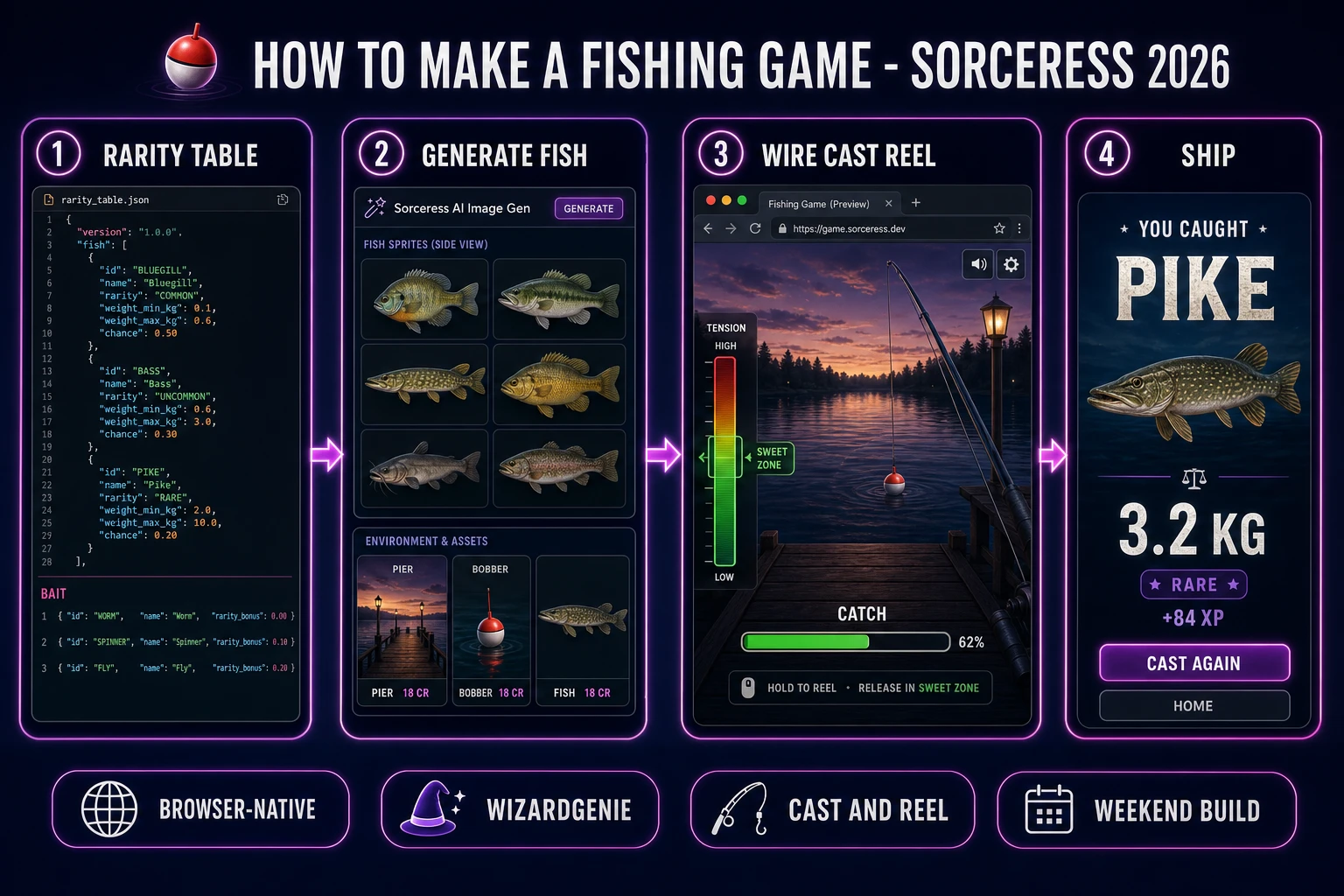
Nothing else in the pipeline matters if every cast returns the same cartoon bass. Ship JSON, not a hardcoded array in the fight file. Each fish needs an id, display name, rarity tier, base weight range, coin value, and a weight in the loot table. Easy bait (worm) should overweight commons. A spinner should lift uncommons. A fly should be the only bait that can roll the rare. Rods do not change species; they change max tension and cast distance so an upgrade feels mechanical, not like a cheat code.
{
  "fish": [
    { "id": "bluegill", "rarity": "common", "minKg": 0.2, "maxKg": 0.6, "coins": 4, "weight": 40 },
    { "id": "bass", "rarity": "uncommon", "minKg": 1.0, "maxKg": 2.4, "coins": 14, "weight": 18 },
    { "id": "pike", "rarity": "rare", "minKg": 2.0, "maxKg": 5.5, "coins": 40, "weight": 6 }
  ],
  "bait": {
    "worm": { "delayMs": [1800, 4200], "mods": { "common": 1.4, "uncommon": 0.8, "rare": 0.2 } },
    "spinner": { "delayMs": [1400, 3600], "mods": { "common": 0.9, "uncommon": 1.5, "rare": 0.6 } },
    "fly": { "delayMs": [2200, 5200], "mods": { "common": 0.6, "uncommon": 1.0, "rare": 2.2 } }
  }
}
Implement pick as a pure function: multiply each fish’s table weight by the active bait’s rarity modifier, drop any fish the current rod cannot land (optional, for later), then choose an index with a crypto-backed unit interval. Return the species plus a rolled weight inside minKg…maxKg. Persist the table separately from session state so a later “night fishing” pack can swap rows without touching the fight loop. That is the whole idle fishing game upgrade path too: the AFK ticker just calls the same picker on a slower clock.
Before you draw a single bobber pixel, unit-test the picker: worm never returns pike on a 10,000-roll sample more than a few percent of the time, fly actually can return pike, a used bait stack decrements, and a fish whose rolled weight is outside its range never ships. Those four asserts catch the bugs that make a dock demo embarrassing — a shop that does nothing, a rare that never appears, and a coin sink with no source.