Boot a Godot Game Tutorial (Browser AI 2026 Path)

By Arron R.14 min read
A 2026 godot game tutorial is more than a text walkthrough: pair Godot 4.7 with WizardGenie for the GDScript, Quick Sprites for animated characters, Seamless Ti

A godot game tutorial in 2026 is not just a text walkthrough with a screenshot of the node dock and a link to the free asset store. Godot 4.7 — the Director’s Cut release that shipped on June 18, 2026 with a new native Asset Store, HDR output, standalone Android exporting, and production-ready Android XR and Steam Frame support — deserves a tutorial that treats the engine as the destination it actually is for indies now. A modern godot game tutorial pairs the native editor with a browser-side AI asset stack that fills the sprite folder, paints the TileMap, scores the audio, and writes the first-draft GDScript alongside the reader. Sorceress WizardGenie is that co-writer, and Quick Sprites, Seamless Tile Gen, Music Gen, SFX Gen, and AI Image Gen are the asset stack — every capability verified against the repository source on July 5, 2026.
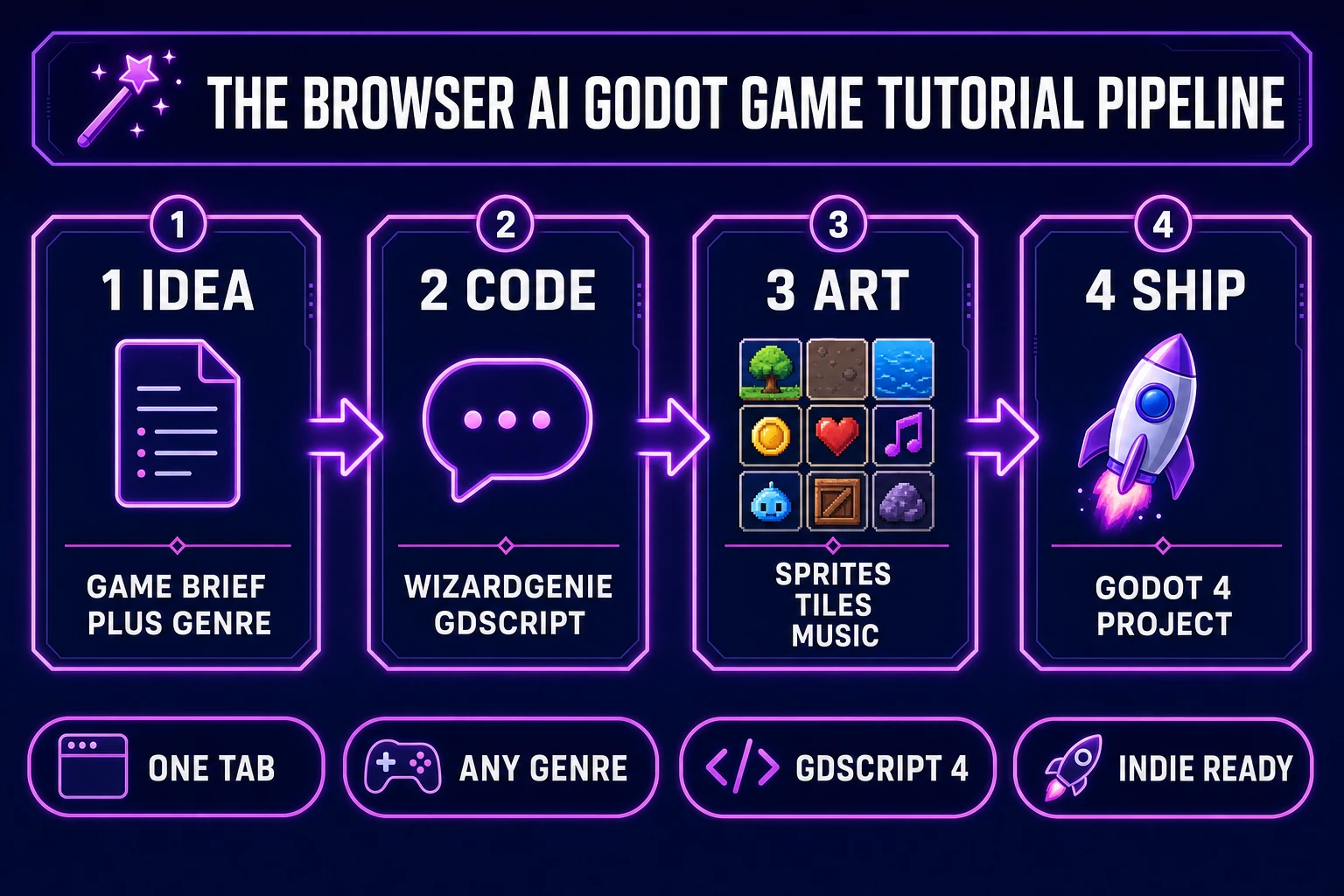
Browser AI godot game tutorial pipeline — four numbered panels for idea, WizardGenie GDScript, Sorceress sprites tiles music, and a Godot 4 project
The 2026 browser-AI godot game tutorial pattern: WizardGenie writes the GDScript alongside the reader, Sorceress asset tools render the sprites, tiles, music, and SFX in the same browser tab, and every file lands directly in the native Godot 4.7 project folder.

What a modern godot game tutorial has to teach in 2026

A useful godot game tutorial has to answer more than “click File, click New Project.” The person searching that exact phrase is almost never asking for a screenshot tour — they are asking whether Godot is a real path for a solo indie in 2026, how much GDScript they will have to learn, where the assets are supposed to come from, and how the whole pipeline compares to the more expensive alternatives they already know about. Any godot game tutorial that only shows the editor is answering the wrong question. The reader needs a full loop: engine choice, the language and syntax, the asset gap, the audio gap, the shipping story, and the honest cost.

Godot itself solves the first two — the engine is free, open source, and MIT-licensed (verified against the Godot game engine reference on July 5, 2026), and GDScript is a Python-adjacent scripting language designed specifically for the engine (verified against GDScript on the same date). What Godot does not solve on its own is the asset and audio pipeline that a first-time indie has to walk through before the game feels playable. That is where the browser-side AI stack earns its keep in a modern godot game tutorial — not as a replacement for the editor, but as the studio-in-a-browser that fills every gap the engine leaves open by design.

Why Godot 4.7 (Director’s Cut) is the honest start for a browser-oriented indie

Verified against godotengine.org/releases/4.7/ on July 5, 2026, Godot 4.7 shipped on June 18, 2026 as the Director’s Cut release. The headline changes matter for a modern indie project. HDR output means the engine can now render bold, brilliant colour ranges natively; standalone Android exporting means an indie can publish an APK straight from the editor without a second toolchain; the new Asset Store gives beginners a legitimate place to find plugins and free packs; production-ready Android XR and Steam Frame support opens a real XR path for anyone whose game genre benefits from head tracking. Steam listed over 700 new Godot games shipped in the first half of 2026 alone on the release page, and itch.io continues to see over 1,000 new Godot entries every week — the ecosystem is real, active, and mostly indie.

Godot 4.7 also cleaned up a stack of quality-of-life papercuts that made older Godot game tutorial guides confusing: Control node offset transforms are the new default for UI juice, the animation and audio pipelines have documented breaking changes from 4.6 that are worth reading in the migration guide, and the C# .NET path is available on every desktop and Android target with a single .NET-tagged download. The three renderer options (Forward Plus, Mobile, and Compatibility) still exist and still pick themselves reasonably well based on target platform. For a browser-oriented indie who wants the AI-heavy asset workflow this article describes, the honest starting configuration is Godot 4.7 stable on the desktop editor, Forward Plus renderer for anything that matters visually, GDScript as the scripting language (skip C# unless you already know why you need it), and the browser open on a second monitor with the Sorceress tool tabs pinned.

The Sorceress asset pipeline behind a godot game tutorial

The Sorceress angle is not “replace Godot.” Godot is the editor, GDScript is the language, and the res:// folder tree is where the project lives. Sorceress is the browser-side asset studio that populates that folder. The pipeline that works well for a modern godot game tutorial project has five roles, and the same Sorceress tool covers each role from an empty project to a playable prototype.

Role one is the coding co-writer: WizardGenie reads your intent in plain English, produces first-draft GDScript targeted at Godot 4.7 syntax, and iterates when you paste back the error message. Role two is the animated sprite source: Quick Sprites renders walk cycles, idle frames, and VFX sequences in a browser tab and drops the PNG grid straight into your res://sprites/ folder. Role three is the TileMap art source: Seamless Tile Gen generates tile-safe textures that snap to a grid, complete with a 3x3 tiled preview so you know the seam is invisible before the file lands in the project. Role four is the audio pipeline: Music Gen scores the theme, boss loops, and ambient beds; SFX Gen handles the short one-shots that make every jump feel weighty. Role five is the concept-and-UI source: AI Image Gen renders the cover art, the loading screen, the character portraits, and the icons that a godot game tutorial normally hand-waves as “placeholder art.”
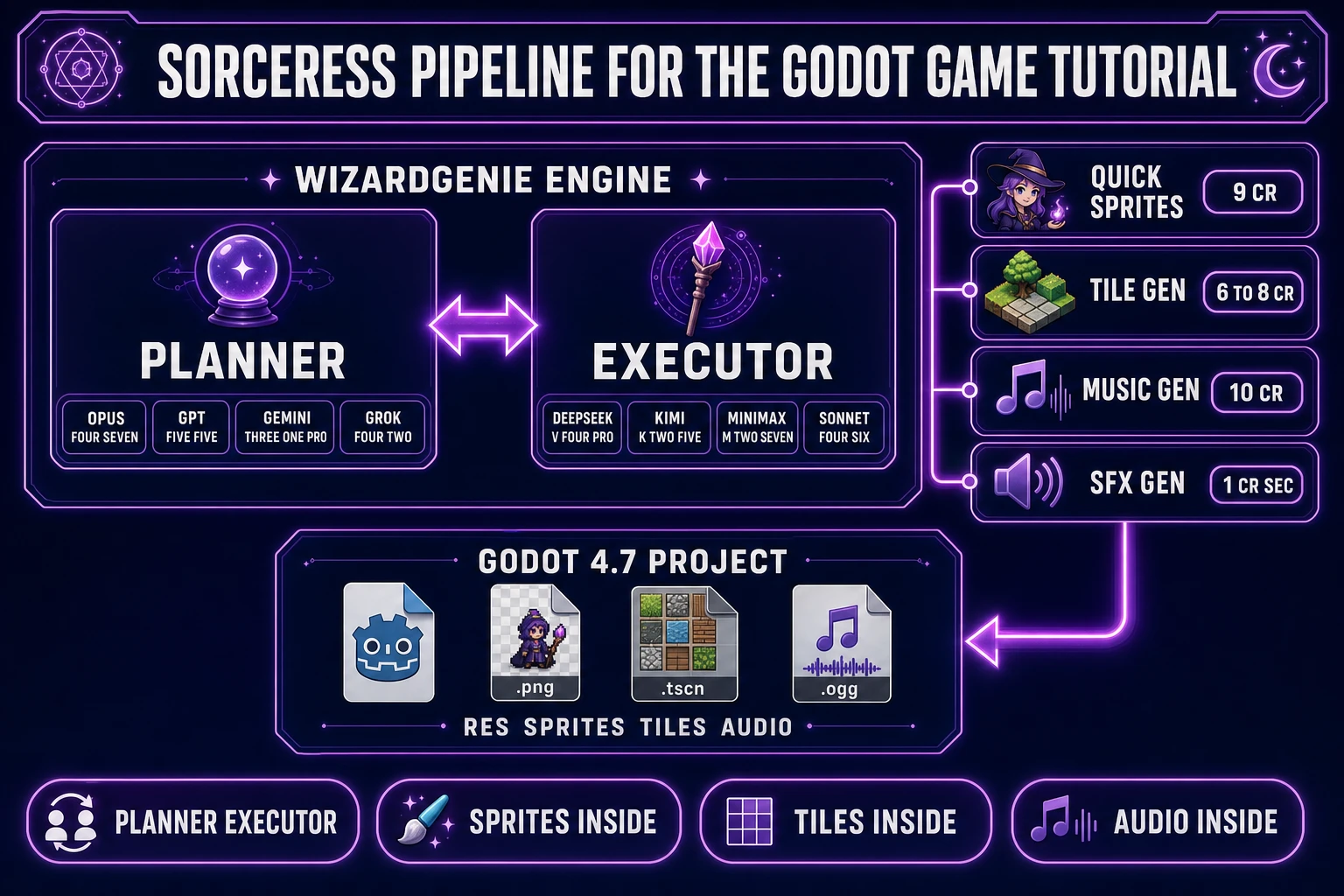
Sorceress asset pipeline for a godot game tutorial — WizardGenie Planner Executor connected to Quick Sprites, Seamless Tile Gen, Music Gen, and SFX Gen feeding a Godot 4.7 project folder
The Sorceress asset pipeline that sits behind a browser-native godot game tutorial. WizardGenie writes the GDScript with your own API key; Quick Sprites, Seamless Tile Gen, Music Gen, and SFX Gen fill the res:// folder tree with sprites, tiles, music, and SFX; every file lands in the native Godot 4.7 project ready for the editor to import on its next scan.

Prompting WizardGenie to write your first GDScript alongside the tutorial

WizardGenie is the conversational core of the browser-side godot game tutorial. Verified against src/app/wizard-genie/page.tsx lines 296-298 on July 5, 2026, WizardGenie ships a dual-agent architecture — the source describes it as “Dual-agent Planner + Executor” and adds “A smart Planner thinks; a cheap Executor codes. Same quality at roughly a quarter of the token cost.” That pattern matters for a GDScript tutorial exactly as much as it matters for a Phaser or Three.js project: the Planner picks the scene-graph shape and the callback structure, the Executor writes the mechanical boilerplate. Verified against src/app/_home-v2/_data/tools.ts lines 734-742 on the same date, WizardGenie ships eight CODING_MODELS you can bring your own API key to — Claude Opus 4.7 (Anthropic, top tier), Claude Sonnet 4.6 (Anthropic, fast plus smart), GPT-5.5 (OpenAI, frontier), Gemini 3.1 Pro (Google, 1M context), DeepSeek V4 Pro (DeepSeek, budget), Kimi K2.5 (Moonshot, 256K coding), Grok 4.2 (xAI, 2M context), and MiniMax M2.7 (MiniMax, agent-ready).

The prompt shape that produces good GDScript is not “write me a Godot script.” It is targeted at the specific behaviour you want to see on-screen. Try something like: “I’m building a 2D top-down roguelike in Godot 4.7 stable. Give me a CharacterBody2D-based player controller that uses Input.get_vector for the eight-directional movement, exports a `speed` variable to the inspector, plays a walk animation from an AnimationPlayer child node when moving and an idle animation when stopped, and emits a `stopped_moving` signal on the frame the input vector reaches zero. Use typed GDScript, target Godot 4.7 syntax specifically, and add a docstring on the class that explains what each exported variable does.” A prompt that specific gives WizardGenie enough scene-graph context to produce a working first draft, and pasting the actual editor error back into the same chat gets you a fixed second draft in under a minute. The dual-agent path shines here: put Opus 4.7 or Gemini 3.1 Pro on the Planner side so the reasoning about signal-vs-callback semantics is right, and put DeepSeek V4 Pro or Kimi K2.5 on the Executor side so the typing bulk stays cheap.
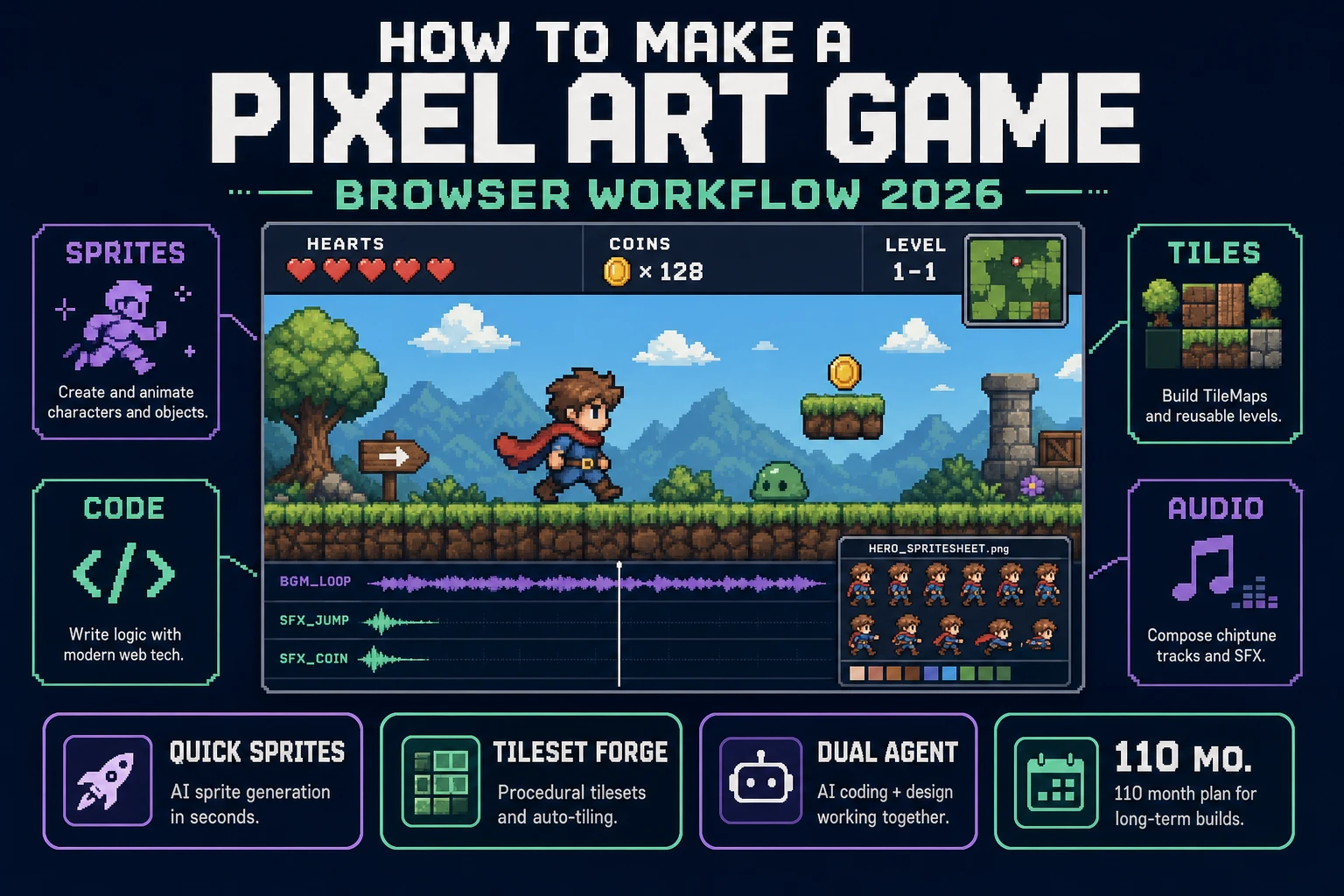
Sprites and animation: filling a Godot 4.7 project from Quick Sprites

The single most common wall in any beginner-level godot game tutorial is the sprite gap. The reader downloads the editor, drops a placeholder square into the scene, and then stares at the placeholder for an hour deciding whether to open Aseprite or spend an afternoon on Kenney’s free packs. Neither answer is wrong — hand-drawn sprites are the honest choice for pixel-art projects, and public asset packs are perfect for prototyping — but a third path exists that fits a modern godot game tutorial cleanly. Sorceress Quick Sprites renders animated sprite sheets from a text prompt in the browser and hands over a PNG grid the Godot editor imports without a config file.

Verified against src/app/quick-sprites/page.tsx on July 5, 2026: Quick Sprites runs on the retro-diffusion/rd-animation model (line 20), each generation costs 9 credits (line 21 CREDITS_PER_GEN = 9), and the tool ships three animation-style presets under ANIMATION_STYLES (line 35): a Four-Angle Walking preset at 48x48, a Small Sprites preset at 32x32, and a VFX Effects preset at 24 to 96 pixels. The prompt structure that works well for a Godot project is a subject line (“a small solarpunk explorer character with a satchel and goggles”), a style line (“32x32 pixel art, four-angle walking cycle, low contrast, warm palette, black outline”), and a motion line (“walking, four frames per direction, front-facing frame lands on the middle beat.”) Drop the resulting PNG into res://sprites/player/, import it into an AnimatedSprite2D node, define the four SpriteFrames animations for up/down/left/right, and the movement code from the previous section immediately has something to render.

A sprite is a two-dimensional bitmap composited onto a scene, and Godot 4.7’s SpriteFrames resource handles the animation-timing side of that composite natively — there is no separate animation library to configure. The natural extension of the Quick Sprites pipeline is to render every character in the game in the same session (player, three enemy types, a friendly NPC, a shopkeeper) so the palette and outline weight stay consistent across the cast. That consistency is the single most common polish gap in beginner Godot projects, and it is essentially free when the whole cast lands from one prompt session.

Music and SFX: scoring your godot game tutorial project

Audio is the second wall in most Godot game tutorial projects. A silent game feels flat regardless of how good the mechanic is, and the traditional answers — buy a royalty-free music library subscription, license a stock SFX bundle, or record every jump-and-hit yourself — all pull the indie dev away from the editor for hours. Sorceress collapses the audio pipeline into two browser tabs.

Music Gen scores the theme and the loops. Verified against src/app/music-gen/page.tsx on July 5, 2026: the tool runs on the Kie Suno music model (line 508 model_key: ‘kie-suno-music’), each track costs 10 credits (line 26 MUSIC_CREDIT_COST = 10), an optional lyrics generation step adds 2 credits (line 384 LYRICS_CREDIT_COST = 2), and the default model version is V5_5 (line 444). Prompts follow the standard music-brief shape — genre plus tempo plus instrumentation plus mood — and the output lands as an OGG or WAV file that Godot 4.7 imports as a stream resource without any conversion step.

SFX Gen handles the short one-shots. Verified against src/app/sfx-gen/page.tsx on the same date: SFX Gen bills at 1 credit per second with a minimum of 1 credit (line 24 SEED_AUDIO_CREDITS_PER_SECOND = 1, line 25 SEED_AUDIO_MIN_CREDITS = 1), and caps a single generation at 120 seconds (line 26 SEED_AUDIO_MAX_SECONDS = 120). A typical Godot project needs roughly eight to twelve one-shots to feel alive — footsteps, jump, land, hurt, coin pickup, door open, menu confirm, menu back — and each of those is one to three seconds of audio, so an entire game’s SFX pass often lands under 30 credits. The generated WAV files import straight into an AudioStreamPlayer2D node with no editing, and Godot’s built-in AudioBus system handles the mix from there.

Textures and tilesets: giving the Godot TileMap the source art it deserves

A tile-based game is one where the world is built from a grid of repeatable image cells, and Godot’s TileMap node is the built-in editor for exactly that pattern. What Godot does not give you natively is the source art for those tiles — historically, that meant an afternoon in Aseprite or a Kenney tileset pack. The AI-native answer is Seamless Tile Gen at /tileset-generator (verified against src/app/tileset-generator/page.tsx line 52 on July 5, 2026: the page renders as TileMaker in the browser). The tool takes a prompt like “seamless repeating grass tile, low-poly pixel art, warm summer palette, 64x64,” renders the tile, and shows a live 3x3 tiled preview so you can spot a bad seam before the file leaves the browser.

Verified against src/lib/models.ts line 70+ on July 5, 2026, the TILESET_MODELS lineup runs four models: Imagen 4 Ultra (8 credits, five aspect ratios), GPT Image 1.5 (7 credits medium, 17 credits high, up to 4 reference images), GPT Image 2 (7 credits medium, 17 credits high, up to 10 reference images), and Seedream 5 Lite (6 credits at 2K, more at 3K, up to 14 reference images). The four-tile prompt cluster that fills a beginner Godot TileMap cleanly is: a grass tile, a stone tile, a dirt-path tile, and a water tile — roughly 30 to 60 credits total depending on model choice. Every tile lands as a PNG that Godot 4.7’s TileSet editor accepts directly, and once the four base tiles are in the atlas the TileMap terrain-set feature (a 4.7 addition to the terrain system) auto-blends the edges without any manual mask work.

For hero characters and NPC portraits that go alongside the tileset art, AI Image Gen at /generate covers the concept-art gap. Verified against src/lib/models.ts line 70+ on the same date, AI Image Gen ships a lineup of image models that span the credit range: Z-Image at 3 credits (browser-native fast), Wan 2.7 Image at 5 credits, Flux 2 Pro at 6 credits, Seedream 4.5 at 6 credits, Seedream 5 Lite at 6 credits, Nano Banana at 6 credits, Grok Imagine at 6 credits, GPT Image 1.5 at 7 credits, GPT Image 2 at 7 credits, Nano Banana 2 at 9 credits, Wan 2.7 Image Pro at 10 credits, and Nano Banana Pro at 18 credits. A first-pass cover-art render for the itch.io page costs 6 to 18 credits depending on which model handles the prompt — roughly the price of a small coffee — and the same tab renders the character portraits and the UI icons that make a beginner Godot project look like a shipped indie rather than a jam prototype.

What a full godot game tutorial pipeline costs on the Sorceress stack in 2026

The economics of a modern godot game tutorial project are what actually decide whether the browser-side AI path is worth the reader’s attention. The Sorceress base unlock is $49 one-time and lifetime — no monthly rent, no subscription decay. Verified against src/app/plans/page.tsx on July 5, 2026: LIFETIME_PRICE = 49 on line 46 and the CREDIT_TIERS array on line 50 lists Starter at $10 for 1,000 credits, Creator at $20 for 2,000, Plus at $50 for 5,000, and Studio at $100 for 10,000. Credits are pay-as-you-go and never expire.

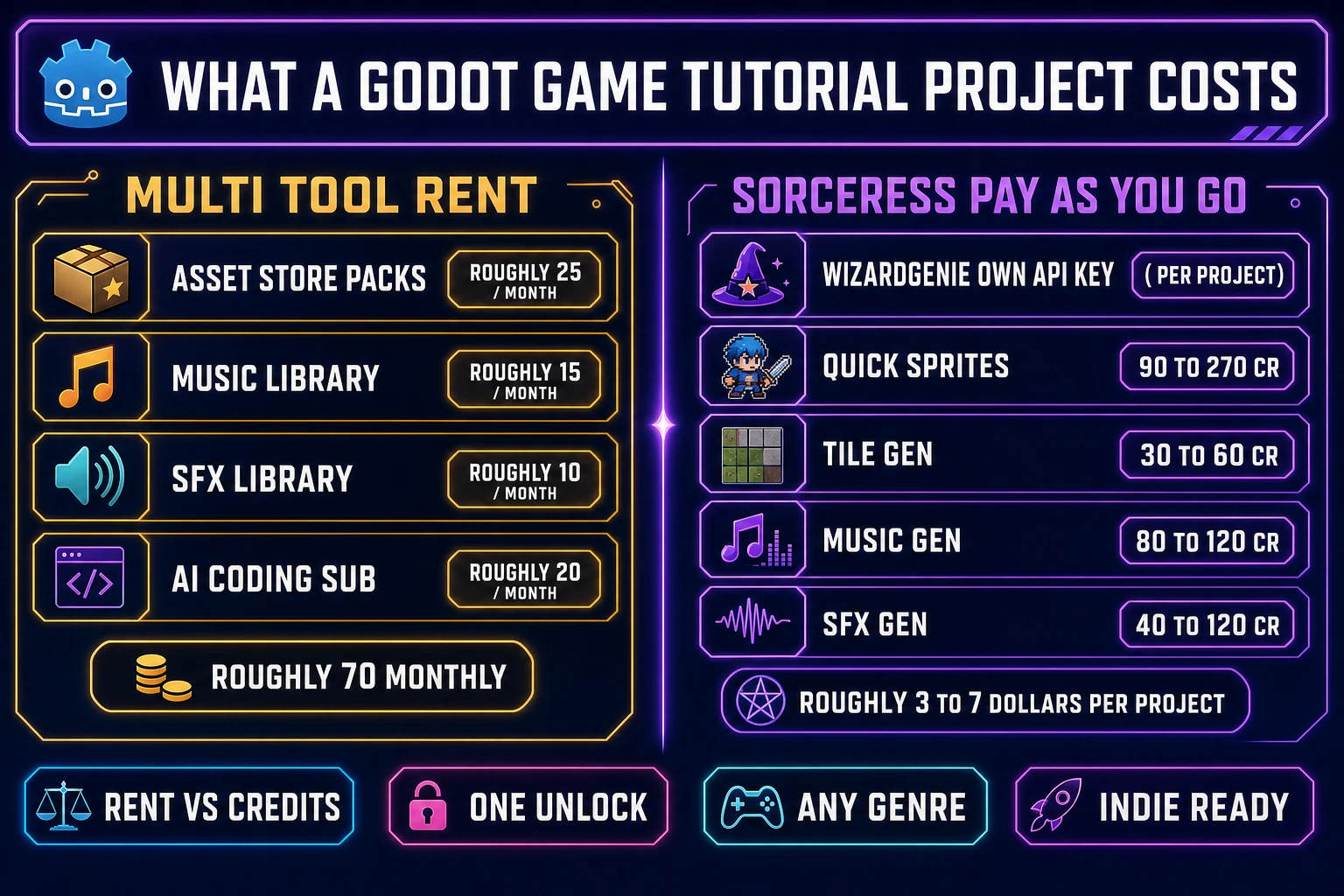
What a godot game tutorial project costs — multi-tool rent versus Sorceress pay-as-you-go credits with per-tool credit costs
Cost side-by-side for a full godot game tutorial pipeline. Multi-tool rent (asset packs, music library, SFX library, AI coding subscription) lands around $70 per month regardless of use. The Sorceress pay-as-you-go path costs roughly $3 to $7 in credits per finished project on top of the one-time $49 unlock — and your own API key for the WizardGenie coding side.

A typical from-empty-repo godot game tutorial project (roughly a two-week indie build for a small 2D game) consumes 300 to 700 credits across the whole AI pipeline: 90 to 270 credits for ten to thirty Quick Sprites generations (9 credits each), 30 to 60 credits for four to eight Seamless Tile Gen tiles at 6 to 8 credits each, 80 to 120 credits for eight to twelve Music Gen tracks at 10 credits, 40 to 120 credits for the full SFX pass at 1 credit per second, and roughly 60 to 130 credits for the AI Image Gen concept-art and UI-icon renders. That lands the credit spend at $3 to $7 per project on top of the $49 unlock — and your own coding-model API key handles the WizardGenie chat side, which most indie devs already have from another workflow.

The comparable multi-tool rent baseline (asset-store subscriptions roughly $25 monthly, a music-library subscription roughly $15, an SFX-library subscription roughly $10, an AI coding subscription roughly $20) runs about $70 monthly regardless of whether you finish a project. The pay-as-you-go path costs less if you ship one project per quarter, and it costs dramatically less if you ship one project a year. It also costs nothing when you take a break from game development for three months, because a lifetime unlock does not expire and pay-as-you-go credits sit in your account until you burn them.

The verdict on a godot game tutorial in 2026

A godot game tutorial in 2026 does not have to end at “now go find some assets.” Godot 4.7 is a legitimately excellent engine for solo indies, the new Asset Store is a real starting point for plugins and free packs, and the desktop editor is where the real work happens. The browser-side AI stack is not a replacement for any of that — it is the studio-in-a-browser that fills every asset gap the engine leaves open by design. WizardGenie writes the GDScript, Quick Sprites fills the sprite folder, Seamless Tile Gen paints the TileMap, Music Gen scores the theme, SFX Gen adds the one-shots, and AI Image Gen renders the concept art and the icons.

Every file the browser produces lands in the native Godot project folder as a standard PNG, WAV, or OGG that the editor imports on its next filesystem scan — no plugin, no custom exporter, no format wrangling. The reader spends their time in the editor, on the mechanic that makes their game their game, instead of on the ninety-percent of a game-project pipeline that is the same regardless of what the mechanic actually is. That is what a modern godot game tutorial should teach: keep Godot where Godot is strongest, and offload the studio work to a browser tab. Ship the prototype in a week instead of a month. Ship the second prototype the week after. Sorceress Tools Guide lists every tool the pipeline uses, the plans page shows the honest cost, and WizardGenie is one tab away when the first GDScript question shows up.

Frequently Asked Questions

Do I have to run Godot in a browser for this godot game tutorial to work, or can I stay on the desktop editor?

Stay on the desktop editor. Godot 4.7 has an experimental web editor (verified against the official docs page on July 5, 2026: docs.godotengine.org/en/4.7/tutorials/editor/using_the_web_editor.html marks the web editor as experimental in 4.0 and later, with the 3.x web editor recommended for actual HTML5 export work), but a serious godot game tutorial in 2026 still lives in the native desktop editor because that is where debugging, breakpoints, the profiler, GDExtension support, and the C# .NET path all actually work. The browser-side of this pipeline is not the editor itself — it is the AI asset stack that fills the project. WizardGenie writes the GDScript in a chat tab; Quick Sprites, Seamless Tile Gen, Music Gen, SFX Gen, and AI Image Gen render the assets in the browser and drop them into the project folder as PNG, OGG, and WAV files that the Godot editor picks up on its next filesystem refresh. Everything is native where native matters, and everything is browser-side where browser-side wins.

Which WizardGenie coding model works best for GDScript specifically, and does it know Godot 4.7 syntax or the older 3.x GDScript?

Verified against src/app/_home-v2/_data/tools.ts lines 734-742 on July 5, 2026. WizardGenie ships eight CODING_MODELS you can pick from with your own API key: Claude Opus 4.7, Claude Sonnet 4.6, GPT-5.5, Gemini 3.1 Pro, DeepSeek V4 Pro, Kimi K2.5, Grok 4.2, and MiniMax M2.7. For a modern godot game tutorial that targets Godot 4.7, the practical Planner picks are Claude Opus 4.7 or Gemini 3.1 Pro because both have training cutoffs well past the Godot 4.x GDScript syntax reset and both understand the typed-GDScript style, node lifecycle callbacks (_ready, _process, _physics_process), signals, and the 4.x scene-tree API. The practical Executor picks are DeepSeek V4 Pro or Kimi K2.5 because both are cheap enough to burn through the mechanical GDScript typing (loops, exports, tween chains) without inflating your token bill. If a model hedges between 3.x and 4.x syntax on a particular question, ask it to target Godot 4.7 explicitly by version number — the reasoning models honour the pin.

Can I use Godot's asset store instead of the Sorceress asset pipeline, or does the godot game tutorial only work with Sorceress assets?

The godot game tutorial in this article works with any asset source — Godot 4.7 introduced a new native Asset Store (verified against godotengine.org/releases/4.7/ on July 5, 2026, which highlights the new Asset Store as a 4.7 feature) and pairing that store with the Sorceress AI asset stack is a completely valid workflow. The honest reason to use Sorceress for the AI-generated pieces of the project is that the store gives you pre-made assets and Sorceress gives you assets that fit your specific game's tone. If your godot game tutorial project is a solarpunk roguelike and you cannot find a sprite pack that reads solarpunk on any store, that is exactly when Quick Sprites and Seamless Tile Gen earn their keep — you type the prompt, get animated sprites and matching tile art in the same session, and the two source pipelines coexist happily in the same res:// folder tree. Pick whichever pipeline fits the specific asset gap the tutorial is trying to fill.

What does a full godot game tutorial project cost on the Sorceress stack from empty repo to playable prototype in 2026?

Cost math verified July 5, 2026 against src/app/plans/page.tsx line 46 (LIFETIME_PRICE = 49) and line 50 (CREDIT_TIERS). The Sorceress base unlock is $49 one-time (lifetime, no monthly rent) and covers the full non-AI asset pipeline plus WizardGenie access with your own coding-model API key. AI generation runs on pay-as-you-go credits: Starter $10 for 1,000 credits, Creator $20 for 2,000, Plus $50 for 5,000, Studio $100 for 10,000. A typical from-empty-repo godot game tutorial project consumes about 300 to 700 credits total end-to-end: roughly 90 to 270 credits for ten to thirty Quick Sprites walk-cycle and idle generations (verified src/app/quick-sprites/page.tsx line 21 CREDITS_PER_GEN = 9), plus 30 to 60 credits for four to eight Seamless Tile Gen tiles at 6 to 8 credits each depending on model (verified src/lib/models.ts line 70+), plus 80 to 120 credits for eight to twelve Music Gen tracks at 10 credits each (verified src/app/music-gen/page.tsx line 26 MUSIC_CREDIT_COST = 10), plus 40 to 120 credits for SFX Gen at 1 credit per second (verified src/app/sfx-gen/page.tsx line 24 SEED_AUDIO_CREDITS_PER_SECOND = 1), plus roughly 60 to 130 credits for AI Image Gen concept art and UI icons across the Z-Image, Flux 2 Pro, Nano Banana, and GPT Image 2 lineup at 3 to 18 credits per render. Landing zone: roughly $3 to $7 of pay-as-you-go credits per project on top of the one-time $49 unlock and your own WizardGenie API-key spend.

Is the browser-side AI path a shortcut for beginners, or does it work for experienced Godot developers running a real godot game tutorial project?

It works for both, but for different reasons. A beginner treats the browser-side AI stack as scaffolding: WizardGenie explains what a _process callback does and generates a first-draft top-down movement script, Quick Sprites hands over a walk-cycle so the beginner does not have to fight Aseprite before they can see the character move, and the first working prototype lands in an afternoon instead of a week. An experienced Godot developer treats the same stack as a bandwidth multiplier: WizardGenie writes the boilerplate tween chains and export variable exposures while the human focuses on the interesting systems work, Quick Sprites and Seamless Tile Gen fill the placeholder-art gap that always slows down feature iteration on solo projects, and Music Gen plus SFX Gen produce serviceable audio the day the mechanic is fun rather than three weeks after the mechanic is fun. The godot game tutorial format is the vehicle; the real value proposition is the same in both cases — move the parts of game-making that are not creative work off the critical path so the creative work can breathe.

Sources

  1. Godot (game engine) (Wikipedia)
  2. GDScript (Wikipedia)
  3. Video game development (Wikipedia)
  4. Sprite (computer graphics) (Wikipedia)
  5. Tile-based video game (Wikipedia)
Written by Arron R.·3,164 words·14 min read

Related posts